
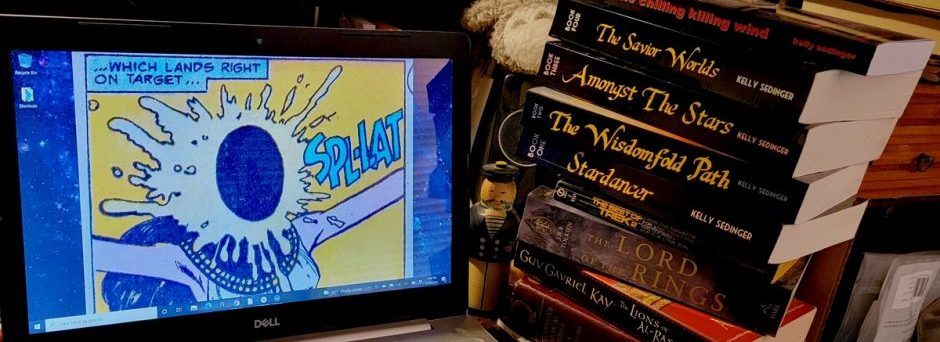
Read this week: Harlan Ellison‘s classic SF story, “‘Repent Harlequin!’ Said the Ticktockman” (reprinted in Masterpieces: The Best Science Fiction of the Century). Orson Scott Card’s introductory note calls the story “a Kafkaesque parable about the dangers of individuality in a conformist society”. I didn’t read it that way; I saw the story as a cautionary tale about the futility of attempting to create a society where everything is controlled and where nothing is left to any kind of chance. The story’s ending suggests to me that although the society’s apparent cause for concern has been eliminated, a seed of sorts has been planted. A crack has been formed in the edifice of the story’s world; now all that remains to happen is for water to get in there, freeze, and melt; water, freeze and melt; water, freeze and melt….
Untitled Post
What to do with the gaping hole left in lower Manhattan following the 9-11 attacks has been a vigorous discussion since the initial shock wore off. Some have suggested rebuilding the towers, only this time adding height so they are again the tallest buildings in the world; some have suggested shorter towers; Roger Ebert suggested turning the whole site into green space with trees and grass and places for quiet contemplation. Just about everyone agrees that there needs to be some kind of monument to those lost on that horrible day. One particularly unique suggestion for a monument can be found here. It is two long piers that would be built out into New York Harbor; each would be the exact length of one of the towers, separated into sections demarking the corresponding floors, and the whole thing would bear the names of those who died. What I want to know is: would this design somehow inhibit boat traffic in New York Harbor? Sixteen hundred feet is a lot of pier.
Share This Post
Untitled Post
Why I hate The Practice, reason number 342: Did the denouement of last night’s episode, the so-called “shocking moment” at the end, really come as a surprise to anybody? This is the kind of plot twist that David E. Kelley has been spinning for years. I only watched the last ten minutes or so of the episode (since I can’t stand the show and normally avoid it like the plague, but at that moment whatever was on the Olympics was boring so I channel-flipped a bit) and I saw the surprise event coming a mile away. I won’t spoil it here, but in a Kelley series a disgraced person putting his/her briefcase on the conference table can mean only one thing….
Share This Post
Untitled Post
Both King of the Hill and The Simpsons last night had gags that involved the Olympic Torch being accidentally extinguished, and both depicted the five Olympic rings upside down, probably for trademark reasons. I wonder if this was planned. Anyway, if the Futurama writers end up being let go as seems might very well happen (FOX doesn’t like the series, for some reason, and insists on giving it shabby treatment) maybe they can just be brought over to The Simpsons, which could use some writing help. The show is still good, but nowhere near the pinacles it once hit (and it came perilously close to jumping the shark when Maud Flanders was bumped off). FOX’s treatment of Futurama puts me in mind of something Jon Lovitz said on Letterman when his FOX show, The Critic, was canceled: “FOX. They should spell it with a ‘u’.”
Share This Post
Untitled Post
Why one should never go to Borders without extra pennies in one’s pocket: Christopher Moore‘s new book, Lamb: The Gospel According to Biff, is out. And I didn’t have enough on me to pick it up. Ah well….there is always next week.
Share This Post
Untitled Post
Last week I saw Disney’s Beauty and the Beast in its new IMAX version. I was a bit apprehensive, because I’ve read that IMAX films have to be edited differently because the images are so huge; compositions that are fine on a normal-sized screen become disorienting when expanded to occupy the entire visual range. Happily, this did not seem to be the case except in the action sequences at the end of the film. The final fight between the Beast and Gaston is a bit hard on the eyes with its quick cuts and jolts (it doesn’t help that the sequence takes place outside in the middle of a violent thunderstorm). But other than that, the film is still wonderful and still loaded with the magic that made it the only animated feature ever nominated for Best Picture. I don’t think that Disney has told a love story that was more tender or heartfelt before or since; the supporting characters are wonderfully realized; and the IMAX presentation makes the musical numbers — already one of the film’s towering strengths — all the greater. Most notable are the “Be Our Guest” sequence with its Busby Berkley staging and the film’s title number, sung movingly by Angela Lansbury and animated with romantic wonder. And there is a new number, apparently recorded for the original film but never animated until now: an ensemble piece called “Human Again”, in which all of the castle-servants-turned-household-objects dream of that wonderful day when the castle’s curse will finally be ended.
The most remarkable thing about the IMAX presentation of Beauty and the Beast, to me, was that the larger image allows the Monet-like construction of the backgrounds to be seen in all their glory, with landscapes dappled with color in the finest Impressionistic manner. This can even be seen in a comedic scene where Gaston falls into a mud puddle, the water of which turns out on closer examination to be delicately colored where lesser animators might have gone with uniform brown.
The film was preceded by a preview of next year’s Disney IMAX release, The Lion King. (Actually, it wasn’t a preview per se but rather that film’s opening “Circle of Life” sequence in its entirety.) I will be interested to see how that film’s African landscapes translate to the new format.
Share This Post
Untitled Post
Roger Ebert’s latest addition to his biweekly series, “The Great Movies”, is a very good one indeed: “Say Anything”, which is probably the greatest adolescent love story ever filmed. And now I remember that it’s been years since I saw it….read what Ebert has to say about the film here.
Share This Post
Untitled Post
As a longtime James Bond devotee, I’ve been enjoying ABC’s broadcasts of the Bond films on Saturday nights lately. Tonight’s entry was “Thunderball”, a film about which I’ve always had mixed feelings. The opening act takes too long to develop, with Bond happening upon intrigue at some British health spa. Of course, the intrigue has to do with the eventual scheme being run by SPECTRE, and Bond is sent to the Bahamas to follow up on a lead (which happens to involve a beautiful woman, of course) and the plot finally gets moving. But even then the story takes its own sweet time in developing; for a plot that involves a countdown until two stolen nuclear bombs will be detonated in a major city, the film unfolds at an uncertain pace, and the sense of urgency never really takes hold. And then, we get to the third act where the thing finally grinds to a stop. We are then treated to thirty or forty minutes of Bond swimming around underwater, a big battle between the good guys and the SPECTRE forces, and finally a fight to the death with the villain on the bridge of a yacht that is speeding out of control through a series of reefs. All that sounds like it should move along at a brisk, tense pace — but sadly it doesn’t. The climax of a Bond film should never be boring, and this one is. John Barry’s music can’t even get things going, which is really saying something. Barry’s music singlehandedly saved “Goldfinger”, during the interminable sequence where Pussy Galore’s pilots take to the air to disperse poison gas over Fort Knox. Sadly, in “Thunderball”, the pace of the film was beyond Barry’s considerable powers.
Interestingly, for legal reasons an associate of Ian Fleming’s actually owned the rights to the plot of “Thunderball”, and it was thus that “Never Say Never Again” — which tells the same story — was made in 1983. The interesting part is that the later film tells the same story much better than the original, which might make “Never Say Never Again” the only remake in history actually superior to its original.
Next week’s ABC Bond film is “You Only Live Twice”, which I’m looking forward to because I haven’t seen it in years. I remember it being a pretty fun film, despite the fact that Donald Pleasance is by far the worst of the three Blofelds. We’ll see.
Share This Post
Untitled Post
Current reading: A Walk in the Woods by Lee Blessing. This is a play that I saw performed way back when I was a freshman in college (1989, to be precise). The story involves two men, a Russian and an American, who are both arms negotiators in Geneva, Switzerland during the Cold War. When I saw the play performed, it was just a month or two before the Berlin Wall came down and the German Reunification began; at that time the Soviet Union still existed. I wondered, when I found a copy of the play in the Buffalo and Erie County Public Library, if the work would still seem relevant given the decade that has passed since the Cold War ended. Now that I’ve read it, I realize that while the specific issues referenced in the play no longer exist, the greater issues — war and our sick fascination with it — are still as present as ever, especially now that we are apparently at war with not even a nation but with a concept (terrorism).
In the play, the Russian (Botvinnik) is a glib man who seems to take nothing seriously, constantly ribbing his American counterpart (Honeyman) for his inability to talk about anything other than arms agreements and weapons levels and verification schemes and the like. The two men walk into the woods during a break one day and sit on a bench, whereupon Botvinnik launches one of many attempts to get Honeyman to talk about something frivolous. Honeyman (and, by extension, the audience) initially sees Botvinnik as unfocused, but as the play progresses it becomes clear that Botvinnik is actually deeply cynical about the degree to which either of the superpowers wants peace at all. Both countries, he says, claim to want peace but put pathetically little effort into the pursuit of peace — because, “Without nuclear weapons our empires would no longer be empires. They would simply be countries among other countries….a rich, powerful Canada and an enormous, distended Poland.” Honeyman, of course, is deeply idealistic and protests: “Mankind truly does hate war.” Botvinnik’s response to this statement is the single line from this play that has stuck with me in all the thirteen years since I saw it, and the line that most made me want to read it when I found it on those library stacks:
“If mankind hated war, there would be millions of us and only two soldiers.”
Powerful stuff, that. It’s a fine, fine play. Seek it out if you can. I’m fairly certain it is out of print, but then, that’s what libraries are for.
Share This Post
Untitled Post
As much as I love Buffalo, a major failing of the city is the lack of a Chinatown and a good dim sum restaurant. Dim sum, for those who haven’t discovered it yet, is a kind of Chinese brunch where servers push carts around the dining room, stopping at each table to offer diners their choice of various delights — steamed dumplings filled with all manner of things, small shrimp dishes, wonderful soups, and — if you are brave — chicken feet. (They’re rather like a chicken wing with much smaller bones.) You sit at your table, drinking tea, awaiting the arrival of the next cart. When it arrives, you select an item or two — or three or four — and then your server marks your check accordingly, per item served. It’s a beautiful way to try things you might normally be unwilling to tackle in the form of a larger entree at the local Chinese takeout (assuming they offer these delicacies at all), and — even better — dim sum tends to be cheap. Each time I’ve had dim sum (in Boston and Toronto), I’ve eaten until I was positively stuffed and at none of those meals did I spend more than twenty dollars. If you’re the type of person who is unafraid to sample new things, then give dim sum a try. If, however, you’re one of those people who eats four or five different things and only those, week in and week out, then dim sum probably isn’t for you.