…is to have a personal library so grand that after you’re gone, the entire thing is preserved, as-is. One prominent example is the personal library of Samuel Pepys, which now resides at Magdalene College in Cambridge. Not only are all of Pepys’s personal books–over 3000 of them–collected there, but they are kept in the arrangement that Pepys devised, in the bookcases he had built for them. I would love to visit this library someday, which is open to the public (though not right now as the building is undergoing preservation and restoration work).
The collection was donated to the Italian state by Eco’s heirs in 2020, on condition that it be placed on permanent loan to the University of Bologna.
Before the move, the library was surveyed shelf by shelf in Milan, with the position of every volume, thematic groupings and connections between authors and disciplines carefully documented, so that the new premises in Bologna could reproduce Eco’s original arrangement exactly, down to which books he kept lying flat and which stood upright.
That arrangement follows the “good neighbour” principle developed by art historian Aby Warburg, which Eco adopted for his own shelving: placing seemingly unrelated texts side by side so that unexpected connections between them could emerge.
The library’s themed rooms, covering subjects from mediaeval philosophy to popular fiction, comic books and occultism, allow visitors to trace the same interdisciplinary connections that shaped Eco’s own research and writing.
Eco’s library is one of the most famous personal libraries of the last century, even now, ten years after Eco’s death. Nicholas Basbanes wrote about Eco in his amazing book Patience and Fortitude: A Roving Chronicle of Book People, Book Places, and Book Culture:
Before taking up residence in a sprawling suite of rooms overlooking the historical Castello Sforzesco fortress in a picturesque district of Milan, Umberto Eco had twice been forced to give up comfortable quarters elsewhere because he owned too many books. “The floors were about to collapse,” the world-renowned semiotician, medievalist, philosopher, essayist, educator, cultural critic, and author of three best-selling novels said as we walked about the beautifully appointed apartment where he and his wife, Renate, are surrounded by thirty-thousand volumes, and where the concept of a personal library takes on an almost bewildering aspect. The floors in the the stone-faced building Eco now calls home, once an elegant hotel, were constructed to bear considerable weight loads; the ceilings, moreover, are high, allowing the placement of shelves that can accommodate eleven tiers of books. To help him reach the highest levels, Eco had several ladders mounted on steel tracks that move effortlessly from room to room. His own writing is done at the rear of the apartment in a secluded cove surrounded by another complex of bookcases, arranged almost like a fantastical maze. Eco insisted that I note the depth of the shelves, which had been designed to his specifications. A quick examination indicated about nine inches of space, just enough room for one book per slot. “No more guessing,” he said, arching his eyebrows for emphasis. “Never again will I have two books deep. Never. Now I can see every title I have at a glance. Everything is in a single line.”
Well, that’s another dream, isn’t it!
Apparently there exists a full-length documentary about Eco and his library. I should watch it.
Image Credit: Instagram, 106.7 “The Fan”, Washington, DC
Sports writer John Feinstein has died. I have only read a few of his books, but that is hardly damning as Feinstein was very prolific, and he wrote about just about every sport that’s out there. Not only was he a superb prose stylist, but he was especially gifted at translating the human stories of sport into words. He made you feel what it was like to be a ballplayer, or a basketball player, or a golfer, or whatever it was he chose to write about. I will miss his voice and I feel I should make it a bit of a priority to read more of his work.
This is a repost of a review I wrote years ago for one of his baseball books. What’s great about good baseball writing is that like the game, the writing doesn’t age. I suspect Feinstein’s work will be read years from now, much as Roger Angell’s is.
So the World Series kicks off tonight. [The 2014 World Series, that is. The San Francisco Giants defeated the Kansas City Royals in seven. -Ed.] I know, that’s the wrong metaphor. Sorry. I used to be a huge baseball fan, and I still find the game itself utterly beautiful to watch unfold, a game of moments where things happen one thing at a time. Baseball may be the last major sport that isn’t a constant flow of motion. As for rooting interests, as the League Championship Series started in each league, I noticed that of those four teams, none were a team I dislike in any major way. Generally, my approach in such cases is this: when there are no teams left for whom I have a rooting interest (be it rooting for a team to win or for a hated team to lose), I root for the remaining teams in order of how long it’s been since they won. In the AL you had the Orioles versus the Royals, whose last World Series wins were in 1983 and 1985, respectively. The Royals haven’t even made the postseason since then. (The Orioles have, but have not won any pennants.) As for the NL, it was the Cardinals and Giants, two teams who have each won it at least twice in the last few years. So no matter who won the AL pennant, I would root for the AL champion in the World Series. Hence, go Royals!
The remainder of this post is a book review. My sports fandom is nowhere near what it once was, and I see little reason to expect it to rebound in any significant way in the future. That said, I do still enjoy good sports writing, and John Feinstein is one of the betters sportswriters out there. He has a new book about baseball, called Where Nobody Knows Your Name: Life in the Minor Leagues of Baseball, and it’s definitely worth a look.
Minor-league baseball is sometimes seen as the more “pure” version of the baseball experience these days, where you can still go to the ballpark and take in a game for a few bucks, where goofball promotions are often used as enticements, where ads for local businesses still cover the outfield walls, where players still endure long bus rides from town to town, and where brushes with true baseball celebrity come mainly from young phenom players or Major Leaguers sent down to the minors to work their way back into the game after an injury.
Feinstein’s portrait of the minors has all that, but he also captures something that a lot of fans may not come to realize: that the minors are, in addition to being a training ground for guys not yet ready for the Majors, a place of frustration. The fact is, especially at the AAA level, nobody wants to be there. This is a fact that everyone must acknowledge, and some managers come right out and say it. Nobody wants to be in AAA baseball, because AAA is the cusp of the Majors. When you’re in AAA, your dream is almost there, constantly tantalizing you and torturing you with every single injury with the big club, with every time the manager’s phone rings, with every invitation to spring training. Triple-A baseball is a land of players who are this close. For some, it’s just a brief spot, while for others, it’s a place to spend years without ever getting to “the show”.
Feinstein focuses his book mostly on just nine men: six players, two managers, and one umpire. Some have made it and will make it back; others haven’t made it yet; some have made it and will never make it back. The central fact of this book is that while dreams do come true, they don’t always stay true. It’s a hard lesson for some of these players, and it’s very easy to understand why they keep signing up for one more year, why they keep trying to catch on someplace, even as they pass their 30th birthdays and start approaching their 40th.
It’s interesting to me, as well, that Feinstein includes an umpire in his journey through AAA baseball. Fans don’t think too much about umpires, really, and the only time their names really come up is when they screw up. If a baseball fan knows Don Denkinger’s name, it’s almost certainly because he blew a call in a World Series game; and even then, it’s not like umpire’s names stay in the memory for long. I couldn’t tell you the name of the umpire who screwed up a call a couple years back that cost a pitcher a perfect game on what should have been the final out. (For the record, I still think that MLB should have reversed the call and credited that guy with the perfect game. The idea that umpire’s calls are sacred and must never be changed, ever ever ever, is deeply bizarre to me.) Umpires work their way through the minors just like players do, hoping for that call to become an umpire at the Major League level. What I didn’t know is that umpires’ time is limited even more than players. A player can stay in the minors as long as some organization is willing to have him, but not so an umpire: you only get so many years, and if by that time the people who choose the Major League umpires don’t think you have it, that’s it: you’re done. There are no career minor league umpires.
I was likewise surprised at the degree to which winning isn’t much of a concern in the minors. They like to win, but winning is mainly seen as a function of playing well, and playing well is seen as the means to the end of reaching the Majors. Feinstein depicts the feel of a championship-winning minor league clubhouse as a pretty surreal place. It’s an accomplishment that nobody much gives a shit about. This reminds me of the great movie Bull Durham, which spans an entire season and yet except for one brief segment in the middle of the movie, you get almost no sense for how the team’s doing in the standings. No one cares. All that matters is who gets the call to go up, and who gets the call to go home.
Minor leaguers, it turns out, put up with a lot of crap. They’ll fly with their team in the morning to a new city for a day game, only to be told as soon as they plane lands that the big club needs an arm for that night’s game, so they’re to turn around and get on another plane entirely. Mets pitcher Chris Schwinden, for example, got a call up to join the Mets in Toronto. After sitting in the bullpen, he flies with the team to Pittsburgh, where he’s told that he’s been sent back down already, so he has to turn around and get to Buffalo (the Mets’ AAA affiliate was the Buffalo Bisons at the time). At this point in the night, a direct flight from Pittsburgh to Buffalo isn’t available, so they fly him to JFK, where he’s supposed to catch a flight to Buffalo. That plane is delayed for two hours, so the team sends a car to drive him from NYC to Buffalo. After a series of mechanical mishaps with the car, Schwinden finally gets back to Buffalo eighteen hours after leaving Pittsburgh. This whole passage had me laughing, because you can drive from Pittsburgh to Buffalo in less than four hours.
Feinstein is an honest sportwriter, which means that he can’t just depict baseball’s poetic and pastoral beauty. Baseball keeps going, and as big as some players get, there is no player so big that the game can’t keep being played once they hang up their cleats. Throughout the book, Feinstein makes clear that each and every person is aware that they are just minor cogs in the game’s history and that the game will go on without them when they’re done, almost as if they were never a part of it at all. At times this aspect of baseball can be bluntly heartless: near the end, when the umpire is finally told that he simply isn’t good enough and that his career is over, one reason given is the time he has missed from umpiring. How much time did he miss? Two weeks once, for the birth of his own child, and two days one other time, so he could attend an uncle’s funeral. That’s pretty brutal.
The emotions go the other way, though, and Feinstein shows this as well in many passages. Why do these players work so hard to chase a dream that few will ever get, for whom the odds get smaller with each year? This passage, from the introduction, explains it perfectly.
Every player knows how much the first call-up means. Which is why there is almost always a celebration of some kind in a Triple-A clubhouse when someone gets the call for the first time. Everyone understands what an extraordinary moment it is in a player’s life. Those who have been called up remember what it meant to them; those who have not know how much they want it to happen.
J.C. Boscan’s story isn’t quite the same as Jimmy Morris’s, because he never stopped playing. He signed with the Atlanta Braves in the summer of 1996 at the age of sixteen and spent the next fourteen seasons bouncing around the minor leagues. He first reached Triple-A in 2002 but couldn’t take the next step, because, even though he was a solid catcher, he just couldn’t hit well enough to be regarded as a serious big-league prospect.
He left the Braves for a couple of years to play Double-A and Triple-A for the Milwaukee Brewers and the Cincinnati Reds. He signed back with the Braves in 2008, because the people running the organization had so much respect for him as a clubhouse leader and someone who would set a good example for younger players that they were willing to bring him back – knowing he was unlikely to ever play in Atlanta.
Two years later, playing in Gwinnett, he had his best offensive season. Nothing spectacular, but a career-high five home runs and a batting average of .250 – higher than his lifetime average of .222. Late in August, Boscan began to hear that he might be on the September call-up list.
Every year on September 1, major-league teams can expand their rosters to as many as forty players (the regular roster size is twenty-five). Rarely do they bring up more than five or six players. Those who are brought up usually provide depth in the bullpen or on the bench of are young players being given a taste of the major leagues. Every once in a while, a team will give a player a “good guy promotion” – bring him up so he can make major-league pay for a month as a reward for being a good guy and not complaining about being stuck in the minor leagues.
Boscan had been in the minors for fourteen years and had never seen the inside of a big-league clubhouse except during spring training. At thirty, he was a long way from being the bright-eyed teenage prospect the Braves had brought to the United States from Venezuela in 1997.
On August 31, the word in the Gwinnett clubhouse was that the Braves were going to make their call-ups after the game. Boscan remembers being more nervous that night than at any other time in his career.
“I walked on the field that night, and all I could think was, ‘If I don’t get the call tonight, it’s never going to come,'” he remembered. “I honestly thought this was my last shot and my best shot to ever get to the majors. I could barely keep my mind on the game. All I could think about was what was going to happen after it was over. I was praying to God to let this be my time.”
When the game ended, Boscan sat in front of his locker and picked at the postgame meal. Hitting coach Jamie Dismuke had been designated by manager Dave Brundage to bring players into his office so they could be told they were going to make the thirty-seven-mile trip down I-85 to Turner Field. As Dismuke worked his way around the clubhouse, that thirty-seven miles felt more like a million to Boscan.
The first player called in was Freddie Freeman, the twenty-year-old phenom, who was hitting .319 and was considered a lock call-up. He came out of Brundage’s office with a huge smile on his face and was engulfed in congratulations.
Dismuke continued his rounds. One player after another walked around the corner to Brundage’s office and came out wearing the giveaway grin. The congratulations continued. No one had made a move to leave because this was a happy night – for those going up.
Six players had gone in to see Brundage – entering as Gwinnett Braves and coming out as Atlanta Braves – and there was no sign of Dismuke for a couple of minutes. Boscan’s heart sank. That was it – six guys. His dream had died.
Dismuke appeared again, this time walking directly toward Boscan.
“Skip wants to see you, J.C.,” he said. He wasn’t smiling. Boscan panicked. Maybe Brundage had gotten the good news out of the way first, and now he was going to let Boscan know that the team needed him in Double-A to work with a young catcher. Or, maybe he was being released.
Brundage was, in fact, preparing that kind of speech for Boscan. “I was going to look very sad and tell him that sometimes things don’t turn out the way you want them to in baseball,” he said. “But when he walked in here, he was shaking. I couldn’t go through with it.”
The entire Gwinnett staff was in the room when Boscan walked in.
“Have a seat, JC,” Brundage said, trying to look grim.
Boscan sat on the couch across from Brundage’s desk.
“You ever been to the big leagues?” he asked – knowing the answer.
“No,” Boscan said, shaking his head.
Brundage couldn’t keep up the charade.
“I was going to mess with you, JC, but I can’t do it,” he said, feeling himself start to choke up. “This is your day. You’re going up.”
Boscan burst into tears. Everyone else in the room was fighting to hold tears back.
“I’ve been a minor-league manager a long time,” Brundage said. “I can honestly say that was the best moment I’ve ever had.”
After Boscan had thanked everyone and shaken everyone’s hand and been hugged all around, he walked out of the office. Brundage’s office is in a hallway that leads to the clubhouse area where the players’ lockers are located. When Boscan turned the corner to reenter the locker area, the entire team was waiting for him.
Feinstein doesn’t reveal what became of JC Boscan after he finally reached the Major Leagues after fourteen years of minor-league toil, because that’s really not the point of his book at all. But I couldn’t help wondering, so I looked it up. That’s the thing about baseball: you can always look it up. He only had one plate appearance with the Braves that fall, in which he drew a walk to load the bases; he would then score a run when a subsequent hitter doubled. Over the next two seasons with the Braves and then one season with the Cubs, he appeared in a total of 17 Major-League games, collecting 7 hits in 28 at-bats, for a .250 average. He has 2 career RBIs, and zero home runs. After the 2013 season he signed with the Dodgers organization, and he’s still there, playing Double-A ball with the Chattanooga Lookouts.
Baseball abides, man.
Postscript: As I wrote this over ten years ago, I thought I should look up where J.C. Boscan is now. He is now coaching in the minors in the Kansas City Royals organization. As was said in Bull Durham, “You have to respect a ballplayer who’s just trying to finish out the season.” Likewise, you have to respect an old ballplayer who’s staying in the game coaching the next generation of ballplayers.
There’s been some debate lately after last week’s NFL games, regarding whether or not it’s right, or good, for teams that have secured their playoff positions and who are thus facing a game that is essentially meaningless to not play their best players. The Kansas City Chiefs rested their starters, having already locked up the Number One seed in the AFC, and because they proceeded to lose to the Denver Broncos, who very much did have something to play for, the Broncos made the playoffs and the Cincinnati Bengals did not. (That the Bengals could have made the playoffs had they actually not lost a pile of games early in the season is not something that a lot of Bengals fans want to admit, for whatever reason.)
Likewise, the Buffalo Bills rested a bunch of their best players in their final game against the New England Patriots, who also won. Now, the Patriots had a very bad season and had they lost they would have secured the First Overall pick in the 2025 draft. By winning, they lost the first pick. Again, much rending of teeth and gnashing of garments. (We mustn’t feel too bad for the Patriots, who will pick 4th, and who will likely be looking to trade down for a package of picks anyway, since they likely aren’t looking for a quarterback in the draft.)
I personally have no problem with resting players if you can. Football is a brutal game, and many times in recent years the Super Bowl has come down to “Who is the least banged up.” Plus, there’s the fact that those backup players are still players who want to play. Maybe they want to shake off some rust before their playoffs, or maybe they want to make a good impression in hopes of securing their roster spot next year. And this quote below, by Patriots quarterback Joe Milton, reminded me of a book I read years ago, a wonderful baseball book by John Feinstein. First Milton’s quote, and then the post I wrote about Feinstein’s book years ago.
So the World Series kicks off tonight. [The 2014 World Series, that is. The San Francisco Giants defeated the Kansas City Royals in seven. -Ed.] I know, that’s the wrong metaphor. Sorry. I used to be a huge baseball fan, and I still find the game itself utterly beautiful to watch unfold, a game of moments where things happen one thing at a time. Baseball may be the last major sport that isn’t a constant flow of motion. As for rooting interests, as the League Championship Series started in each league, I noticed that of those four teams, none were a team I dislike in any major way. Generally, my approach in such cases is this: when there are no teams left for whom I have a rooting interest (be it rooting for a team to win or for a hated team to lose), I root for the remaining teams in order of how long it’s been since they won. In the AL you had the Orioles versus the Royals, whose last World Series wins were in 1983 and 1985, respectively. The Royals haven’t even made the postseason since then. (The Orioles have, but have not won any pennants.) As for the NL, it was the Cardinals and Giants, two teams who have each won it at least twice in the last few years. So no matter who won the AL pennant, I would root for the AL champion in the World Series. Hence, go Royals!
The remainder of this post is a book review. My sports fandom is nowhere near what it once was, and I see little reason to expect it to rebound in any significant way in the future. That said, I do still enjoy good sports writing, and John Feinstein is one of the betters sportswriters out there. He has a new book about baseball, called Where Nobody Knows Your Name: Life in the Minor Leagues of Baseball, and it’s definitely worth a look.
Minor-league baseball is sometimes seen as the more “pure” version of the baseball experience these days, where you can still go to the ballpark and take in a game for a few bucks, where goofball promotions are often used as enticements, where ads for local businesses still cover the outfield walls, where players still endure long bus rides from town to town, and where brushes with true baseball celebrity come mainly from young phenom players or Major Leaguers sent down to the minors to work their way back into the game after an injury.
Feinstein’s portrait of the minors has all that, but he also captures something that a lot of fans may not come to realize: that the minors are, in addition to being a training ground for guys not yet ready for the Majors, a place of frustration. The fact is, especially at the AAA level, nobody wants to be there. This is a fact that everyone must acknowledge, and some managers come right out and say it. Nobody wants to be in AAA baseball, because AAA is the cusp of the Majors. When you’re in AAA, your dream is almost there, constantly tantalizing you and torturing you with every single injury with the big club, with every time the manager’s phone rings, with every invitation to spring training. Triple-A baseball is a land of players who are this close. For some, it’s just a brief spot, while for others, it’s a place to spend years without ever getting to “the show”.
Feinstein focuses his book mostly on just nine men: six players, two managers, and one umpire. Some have made it and will make it back; others haven’t made it yet; some have made it and will never make it back. The central fact of this book is that while dreams do come true, they don’t always stay true. It’s a hard lesson for some of these players, and it’s very easy to understand why they keep signing up for one more year, why they keep trying to catch on someplace, even as they pass their 30th birthdays and start approaching their 40th.
It’s interesting to me, as well, that Feinstein includes an umpire in his journey through AAA baseball. Fans don’t think too much about umpires, really, and the only time their names really come up is when they screw up. If a baseball fan knows Don Denkinger’s name, it’s almost certainly because he blew a call in a World Series game; and even then, it’s not like umpire’s names stay in the memory for long. I couldn’t tell you the name of the umpire who screwed up a call a couple years back that cost a pitcher a perfect game on what should have been the final out. (For the record, I still think that MLB should have reversed the call and credited that guy with the perfect game. The idea that umpire’s calls are sacred and must never be changed, ever ever ever, is deeply bizarre to me.) Umpires work their way through the minors just like players do, hoping for that call to become an umpire at the Major League level. What I didn’t know is that umpires’ time is limited even more than players. A player can stay in the minors as long as some organization is willing to have him, but not so an umpire: you only get so many years, and if by that time the people who choose the Major League umpires don’t think you have it, that’s it: you’re done. There are no career minor league umpires.
I was likewise surprised at the degree to which winning isn’t much of a concern in the minors. They like to win, but winning is mainly seen as a function of playing well, and playing well is seen as the means to the end of reaching the Majors. Feinstein depicts the feel of a championship-winning minor league clubhouse as a pretty surreal place. It’s an accomplishment that nobody much gives a shit about. This reminds me of the great movie Bull Durham, which spans an entire season and yet except for one brief segment in the middle of the movie, you get almost no sense for how the team’s doing in the standings. No one cares. All that matters is who gets the call to go up, and who gets the call to go home.
Minor leaguers, it turns out, put up with a lot of crap. They’ll fly with their team in the morning to a new city for a day game, only to be told as soon as they plane lands that the big club needs an arm for that night’s game, so they’re to turn around and get on another plane entirely. Mets pitcher Chris Schwinden, for example, got a call up to join the Mets in Toronto. After sitting in the bullpen, he flies with the team to Pittsburgh, where he’s told that he’s been sent back down already, so he has to turn around and get to Buffalo (the Mets’ AAA affiliate was the Buffalo Bisons at the time). At this point in the night, a direct flight from Pittsburgh to Buffalo isn’t available, so they fly him to JFK, where he’s supposed to catch a flight to Buffalo. That plane is delayed for two hours, so the team sends a car to drive him from NYC to Buffalo. After a series of mechanical mishaps with the car, Schwinden finally gets back to Buffalo eighteen hours after leaving Pittsburgh. This whole passage had me laughing, because you can drive from Pittsburgh to Buffalo in less than four hours.
Feinstein is an honest sportwriter, which means that he can’t just depict baseball’s poetic and pastoral beauty. Baseball keeps going, and as big as some players get, there is no player so big that the game can’t keep being played once they hang up their cleats. Throughout the book, Feinstein makes clear that each and every person is aware that they are just minor cogs in the game’s history and that the game will go on without them when they’re done, almost as if they were never a part of it at all. At times this aspect of baseball can be bluntly heartless: near the end, when the umpire is finally told that he simply isn’t good enough and that his career is over, one reason given is the time he has missed from umpiring. How much time did he miss? Two weeks once, for the birth of his own child, and two days one other time, so he could attend an uncle’s funeral. That’s pretty brutal.
The emotions go the other way, though, and Feinstein shows this as well in many passages. Why do these players work so hard to chase a dream that few will ever get, for whom the odds get smaller with each year? This passage, from the introduction, explains it perfectly.
Every player knows how much the first call-up means. Which is why there is almost always a celebration of some kind in a Triple-A clubhouse when someone gets the call for the first time. Everyone understands what an extraordinary moment it is in a player’s life. Those who have been called up remember what it meant to them; those who have not know how much they want it to happen.
J.C. Boscan’s story isn’t quite the same as Jimmy Morris’s, because he never stopped playing. He signed with the Atlanta Braves in the summer of 1996 at the age of sixteen and spent the next fourteen seasons bouncing around the minor leagues. He first reached Triple-A in 2002 but couldn’t take the next step, because, even though he was a solid catcher, he just couldn’t hit well enough to be regarded as a serious big-league prospect.
He left the Braves for a couple of years to play Double-A and Triple-A for the Milwaukee Brewers and the Cincinnati Reds. He signed back with the Braves in 2008, because the people running the organization had so much respect for him as a clubhouse leader and someone who would set a good example for younger players that they were willing to bring him back – knowing he was unlikely to ever play in Atlanta.
Two years later, playing in Gwinnett, he had his best offensive season. Nothing spectacular, but a career-high five home runs and a batting average of .250 – higher than his lifetime average of .222. Late in August, Boscan began to hear that he might be on the September call-up list.
Every year on September 1, major-league teams can expand their rosters to as many as forty players (the regular roster size is twenty-five). Rarely do they bring up more than five or six players. Those who are brought up usually provide depth in the bullpen or on the bench of are young players being given a taste of the major leagues. Every once in a while, a team will give a player a “good guy promotion” – bring him up so he can make major-league pay for a month as a reward for being a good guy and not complaining about being stuck in the minor leagues.
Boscan had been in the minors for fourteen years and had never seen the inside of a big-league clubhouse except during spring training. At thirty, he was a long way from being the bright-eyed teenage prospect the Braves had brought to the United States from Venezuela in 1997.
On August 31, the word in the Gwinnett clubhouse was that the Braves were going to make their call-ups after the game. Boscan remembers being more nervous that night than at any other time in his career.
“I walked on the field that night, and all I could think was, ‘If I don’t get the call tonight, it’s never going to come,'” he remembered. “I honestly thought this was my last shot and my best shot to ever get to the majors. I could barely keep my mind on the game. All I could think about was what was going to happen after it was over. I was praying to God to let this be my time.”
When the game ended, Boscan sat in front of his locker and picked at the postgame meal. Hitting coach Jamie Dismuke had been designated by manager Dave Brundage to bring players into his office so they could be told they were going to make the thirty-seven-mile trip down I-85 to Turner Field. As Dismuke worked his way around the clubhouse, that thirty-seven miles felt more like a million to Boscan.
The first player called in was Freddie Freeman, the twenty-year-old phenom, who was hitting .319 and was considered a lock call-up. He came out of Brundage’s office with a huge smile on his face and was engulfed in congratulations.
Dismuke continued his rounds. One player after another walked around the corner to Brundage’s office and came out wearing the giveaway grin. The congratulations continued. No one had made a move to leave because this was a happy night – for those going up.
Six players had gone in to see Brundage – entering as Gwinnett Braves and coming out as Atlanta Braves – and there was no sign of Dismuke for a couple of minutes. Boscan’s heart sank. That was it – six guys. His dream had died.
Dismuke appeared again, this time walking directly toward Boscan.
“Skip wants to see you, J.C.,” he said. He wasn’t smiling. Boscan panicked. Maybe Brundage had gotten the good news out of the way first, and now he was going to let Boscan know that the team needed him in Double-A to work with a young catcher. Or, maybe he was being released.
Brundage was, in fact, preparing that kind of speech for Boscan. “I was going to look very sad and tell him that sometimes things don’t turn out the way you want them to in baseball,” he said. “But when he walked in here, he was shaking. I couldn’t go through with it.”
The entire Gwinnett staff was in the room when Boscan walked in.
“Have a seat, JC,” Brundage said, trying to look grim.
Boscan sat on the couch across from Brundage’s desk.
“You ever been to the big leagues?” he asked – knowing the answer.
“No,” Boscan said, shaking his head.
Brundage couldn’t keep up the charade.
“I was going to mess with you, JC, but I can’t do it,” he said, feeling himself start to choke up. “This is your day. You’re going up.”
Boscan burst into tears. Everyone else in the room was fighting to hold tears back.
“I’ve been a minor-league manager a long time,” Brundage said. “I can honestly say that was the best moment I’ve ever had.”
After Boscan had thanked everyone and shaken everyone’s hand and been hugged all around, he walked out of the office. Brundage’s office is in a hallway that leads to the clubhouse area where the players’ lockers are located. When Boscan turned the corner to reenter the locker area, the entire team was waiting for him.
Feinstein doesn’t reveal what became of JC Boscan after he finally reached the Major Leagues after fourteen years of minor-league toil, because that’s really not the point of his book at all. But I couldn’t help wondering, so I looked it up. That’s the thing about baseball: you can always look it up. He only had one plate appearance with the Braves that fall, in which he drew a walk to load the bases; he would then score a run when a subsequent hitter doubled. Over the next two seasons with the Braves and then one season with the Cubs, he appeared in a total of 17 Major-League games, collecting 7 hits in 28 at-bats, for a .250 average. He has 2 career RBIs, and zero home runs. After the 2013 season he signed with the Dodgers organization, and he’s still there, playing Double-A ball with the Chattanooga Lookouts.
This is a repost from a couple of years ago. I chose to repost this, about a book by astronomer Sara Seager, because it has lodged in my brain since I read it.
I generally try to avoid reading grief memoirs, for various reasons that mainly boil down to…well, I’ve had enough grief in my life already and I know that more is on the way someday*, and it’s a subject I don’t much enjoy plumbing any more than I have to. But sometimes I find a grief memoir that piques my interest and I read it anyway. Smallest Lights is such a book, and I am very glad that I read it. It’s so much more than a grief memoir, really. It’s about science and love and life and death and love again and parenthood and dealing with autism.
It’s also beautifully written.
Not every planet has a star. Some aren’t part of a solar system. They are alone. We call them rogue planets.
Because rogue planets aren’t the subjects of stars, they aren’t anchored in space. They don’t orbit. Rogue planets wander, drifting in the current of an endless ocean. They have neither the light nor the heat that stars provide. We know of one rogue planet, PSO J318.5-22–right now, it’s up there, it’s out there–lurching across the galaxy like a rudderless ship, wrapped in perpetual darkness. Its surface is swept by constant storms. It likely rains on PSO J318.5-22, but it wouldn’t rain water there. Its black skies would more likely unleash bands of molten iron.
It can be hard to picture, a planet where it rains liquid metal in the dark, but rogue planets aren’t science fiction. We haven’t imagined them or dreamed them. Astrophysicists like me have found them. They are real places on our celestial maps. There might be thousands of billions of more conventional exoplanets–planets that orbit stars other than the sun–in the Milky Way alone, circling our galaxy’s hundreds of billions of stars. But amid that nearly infinite, perfect order, in the emptiness between countless pushes and pulls, there are also the lost ones: rogue planets. PSO J318.5-22 is as real as Earth.
There were days when I woke up and couldn’t see much difference between there and here.
Sara Seager is an astrophysicist at MIT whose main body of work involves exoplanets, their discovery around other stars, and analyzing them for signs of life. Among other things, if you wonder how on Earth (literally!) we can look for life on planets lightyears away that nobody in our lifetime (or, likely, in our great-grandchildrens’ lifetimes) will ever see directly, this book will give you some hints as to how that search is currently going. (It involves ingenious analysis of light coming from those planets. It really is amazing, when you think about it, the degree to which light energy is the main carrier of information in this universe of ours.)
In her book, Seager discusses her own work and the degree to which her work has shaped her personal life, and how her personal life has shaped her work in return. Her first husband was a man of considerable energy, whom she met on a canoeing trip; their courtship progressed on more canoeing trips all over the place. But he developed cancer, which eventually killed him at a terribly and unfairly young age. Thus this brilliant astrophysicist, whose work is an important part of the current growth of human knowledge of our universe, finds herself a single parent attending meetings of the local widow’s club, figuring out the nature of this new world she’s been thrust into. It’s the cruelest of ironies, I suppose, that this woman whose life’s work is understanding the universe and seeking other worlds suddenly finds herself in a new world, one that’s familiar to people who have known deep grief, where everything is the same and yet everything is deeply different.
Throughout Seager’s book, I found myself frequently hit in the heart by some of her observations:
:: Everybody dies instantly. It’s the dying that happens either quickly or over a long period of time. Mike spent a long time dying: eighteen months separated his diagnosis and his death.
:: There have been lessons I have chosen not to teach. Not all knowledge is power; not all things are worth knowing. Max and Alex [her sons] never saw Mike’s body. They did not see him leave the house.
:: [On the Widow’s club] All of our children had become friends. They didn’t gather because their fathers had died; they gathered because it was fun. There is a reason every children’s book is written from the perspective of the child. Children don’t care about adult concerns. We think of children as helpless when they are the embodiment of resilience, more impervious to outside forces than we could ever be again. Despite their suffering, our kids still knew pure joy.
:: Sometimes you need darkness to see. Sometimes you need light.
:: I don’t think it’s an accident that there’s a mirror at the heart of every telescope. If we want to find another Earth, that means we want to find another us. We think we’re worth knowing. We want to be a light in somebody else’s sky. And so long as we keep looking for each other, we will never be alone.
I love that last one (which actually closes the book, so apologies for the ‘spoiler’). Seager casts loneliness not in terms of presence but in terms of action: we’re only truly lonely when we accept that we are alone and stop seeking others to enrich our lives. True loneliness, really being alone, comes of a permanent turning inward, of looking down and not up. And really, how else would someone who loves the stars see things?
The Smallest Lights in the Universe is a wonderful book that stands in stark contrast, it seems to me, to the view of science as cold and mechanical and mathematical, an enterprise that somehow forgets about emotion and wonder. No less a genius than Walt Whitman expressed this view, in “When I Heard the Learn’d Astronomer”. But the numbers and the proofs surely don’t have to get in the way of the wonder; rather they inform it and give it focus. Science is not an impediment to love and life. Science is a part of those things. Sara Seager’s book shows us how.
This is a repost that first appeared three years ago, on the old blog. I’m reposting it now, because of the season and because I’ve been thinking today, prompted by discussions elsewhere, about problematic people and what to do with their work. I also have the subject of food and memory on my mind, particularly this year, as this will be the first Christmas of my life without my mother’s “cheesy potatoes”, which are basically potatoes au gratin. Yes, I’ve looked around at some recipes, and yes, I’ve found some that sound good that will probably be pretty close. But will they be close enough? Of course not. Mom’s not making them.
As I write this, it’s 4:45pm and the light is fading. The long darkness is settling, and even for someone like me for whom “belief” is deeply difficult, it’s hard not to think of that darkness being pierced by the most unlikely of births….
Back when I was in college, I decided that I needed to start learning to cook. One of the cornerstones of that effort was to buy all the cookbooks by Jeff Smith, also known by his PBS brand name “The Frugal Gourmet”, and read them cover to cover while also cooking quite a few of the recipes. I learned a hell of a lot about cooking in that way (“Hot wok, cold oil, foods won’t stick!”), and while I think Smith’s notions about food and peacekeeping were a bit out there (one of his last cookbooks has a very odd passage in which he envisions Bill Clinton and Saddam Hussein cooking together), I very much agree with his insights about food and memory. There’s a reason why, when a beloved elder dies, a lot of times those left behind despair over being able to replicate their best dishes. “It’s good,” we say. “I’ve got it pretty close, but there was something she did that I can’t quite get my finger on.”
I still own most of Smith’s output to this day, and a few of his recipes are in my permanent rotation. I have never stopped reading them or even watching some of his shows which have shown up on YouTube, even though…
Smith, it turned out, was really not the kindly pastoral gentleman he portrayed on his shows. I don’t really want to get into that here, but suffice it to say that there were accusations of sexual improprieties in the late 90s that brought his career to a slamming, screeching halt. If you search around the Internet, you can find other testimonials about Smith that are, shall we say, less than flattering. He may have spent many years not even living with his wife (speculations as to why that may have been abound), and he seems to have been an unpleasant fixture in the Seattle food scene toward the end of his life. Again, I don’t want to get into that.
It all comes back as we have discussions in society today, quite repeatedly, about what we do when people we admire, especially the creative folks whose works have touched and shaped us, turn out to not only be very human, but very disappointingly human, at that. JK Rowling turns out to be transphobic to a deeply creepy degree. Isaac Asimov…well, rumors abounded about his conduct at science fiction conventions for years, and they don’t seem to have gone away despite his being dead for nearly thirty years. Marion Zimmer Bradley’s private life was appalling, and Orson Scott Card turns out to be deeply homophobic. Michael Jackson.
We all have to struggle with to what degree our artistic heroes were real people who committed acts ranging from missteps to simply awful deeds. I’ve known this for years, since I obsessively read about music history as a kid. My favorite composer, Hector Berlioz, was an addict and a manipulative stalker weirdo. Robert Schumann obsessively pursued a girl who today would be a minor and basically forced her to give up almost all of her own musical career outside of helping to perform and advance his works. (Clara Schumann was, by all accounts, an amazingly talented woman who might well have become a beloved composer in her own right, had husband Robert not dominated her so completely.) Richard Wagner? Well, as David Dubal writes in The Essential Canon of Classical Music, in reference to Wagner’s “Siegfried Idyll”, a gorgeous piece he wrote as a wedding gift for his wife, “That this man, capable of such emotion, was enraged at Bismarck for not burning Paris to the ground will always tantalize and disturb.”
So…back to Jeff Smith, among whose cookbooks is the one pictured above, a quite wonderful volume of Christmas recipes and ruminations about our modern Christmas. (Well, not quite our modern Christmas! This book is almost thirty years old.) Smith presents an entire Christmas menu, based on those present at the Nativity: dishes for Joseph, for Mary, for the Innkeeper (whom Smith believed has gotten kind of a bum rap over the years) and the tax collector. There are dishes for the Wise Men, for the angels, and even for the donkey (who gets “Straw and Hay”, which is now one of my best pasta dishes). The book has cookie recipes, recipes for mincemeat pie and two kinds of fruitcake–I want to like fruitcake but I can never get there!–and more. He finally presents several complete Christmas dinner menus…and the photographs throughout are wonderfully colorful, as well. There’s a reason I love this cookbook: it’s the kind of cookbook you can thumb through with pleasure, in addition to having good insights on food.
In the middle of the book comes this section, about Christmas traditions. This has been one of my favorite pieces of Christmas writing ever since I bought this book in the 90s, and if it is coming from someone who would later turn out to be quite a lot less than the sum of his parts, well…that’s frankly the case with most art, isn’t it? It’s up to us to decide how much these things bother us, and which things are our personal dealbreakers.
Our Family Christmas
From THE FRUGAL GOURMET CELEBRATES CHRISTMAS
Our family traditions came about in much the same way as did your family traditions…they just sort of happened.
Patty and I originally made a prime rib of beef for Christmas, and then the boys came along. Somehow Patty got into the roast goose routine, and we enjoyed that for years. As the boys grew, we began to celebrate one of the Christmas menus that follow, and then on Christmas Day I would prepare a full Norwegian smorgasbord with baked beans, potato salad, several different kinds of herring, luncheon meats, special breads, fish balls in cream sauce, cold salmon or lox, lefse, Christmas bread, and, of course, the leftover roast beef or goose from the night before. We still do that.
Last year I did a Swedish meal of pickled pork. The Paulina Market in Chicago makes a Swedish pickled fresh ham that is just terrific. So, now we all have a new favorite dinner. The boys side with the goose, Patty with the roast beef, and I go for the pickled ham. Now what do we do?
One year I suggested to Jason that we make some changes in our Christmas dinners. Try something new. He was quite young at the time, but his response meant that we had established some family traditions that he wanted to maintain. I was so touched by his insight that I wrote the following letter to him, a letter that was circulated by the Roman Catholic parish in Chicago. You will probably recognize your own family in this letter.
My dear Jason,
I probably came very close to violating the meaning of tradition when I suggested that we try something a bit different this year. You are happily bound up in memories of Christmases past, and I expect that I will hear you say, “Dad, can’t we have real dressing? I mean the old kind. After all, it is Christmas!”
You are right, son, it is Christmas. And on the day of the Mass, the feast of Christ, I should not go around breaking family traditions.
But I must consider anew the meaning of the Feast of the Christmas, and I think you and I should think about it together.
The term feast is very much involved with the meaning of memory. We feast because we remember certain events in our lives; sometimes wonderful events, sometimes painful events. That seems to be the way it has been with man- and womankind for a long time.
Christmas for me as a child was very different from our Christmas now. We would travel to greet my father’s family at his mother’s house, your great-grandmother, Nettie Smith. Oh how sad I feel that you did not know this tough old girl. She was a member of the state legislature and she was a left-winger from the start. But in the kitchen she was just terrible. She cooked turkey in the Old Testament style, burning the poor thing on the altar until smoke drifted up to heaven. Then, to the table it would come, though it was so dessicated, so dried out, so tasteless, that I could not understand why someone else in the family did not cook the bird instead. You know why they did not? Because it was job traditionally reserved for Gramma. To this day, when I eat dried-out turkey, I think of her…and how much I miss her.
Christmas morning in my family was wonderful. World War II was in the midst of every event, and candy and sugar were hard to find. One Yule morning my mother, your Grandma Smith, brought us to the table and presented us with marzipan candy shaped like eggs and bacon. My brother, Greg, sister, Judy, and I were amazed that Mom could find such things.
Some of our Christmas traditions are a bit strange, I will admit. But they are our traditions, our family. Each year we carefully unpack the papier-mache manger figures we made together when you and Channing were tiny children. And each year we spend precious time gluing the poor shepherd boy back together. Would it not be much more practical simply to go out and buy a new creche, a new king, a new Christ child? Ah, now, my boy, we are speaking of utter heresy, of violations against the meaning of our past…and I suppose therefore, our future.
A true feast actually has nothing to do with what you eat…but with what you remember. Many families in this nation have no traditions at all, few roots, and thus, few feasts. I am for feasting and celebrating in such a way that we will always remember we are a family. Sometimes I know that it is tough having me for a father, since I always want to add sherry to a gravy that you find perfectly in order already. Or I want to put mushrooms in a dressing, and you claim that they taste like dirt.
So, now, back to the kitchen. We have much to prepare before the star grows bright over the manger and you and I come to the creche, dazed by what we find, but carrying two gravies. One with mushrooms, and one without.
I love you,
Dad
Christmas is as much a time of memory as it is of anything else, and food is memory.
I’m currently reading a book called All the Beauty in the World, by Patrick Bringley. The book is a memoir of Bringley’s tenure as a guard at the Metropolitan Museum of Art in New York City, a job he took in the wake of his older brother’s death from cancer.
Not visiting the Met is the one regret I have from our trip to NYC in 2015, and a high priority next time we go. Maybe regret is too strong a word, as we weren’t in NYC long enough to do everything we’d have wanted to do. We were only there for four days, after all–and four days in NYC isn’t even a “scratch the surface” length of time.
I checked this book out last time I was was at the library, one of those “This looks interesting” pickups that your library makes so wonderfully possible. So far–I’m about a third of the way through it–the book is quite good, but I just read a passage that I loved so much that I’m going to quote it here. This passage is literally the last thing I read in the book. Here Bringley is describing the fruits of all his people-watching while on the job.
There is no one way that visitors experience the museum, but there are a few typical ways. Like anything else, people watching is something one can get better at; and once I commit myself to mastering the art of it, so to speak, I learn to pick out exemplary characters among the thousands I see every day. There is the Sightseer–a father in his local high school’s windbreaker, camera around his neck, on the hunt for whatever’s mot famous. He has no special interest in art, but it doesn’t mean that he’s blind to what he sees. In fact, he loudly says, “I mean, the frames alone!” several times while admiring the workmanship in the old master wing. He listens carefully as his school-age children relate what they’re learning in Global History. But he surprised and disappointed to learn that the Met–which he conceives as a kind of Art Hall of Fame–doesn’t have nay Leonardo da Vincis. Nevertheless, he leaves the museum enthused.
There is the Dinosaur Hunter–a mother with small children who cranes her neck to peer around corners, panicked by each new piece of evidence that this museum only has art. It is a first visit to New York, a big deal for her and her family; they’re staying in Times Square. And she just sort of assumed that a famous museum would have a T. rex or an interactive laser display or something to entertain the kids. But she resolves to make the most of it, and a guard pulls her aside to recommend the mummies and the knights in shining armor. She gets a kick out of this guard, who says goofy stuff to her kids, and she walks away ready to report that New Yorkers are very nice.
There are three distinct types of Lovers. The first is the Art Lover–a quiet, intent-looking person who’s traveled from another city to see an exhibition that got a great write-up in The New Yorker. Her face doesn’t move much but her mind is furiously churning as she inches through the galleries like a tortoise among hares. Then there is the Lover of the Met itself, a local who’s known it as a secular church for as long as he can remember. In his youth, he paid a few dollars each visit; now he can spring for the basic, no-frills membership. Though his job has nothing to do with big ideas or beautiful things, he lives in this city because here they feel at his fingertips. Finally there are the Lovebirds, who flutter through the galleries, alighting in spaces where silences aren’t awkward and strong emotions feel natural.
There are several different kinds of visitors who can’t keep their mitts off statues, sarcophagi, antique chairs, and anything with drawers. For the most part, people are good about not touching paintings, but anything else, forget it. If you dusted the Met for prints, you’d have countless suspects. Some can’t help themselves: the cold, cold marble calls to them and before they know it, they’ve caressed. Others lock on to their targets with premeditation, a certain too purposeful quality in their gait allowing me to detect their motive and jump in between. Finally, there are visitors who simply don’t know the rules, who haven’t thought through the various questions about old and fragile art that all lead to one answer: “Don’t touch.” When I stop a middle school kid from climbing into the lap of an ancient Venus one day, he apologizes and looks around thoughtfully. “So all of this broken stuff,” he says, surveying a battlefield of headless and noseless and limbless ancient statuary, “did it all break in here?”
There are also singular individuals who catch my eye. An old man bends horizontally down on his walker, exhausted by the effort of looking, and his wife bends her head to whisper in his ear. For several long minutes she minutely describes the medieval reliquaries that, for want of energy, he will have to miss. Finished, she helps to right him, and they inch along their way.
A mother at the American Wing fountain hands her child two coins: “One wish for yourself,” she says, “and another, just as big, for someone else.” I have never heard this before and immediately know I will say it to my children one day.
Two elderly, white-haired ladies are dressed exactly alike. On closer inspection, they are identical twins. On even closer inspection, there is one difference between them: a string bow tie worn by one but not the other.
Sometimes I will be watching such a person for a minute or more when an uncanny thing happens. All of a sudden, the visitor will turn on their heel, walk in my direction, and ask me a question.
What’s the question? I don’t know. That’s where I stopped reading.
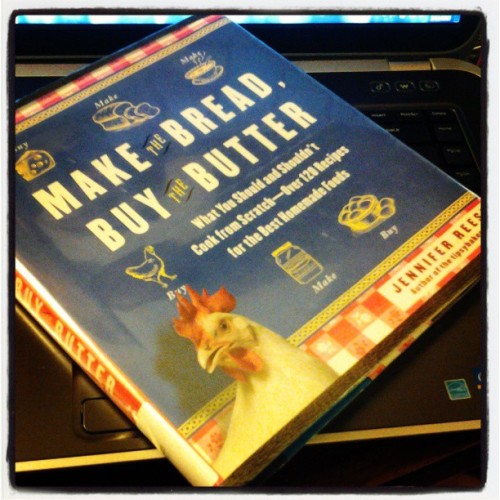
I don’t own this book yet. But I’ve had it checked out of the library a majority of the weeks it’s been in the collection, which means that it’s well past time for me to get off my ass and buy a copy, innit? Anyway, Jennifer Reese‘s Make the Bread, Buy the Butter (subtitled What You Should and Shouldn’t Cook From Scratch) is a terrific cookbook. Not just a collection of recipes, it’s a chronicle of one woman’s quest to take more of a do-it-yourself (DIY) approach to her family’s food preparation, and the discoveries she made along the way that there are some things that you certainly should make for yourself (either because it’s easier, or cheaper, or just plain better, or all three), and that there are other things that you’re just fine buying for yourself at the store.
I haven’t done a whole lot of cooking out of the book yet (one new wrinkle is The Wife’s adoption of a gluten-free diet, which has us going in other food directions currently), but there are a lot of good insights here on food and making it yourself and the fact that sometimes it’s just fine to not do things from scratch. The book is full of frank observations, like this:
If bay leaf didn’t exist, would anyone miss it? I’ve never tasted anything and thought, This stew is just crying out for bay leaf. But I keep buying and using it nonetheless.
And Reese’s explorations are hard-core. This isn’t just about making your own breads or spice mixes or your own peanut butter. She writes about keeping — and killing — her own chickens, and keeping goats. She writes about making her own hot dogs (her conclusion? Just buy ’em.). And she writes thusly about a dish that’s wonderful when made at home, but may or may not be worth all the effort: fried chicken.
One rainy Sunday a few years ago, Isabel, Owen, and I decided to pass the afternoon by watching a DVD of The Fellowship of the Ring, that movie about hobbits and elves and Orcs that we’d been hearing about. One hundred and seventy-eight minutes later, during which we neither moved nor spoke, we looked at each other, eyes glazed. We walked straight to the car, drove to the video store, and rented The Two Towers and The Return of the King. It was getting on dusk when I pulled into the Kentucky Fried Chicken down the hill and bought dinner.
My kids were shocked. Happy, but shocked. What was going on with Mom? KFC? I wondered that myself. But we were hungry and the chicken was hot and we had five more hours of Viggo Mortensen to watch. Fifteen minutes after I pulled into the KFC, we were back on the sofa with the bucket on the coffee table, eating mediocre chicken and mashed potatoes and biscuits and watching The Two Towers. It was one of the happiest nights of my adult life and my children still get dreamy and nostalgic talking about it.
Not long ago, I cooked a grand fried chicken dinner out of Ad Hoc At Home by Thomas Keller. I bought the book based on rave reviews of Keller’s chicken, which is brined and air-dried before it is dipped in multiple coatings and fried. The effort paid off; the recipe did not disappoint. TO go with that incredible chicken — because you can’t serve fried chicken without fixins — I mashed potatoes and baked biscuits. There was a salad in there somewhere, too. Frying chicken is messy and nerve-racking because oil spatters and spits and stings your forearms and you have to do it at the last minute, which is also when you’re mashing potatoes and pulling biscuits out of the oven and pouring glasses of water and calling to everyone that dinner is ready. Leave it in the pan too long, and the chicken is ruined; take it out too soon and it’s a health hazard. You really have to be up for the logistical challenge.
And fried chicken comes with baggage: You expect fried chicken to be so good that people lick their fingers. Literally. You expect people to linger at the table and loosen their belts, lean back in their chairs, tell stories, pull out a bottle of corn likker. You expect people to somehow recognize that this isn’t a meal like all other meals.
Sometimes all of that will happen.
Sometimes it will not.
By the time we sat down, I was bleak with exhaustion, everyone was ravenous, and we put away that chicken in about ten minutes flat. The coating formed a crispy sheath around meat that, thanks to brining, was juicy and flavorful through to the bone. The potatoes were a celestial cloud of starch and butter; the biscuits, perfection. But I don’t remember a thing anyone said; I don’t remember anyone lingering at the table or thanking me or recognizing that the meal was special or iconic or hanging around afterward to drink corn likker. One of these days I will forget the evening ever happened. I suspect Mark and the children already have. But that night we ate KFC on the sofa and watched The Two Towers? That, we will never forget.
Sometimes I have to remind myself that the symbols of wholesome domestic happiness — hot biscuits, a platter of home-fried free-range chicken, a family sitting around a table — are not domestic happiness. The family sitting in front of the TV with the bucket may be experiencing more joy and grace and love. Or, of course, they may not be.
Should you make your own fried chicken or buy KFC? Reese says there’s no easy answer to that, and I tend to agree. I’ve made my own fried chicken, and had a good time doing it. And you can probably tell by my self-photos that I’ve had my share of KFC.
I need to buy this book…and even after I do, I’ll probably keep checking it out periodically, just to keep its circulation numbers up.
A literary anniversary went by last week, and I do want to mark its passing: on June 26, 1948, seventy-five years ago, The New Yorker published a new story by author Shirley Jackson. By this time Jackson was an established writer, albeit early on in her career, and her June, 1948 appearance in The New Yorker is the event that put her on the literary map, so to speak. And what an event that story’s publication was: that story became one of the most controversial ever published by that magazine, and to this day the story is a classic of the horror genre, which is even more notable as it does not contain one bit of supernatural behavior in it. No, this story is a simple one of the horror of human interactions and human adherence to tradition, and most disturbingly, the oh so human way of managing to put human life into a position of secondary, or even tertiary, importance.
The story is “The Lottery”. You can read it here. I recommend doing so; it’s a great work that has lost none of its ability to disturb in all its years. It’s not a long read, and I wouldn’t dream of spoiling it, if you haven’t read it.
Jackson would later write a lecture about her experiences with the reaction to “The Lottery”. I don’t know where or when she actually delivered this lecture, but it’s been anthologized in a book called Come Along With Me, which anthologizes several of her stories, a couple of lectures, and a novel draft on which she was working at the time of her untimely death in 1965.
Here is a portion of that lecture:
On the morning of June 28, 1948, I walked down to the post office in our little Vermont town to pick up the mail. I was quite casual about it, as I recall–I opened the box, took out a couple of bills and a letter or two, talked to the postmaster for a few minutes, and left, never supposing that it was the last time for months that I was to pick up the mail without an active feeling of panic. By the next week I had had to change my mailbox to the largest one in the post office, and casual conversation with the postmaster was out of the question, because he wasn’t speaking to me. June 28, 1948 was the day The New Yorker came out with a story of mine in it. It was not my first published story, nor my last, but I have been assured over and over that if it had been the only story I ever wrote or published, there would be people who would not forget my name.
I had written the story three weeks before, on a bright June morning when summer seemed to have come at last, with blue skies and warm sun and no heavenly signs to warn me that my morning’s work was anything but just another story. The idea had come to me while I was pushing my daughter up the hill in her stroller–it was, as I say, a warm morning, and the hill was steep, and beside my daughter the stroller held the day’s groceries–and perhaps the effort of that last fifty yards up the hill put an edge to the story; at any rate, I had the idea fairly clearly in my mind when I put my daughter in her playpen and the frozen vegetables in the refrigerator, and, writing the story, I found that it went quickly and easily, moving from beginning to end without pause. As a matter of fact, when I read it over later and decided that except for one or two minor corrections, it needed no changes, and the story I finally typed up and sent off to my agent the next day was almost word for word the original draft. This, as any writer of stories can tell you, is not a usual thing. All I know is that when I came to read the story over I felt strongly that I didn’t want to fuss with it. I didn’t think it was perfect, but I didn’t want to fuss with it. It was, I thought, a serious, straightforward story, and I was pleased and a little surpised at the ease with which it had been written; I was reasonably proud of it, and hoped that my agent would sell it to some magazine and I would have the gratification of seeing it in print.
My agent did not care for the story, but–as she said in her note at the time–her job was to sell it, not to like it. She sent it at once to The New Yorker, and about a week after the story had been written I received a telephone call from the fiction editor of The New Yorker; ti was quite clear that he did not really care for the story, either, but The New Yorker was going to buy it. He asked for one change–that the date mentioned in the story be changed to coincide with the date of the issue of the magazine in which the story would appear, and I said of course. He then asked, hesitantly, if I had any particular interpretation of my own for the story; Mr. Harold Ross, then the editor of The New Yorker, was not altogether sure that he understood the story, and wondered if I would care to enlarge upon its meaning. I said no. Mr. Ross, he said, thought that the story might be puzzling to some people, and in case anyone telephoned the magazine, as sometimes happened, or wrote in asking about the story, was there anything in particular I wanted them to say? No, I said, nothing in particular; it was just a story I wrote.
I had no more preparation than that. I went on picking up the mail every morning, pushing my daughter up and down the hill in her stroller, anticipating pleasurably the check from The New Yorker, and shopping for groceries. The weather stayed nice and it looked as though it was going to be a good summer. Then, on June 28, The New Yorker came out with my story.
What ensues is an encapsulation of Jackson’s reaction to the reactions to her story, which roughly fall into general groups: those who wonder if the events described in the story are based on reality, those who think the story is disturbing fiction, and…well, those pretty much are the two camps. Jackson’s story even inspired a number of “Cancel my subscription!” reactions. One particular such demand is phrased quite well:
Heretofore mine has been almost a stockholder’s pride in The New Yorker. I shared my copy with my friends as I do the other possessions which I most enjoy. When your latest issue arrived, my new distaste kept me from removing the brown paper wrapping, and into the wastebasket it went. Since I can’t conceive that I’ll develop interest in it again, save the results of your efforts that indignity every week and cancel my subscription immediately.
Ouch.
The New Yorker did a retrospective of reader reaction to “The Lottery” ten years ago, which you can find here; one interesting tidbit is that the magazine did not always label its fiction and nonfiction pieces, so perhaps the befuddlement of some readers who couldn’t determine on their own that “The Lottery” was just a story with no basis in the daily life of any small town in America is to be excused. I don’t know, I wasn’t there. But surely these events would have been common knowledge if they were real, yes? I mean, wouldn’t everyone know about that small town in such-and-such a state where every year they got everyone in the town together and held a lottery to choose one of its denizens for–wait. That would be spoiling it, if you haven’t read “The Lottery”.
This is a repost from a couple of years ago. I chose to repost this, about a book by astronomer Sara Seager, because it has lodged in my brain since I read it.
I generally try to avoid reading grief memoirs, for various reasons that mainly boil down to…well, I’ve had enough grief in my life already and I know that more is on the way someday*, and it’s a subject I don’t much enjoy plumbing any more than I have to. But sometimes I find a grief memoir that piques my interest and I read it anyway. Smallest Lights is such a book, and I am very glad that I read it. It’s so much more than a grief memoir, really. It’s about science and love and life and death and love again and parenthood and dealing with autism.
It’s also beautifully written.
Not every planet has a star. Some aren’t part of a solar system. They are alone. We call them rogue planets.
Because rogue planets aren’t the subjects of stars, they aren’t anchored in space. They don’t orbit. Rogue planets waner, drifting in the current of an endless ocean. They have neither the light nor the heat that stars provide. We know of one rogue planet, PSO J318.5-22–right now, it’s up there, it’s out there–lurching across the galaxy like a rudderless ship, wrapped in perpetual darkness. Its surface is swept by constant storms. It likely rains on PSO J318.5-22, but it wouldn’t rain water there. Its black skies would more likely unleash bands of molten iron.
It can be hard to picture, a planet where it rains liquid metal in the dark, but rogue planets aren’t science fiction. We haven’t imagined them or dreamed them. Astrophysicists like me have found them. They are real places on our celestial maps. There might be thousands of billions of more conventional exoplanets–planets that orbit stars other than the sun–in the Milky Way alone, circling our galaxy’s hundreds of billions of stars. But amid that nearly infinite, perfect order, in the emptiness between countless pushes and pulls, there are also the lost ones: rogue planets. PSO J318.5-22 is as real as Earth.
There were days when I woke up and couldn’t see much difference between there and here.
Sara Seager is an astrophysicist at MIT whose main body of work involves exoplanets, their discovery around other stars, and analyzing them for signs of life. Among other things, if you wonder how on Earth (literally!) we can look for life on planets lightyears away that nobody in our lifetime (or, likely, in our great-grandchildrens’ lifetimes) will ever see directly, this book will give you some hints as to how that search is currently going. (It involves ingenious analysis of light coming from those planets. It really is amazing, when you think about it, the degree to which light energy is the main carrier of information in this universe of ours.)
In her book, Seager discusses her own work and the degree to which her work has shaped her personal life, and how her personal life has shaped her work in return. Her first husband was a man of considerable energy, whom she met on a canoeing trip; their courtship progressed on more canoeing trips all over the place. But he developed cancer, which eventually killed him at a terribly and unfairly young age. Thus this brilliant astrophysicist, whose work is an important part of the current growth of human knowledge of our universe, finds herself a single parent attending meetings of the local widow’s club, figuring out the nature of this new world she’s been thrust into. It’s the cruelest of ironies, I suppose, that this woman whose life’s work is understanding the universe and seeking other worlds suddenly finds herself in a new world, one that’s familiar to people who have known deep grief, where everything is the same and yet everything is deeply different.
Throughout Seager’s book, I found myself frequently hit in the heart by some of her observations:
:: Everybody dies instantly. It’s the dying that happens either quickly or over a long period of time. Mike spent a long time dying: eighteen months separated his diagnosis and his death.
:: There have been lessons I have chosen not to teach. Not all knowledge is power; not all things are worth knowing. Max and Alex [her sons] never saw Mike’s body. They did not see him leave the house.
:: [On the Widow’s club] All of our children had become friends. They didn’t gather because their fathers had died; they gathered because it was fun. There is a reason every children’s book is written from the perspective of the child. Children don’t care about adult concerns. We think of children as helpless when they are the embodiment of resilience, more impervious to outside forces than we could ever be again. Despite their suffering, our kids still knew pure joy.
:: Sometimes you need darkness to see. Sometimes you need light.
:: I don’t think it’s an accident that there’s a mirror at the heart of every telescope. If we want to find another Earth, that means we want to find another us. We think we’re worth knowing. We want to be a light in somebody else’s sky. And so long as we keep looking for each other, we will never be alone.
I love that last one (which actually closes the book, so apologies for the ‘spoiler’). Seager casts loneliness not in terms of presence but in terms of action: we’re only truly lonely when we accept that we are alone and stop seeking others to enrich our lives. True loneliness, really being alone, comes of a permanent turning inward, of looking down and not up. And really, how else would someone who loves the stars see things?
The Smallest Lights in the Universe is a wonderful book that stands in stark contrast, it seems to me, to the view of science as cold and mechanical and mathematical, an enterprise that somehow forgets about emotion and wonder. No less a genius than Walt Whitman expressed this view, in “When I Heard the Learn’d Astronomer”. But the numbers and the proofs surely don’t have to get in the way of the wonder; rather they inform it and give it focus. Science is not an impediment to love and life. Science is a part of those things. Sara Seager’s book shows us how.
I have just finished reading James Baldwin’s powerful essay-book No Name in the Street, in which Baldwin describes his early life and his encounters later with many figures, some seminal and some less-so, and how he relates all of this to his larger experience as a Black man in 20th century America. It does not come as a surprise to observe how many of his observations can be, and are being by others, advanced as true to this very day. For all that we, for certain definitions of “we”, like to pat ourselves on the back for how far we’ve come, it’s very much worth the effort to look at history from the vantage point of those who don’t think we’ve come very far at all. And that view is absolutely justified, which goes a long way toward explaining the vehement degree to which many in power now are working hard to make sure this view is as hard to hear as possible.
I could say more, but…no. Better to listen to the voices we’re shouting down, and to amplify them, if possible. Here are three excerpts from Baldwin. (Page numbers are from the Library of America edition of No Name in the Street, which appears in their volume, James Baldwin: Collected Essays. (A word about usage: Baldwin wrote fifty years ago, well before some aspects of terminology were settled or adopted, such as the recent standard of capitalizing Black. Opening capitalizations of these passages are added to differentiate one passage from the next.)
WHEN THE PAGAN and the slave spit on the cross and pick up the fun, it means that the halls of history are about to be invaded once again, destroying and dispersing the present occupants. These, then, can call only on their history to save them–that same history which, in the eyes, of the subjugated, has already condemned them. Therefore, Faulkner hoped that American blacks would have the generosity to “go slow”–would allow white people, that is, the time to save themselves, as though they had not had more than enough time already, and as thought heir victims still believed in white miracles–and Camus repeated the word “justice” as though it were a magical incantation to which all of Africa would immediately respond. American blacks could not “go slow” because they had made a rendezvous with history for the purpose of taking their children out of history’s hands. And Camus’ “justice” was a concept forged and betrayed in Europe, in exactly the same way the Christian church has betrayed and dishonored and blasphemed that Saviour in whose name they have slaughtered millions and millions and millions of people. And if this mighty objection seems trivial, it can only be because of the total hardening of the heart and the coarsening of the conscience among those people who believed that their power has given them the exclusive right to history. If the Christians do not believe in their Saviour (who has certainly, furthermore, failed to save them) why, then, wonder the unredeemed, should I abandon my gods for yours? For I know my gods are real: they have enabled me to withstand you. (p. 382-383)
THIS IS A FORMULA for a nation’s or a kingdom’s decline, for no kingdom can maintain itself by force alone. Force does not work the way its advocates seem to think it does. It does not, for example, reveal to the victim the strength of his adversary. On the contrary, it reveals the weakness, even the panic of his adversary, and this revelation invests the victim with patience. Furthermore, it is ultimately fatal to create too many victims. The victor can do nothing with these victims, for they do not belong to him, but–to the victims. They belong to the people he is fighting. The people know this, and as inexorably as the roll call–the honor roll–of victims expands, so does their will become inexorable: they resolve that these dead, their brethren, shall not have died in vain. When this point is reached, however long the battle may go on, the victor can never be the victor: on the contrary, all his energies, his entire life, are bound up in a terror he cannot articulate, a mystery he cannot read, a battle he cannot win–he has simply become the prisoner of the people he thought to cow, chain, or murder into submission. (p. 406-407)
THOSE WHO RULE this country now–as distinguished, it must be said, from governing it–are determined to smash the Panthers [the Black Panther Party] in order to hide the truth of the American black situation. They want to hide this truth from black people–by making it impossible for them to respond to it–and they would like to hide it from the world; and not, alas, because they area ashamed of it but because they have no intention of changing it. They cannot afford to change it. They would not know how to go about changing, it, even if their imaginations were capable of encompassing the concept of black freedom. But this concept lives in their imaginations, and in the popular imagination, only as a nightmare. Blacks have never been free in this country, never was it intended that they should be free, and the spectre of so dreadful a freedom–the idea of a license so bloody and abandoned–conjures up another, unimaginable country, a country in which no decent, God-fearing white man or woman can live. A civilized country is, by definition, a country dominated by whites, in which the blacks clearly know their place. This is really the way the generality of white Americans feel, and they consider–quite rightly, as far as any concern for their interest goes–that it is they who, now, at long last, are represented in Washington. (p. 462-463)
TO BE AN AFRO-AMERICAN, or an American black, is to be in the situation, intolerably exaggerated, of all those who have ever found themselves part of a civilization which they could in no wise honorably defend–which they were compelled, indeed, endlessly to attack and condemn–and who yet spoke out of the most passionate love, hoping to make the kingdom new, to make it honorable and worthy of life. Whoever is part of whatever civilization helplessly loves some aspects of it, and some of the people in it. A person does not lightly elect to oppose his society. One would much rather be at home among one’s compatriots than be mocked and detested by them. And there is a level on which the mockery of the people, even their hatred, is moving because it is blind: it is terrible to watch people cling to their captivity and insist on their own destruction. I think black people have always felt this about America, and Americans, and have always seen, spinning above the thoughtless American head, the shape of the wrath to come. (p. 474)
That last passage is one that haunts me especially, because I’m not sure that Baldwin’s “wrath to come” has unfolded yet.