STAR TREK and Me (a repost)

Today is the 58th anniversary of Star Trek‘s first appearance on teevee. On this date in 1966, an episode called “The Man Trap” of a new science-fiction show aired, and I guess that at the time this seemed like just another airing of some new show. New shows arrive every year, most of which are completely forgotten eventually…but somehow that particular new show made enough of an impact that it lives on as a huge franchise, over half a century later. Most of the people involved with making that very first episode are gone now…but their memory endures through the legacy of this great show. This is a post that I wrote on my old blog for the occasion of Star Trek‘s fiftieth anniversary, and it seems that I am now posting it on a yearly basis. Happy birthday, Star Trek!

And you people, you’re all astronauts on…some kind of star trek?

–Zefram Cochrane, Star Trek First Contact

Wow. Star Trek made its official US debut fifty years ago today. That’s…amazing. (The show aired for the first time anywhere on September 6, 1966, in Canada.)

Star Trek came and went and was already in syndication when I was born, but my sister loved it, so I quite literally do not remember a time when Star Trek wasn’t a thing. One of my earliest teevee memories is, in fact, the brief bit at the end of the episode “Friday’s Child”, when Dr. McCoy is saying “Oochie woochie coochie coo” to a newborn baby, to Spock’s great confusion.

It’s often taken as an article of faith in the geek universe that one is either a Star Wars fan or a Star Trek fan, and I can kind of see why. It’s a Yankees-Red Sox kind of thing, I suppose. Or Bears-Packers. But for me, it’s complicated. I have to be honest: push me to answer, hold a gun to my head, and I will almost certainly choose Star Wars. But the margin of victory is not large, and in truth, there’s no way I’m the writer I am now without both of them.

“Let me help.” A hundred years or so from now, I believe, a famous novelist will write a classic using that theme. He’ll recommend those three words even over “I love you.”

–James T. Kirk, “The City on the Edge of Forever”

Star Trek shaped my view, in a lot of ways, of what the future can and should be. It should be a time when humans are not afraid to explore the universe and, in fact, do so with enthusiasm. It should be a time when the diversity of humanity should be celebrated and not resisted. It should be a time when beautiful ships fly the stars, instead of rusting dingy hulks. It should be a time of wonderful cities, not dystopic nightmares. It should not be a time of universal peace without conflict, because that’s almost certainly impossible, but it should be a time when we approach conflict from a much more mature standpoint than we do now.

Of course, when I was a kid, Star Trek was none of that. It was just a show about nifty adventures in space, a way for me to scratch that particular itch in the years between releases of Star Wars movies. It didn’t ever occur to me back then that I was supposed to like one over the other; they were different things, and I liked ‘em both. If Star Wars hit me like a bolt from the blue, Star Trek was the thing that was there, day in and day out. Star Trek was what was on during the afternoon hours after school. I’d get home and watch it and thrill to the adventures of Captain Kirk and crew on the black-and-white teevee set I had in my room. This was before the Internet, obviously, and I didn’t have any access to an episode guide, so the only way to learn the episodes was to watch and watch and rewatch them as they came. I got pretty good at recognizing the episodes by sight, usually within seconds. (Often I had to wait until the first shot after the obligatory opening shot of the Enterprise.)

I don’t know if the station had some kind of plan for airing the episodes in any particular order, but I recall that you could go upwards of a year without seeing “Mirror, Mirror” or “The Trouble with Tribbles”, but other episodes – “The Return of the Archons”, “Errand of Mercy” – would show up more frequently. A certain “This one again?!” factor crept in at times, especially with some of the crappier episodes. (I can live the rest of my life to a rich old age and never watch “The Alternative Factor” again.) But the great episodes? Those live on forever. I still laugh at “The Trouble with Tribbles”, and I live for a moment when someone near me uses the phrase “storage compartments”, so I can respond as Kirk does: “STORAGE compartments? STORAGE compartments?!” And I still feel that sense of doom slowly unfolding as “The City on the Edge of Forever” spins its tale, toward the awful moment when, in order to fix history after it has been changed, James Kirk must stand and watch as a 20th century woman with whom he has fallen in love is killed.

MCCOY: You deliberately stopped me, Jim! I could have saved her. Do you know what you just did?

SPOCK: He knows, Doctor. He knows.

–”The City on the Edge of Forever”

As a kid, I attended two Star Trek conventions with my older sister – or at least, one Trek convention and one general sci-fi convention. At the latter, “The Trouble with Tribbles” was aired, followed by 2001: A Space Odyssey. Those were fun. George Takei was the guest of honor at the first one, in 1977 or 1978. I was in first grade at the time. I remember Takei wearing a gleaming white suit. (Peter Mayhew was guest at the next one.)

I eventually lost track of daily Star Trek reruns by the mid-1980s, but also by this point, the movies were a thing. I remember being terribly excited for The Motion Picture, and even though I didn’t quite understand all of the plot, I have never – not once – disliked that often-maligned film. I recall being mildly disappointed that the Enterprise never fires its phasers once in that film, and in fact it only dispatches a single photon torpedo, and that’s at an errant asteroid that’s about to collide with the Great Bird. I didn’t realize it at the time, but I think The Motion Picture is the first real science fiction story I saw on the big screen that wasn’t about a galactic war or some other action-based adventure. I wasn’t thinking in those terms, but yes, the movie primed that particular pump.

I liked all of the movies that came, and I saw every one in the theater over the next decade. This was an odd time for Trek, when a movie every couple of years was all there was. Sure, every once in a while there would be a tidbit in Starlog (the late, great SF fandom magazine) about how somebody somewhere wanted to make a new Trek teevee series, but it never amounted to much until we learned that we were finally getting The Next Generation. This was for several reasons, not the least of which was that Paramount wanted to keep making money off Trek but the original cast was starting to show its age.

Through the 1980s, as Star Wars seemed to fade away, Trek was still there, churning out a movie every couple of years and then a new teevee show. That’s what Trek always was for me. It didn’t fuel my imagination in quite the same way that Star Wars has always moved me at a very basic level of storytelling taste, but Trek has always been around. Always, always there. In fact, it was always there to such an extent that in the late 1990s, I started letting Trek go…but I’m getting ahead. During this time I read a number of Trek novels, and there was a fanzine called Trek that would annually publish a paperback book filled with its best articles. These I read with zeal, and I’ve lately started regathering them all via eBay. Maybe this winter I’ll spend some time reliving some fine old fan writing.

I loved The Next Generation, and watching it religiously formed a tradition in college among my mates and I. TNG aired reruns every weeknight, and the new episodes ran every Sunday night after the 10:00 news. That station even went so far, as TNG’s popularity grew, of including a very brief astronomy segment in its 10:00 Sunday newscast – “Tonight you can see Mars in the eastern sky!”, that sort of thing – complete with an Enterprise fly-by animation. And then, in our senior year, the next show, Star Trek: Deep Space Nine, arrived. That premiere was an event, and I still think that premiere was an amazing episode.

Never trust ale from a god-fearing people, or a Starfleet Commander that has one of your relatives in jail.

–Quark, Star Trek: Deep Space Nine

It took a little while for TNG to really get going, but once the writers had the chemistry down, the show was more than ready to carry on the Trek tradition, with many a fine and thought-provoking story, about love and loss and what it means to be human even as we take to the stars.

If you can’t take a little bloody nose, maybe you ought to go back home and crawl under your bed. It’s not safe out here. It’s wondrous, with treasures to satiate desires both subtle and gross. But it’s not for the timid.

–Q, Star Trek: The Next Generation

And still the movies came. The Wrath of Khan and The Search for Spock, which I saw with school friends. The Voyage Home, with its goofy and infectious joy. Even the much-maligned (and mostly deservedly so) The Final Frontier had its charms for me. That poor movie may have failed, but I really give it credit for trying to be about something.

The Undiscovered Country came along in 1991, when TNG had hit its stride. We saw it in the theater the night it opened, which happened to be the same night as our annual Christmas concert performance at a big church in Cedar Falls, IA. We did the concert, quickly changed clothes, and bolted down the street to catch the show. I loved that movie, and in fact, to this day Star Trek VI is my favorite Trek film. I remember a lump in my throat at the closing scene, which boiled down to just the classic crew onscreen (minus Sulu, who finally got his promotion to Captain and got to fly away on his own ship, the Excelsior), followed by the animated signatures of the original cast. Their time was done. (Although, in classic Trek and science fiction fashion, not quite.)

CHEKOV: Course heading, Captain?

KIRK: (smiles) Second star to the right…and straight on ‘til morning.

Star Trek VI: The Undiscovered Country

College ended and the real world began, and there was still Star Trek, even as Star Wars started making rumblings again. The TNG crew graduated to movies, and DS9 soared in quality. Another series began, Voyager…which is when I started to lose a bit of energy with respect to Trek. For one thing, I had a lot of other interests by this time, but for another, it was pretty clear as Voyager got going that the creative folks behind Trek were starting to lose steam. I stopped watching Voyager about the fourth season, and the next series? Well, to this day, I have never watched a single episode of Enterprise.

But now Trek is coming back. Three new movies, with varying degrees of success. A new series on the way, reimagined to seasons of thirteen episodes each. The Trek continues. (I haven’t seen Star Trek Beyond yet. It came and went from the theaters too quickly this summer, and it came out during our busiest time of the summer as well, so I simply was never able to squeeze it in. Beyond and Nemesis are, to date, the only Trek films I did not see in the theaters.) Will Trek eventually reach similar heights again? Are there more stories in the offing to match tales like “The Devil in the Dark,” “The Doomsday Machine,” “A Piece of the Action,” “The Best of Both Worlds,” “Yesterday’s Enterprise,” “Tapestry,” “The Visitor”? Who knows…but I look forward to finding out.

Star Trek is, was, and has been many things. It will continue to be many things, too. I don’t know that I’ll ever have the same old investment in it that I did in the late 70s and through the 80s. I don’t know that I’ll ever feel that same enthusiasm for Star Wars either, so the two tentpoles of my science fiction life have that much in common, don’t they? But I’ll always owe a debt to Star Trek. It shone a bright light on a future that doesn’t have to be awful, and it showed beautiful space ships. It put a new light on the idea of space adventure, and it showed a military organization that was devoted truly to peace. Star Trek did time travel better than just about anybody else. Star Trek gave us amazing characters, and it let those characters do amazing things.

They used to say if man could fly, he’d have wings, but he did fly. He discovered he had to. Do you wish that the first Apollo mission hadn’t reached the moon, or that we hadn’t gone on to Mars and then to the nearest star? That’s like saying you wish that you still operated with scalpels and sewed your patients up with catgut like your great-great-great-great grandfather used to. I’m in command. I could order this, but I’m not because Doctor McCoy is right in pointing out the enormous danger potential in any contact with life and intelligence as fantastically advanced as this, but I must point out that the possibilities – the potential for knowledge and advancement – is equally great. Risk! Risk is our business. That’s what this starship is all about. That’s why we’re aboard her.

–James T. Kirk, “Return to Tomorrow”

Star Trek is fifty. Amazing. Long live Star Trek.

Space: the final frontier. These are the voyages of the starship Enterprise. Her ongoing mission: to explore strange, new worlds; to seek out new life and new civilizations; to boldly go where no one has gone before.

Share This Post

“The Force will be with you. Always.” (a repost)

Today marks the 47th anniversary of the release of George Lucas’s “little space movie”, which wasn’t even 20th Century Fox’s projected “Big Movie” of that year. Little did the world know what was about to happen…and certainly a five-year-old kid in LaCrosse, Wisconsin had no idea how his world was about to be shaped forever. I wrote this post in 2017 for the 40th anniversary of Star Wars, and I wouldn’t change anything. I’ll probably write something completely new for the 50th, though…my God, we’re almost at fifty years of Star Wars….


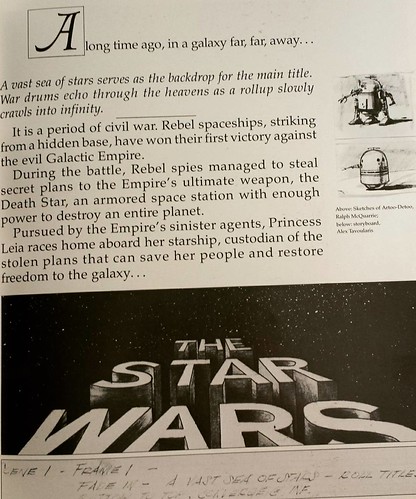
D19 of #IGWritersMay: Novel aesthetics. I make no secret that at its heart, THE SONG OF FORGOTTEN STARS is really my love letter to STAR WARS. (This is a page from the book THE ART OF STAR WARS.) #amwriting #starwars #sciencefiction #spaceopera #Forgotten


I didn’t see Star Wars on opening day. In truth I don’t even remember exactly when I saw it, but it was later in the summer of 1977. We had just moved from Wisconsin to Oregon, and in that time I was not even aware of this enormous movie phenomenon whose popularity was sweeping the nation.

I finally saw it, though, with my sister, who is six years older than me.

I didn’t like it.

It was very loud. It opened with big words flying through space and then there was loud spaceships and talking robots (one of whom only talked in beeps and whistles). There was a girl in white and a bad guy in black whose breath sounded weird. There was a desert planet with weird dwarf-creatures and a kid named Luke who lived with his aunt and uncle. (The uncle could be pretty gruff if Luke was goofing off, to which I could relate.) There were more loud spaceships and one really really big spaceship shaped like a giant ball. There was a guy dressed in black and white who helped the farm kid, and this guy had a giant ape-man friend. There were swords made of light and even more spaceships and a big battle in space.

All of that, and I didn’t understand a lick of it.

In my defense, I was all of five years old at the time.

Until Star Wars, my movie experience was pretty much limited to stuff like Bugs Bunny Superstar and Disney live-actions like The Shaggy DA (which contained a hoot of a pie fight). Then there was this movie with loud spaceships and robots and a farm kid and a bad guy in black and…well, I had no idea what to make of this movie.

Luckily for me I had my sister, who is six years older than me.

She went all-in for Star Wars. She ate it, drank it, breathed it. She talked about it a lot, and gradually her enthusiasm began to win me over. She explained the story to me because I hadn’t understood it all that well, and I decided that I wanted a part of her enthusiasm for my own. So I went with her to see the movie a second time.

I have never ever ever recovered.

I’ve been thinking a lot about Star Wars as it nears and achieves 40 years, and I find myself relating to it most as a storyteller myself. As a writer I tend most to look at Star Wars through the prism of story. Many stories have had a deep effect on me, on the stories I want to tell, and the way I go about telling them, but none moreso than Star Wars, even as the Star Wars story itself has changed over the course of its four decades. Most of the core ideas are still there, though, as Star Wars is now no longer in the hands of its creator, George Lucas. Star Wars is still a tale of heroic adventure unfolding in the sky. It is still a tale not just of the wars but more well-focused on the people fighting that war. It is a tale of improbably redeemable villains, of the way our paths mirror those of our parents, and of finding love in the face of desperation. It is a tale of family.

I can’t help thinking in most, if not all, of these terms every time I write a story, no matter which genre it’s in. Star Wars made me want to be a storyteller (what is playing with action figures, if not storytelling?). It also taught me that stories can focus at times on more mystical matters, and it taught me that story is an excellent way of addressing the challenges people face in their hearts. Most importantly, though, Star Wars taught me about heroes and quests and the wise elders who try to guide the heroes on their way.

Other stories have come since Star Wars arrived, and many have come to places almost as near to my heart. It’s not only stories, either; it’s all of creative art, really:

Lloyd Alexander’s Prydain Chronicles
The Lord of the Rings
Casablanca
On Her Majesty’s Secret Service
My Fair Lady
Cosmos
Much Ado About Nothing
The House with a Clock in its Walls
The Lions of Al-Rassan
Mary Stewart’s Arthurian trilogy (plus The Wicked Day)
Berlioz’s Symphonie fantastique
Rachmaninov’s Symphony No. 2 in E minor
Invisible Touch by Genesis
Once and Again
Princess Mononoke

These are all things — and there are more — that are at the center of my creative life, but none has ever quite dislodged Star Wars as my Prime Mover. Star Wars is, and continues to be, my Platonic Ideal of what story is.

Even so, I haven’t always kept as close an eye on Star Wars as a massive universe as many. I’ve read only a small handful of all the many novels and comics written over the years, and I haven’t played any of the video games. For me, my appreciation focuses pretty exclusively on the movies themselves, and not just the wonderful Original Trilogy but also the admittedly uneven — but still, in my eyes, uniquely compelling — Prequel Trilogy and even to a smaller extent the recent “Rebirth” movies, The Force Awakens and Rogue One. Those form the core.

Star Wars is as strong now as it ever was, and it is very likely even stronger. It has more fans than ever, and it is now in the hands of a corporate power whose pockets are deep enough to maintain it at a very high level for decades to come. More fans are created every day, it seems, and yet…I do have to admit to feeling a certain level of possibly grumpy oldsterism. Sure, you kids can love Star Wars and in fact I hope that you will, and that your love for Star Wars will lead you to other things. But I came in on the ground level. My memories may be hazy, but I do remember a time before Star Wars.

I believe that every story one writes — or rather, every story that I write — should be, in one way or another, a love letter, either to someone or something. The Song of Forgotten Stars has many influences, but it is ultimately my love letter to Star Wars. If not for Star Wars, there’s no way I would be writing this story. It’s not just about the internals of Star Wars, though: it’s about the way Star Wars impacted me and shaped my life and helped reflected certain relationships in my life. Put it this way: There’s a reason why the two main characters in my Forgotten Stars books are two Princesses, one of whom is six years older than the other. It’s a dynamic that makes sense to me on a lot of different levels.

I also know, from reading a lot about the making of Star Wars over the years and about the life of George Lucas in particular, that the way by which a creative work comes into existence is often a messy one. Lucas’s manner of creation is eerily similar to my own, or maybe vice versa. Lucas is someone who starts out by following ideas in any direction they might go, and only gradually whittles things down and discards this notion or that idea until a streamlined story starts to emerge. I work the same way, at least in part. My rough drafts are often very messy and they always contain entire ideas that I remove entirely, for one reason or another. Lucas has done so much mixing and matching of ideas over the decades (remember that for him, Star Wars is 47 or 48 years old, depending on where he dates The Beginning) that he at times seems to be misremembering his own history. I know how he feels. There are times when an idea seems so organic that it’s hard to claim it for my own. Even if it is.

So thank you for forty years, Star Wars! And may the Force be with you, forevermore.


Share This Post

STAR TREK and Me (a repost)

Today is the 57th anniversary of Star Trek‘s first appearance on teevee. On this date in 1966, an episode called “The Man Trap” of a new science-fiction show aired, and I guess that at the time this seemed like just another airing of some new show. New shows arrive every year, most of which are completely forgotten eventually…but somehow that particular new show made enough of an impact that it lives on as a huge franchise, over half a century later. Most of the people involved with making that very first episode are gone now…but their memory endures through the legacy of this great show. This is a post that I wrote on my old blog for the occasion of Star Trek‘s fiftieth anniversary, and it seems that I am now posting it on a yearly basis. Happy birthday, Star Trek!

And you people, you’re all astronauts on…some kind of star trek?

–Zefram Cochrane, Star Trek First Contact

Wow. Star Trek made its official US debut fifty years ago today. That’s…amazing. (The show aired for the first time anywhere on September 6, 1966, in Canada.)

Star Trek came and went and was already in syndication when I was born, but my sister loved it, so I quite literally do not remember a time when Star Trek wasn’t a thing. One of my earliest teevee memories is, in fact, the brief bit at the end of the episode “Friday’s Child”, when Dr. McCoy is saying “Oochie woochie coochie coo” to a newborn baby, to Spock’s great confusion.

It’s often taken as an article of faith in the geek universe that one is either a Star Wars fan or a Star Trek fan, and I can kind of see why. It’s a Yankees-Red Sox kind of thing, I suppose. Or Bears-Packers. But for me, it’s complicated. I have to be honest: push me to answer, hold a gun to my head, and I will almost certainly choose Star Wars. But the margin of victory is not large, and in truth, there’s no way I’m the writer I am now without both of them.

“Let me help.” A hundred years or so from now, I believe, a famous novelist will write a classic using that theme. He’ll recommend those three words even over “I love you.”

–James T. Kirk, “The City on the Edge of Forever”

Star Trek shaped my view, in a lot of ways, of what the future can and should be. It should be a time when humans are not afraid to explore the universe and, in fact, do so with enthusiasm. It should be a time when the diversity of humanity should be celebrated and not resisted. It should be a time when beautiful ships fly the stars, instead of rusting dingy hulks. It should be a time of wonderful cities, not dystopic nightmares. It should not be a time of universal peace without conflict, because that’s almost certainly impossible, but it should be a time when we approach conflict from a much more mature standpoint than we do now.

Of course, when I was a kid, Star Trek was none of that. It was just a show about nifty adventures in space, a way for me to scratch that particular itch in the years between releases of Star Wars movies. It didn’t ever occur to me back then that I was supposed to like one over the other; they were different things, and I liked ‘em both. If Star Wars hit me like a bolt from the blue, Star Trek was the thing that was there, day in and day out. Star Trek was what was on during the afternoon hours after school. I’d get home and watch it and thrill to the adventures of Captain Kirk and crew on the black-and-white teevee set I had in my room. This was before the Internet, obviously, and I didn’t have any access to an episode guide, so the only way to learn the episodes was to watch and watch and rewatch them as they came. I got pretty good at recognizing the episodes by sight, usually within seconds. (Often I had to wait until the first shot after the obligatory opening shot of the Enterprise.)

I don’t know if the station had some kind of plan for airing the episodes in any particular order, but I recall that you could go upwards of a year without seeing “Mirror, Mirror” or “The Trouble with Tribbles”, but other episodes – “The Return of the Archons”, “Errand of Mercy” – would show up more frequently. A certain “This one again?!” factor crept in at times, especially with some of the crappier episodes. (I can live the rest of my life to a rich old age and never watch “The Alternative Factor” again.) But the great episodes? Those live on forever. I still laugh at “The Trouble with Tribbles”, and I live for a moment when someone near me uses the phrase “storage compartments”, so I can respond as Kirk does: “STORAGE compartments? STORAGE compartments?!” And I still feel that sense of doom slowly unfolding as “The City on the Edge of Forever” spins its tale, toward the awful moment when, in order to fix history after it has been changed, James Kirk must stand and watch as a 20th century woman with whom he has fallen in love is killed.

MCCOY: You deliberately stopped me, Jim! I could have saved her. Do you know what you just did?

SPOCK: He knows, Doctor. He knows.

–”The City on the Edge of Forever”

As a kid, I attended two Star Trek conventions with my older sister – or at least, one Trek convention and one general sci-fi convention. At the latter, “The Trouble with Tribbles” was aired, followed by 2001: A Space Odyssey. Those were fun. George Takei was the guest of honor at the first one, in 1977 or 1978. I was in first grade at the time. I remember Takei wearing a gleaming white suit. (Peter Mayhew was guest at the next one.)

I eventually lost track of daily Star Trek reruns by the mid-1980s, but also by this point, the movies were a thing. I remember being terribly excited for The Motion Picture, and even though I didn’t quite understand all of the plot, I have never – not once – disliked that often-maligned film. I recall being mildly disappointed that the Enterprise never fires its phasers once in that film, and in fact it only dispatches a single photon torpedo, and that’s at an errant asteroid that’s about to collide with the Great Bird. I didn’t realize it at the time, but I think The Motion Picture is the first real science fiction story I saw on the big screen that wasn’t about a galactic war or some other action-based adventure. I wasn’t thinking in those terms, but yes, the movie primed that particular pump.

I liked all of the movies that came, and I saw every one in the theater over the next decade. This was an odd time for Trek, when a movie every couple of years was all there was. Sure, every once in a while there would be a tidbit in Starlog (the late, great SF fandom magazine) about how somebody somewhere wanted to make a new Trek teevee series, but it never amounted to much until we learned that we were finally getting The Next Generation. This was for several reasons, not the least of which was that Paramount wanted to keep making money off Trek but the original cast was starting to show its age.

Through the 1980s, as Star Wars seemed to fade away, Trek was still there, churning out a movie every couple of years and then a new teevee show. That’s what Trek always was for me. It didn’t fuel my imagination in quite the same way that Star Wars has always moved me at a very basic level of storytelling taste, but Trek has always been around. Always, always there. In fact, it was always there to such an extent that in the late 1990s, I started letting Trek go…but I’m getting ahead. During this time I read a number of Trek novels, and there was a fanzine called Trek that would annually publish a paperback book filled with its best articles. These I read with zeal, and I’ve lately started regathering them all via eBay. Maybe this winter I’ll spend some time reliving some fine old fan writing.

I loved The Next Generation, and watching it religiously formed a tradition in college among my mates and I. TNG aired reruns every weeknight, and the new episodes ran every Sunday night after the 10:00 news. That station even went so far, as TNG’s popularity grew, of including a very brief astronomy segment in its 10:00 Sunday newscast – “Tonight you can see Mars in the eastern sky!”, that sort of thing – complete with an Enterprise fly-by animation. And then, in our senior year, the next show, Star Trek: Deep Space Nine, arrived. That premiere was an event, and I still think that premiere was an amazing episode.

Never trust ale from a god-fearing people, or a Starfleet Commander that has one of your relatives in jail.

–Quark, Star Trek: Deep Space Nine

It took a little while for TNG to really get going, but once the writers had the chemistry down, the show was more than ready to carry on the Trek tradition, with many a fine and thought-provoking story, about love and loss and what it means to be human even as we take to the stars.

If you can’t take a little bloody nose, maybe you ought to go back home and crawl under your bed. It’s not safe out here. It’s wondrous, with treasures to satiate desires both subtle and gross. But it’s not for the timid.

–Q, Star Trek: The Next Generation

And still the movies came. The Wrath of Khan and The Search for Spock, which I saw with school friends. The Voyage Home, with its goofy and infectious joy. Even the much-maligned (and mostly deservedly so) The Final Frontier had its charms for me. That poor movie may have failed, but I really give it credit for trying to be about something.

The Undiscovered Country came along in 1991, when TNG had hit its stride. We saw it in the theater the night it opened, which happened to be the same night as our annual Christmas concert performance at a big church in Cedar Falls, IA. We did the concert, quickly changed clothes, and bolted down the street to catch the show. I loved that movie, and in fact, to this day Star Trek VI is my favorite Trek film. I remember a lump in my throat at the closing scene, which boiled down to just the classic crew onscreen (minus Sulu, who finally got his promotion to Captain and got to fly away on his own ship, the Excelsior), followed by the animated signatures of the original cast. Their time was done. (Although, in classic Trek and science fiction fashion, not quite.)

CHEKOV: Course heading, Captain?

KIRK: (smiles) Second star to the right…and straight on ‘til morning.

Star Trek VI: The Undiscovered Country

College ended and the real world began, and there was still Star Trek, even as Star Wars started making rumblings again. The TNG crew graduated to movies, and DS9 soared in quality. Another series began, Voyager…which is when I started to lose a bit of energy with respect to Trek. For one thing, I had a lot of other interests by this time, but for another, it was pretty clear as Voyager got going that the creative folks behind Trek were starting to lose steam. I stopped watching Voyager about the fourth season, and the next series? Well, to this day, I have never watched a single episode of Enterprise.

But now Trek is coming back. Three new movies, with varying degrees of success. A new series on the way, reimagined to seasons of thirteen episodes each. The Trek continues. (I haven’t seen Star Trek Beyond yet. It came and went from the theaters too quickly this summer, and it came out during our busiest time of the summer as well, so I simply was never able to squeeze it in. Beyond and Nemesis are, to date, the only Trek films I did not see in the theaters.) Will Trek eventually reach similar heights again? Are there more stories in the offing to match tales like “The Devil in the Dark,” “The Doomsday Machine,” “A Piece of the Action,” “The Best of Both Worlds,” “Yesterday’s Enterprise,” “Tapestry,” “The Visitor”? Who knows…but I look forward to finding out.


Star Trek is, was, and has been many things. It will continue to be many things, too. I don’t know that I’ll ever have the same old investment in it that I did in the late 70s and through the 80s. I don’t know that I’ll ever feel that same enthusiasm for Star Wars either, so the two tentpoles of my science fiction life have that much in common, don’t they? But I’ll always owe a debt to Star Trek. It shone a bright light on a future that doesn’t have to be awful, and it showed beautiful space ships. It put a new light on the idea of space adventure, and it showed a military organization that was devoted truly to peace. Star Trek did time travel better than just about anybody else. Star Trek gave us amazing characters, and it let those characters do amazing things.

They used to say if man could fly, he’d have wings, but he did fly. He discovered he had to. Do you wish that the first Apollo mission hadn’t reached the moon, or that we hadn’t gone on to Mars and then to the nearest star? That’s like saying you wish that you still operated with scalpels and sewed your patients up with catgut like your great-great-great-great grandfather used to. I’m in command. I could order this, but I’m not because Doctor McCoy is right in pointing out the enormous danger potential in any contact with life and intelligence as fantastically advanced as this, but I must point out that the possibilities – the potential for knowledge and advancement – is equally great. Risk! Risk is our business. That’s what this starship is all about. That’s why we’re aboard her.

–James T. Kirk, “Return to Tomorrow”

Star Trek is fifty. Amazing. Long live Star Trek.

Space: the final frontier. These are the voyages of the starship Enterprise. Her ongoing mission: to explore strange, new worlds; to seek out new life and new civilizations; to boldly go where no one has gone before.


Share This Post

No, Robert AND Bruce. Not Robert THE Bruce. That’s different.

I’ve seen a few of these photos surfacing online the last few months, and they make me really happy because there’s a kind of absurdity going on. These are behind-the-scenes snapshots from JAWS, featuring actor Robert Shaw and “Bruce” the Shark, in between takes. Bruce, if you didn’t know, was the name lovingly bestowed upon the mechanical shark they made for the movie, which ended up not working half the time, forcing director Steven Spielberg to rely on implied-shots, shadows, oblique techniques and other ways of creating the sense that the shark was there without actually showing that the shark was there. It’s generally accepted that the difficulties with the model are a big reason why the movie ended up as good as it is.

I love these shots because they have a kind of absurdity to them, as if Bruce was really a living part of the cast, waiting for his next take like everyone else. They just scream out to be captioned, so:

“Come on, Bob, sing it with me! ‘Farewell and adieu to you fair Spanish ladies….” “Shut UP, Bruce.”

“I mean, it was a great fight scene and all, but you gotta admit, Bob, the way your character in FROM RUSSIA WITH LOVE lets James Bond get one up on him is kinda lame.” “I didn’t write it, Bruce.”


“Haha, in your big speech you’re supposed to say ‘We delivered the bomb’ but you make it sound like ‘We delivered the bum’! Hahaha…ouch, please get your hand off my eye! It’s not REALLY like a doll’s eye!” “Too bad, Bruce.”

As John Oliver always says, “Moving on….”


Share This Post

Oh, Bennie, no….

“You cannot sow a million seeds without reaping one potato.”
–Ian Fleming, From Russia With Love

I suppose it had to happen eventually…but nevertheless, it’s totally unexpected. When I say it “had to happen eventually”, I figured “eventually” in the sense that those million monkeys banging away on a million typewriters will, given sufficient time, eventually produce the works of Shakespeare.

It had to happen eventually.

I found myself nodding with agreement to something written by Ben Shapiro.

If you have no idea who Ben Shapiro is, you’re lucky. He’s one of the most obnoxious voices in the American right-wing today, and he is such a consistently reliable source of complete error, total bollocks, and utter bullshit that his degree of prominence makes one fear for one’s country. If you really want a taste of the general quality of Ben Shapiro’s thinking, this video pretty much sums it up:

Shapiro is a skilled “debater” in that he thinks quickly and he speaks very quickly. It’s worth seeking out a video of him talking gender issues with Neil DeGrasse Tyson, who also thinks quickly but does not speak quickly; the effect is of a frantic teenager being gently put in his place by a wiser soul. Which is exactly what happens.

So, what did he say that I agreed with? At least in part? He said something about Star Wars.

Specifically, this (as shared on Twitter by an acquaintance):

As Star Wars takes go, this…isn’t bad at all. It’s not even incorrect! At least, not entirely. It’s incorrect in a way, but not a really major way…except for being part of how Shapiro relates to the world and opines about it.

But he gets a lot right here about The Empire Strikes Back. While I don’t hold it the best SW film, personally, it’s right near the top of my personal ranking, and his position that TESB is the undisputed best SW movie ever is not a fringe opinion. And he’s actually right about his reasons why it’s good. TESB has a lot going for it, but Shapiro is totally right about competence at its heart. It pits a small band of competent Rebels against a much larger, and also very competent, evil Galactic Empire. Nobody screws up in this movie (well, Luke might screw up, but a strong case can be made that he really has no choice but to abandon his training; his experiences in getting his ass kicked during the film’s third act are absolutely formative to the competent character he is in Return of the Jedi). All you have is competent people being successful or failing because the other person is either better, or they have more information, or they have more power behind them.

Shapiro’s take on the Original Trilogy being a showcase of competence is pretty interesting, actually. He then takes the “Disney era” to task for “making every man incompetent”. That’s where he goes a bit awry…but not totally.

I assume he’s limiting his thinking here to the Sequel Trilogy only, because to say that the entire “Disney era” of Star Wars is loaded with incompetent men is simply false. I defy anyone to watch Rogue OneSolo, The Mandalorian, Book of Boba Fett, or Andor and make the subsequent case that the men in those films and shows are incompetent. So that leaves us with just the Sequel Trilogy…and it doesn’t really depict all its men as incompetent, either. But it does show some of them in that light. The Force Awakens inexplicably turns Han Solo back into a giant space loser, and that’s after he spent the entire Original Trilogy being both (a) competent and (b) on a clear character trajectory from selfish-loner to committed member of a cause. (It’s for that last reason that I’ve always rejected Harrison Ford’s insistence that Han should have died in ROTJ because “he had no story”.

Mostly, though, the Sequel Trilogy gives us inept villains who are barely above the Keystone Kops in menace and competence; that they spend the entire trilogy seemingly on the cusp of victory is frustrating given how bumbling they are. Of the three Sequel films, only The Last Jedi puts competence on display to a significant degree, and then it meditates on how competence and failure are often bedmates anyway.

Shapiro doesn’t use the word, but I suspect what he’s getting at with that “Disney made all the men incompetent” thing is that Disney made Star Wars “woke”. Ranting against “woke” is one of Shapiro’s bread-and-butter activities, so I’m sure that’s the kind of thinking that’s informing his view of the Disney trilogy. But even so, he’s not really totally wrong here: one big reason I find the Sequel Trilogy uninspiring is that it’s not a story of competent heroes versus competent villains. It’s the story of somewhat-competent heroes (to the extent that we can really determine their competence at all, since the movies don’t really give us anything to go on as to what these characters even want) versus generically incompetent villains.

So, yes, I found myself in agreement with Ben Shapiro this weekend. I felt the need to work those feelings out through a blog post, which is probably better than my initial reaction, which was to sit on the floor of my shower, rocking back and forth with my arms wrapped ’round my drawn-up knees as the cold water rained down upon me.


Share This Post

“That hurts worse than the uniform!”

A friend sent me this meme today:

And I, of course, took this as an opportunity to exercise my overflow of geekosterone, telling him the story that some actors couldn’t make the Vulcan salute and would get their hands in position, sometimes with the aid of tape or fishing line, and then lift their hand into view when the moment came for their character to make the salute.

Also, the title of this post is a line of Dr. McCoy’s, from the episode “Journey to Babel”, when he and Kirk and Spock are awaiting the arrival of Ambassador Sarek. McCoy asks Spock to demonstrate the Vulcan salute, and McCoy grunts his displeasure at trying to get his fingers to obey.

The Salute was famously created by Leonard Nimoy, taken from a bit of ritual he observed in his youth when he attended services at a Boston synagogue. This is another great example of creative people using anything and everything they observe in the real world. You never know what’s going to be useful!

Share This Post

STAR TREK and Me (a repost)

I first wrote this on the old blog six years ago, on the 50th anniversary of STAR TREK’s first airing. Today that anniversary rolls around again, now the 56th, and all these words still apply, so here they are!

And you people, you’re all astronauts on…some kind of star trek?

–Zefram Cochrane, Star Trek First Contact

Wow. Star Trek made its official US debut fifty years ago today. That’s…amazing. (The show aired for the first time anywhere on September 6, 1966, in Canada.)

Star Trek came and went and was already in syndication when I was born, but my sister loved it, so I quite literally do not remember a time when Star Trek wasn’t a thing. One of my earliest teevee memories is, in fact, the brief bit at the end of the episode “Friday’s Child”, when Dr. McCoy is saying “Oochie woochie coochie coo” to a newborn baby, to Spock’s great confusion.

It’s often taken as an article of faith in the geek universe that one is either a Star Wars fan or a Star Trek fan, and I can kind of see why. It’s a Yankees-Red Sox kind of thing, I suppose. Or Bears-Packers. But for me, it’s complicated. I have to be honest: push me to answer, hold a gun to my head, and I will almost certainly choose Star Wars. But the margin of victory is not large, and in truth, there’s no way I’m the writer I am now without both of them.

“Let me help.” A hundred years or so from now, I believe, a famous novelist will write a classic using that theme. He’ll recommend those three words even over “I love you.”

–James T. Kirk, “The City on the Edge of Forever”

Star Trek shaped my view, in a lot of ways, of what the future can and should be. It should be a time when humans are not afraid to explore the universe and, in fact, do so with enthusiasm. It should be a time when the diversity of humanity should be celebrated and not resisted. It should be a time when beautiful ships fly the stars, instead of rusting dingy hulks. It should be a time of wonderful cities, not dystopic nightmares. It should not be a time of universal peace without conflict, because that’s almost certainly impossible, but it should be a time when we approach conflict from a much more mature standpoint than we do now.

Of course, when I was a kid, Star Trek was none of that. It was just a show about nifty adventures in space, a way for me to scratch that particular itch in the years between releases of Star Wars movies. It didn’t ever occur to me back then that I was supposed to like one over the other; they were different things, and I liked ‘em both. If Star Wars hit me like a bolt from the blue, Star Trek was the thing that was there, day in and day out. Star Trek was what was on during the afternoon hours after school. I’d get home and watch it and thrill to the adventures of Captain Kirk and crew on the black-and-white teevee set I had in my room. This was before the Internet, obviously, and I didn’t have any access to an episode guide, so the only way to learn the episodes was to watch and watch and rewatch them as they came. I got pretty good at recognizing the episodes by sight, usually within seconds. (Often I had to wait until the first shot after the obligatory opening shot of the Enterprise.)

I don’t know if the station had some kind of plan for airing the episodes in any particular order, but I recall that you could go upwards of a year without seeing “Mirror, Mirror” or “The Trouble with Tribbles”, but other episodes – “The Return of the Archons”, “Errand of Mercy” – would show up more frequently. A certain “This one again?!” factor crept in at times, especially with some of the crappier episodes. (I can live the rest of my life to a rich old age and never watch “The Alternative Factor” again.) But the great episodes? Those live on forever. I still laugh at “The Trouble with Tribbles”, and I live for a moment when someone near me uses the phrase “storage compartments”, so I can respond as Kirk does: “STORAGE compartments? STORAGE compartments?!” And I still feel that sense of doom slowly unfolding as “The City on the Edge of Forever” spins its tale, toward the awful moment when, in order to fix history after it has been changed, James Kirk must stand and watch as a 20th century woman with whom he has fallen in love is killed.

MCCOY: You deliberately stopped me, Jim! I could have saved her. Do you know what you just did?

SPOCK: He knows, Doctor. He knows.

–”The City on the Edge of Forever”

As a kid, I attended two Star Trek conventions with my older sister – or at least, one Trek convention and one general sci-fi convention. At the latter, “The Trouble with Tribbles” was aired, followed by 2001: A Space Odyssey. Those were fun. George Takei was the guest of honor at the first one, in 1977 or 1978. I was in first grade at the time. I remember Takei wearing a gleaming white suit. (Peter Mayhew was guest at the next one.)

I eventually lost track of daily Star Trek reruns by the mid-1980s, but also by this point, the movies were a thing. I remember being terribly excited for The Motion Picture, and even though I didn’t quite understand all of the plot, I have never – not once – disliked that often-maligned film. I recall being mildly disappointed that the Enterprise never fires its phasers once in that film, and in fact it only dispatches a single photon torpedo, and that’s at an errant asteroid that’s about to collide with the Great Bird. I didn’t realize it at the time, but I think The Motion Picture is the first real science fiction story I saw on the big screen that wasn’t about a galactic war or some other action-based adventure. I wasn’t thinking in those terms, but yes, the movie primed that particular pump.

I liked all of the movies that came, and I saw every one in the theater over the next decade. This was an odd time for Trek, when a movie every couple of years was all there was. Sure, every once in a while there would be a tidbit in Starlog (the late, great SF fandom magazine) about how somebody somewhere wanted to make a new Trek teevee series, but it never amounted to much until we learned that we were finally getting The Next Generation. This was for several reasons, not the least of which was that Paramount wanted to keep making money off Trek but the original cast was starting to show its age.

Through the 1980s, as Star Wars seemed to fade away, Trek was still there, churning out a movie every couple of years and then a new teevee show. That’s what Trek always was for me. It didn’t fuel my imagination in quite the same way that Star Wars has always moved me at a very basic level of storytelling taste, but Trek has always been around. Always, always there. In fact, it was always there to such an extent that in the late 1990s, I started letting Trek go…but I’m getting ahead. During this time I read a number of Trek novels, and there was a fanzine called Trek that would annually publish a paperback book filled with its best articles. These I read with zeal, and I’ve lately started regathering them all via eBay. Maybe this winter I’ll spend some time reliving some fine old fan writing.

I loved The Next Generation, and watching it religiously formed a tradition in college among my mates and I. TNG aired reruns every weeknight, and the new episodes ran every Sunday night after the 10:00 news. That station even went so far, as TNG’s popularity grew, of including a very brief astronomy segment in its 10:00 Sunday newscast – “Tonight you can see Mars in the eastern sky!”, that sort of thing – complete with an Enterprise fly-by animation. And then, in our senior year, the next show, Star Trek: Deep Space Nine, arrived. That premiere was an event, and I still think that premiere was an amazing episode.

Never trust ale from a god-fearing people, or a Starfleet Commander that has one of your relatives in jail.

–Quark, Star Trek: Deep Space Nine

It took a little while for TNG to really get going, but once the writers had the chemistry down, the show was more than ready to carry on the Trek tradition, with many a fine and thought-provoking story, about love and loss and what it means to be human even as we take to the stars.

If you can’t take a little bloody nose, maybe you ought to go back home and crawl under your bed. It’s not safe out here. It’s wondrous, with treasures to satiate desires both subtle and gross. But it’s not for the timid.

–Q, Star Trek: The Next Generation

And still the movies came. The Wrath of Khan and The Search for Spock, which I saw with school friends. The Voyage Home, with its goofy and infectious joy. Even the much-maligned (and mostly deservedly so) The Final Frontier had its charms for me. That poor movie may have failed, but I really give it credit for trying to be about something.

The Undiscovered Country came along in 1991, when TNG had hit its stride. We saw it in the theater the night it opened, which happened to be the same night as our annual Christmas concert performance at a big church in Cedar Falls, IA. We did the concert, quickly changed clothes, and bolted down the street to catch the show. I loved that movie, and in fact, to this day Star Trek VI is my favorite Trek film. I remember a lump in my throat at the closing scene, which boiled down to just the classic crew onscreen (minus Sulu, who finally got his promotion to Captain and got to fly away on his own ship, the Excelsior), followed by the animated signatures of the original cast. Their time was done. (Although, in classic Trek and science fiction fashion, not quite.)

CHEKOV: Course heading, Captain?

KIRK: (smiles) Second star to the right…and straight on ‘til morning.

Star Trek VI: The Undiscovered Country

College ended and the real world began, and there was still Star Trek, even as Star Wars started making rumblings again. The TNG crew graduated to movies, and DS9 soared in quality. Another series began, Voyager…which is when I started to lose a bit of energy with respect to Trek. For one thing, I had a lot of other interests by this time, but for another, it was pretty clear as Voyager got going that the creative folks behind Trek were starting to lose steam. I stopped watching Voyager about the fourth season, and the next series? Well, to this day, I have never watched a single episode of Enterprise.

But now Trek is coming back. Three new movies, with varying degrees of success. A new series on the way, reimagined to seasons of thirteen episodes each. The Trek continues. (I haven’t seen Star Trek Beyond yet. It came and went from the theaters too quickly this summer, and it came out during our busiest time of the summer as well, so I simply was never able to squeeze it in. Beyond and Nemesis are, to date, the only Trek films I did not see in the theaters.) Will Trek eventually reach similar heights again? Are there more stories in the offing to match tales like “The Devil in the Dark,” “The Doomsday Machine,” “A Piece of the Action,” “The Best of Both Worlds,” “Yesterday’s Enterprise,” “Tapestry,” “The Visitor”? Who knows…but I look forward to finding out.


Star Trek is, was, and has been many things. It will continue to be many things, too. I don’t know that I’ll ever have the same old investment in it that I did in the late 70s and through the 80s. I don’t know that I’ll ever feel that same enthusiasm for Star Wars either, so the two tentpoles of my science fiction life have that much in common, don’t they? But I’ll always owe a debt to Star Trek. It shone a bright light on a future that doesn’t have to be awful, and it showed beautiful space ships. It put a new light on the idea of space adventure, and it showed a military organization that was devoted truly to peace. Star Trek did time travel better than just about anybody else. Star Trek gave us amazing characters, and it let those characters do amazing things.

They used to say if man could fly, he’d have wings, but he did fly. He discovered he had to. Do you wish that the first Apollo mission hadn’t reached the moon, or that we hadn’t gone on to Mars and then to the nearest star? That’s like saying you wish that you still operated with scalpels and sewed your patients up with catgut like your great-great-great-great grandfather used to. I’m in command. I could order this, but I’m not because Doctor McCoy is right in pointing out the enormous danger potential in any contact with life and intelligence as fantastically advanced as this, but I must point out that the possibilities – the potential for knowledge and advancement – is equally great. Risk! Risk is our business. That’s what this starship is all about. That’s why we’re aboard her.

–James T. Kirk, “Return to Tomorrow”

Star Trek is fifty. Amazing. Long live Star Trek.

Space: the final frontier. These are the voyages of the starship Enterprise. Her ongoing mission: to explore strange, new worlds; to seek out new life and new civilizations; to boldly go where no one has gone before.


Share This Post

“The Force will be with you. Always.”

Forty-five years ago today, Star Wars opened in theaters. Here is a post I wrote in 2017 for the movie’s 40th anniversary.


D19 of #IGWritersMay: Novel aesthetics. I make no secret that at its heart, THE SONG OF FORGOTTEN STARS is really my love letter to STAR WARS. (This is a page from the book THE ART OF STAR WARS.) #amwriting #starwars #sciencefiction #spaceopera #Forgotten
I didn’t see Star Wars on opening day. In truth I don’t even remember exactly when I saw it, but it was later in the summer of 1977. We had just moved from Wisconsin to Oregon, and in that time I was not even aware of this enormous movie phenomenon whose popularity was sweeping the nation.

I finally saw it, though, with my sister, who is six years older than me.

I didn’t like it.

It was very loud. It opened with big words flying through space and then there was loud spaceships and talking robots (one of whom only talked in beeps and whistles). There was a girl in white and a bad guy in black whose breath sounded weird. There was a desert planet with weird dwarf-creatures and a kid named Luke who lived with his aunt and uncle. (The uncle could be pretty gruff if Luke was goofing off, to which I could relate.) There were more loud spaceships and one really really big spaceship shaped like a giant ball. There was a guy dressed in black and white who helped the farm kid, and this guy had a giant ape-man friend. There were swords made of light and even more spaceships and a big battle in space.

All of that, and I didn’t understand a lick of it.

In my defense, I was all of five years old at the time.

Until Star Wars, my movie experience was pretty much limited to stuff like Bugs Bunny Superstar and Disney live-actions like The Shaggy DA (which contained a hoot of a pie fight). Then there was this movie with loud spaceships and robots and a farm kid and a bad guy in black and…well, I had no idea what to make of this movie.

Luckily for me I had my sister, who is six years older than me.

She went all-in for Star Wars. She ate it, drank it, breathed it. She talked about it a lot, and gradually her enthusiasm began to win me over. She explained the story to me because I hadn’t understood it all that well, and I decided that I wanted a part of her enthusiasm for my own. So I went with her to see the movie a second time.

I have never ever ever recovered.

I’ve been thinking a lot about Star Wars as it nears and achieves 40 years, and I find myself relating to it most as a storyteller myself. As a writer I tend most to look at Star Wars through the prism of story. Many stories have had a deep effect on me, on the stories I want to tell, and the way I go about telling them, but none moreso than Star Wars, even as the Star Wars story itself has changed over the course of its four decades. Most of the core ideas are still there, though, as Star Wars is now no longer in the hands of its creator, George Lucas. Star Wars is still a tale of heroic adventure unfolding in the sky. It is still a tale not just of the wars but more well-focused on the people fighting that war. It is a tale of improbably redeemable villains, of the way our paths mirror those of our parents, and of finding love in the face of desperation. It is a tale of family.

I can’t help thinking in most, if not all, of these terms every time I write a story, no matter which genre it’s in. Star Wars made me want to be a storyteller (what is playing with action figures, if not storytelling?). It also taught me that stories can focus at times on more mystical matters, and it taught me that story is an excellent way of addressing the challenges people face in their hearts. Most importantly, though, Star Wars taught me about heroes and quests and the wise elders who try to guide the heroes on their way.

Other stories have come since Star Wars arrived, and many have come to places almost as near to my heart. It’s not only stories, either; it’s all of creative art, really:

Lloyd Alexander’s Prydain Chronicles
The Lord of the Rings
Casablanca
On Her Majesty’s Secret Service
My Fair Lady
Cosmos
Much Ado About Nothing
The House with a Clock in its Walls
The Lions of Al-Rassan
Mary Stewart’s Arthurian trilogy (plus The Wicked Day)
Berlioz’s Symphonie fantastique
Rachmaninov’s Symphony No. 2 in E minor
Invisible Touch by Genesis
Once and Again
Princess Mononoke

These are all things — and there are more — that are at the center of my creative life, but none has ever quite dislodged Star Wars as my Prime Mover. Star Wars is, and continues to be, my Platonic Ideal of what story is.

Even so, I haven’t always kept as close an eye on Star Wars as a massive universe as many. I’ve read only a small handful of all the many novels and comics written over the years, and I haven’t played any of the video games. For me, my appreciation focuses pretty exclusively on the movies themselves, and not just the wonderful Original Trilogy but also the admittedly uneven — but still, in my eyes, uniquely compelling — Prequel Trilogy and even to a smaller extent the recent “Rebirth” movies, The Force Awakens and Rogue One. Those form the core.

Star Wars is as strong now as it ever was, and it is very likely even stronger. It has more fans than ever, and it is now in the hands of a corporate power whose pockets are deep enough to maintain it at a very high level for decades to come. More fans are created every day, it seems, and yet…I do have to admit to feeling a certain level of possibly grumpy oldsterism. Sure, you kids can love Star Wars and in fact I hope that you will, and that your love for Star Wars will lead you to other things. But I came in on the ground level. My memories may be hazy, but I do remember a time before Star Wars.

I believe that every story one writes — or rather, every story that I write — should be, in one way or another, a love letter, either to someone or something. The Song of Forgotten Stars has many influences, but it is ultimately my love letter to Star Wars. If not for Star Wars, there’s no way I would be writing this story. It’s not just about the internals of Star Wars, though: it’s about the way Star Wars impacted me and shaped my life and helped reflected certain relationships in my life. Put it this way: There’s a reason why the two main characters in my Forgotten Stars books are two Princesses, one of whom is six years older than the other. It’s a dynamic that makes sense to me on a lot of different levels.

I also know, from reading a lot about the making of Star Wars over the years and about the life of George Lucas in particular, that the way by which a creative work comes into existence is often a messy one. Lucas’s manner of creation is eerily similar to my own, or maybe vice versa. Lucas is someone who starts out by following ideas in any direction they might go, and only gradually whittles things down and discards this notion or that idea until a streamlined story starts to emerge. I work the same way, at least in part. My rough drafts are often very messy and they always contain entire ideas that I remove entirely, for one reason or another. Lucas has done so much mixing and matching of ideas over the decades (remember that for him, Star Wars is 47 or 48 years old, depending on where he dates The Beginning) that he at times seems to be misremembering his own history. I know how he feels. There are times when an idea seems so organic that it’s hard to claim it for my own. Even if it is.

So thank you for forty years, Star Wars! And may the Force be with you, forevermore.


Share This Post

“I’d rather have fewer spectacular theaters than tons of cheap little multiplexes.” –Douglas Trumbull

Filmmaker and special effects guru Douglas Trumbull died earlier this month. His body of work is not large, but its influence is gigantic. For filmgoers of a certain age and a certain disposition to genre–say, 50ish and inclined to fantasy and science fiction–Trumbull’s work is likely as big an influence on how such stories are visualized as George Lucas’s Industrial Light and Magic.

Trumbull was instrumental in the look and feel of such films as Close Encounters of the Third Kind, Star Trek: The Motion PictureBlade Runner, and, probably the granddaddy of them all in terms of lasting influence, 2001: A Space Odyssey. Trumbull also dabbled in directing, with a number of short films and two features, Silent Running (a rather dour environmental allegory that actually makes you care about some robots) and Brainstorm, the infamous sci-fi thriller about a scientist who invents a way to plug memories and images directly into the brain. Brainstorm isn’t a bad film, nor is it a great one, but it certainly deserves better than to be chiefly remembered as the film Natalie Wood was almost done making when she drowned.

Trumbull’s experience on Brainstorm led to him never directing a feature film again, and it’s not hard to see why, given the tragic death of Wood and the subsequent attempts by MGM to kill the production entirely. I can’t assess Trumbull’s directorial skill on the basis of just two movies, but I do know that he was a huge part of the visualization of science fiction at the time I was being shaped most strongly by it. Trumbull’s work tended to be on the less action-oriented side of the genre; he wasn’t much for the “Explodey Spaceshippy Goodness” side of things, but rather he was an excellent visionary at creating futures that were plausible and beautiful. Even in the case of Blade Runner, a noir thriller that takes place in a rain-soaked Los Angeles of seemingly unending darkness, Trumbull infused the bleak cityscape with a type of beauty.

Trumbull’s work on Close Encounters of the Third Kind is particularly legendary, in the way he uses bright bursts of colored light throughout to suggest the UFOs until the film’s climax, when he gives us the Mothership in all its glory:

I can look at this image and fill in the exact chord from the John Williams score at this moment….

You can watch this scene here. Remember that none of the actors had any idea what they were reacting to, so it was up to Trumbull to make their reactions worth it. Obviously, he nailed it.

And then there is his now-legendary work on Star Trek: The Motion Picture, a film whose reception was mixed at the time (and remains so to this day), a film whose transition from planned teevee series to feature film was no doubt pushed along by the wild success of Star Wars two years before. But ST:TMP was a different kind of movie than Star Wars, a film in which there’s no “pew pew” action, and in which the main developments are all conceptual. Trumbull’s effects work had to carry a disproportionate amount of the film’s emotional heft, and for me, they rose to the occasion. One sequence that occasionally gets cited as an example of the film’s visual excess is the long fly-by of the Enterprise, but I have never been one of that sequence’s detractors. Here’s a video where Trumbull discusses his approach to that scene, as well as the lighting of the Enterprise itself:

That is fascinating stuff: Trumbull discusses the technical aspects of the shot, but also the thinking that went into it, the nature of the sequence in terms of the film’s storytelling, and he even singles out Jerry Goldsmith’s amazing contribution.

Douglas Trumbull’s innovations and achievements may seem a bit quaint in this day of computers being able to shape just about any scene a human can imagine, but they were innovations. Before 2001: A Space Odyssey, the idea of a film showing a starfield that actually looks like what you see when you go outside on a cloudless night and look up, and then being able to pan across that starfield, was unheard of. Every Star Wars movie’s opening pan across the stars, after the opening crawl, is owed to Douglas Trumbull.

When I started looking up Trumbull’s career information for this post, I remembered his body of work being larger than it was. That shows just how big the man’s influence was. You really can’t tell the story of science fiction and fantasy filmmaking of the last sixty years without giving Douglas Trumbull a big credit for how things look and feel. His reach will endure. I know this because it already does.

Finally, I note that films to which Trumbull was attached, either as director or visual effects supervisor, always seemed to boast great filmscores. I leave with two examples.


Share This Post