Ever wonder how life would turn out for you if you could literally be dropped into the live of any person ever? Well, there’s a tool that lets you envision just that: Any Human Ever.
History, let’s face it, is a collection of stories. We walk around with a grab bag of anecdotes in our heads: Abraham Lincoln kept his papers in his top hat, Henry VIII’s leg smelled terrible, Vikings didn’t actually have horns on their helmets, and so on. For many of us, this set of stories is part factoid, part anecdote, and part moral arc.
But as a depiction of reality, it’s a statistician’s nightmare. The stories that we call history are a deeply biased sample, selected for a variety of reasons, none of them having to do with fairly representing our collective past. We know far more about the sequence of Frankish kings than we do about a typical peasant’s routine in 5th century Avignon. Think of your notion of history, and contrast it to the fact that most lives ever lived were Asian, poor, and brief. You knew that thing about the Vikings’ helmets, but how much could you say about the unrecorded 99% of past humanity?
The site uses statistical information to generate a representative “life” each time you run it. These are not real lives, just lives that you might have reasonably expected to live had you been randomly born at any other point in human history. I ran the experiment one time, and I “became” a Chinese woman named Ping who lived in the third century CE:
Ping was born in 237 CE, in the countryside near Chengdu. Her village held about 250 people. She lived in a rammed-earth courtyard house. Among four children, Ping was the third. She was 17 years old when her mother died. Her food was mostly rice, pork, and pickled mustard greens, with citrus and loquat in season. She stood some 152 cm tall (5 ft 0 in).
At 21, she married. Ping’s one child, a son, did not live past childhood. Her farthest journey was a day’s walk, to a neighbouring village. She spoke a Sinitic language with a Ba-Shu substratum; her faith was ancestor worship and early Confucianism. She spent her days as a farmer and silk-raiser.
Death came at 24, of complications of childbirth. After death, she was buried in the family’s ground in a wooden coffin, the grave tended and offerings left there each spring.
Here’s the result from my second iteration:
Iara was born in the countryside near Manaus, in 1622 CE. She grew up in a village of about 250 people. Her dwelling was a palm-thatched communal maloca. She was the second of six children. She was 30 when her father died. Iara’s diet was mostly manioc (cassava) bread, game and forest birds, river fish, and peppers and palm hearts, with palm fruits, pineapple, and guava in season. Her height was about 162 cm (5 ft 4 in).
Iara married at 14, sharing the household with co-wives. Of the three children she had, a boy and a girl survived past childhood. The limit of her travels was half a day’s walk, to a neighbouring village. Iara spoke an Arawakan language and followed Christianity. By occupation she was a gardener of manioc and maize. At 18, Iara lived through a cold, sunless year caused by the far-off eruption of Parker in the Philippines.
She died at 34, of complications of childbirth. Her body was afterwards buried in consecrated ground beside the church, in a shroud, and later in a coffin.
And one more. This one turned out short:
Selvan was born in 1298 CE, on the Deccan Plateau, near present-day Badami. His town was home to about 3,000 people. Among seven children, he was the seventh. Selvan died at 1, of malaria. After death, he was buried rather than burned for a child who had not yet had the tonsure.
Today marks 57 years since humans first landed and walked on another world. All my life I have wondered, “When will we go back?” I’m thrilled to know that, even with everything else that’s going wrong, we’re working on doing just that. We’re going back, and Apollo wasn’t just a thing we did one time. It really was a start.
Here is my annual repost:
Sam Seaborn: There are a lot of hungry people in the world, Mal, and none of them are hungry ‘cause we went to the moon. None of them are colder and certainly none of them are dumber ‘cause we went to the moon.
Mallory O’Brian: And we went to the moon. Do we really have to go to Mars?
Sam Seaborn: Yes.
Mallory O’Brian: Why?
Sam Seaborn: ‘Cause it’s next. ‘Cause we came out of the cave, and we looked over the hill and we saw fire; and we crossed the ocean and we pioneered the west, and we took to the sky. The history of man is hung on a timeline of exploration and this is what’s next.
–from “Galileo Five”, season two of The West Wing, written by Aaron Sorkin
Anniversaries are a good thing, even if they’re leavened with the weight of years of thwarted expectations and deferred dreams, as the First Lunar Landing’s is: Why have we never gone back? Why are we stuck in low-Earth orbit? Was it all just politics and none of it the call of the stars?
But such anniversaries are a bit of a balm in times such as these, when humanity seems bound and determined to roll back on itself like some kind of distended, drunken serpent consuming its own tail in a weird and awful version of an ouroboros. We can look back on the Apollo missions as a reminder of the kinds of things humanity can do when the primary motive isn’t necessarily profit.
I was born in September 1971, which means that I have never lived in a world where the Moon was not a place where humans have gone. I hope that I live to see a day when the Moon is no longer the only place other than Earth that we’ve gone.
From Pale Blue Dot by Carl Sagan:
It’s a sultry night in July. You’ve fallen asleep in the armchair. Abruptly, you startle awake, disoriented. The television set is on, but not the sound. You strain to understand what you’re seeing. Two ghostly white figures in coveralls and helmets are softly dancing under a pitch-black sky. They make strange little skipping motions, which propel them upward amid barely perceptible clouds of dust. But something is wrong. They take too long to come down. Encumbered as they are, they seem to be flying — a little. You rub your eyes, but the dreamlike tableau persists.
Of all the events surrounding Apollo 11‘s landing on the Moon on July 20, 1969, my most vivid recollection is its unreal quality. Neil Armstrong and Buzz Aldrin shuffled along the gray, dusty lunar surface, the Earth looming large in their sky, while Michael Collins, now the Moon’s own moon, orbited above them in lonely vigil. Yes, it was an astonishing technical achievement and a triumph for the United States. Yes, as Armstrong said as he first alighted, this was a historic step for the human species. But if you turned off the byplay between Mission Control and the Sea of Tranquility, with its deliberately mundane and routine chatter, you could glimpse that we humans had entered the realm of myth and legend.
We knew the Moon from our earliest days. It was there when our ancestors descended from the trees into the savannahs, when we learned to walk upright, when we first devised stone tools, when we domesticated fire, when we invented agriculture and built cities and set out to subdue the Earth. Folklore and popular songs celebrate a mysterious connection between the Moon and love. The word “month” and the second day of the week are both named after the Moon. Its waxing and waning — from crescent to full to crescent to new — was widely understood as a celestial metaphor of death and rebirth. It was connected with the ovulation cycle of women, which has nearly the same period — as the word “menstruation” (Latin mensis = month, from the word “to measure”) reminds us. Those who sleep in moonlight go mad; the connection is preserved in the English word “lunatic”. In the old Persian story, a vizier renowned for his wisdom is asked which is more useful, the Sun or the Moon. “The Moon,” he answers, “because the Sun shines in daytime, when it’s light out anyway.” Especially when we lived out-of-doors, it was a major — if oddly tangible — presence in our lives.
The Moon was a metaphor for the unattainable: “You might as well ask for the Moon,” they used to say. Or “You can no more do that than fly to the Moon.” For most of our history, we had no idea what it was. A spirit? A god? A thing? It didn’t look like something big far away, but more like something small nearby — something the size of a plate, maybe, hanging in the sky a little above our heads. Ancient Greek philosophers debated the propositon “that the Moon is exactly as large as it looks” (betraying a hopeless confusion between linear and angular size). Walking on the Moon would somehow have seemed a screwball idea; it made more sense to imagine somehow climbing up into the sky on a ladder or on the back of a giant bird, grabbing the Moon, and bringing it down to Earth. Nobody ever succeeded, although there were myths aplenty about heroes who had tried.
Not until a few centuries ago did the idea of the Moon as a place, a quarter-million miles away, gain wide currency. And in that brief flicker of time, we’ve gone from the earliest steps in understanding the Moon’s nature to walking and joy-riding on its surface. We calculated how objects move in space; liquefied oxygen from the air; invented big rockets, telemetry, reliable electronics, inertial guidance, and much else. Then we sailed out into the sky.
…
The Moon is no longer unattainable. A dozen humans, all Americans, have made those odd bouncing motions they called “moonwalks” on the crunchy, cratered, ancient gray lava — beginning on that July day in 1969. But since 1972, no one from any nation has ventured back. Indeed, none of us has gone anywhere since the glory days of Apollo except into low Earth orbit — like a toddler who takes a few tentative steps outward and then, breathless, retreats to the safety of his mother’s skirts.
Once upon a time, we soared into the Solar System. For a few years. Then we hurried back. Why? What happened? What was Apollo really about?
…
For me, the most ironic token of that moment in history is the plaque signed by President Richard M. Nixon that Apollo 11 took to the Moon. It reads: “We came in peace for all mankind.” As the United States was dropping 7.5 megatons of conventional explosives on small nations in Southeast Asia, we congratulated ourselves on our humanity: We would harm no one on a lifeless rock. That plaque is there still, attached to the base of the Apollo 11 Lunar Module, on the airless desolation of the Sea of Tranquility. If no one disturbs it, it will still be readable millions of years from now.
Six more missions followed Apollo 11, all but one of which successfully landed on the lunar surface. Apollo 17 was the first to carry a scientist. As soon as he got there, the program was canceled. The first scientist and the last human to land on the Moon were the same person. The program had already served its purpose that July night in 1969. The half-dozen subsequent missions were just momentum.
Apollo was not mainly about science. It was not even mainly about space. Apollo was about ideological confrontation and nuclear war — often described by such euphemisms as world “leadership” and national “prestige”. Nevertheless, good space science was done. We now know much more about the composition, age, and history of the Moon and the origin of the lunar landforms. We have made progress in understanding where the Moon came from. Some of us have used lunar cratering statistics to better understand the Earth at the time of the origin of life. But more important than any of this, Apollo provided an aegis, an umbrella under which brilliantly engineered robot spacecraft were dispatched throughout the Solar System, making that preliminary reconnaissance of dozens of worlds. The offspring of Apollo have now reached the planetary frontiers.
If not for Apollo — and, therefore, if not for the political purpose it served — I doubt whether the historic American expeditions of exploration and discovery throughout the Solar System would have occurred. The Mariners, Vikings, Pioneers, Voyagers, and Galileo are among the gifts of Apollo. Magellan and Cassini are more distant descendants. Something similar is true for the pioneering Soviet efforts in Solar System exploration, including the first soft landings of robot spacecraft — Luna 9, Mars 3, Venera 8 — on other worlds.
Apollo conveyed a confidence, energy, and breadth of vision that did capture the imagination of the world. That too was part of its purpose. It inspired an optimism about technology, an enthusiasm for the future. If we could fly to the Moon, as so many have asked, what else were we capable of? Even those who opposed the policies and actions of the United States — even those who thought the worst of us — acknowledged the genius and heroism of the Apollo program. With Apollo, the United States touched greatness.
When you pack your bags for a big trip, you never know what’s in store for you. The Apollo astronauts on their way to and from the Moon photographed their home planet. It was a natural thing to do, but it had consequences that few foresaw. For the first time, the inhabitants of Earth could see their world from above — the whole Earth, the Earth in color, the Earth as exquisite spinning white and blue ball set against the vast darkness of space. Those images helped awaken our slumbering planetary consciousness. They provide incontestable evidence that we all share the same vulnerable planet. They remind us of what is important and what is not. They were the harbingers of Voyager‘s pale blue dot.
We may have found that perspective just in time, just as our technology threatens the habitability of our world. Whatever the reason we first mustered the Apollo program, however mired it was in Cold War nationalism and the instruments of death, the inescapable recognition of the unity and fragility of the Earth is its clear and luminous dividend, the unexpected final gift of Apollo. What began in deadly competition has helped us to see that global cooperation is the essential precondition for our survival.
Travel is broadening.
It’s time to hit the road again.
Someday we’ll look up with wonder again. Someday we’ll go. I firmly believe that.
Footage of Walter Cronkite’s live broadcast of the lunar landing. Note his happy amazement at what he gets to report, at the 1:58 mark. He takes off his glasses, shakes his head, and smiles at the person next to him. I can’t help contrasting that with another moment when, while reporting on air, he had to remove his glasses and shake his head with disbelief, less than six years prior to this moment.
And I know it’s not the right mission, but for the movie Apollo 13, James Horner managed to really catch some of the unbridled optimism of the entire Apollo era.
Seriously, humans: when are we going back, and when are we going farther?
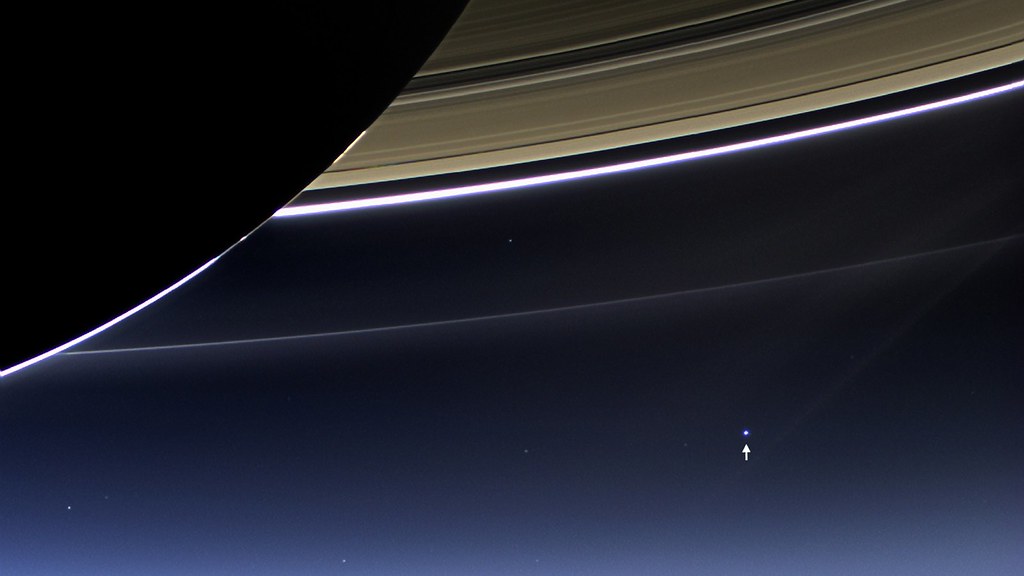
“In this rare image taken on July 19, 2013, the wide-angle camera on NASA’s Cassini spacecraft has captured Saturn’s rings and our planet Earth and its moon in the same frame. It is only one footprint in a mosaic of 33 footprints covering the entire Saturn ring system (including Saturn itself). At each footprint, images were taken in different spectral filters for a total of 323 images: some were taken for scientific purposes and some to produce a natural color mosaic. This is the only wide-angle footprint that has the Earth-moon system in it.”
This new image features NGC 1546, a nearby galaxy in the constellation Dorado. The galaxy’s orientation gives us a good view of dust lanes from slightly above and backlit by the galaxy’s core. This dust absorbs light from the core, reddening it and making the dust appear rusty-brown. The core itself glows brightly in a yellowish light indicating an older population of stars. Brilliant-blue regions of active star formation sparkle through the dust. Several background galaxies also are visible, including an edge-on spiral just to the left of NGC 1546.
I need continuing reminders that we live in an astonishing universe and we have astonishing ways of learning about it.
Composer Eric Whitacre, whom I have featured several times in this space before, is an always fascinating voice to return to. I had, in fact, forgotten about him until the week before the eclipse, when I looked up classical music selections inspired by space (that were not Holst’s The Planets, which is a work with which I’ve had a strained relationship over the years). Whitacre’s name came up for a piece called Deep Field, which sounded interesting. It turns out that the background of Deep Field is even more interesting.
If you’re up on your Hubble Space Telescope lore, you’ll recognize the title Deep Field as referring to one specific image: the “Hubble eXtreme Deep Field”, and here it is:
Bigger versions are available here. By way of background:
This image, called the Hubble eXtreme Deep Field (XDF), combines Hubble observations taken over the past decade of a small patch of sky in the constellation of Fornax. With a total of over two million seconds of exposure time, it is the deepest image of the Universe ever made, combining data from previous images including the Hubble Ultra Deep Field (taken in 2002 and 2003) and Hubble Ultra Deep Field Infrared (2009).
The image covers an area less than a tenth of the width of the full Moon, making it just a 30 millionth of the whole sky. Yet even in this tiny fraction of the sky, the long exposure reveals about 5500 galaxies, some of them so distant that we see them when the Universe was less than 5% of its current age.
The Hubble eXtreme Deep Field image contains several of the most distant objects ever identified.
It’s one of the most awe-inspiring images of our Cosmos ever captured, particularly when you realize that (a) this comprises just the tinies part of what we can see from here, and (b) the Cosmos looks like that in every direction. The vastness of space-time captured here and implied by the strange smallness of this specific infinity is utterly humbling.
The XDF image inspired the making of a film celebrating the years of Hubble’s service to astronomy, and Mr. Whitacre was brought in to score the film. The result is an amazing ethereal work that builds and builds and builds with intensity, before subsiding with the entrance of a choir. The work is open and yet dense, peaceful and yet driving…it’s music that stands alongside our images of the depths of our universe.
Grammy® award-winning American composer Eric Whitacre’s symphonic work Deep Field was inspired by the world’s most famous space observatory, the Hubble Space Telescope which celebrated its 30th year in orbit in 2020, and its greatest discovery – the iconic Deep Field image. The film – Deep Field: The Impossible Magnitude of our Universe – illuminates the score by combining Hubble’s stunning imagery, including never-seen-before galaxy fly-bys, with bespoke animations to create an immersive, unforgettable journey from planet Earth to the furthest edges of our universe.
The film is a first-of-its-kind collaboration between Grammy® award-winning composer & conductor Eric Whitacre, producers Music Productions, scientists and visualizers from the Space Telescope Science Institute and multi award-winning artists 59 Productions. The score and film paint the incredible story of the Hubble Deep Field. Turning its gaze to a tiny and seemingly dark area of space (around one 24-millionth of the sky) for an 11-day long period, the Hubble Space Telescope revealed over 3,000 galaxies that had never previously been seen, each one composed of hundreds of billions of stars.
Here is Deep Field, first performed in concert at the Royal Albert Hall, and then the film with the work alongside it. This is amazing stuff.
In Buffalo, the eclipse was simultaneously an astonishingly powerful and deeply disappointing experience. Clouds were in the forecast all along, but for the last several days, local meteorologists were constantly offering up reasons for optimism…which turned to “Sorry, we’re not clearing out until after totality, bummer, but it’ll still get dark and stuff.”
I know these folks don’t control the weather, but for all the technology and scientific expertise they have, it sometimes seems that their ability to offer up any kind of reliable forecast has been whittled down to timeframes measured in hours, or even minutes. I know some people around here were lucky enough to get enough of a view of totality to get a photo or two, but I wasn’t that lucky; all I caught of totality was a brief glimpse, maybe half a second.
Those four minutes or so of darkness, though? They were amazing. Truly, astonishingly amazing. For every cynic out there who has been saying things like “It’s just like at night, what’s the big deal,” I can’t say it any other way than to simply say, “It’s not just like night.” There was something qualitatively different about those four minutes…in how quickly they plunged over us, in how the flocks of gulls in the parking lot across the street went mad, in how everything in my circadian-rhythm loving body was screaming, “This isn’t right.” I can see how eclipses were terrifying moments for humans, for millennia, before we learned what they are and how to predict them and thus rendered them a thing of wonder.
There were other feelings, too. I couldn’t help thinking of Mom and how she would have loved to make it to today. She loved the sky and celestial happenings. I remember going to see if we could spot Halley’s Comet back in 1986, and she loved the Perseid meteor shower. She would often send me emails: “Go outside tonight and look at the moon because Venus and Mars are going to be right by it.” She would have been amazed by today, even if she would have been really annoyed by, as she would almost certainly have phrased it, “all these goddamned clouds”.
Last week I was blessed with (a) a clear night, and (b) very little moonlight. This led to a brief astrophotography session outside, where I set up my tripod right in my driveway, set my camera’s focus for “infinity”, bumped up the ISO a bit, set the shutter for various lengths, and took photos.
This resulted in a lot of clunker photos, but…not all! One thing I’m quickly learning is that the formula “take a bunch of photos during a session and maybe you’ll have a few keepers” is quite normal, even for really good photographers. I was happier with my star photos than with my moon photos; clearly I have work to do in that particular department. I still have quite a bit to learn, but for now, these are much better than my first efforts at astrophotography with this camera, last summer.
I really think my problem with the Moon is one of getting the right focus and light settings.
Orion and Canis Major, rising over one of the big trees at the end of the street. I love astrophotography photos that combine the sky with a terrestrial element, like this tree.
Just Orion this time, with other stellar friends.
If you follow the three stars of Orion’s belt to the left–“southwest” across the sky–you encounter Sirius, the brightest star in our sky, in its constellation home of Canis Major. If you follow those same belt stars the other direction, though, you’ll find a small stellar cluster called the Pleiades. That’s them near the center of this photo. The Pleiades are utterly stunning through a telescope, but to the naked eye they are very dim. Luckily this timed exposure captured them nicely!
Of course, there’s a major celestial event coming up in just a couple of weeks that will test my photography skills in a unique way that I’m not likely to get another chance to practice in my lifetime. I’m starting to get excited for the eclipse!