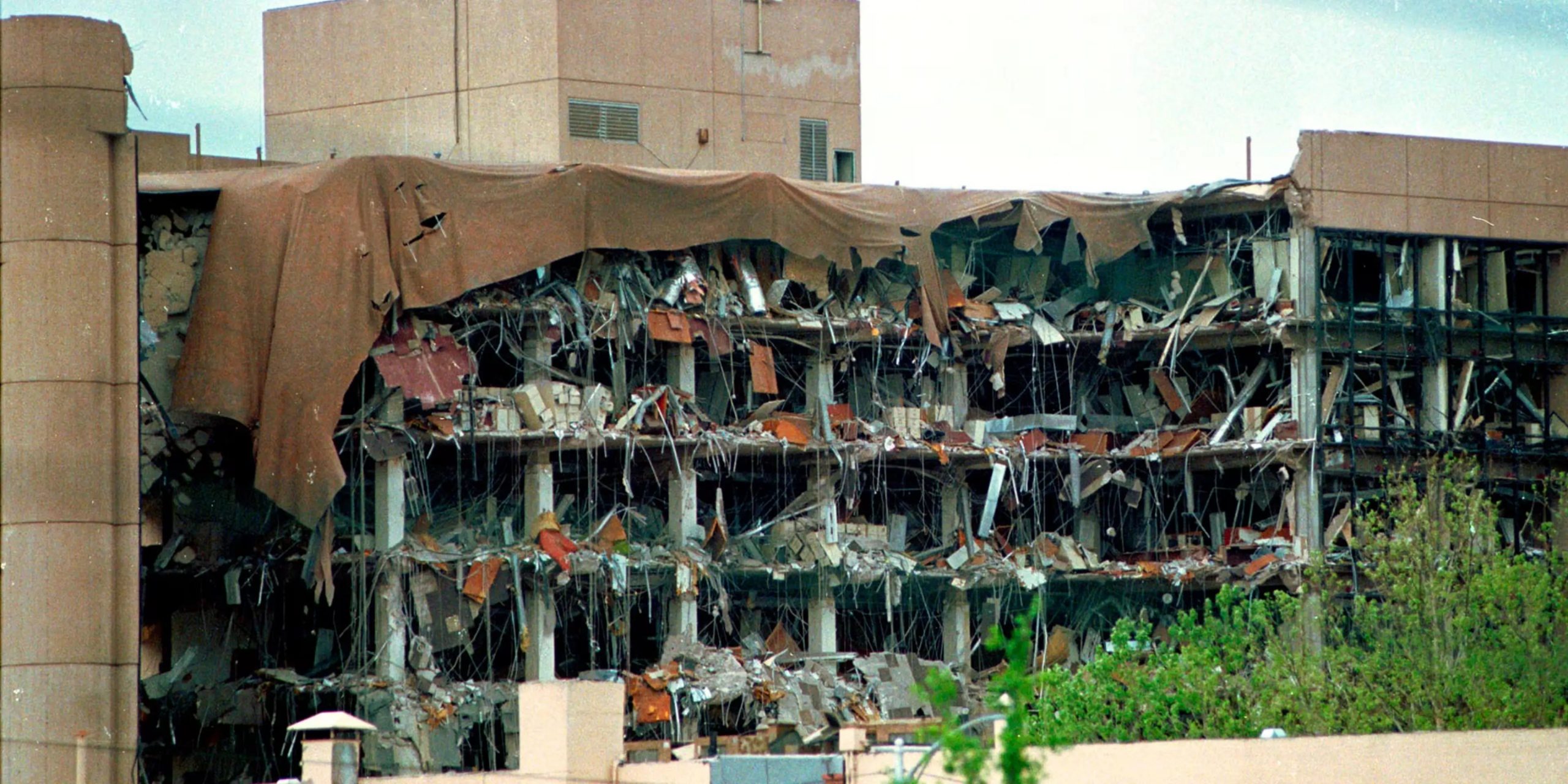
Twenty-Five

It’s been a quarter-century since the attacks on the United States on September 11, 2001. I barely know how to process that it’s been that long. Over on Threads, someone asked these questions about the experience of that day, and I’ll answer them here:

1. Where were you when you found out about 9/11?

I was in my car, on my way to work. This was when I was working in pharmaceutical telesales, and my shift started at 9:30am. I got in my car and put on NPR, which was my habit at the time, and they were reporting on the breaking news that “an airplane” had struck one of the World Trade Center towers.

2. How did you feel in that moment?

Honestly, mildly disturbed, but that’s about it. I got the news so early that it wasn’t even clear yet to anyone listening to news that it was as bad as it was. I had the luxury, for a few minutes, of thinking that it was a Cessna or a Piper Cub or some such small plane. There would likely be a few deaths, and it’s scary, but that’s about it. I don’t remember how quickly the sheer magnitude of what had happened became clear. I don’t remember when, exactly, I learned that the second plane had hit; I’ve just looked up the actual timeline of events and the second hit came at 9:03am, so I likely learned about that while I was still on my way to work. It was just after we all got to work, where we had the radio on immediately, that the plane hit the Pentagon…and I recall a great deal of confusion over the rest of the day. I remember a report of a car bomb detonating somewhere in Washington, and there were rumors of a fourth plane whose fate did not become clear for a while. It was just a staggering, horrific day, and it was the greatest cognitive dissonance I could experience, still making telesales calls in the middle of all this. I do still remember the gasps in the office when the news came over the radio that one of the towers had collapsed.

3. Did 9/11 directly affect your family?

In terms of knowing anyone killed or injured? No. But my father, a math teacher at St. Bonaventure University, had a former student who was working for Cantor-Fitzgerald and who died that day.

At the end of that week, we–myself, The Wife, and The Kid–were embarking on a road trip to Iowa to visit The Wife’s family. My plan was to cash my paycheck that week and use it for vacation. At that company, our paychecks were processed at the corporate office in Baltimore and then sent via FedEx to Buffalo to be distributed to workers in the offices here. But the FedEx planes were grounded, so…I had no paycheck. My boss actually loaned me the $400 out of her pocket. She was a good boss, I wonder what ever became of her….

(That’s the job I was eventually fired from because I was honestly very bad at it.)

4. Did you leave school home or work after the attacks?

No, we all worked out the day. But none of our hearts were in it.

Over the next bunch of days, as the enormity of what had happened settled and the scope of the losses became known…and as the stories from the day started to crystalize, the mood became darker, so much darker. I found myself unable to listen to music for a long time after 9-11. This, a work called Elegy by composer Mark Camphouse, is the first piece I was able to listen to all the way through. Though Camphouse never intended this association, for me Elegy is part of my set of 9-11 memories.

Finally, at some point after 9-11–probably a month later, maybe two–I found myself writing a story. I haven’t shared it here in several years, but here it is:

The City of Dead Works

There is never any rest for me, the Ferryman of the Dead.

I pole my barge across the black waters and up to the pier. So many wait this time, many more than usual. I wonder what has happened, what event has sent me this many. “Come aboard,” I say. “I will take your coin for passage.” One by one they file past me, each handing to me the coin that they never knew they had. It is the coin which determines where they shall be taken to rest, its metal shaped and determined by life. The coins of these dead are gold, every one of them purest gold. Six thousand come aboard my barge, and each has passage for the farthest and greatest of destinations. In that moment I know that something truly dark has happened; the gold coins are always forged in moments of darkness. I am the Ferryman. I can give them no answers to what lies behind their haunted, questioning eyes. I can only take them on this, the last of all journeys.

When they are all aboard I take up the pole and push away from the pier. The barge always feels the same, no matter how many stand upon its decks. Whether six or six thousand, it is all the same to me. I guide us out onto the River Styx. Some of the people look worried, but there is no need for fear. This river can do them no harm. They are already dead.

This is to be a long journey, I know – it always is, to this destination. As I guide the barge through the black waters, I look on the faces of those who have come to me. As different as these people all look, they all have the same expressions of shock, disbelief, and withering sadness. Here is a man of business, talking into a cell phone. He is trying to call someone, anyone, who will tell him that it’s all a dream, that it didn’t happen, that he didn’t die in a blast of fire, smoke, glass and steel. There is a mother who is explaining to her daughter that they won’t be going to Disneyland after all. And there, a group of firemen stand together, realizing that soon they will meet all their brothers-in-arms who have gone into the infernos before them. So many now – colleagues once in business and now colleagues in death, people who have never before met but now have the gravest thing in common. As the current takes hold, I look back at the pier. There are more gathering there. There are always more. They will wait. Time does not exist for the dead.

“Please,” a young man says as he turns to me, “I have to go home to my daughters.”

“You are going home now,” I reply. “To the home where all eventually return.” Two black rocks slide past on either side, the rocks that mark the passage of the circling Styx.

“This can’t be,” a woman cries out. “My mother needs me.”

“She will be with you soon enough.”

“When?” Her voice pleads, and yet there is no solace that is mine to give.

“I cannot say,” I reply. “The Ferryman has no hand in Fate.”

The tears come then, tears from the six thousand that run over the gunwales and into the river which has been fed by tears for centuries. All tears are born in the River Styx.

“Where will you take us?” someone asks.

“To the place you are promised,” I answer. I recall the words of a poet: Will there be beds for all who seek? Yea, beds for all who come.

One our left we approach the Hills of the Damned, an endless stretch of shattered lands which reach away into the blackness. The waters echo with the cries of all those who have been taken to the Hills for the agony they have brought on the living. I consider the bag of six thousand gold coins, and I realize that I will have to journey to the Hills this day. There will be a person, perhaps more, who will pay me with a coin of black tin; but not on this journey. As the hills recede behind us, the unending cries of the damned become fainter and fainter until they are drowned out by the lapping of the waters upon the sides of the boat and the marker stones that we pass. The six thousand fall silent, each realizing that it is not a dream. I would offer solace, but as ever I cannot. I am the Ferryman.

We come around a particularly dark bend, and before us lies a very wide expanse of water, as if the Styx has become an ocean – which in some sense it probably has. And beyond that expanse are the thousands of twinkling lights that I have come to know so well. One man, a fireman, sees them too. “What is that?” he asks.

“It is the City of Dead Works,” I reply. The lights of the city glow on the horizon, and every one of the six thousand turns toward them as the Styx impels us onward. As we come ever closer to the city, the glittering lights reflect off the black water.

“I don’t understand,” someone else says. “The City of Dead Works?”

“Aye,” I reply. “Behold!”

From behind us, golden light: the Sun of the Dead is rising as it always does when the dead come near the City. Above us the firmament is turning purple, then blue; soon the light of the Sun will illuminate the City of Dead Works. As the sky lightens, the true scope of that city becomes plain: it stretches away into the land, farther than any eye could see. Not even the highest-soaring raven, cavorting in the breezes and zephyrs of the dead, could take it all in. It is bigger by far than any one city ever built by the hand of men, because it encompasses some part of all of them. Perhaps it is bigger than all of the cities ever built. Now the sun’s first rays come up behind us, and the first buildings can be seen down by the water.

“That one looks Egyptian,” a woman says.

“The Great Library of Alexandria,” I tell her. “Once the greatest repository of learning the world had ever seen, now only a memory to the living and a reality only to the dead.”

A man points to a building high upon a rock. I nod.

“The Temple of Solomon,” I say.

“There are ships in the harbor,” says another. Thus for him I name the ships: Arizona, Indianapolis, Lusitania, Bismarck, Wilhelm Gustloff, Cap Arcona. And many, many others. I scan over the impossibly vast city and spot Dresden, as it was; and beside it the cities of Hiroshima and Nagasaki. And how many smaller villages, tucked into the hills beyond the City? None can say. The Sun of the Dead shines upon those hills now, and the great stone statues in the likeness of Siddhartha Gautama.

“I don’t understand,” a young man says. “Why this City? Why here?”

I only shake my head as we continue to float by the City. I do not point out the fairly small, nondescript office building that sits near the water. It is not a particularly remarkable building; nor was it, really, until the fuse was lit. The six thousand almost don’t recognize it.

Almost.

Not one word is uttered as we slide past the Alfred Murrah Federal Building. Then we turn away from the City of Dead Works, and head again down the waters of the Styx toward distant hills and the place where these people will join their brethren.

“Who lives in that city?” It is a priest in a fireman’s coat.

“No one lives there,” I tell him. “The City of Dead Works is not for people. It is for the buildings and the ships. It is for the books and the music, the sculptures and the paintings which are gone forever. It is for everything destroyed by craven people in the name of foolish wars, for everything judged forfeit in the face of transitory desires.”

The Styx takes us into the Golden Hills. Soon we will be there, and the six thousand will go where they belong. And then the Styx will complete its circle, taking me back to the pier where more dead await.

“We will be there soon,” I say. “Soon we will be at the Elysian Fields, where all heroes go – for that is what you all are. It is what you have bought with your lives, with the shaping of your coins into gold.” No one replies. We near the last bend now, and before us lie the Elysian Fields, where peace reigns and where heroes dwell; where all is light and voices are always raised in song. The Sun of the Dead shines warmly on Elysium.

But they do not see it. They, the six thousand, all gaze back behind us upon the City of Dead Works. It will soon be behind us forever as we round the last bend of the River Styx into Elysium. I know they all need one last look upon that City, and I do not grudge them that. For myself, I do not look back; the eyes of the Ferryman are ever forward. But I know. I know that the City of Dead Works is different now. I know that it has changed. I know that the people who come with me now to Elysium, the dead around me, look back on the two soaring towers of steel that now rise above the City where there had been no towers before.

I know these things.

I am the Ferryman of the Dead.


Even now, 9-11-01 is more history than memory, and it will be more and more so with every passing year. There are adults today in the work force for whom 9-11 is only something they have been taught. There is an entire generation for whom it is not a memory; 9-11 is as much a point in history as 12-7-41 is for me and my generation. Perhaps this is the gentle side of the poem about Ozymandias: memory passes, but so does the tangible pain even as our mighty works are torn down and buried in so much sand and dust.

Nevertheless, those of us who lived that day remember.


Share This Post

“Timeline? This is no time to talk about time! We don’t have the time!…what was I saying?” (Cmdr. Deanna Troi, STAR TREK FIRST CONTACT)

OK, fine, I guess I’ll put all of my thoughts on Daylight Saving Time here, since there’s a really good chance we’re going to adopt Permanent DST in the United States, which seems to me a terrible idea. This is in no particular order and is not structured in any way.

Photo by Laura Lautner on July 14, 2026. May be an image of text that says 'NEW YORK IF DAYLIGHT SAVING TIME BECOMES PERMANENT JANUARY JULY SUNRISE 8:32 AM SUNRISE 5:31 AM SUNSET 5:42 PM SUNSET 8:43 PM'.

::  It is simply beyond dispute at this point that from a standpoint of human health, maintaining permanent standard time would be the best option. Circadian rhythms are best reflected by standard time, and doing away with the disruptive effects of twice-annual clock changes would also be a good thing. There is simply no questioning the biology on this.

::  Americans worship a lot of things: cars, guns, the military. We also worship sunlight, and oppositely, we generally do not like the night very much. This is a very odd cultural artifact that leads us to doing things like pushing for permanent Daylight Saving, on the basis that “I want to have a little light when I get off work!”

To that I ask, “Why? For what?”

Taking those times in the image above: my work shift starts at 7:30am and ends at 4:00pm. Now, I’m rarely actually out of work at 4pm; there’s usually a bit of wrap-up time, and quite a few days I have to stick around to do a bit of shopping. So, many days it’s close to 4:30pm by the time I actually depart work. At that point, by this time in the graphic above, there’s 1 hour, 12 minutes left of daylight.

My commute is about 15 minutes. Now, by the time I get home, there’s less than an hour of light. I have to bring in anything I’ve purchased, put it away, grab the mail, let the dogs out, greet The Wife if she’s working from home that day, and then change clothes and shower. By the time all of this is done, the available daylight is down to well under 30 minutes.

And there’s something else: note when all this is taking place.

January.

An extra hour, on the back end of my day when that hour is already taken up by post-work rituals, during the coldest time of the year. And I’m to believe this is a benefit? Give me a break.

::  As a matter of public policy, there is a lot to criticize about time in the United States. I’d say the biggest fish we could fry here wouldn’t even be fixing DST, but fixing time zones. A lot of New England should probably be on Atlantic time. Part of the problem with the discourse here is that we have a geographical situation where on January 1, someone in Portland, ME is watching the sun set at 4:15pm. Someone else in Kalamazoo, MI will watch the sun set at 5:21pm…and both cities, which are nearly a thousand miles apart, are in the same time zone. This is absurd.

::  No, I don’t know how we fix the time zone issue. Smaller time zones, separated by half an hour? Maybe. But I’ve always noticed that people I encounter online who really like Daylight Saving Time and who think keeping it year-round is a great idea are people who live in the eastern reaches of their particular time zone, making sunset earlier for them than most others. I get that concern, really.

::  The strange argument I keep hearing is along the lines of “Now you’d have more daylight to spend with your kids!” and “Now you’ll have an hour to enjoy your day!” Where did we get the idea that you can’t do any of those things if it’s not light out? Where did we get the idea that the only fun and enjoyment we can have in life can only take place in sunlight? Are we all coming home in utter darkness to sit, lonely and dejected, staring at a wall by the light of a single guttering tallow candle?

The one genuine, and kind of convincing, answer I’ve ever received to my eternal question of “What the hell do you all need all this LIGHT for at the end of the day, anyway?” came from a local friend who is also a sports coach for young people. In reply to a version of that question, he simply answered, “Playing baseball.” I really can’t argue that particular point. If the park you play in has no lights, and you want to play a lot of baseball, then yes, later summer light is clearly your friend.

But I keep coming back to my original thought: WHAT IS SO DAMNED AWFUL ABOUT NIGHT AND DARKNESS? Seriously, why do we venerate sunlight and hate the night so much in this country? I will never understand the American fixation on sunshine and light. Is the night not beautiful? Is it not wonderful to watch the world at Golden Hour become the world at Blue Hour and then see the night?

::  In the end, fixing the problems created by DST, and by changing the clocks twice a year, is likely more complex than this one simple bill will achieve, and it’s pretty clear to me that this bill will just make things worse. Sadly, we are not living in a time when American government is particularly oriented toward making nuanced policy changes. To the extent that we are able to address policy at all, our approach seems to often boil down to: “We have to do SOMETHING, and THIS is SOMETHING, so therefore we have to do THIS.”

Over the past few days I’ve seen a bunch of Congress people and Senators posting to social media: “Look what we did! We’re fixing an issue! Yay!” And look, I’m never one to get deep in the weeds of “Why are you thinking about X when Y is so much worse,” but…seriously, this was a priority, but fixing just about any other issue was not.

Anyway, I hope this bill dies and if it doesn’t and it becomes law, well, I reserve the right to point back at this post when a whole lot of the country concludes that this was, and is, a bad idea. Sadly, this being America, it won’t be the first time.

Share This Post

“A court that will do what it is told”

Five years ago, I wrote this post about my thoughts on reforming the Supreme Court. My thoughts were intended as an “intro” to the topic, and I got some interesting commentary response. I have been thinking about the topic again, because the Court is an even bigger problem now, to the point that addressing its problems is rapidly becoming essential, once–and if–saner voices take elective power in Washington. I present below the text of that original post of mine, a lot of which I still think might be a good way of approaching things; lifetime tenure needs to go away, but so does the “accidental” nature of which President gets to make a lot of appointments to the Court and which one does not. I also gave a lot of thought to the shenanigans of one Senator Mitch McConnell, who used the power of the Senate to simply deny a Democratic President a Supreme Court appointment. My attempt to address this got some interesting pushback, and I’m open to suggestion, but I still believe that fundamentally the Senate cannot be allowed to do nothing when an active Supreme Court nomination lies before it. Maybe in addition to requiring a vote, and forbidding the Senate to adjourn while a nomination lies before it, we also change the voting procedure so the vote is not one to confirm, but to deny, with a 3/5 majority required to decline a nomination. Also, re-reading my post, I see that I wrote against expanding the Court. I have changed my mind, and frankly, expanding it to 21 would be OK with me.

Before delving into my own thoughts, though, here’s a video on the topic of our corrupt Supreme Court by the always-brilliant Jamelle Bouie. It’s always worth remembering that our government was structured such that each branch’s power would be checked and balanced by the other two, and that the current state of affairs–in which Congress, run by Republicans, has completed abdicated its responsibility to check or balance anything–is a voluntary one, and also a political one. Nothing in the US Constitution establishes the Supreme Court as a de facto royal body that governs by decree, and in fact, there is a great deal of power that the Congress holds over the Court.

Here is my original post from five years ago:

Here’s something I’ve been thinking about for quite a while: how I would fix the Supreme Court. Obviously, I’m not an expert and am quite possibly wrong in many ways, but you have to start SOMEWHERE, right? Here’s my proposed Amendment which would fix the Court, with interspersed commentary.

WHEREAS it is sufficiently clear in 2021 that the current structure of the United States Supreme Court has proven too easily forced by concerted effort by various factions to extended periods of ideological extremity, I propose the following alterations in how the Court is structured.

While I’m sure American conservatives are all kinds of gleeful that they have finally, after years of focus and hard work, managed to create a Court majority that will favor their ideological goals for quite possibly decades to come, I hope most Americans will agree that this is not a desirable state of affairs.


1. The Supreme Court shall consist of 9 seats, with each Seat being held by one Justice.

Why 9? Why not engage in the current liberal wishlist of bumping it up to 13, thus allowing President Biden to name four liberals and immediately grab the balance of the Court back? Well, as much as I’d be on board with that concept in my angrier moments, I’m trying for a more nuanced approach right here. Currently the number of Justices is set by Congress, and there’s no reason to believe that even if the Democrats in Congress pulled this off right now that a future President Hawley (God help us all) and a Republican Congress to come wouldn’t just do the same thing right back, and somehow find a weaselly way to make it worse. Remember, they were quite content to engage in reverse Court-packing by holding the number of Justices at 8 until they could control the nominee. I’d hardwire the 9 into the Constitution at this point. Also, there’s math involved. And why am I referring to nine seats, instead of nine Justices? Read on! We’re getting to the meat of it now:


2. One Seat on the Supreme Court shall be vacated on July 5 of each year numbered Oddly, to be filled by an individual named by the sitting President of the United States, with the nominated Justice taking the vacant Seat upon confirmation by a simple Majority vote in the United States Senate.

3. The Senate shall bring any nomination of a Supreme Court Justice to its Floor for a full Confirmation vote within TWO WEEKS of the President’s official Nomination of said Justice, regardless of whether the Senate has concluded its Business in the course of Advising and Consenting. In the event that the Senate fails to confirm a nominated Justice or Judge on three consecutive Votes, the President shall name an APPOINTED JUSTICE to serve on that Seat until either the swearing-in of the Next Senate or the beginning of that Seat’s next term, whichever comes first. No Nominee for the Court, having been rejected by full vote of the Senate, shall be eligible for Renomination before the beginning of a new Senate. 

4. Upon confirmation and installation, a Justice shall hold their Seat for a single term of EIGHTEEN years, at the conclusion of which their Seat shall become again vacant and the sitting President shall name their Successor.

OK. Let’s unpack. What am I getting at here?

First: No more lifetime tenure to the Court for judges. That shit is OVER. No more nominating young judges who will then sit for thirty or forty years or longer. Yes, I’m quite annoyed at the fact that I may well need to adjust my diet to include large amounts of broccoli at this point if I have any hope of seeing a liberal court in my lifetime. Moreover, I don’t think a President, any President, should be able to extend their legacy so far into the future, either through chicanery or by accident of timing or some combination thereof.

It is utterly absurd to me that our 45th President, in his one disastrous term, was able to name three Supreme Court Justice while Presidents Carter, Clinton, and Obama combined for four in their twenty combined years in office. That 45’s nominations came respectively via Mitch McConnell’s gaming of the rules, Anthony Kennedy’s oddly convenient decision to step down, and Ruth Bader Ginsburg’s passing (which gave McConnell a chance to demonstrate just how low his actual commitment was to his previous deeply held principle of not voting on Judicial nominees in election years) isn’t relevant, but we should make sure that this kind of gamesmanship is much harder to pull off, moving forward.

However, while I do favor eliminating lifetime tenure, I do think it’s important to remove the Court as much as we can from the normal cycles of political life in Washington. So I have Justices serving eighteen years: a good long term that gives them political independence that lasts well beyond the reahc of a single Presidential term. As of this writing, eighteen years has spanned four Presidents, two from each party.

Next: Well, since we already know the Mitch McConnells of the world will simply change rules any which way they need to in order to make sure that Republicans are the ones controlling the judiciary (and not just the Supreme Court–look at the ways they changed rules for Federal judicial appointments constantly starting in 1995 and then with each subsequent time they either had the Senate, the Presidency, or both), I suppose we need to hard-wire into the Constitution that the Senate will vote on Supreme Court nominees. As a writer whose work involves occasional villains, I have to admit that McConnell’s simple tactic of just not voting at all on Merrick Garland was some Class-A villainy in its ruthless cunning. So, that shot having been fired once, I’d like to take that one permanently out of circulation.

But! Here’s the thing: since 1981–the last forty years–only 22 of those years, barely more than half the time, has seen a President and the Majority of the United States Senate serving from the same party at the same time. It’s easy to see a Republican Senate saying to a Democratic President: “OK, we’re required to give your nominee an up or down vote, so we’re just gonna keep voting your nominees down and run out the clock that way.”

Well…no dice there, either. Three times in a row and the President gets to fill the seat on the Court temporarily, until either the Seat’s term ends (i.e., the 18 years ends) or a Congressional election happens and a new Senate is seated. Then the whole thing starts up again, and the President can nominate the person he or she chose in the first place. Also, note the required time frame: just two weeks, and the Senate is required to vote. If they can’t figure out if they’re on board with a Justice or not within two weeks, they shouldn’t be in that job, and obviously the possibility of any filibustering has to be neutered right in the Constitution. (But ixnay on the President just nominating the same person three times and then seating that person anyway. We still need to take the Senate’s “advise and consent” thing a little seriously.)

Oh, and I said up above that there’s math involved in picking nine judges? Well, assuming an 18-year-term, if you have more than nine judges, then eventually you get to a situation where multiple seats are opening up in odd years. This system guarantees that every President will make some mark on the Supreme Court, as every President will name at least two Justices. But I don’t want a President naming as many as eight. Of course, you could get around this by extending the term of a Justice’s service to twice the number of years as there are sitting Justices, but then terms start getting uncomfortably long again.

All right. We’ve got our Justices serving one eighteen year term on the Supreme Court. Also note that they’re ineligible to hold any other judicial position in the country after they leave! I’m not sure if that would be a big deal or not, but you wouldn’t get to have a Republican President give us a bitter pill like Brett Kavanaugh and then, if his term happens to end during another Republican presidency, just get re-nominated for another 18 years. Also, the eighteen-year-term refers to the seat on the Court, not the specific Justice holding it. In this respect it would be like the Presidency: the term is four years, but if the sitting President dies and the Vice President becomes President, they don’t get four new years: the Presidential term ends at noon on January 20 every four years, no matter what. Likewise, if a Justice dies fifteen years in, obviously you need a replacement–but you do not get to reset the clock with someone to your ideological liking. No getting around it: eighteen years. That’s it. So we would have this provision:


5. In the event that a Seat on the Supreme Court becomes vacant sooner than the conclusion of its Eighteen Year Term, the sitting President shall name a Justice to that seat, also pending Senate majority confirmation, to serve only the remaining time in that Seat’s term, at the end of which that Justice shall leave the Court.

Now, we well know that for all the “the Courts are apolitical!” talk we hear a lot, the fact is that the Courts and people on them are as much a part of the political life in this country as anyone else. But to help foster as much political independence as we possibly can, I’d add this:


6. No person, having held any portion of a Seat on the United States Supreme Court, shall be eligible for any Senate-confirmable position upon leaving said Seat, or for any Judicial position in the United States; also, no member of that Justice’s family shall be eligible for any Senate-confirmable position for a period beginning with their assumption of that Seat until five years after their departure from it.

In short, no “Hey Judge, I’ll make your kid or your wife Ambassador to the Bahamas”, and no “Hey Judge, if you’re looking to retire early, I might need a new Ambassador to Sweden”. Also, once you leave the Supreme Court, that’s it for your legal career. And really, there’s nowhere else to go after that but write your books and be on a corporate board or two, right? No, I’m not worried about what our Justices will do in their now-much-longer retirements. They’ll make out just fine, I suspect.

Of course, if you’re going to limit the terms, then you have to schedule the terms as well. If we just wait for the existing judges to die or retire and then start the eighteen year thing, then you’d have nominations clustering at eighteen year intervals from whenever those passings happen. So, one seat will open on the Supreme Court every two years, during the odd-numbered years to minimize the degree to which federal-level elections play a role in the politics.


7. The transition to this prescription for Supreme Court tenure shall begin on July 5 of the first odd-numbered year following Ratification of this Amendment, with pre-existing terms ending in reverse order of service on the Court.

You have to make your transition some way, right? For my purposes, if I could wave my magic wand and instantly ratify this amendment, then Clarence Thomas would get the boot on July 5, 2023.

As noted above, I’m sure I’ve missed something, and I’m sure there are ways this system would work badly, but…we’ve got to start somewhere, right? And while I yield to no one in my anger at the way Republicans have been gaming our democracy against us (and are still doing so, to what I expect may be our eternal regret, and sooner than we think), I do not want to just shift the gaming-of-the-system to the Democrats just because I’m currently on their side. If there’s one thing the post-2016 era has shown me, it’s that our Constitutional systems are nowhere near as robust as they need to be to withstand the threats confronting them now.

Share This Post

A thought

It seems to me that “Cops have the right to kill you if you inconvenience them in any way” is not any kind of fundamental principle for a healthy society. It is, however, an excellent fundamental principle for an authoritarian police state. An awful lot of Americans would do well to give some thought into what kind of country they really want to be living in.

Share This Post

2025: Was that what 1861 felt like?

Well, here we go: it’s time for my annual look back at the year that has just ended. On a personal level, I didn’t have that bad a year at all. Which is nice, because I don’t just exist on a personal level, now do I?

Let’s get right to it:

Did you keep your New Years’ resolutions, and will you make more for next year?

I have entered every year for the last, oh, ten or so with the intent to get better at planning and structuring my life. This has always been a struggle, and I can report that I am, in fact, getting better at this. Late in every year I buy a new planner for the year to come, and every new year I start using that planner, only to peter out at some point and then come back to it and peter out again. But, over the last several years, the “peter out” phases of this cycle have become (a) shorter, and (b) less frequent! So I am getting better. Maybe 2026 is the year I actually “put it all together”! We’ll see.

When it comes to resolutions, I’m not really a fan of those. I’m more about setting goals, and maybe (or maybe not) achieving them. So, goals this year include:

  • A bit of weight loss (not much, we’ll get back to this below)
  • Trying a bunch of new recipes
  • Eating vegetarian/pescatarian for a whole day, at least once per week
  • Stop allowing the chairs and the desk in my library to become collecting points for stuff
  • Starting The Song of Forgotten Stars, book six
  • Get my damnable sweet tooth under control (this is the struggle of my life…I have a wicked sweet tooth and a brain that refuses to take a sensible approach to serving sizes, so this will be a thing)
  • Relaunching my newsletter (likely on a different platform because Substack has issues)
  • Take 10,000 photos (Why 10,000? I dunno, it’s a nice big round number. I don’t know if this one’s really going to be doable, but we’ll see. The main thing is I will be shooting a lot, even more in 2026 than I did in 2025, and I shot a lot in 2025.)
  • Focus my reading life on books I already own (and as I write this, it’s the day after I went to the library and checked out nine books, so, yeah)
  • Reading: 52 books, 200 poems.
  • Creating content, including more video. (I’ll have more to say about my new approach to social media in an upcoming post!)
  • Selling photography prints

That sounds like a lot, and you might think, “Wow, maybe you should do one thing at a time.” Well, as characters often say in Aaron Sorkin scripts, “I don’t have time to do one thing at a time!”

Did anyone close to you give birth?

No, unless we count a number of people I follow on social media. It’s funny: I’ve seen several instances lately of a reliable content creator going dark for a bit, and then resurfacing with a video in which they say something like “Hi everyone, I’m so sorry for disappearing, but now I think it’s time to come back and tell you what’s been going on….” And then they stand up and turn to the side, revealing their “baby bump”. That’s always nice.

Did anyone close to you die?

No, thankfully.

What countries did you visit?

We went to Canada last April and we hope to go again this spring!

What would you like to have this year that you lacked last year?

I wouldn’t characterize it as a “lack”, but I’m strongly considering making a big upgrade this year in terms of my camera gear. I feel like I’m achieving consistency with Miranda that indicates that I have, in fact, leveled up a bit. I’m excited by this prospect.

What was your biggest achievement of the year?

It turns out that 2025 wasn’t really a year of “big achievements” for me. It was more a year of moving the needle slowly toward where I want to be. And that’s not nothing!

What was your biggest failure?

I endured something of a “crisis of confidence” in terms of my writing life, to the point that I was wondering if I was still a writer at all. More recently, I’ve come to the new-ish realization, alluded to above, that what’s at work here isn’t a lack of confidence in writing, or a loss of desire, but a lack of clarity about how to fit writing into a creative life that just three years ago at this time I didn’t see expanding the way it has. And that’s where the “structure” mentioned above comes into play. I will likely have more to say about this, moving forward.

What was the best thing you bought?

I don’t think I’ve written about them yet! Weird…I need to get on that. I even have the content in mind, but I’ve done it a few times on video and not shared it yet. Anyway, there’s a specific pair of vintage overalls that I bought back in April that make me really happy. Also, a pair of white overalls by the Hisea brand that I got this year. And some new shirts. It wasn’t a big year for buying stuff. Oh, I did get a new shoulder-sling bag that I like a lot. It’s not specifically designed for cameras, but I may be able to make it work as such when I upgrade my camera kit, which I’m hoping to do in 2026.

Whose behavior merited celebration?

Americans who continue to resist and oppose what often feels like the relentless march toward an end of democracy and the dawn of authoritarianism in America.

Whose behavior made you appalled and depressed?

The people who are marching in lockstep with the administration.

Where did most of your money go?

Food, drink, new overalls and shirts, and gifts and stuff along the way.

What did you get really excited about?

Going to Toronto in April was an absolute thrill. If I were guaranteed a decent living in a city outside of America and I had to go there and never return, Toronto would be my choice.

Compared to this time last year, are you happier or sadder?

I don’t mean to be wishy-washy here, but…both. And I’m not joking! Seriously, it’s both. Aspects of life are getting better, and other aspects are getting worse. I imagine that balancing act isn’t sustainable for life, but, as the Zen master said, “We’ll see.”

Thinner or fatter?

You know what, this one’s kind of funny: based on my official weight last time I visited my doctor (just a month or so ago), the answer is, neither! My weight has stayed basically the same, literally within no more than a pound or two, for over a year now. 

Richer or poorer?

Richer, I suppose, but not by much.

What do you wish you’d done more of?

Photography, reading, listening to music, going places with The Wife, hanging with The Kid, and any pie-throwing at all would have been nice!

What do you wish you’d done less of?

You know, a day’s gonna come when I actually don’t have to think about Donald Goddamned Trump at all. I keep hoping for that day to come.

How did you spend Christmas?

Quietly, with family. Basically the way we do every year. Sometimes I envy people with large families and relations close by…but mostly, I don’t.

Did you fall in love last year?

Don’t I always? I mean, haven’t you ever been sittin’ across from someone, just trying to have a normal conversation, fighting every urge inside yourself to just scream out, “YEAH!”?

How many one-night stands?

As James Bond once noted, “That’s not the sort of question a gentleman answers.”

What was your favorite TV program?

Shoresy and Resident Alien are ruling the roost right now.

Do you hate anyone now that you didn’t hate this time last year?

If there is, they’re probably a Republican of whom I was unaware a year ago.

What was the best book you read?

Guy Gavriel Kay’s latest novel, Written on the Dark.

What was your greatest musical discovery?

No one specific artist or composer, really…but I’ve been listening to a few playlists of music that was heard on the show Shoresy of late, and it’s a lot of Canadian rap and techno and dance music. Some of it goes right through one ear and out the other, but some of it…really does hit. It “slaps”, as the kids say. (Are they still saying that? How the hell do I know?)

What did you want and get?

The Kansas City Chiefs faceplanting in the Super Bowl, and then having a crappy season this year. Also, I got a lot more experience with the camera and I got a lot of shots that make me very happy.

What did you want and not get?

Any conclusive sign that America is shifting toward sanity, a Super Bowl championship for the Bills, a new owner for the Pittsburgh Pirates, and a pie in the face.

What were your favorite films of this year?

We didn’t watch it until 2026, but Wake Up Dead Man, the new Benoit Blanc mystery movie, made us happy.

It occurs to me that in 2026 I need to do a lot better job recording what we actually watched, because as I write this, I’m drawing a blank and I’m kinda too lazy to go look up the “watch history” on Netflix….

What did you do on your birthday?

We always celebrate my birthday by traveling to Ithaca and the Finger Lakes region for the Apple Harvest Festival and some wine tasting and other fun, which we did this year as well…but this is the first time those events actually coincided with my birthday! We set out for our three-day-weekend right on my birthday, which was nice.

How would you describe your personal fashion concept in 2019?

Overalls Conquers The World. Or, when I wear my favorite white poofy shirt under a pair of hickory-striped overalls, “Bridgerton Plus Trains”.

What kept you sane?

Good lord, I have no idea. I’m not sure anything did. Creative pursuits, maybe. Walking around a lot with a camera in my hand or hanging around my shoulder.

Which celebrity/public figure did you fancy the most?

I’ll go a little off-kilter here: I’ve been following Luke of the Outdoor Boys YouTube channel for a few years, and I’ve liked his no-nonsense and enthusiastic approach to exploring his nook of the world and his pursuit of his passions and his explanations for why and how he does what he does. At the end of one of his videos, about how to dig a snow cave for yourself and survive in the wilderness in a deep freeze, he says that you should do your homework and your research: “I’m just a guy on the Internet who has managed to not kill himself yet. What do I know?” Luke pretty much ended his own channel in 2026, mainly due to burnout and the physically draining nature of the content he made for years, and I salute his work. 

What political issue stirred you the most?

Climate change, the loss of democracy, trans rights, human rights of all sorts, racism, sexism, the strife in Gaza and the inescapable twinge of anti-Semitism, and who should be mayor of Buffalo.

Who did you miss?

Mom and Dad. Always. (Dad isn’t gone yet, but I haven’t written about him yet…so I’ll just note that I’m not sure there’s anything sadder than dementia.)

Tell us a valuable life lesson you learned last year:

There’s usually a big block of stuff I paste in here every year, but 2025 was different (and as I write this, 2026 is not off to a promising start). This year is the twenty-fifth anniversary of the Lord of the Rings movies, and this speech by Samwise Gamgee at the end of The Two Towers is a great one. I just wish it wasn’t so constantly applicable.

Frodo: I can’t do this, Sam.

Sam: I know. It’s all wrong. By rights we shouldn’t even be here. But we are. It’s like in the great stories, Mr. Frodo. The ones that really mattered. Full of darkness and danger, they were. And sometimes you didn’t want to know the end. Because how could the end be happy? How could the world go back to the way it was when so much bad had happened? But in the end, it’s only a passing thing, this shadow. Even darkness must pass. A new day will come. And when the sun shines it will shine out the clearer. Those were the stories that stayed with you. That meant something, even if you were too small to understand why. But I think, Mr. Frodo, I do understand. I know now. Folk in those stories had lots of chances of turning back, only they didn’t. They kept going. Because they were holding on to something.

Frodo: What are we holding onto, Sam?

Sam: That there’s some good in this world, Mr. Frodo… and it’s worth fighting for.

You know what? I was just about to call this answer done and actually publish the post, but I just remembered something. There’s a brilliant creator named Amanda Nelson who posts a lot on various social media platforms. I believe she’s a historian by training, but I’m not sure on that point. She is always thoughtful and measured in her content, and what I strongly appreciate about her is how even-keeled she is; Ms. Nelson will point out that yes, we’re in a really bad spot, but she’s still not particularly given to the kind of “We’re doomed” rhetoric that often dominates my side of the aisle. At one point this year, and I cannot for the life of me remember in which video she said this and she makes so much content that I have no intention of taking the time to find it, she said something that I have thought myself in various ways, but never put so succinctly. This really hit me between the eyes:

“America is not a thing that happens to us.”

Think about that.

If you take selfies, post your six favorite ones:

I’m going to relocate these to the concluding 2025 Photography Recap post, which will appear tomorrow. I’m doing this for one very important reason: WordPress’s “block” format gets a bit unwieldy with long posts like this, and I don’t feel like struggling with it anymore this morning! Harumph.

Quote a song lyric that sums up your year:

This one has been tripping me up for a while, but I think I got it. You see, finding a song to sum up 2025 is tough, because 2025 was a year of serious absurdity, in which some of the most consequential things of my lifetime, events and policies that will define life for decades to come, are being imposed and enforced by complete idiots. Seriously: we are being governed by people who, without exception, think and believe things that are simply false, objectively untrue, and therefore utterly stupid. I keep coming back to this moment from the movie Glass Onion:

So, what kind of song could possibly align to times like these? It wasn’t a good year at all, but to note that it wasn’t a good year isn’t enough; the year was made un-good by people who aren’t serious, who aren’t smart, and who have never had any kind of genuine human feeling (other than hate) or any kind of genuine human thought. Everything about this time in which we’re disastrously living is just dumb and absurd and just…pedestrian. That’s what irritates me the most about these times: our villains are pedestrian dullards.

Thus, I needed a song that’s kind of pedestrian and somehow absurd. And that’s where my train of thought stopped.

And then, as Ray Romano once noted, “Sometimes, material presents itself.”

First, the song. There was a one-hit wonder in the mid-2000s that you may remember. This song was everywhere. For a while you couldn’t go anywhere without hearing it at least once, someplace, and American Idol used it for its “Goodbye” segment every week when someone was eliminated. The song was, of course, Daniel Powter’s “Bad Day”.

Yup, that’s where I’m going, because in 2025, America had a “bad day”.

But where’s the absurd part, the fact that our collective bad day was brought upon us by a giant collection of nitwits and nincompoops?

Enter a content creator I’ve been following for quite a while now, first on Instagram and now on Tiktok. She goes by “Capture Calliope”, and the other day I saw this recent video of hers:

https://www.tiktok.com/@capturecalliope2/video/7585624022394653966

So, there it is. What song lyric and song makes me think of 2025? Daniel Powter’s “Bad Day”, as performed by Alvin and the Goddamned Chipmunks. That’s the kind of freaking year 2025 was.

“Because you had a bad day, you’re taking one down
You sing a sad song just to turn it around
You say you don’t know, you tell me, don’t lie
You work at a smile and you go for a ride

You had a bad day, the camera don’t lie
You’re coming back down and you really don’t mind
You had a bad day
You had a bad day….”

Yeah. Tell us about it.

Anyway, here we go, into 2026. As I write this we’re ten days in and ICE has already murdered someone and the usual suspects are telling us that she had it coming. Another year in America.

But remember:

America is not a thing that happens to us.

America is what we choose it to be.

Share This Post

On rethinking the year as a series of Festivals (a repost)

NOTE: As stated in the title, this is a repost of something I wrote a couple years ago toward the end of summer. Now that Thanksgiving 2025 is in the rear-view mirror and most people who took the long weekend are going back to work tomorrow (except me! I took Monday off! HAHAHA!!!), we’re solidly into The Christmas Season, or The Holidays, or whatever you call this time of year. Now, I’ve always been one to factor Thanksgiving mentally into “The Holidays”: after all, that term is plural, and for me it includes not two but three separate holidays that all reflect a common theme of people coming together to celebrate one another. (In my view, celebrating Christmas absent the actual Christian content of the day is not a bad thing at all.) I hear it every single year, the vexation at Christmas-themed content before Thanksgiving, and the complaint that “We should keep our holidays separate!” That does not work for me and never has, for various reasons that I think pertain to our societal view of Time and what feels to me a hard-wired suspicion of anything that isn’t directly related to what we’re SUPPOSED to be doing with our time, which is WORK. Anyway, here’s how I tend to see the year as we move through it.

(Image credit: “Father Time”.)

It’s late August, which means it’s time for an increasingly dreary annual tradition: people posting on social media to complain about the arrival of Pumpkin Spice items in the stores and elsewhere.

First of all, there’s the usual proviso: Let People Like Things! No, your summer isn’t any shorter because the Pumpkin Spice stuff is showing up. No, you’re not being forced into cold nights or flannel shirts or raking the leaves (by the way, raking leaves is dumb and you should stop doing it) or going back to school any earlier. Just relax. The clock is not actually affected by the arrival of the Pumpkin Spice stuff.

But on the other hand…I get it, to an extent. It’s all driven by Big Retail’s cost-control and inventory-management strategies. That’s the only reason all the seasonal stuff always shows up freakishly early and seems to be gone when the actual season is in full swing. Big Retail’s problem is that it wants to sell the popular seasonal stuff to the people that love it, but retail doesn’t want to get stuck with leftover stuff if they make too much of it after the season is over. Thus you have the inherent absurdity of seasonal merchandise hitting the market well before the actual season starts, and then–and this is the part that pisses me off–disappearing from the market before the actual season has even ended.

I guarantee you this, folks: for the most part, Pumpkin Spice stuff will have completely disappeared sometime in the first half of November at the latest, except for whatever hanger-on items exist because they just didn’t fly off the shelves as planned. So when Thanksgiving Week rolls around and you’re actually thinking, “Wow, I am really in the mood for a pumpkin spice item right now,” you will be out of luck. Because the Christmas stuff, with the eggnog and the mint flavorings, will have touched down.

And that will keep on going! Because you’ll try to hit the store up to buy some last-minute Christmas candy, maybe on December 23, and you’ll be out of luck, because the stores will have sold it all down and put out the stuff for that noted holiday for which everybody on earth is known for shopping for way in advance, Valentine’s Day.

That’s just how retail thinks, and yes, it’s deeply annoying. It’s the exact same mindset that leads to the absurdity of it being really hard to find a nice winter coat in February or a new swim suit in late July.

Another dirty secret of all this is that for a lot of specifically seasonal merchandise, stores can’t even re-order. They get one giant shipment of it all at once, and then they work through it until it’s gone. If you’ve noticed that the Halloween candy is already showing up at stores? And you’re thinking, “Geez, we’re still more than two weeks from Labor Day!”? Well, that stuff arrived at the stores almost a month ago. Yup.

Businesses can claim this is all about “market forces” and it’s just what the market wants, but that’s a lot of special pleading; what’s really at work is the desire to sell what one might while also not being stuck with what one can’t. And I don’t know what the solution to that is, but that is the problem you need to solve if you want the Christmas stuff to at least not be on display until November 15 and the Pumpkin Spice stuff to sit in reserve until September. What it all boils down to, as always in our Capitalist society, is profit. And it has been determined that this is the road to maximizing profit.

As I’m thinking of this, though, I remember my earlier thoughts from about thinking of the year less in terms of being punctuated by holidays and more like being a series of festivals, not unlike the old church calendar. I’m not much of a liturgical person, but I do think the church calendar from the Middle Ages did represent a relationship with time that might have been in ways more healthy than the one we have going on now. We seem to approach holidays grudgingly, don’t we? We make sure to limit our holidays to one day, and then the day after, it’s time to put it all away and get back to work. Holidays in America are occasional interruptions in the real important thing: working and ensuring profit for somebody (almost always not ourselves). Our approach to holidays, all of them, is of a piece with our approach to time off from work in general. We take less vacation time than anybody else on Earth, and when we do take vacation, we get back to work to an overflowing inbox that makes the mere act of taking earned vacation feel like something that merits a punishment.

And all of that is baked into our general societal distrust of pleasure and leisure, which is a bigger topic than I’m going to solve right here…but I do like the idea of framing our calendar into a series of festivals. Here’s how I would break it all down:

September 15 through November 1: Autumn Harvest. This is the Pumpkin Spice period. Flannels, earth tones, pumpkin, big pots of chili, falling leaves. Also Halloween! I know that lots of people, including some dear friends of mine, would straight-up make this entire Festival Halloween, but not everyone is into the spooky/supernatural scene as strongly. It would definitely have a strong presence, though.

November 1 through The Night Before Thanksgiving: Winter Gathering. I call it this because this is usually when a lot of us start loading up on things we expect to need soon: food for Thanksgiving, or heating pellets, or whatever. It’s colder, but not actually winter yet.

Thanksgiving through January 2: Winter Lights. I dunno, I might come back and change the name of this…I thought about just calling it “Christmas” and making that into a whole Festival, because that’s how I see it, but that’s not especially inclusive, is it? A whole lot of religions have winter celebrations, and it would be nice if our societal calendar was maybe a bit less centered on the trappings of Christendom.

January 3 through February 15: Winter Meditation. This is when winter gets quieter, more reflective. But not always! This period includes Valentine’s Day and the Super Bowl, so…yeah. Generally, though, this period can be for refocusing, thinking things through, and just plain living.

February 16 through March 17: Spring training. Because there’s a sense that things are starting to shift a bit once the pitchers and catchers report!

March 18 through April 30: Reawakening. Obviously this includes the Vernal Equinox and Easter. In most places in this country this is when Spring really takes place. (Not in my neck of the woods, sadly…spring in Buffalo is generally awful, but we’ll see what our old friend Climate Change does for that….)

May 1 through June 20: Beltane. Yes, I’m co-opting an ancient Celtic festival name for this period. By this point spring is well underway, baseball games actually count toward the standings, and hockey and basketball are starting to work toward their respective championships.

June 21 through July 31: High Summer. Yup, this is summer proper. Grilling, campfires, trips to the beach, yada yada yada. It’s also generally my personal least favorite time of year, after spring (again, this is just because of the nature of where I live), but I do acknowledge that I’m liking it more with each passing year, as my body does that thing that most peoples’ do as the years accumulate: feeling cooler every year. I wonder why this happens….

August 1 through September 14: Golden Summer. There’s a term in photography: Golden hour, which indicates roughly the hour right after sunrise and the hour right before sunset, when the sun’s angle in the sky is low and thus the light is less harsh and, well, more golden. This is the hour when the day tends to be its most beautiful, just in terms of the light that’s in the air. And yes, it’s a magical time for taking photos. Well, I think that this particular stretch of time is when summer is its most beautiful. By this point it’s still warm and bright, but the summer days feel less like a thirteen-hour bath in hot blazing sunlight. This is the time of cooling and fireflies in the woods and the campfires blazing under actually darkening skies.

And that brings us back to Autumn Harvest.

Nothing here suggests the replacement or abandonment of specific holidays, mind you! But I really do tend to see the calendar as a grouping of “times of year” than of specific dates, and I even go a bit broader than what I outline here: In my life, I tend to see “Golden Summer” and “Autumn Harvest” as not-entirely-distinct periods that begin with the Erie County Fair and last up to, and even beyond, our annual trip to Ithaca and the Finger Lakes in late September or early October. And I really do mentally file all of November and all of December and the first few days of January into one big “Christmastime” season. I just don’t see why every holiday has to be its own unique and separate atomic entity whose celebration is a complete in-and-of-itself kind of thing.

Share This Post

“Divisive”

President Barack Obama runs down the East Colonnade with family dog, Bo, on the dog’s initial visit to the White House, March 15, 2009. Bo came back to live at the White House in April.
(Official White House Photo by Pete Souza)
(image via)

This photo is one of my favorites from Barack Obama’s time in the White House. It was taken less than two months into his administration. I love Presidential photography and always have; glimpses into the inner life and the humanity of the people who hold the office of President and those who serve the President are always welcome. I find now, though, a certain tragic note as well in photos like this, and not just of Obama but of Presidents Biden and Bush and Clinton and Bush the Elder and even Reagan, Carter, Ford, and hell, even Nixon, who as weird and skeevy as he was at least looked like a human being sometimes. The guy liked to bowl, at least. The current guy? There’s not a human moment to be found in the man. His White House is bereft of art and music and humanity. He has no dog, no cat, no pet goldfish. Looking for humanity in President DJT is an exercise in futility. It’s one of the things about him that I find the most baffling, in terms of who he is and how he has been so thoroughly embraced by millions of Americans he wouldn’t dream of embracing in return.

Of course, the photo is also sad because of the components in the photo, only one–President Obama himself–still exists. Bo the dog passed away several years ago, and President DJT had the East Colonnade demolished last week in favor of building his colossally stupid ball room.

I’ve had President Obama on my mind of late, for various reasons…and not just because I find myself wistfully looking back on a President who wasn’t, well, garbage in every way. I’m thinking about him because of a talking point that I see over and over again from right-wingers.

I rarely try to plumb the depth of right-wing logic anymore, because generally the right (at least in the US, I’m not sure about elsewhere) increasingly bases its ideas on pure, unadulterated fantasy coupled with constructs of logic that are about as sound as the present-day hull of the RMS Titanic. But one talking point that I have heard a lot in recent years that actually does pose an interesting look into just how the American right views the world is their idea that the most divisive political figure in recent American history is not Donald Trump, or Mitch McConnell, or Steve Bannon, or Stephen Miller, or JD Vance. No, for them the most divisive political figure in recent American history (or in all of American history, depending on who is spouting the talking point) is former President Barack Obama.

When I’ve encountered this notion, I’ve pretty much laughed it off because it just doesn’t make any sense…but I keep hearing it and I keep hearing it, to the point that I couldn’t ignore it any longer. I had to figure out just how on Earth President Obama is supposed to have been a deeply divisive person, and I’m pretty sure I’ve got it.

Maybe this is the most obvious thing ever, but…the man is Black.

Yes, I know. But why would he be divisive just by being Black?

This is where the white “entitlement” comes into play. Because Barack Obama didn’t just be president while being Black. He also talked about his Blackness. He talked about race. Did he talk about those things a lot? Probably not. Did he talk about those things enough? In my opinion, definitely not. But for many Americans, and almost all of them on the right, his error was in ever talking about his Blackness in particular and about race in general at all.

Barack Obama was elected President for many reasons: his predecessor had made a thorough mess of everything; he was an energetic new voice who spoke with eloquent relish about rising to the challenges facing the country; and yes, he is Black. For many Americans, if not most Americans, the prospect of President Barack Obama was an opportunity to embrace a future that was unthinkable just years before, certainly within my lifetime. The problem is that for a great many Americans, and quite possibly a majority of white Americans, the election of Barack Obama as President of the United States wasn’t just about making a big step in our nation’s long struggle with race. No, for many–and certainly for everyone on the right, even if they never once considered voting for him–the election of Barack Obama to the Presidency was about ending our nation’s long struggle with race.

With Obama’s election, race was over. It was done. We had finally defeated racism, for all time. How could a racist country elect a Black man to its highest office? Obviously it couldn’t…which means, ergo, that America was no longer racist. All such talk was now off the table permanently. “See, Black people? We did it! We let one of you be President! Now it’s all done and none of you can complain anymore!”

That is absolutely the logic that the American right took when Obama was elected…and so, when it turned out that no, we were not done with our racial struggle, not by a long shot, not by any damn sight, that meant that it was all Obama’s fault. He was supposed to get into office and declare racism over, but he didn’t. Racial things still happened, and worst of all, Barack Obama talked about it. He brought it up.

And that is where the division, the divisiveness, comes in. Because by electing Barack Obama, White America finally gave itself permission to not think about race anymore. The slate was clean, atonement was achieved, and all wrongs had been addressed. And now this uppity Black President thinks that he gets to talk about race more? He thinks he gets to keep–gasp!–playing the Race Card?

(That’s what “playing the Race Card” means. You realize this, right? You know that when a white person complains about a Black person “playing the Race Card”, the white person is actually saying, “That Black person mentioned race in a way that I do not personally approve of.”)

Ultimately, Barack Obama is seen as “divisive” because white people don’t want to have to think about race anymore, and he made them think about it. White people don’t want to talk about race anymore, and he made them talk about it. White people want Black people to just calm down and be quiet about all that unpleasantness, see. Race is over, see. Why do you gotta keep bringing it up?

Why can’t you people just stay in your lane? Why can’t you people just stay where you belong?

They think Barack Obama is divisive because he didn’t quiet down and he dared set the direction of the national conversation. Which is what Presidents of the United States are supposed to do, isn’t it…unless. Unless they’re Black. In that case, a President is supposed to prioritize the comfort of white people. He was divisive because he didn’t maintain the national conversation in a way that they preferred.

As for me…well, I wonder if President Obama wasn’t divisive enough. I, for one, am deeply tired of all of the factors holding America back, and one of those is very much the “comfort of white people”. Maybe it’s time for more discomfort. Maybe. Just maybe.

Share This Post