
It all began this day, 1977. Well done, Uncle George and everyone else!

The official site of Kelly Sedinger: Reader, writer, photographer, and dreamer
Today marks the 47th anniversary of the release of George Lucas’s “little space movie”, which wasn’t even 20th Century Fox’s projected “Big Movie” of that year. Little did the world know what was about to happen…and certainly a five-year-old kid in LaCrosse, Wisconsin had no idea how his world was about to be shaped forever. I wrote this post in 2017 for the 40th anniversary of Star Wars, and I wouldn’t change anything. I’ll probably write something completely new for the 50th, though…my God, we’re almost at fifty years of Star Wars….
I didn’t see Star Wars on opening day. In truth I don’t even remember exactly when I saw it, but it was later in the summer of 1977. We had just moved from Wisconsin to Oregon, and in that time I was not even aware of this enormous movie phenomenon whose popularity was sweeping the nation.
I finally saw it, though, with my sister, who is six years older than me.
I didn’t like it.
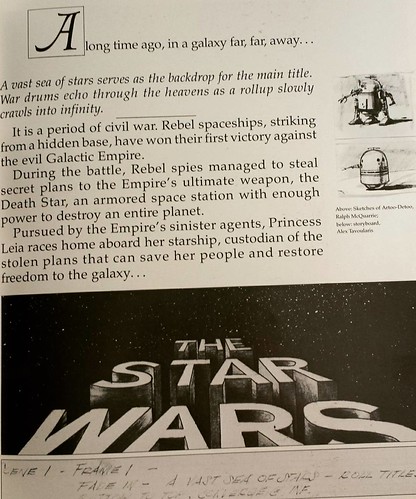
It was very loud. It opened with big words flying through space and then there was loud spaceships and talking robots (one of whom only talked in beeps and whistles). There was a girl in white and a bad guy in black whose breath sounded weird. There was a desert planet with weird dwarf-creatures and a kid named Luke who lived with his aunt and uncle. (The uncle could be pretty gruff if Luke was goofing off, to which I could relate.) There were more loud spaceships and one really really big spaceship shaped like a giant ball. There was a guy dressed in black and white who helped the farm kid, and this guy had a giant ape-man friend. There were swords made of light and even more spaceships and a big battle in space.
All of that, and I didn’t understand a lick of it.
In my defense, I was all of five years old at the time.
Until Star Wars, my movie experience was pretty much limited to stuff like Bugs Bunny Superstar and Disney live-actions like The Shaggy DA (which contained a hoot of a pie fight). Then there was this movie with loud spaceships and robots and a farm kid and a bad guy in black and…well, I had no idea what to make of this movie.
Luckily for me I had my sister, who is six years older than me.
She went all-in for Star Wars. She ate it, drank it, breathed it. She talked about it a lot, and gradually her enthusiasm began to win me over. She explained the story to me because I hadn’t understood it all that well, and I decided that I wanted a part of her enthusiasm for my own. So I went with her to see the movie a second time.
I have never ever ever recovered.

I’ve been thinking a lot about Star Wars as it nears and achieves 40 years, and I find myself relating to it most as a storyteller myself. As a writer I tend most to look at Star Wars through the prism of story. Many stories have had a deep effect on me, on the stories I want to tell, and the way I go about telling them, but none moreso than Star Wars, even as the Star Wars story itself has changed over the course of its four decades. Most of the core ideas are still there, though, as Star Wars is now no longer in the hands of its creator, George Lucas. Star Wars is still a tale of heroic adventure unfolding in the sky. It is still a tale not just of the wars but more well-focused on the people fighting that war. It is a tale of improbably redeemable villains, of the way our paths mirror those of our parents, and of finding love in the face of desperation. It is a tale of family.
I can’t help thinking in most, if not all, of these terms every time I write a story, no matter which genre it’s in. Star Wars made me want to be a storyteller (what is playing with action figures, if not storytelling?). It also taught me that stories can focus at times on more mystical matters, and it taught me that story is an excellent way of addressing the challenges people face in their hearts. Most importantly, though, Star Wars taught me about heroes and quests and the wise elders who try to guide the heroes on their way.
Other stories have come since Star Wars arrived, and many have come to places almost as near to my heart. It’s not only stories, either; it’s all of creative art, really:
Lloyd Alexander’s Prydain Chronicles
The Lord of the Rings
Casablanca
On Her Majesty’s Secret Service
My Fair Lady
Cosmos
Much Ado About Nothing
The House with a Clock in its Walls
The Lions of Al-Rassan
Mary Stewart’s Arthurian trilogy (plus The Wicked Day)
Berlioz’s Symphonie fantastique
Rachmaninov’s Symphony No. 2 in E minor
Invisible Touch by Genesis
Once and Again
Princess Mononoke
These are all things — and there are more — that are at the center of my creative life, but none has ever quite dislodged Star Wars as my Prime Mover. Star Wars is, and continues to be, my Platonic Ideal of what story is.
Even so, I haven’t always kept as close an eye on Star Wars as a massive universe as many. I’ve read only a small handful of all the many novels and comics written over the years, and I haven’t played any of the video games. For me, my appreciation focuses pretty exclusively on the movies themselves, and not just the wonderful Original Trilogy but also the admittedly uneven — but still, in my eyes, uniquely compelling — Prequel Trilogy and even to a smaller extent the recent “Rebirth” movies, The Force Awakens and Rogue One. Those form the core.
Star Wars is as strong now as it ever was, and it is very likely even stronger. It has more fans than ever, and it is now in the hands of a corporate power whose pockets are deep enough to maintain it at a very high level for decades to come. More fans are created every day, it seems, and yet…I do have to admit to feeling a certain level of possibly grumpy oldsterism. Sure, you kids can love Star Wars and in fact I hope that you will, and that your love for Star Wars will lead you to other things. But I came in on the ground level. My memories may be hazy, but I do remember a time before Star Wars.
I believe that every story one writes — or rather, every story that I write — should be, in one way or another, a love letter, either to someone or something. The Song of Forgotten Stars has many influences, but it is ultimately my love letter to Star Wars. If not for Star Wars, there’s no way I would be writing this story. It’s not just about the internals of Star Wars, though: it’s about the way Star Wars impacted me and shaped my life and helped reflected certain relationships in my life. Put it this way: There’s a reason why the two main characters in my Forgotten Stars books are two Princesses, one of whom is six years older than the other. It’s a dynamic that makes sense to me on a lot of different levels.
I also know, from reading a lot about the making of Star Wars over the years and about the life of George Lucas in particular, that the way by which a creative work comes into existence is often a messy one. Lucas’s manner of creation is eerily similar to my own, or maybe vice versa. Lucas is someone who starts out by following ideas in any direction they might go, and only gradually whittles things down and discards this notion or that idea until a streamlined story starts to emerge. I work the same way, at least in part. My rough drafts are often very messy and they always contain entire ideas that I remove entirely, for one reason or another. Lucas has done so much mixing and matching of ideas over the decades (remember that for him, Star Wars is 47 or 48 years old, depending on where he dates The Beginning) that he at times seems to be misremembering his own history. I know how he feels. There are times when an idea seems so organic that it’s hard to claim it for my own. Even if it is.
So thank you for forty years, Star Wars! And may the Force be with you, forevermore.

Check this out:

I that poster for Star Wars on Twitter earlier today, and I wanted some more information: was this an actual poster used to advertise the movie in Japan, or was this one artist’s flight-of-fancy? Many artists create “unofficial” movie posters for favorite films, so I wondered if that’s what this was.
Artist Noriyoshi Ohrai made these three posters for Japanese dubbed versions of all three Original Trilogy movies, and they are glorious:


I wonder what made the artist opt for a more “minimalistic” approach for Return of the Jedi, only choosing to show C-3PO and R2-D2 in front of a wonderful cosmic background, with what are clearly the main lightsaber blades of the movie at the sides. Still, it’s a fascinating artistic choice, and I’m glad these posters came to my attention today.
More of Noriyushi’s artwork here. These posters weren’t the only time he had Star Wars as his subject! And much of his other work is breathtaking. I might need to see if there’s a book collecting his work available….
“You cannot sow a million seeds without reaping one potato.”
–Ian Fleming, From Russia With Love
I suppose it had to happen eventually…but nevertheless, it’s totally unexpected. When I say it “had to happen eventually”, I figured “eventually” in the sense that those million monkeys banging away on a million typewriters will, given sufficient time, eventually produce the works of Shakespeare.
It had to happen eventually.
I found myself nodding with agreement to something written by Ben Shapiro.
If you have no idea who Ben Shapiro is, you’re lucky. He’s one of the most obnoxious voices in the American right-wing today, and he is such a consistently reliable source of complete error, total bollocks, and utter bullshit that his degree of prominence makes one fear for one’s country. If you really want a taste of the general quality of Ben Shapiro’s thinking, this video pretty much sums it up:
Shapiro is a skilled “debater” in that he thinks quickly and he speaks very quickly. It’s worth seeking out a video of him talking gender issues with Neil DeGrasse Tyson, who also thinks quickly but does not speak quickly; the effect is of a frantic teenager being gently put in his place by a wiser soul. Which is exactly what happens.
So, what did he say that I agreed with? At least in part? He said something about Star Wars.
Specifically, this (as shared on Twitter by an acquaintance):

As Star Wars takes go, this…isn’t bad at all. It’s not even incorrect! At least, not entirely. It’s incorrect in a way, but not a really major way…except for being part of how Shapiro relates to the world and opines about it.
But he gets a lot right here about The Empire Strikes Back. While I don’t hold it the best SW film, personally, it’s right near the top of my personal ranking, and his position that TESB is the undisputed best SW movie ever is not a fringe opinion. And he’s actually right about his reasons why it’s good. TESB has a lot going for it, but Shapiro is totally right about competence at its heart. It pits a small band of competent Rebels against a much larger, and also very competent, evil Galactic Empire. Nobody screws up in this movie (well, Luke might screw up, but a strong case can be made that he really has no choice but to abandon his training; his experiences in getting his ass kicked during the film’s third act are absolutely formative to the competent character he is in Return of the Jedi). All you have is competent people being successful or failing because the other person is either better, or they have more information, or they have more power behind them.
Shapiro’s take on the Original Trilogy being a showcase of competence is pretty interesting, actually. He then takes the “Disney era” to task for “making every man incompetent”. That’s where he goes a bit awry…but not totally.
I assume he’s limiting his thinking here to the Sequel Trilogy only, because to say that the entire “Disney era” of Star Wars is loaded with incompetent men is simply false. I defy anyone to watch Rogue One, Solo, The Mandalorian, Book of Boba Fett, or Andor and make the subsequent case that the men in those films and shows are incompetent. So that leaves us with just the Sequel Trilogy…and it doesn’t really depict all its men as incompetent, either. But it does show some of them in that light. The Force Awakens inexplicably turns Han Solo back into a giant space loser, and that’s after he spent the entire Original Trilogy being both (a) competent and (b) on a clear character trajectory from selfish-loner to committed member of a cause. (It’s for that last reason that I’ve always rejected Harrison Ford’s insistence that Han should have died in ROTJ because “he had no story”.
Mostly, though, the Sequel Trilogy gives us inept villains who are barely above the Keystone Kops in menace and competence; that they spend the entire trilogy seemingly on the cusp of victory is frustrating given how bumbling they are. Of the three Sequel films, only The Last Jedi puts competence on display to a significant degree, and then it meditates on how competence and failure are often bedmates anyway.
Shapiro doesn’t use the word, but I suspect what he’s getting at with that “Disney made all the men incompetent” thing is that Disney made Star Wars “woke”. Ranting against “woke” is one of Shapiro’s bread-and-butter activities, so I’m sure that’s the kind of thinking that’s informing his view of the Disney trilogy. But even so, he’s not really totally wrong here: one big reason I find the Sequel Trilogy uninspiring is that it’s not a story of competent heroes versus competent villains. It’s the story of somewhat-competent heroes (to the extent that we can really determine their competence at all, since the movies don’t really give us anything to go on as to what these characters even want) versus generically incompetent villains.
So, yes, I found myself in agreement with Ben Shapiro this weekend. I felt the need to work those feelings out through a blog post, which is probably better than my initial reaction, which was to sit on the floor of my shower, rocking back and forth with my arms wrapped ’round my drawn-up knees as the cold water rained down upon me.
Here are some random notes and thoughts on things we watched in February:
Teevee:
If you’re not watching Abbott Elementary, I really don’t know what you’re doing with your life. I was getting kind of tired of the whole “workplace documentary” sitcom subgenre that The Office blew up, spawning a dozen imitators, but the characters in Abbott Elementary are just so fun and compelling that all the usual “workplace documentary” stuff–the knowing glances at the camera, the “stealth shots” of characters’ hidden reactions to things other people are saying or doing–don’t feel at all forced. If you’re unfamiliar, Abbott Elementary takes place in an inner city elementary school in Philadelphia, where talented and well-meaning teachers work with too little resources and too little money to teach their overstuffed classrooms. Yes, there is a slow-burn romance subplot a la Jim-and-Pam from The Office, and yes, the boss figure, Principal Ava Coleman, is portrayed in the grand Michael Scott tradition as an often-inept obstacle that the teachers have to overcome. But where The Office would occasionally try to portray Michael as a guy who was actually a much better boss than he was usually depicted (and as many funny moments as there were with Michael Scott, this was not an angle the show was terribly successful), Principal Coleman actually does have more than a few moments where you see that she’s good at her job–or really would be if she was actually invested in it.
:: Our other sitcom candy of the moment is Home Economics, a show about three siblings and their families. The original notion is that the three siblings are all at different levels of financial success: the millionaire techbro, the middle-class brother who is a writer, and the social-worker sister who is in a constant financial struggle. Now in its third season all of those lines have been blurred a bit and the show is mainly about the quirky goings-on of this family with all their extended things going on, but it’s a fun and mostly positive show where nobody is unlikeable. Honestly, that goes a long way. (I think the show may have ended for the season! Apparently it had a 13-episode order, which does not leave me terribly optimistic for a fourth season.)
:: Then there’s American Auto, another mockumentary workplace sitcom that somehow works despite everybody being fairly unlikeable. This show is a strange case. It focuses on the upper management team of a car maker company. I suppose the pleasure here is mostly on watching upper management look like a bunch of rubes on a regular basis. The second season is unfolding now, and it’s full of a lot of madcap antics that don’t portray American management in too flattering of a light. The show does have a kind-of slow-burn romance subplot going on, but so far it’s really a slow burn, and I do find the show entertaining in its skewering way. It was created by the guy who previously created Superstore, which was also a terrific workplace comedy, so all of this tracks. Plus, alumni of Superstore show up on American Auto regularly.
:: The latest season of Hell’s Kitchen wrapped up recently, and wow, has that show become a robotic paint-by-numbers exercise. We’re watching more out of habit now than anything else. Gordon Ramsay is always fun to watch, but the challenges are almost always the same, and the punishments are just goofy (“All of our peppercorns are being delivered today, but they screwed up and mixed them all together, so you have to manually separate the black peppercorns from the white peppercorns!”), and honestly, at this point I’m not sure how much shelf life Hell’s Kitchen still has, if it doesn’t do something to mix itself up a bit. Twenty-one seasons in, watching new cooks screw up the scallops and the Beef Wellington isn’t nearly as interesting as it used to be…and with every individual cooking challenge being a 45-minute cook, watching every dish served be a “protein on top of a root vegetable puree” isn’t all that exciting, either. (But yes, we’ll watch Season 22. It’s a show that can be on in the background while I read.)
:: Then there was Pressure Cooker, a cooking competition show that actually added a Survivor/Big Brother wrinkle. A bunch of chefs are brought to live in a house that’s outfitted with a killer kitchen, and they are submitted to cooking challenges that result in elimination challenges. So in addition to cooking, this show adds the subterfuge and “alliance forming” that informs the Survivor genres. One particular chef, a young woman named Jeana, was depicted as one of the bigger “villains” in the show, as she did a lot of scheming and at one point her strategizing and, well, outright lying managed to get one of the strongest competitors eliminated. Now, I know that this woman is the villain and we’re not supposed to like her, but I don’t know…there was just something about her….

I dunno, it’s a mystery.
:: Next Level Chef has started a second season. It’s a strange concept: the set is three kitchens, stacked on top of one another, with the top level being a state-of-the-art kitchen with the very best stuff, the middle being a standard commercial kitchen that’s decent but not as good as the top level, and the basement being where old equipment, pans with loose handles, uncalibrated gas burners, and the like reside. There are three teams of cooks, and based on the results each week the teams are slotted into one of the kitchens, and each week someone is eliminated. It’s a fun concept, though the “basement level” is still good enough that we don’t really see those cooks struggle all that much. I was thinking in terms of the sabotages from Cutthroat Kitchen here, but no dice. I like the show mainly because it has a relatively fresh concept, unlike Hell’s Kitchen which is honestly just pure formula at this point.
Finally: Andor is the latest Star Wars show on DisneyPlus. I was looking forward to it after a whole bunch of people opined that it’s the best Star Wars show yet and it might even be one of the best pieces of Star Wars filmed entertainment of all, including all of the movies. So imagine my shock when I found myself bored and unengaged with the characters, to the point that my enthusiasm petered out completely and we stopped watching it after the 8th episode. (There are 12.) Andor tells the backstory of Rebel spy Cassian Andor, who was one of the leads in Rogue One. In so doing, we also get a lot of background on the earliest days of the Rebel Alliance and some citizen’s-eye-view of life under the Galactic Empire. The show is crafted as a political thriller with some heist action along the way, but the pacing was incredibly slow for me to the point of tedium, and the characters were nearly impossible for me to connect with. Andor didn’t work for me at all, being too disjointed and having too many concurrent subplots for me to invest fully in any of them. (After giving up, I learned that there’s a post-credits scene on the last episode, so I tracked it down and watched it…and it turns out that when Andor is sent to an Imperial prison-labor planet, the electronic parts he and others are forced to make are components for the super-laser for the still-under-construction Death Star. My eyes rolled at this revelation, if I’m being honest; at this point I am so tired of everything in Star Wars being tied back to the same story.)
Movies:
:: The Age of Adaline is a deeply affecting fantasy about a woman who was born in 1908 and who, when she is 29 years old, is in an accident that arrests her body’s natural aging process, basically making her forever 29. The events of the the film unfold in the present day, when Adaline’s daughter–born before Adaline’s husband’s death in 1937, just ten months before the accident–is an old woman herself, and Adaline is getting ready to push the “reset” button on her life yet again, something that became necessary when she realized people were starting to ask questions about the woman who never seems to get older. Over the course of the movie Adaline meets a man who somehow manages to slip through the defense mechanisms she’s set up for herself over the years, and then more complications develop when the new guy’s past intersects Adaline’s past in ways she couldn’t have seen coming. The story is like a kind-of Back to the Future in reverse, and it’s a beautifully made film, wonderfully shot and acted with Blake Lively in the lead as Adaline and a frankly amazing supporting role played by Harrison Ford.
:: Top Gun: Maverick wasn’t a movie that interested me in the slightest when I learned they were making it. I was never a fan of the original movie, which I found to be really predictable and kind of boring, as great as the fighter-pilot flying sequences were in that picture. I never really cared about the characters in that movie, so I wasn’t going to watch this new one…except that the buzz on it has been exceptionally strong, and curiosity got the better of me. Wouldn’t you know it: the new one is a terrific movie, that somehow makes Tom Cruise’s “Maverick” character somebody I can actually relate to, and he’s surrounded by interesting characters of their own, as well. The movie’s story is every bit as predictable as the first film, but a story’s strength does not always lie in its surprises and its twists and turns. I enjoyed this movie immensely. (For The Wife, Tom Cruise’s perfectly brown hair without a hint of salt-and-pepper was a point of contention. I’m not sure why that particular item was what tripped off her Plausibility Meter, but there it is.)
:: Like Father is an insightful story about a young woman and her troubled reconnection with her estranged father…trapped inside a dumb sitcom. The bad parts are a shame, because they drag down the good parts; but the good parts are good enough to lift the bad parts, so much so that I’m not sure where I even come down on this movie. Kristen Bell plays a young professional who is so work-obsessed that she is late to walk down the aisle at her own wedding because she took a work call as she was waiting outside the venue. This enrages her fiance, who leaves her on the altar when her phone falls out of her bouquet (because, in the movie’s first sitcom moment, she realizes she has no place to put her phone so she stuffs it down in the bouquet). As she stands on the altar not even sure what’s just happened, she recognizes her estranged father (Kelsey Grammer), whom she has not seen in years, ducking out the back. Tracking him down, they go out and get ripping drunk to the point that they don’t even remember getting on the cruise ship that was already booked for her honeymoon; thus, trapped together for the length of the cruise, they start to wear each other down and figure out where they stand, where they went wrong, and where they can go from here.
Like I said, there’s a lot of good stuff in here, mostly when the two of them put aside all the shenanigans that the movie forces upon them and just talk. When the conversation finally comes as to just why it is that now, of all times, Dad has re-emerged into the picture, it’s a welcome scene indeed and Bell and Grammer do it justice. In fact, they both sell the idea of their relationship very well, even through obnoxious stuff like their participation in the cruise ship’s lip-sync contest or other episodes that are pure sitcom. We’re talking Three’s Company-level stuff here, folks. It’s a maddening movie, honestly, because there’s enough of a really good relationship study here to make me wonder throughout, “Then why are we watching all this other goofy shit for?”
:: Finally, I randomly found Foul Play on YouTube (right here, though I wouldn’t be surprised to see it gone for copyright violation at some point). This is a movie I saw as a kid when it came out, featuring Goldie Hawn as the adorkable librarian who finds herself in the middle of some kind of criminal conspiracy that keeps ending up with dead bodies in her presence…but when she goes to notify someone about the dead bodies, the bad guys have whisked them away. It’s the classic “Normal person caught in a conspiracy but nobody believes her” story, until a cop played by Chevy Chase comes along and starts to think that maybe she has stumbled on to something. Which she has: a plot to assassinate the Pope. It’s kind of a love letter to the kind of Hitchcockian screwball mystery flick, and it still holds up pretty well. Chase is especially noteworthy here because he actually gives a performance; aside from exactly two pratfalls, none of his SNL antics are on display here, and he’s nowhere near the full-on gonzo work he’d later do for the Vacation movies and whatever else he did. Chase has had a long and productive career, even with his reputation for being enormously difficult to work with, so I guess he’s done fine, but it’s interesting to look at Foul Play and wonder what he might have done if he’d followed this line of work instead of creating Clark Griswold.
Forty-five years ago today, Star Wars opened in theaters. Here is a post I wrote in 2017 for the movie’s 40th anniversary.
I finally saw it, though, with my sister, who is six years older than me.
I didn’t like it.
It was very loud. It opened with big words flying through space and then there was loud spaceships and talking robots (one of whom only talked in beeps and whistles). There was a girl in white and a bad guy in black whose breath sounded weird. There was a desert planet with weird dwarf-creatures and a kid named Luke who lived with his aunt and uncle. (The uncle could be pretty gruff if Luke was goofing off, to which I could relate.) There were more loud spaceships and one really really big spaceship shaped like a giant ball. There was a guy dressed in black and white who helped the farm kid, and this guy had a giant ape-man friend. There were swords made of light and even more spaceships and a big battle in space.
All of that, and I didn’t understand a lick of it.
In my defense, I was all of five years old at the time.
Until Star Wars, my movie experience was pretty much limited to stuff like Bugs Bunny Superstar and Disney live-actions like The Shaggy DA (which contained a hoot of a pie fight). Then there was this movie with loud spaceships and robots and a farm kid and a bad guy in black and…well, I had no idea what to make of this movie.
Luckily for me I had my sister, who is six years older than me.
She went all-in for Star Wars. She ate it, drank it, breathed it. She talked about it a lot, and gradually her enthusiasm began to win me over. She explained the story to me because I hadn’t understood it all that well, and I decided that I wanted a part of her enthusiasm for my own. So I went with her to see the movie a second time.
I have never ever ever recovered.
I’ve been thinking a lot about Star Wars as it nears and achieves 40 years, and I find myself relating to it most as a storyteller myself. As a writer I tend most to look at Star Wars through the prism of story. Many stories have had a deep effect on me, on the stories I want to tell, and the way I go about telling them, but none moreso than Star Wars, even as the Star Wars story itself has changed over the course of its four decades. Most of the core ideas are still there, though, as Star Wars is now no longer in the hands of its creator, George Lucas. Star Wars is still a tale of heroic adventure unfolding in the sky. It is still a tale not just of the wars but more well-focused on the people fighting that war. It is a tale of improbably redeemable villains, of the way our paths mirror those of our parents, and of finding love in the face of desperation. It is a tale of family.
I can’t help thinking in most, if not all, of these terms every time I write a story, no matter which genre it’s in. Star Wars made me want to be a storyteller (what is playing with action figures, if not storytelling?). It also taught me that stories can focus at times on more mystical matters, and it taught me that story is an excellent way of addressing the challenges people face in their hearts. Most importantly, though, Star Wars taught me about heroes and quests and the wise elders who try to guide the heroes on their way.
Other stories have come since Star Wars arrived, and many have come to places almost as near to my heart. It’s not only stories, either; it’s all of creative art, really:
Lloyd Alexander’s Prydain Chronicles
The Lord of the Rings
Casablanca
On Her Majesty’s Secret Service
My Fair Lady
Cosmos
Much Ado About Nothing
The House with a Clock in its Walls
The Lions of Al-Rassan
Mary Stewart’s Arthurian trilogy (plus The Wicked Day)
Berlioz’s Symphonie fantastique
Rachmaninov’s Symphony No. 2 in E minor
Invisible Touch by Genesis
Once and Again
Princess Mononoke
These are all things — and there are more — that are at the center of my creative life, but none has ever quite dislodged Star Wars as my Prime Mover. Star Wars is, and continues to be, my Platonic Ideal of what story is.
Even so, I haven’t always kept as close an eye on Star Wars as a massive universe as many. I’ve read only a small handful of all the many novels and comics written over the years, and I haven’t played any of the video games. For me, my appreciation focuses pretty exclusively on the movies themselves, and not just the wonderful Original Trilogy but also the admittedly uneven — but still, in my eyes, uniquely compelling — Prequel Trilogy and even to a smaller extent the recent “Rebirth” movies, The Force Awakens and Rogue One. Those form the core.
Star Wars is as strong now as it ever was, and it is very likely even stronger. It has more fans than ever, and it is now in the hands of a corporate power whose pockets are deep enough to maintain it at a very high level for decades to come. More fans are created every day, it seems, and yet…I do have to admit to feeling a certain level of possibly grumpy oldsterism. Sure, you kids can love Star Wars and in fact I hope that you will, and that your love for Star Wars will lead you to other things. But I came in on the ground level. My memories may be hazy, but I do remember a time before Star Wars.
I believe that every story one writes — or rather, every story that I write — should be, in one way or another, a love letter, either to someone or something. The Song of Forgotten Stars has many influences, but it is ultimately my love letter to Star Wars. If not for Star Wars, there’s no way I would be writing this story. It’s not just about the internals of Star Wars, though: it’s about the way Star Wars impacted me and shaped my life and helped reflected certain relationships in my life. Put it this way: There’s a reason why the two main characters in my Forgotten Stars books are two Princesses, one of whom is six years older than the other. It’s a dynamic that makes sense to me on a lot of different levels.
I also know, from reading a lot about the making of Star Wars over the years and about the life of George Lucas in particular, that the way by which a creative work comes into existence is often a messy one. Lucas’s manner of creation is eerily similar to my own, or maybe vice versa. Lucas is someone who starts out by following ideas in any direction they might go, and only gradually whittles things down and discards this notion or that idea until a streamlined story starts to emerge. I work the same way, at least in part. My rough drafts are often very messy and they always contain entire ideas that I remove entirely, for one reason or another. Lucas has done so much mixing and matching of ideas over the decades (remember that for him, Star Wars is 47 or 48 years old, depending on where he dates The Beginning) that he at times seems to be misremembering his own history. I know how he feels. There are times when an idea seems so organic that it’s hard to claim it for my own. Even if it is.
So thank you for forty years, Star Wars! And may the Force be with you, forevermore.
Film music today!
This weekend was, among other things, the twentieth anniversary of the release of Star Wars Episode II: Attack of the Clones, which is one of my favorite installments in the series. Even now, when the Prequel Trilogy has benefitted from the passing of time and some much-needed critical reassessment (way overdue, but I remain proud of having done a lot of that lonely heavy-lifting myself back when hating the Prequels was still the mainstream position), AotC still seems to be the one that gets picked on the most, which I continue to not understand.
The movie’s music is something of an oddity. John Williams turns in a lot of his usual inventive brilliance, even though the film’s last act was apparently still under heavy revision so late in the production game that the entire last act is largely scored with music re-used from the previous film, The Phantom Menace. Williams’s original work is typically amazing, centering on a new Love Theme for the romance of Anakin and Padme, which even at this point we know is (a) doomed to failure, and (b) going to produce the baby twins of Luke Skywalker and Leia Organa.
As the romance is doomed and tragic from the get-go, Williams wrote a lush love theme that leaps and yearns in suitably sad and tragic fashion. But he does some more with it: he gives that love theme a darkly militaristic middle section, for one thing, in line with the fact that Anakin’s fall to the Dark Side (which helps give the Empire its beginnings) is borne from this very love affair. Williams also crafts the love theme itself from a kind of minor-key inversion of the Star Wars main theme, and the theme’s final bars form a quote from the classic Imperial March.
In this selection, the Finale and End Credits Suite from the film, we start with some suspenseful music as the Battle of Geonosis winds down and the traitorous Count Dooku flees to Coruscant, so he can report to his master, Darth Sidious (the Sith alter-ego of Chancellor Palpatine, who is the puppet master behind everything). Then the music swells as the Republic’s Clone Army is revealed in all its terrifying majesty, setting forth to war–but the music here is the Imperial March from the Original Trilogy. Williams is telling us that this is the true moment the Empire is born.
Then, a blazing rendition of that love theme as Anakin and Padme marry in secret, before the film’s smash-cut transition to the end credits. This is the best of these transitions in the entire saga, in my opinion, and it’s the last time that Williams would end a Star Wars movie’s narrative with anything other than his iconic theme for the Force.