
I have too many thoughts about the state of the United States to frame into anything essayish today, and too many of my thoughts are of the negative variety anyway. So…let’s just listen to some American music, shall we?
Frohes Neues Jahr!
It’s January 1, 2026. Wow. We made it. We got through 2025. And if I’m being honest, I’m not entirely sure that 2025 doesn’t slide in right above 2020 if we’re ranking recent years by how much of a shitshow they’ve been. 2025 was a shitshow, and there’s no mistaking it.
Normally right about now I’m tucking into a lengthy year-end quiz-thing, but this time…I’m not going to do that. At least, not right now. I’m already working on it, but it probably won’t be appearing until Saturday, 10 January. Why so? Because 2025 was a year that needs some thinking about. Lots of dust to settle, and much of it won’t settle for years anyway. I just want to take my time with this, is basically where I land here. So stick around. Regular posting will resume now…though also with a few changes there to come, which I’ll be announcing soon. (Nothing bad, by the way, but I’m going to try adopting a more structured approach to my content creation, in hopes of spinning it into something possibly lucrative.)
Longtime readers will know that my annual tradition is to, at some point in the first few days of the New Year, watch the New Years From Vienna concert, featuring the Vienna Philharmonic Orchestra. This year is no different. If you’ve never seen it, I strongly recommend it! PBS always has it on Great Performances, but they do an abbreviated version of the program, which is why I recommend, if you can find it, the BBC’s full version. Still, it is always a wonderful way to bring in the new year and send out the old. And if you just can’t manage that at all, well, here’s the work that is always heard second-to-last in the program. A musical cliche, yes…but cliches become cliches for a reason, and not always bad.
Share This Post
“Vultures, vultures everywhere!”
Eighty-three years of Casablanca.
This morning I got in the car, turned on the radio, and as I was preparing to switch it over to my phone’s output so I could listen to a podcast, the announcer on WNED indicated that they were about to play a suite of Max Steiner’s wonderful music for Casablanca, because the film opened eighty-three years ago today.
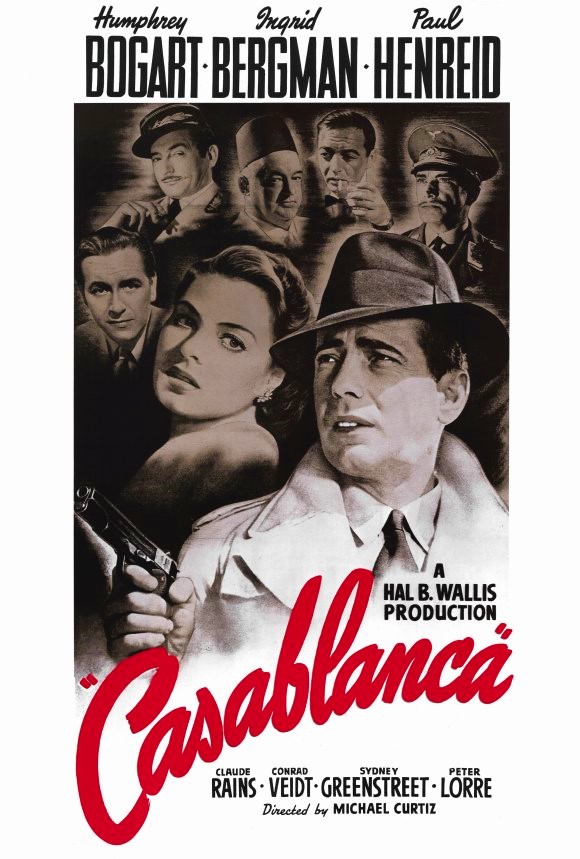
That movie has been a part of my world my entire life. I didn’t watch it myself until sometime during, or immediately after, my freshman year of college, but I was always aware of it, and my parents always spoke very highly of it. I remember when I watched it the first time I thought, “Yeah, that’s pretty damned good, I don’t know if it’s quite as good as everyone makes it out to be, but that’s a damned good movie.”
A while later I watched it again, though…and I discovered something that Roger Ebert would later write about: the fact that Casablanca is, somehow, always better the second time. There’s just something about it that makes it a “pretty good” watch the first time and makes it utterly engrossing the second time around…and each and every time thereafter.
Eighty-three years.
When I was a kid, Casablanca was my benchmark for “an old movie”. Since it was only 29 years old when I was born, I guess I kind of set “twenty-nine years old” as my thought for what constituted an “old movie”. So, using that metric, here in the Year of Our Lord 2025, new “old movies” include Independence Day, Scream, Jerry Maguire, and the first Mission: Impossible movie.
Anyway, here’s the Max Steiner suite I listened to this morning on my ride to work. This is music to put you in the mood to be a big inconvenience to Nazis…which honestly, is saddeningly needed right now, innit?
Share This Post
A Turnip Cures Elvis (Something for Thursday, Friday edition)
Like I said the other day, there’s a kind of perfect storm of STUFF all coming to a head at once that isn’t leaving me with a ton of time for posting, so posting much, I have not. This is likely to continue for the next week, maybe even two, depending on how things transpire. None of this is bad, by any means: we have a big work event that’s taking up tons of time to prep coming up, and then next weekend is our annual getaway to Ithaca and the Finger Lakes, and right after that, The Wife has a medical procedure that will occupy a lot of mental cycles and energy.
But, I do need to get something up here at least once in a while, don’t I? And I’m still saddened by the passing earlier this week of Robert Redford, so I’ll discuss my personal favorite Redford movie, to which the title of this post alludes. The film is the 1992 caper film Sneakers.
Here’s the text of a post I wrote some years ago about the film, and then I’ll come back and say a few things more about it:

COSMO: You could have shared this with me.
MARTIN: I know.
COSMO: You could have had the power.
MARTIN: I don’t want it.
COSMO: Don’t you know the places we can go with this?
MARTIN: Yeah, I do. There’s nobody there.
COSMO: Exactly! The world isn’t run by weapons anymore, or energy or money. It’s run by ones and zeroes, little bits of data. It’s all just electrons!
MARTIN: I don’t care.
COSMO: I don’t expect other people to understand this, but I do expect you to understand this! We started this journey together!
MARTIN: It wasn’t a ‘journey’, Coz. It was a prank.
COSMO: There’s a war out there, old friend, a world war. And it’s not about who’s got the most bullets. It’s about who controls the information: what we see and hear, how we work, what we think. It’s all about the information!
MARTIN: If I were you, I’d destroy that thing.
I saw Sneakers when it first came out, back in 1992 or thereabouts. It quickly became one of my favorite movies, and I saw it several more times theatrically before it became a fixture in my rotation of movies to rent on occasion, and later, when I had a sizeable collection of movies on VHS. But for one reason or another – mainly because I just never got around to it – Sneakers never got into my DVD collection, so I haven’t seen it in…holy crap. More than ten years. That seems rather wrong to me now, in retrospect, but never fear – I finally watched it recently, with some fear and trepidation that, like many a techno-thriller made more than a decade ago, it wouldn’t hold up very well.
Surprisingly – and satisfyingly – it does hold up, very well. And more than that: it’s striking to me now, twenty years later, just how eerily prescient this movie was.
Sneakers is one of the most entertaining cyberthriller-espionage movies I’ve ever seen. Robert Redford stars as Martin Bishop, the head of a security firm consisting of a group of men whose backgrounds mostly include shady dealings or outright brushes with the law. Their main job is simply to break into places that are supposedly highly secure, in order to demonstrate the lax areas in the security. They seem to be mostly just eking by: when they complete a job for a bank early in the film, a bank officer fills out the payment check, looks at it, and comments that it’s not a very good living. The team gets hired for another job, this time by two men claiming to be NSA agents, who happen to know who Martin Bishop really is (for which he could go to jail). They are to steal a device that decrypts codes which are supposedly unbreakable, which they do, and then give to the NSA guys – only to learn that they’re not NSA guys at all, and that they’ve murdered the mathematician who invented the device.
In a deeply eerie scene, Bishop’s hacker buddies start probing around with the little black box, just to see what it can do – and they discover that it can allow anyone to hack into extremely sensitive computer systems. The power grid of the entire Northeast…the Federal Reserve…air traffic control. They couldn’t have known it, writing this movie ten years before 9-11, but hearing one of the hackers jokingly say, “Anybody want to crash a few passenger jets?” is deeply chilling.
The entire movie is about security in an increasingly digital world, and at the end of the film, the exchange quoted above takes place, between Bishop and his onetime college buddy Cosmo, who has become a villain since doing time in prison for a crime that he committed with Martin at his side (but who eluded capture by the police simply by going out for pizza when they showed up with the guns). The idea of the world become increasingly governed by, and even defined by, the processing of data was a pretty bold one back in 1992. When I saw this movie, I had not yet even heard of the Internet, and the digital infrastructure that Sneakers portrays – with dial-up modems and not a cell phone in sight – seems utterly quaint. And yet, the movie is somehow fresh, despite all that, largely owing to the charm of the cast, the sparkling dialogue, the engaging direction, the brisk pacing, and – in terms of the technology – the nicely non-specific way the technology is depicted.
There are a lot of very clever touches in Sneakers: the reverse ‘race against time’, for example, in which Martin Bishop has to get a job done and yet literally can only do it at a very slow pace, lest the motion detectors notice his presence. Also the way they enlist Martin’s former (and yet still friendly) girlfriend to help with the problem of recording a particular scientist’s voice for use against the voice-print ID gizmo. (If the phrase “My name is Werner Brandes. My voice is my passport. Verify me.” is in your geek lexicon, then you are my kind of people.) I also like how vague the movie is about Cosmo’s villainy. We never learn who he works for, or if he is the main ringleader; we never learn what exactly it is that he wants to accomplish with the little black codebreaking box. In fact, it’s entirely possible that Cosmo doesn’t even have a specific plan in mind at all, and that he just wants the codebreaker because it will give him power that he as yet doesn’t really know how he intends to use it. He’s almost purely a theoretical villain, which is what makes him even scarier — as well as the sheer optimism of his villainy, which is what makes the quote above so memorable. It’s not about making threats or committing crimes or any of that dirty stuff. It’s about the possibilities inherent in controlling the world’s data.
And that is really makes this twenty-year-old film stay relevant.
OK, that’s the old post. I notice that I didn’t mention the film’s acting much in my original post, so I’m addressing that now, because Sneakers is one of the best-cast movies ever made, in my opinion. If they handed out Oscars for casting, Sneakers would have won it that year. You have River Phoenix as a young hacker, and Dan Aykroyd as an old hacker who is deeply invested in paranoid conspiracy theories. (This was a considerably more charming and entertaining character trait thirty years ago. Now, not so much.) You have Sidney Poitier as a retired CIA spook who hasn’t given up the game just yet, and David Strathairn as a blind hacker. Leading them all is Mr. Redford, a hacker with a past that has led him to assume a false identity. Joining them is Redford’s old girlfriend, played by Mary McDonnell, and the villain is Ben Kingsley as an old friend of Redford’s who went to jail for their escapades while Redford did not.
It’s really something to watch this movie and note the complete chemistry among the cast. At no point is there any break in the illusion; we really believe that this motley crew of hackers and law-benders has spent years working with one another at the weird intersection of legality and morality and…neither of those things. And they really do seem to enjoy doing it; they’re having fun, up until the moment when they realize that they have somehow become embroiled in something very real and very dangerous. But even then, once they sense that the winds have shifted in their direction again…the sense of fun returns.
Speaking specifically of Mr. Redford’s performance, he is doing more than having fun. There’s a sense right from the start that he’s been at this longer than anyone else, and that he’s starting to get a bit weary of the whole business. Redford shows us a Martin Bishop who is genuinely sorry for what happened to his old friend back in college, and who does want to move past the hackery part of his life. He’s also skeptical of what is to come and what Cosmo seems to be embracing, as shown in the exchange quoted above; Bishop’s hesitance to embrace a world where everything is determined by information and who controls it is notable, and in Redford’s hands, very, very real. Redford does things in this film with simple facial expressions that are just wonderful: a rolling of his eyes when he’s told to hurry up when doing a job where moving as slowly as possible is required, or a sudden snarl when he decides to punch out the thug who has been inconveniencing him all movie long. Or his mischievous smile that lets us know he’s pulled a fast one on somebody.
Most of all, though, Redford captures that Bishop is the brains and the heart of this whole operation. He’s the one who suspects first that this whole business with the code-breaking machine is more than he bargained for and that he and his team are involved in something more deep and sinister than they have ever dealt with before. This is something that Robert Redford was always great at, something that made him one of the best. He was always able to suggest, often without even saying anything, the emotional and intellectual lives his characters were leading.
And he was just so damned cool about it. Who wouldn’t want to be Robert Redford, after all?
Oh, this is a delayed Something for Thursday post as well, so here’s a nice suite culled together from the soundtrack to Sneakers, with music composed by the late, great James Horner. This is one of the great “caper film” scores of all time.
Share This Post
Remembering James Horner (1953-2015)
(This is a repost of what I wrote when composer James Horner died ten years ago, very prematurely, in a plane crash. Apparently Horner had been an amateur, hobbyist pilot. My relationship with his music through the years was complicated, but I wouldn’t ever say it was complicated to the point of being “love-hate”. Horner was one of the most important and notable film composers from 1980 until his death, after all, and as prolific as he was, I wish he was still around.)
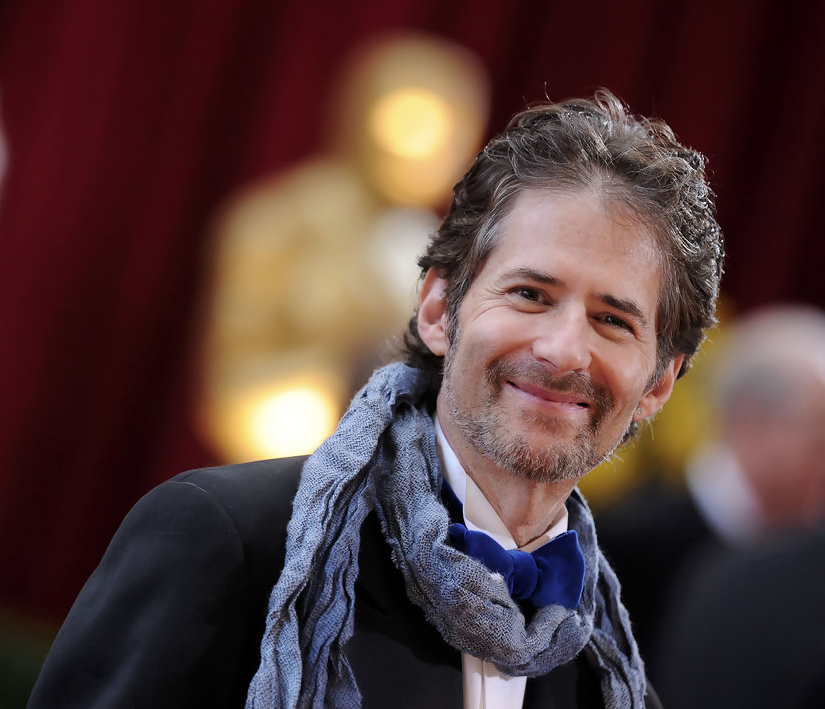
Composer James Horner died the other day when the airplane he was piloting crashed. He was the sole passenger.
This is, quite simply, the worst news to hit the film music world since Michael Kamen, Jerry Goldsmith, and Elmer Bernstein all died within a year of each other.
For me, though, the hit is more directly personal. Although my relationship with Horner’s music has been rather complicated over the years, he still wrote a fair number of my favorite filmscores of all time, and when a score of his connected, it connected. He had the ability to hone in on the precise moment of a given scene’s emotional high point and construct his music to reach its high at the same moment. All film composers strive for this, but Horner’s gift for this was something else.
Moreover, I saw Horner’s career take flight, as he rose from obscurity to, well, stardom in his small corner of the film world. He started writing for films in the late 1970s, and I first encountered him in his fifth film, the Roger Corman space opera flick Battle Beyond the Stars. This is the first James Horner music I ever heard:
That score is still a fun listen to this day, even with all its minor faults: its heavy debt to Jerry Goldsmith (one of Horner’s strongest early influences), its occasionally awful orchestration (there is a track called “Cowboy and the Jackers” when you can hear the trumpet section slowly die), and occasional transitional missteps. Horner wrote a swashbuckling score that was better than the film it accompanied (although the film really is not all that bad, as long as you don’t ask too much of it).
When next I encountered the music of James Horner, it was for another science fiction film: Star Trek II: The Wrath of Khan.
Gone was Jerry Goldsmith’s brightly optimistic bombast from The Motion Picture, and in its place was a lyrical score that had an older and more seafaring quality to it.
It wasn’t all lyricism, though; Horner’s action writing was impeccable, and the film’s climax gives a great example of Horner’s skill for matching the music to the exact visual and the emotional beats of the scene. Here is the music, titled “Genesis Countdown”:
And here is a portion of the scene as scored, starting with the Enterprise backing away from Khan’s crippled Reliant:
This entire cue is a clinic in how to spot a film: you hear the desperation as the ship begins to move so painfully slowly, the drive as Spock climbs down through the ship toward Engineering, a snippet of Horner’s theme for Spock himself as he mind-melds with McCoy, the desperate ticking down of the seconds as the bridge crew realizes they’re doomed, Khan’s final expressions of hatred. When Horner was on, this is what he could do.
Horner would return to Star Trek for the next film, The Search for Spock, but he never did any more Trek after that. This always seemed to me a pity. I would have liked to hear, perhaps, a more light-hearted take on his themes from Treks II and III in IV, perhaps, or maybe his take on the adventures of the Next Generation in any of their films. Alas, it didn’t happen. I next encountered Horner via his score to the SF film Brainstorm, which is notable mainly for being Natalie Wood’s last film and, well, for Horner’s score.
And then there was Krull.
It’s amazing to hear the progression in Horner’s sound from Battle to the Treks to Krull and beyond. You can really tell how much he was learning along the way, and his development along these lines culminated in 1988’s Willow.
One can detect a certain amount of the common lot of the film composer: often the scores are, on balance, better than the films. Not everyone can be John Williams, with a partnership with Steven Spielberg.
Horner was also able to do a lot more than genre films. He scored everybody’s favorite gentle baseball film Field of Dreams, in which he flexed his Americana muscles without quite aping the typical Coplandesque sound, and a couple years later he scored the Robert Redford caper flick Sneakers.
In the mid-90s, Horner reached what was almost certainly the height of his powers, and his filmography from about 1993 to 1998 basically includes one fine score after another, with three that were truly wonderful and one other which would become his single most famous work.
For Ron Howard’s Apollo 13, Horner managed to capture both the optimism of the Apollo moon missions and the elegiac sense, looking back, that that was as far as we were willing to go at that time and for quite a long time afterward. Horner infused that entire film with amazing energy, never moreso than during that film’s incredible rocket launch sequence:
Then there was Braveheart. Horner’s score for this film is amazing, one of my favorites of all time, and I consider its first half to be some of the finest film music ever written. It’s really quite something, what Horner did here. Mel Gibson’s film takes a fairly ‘dreamy’ approach to its subject matter, with long, lingering shots and scenes that feel like meditations. Horner accompanies all this amazingly, never better than in the “Secret Wedding” sequence. This love music is more complex than it seems, with a main melody that is subtly varied through a number of different stepwise progressions, and as the scene becomes more and more intimate in the film, so too does Horner’s score, boiling down to the utter simplicity of the rhythm being set by an ostinato harp. The first half of this score amazes me each time I listen to it.
Also in this same period came what I consider to be Horner’s finest score, Legends of the Fall. This melodrama is actually a favorite film of mine, and Horner’s approach to its big emotions is to basically say, “To hell with subtlety”. It’s a choice that works amazingly well, as Horner moves from big moment to big moment. This is a movie that blends World War I tragedy with Native American mysticism and Depression-era bootlegging with the generational drama of a family of strong-willed men and women underneath the Big Montana Sky, and Horner turns in a lush, Romantic score that proves that sometimes less is not more.
And then, in 1997, Titanic arrived.
Oddly, while I love the movie Titanic to this day, I’m not a huge fan of its score. It does, though, have a number of great moments. Horner would win his only Oscar for Best Original Score for Titanic (he also won Best Original Song that year for “My Heart Will Go On”). Titanic seems to be mostly laughed-at these days, which I always find unfortunate, but Horner did play a crucial part in its success, from the wonderful energy of “Southampton” to the way he scored the scene where Jack shows Rose how to “fly”. Note, in the latter scene, how the music seems to swell, only to swell again, with an upward modulation, when Rose lifts her hand to Jack’s neck, making the kiss all the more intimate.
One thing that’s always struck me about Horner’s Titanic score is how unobvious it is. He doesn’t go for the type of “seafaring” sound that one might expect from a disaster-at-sea film; nor does he particularly try to capture a “British” feel with proper Elgarian pomposity. Horner’s score, even if it’s not one of my favorites of his, still does manage to somewhat lift the film from its period setting, thus helping make the love story a bit more eternal, if that makes any sense.
The best part of this score, though, comes when Horner sends the orchestra home and uses a simple solo piano for the scene when Jack draws the portrait of Rose. It’s the film’s most intimate scene, and the solo piano is an inspired choice. You can hear that track here. (I’m having trouble embedding it because this post was originally written for the old BlogSpot iteration of this site, and the copying-and-pasting of entire blocks of text-and-video doesn’t always play well with WordPress’s “blocks”.)
Listening to all these selections, I’m struck by something I’d never totally noticed before, with regard to Horner’s melodies. He leans toward long melodies that seem at first to meander, before settling into an internal logic that makes a lot of sense.
Since the late 90s, I’ve lost track of Horner a bit. Partly this is because I stopped seeing as many movies, and he wasn’t scoring as many films that I actually wanted to see. Also, it seems that he wasn’t scoring as many films in general. He was active right up to the end, but he wasn’t getting as many of the blockbuster assignments and high-profile films, as tastes in film music have shifted toward the kind of tuneless soundscapes of Hans Zimmer and the like. I think Horner’s style has somewhat fallen out of favor, but he didn’t disappear entirely. The last new score of his that I heard to any significant degree was his music for James Cameron’s Avatar. I didn’t care for it all that much at first, but it has grown on me on repeated listens.
Horner had his detractors, of course, and sometimes they had cause. Over time, it became clear that Horner had little sonic “tricks” that he liked to use repeatedly throughout his scores — a particular motif to indicate that something bad was in the offing, for instance; film music fans would sometimes call this the “Danger Motif”. Another is what I came to call the “James Horner Rolling Chord of Melodic Punctuation”. More than a few times I would see a film with a Horner score and notice these very tricks playing out, and though it wouldn’t much faze the general audience, I knew what was going on.
Horner’s gifts of melody and his skill at spotting a film were always in evidence, however, and I can’t name a single film that he didn’t enhance with his music. After John Williams and Jerry Goldsmith, James Horner’s music was the most familiar to me growing up. His musical storytelling, in its finest moments, stands with any film composer who has ever put pen to paper.
And his voice will be missed. I may not have heard much of his music of late, but I don’t like knowing that there will be no more to discover. I didn’t like everything he did, but I liked most of it and loved a lot of it. Seeing his name attached to a film was always exciting.
So thank you, James Horner. Your music is part of the soundtrack of my life.
Share This Post
A musical offering….
Any accounting of the greatest composers of the Baroque era would include, as a short list, the names of J.S. Bach, Alessandro Scarlatti, Antonio Vivaldi, and George Frideric Handel. We’re talking about Handel briefly today, partly because of his immense status in the history of music, and also partly because he may have been gay. Possibly. There is very little information about that to go on, but it is known that Handel was an enthusiastic member of several communities in his life where homosexuality was known and condoned. Is that enough to make any conclusion? Obviously not…but there does seem to be a high likelihood that many of our great musical masters–our great artistic masters, come to that–were queer in one way or another.
Handel is best known mainly for a few of his towering masterpieces–the oratorio Messiah, most importantly, and his Water Music and Music for the Royal Fireworks. But Handel was highly prolific, and also among his great works are his Concerto grossi. The concerto grosso is a form that arose during the Baroque era and then fell into disuse as other forms, like the symphony and the more familiar modern concerto, arose. A concerto grosso features a group of soloists engaging in musical interplay with a larger orchestra. Handel was a master of the form, composing eighteen concerto grossi over his lifetime. Here is the first in a group of concerto grossi that was later organized as Handel’s Op. 6, numbered 319-330 in the HWV numbering of all Handel’s works. (The numbering of composers’ works can be a surprisingly messy affair.)
Share This Post
Pride Month: Peter Ilyich Tchaikovsky
Today begins Pride Month, so let’s listen to some Tchaikovsky.
It is not actually conclusively known if Peter Ilyich Tchaikovsky was gay or not, but most biographers and historians have concluded, from the nature and the durations of the various relationships in his life, that he was. Sadly, late 19th-century Imperial Russia was not a good time for being homosexual, and it’s certainly known that Tchaikovsky, for all his artistic success, struggled for all of his 53 years through a life full of melancholy, loneliness, and outright depression. He married once, and it was a calamity that was annulled within just a few months. Most of the important relationships in his life were with men, though the nature of those relationships can only be guessed at from the contents of letters and contemporary accounts, many of which were suppressed by various Russian and later Soviet governments. Even in death, Tchaikovsky has been forced into a closeted existence.
Tchaikovsky’s death itself may, or may not, have arisen from his tortured melancholia. The facts seem to be that, in the midst of a cholera epidemic, Tchaikovsky went out with some friends and at some point drank unboiled water. He was dead of cholera just days later…at least, as far as the official accounting of his passing goes. Some wonder if he drank the unboiled water intentionally, or if he actually purposely poisoned himself in an act of suicide. The truth of this will never be known, either. It does seem to be the case that Tchaikovsky’s sad life is an artifact of a time when queerness was held in contempt and disdain. Have we made progress? Yes. Have we made enough? Oh, most certainly not.
But at least Tchaikovsky’s music remains! Here is his Symphony No. 5, my favorite of his six symphonies, with its stormy first movement, its stunningly meditative and heartbreaking second, its graceful third, and its epic finale that in the end feels like sun breaking through clouds. This performance isn’t the best sonically, but the quality of the playing (by the Boston Symphony Orchestra at Tanglewood in 1974) and the interpretation (by conductor Leonard Bernstein) is simply amazing. Of course, Bernstein himself was a figure whose sexuality has been the subject of much speculation…but that’s another post.
Share This Post
Tuesday Tones
Wind ensemble music today, by prolific composer David R. Holsinger. My band director in college formed quite a fascination with Holsinger’s work and programmed something by him each of the years I was there. I don’t think this was one of the pieces, but some of his works are long and complex and involved and I want to give some of those another listen before I feature them here. This shorter piece is titled On an American Spiritual, and it starts off the way one would expect such a piece to start…but then it takes some unexpected turns on the way to its conclusion. Interesting piece!
Share This Post
Indy and the BPO

At some point in the last ten-fifteen years, orchestras happened upon a new formula for a cash-cow event: performing the entire score to a movie as the movie itself played on a screen above them. These events have proven very popular, and thus have given orchestras a much needed series of events that draw big crowds.
And yet, as much as I adore film music, I had never attended one of these events…until last week, when The Wife and I went to see Raiders of the Lost Ark at the Buffalo Philharmonic. I bought the tickets several months ago, for The Wife’s birthday in February. We’ve been trying to give events as gifts more over the last few years, and when I started “event shopping”, this was the nearest one that made me go “Oooooh, yeah, that!” So on her birthday on February 25 I got to say, “Happy birthday! I bought tickets to this thing in twelve weeks!”
Luckily, she didn’t mind.
I don’t have much to say about Raiders as a movie, since it’s one of my favorite movies of all time and I know it as well as I like any movie ever made. It did occur to me that this was the first time I’ve seen Raiders on a big screen since it came out in 1981. The movie’s story pulled me in, to the point that at times I actually forgot that the BPO was right there on the stage.
And how did the BPO do? Brilliantly, as a matter of fact. This isn’t surprising, really. The BPO is a terrific orchestra, and they were more than up to the task at hand. Their sound is really suited to the big, lush romantic sounds of John Williams’s score, especially in the showpiece cues like the Map Room sequence and the “basket chase” in Cairo. They really excelled in the extremely technical action music during the airplane fight and the “Desert Chase”, which is one of the most difficult and complex movie action cues ever written. Here the BPO held up amazingly.
The event was an absolute delight, and I’ll be looking for more such concert-filmscore performances to come!


Share This Post
Happy Birthday, Maestro John Williams!
Today John Williams turns 93. His music stands as one of the undisputed bright spots and creative forces behind my own life; to recall a time in my life when I was not keenly aware of his music I have to dig back to memories that are mostly hazy and almost sepia-tinged. I don’t remember when exactly my sister took me to see Star Wars–it wasn’t in May of that year, it was later, probably sometime in the summer, when it came out we were still living out our one year in Wisconsin and then we moved to Oregon, which is where we saw it–but I’m pretty sure it was well before my late-September birthday, so I was still 5 years old when I first got my serious exposure to John Williams. And he’s been there ever since. It sometimes feels like I’ve kind of let him down as a fan, since I haven’t heard a lot of his post-2000 work beyond snippets here and there, but then I stop and re-cast that as seeing it as a gift to myself: I have many hours of new John Williams music to hear.
Below is the text of the post I wrote on this date a year ago, when Williams’s birthday coincided with Thursday so I was able to use it as the genesis of my weekly Something For Thursday music post. I’m reposting it now, because Williams is great on ANY day of the week!
Here is a wonderful tribute by the author of a forthcoming biography of Maestro Williams, and here below is my post from a year ago.

John Williams turns 93 today…and he’s still working.
In his honor, let’s listen to some of his work!
Williams won a Grammy just the other night for this: “Helena’s Theme” from Indiana Jones and the Dial of Destiny. It’s a typically gorgeous theme that manages to evoke Marion’s Theme from all the way back in Raiders of the Lost Ark without echoing it or quoting it.
Here’s something that vexed film music fans for years: the unavailability of the End Credits music that actually was heard in the film of Indiana Jones and the Temple of Doom. The suite that appeared on the album was nice enough, but the film version is longer, quoting several of the movie’s themes as the last scene in the Indian village plays out. And when we finally go to credits and the Raiders March fires up, it actually fades out in the repeat (at the 3:32 mark) so that we can here a brief quote of Short Round’s Theme. Williams’s ability to put seemingly disparate themes together into an actually cohesive whole is always amazing.
Going back even farther, here’s one of Williams’s earliest contributions to film music: his score to the law-school drama The Paper Chase. Yes, it sounds a bit dated, but you can absolutely hear the fingerprints of the Williams-to-come in this cue, the End Credits suite from that movie:
It’s the lot of most film composers to have to turn in really good work for movies that…aren’t. Hook is, for me, one of the few misfires in Steven Spielberg’s output; it fell in that weird late 80s-early 90s era when Spielberg hadn’t really transitioned into the finer drama work that was to come, but you could tell that his heart wasn’t entirely in the magic-and-fantasy flicks he was still doing. But along comes Williams with this amazing score, and this almost perfect tone-poem-in-miniature:
When Williams’s score to 2002’s Star Wars Episode II: Attack of the Clones arrived, a lot of people were a bit befuddled by that score’s mix of darkness and lyrical love music. One person quipped on some message board or someplace, “It sounds like Nixon on a date.” That was pretty funny, but it seemed to highlight the fact that Williams’s score to Oliver Stone’s Nixon has never been particularly beloved. And that interests me, because I have always found it one of his most fascinating scores. He brings just the right blend of paranoid darkness and throwback Americana to Stone’s film (which I consider a masterpiece). Nixon has some of Williams’s most powerful and most overlooked music.
I do have to make an admission: I’m not always a big fan of Williams when he is scoring comedies or really light movies. For whatever reason, I always feel better when there’s a tinge of darkness in Williams’s music. (I can live quite happily without hearing Home Alone again, to be honest.) But in this wonderful march for Spielberg’s early big-budget misfire 1941, you can tell that John Williams has his tongue firmly planted in his cheek. This is absolutely delightful.
I’ve never seen Seven Years in Tibet. I couldn’t even tell you right now what it’s about without Googling it, other than…a guy is in Tibet for seven years. But I love this theme:
Finally–and I’m only ending this here because let’s be honest, I could go on a lot longer about John Williams and how much he’s meant to me and to my creative life throughout my years, but I actually have to eat dinner tonight–here’s a suite of another of what seems to me an underrated score, which is all the more surprising to me because every time I listen to it, I’m dazzled anew by how new this sounds, even for a throwback score. It’s Catch Me If You Can.
Thank you for the music, Maestro Williams!