

We all need some Star Trek music, don’t we?
STAR TREK and Me: An Annual Repost
Today is the 60th anniversary of Star Trek‘s first appearance on teevee. On this date in 1966, an episode called “The Man Trap” of a new science-fiction show aired, and I guess that at the time this seemed like just another airing of some new show. New shows arrive every year, most of which are completely forgotten eventually…but somehow that particular new show made enough of an impact that it lives on as a huge franchise, over half a century later. Most of the people involved with making that very first episode are gone now…but their memory endures through the legacy of this great show. This is a post that I wrote on my old blog for the occasion of Star Trek‘s fiftieth anniversary, and it seems that I am now posting it on a yearly basis. Happy birthday, Star Trek!

And you people, you’re all astronauts on…some kind of star trek? –Zefram Cochrane, Star Trek First Contact
Wow. Star Trek made its official US debut fifty years ago today. That’s…amazing. (The show aired for the first time anywhere on September 6, 1966, in Canada.)
Star Trek came and went and was already in syndication when I was born, but my sister loved it, so I quite literally do not remember a time when Star Trek wasn’t a thing. One of my earliest teevee memories is, in fact, the brief bit at the end of the episode “Friday’s Child”, when Dr. McCoy is saying “Oochie woochie coochie coo” to a newborn baby, to Spock’s great confusion.

It’s often taken as an article of faith in the geek universe that one is either a Star Wars fan or a Star Trek fan, and I can kind of see why. It’s a Yankees-Red Sox kind of thing, I suppose. Or Bears-Packers. But for me, it’s complicated. I have to be honest: push me to answer, hold a gun to my head, and I will almost certainly choose Star Wars. But the margin of victory is not large, and in truth, there’s no way I’m the writer I am now without both of them.
“Let me help.” A hundred years or so from now, I believe, a famous novelist will write a classic using that theme. He’ll recommend those three words even over “I love you.” –James T. Kirk, “The City on the Edge of Forever”
Star Trek shaped my view, in a lot of ways, of what the future can and should be. It should be a time when humans are not afraid to explore the universe and, in fact, do so with enthusiasm. It should be a time when the diversity of humanity should be celebrated and not resisted. It should be a time when beautiful ships fly the stars, instead of rusting dingy hulks. It should be a time of wonderful cities, not dystopic nightmares. It should not be a time of universal peace without conflict, because that’s almost certainly impossible, but it should be a time when we approach conflict from a much more mature standpoint than we do now.

Of course, when I was a kid, Star Trek was none of that. It was just a show about nifty adventures in space, a way for me to scratch that particular itch in the years between releases of Star Wars movies. It didn’t ever occur to me back then that I was supposed to like one over the other; they were different things, and I liked ‘em both. If Star Wars hit me like a bolt from the blue, Star Trek was the thing that was there, day in and day out. Star Trek was what was on during the afternoon hours after school. I’d get home and watch it and thrill to the adventures of Captain Kirk and crew on the black-and-white teevee set I had in my room. This was before the Internet, obviously, and I didn’t have any access to an episode guide, so the only way to learn the episodes was to watch and watch and rewatch them as they came. I got pretty good at recognizing the episodes by sight, usually within seconds. (Often I had to wait until the first shot after the obligatory opening shot of the Enterprise.)
I don’t know if the station had some kind of plan for airing the episodes in any particular order, but I recall that you could go upwards of a year without seeing “Mirror, Mirror” or “The Trouble with Tribbles”, but other episodes – “The Return of the Archons”, “Errand of Mercy” – would show up more frequently. A certain “This one again?!” factor crept in at times, especially with some of the crappier episodes. (I can live the rest of my life to a rich old age and never watch “The Alternative Factor” again.) But the great episodes? Those live on forever. I still laugh at “The Trouble with Tribbles”, and I live for a moment when someone near me uses the phrase “storage compartments”, so I can respond as Kirk does: “STORAGE compartments? STORAGE compartments?!” And I still feel that sense of doom slowly unfolding as “The City on the Edge of Forever” spins its tale, toward the awful moment when, in order to fix history after it has been changed, James Kirk must stand and watch as a 20th century woman with whom he has fallen in love is killed.
MCCOY: You deliberately stopped me, Jim! I could have saved her. Do you know what you just did? SPOCK: He knows, Doctor. He knows. –”The City on the Edge of Forever”
As a kid, I attended two Star Trek conventions with my older sister – or at least, one Trek convention and one general sci-fi convention. At the latter, “The Trouble with Tribbles” was aired, followed by 2001: A Space Odyssey. Those were fun. George Takei was the guest of honor at the first one, in 1977 or 1978. I was in first grade at the time. I remember Takei wearing a gleaming white suit. (Peter Mayhew was guest at the next one.)
I eventually lost track of daily Star Trek reruns by the mid-1980s, but also by this point, the movies were a thing. I remember being terribly excited for The Motion Picture, and even though I didn’t quite understand all of the plot, I have never – not once – disliked that often-maligned film. I recall being mildly disappointed that the Enterprise never fires its phasers once in that film, and in fact it only dispatches a single photon torpedo, and that’s at an errant asteroid that’s about to collide with the Great Bird. I didn’t realize it at the time, but I think The Motion Picture is the first real science fiction story I saw on the big screen that wasn’t about a galactic war or some other action-based adventure. I wasn’t thinking in those terms, but yes, the movie primed that particular pump.

I liked all of the movies that came, and I saw every one in the theater over the next decade. This was an odd time for Trek, when a movie every couple of years was all there was. Sure, every once in a while there would be a tidbit in Starlog (the late, great SF fandom magazine) about how somebody somewhere wanted to make a new Trek teevee series, but it never amounted to much until we learned that we were finally getting The Next Generation. This was for several reasons, not the least of which was that Paramount wanted to keep making money off Trek but the original cast was starting to show its age.
Through the 1980s, as Star Wars seemed to fade away, Trek was still there, churning out a movie every couple of years and then a new teevee show. That’s what Trek always was for me. It didn’t fuel my imagination in quite the same way that Star Wars has always moved me at a very basic level of storytelling taste, but Trek has always been around. Always, always there. In fact, it was always there to such an extent that in the late 1990s, I started letting Trek go…but I’m getting ahead. During this time I read a number of Trek novels, and there was a fanzine called Trek that would annually publish a paperback book filled with its best articles. These I read with zeal, and I’ve lately started regathering them all via eBay. Maybe this winter I’ll spend some time reliving some fine old fan writing.

I loved The Next Generation, and watching it religiously formed a tradition in college among my mates and I. TNG aired reruns every weeknight, and the new episodes ran every Sunday night after the 10:00 news. That station even went so far, as TNG’s popularity grew, of including a very brief astronomy segment in its 10:00 Sunday newscast – “Tonight you can see Mars in the eastern sky!”, that sort of thing – complete with an Enterprise fly-by animation. And then, in our senior year, the next show, Star Trek: Deep Space Nine, arrived. That premiere was an event, and I still think that premiere was an amazing episode.
Never trust ale from a god-fearing people, or a Starfleet Commander that has one of your relatives in jail. –Quark, Star Trek: Deep Space Nine
It took a little while for TNG to really get going, but once the writers had the chemistry down, the show was more than ready to carry on the Trek tradition, with many a fine and thought-provoking story, about love and loss and what it means to be human even as we take to the stars.
If you can’t take a little bloody nose, maybe you ought to go back home and crawl under your bed. It’s not safe out here. It’s wondrous, with treasures to satiate desires both subtle and gross. But it’s not for the timid. –Q, Star Trek: The Next Generation
And still the movies came. The Wrath of Khan and The Search for Spock, which I saw with school friends. The Voyage Home, with its goofy and infectious joy. Even the much-maligned (and mostly deservedly so) The Final Frontier had its charms for me. That poor movie may have failed, but I really give it credit for trying to be about something.
The Undiscovered Country came along in 1991, when TNG had hit its stride. We saw it in the theater the night it opened, which happened to be the same night as our annual Christmas concert performance at a big church in Cedar Falls, IA. We did the concert, quickly changed clothes, and bolted down the street to catch the show. I loved that movie, and in fact, to this day Star Trek VI is my favorite Trek film. I remember a lump in my throat at the closing scene, which boiled down to just the classic crew onscreen (minus Sulu, who finally got his promotion to Captain and got to fly away on his own ship, the Excelsior), followed by the animated signatures of the original cast. Their time was done. (Although, in classic Trek and science fiction fashion, not quite.)
CHEKOV: Course heading, Captain? KIRK: (smiles) Second star to the right…and straight on ‘til morning. —Star Trek VI: The Undiscovered Country
College ended and the real world began, and there was still Star Trek, even as Star Wars started making rumblings again. The TNG crew graduated to movies, and DS9 soared in quality. Another series began, Voyager…which is when I started to lose a bit of energy with respect to Trek. For one thing, I had a lot of other interests by this time, but for another, it was pretty clear as Voyager got going that the creative folks behind Trek were starting to lose steam. I stopped watching Voyager about the fourth season, and the next series? Well, to this day, I have never watched a single episode of Enterprise.

But now Trek is coming back. Three new movies, with varying degrees of success. A new series on the way, reimagined to seasons of thirteen episodes each. The Trek continues. (I haven’t seen Star Trek Beyond yet. It came and went from the theaters too quickly this summer, and it came out during our busiest time of the summer as well, so I simply was never able to squeeze it in. Beyond and Nemesis are, to date, the only Trek films I did not see in the theaters.) Will Trek eventually reach similar heights again? Are there more stories in the offing to match tales like “The Devil in the Dark,” “The Doomsday Machine,” “A Piece of the Action,” “The Best of Both Worlds,” “Yesterday’s Enterprise,” “Tapestry,” “The Visitor”? Who knows…but I look forward to finding out.

Star Trek is, was, and has been many things. It will continue to be many things, too. I don’t know that I’ll ever have the same old investment in it that I did in the late 70s and through the 80s. I don’t know that I’ll ever feel that same enthusiasm for Star Wars either, so the two tentpoles of my science fiction life have that much in common, don’t they? But I’ll always owe a debt to Star Trek. It shone a bright light on a future that doesn’t have to be awful, and it showed beautiful space ships. It put a new light on the idea of space adventure, and it showed a military organization that was devoted truly to peace. Star Trek did time travel better than just about anybody else. Star Trek gave us amazing characters, and it let those characters do amazing things.
They used to say if man could fly, he’d have wings, but he did fly. He discovered he had to. Do you wish that the first Apollo mission hadn’t reached the moon, or that we hadn’t gone on to Mars and then to the nearest star? That’s like saying you wish that you still operated with scalpels and sewed your patients up with catgut like your great-great-great-great grandfather used to. I’m in command. I could order this, but I’m not because Doctor McCoy is right in pointing out the enormous danger potential in any contact with life and intelligence as fantastically advanced as this, but I must point out that the possibilities – the potential for knowledge and advancement – is equally great. Risk! Risk is our business. That’s what this starship is all about. That’s why we’re aboard her. –James T. Kirk, “Return to Tomorrow”
Star Trek is fifty. Amazing. Long live Star Trek.
Space: the final frontier. These are the voyages of the starship Enterprise. Her ongoing mission: to explore strange, new worlds; to seek out new life and new civilizations; to boldly go where no one has gone before.

Share This Post
STAR TREK and Me (a repost)
Today is the 58th anniversary of Star Trek‘s first appearance on teevee. On this date in 1966, an episode called “The Man Trap” of a new science-fiction show aired, and I guess that at the time this seemed like just another airing of some new show. New shows arrive every year, most of which are completely forgotten eventually…but somehow that particular new show made enough of an impact that it lives on as a huge franchise, over half a century later. Most of the people involved with making that very first episode are gone now…but their memory endures through the legacy of this great show. This is a post that I wrote on my old blog for the occasion of Star Trek‘s fiftieth anniversary, and it seems that I am now posting it on a yearly basis. Happy birthday, Star Trek!
And you people, you’re all astronauts on…some kind of star trek?
–Zefram Cochrane, Star Trek First Contact
Wow. Star Trek made its official US debut fifty years ago today. That’s…amazing. (The show aired for the first time anywhere on September 6, 1966, in Canada.)
Star Trek came and went and was already in syndication when I was born, but my sister loved it, so I quite literally do not remember a time when Star Trek wasn’t a thing. One of my earliest teevee memories is, in fact, the brief bit at the end of the episode “Friday’s Child”, when Dr. McCoy is saying “Oochie woochie coochie coo” to a newborn baby, to Spock’s great confusion.
It’s often taken as an article of faith in the geek universe that one is either a Star Wars fan or a Star Trek fan, and I can kind of see why. It’s a Yankees-Red Sox kind of thing, I suppose. Or Bears-Packers. But for me, it’s complicated. I have to be honest: push me to answer, hold a gun to my head, and I will almost certainly choose Star Wars. But the margin of victory is not large, and in truth, there’s no way I’m the writer I am now without both of them.
“Let me help.” A hundred years or so from now, I believe, a famous novelist will write a classic using that theme. He’ll recommend those three words even over “I love you.”
–James T. Kirk, “The City on the Edge of Forever”
Star Trek shaped my view, in a lot of ways, of what the future can and should be. It should be a time when humans are not afraid to explore the universe and, in fact, do so with enthusiasm. It should be a time when the diversity of humanity should be celebrated and not resisted. It should be a time when beautiful ships fly the stars, instead of rusting dingy hulks. It should be a time of wonderful cities, not dystopic nightmares. It should not be a time of universal peace without conflict, because that’s almost certainly impossible, but it should be a time when we approach conflict from a much more mature standpoint than we do now.
Of course, when I was a kid, Star Trek was none of that. It was just a show about nifty adventures in space, a way for me to scratch that particular itch in the years between releases of Star Wars movies. It didn’t ever occur to me back then that I was supposed to like one over the other; they were different things, and I liked ‘em both. If Star Wars hit me like a bolt from the blue, Star Trek was the thing that was there, day in and day out. Star Trek was what was on during the afternoon hours after school. I’d get home and watch it and thrill to the adventures of Captain Kirk and crew on the black-and-white teevee set I had in my room. This was before the Internet, obviously, and I didn’t have any access to an episode guide, so the only way to learn the episodes was to watch and watch and rewatch them as they came. I got pretty good at recognizing the episodes by sight, usually within seconds. (Often I had to wait until the first shot after the obligatory opening shot of the Enterprise.)
I don’t know if the station had some kind of plan for airing the episodes in any particular order, but I recall that you could go upwards of a year without seeing “Mirror, Mirror” or “The Trouble with Tribbles”, but other episodes – “The Return of the Archons”, “Errand of Mercy” – would show up more frequently. A certain “This one again?!” factor crept in at times, especially with some of the crappier episodes. (I can live the rest of my life to a rich old age and never watch “The Alternative Factor” again.) But the great episodes? Those live on forever. I still laugh at “The Trouble with Tribbles”, and I live for a moment when someone near me uses the phrase “storage compartments”, so I can respond as Kirk does: “STORAGE compartments? STORAGE compartments?!” And I still feel that sense of doom slowly unfolding as “The City on the Edge of Forever” spins its tale, toward the awful moment when, in order to fix history after it has been changed, James Kirk must stand and watch as a 20th century woman with whom he has fallen in love is killed.
MCCOY: You deliberately stopped me, Jim! I could have saved her. Do you know what you just did?
SPOCK: He knows, Doctor. He knows.
–”The City on the Edge of Forever”
As a kid, I attended two Star Trek conventions with my older sister – or at least, one Trek convention and one general sci-fi convention. At the latter, “The Trouble with Tribbles” was aired, followed by 2001: A Space Odyssey. Those were fun. George Takei was the guest of honor at the first one, in 1977 or 1978. I was in first grade at the time. I remember Takei wearing a gleaming white suit. (Peter Mayhew was guest at the next one.)
I eventually lost track of daily Star Trek reruns by the mid-1980s, but also by this point, the movies were a thing. I remember being terribly excited for The Motion Picture, and even though I didn’t quite understand all of the plot, I have never – not once – disliked that often-maligned film. I recall being mildly disappointed that the Enterprise never fires its phasers once in that film, and in fact it only dispatches a single photon torpedo, and that’s at an errant asteroid that’s about to collide with the Great Bird. I didn’t realize it at the time, but I think The Motion Picture is the first real science fiction story I saw on the big screen that wasn’t about a galactic war or some other action-based adventure. I wasn’t thinking in those terms, but yes, the movie primed that particular pump.
I liked all of the movies that came, and I saw every one in the theater over the next decade. This was an odd time for Trek, when a movie every couple of years was all there was. Sure, every once in a while there would be a tidbit in Starlog (the late, great SF fandom magazine) about how somebody somewhere wanted to make a new Trek teevee series, but it never amounted to much until we learned that we were finally getting The Next Generation. This was for several reasons, not the least of which was that Paramount wanted to keep making money off Trek but the original cast was starting to show its age.
Through the 1980s, as Star Wars seemed to fade away, Trek was still there, churning out a movie every couple of years and then a new teevee show. That’s what Trek always was for me. It didn’t fuel my imagination in quite the same way that Star Wars has always moved me at a very basic level of storytelling taste, but Trek has always been around. Always, always there. In fact, it was always there to such an extent that in the late 1990s, I started letting Trek go…but I’m getting ahead. During this time I read a number of Trek novels, and there was a fanzine called Trek that would annually publish a paperback book filled with its best articles. These I read with zeal, and I’ve lately started regathering them all via eBay. Maybe this winter I’ll spend some time reliving some fine old fan writing.
I loved The Next Generation, and watching it religiously formed a tradition in college among my mates and I. TNG aired reruns every weeknight, and the new episodes ran every Sunday night after the 10:00 news. That station even went so far, as TNG’s popularity grew, of including a very brief astronomy segment in its 10:00 Sunday newscast – “Tonight you can see Mars in the eastern sky!”, that sort of thing – complete with an Enterprise fly-by animation. And then, in our senior year, the next show, Star Trek: Deep Space Nine, arrived. That premiere was an event, and I still think that premiere was an amazing episode.
Never trust ale from a god-fearing people, or a Starfleet Commander that has one of your relatives in jail.
–Quark, Star Trek: Deep Space Nine
It took a little while for TNG to really get going, but once the writers had the chemistry down, the show was more than ready to carry on the Trek tradition, with many a fine and thought-provoking story, about love and loss and what it means to be human even as we take to the stars.
If you can’t take a little bloody nose, maybe you ought to go back home and crawl under your bed. It’s not safe out here. It’s wondrous, with treasures to satiate desires both subtle and gross. But it’s not for the timid.
–Q, Star Trek: The Next Generation
And still the movies came. The Wrath of Khan and The Search for Spock, which I saw with school friends. The Voyage Home, with its goofy and infectious joy. Even the much-maligned (and mostly deservedly so) The Final Frontier had its charms for me. That poor movie may have failed, but I really give it credit for trying to be about something.
The Undiscovered Country came along in 1991, when TNG had hit its stride. We saw it in the theater the night it opened, which happened to be the same night as our annual Christmas concert performance at a big church in Cedar Falls, IA. We did the concert, quickly changed clothes, and bolted down the street to catch the show. I loved that movie, and in fact, to this day Star Trek VI is my favorite Trek film. I remember a lump in my throat at the closing scene, which boiled down to just the classic crew onscreen (minus Sulu, who finally got his promotion to Captain and got to fly away on his own ship, the Excelsior), followed by the animated signatures of the original cast. Their time was done. (Although, in classic Trek and science fiction fashion, not quite.)
CHEKOV: Course heading, Captain?
KIRK: (smiles) Second star to the right…and straight on ‘til morning.
—Star Trek VI: The Undiscovered Country
College ended and the real world began, and there was still Star Trek, even as Star Wars started making rumblings again. The TNG crew graduated to movies, and DS9 soared in quality. Another series began, Voyager…which is when I started to lose a bit of energy with respect to Trek. For one thing, I had a lot of other interests by this time, but for another, it was pretty clear as Voyager got going that the creative folks behind Trek were starting to lose steam. I stopped watching Voyager about the fourth season, and the next series? Well, to this day, I have never watched a single episode of Enterprise.
But now Trek is coming back. Three new movies, with varying degrees of success. A new series on the way, reimagined to seasons of thirteen episodes each. The Trek continues. (I haven’t seen Star Trek Beyond yet. It came and went from the theaters too quickly this summer, and it came out during our busiest time of the summer as well, so I simply was never able to squeeze it in. Beyond and Nemesis are, to date, the only Trek films I did not see in the theaters.) Will Trek eventually reach similar heights again? Are there more stories in the offing to match tales like “The Devil in the Dark,” “The Doomsday Machine,” “A Piece of the Action,” “The Best of Both Worlds,” “Yesterday’s Enterprise,” “Tapestry,” “The Visitor”? Who knows…but I look forward to finding out.
Star Trek is, was, and has been many things. It will continue to be many things, too. I don’t know that I’ll ever have the same old investment in it that I did in the late 70s and through the 80s. I don’t know that I’ll ever feel that same enthusiasm for Star Wars either, so the two tentpoles of my science fiction life have that much in common, don’t they? But I’ll always owe a debt to Star Trek. It shone a bright light on a future that doesn’t have to be awful, and it showed beautiful space ships. It put a new light on the idea of space adventure, and it showed a military organization that was devoted truly to peace. Star Trek did time travel better than just about anybody else. Star Trek gave us amazing characters, and it let those characters do amazing things.
They used to say if man could fly, he’d have wings, but he did fly. He discovered he had to. Do you wish that the first Apollo mission hadn’t reached the moon, or that we hadn’t gone on to Mars and then to the nearest star? That’s like saying you wish that you still operated with scalpels and sewed your patients up with catgut like your great-great-great-great grandfather used to. I’m in command. I could order this, but I’m not because Doctor McCoy is right in pointing out the enormous danger potential in any contact with life and intelligence as fantastically advanced as this, but I must point out that the possibilities – the potential for knowledge and advancement – is equally great. Risk! Risk is our business. That’s what this starship is all about. That’s why we’re aboard her.
–James T. Kirk, “Return to Tomorrow”
Star Trek is fifty. Amazing. Long live Star Trek.
Space: the final frontier. These are the voyages of the starship Enterprise. Her ongoing mission: to explore strange, new worlds; to seek out new life and new civilizations; to boldly go where no one has gone before.
Share This Post
Whoa….
STAR TREK and Me (a repost)
Today is the 57th anniversary of Star Trek‘s first appearance on teevee. On this date in 1966, an episode called “The Man Trap” of a new science-fiction show aired, and I guess that at the time this seemed like just another airing of some new show. New shows arrive every year, most of which are completely forgotten eventually…but somehow that particular new show made enough of an impact that it lives on as a huge franchise, over half a century later. Most of the people involved with making that very first episode are gone now…but their memory endures through the legacy of this great show. This is a post that I wrote on my old blog for the occasion of Star Trek‘s fiftieth anniversary, and it seems that I am now posting it on a yearly basis. Happy birthday, Star Trek!
And you people, you’re all astronauts on…some kind of star trek?
–Zefram Cochrane, Star Trek First Contact
Wow. Star Trek made its official US debut fifty years ago today. That’s…amazing. (The show aired for the first time anywhere on September 6, 1966, in Canada.)
Star Trek came and went and was already in syndication when I was born, but my sister loved it, so I quite literally do not remember a time when Star Trek wasn’t a thing. One of my earliest teevee memories is, in fact, the brief bit at the end of the episode “Friday’s Child”, when Dr. McCoy is saying “Oochie woochie coochie coo” to a newborn baby, to Spock’s great confusion.
It’s often taken as an article of faith in the geek universe that one is either a Star Wars fan or a Star Trek fan, and I can kind of see why. It’s a Yankees-Red Sox kind of thing, I suppose. Or Bears-Packers. But for me, it’s complicated. I have to be honest: push me to answer, hold a gun to my head, and I will almost certainly choose Star Wars. But the margin of victory is not large, and in truth, there’s no way I’m the writer I am now without both of them.
“Let me help.” A hundred years or so from now, I believe, a famous novelist will write a classic using that theme. He’ll recommend those three words even over “I love you.”
–James T. Kirk, “The City on the Edge of Forever”
Star Trek shaped my view, in a lot of ways, of what the future can and should be. It should be a time when humans are not afraid to explore the universe and, in fact, do so with enthusiasm. It should be a time when the diversity of humanity should be celebrated and not resisted. It should be a time when beautiful ships fly the stars, instead of rusting dingy hulks. It should be a time of wonderful cities, not dystopic nightmares. It should not be a time of universal peace without conflict, because that’s almost certainly impossible, but it should be a time when we approach conflict from a much more mature standpoint than we do now.
Of course, when I was a kid, Star Trek was none of that. It was just a show about nifty adventures in space, a way for me to scratch that particular itch in the years between releases of Star Wars movies. It didn’t ever occur to me back then that I was supposed to like one over the other; they were different things, and I liked ‘em both. If Star Wars hit me like a bolt from the blue, Star Trek was the thing that was there, day in and day out. Star Trek was what was on during the afternoon hours after school. I’d get home and watch it and thrill to the adventures of Captain Kirk and crew on the black-and-white teevee set I had in my room. This was before the Internet, obviously, and I didn’t have any access to an episode guide, so the only way to learn the episodes was to watch and watch and rewatch them as they came. I got pretty good at recognizing the episodes by sight, usually within seconds. (Often I had to wait until the first shot after the obligatory opening shot of the Enterprise.)
I don’t know if the station had some kind of plan for airing the episodes in any particular order, but I recall that you could go upwards of a year without seeing “Mirror, Mirror” or “The Trouble with Tribbles”, but other episodes – “The Return of the Archons”, “Errand of Mercy” – would show up more frequently. A certain “This one again?!” factor crept in at times, especially with some of the crappier episodes. (I can live the rest of my life to a rich old age and never watch “The Alternative Factor” again.) But the great episodes? Those live on forever. I still laugh at “The Trouble with Tribbles”, and I live for a moment when someone near me uses the phrase “storage compartments”, so I can respond as Kirk does: “STORAGE compartments? STORAGE compartments?!” And I still feel that sense of doom slowly unfolding as “The City on the Edge of Forever” spins its tale, toward the awful moment when, in order to fix history after it has been changed, James Kirk must stand and watch as a 20th century woman with whom he has fallen in love is killed.
MCCOY: You deliberately stopped me, Jim! I could have saved her. Do you know what you just did?
SPOCK: He knows, Doctor. He knows.
–”The City on the Edge of Forever”
As a kid, I attended two Star Trek conventions with my older sister – or at least, one Trek convention and one general sci-fi convention. At the latter, “The Trouble with Tribbles” was aired, followed by 2001: A Space Odyssey. Those were fun. George Takei was the guest of honor at the first one, in 1977 or 1978. I was in first grade at the time. I remember Takei wearing a gleaming white suit. (Peter Mayhew was guest at the next one.)
I eventually lost track of daily Star Trek reruns by the mid-1980s, but also by this point, the movies were a thing. I remember being terribly excited for The Motion Picture, and even though I didn’t quite understand all of the plot, I have never – not once – disliked that often-maligned film. I recall being mildly disappointed that the Enterprise never fires its phasers once in that film, and in fact it only dispatches a single photon torpedo, and that’s at an errant asteroid that’s about to collide with the Great Bird. I didn’t realize it at the time, but I think The Motion Picture is the first real science fiction story I saw on the big screen that wasn’t about a galactic war or some other action-based adventure. I wasn’t thinking in those terms, but yes, the movie primed that particular pump.
I liked all of the movies that came, and I saw every one in the theater over the next decade. This was an odd time for Trek, when a movie every couple of years was all there was. Sure, every once in a while there would be a tidbit in Starlog (the late, great SF fandom magazine) about how somebody somewhere wanted to make a new Trek teevee series, but it never amounted to much until we learned that we were finally getting The Next Generation. This was for several reasons, not the least of which was that Paramount wanted to keep making money off Trek but the original cast was starting to show its age.
Through the 1980s, as Star Wars seemed to fade away, Trek was still there, churning out a movie every couple of years and then a new teevee show. That’s what Trek always was for me. It didn’t fuel my imagination in quite the same way that Star Wars has always moved me at a very basic level of storytelling taste, but Trek has always been around. Always, always there. In fact, it was always there to such an extent that in the late 1990s, I started letting Trek go…but I’m getting ahead. During this time I read a number of Trek novels, and there was a fanzine called Trek that would annually publish a paperback book filled with its best articles. These I read with zeal, and I’ve lately started regathering them all via eBay. Maybe this winter I’ll spend some time reliving some fine old fan writing.
I loved The Next Generation, and watching it religiously formed a tradition in college among my mates and I. TNG aired reruns every weeknight, and the new episodes ran every Sunday night after the 10:00 news. That station even went so far, as TNG’s popularity grew, of including a very brief astronomy segment in its 10:00 Sunday newscast – “Tonight you can see Mars in the eastern sky!”, that sort of thing – complete with an Enterprise fly-by animation. And then, in our senior year, the next show, Star Trek: Deep Space Nine, arrived. That premiere was an event, and I still think that premiere was an amazing episode.
Never trust ale from a god-fearing people, or a Starfleet Commander that has one of your relatives in jail.
–Quark, Star Trek: Deep Space Nine
It took a little while for TNG to really get going, but once the writers had the chemistry down, the show was more than ready to carry on the Trek tradition, with many a fine and thought-provoking story, about love and loss and what it means to be human even as we take to the stars.
If you can’t take a little bloody nose, maybe you ought to go back home and crawl under your bed. It’s not safe out here. It’s wondrous, with treasures to satiate desires both subtle and gross. But it’s not for the timid.
–Q, Star Trek: The Next Generation
And still the movies came. The Wrath of Khan and The Search for Spock, which I saw with school friends. The Voyage Home, with its goofy and infectious joy. Even the much-maligned (and mostly deservedly so) The Final Frontier had its charms for me. That poor movie may have failed, but I really give it credit for trying to be about something.
The Undiscovered Country came along in 1991, when TNG had hit its stride. We saw it in the theater the night it opened, which happened to be the same night as our annual Christmas concert performance at a big church in Cedar Falls, IA. We did the concert, quickly changed clothes, and bolted down the street to catch the show. I loved that movie, and in fact, to this day Star Trek VI is my favorite Trek film. I remember a lump in my throat at the closing scene, which boiled down to just the classic crew onscreen (minus Sulu, who finally got his promotion to Captain and got to fly away on his own ship, the Excelsior), followed by the animated signatures of the original cast. Their time was done. (Although, in classic Trek and science fiction fashion, not quite.)
CHEKOV: Course heading, Captain?
KIRK: (smiles) Second star to the right…and straight on ‘til morning.
—Star Trek VI: The Undiscovered Country
College ended and the real world began, and there was still Star Trek, even as Star Wars started making rumblings again. The TNG crew graduated to movies, and DS9 soared in quality. Another series began, Voyager…which is when I started to lose a bit of energy with respect to Trek. For one thing, I had a lot of other interests by this time, but for another, it was pretty clear as Voyager got going that the creative folks behind Trek were starting to lose steam. I stopped watching Voyager about the fourth season, and the next series? Well, to this day, I have never watched a single episode of Enterprise.
But now Trek is coming back. Three new movies, with varying degrees of success. A new series on the way, reimagined to seasons of thirteen episodes each. The Trek continues. (I haven’t seen Star Trek Beyond yet. It came and went from the theaters too quickly this summer, and it came out during our busiest time of the summer as well, so I simply was never able to squeeze it in. Beyond and Nemesis are, to date, the only Trek films I did not see in the theaters.) Will Trek eventually reach similar heights again? Are there more stories in the offing to match tales like “The Devil in the Dark,” “The Doomsday Machine,” “A Piece of the Action,” “The Best of Both Worlds,” “Yesterday’s Enterprise,” “Tapestry,” “The Visitor”? Who knows…but I look forward to finding out.
Star Trek is, was, and has been many things. It will continue to be many things, too. I don’t know that I’ll ever have the same old investment in it that I did in the late 70s and through the 80s. I don’t know that I’ll ever feel that same enthusiasm for Star Wars either, so the two tentpoles of my science fiction life have that much in common, don’t they? But I’ll always owe a debt to Star Trek. It shone a bright light on a future that doesn’t have to be awful, and it showed beautiful space ships. It put a new light on the idea of space adventure, and it showed a military organization that was devoted truly to peace. Star Trek did time travel better than just about anybody else. Star Trek gave us amazing characters, and it let those characters do amazing things.
They used to say if man could fly, he’d have wings, but he did fly. He discovered he had to. Do you wish that the first Apollo mission hadn’t reached the moon, or that we hadn’t gone on to Mars and then to the nearest star? That’s like saying you wish that you still operated with scalpels and sewed your patients up with catgut like your great-great-great-great grandfather used to. I’m in command. I could order this, but I’m not because Doctor McCoy is right in pointing out the enormous danger potential in any contact with life and intelligence as fantastically advanced as this, but I must point out that the possibilities – the potential for knowledge and advancement – is equally great. Risk! Risk is our business. That’s what this starship is all about. That’s why we’re aboard her.
–James T. Kirk, “Return to Tomorrow”
Star Trek is fifty. Amazing. Long live Star Trek.
Space: the final frontier. These are the voyages of the starship Enterprise. Her ongoing mission: to explore strange, new worlds; to seek out new life and new civilizations; to boldly go where no one has gone before.
Share This Post
Speaking of STAR TREK…
…check this out. If you remember the episode “Metamorphosis”, this looks a lot like the Companion!

What is it, actually? NASA explains:
Using data from NASA’s Imaging X-ray Polarimetry Explorer (IXPE), international researchers have uncovered new information about the Tycho supernova remnant, an exploded star in the constellation Cassiopeia, the light from which was first seen on Earth in 1572. The results offer new clues about how shock waves created by these titanic stellar explosions accelerate particles to nearly the speed of light, and reveal, for the first time, the geometry of the magnetic fields close to the supernova’s blast wave, which forms a boundary around the ejected material, as seen in this composite image. IXPE data (dark purple and white) have been combined with data from NASA’s Chandra X-ray Observatory (red and blue) and overlaid with the stars in the field of view as captured by the Digitized Sky Survey.
I really do love our universe, even if it is a place that is constantly trying to kill us.
Share This Post
STAR TREK and Me (a repost)
I first wrote this on the old blog six years ago, on the 50th anniversary of STAR TREK’s first airing. Today that anniversary rolls around again, now the 56th, and all these words still apply, so here they are!
And you people, you’re all astronauts on…some kind of star trek?
–Zefram Cochrane, Star Trek First Contact
Wow. Star Trek made its official US debut fifty years ago today. That’s…amazing. (The show aired for the first time anywhere on September 6, 1966, in Canada.)
Star Trek came and went and was already in syndication when I was born, but my sister loved it, so I quite literally do not remember a time when Star Trek wasn’t a thing. One of my earliest teevee memories is, in fact, the brief bit at the end of the episode “Friday’s Child”, when Dr. McCoy is saying “Oochie woochie coochie coo” to a newborn baby, to Spock’s great confusion.
It’s often taken as an article of faith in the geek universe that one is either a Star Wars fan or a Star Trek fan, and I can kind of see why. It’s a Yankees-Red Sox kind of thing, I suppose. Or Bears-Packers. But for me, it’s complicated. I have to be honest: push me to answer, hold a gun to my head, and I will almost certainly choose Star Wars. But the margin of victory is not large, and in truth, there’s no way I’m the writer I am now without both of them.
“Let me help.” A hundred years or so from now, I believe, a famous novelist will write a classic using that theme. He’ll recommend those three words even over “I love you.”
–James T. Kirk, “The City on the Edge of Forever”
Star Trek shaped my view, in a lot of ways, of what the future can and should be. It should be a time when humans are not afraid to explore the universe and, in fact, do so with enthusiasm. It should be a time when the diversity of humanity should be celebrated and not resisted. It should be a time when beautiful ships fly the stars, instead of rusting dingy hulks. It should be a time of wonderful cities, not dystopic nightmares. It should not be a time of universal peace without conflict, because that’s almost certainly impossible, but it should be a time when we approach conflict from a much more mature standpoint than we do now.
Of course, when I was a kid, Star Trek was none of that. It was just a show about nifty adventures in space, a way for me to scratch that particular itch in the years between releases of Star Wars movies. It didn’t ever occur to me back then that I was supposed to like one over the other; they were different things, and I liked ‘em both. If Star Wars hit me like a bolt from the blue, Star Trek was the thing that was there, day in and day out. Star Trek was what was on during the afternoon hours after school. I’d get home and watch it and thrill to the adventures of Captain Kirk and crew on the black-and-white teevee set I had in my room. This was before the Internet, obviously, and I didn’t have any access to an episode guide, so the only way to learn the episodes was to watch and watch and rewatch them as they came. I got pretty good at recognizing the episodes by sight, usually within seconds. (Often I had to wait until the first shot after the obligatory opening shot of the Enterprise.)
I don’t know if the station had some kind of plan for airing the episodes in any particular order, but I recall that you could go upwards of a year without seeing “Mirror, Mirror” or “The Trouble with Tribbles”, but other episodes – “The Return of the Archons”, “Errand of Mercy” – would show up more frequently. A certain “This one again?!” factor crept in at times, especially with some of the crappier episodes. (I can live the rest of my life to a rich old age and never watch “The Alternative Factor” again.) But the great episodes? Those live on forever. I still laugh at “The Trouble with Tribbles”, and I live for a moment when someone near me uses the phrase “storage compartments”, so I can respond as Kirk does: “STORAGE compartments? STORAGE compartments?!” And I still feel that sense of doom slowly unfolding as “The City on the Edge of Forever” spins its tale, toward the awful moment when, in order to fix history after it has been changed, James Kirk must stand and watch as a 20th century woman with whom he has fallen in love is killed.
MCCOY: You deliberately stopped me, Jim! I could have saved her. Do you know what you just did?
SPOCK: He knows, Doctor. He knows.
–”The City on the Edge of Forever”
As a kid, I attended two Star Trek conventions with my older sister – or at least, one Trek convention and one general sci-fi convention. At the latter, “The Trouble with Tribbles” was aired, followed by 2001: A Space Odyssey. Those were fun. George Takei was the guest of honor at the first one, in 1977 or 1978. I was in first grade at the time. I remember Takei wearing a gleaming white suit. (Peter Mayhew was guest at the next one.)
I eventually lost track of daily Star Trek reruns by the mid-1980s, but also by this point, the movies were a thing. I remember being terribly excited for The Motion Picture, and even though I didn’t quite understand all of the plot, I have never – not once – disliked that often-maligned film. I recall being mildly disappointed that the Enterprise never fires its phasers once in that film, and in fact it only dispatches a single photon torpedo, and that’s at an errant asteroid that’s about to collide with the Great Bird. I didn’t realize it at the time, but I think The Motion Picture is the first real science fiction story I saw on the big screen that wasn’t about a galactic war or some other action-based adventure. I wasn’t thinking in those terms, but yes, the movie primed that particular pump.
I liked all of the movies that came, and I saw every one in the theater over the next decade. This was an odd time for Trek, when a movie every couple of years was all there was. Sure, every once in a while there would be a tidbit in Starlog (the late, great SF fandom magazine) about how somebody somewhere wanted to make a new Trek teevee series, but it never amounted to much until we learned that we were finally getting The Next Generation. This was for several reasons, not the least of which was that Paramount wanted to keep making money off Trek but the original cast was starting to show its age.
Through the 1980s, as Star Wars seemed to fade away, Trek was still there, churning out a movie every couple of years and then a new teevee show. That’s what Trek always was for me. It didn’t fuel my imagination in quite the same way that Star Wars has always moved me at a very basic level of storytelling taste, but Trek has always been around. Always, always there. In fact, it was always there to such an extent that in the late 1990s, I started letting Trek go…but I’m getting ahead. During this time I read a number of Trek novels, and there was a fanzine called Trek that would annually publish a paperback book filled with its best articles. These I read with zeal, and I’ve lately started regathering them all via eBay. Maybe this winter I’ll spend some time reliving some fine old fan writing.
I loved The Next Generation, and watching it religiously formed a tradition in college among my mates and I. TNG aired reruns every weeknight, and the new episodes ran every Sunday night after the 10:00 news. That station even went so far, as TNG’s popularity grew, of including a very brief astronomy segment in its 10:00 Sunday newscast – “Tonight you can see Mars in the eastern sky!”, that sort of thing – complete with an Enterprise fly-by animation. And then, in our senior year, the next show, Star Trek: Deep Space Nine, arrived. That premiere was an event, and I still think that premiere was an amazing episode.
Never trust ale from a god-fearing people, or a Starfleet Commander that has one of your relatives in jail.
–Quark, Star Trek: Deep Space Nine
It took a little while for TNG to really get going, but once the writers had the chemistry down, the show was more than ready to carry on the Trek tradition, with many a fine and thought-provoking story, about love and loss and what it means to be human even as we take to the stars.
If you can’t take a little bloody nose, maybe you ought to go back home and crawl under your bed. It’s not safe out here. It’s wondrous, with treasures to satiate desires both subtle and gross. But it’s not for the timid.
–Q, Star Trek: The Next Generation
And still the movies came. The Wrath of Khan and The Search for Spock, which I saw with school friends. The Voyage Home, with its goofy and infectious joy. Even the much-maligned (and mostly deservedly so) The Final Frontier had its charms for me. That poor movie may have failed, but I really give it credit for trying to be about something.
The Undiscovered Country came along in 1991, when TNG had hit its stride. We saw it in the theater the night it opened, which happened to be the same night as our annual Christmas concert performance at a big church in Cedar Falls, IA. We did the concert, quickly changed clothes, and bolted down the street to catch the show. I loved that movie, and in fact, to this day Star Trek VI is my favorite Trek film. I remember a lump in my throat at the closing scene, which boiled down to just the classic crew onscreen (minus Sulu, who finally got his promotion to Captain and got to fly away on his own ship, the Excelsior), followed by the animated signatures of the original cast. Their time was done. (Although, in classic Trek and science fiction fashion, not quite.)
CHEKOV: Course heading, Captain?
KIRK: (smiles) Second star to the right…and straight on ‘til morning.
—Star Trek VI: The Undiscovered Country
College ended and the real world began, and there was still Star Trek, even as Star Wars started making rumblings again. The TNG crew graduated to movies, and DS9 soared in quality. Another series began, Voyager…which is when I started to lose a bit of energy with respect to Trek. For one thing, I had a lot of other interests by this time, but for another, it was pretty clear as Voyager got going that the creative folks behind Trek were starting to lose steam. I stopped watching Voyager about the fourth season, and the next series? Well, to this day, I have never watched a single episode of Enterprise.
But now Trek is coming back. Three new movies, with varying degrees of success. A new series on the way, reimagined to seasons of thirteen episodes each. The Trek continues. (I haven’t seen Star Trek Beyond yet. It came and went from the theaters too quickly this summer, and it came out during our busiest time of the summer as well, so I simply was never able to squeeze it in. Beyond and Nemesis are, to date, the only Trek films I did not see in the theaters.) Will Trek eventually reach similar heights again? Are there more stories in the offing to match tales like “The Devil in the Dark,” “The Doomsday Machine,” “A Piece of the Action,” “The Best of Both Worlds,” “Yesterday’s Enterprise,” “Tapestry,” “The Visitor”? Who knows…but I look forward to finding out.
Star Trek is, was, and has been many things. It will continue to be many things, too. I don’t know that I’ll ever have the same old investment in it that I did in the late 70s and through the 80s. I don’t know that I’ll ever feel that same enthusiasm for Star Wars either, so the two tentpoles of my science fiction life have that much in common, don’t they? But I’ll always owe a debt to Star Trek. It shone a bright light on a future that doesn’t have to be awful, and it showed beautiful space ships. It put a new light on the idea of space adventure, and it showed a military organization that was devoted truly to peace. Star Trek did time travel better than just about anybody else. Star Trek gave us amazing characters, and it let those characters do amazing things.
They used to say if man could fly, he’d have wings, but he did fly. He discovered he had to. Do you wish that the first Apollo mission hadn’t reached the moon, or that we hadn’t gone on to Mars and then to the nearest star? That’s like saying you wish that you still operated with scalpels and sewed your patients up with catgut like your great-great-great-great grandfather used to. I’m in command. I could order this, but I’m not because Doctor McCoy is right in pointing out the enormous danger potential in any contact with life and intelligence as fantastically advanced as this, but I must point out that the possibilities – the potential for knowledge and advancement – is equally great. Risk! Risk is our business. That’s what this starship is all about. That’s why we’re aboard her.
–James T. Kirk, “Return to Tomorrow”
Star Trek is fifty. Amazing. Long live Star Trek.
Space: the final frontier. These are the voyages of the starship Enterprise. Her ongoing mission: to explore strange, new worlds; to seek out new life and new civilizations; to boldly go where no one has gone before.
Share This Post
Farewell, Vonda N. McIntyre (From the Books)
Science fiction and fantasy author Vonda N. McIntyre has died.
I feel that I’ve done McIntyre a disservice all these years. I’ve read a lot of her work, but none beyond her well-known tie-in books in the Star Trek and Star Wars universes. But on the other hand, she wrote all those books voluntarily and she wrote some of them so well that they stand up even outside their tie-in status. And what’s so bad about tie-in work, anyway? There’s a reason the Trek and Wars franchises are so well-established. I do own a couple of McIntyre’s non-Trek books, and I should probably make reading them a higher priority.
One novel of hers that I especially liked was her original Trek novel Enterprise: The First Adventure, in which she told the story of how the very first voyage of the starship Enterprise under the command of Captain James T. Kirk went. This novel posed a number of challenges for McIntyre: she couldn’t rely on the tried-and-true relationship tropes of Trek. Kirk and McCoy were already good friends at this point, but neither knew the Enterprise‘s Vulcan science officer; there couldn’t be any hint here of “I have been, and always shall be, your friend.” McIntyre also wrote a Lt. Sulu who didn’t even want to be on the Enterprise, and Commander Montgomery Scott who was so skeptical of his new Captain and so possessive of “his” ship that he nearly let his attitude force Captain Kirk to order his transfer off the finest ship in Starfleet.
Another thing McIntyre did in this book is to show that Kirk’s ascent to commanding the Enterprise wasn’t just a straight-line thing that involved no sacrifice at all. Star Trek II: The Wrath of Khan, which McIntyre novelized, established that there was one woman in Kirk’s past life who was much more than a momentary conquest. Dr. Carol Marcus might have been the love of his life, and she was the only one (that we ever knew of) to bear James T. Kirk’s child. So in Enterprise, Vonda McIntyre wrote a wonderful scene in which Kirk is torn between his dream of command and a woman he loves. It’s the kind of amazing character writing at which McIntyre excelled. She made you care about these characters. Her writing is full of scenes like this, and now I have to wonder even more what magic she was able to conjure with characters of her very own.
Here’s the scene.
Carol turned, uncharacteristically flustered. “Jim–!”
“Hello, Carol.” He stopped. He wanted to say everything to her, or he wanted to say nothing. He wanted to make love with her, or he wanted never to see her again.
“Talk to you later,” Dr. Eng said, and made a diplomatic exit.
“How are you feeling, Jim?”
He ignored the question. His heart beat hard. “It’s wonderful to see you. I have to leave soon. Can we…I’d like to talk to you. Would you have a drink with me?”
“I don’t feel like having a drink,” she said. “But I will go for a walk with you.”
Jim paused beside Gary, still hoping he might awaken. [That’s Gary Mitchell, Kirk’s best friend who was his First Office in the episode “Where No Man Has Gone Before,” before his character died.] “Get well, my friend,” Jim said, and left Ms. Chapel the note to give him when he regained consciousness.
They did not have to discuss where to go. Jim and Carol walked toward their park.
Without meaning to, exactly, Jim kept brushing against Carol. His shoulder touched her shoulder; his fingers touched the back of her hand. At first she moved aside.
“Oh–” Carol said impatiently the third time Jim touched her. She took his hand and held it. “We are still friends, I hope.”
“I hope so too,” Jim said. He tried to pretend the electric tingle of physical attraction no longer existed between them, but he found it impossible to deceive himself that much. Being near Carol made Jim feel as if a powerful current case a web over both of them, exchanging and intensifying every passion.
“Are you sleeping any better?” Carol said.
Jim hesitated between the truth and a lie. “I’m sleeping fine,” he said.
Carol gave him a quizzical glance, and he knew he had hesitated too long. She had held him too many times, when the nightmare slapped him awake in the darkest hours of the morning.
“If you want to talk about it….” she said.
“No. I don’t want to talk about it,” he said in a clipped tone. [This all happens in the aftermath of a bad incident that left Kirk emotionally scarred.]…”No,” he said again, more gently. “I don’t want to talk about it.”
Still holding hands, they reached the small park and set out along the path that circled the lake. Ducks swam alongside them, quacking for a handout.
“We always forget to bring them anything,” Carol said. “How many times have we walked here–we always meant to bring them some bread, but we never did.”
“We had…other things on our minds.”
“Yes.”
“Carol, there’s got to be some way–!”
He cut off his words when he felt her tense.
“Such as what?” she said.
“We could–we could get married.”
She looked at him; for a moment he thought she was going to burst out laughing.
“What?” she said.
“Let’s get married. We could transport to Spacedock. Admiral Noguchi could perform the ceremony.”
“But why marriage, for heaven’s sake?”
“That’s the way we do it in my family,” Jim said stiffly.
“Not in mine,” Carol said. “And anyway, it still wouldn’t work.”
“It’s worked for quite a number of generations,” Jim said, though in the case of his own parents the statement stretched the truth. “Carol, I love you. You love me. You’re the person I’d most want to be with if I were stranded on a desert planet. We have fun together–remember when we went to the dock and snuck on board the Enterprise for our own private tour–” At her expression, he stopped. “It’s true.”
“Yes,” she said. “It’s true. And I’ve missed you. The house is awfully quiet without you.”
“Then you’ll do it?”
“No. We talked about this too many times. No matter what we do, it wouldn’t make any difference. I can’t be with you and you can’t stay with me.”
“But I could. I could transfer to headquarters–“
“Jim…” She turned to face him. She held both his hands and looked into his eyes. “I remember how you felt when you found out you’re getting command of the Enterprise. Do you think anyone who loved you would want to take that away from you? Do you think you could love anyone who tried?”
“I love you,” he said. “I don’t want to lose you.”
“I don’t want to lose you, either. But I lost you before I ever met you. I can get used to the quiet. I can’t get used to having you back for a few weeks at a time and losing you over and over and over again.”
He kept seeking a different solution, but the pattern led him in circles and he could find no way out.
“I know you’re right,” he said, miserable. “I just…”
Tears silvered Carol’s dark blue eyes.
They kissed each other, one last time. She held him. He laid his head on her shoulder with his face turned away, because he, too, was near tears.
“I love you too, Jim,” she said. “But we don’t live on a desert planet.”
That‘s how you write a heartbreaking farewell scene…and it comes very early in the book, before we even see Captain Kirk on the bridge of his new ship. McIntyre knew how to set the emotional stage for her stories.
I really do owe her a reading with newer eyes….
Share This Post
At least THAT happened in 2017!
Mark Hamill, Luke Skywalker himself, tweeted my name.
Here’s how it happened.
It began with, surprisingly enough, William Shatner:
I think @starwars has officially jumped the shark. 😳🙄 Wasn’t @HamillHimself supposed to be in this movie? 🤔 pic.twitter.com/HFiA56hlS3
— William Shatner (@WilliamShatner) October 10, 2017
Mark Hamill, cited by Mr. Shatner, replied:
I think @WilliamShatner has officially jumped the snark.😜😇 You've got your BORGS, Bill- I've got my PORGS, OK? 😎 #TheFarceIsStrongInShatner https://t.co/W28T3sixr3
— @HamillHimself (@HamillHimself) October 10, 2017
Funny reply! Until, that is, a Star Trek geek from the Buffalo, NY area felt the need to point out that Mr. Shatner never faced the Borg on Star Trek. They came along for Patrick Stewart’s tenure as Enterprise captain.
Sayeth the Trek geek from Buffalo:
The Borg? That was Patrick Stewart, NOT Mr. Shatner! Come ON, Mr. Hamill!!!
— Kelly Sedinger (@Jaquandor) October 10, 2017
And then, replyeth Mr. Hamill:
That tweet was from someone who once flunked a #StarWars trivia quiz. Why would I do any better w/ #StarTrek minutia? Come ON, Mr. Sedinger!
— @HamillHimself (@HamillHimself) October 10, 2017
Squeee! Proof for eternity that for a period of time–who cares if it was mere seconds long–Mark Hamill was aware of my existence!
I, of course, couldn’t allow Mr. Hamill the last word, so:
Well, might as well bring a third franchise into the mix…. 🙂 pic.twitter.com/Q8Yfcy0jc3
— Kelly Sedinger (@Jaquandor) October 10, 2017
And as of this writing, there we stand.
Sometimes the future is kind of cool, in amidst the moments of existential dread and the ongoing awareness that everything is terrible.
Share This Post
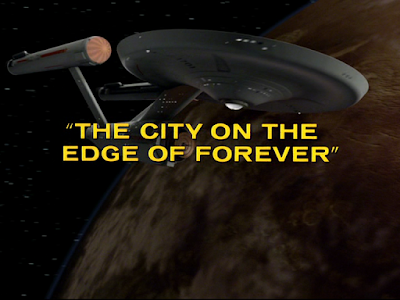
“Let me help” (Thoughts on “The City on the Edge of Forever”, on its 50th anniversary)

Edith Keeler: And you, um, don’t want to talk about it? Why? Oh. Did you… did you do something wrong? Are you afraid of something? Whatever it is, let me help.
Capt. Kirk: “Let me help.” A hundred years or so from now, I believe, a famous novelist will write a classic using that theme. He’ll recommend those three words even over “I love you.”
Fifty years ago today, “The City on the Edge of Forever” aired for the first time. This episode of Star Trek is, for me, not only the best episode of any Trek series ever filmed, but it’s also the best Trek story of all time. It’s one of the great science fiction stories, one of the great science fiction romances, one of the great time travel stories, and its ending packs one of the greatest gut-punches ever.
If you’ve never seen it…you should. Really. The story doesn’t really require a huge amount of knowledge of Trek. The Enterprise is investigating strange “ripples in time” that are emanating from a particular planet, and during one such jolt, Dr. McCoy accidentally injects himself with an enormous overdose of a drug that drives him temporarily insane. He flees to the planet surface, and Kirk follows, with Spock and some others. They find themselves in the ruins of an ancient city, with one functioning artifact remaining: a giant portal which is actually a portal through time itself. McCoy, still mad, jumps through and into history, and suddenly the members of the landing party realize that the Enterprise is gone. McCoy has changed history so that the Federation never happened.
With no choice but to try and put things right, Kirk and Spock follow, and find themselves in 1930s New York City. While trying to figure out what McCoy did and where he is, they enter the employ of a woman named Edith Keeler, a visionary who runs a soup kitchen. Kirk falls in love with her…only to have Spock discover that what McCoy did was prevent Edith Keeler from dying in a car accident. If she survives, she lives to found a peace movement that prevents America’s entry into World War II, allowing the Nazis to win and take over the world.
Spock: Jim, Edith Keeler must die.
The story unfolds so organically that the episode feels longer, heftier, than its 50-minute or so running time. The episode feels large, and yet all of its key moments play out on an intimate stage, such as when Jim Kirk and Edith are walking along the street at night and Kirk tells Edith some things about the future, things that don’t even strike her as strange to be hearing from this man she’s just met. And the way she sizes up Kirk and Spock’s relationship:
Edith Keeler: [to Kirk] I still have a few questions I’d to ask about you two. Oh, and don’t give me that “Questions about little old us?” look. You know as well as I do how out of place you two are around here.
Spock: Interesting. Where would you estimate we belong, Miss Keeler?
Edith Keeler: [to Spock] You? At his side, as if you’ve always been there and always will. [to Kirk] And you… you belong… in another place. I don’t know where or how… I’ll figure it out eventually.
Spock: [to Kirk] I’ll finish with the furnace.
Edith Keeler: [to Kirk] “Captain.” Even when he doesn’t say it, he does.

“The City on the Edge of Forever” involves relatively little action. It relies on its character work, showing us that Kirk is falling in love with Edith Keeler before Spock’s discovery that she is the key focal point around which history will pivot. William Shatner, Leonard Nimoy, and Joan Collins likewise turn in amazing work in this episode. Collins’s Edith Keeler is probably the woman in James T. Kirk’s history, the one he could not save even though he desperately wanted to. Her death is the memory that he will carry with him forever. Shatner sells every single minute of this, never once over-emoting, never once going too far. His Kirk doesn’t just fall for a pretty woman. Shatner portrays a Kirk who has just discovered, hundreds of years in his past, a kindred spirit. He has found someone whom he can understand and who can understand him. And when he realizes that he may well have to stand by as she dies…Shatner’s portrayal of a man torn on both sides of the awfullest of dilemmas is so stark, so aching, that it always moves me nearly to tears.
And then the moment arrives.
The script’s other masterstroke is that Spock can’t determine when the awful event will occur. There is no “She dies on November 12, 1937.” This isn’t like Stephen King’s (masterful) 11-22-1963, when we know exactly when the events are going to occur. Kirk has no idea it’s happening, even as we do. He sees her coming back across the street. He starts out to help her…and then he stops. He knows. The moment is upon him, and it unfolds as quickly as it has to. No slow-motion here, no long-held gazes. It comes so quickly that for us, the viewers, it’s almost like–what? Was that it? Oh my God, that was it. Over, that quickly.
But Kirk not only had to let Edith die, his choice — his only choice — was more awful than that. Because Dr. McCoy was there too, and he didn’t know. They had just found him, seconds before, and now McCoy too is watching Edith Keeler walk into the path of the truck. Kirk can’t just stand aside, or stand still, and watch Edith die, because if the script allowed him that much, he’d be able to say later, “I couldn’t have saved her. She was too far away.”
The script doesn’t pull its punches. It doesn’t give Jim Kirk that one possible out, that one possible way he can morally justify it all to himself.
Jim Kirk doesn’t just passively allow Edith Keeler to die. Jim Kirk grabs McCoy and holds him back. Jim Kirk stops McCoy from saving her.
Kirk’s choice is an active one.
McCoy doesn’t know this. He doesn’t know any of it. He only knows that he could have saved her. His voice fills with rage.
McCoy: You deliberately stopped me, Jim! I could have saved her. Do you know what you just did?
And then Spock, summing it up so logically, so heart-breakingly, in a line that no actor other than Leonard Nimoy could have delivered:
Spock: He knows, Doctor. He knows.
One thing about Star Trek II: The Wrath of Khan that has always bothered me was the idea of the Kobayashi Maru test, the idea that a false scenario could somehow test a cadet’s approach to a situation in which there is no possible “victory”. In that movie, Kirk openly says “I don’t believe in the no-win scenario,” and later on, after Spock’s death, he says that he has never really faced death. But in “The City on the Edge of Forever”, he faces both a no-win scenario, and he faces death. The idea that Kirk can later on claim otherwise has always seemed deeply false to me. Maybe he’s blocked the memory of Edith Keeler? Maybe it’s so painful that he doesn’t admit it in either case? Certainly Kirk never mentioned her again in any filmed episode or movie, which isn’t that surprising given the tendency of teevee shows back in that period to not mention previous events much. But the story here, this love between starship captain and soup-kitchen owner three hundred years before his time, is so iconic, and it carries so much weight, that it’s almost offensive to me to think that a James T. Kirk can exist who isn’t carrying her memory around. Maybe better, then, if in reply to his son David’s accusation that he never has faced death, Jim Kirk were to say, “There was one. She died saving us all, too.”
But then, you can’t have too many mentions, either. Trek would never again visit that City on the Edge of Forever, except in one episode of the animated series, and with good reason. No story involving the Guardian of Forever could possibly stand up to comparison with this one. Trek would not eschew time travel, by any means, but this particular means was left as a singular part of Trek mythology. I wonder if any Next Generation writers were tempted to visit it. I’m glad they didn’t. It is interesting, though, that Jean-Luc Picard would get his own kind of iconic time-travel story in “The Inner Light”, as would Benjamin Sisko in “The Visitor”.
James T. Kirk is an explorer at heart, and an adventurer. But his experiences in the past, via the Guardian of Forever, have a profound effect on him. At episode’s end, when he and Spock and McCoy return to the present with everything restored, the Guardian appeals to that part of his soul, offering to guide him and the others through history. What an offer to someone whose life is charged with boldly going! And yet, all Kirk can muster in that moment is a gruff, “Let’s get the hell out of here.”
“The City on the Edge of Forever” is the kind of story I dream of writing. For a single one-hour episode of a teevee show to hit so many emotional highs and lows? To linger in the memory as it does? I wonder if, as they were shooting it — maybe at the first table read — anyone either thought or muttered, “They’ll still be talking about this one in fifty years.”
Who knows? If my health permits, I’ll still be talking about this episode when it hits one hundred.

