Yeah, y’all need to step it up.

We’ve all known someone who had one significant accomplishment, and then on the basis of that one achievement they enjoyed notoriety and reputation based on that one achievement, though they never managed to come close to achieving anything on that scale again, right?

Yes, I’m talking about the Ides of March.

The Death of Julius Caesar (1806), by Vincenzo Camuccini (1771-1844)

Share This Post

Apollo at 56 (a repost)

Yesterday was the anniversary of the first lunar landing, when Eagle, the Apollo 13 mission’s Lunar Excursion Module, landed on the moon at the Sea of Tranquility. This is a repost of what I’ve posted in the past on that date. (We were out and about yesterday, hence the lack of posting.)


Sam Seaborn: There are a lot of hungry people in the world, Mal, and none of them are hungry ‘cause we went to the moon. None of them are colder and certainly none of them are dumber ‘cause we went to the moon.

Mallory O’Brian: And we went to the moon. Do we really have to go to Mars?

Sam Seaborn: Yes.

Mallory O’Brian: Why?

Sam Seaborn: ‘Cause it’s next. ‘Cause we came out of the cave, and we looked over the hill and we saw fire; and we crossed the ocean and we pioneered the west, and we took to the sky. The history of man is hung on a timeline of exploration and this is what’s next.

–from “Galileo Five”, season two of The West Wing, written by Aaron Sorkin

Anniversaries are a good thing, even if they’re leavened with the weight of years of thwarted expectations and deferred dreams, as the First Lunar Landing’s is: Why have we never gone back? Why are we stuck in low-Earth orbit? Was it all just politics and none of it the call of the stars?

But such anniversaries are a bit of a balm in times such as these, when humanity seems bound and determined to roll back on itself like some kind of distended, drunken serpent consuming its own tail in a weird and awful version of an ouroboros. We can look back on the Apollo missions as a reminder of the kinds of things humanity can do when the primary motive isn’t necessarily profit.

I was born in September 1971, which means that I have never lived in a world where the Moon was not a place where humans have gone. I hope that I live to see a day when the Moon is no longer the only place other than Earth that we’ve gone.


From Pale Blue Dot by Carl Sagan:

It’s a sultry night in July. You’ve fallen asleep in the armchair. Abruptly, you startle awake, disoriented. The television set is on, but not the sound. You strain to understand what you’re seeing. Two ghostly white figures in coveralls and helmets are softly dancing under a pitch-black sky. They make strange little skipping motions, which propel them upward amid barely perceptible clouds of dust. But something is wrong. They take too long to come down. Encumbered as they are, they seem to be flying — a little. You rub your eyes, but the dreamlike tableau persists.

Of all the events surrounding Apollo 11‘s landing on the Moon on July 20, 1969, my most vivid recollection is its unreal quality. Neil Armstrong and Buzz Aldrin shuffled along the gray, dusty lunar surface, the Earth looming large in their sky, while Michael Collins, now the Moon’s own moon, orbited above them in lonely vigil. Yes, it was an astonishing technical achievement and a triumph for the United States. Yes, as Armstrong said as he first alighted, this was a historic step for the human species. But if you turned off the byplay between Mission Control and the Sea of Tranquility, with its deliberately mundane and routine chatter, you could glimpse that we humans had entered the realm of myth and legend.

We knew the Moon from our earliest days. It was there when our ancestors descended from the trees into the savannahs, when we learned to walk upright, when we first devised stone tools, when we domesticated fire, when we invented agriculture and built cities and set out to subdue the Earth. Folklore and popular songs celebrate a mysterious connection between the Moon and love. The word “month” and the second day of the week are both named after the Moon. Its waxing and waning — from crescent to full to crescent to new — was widely understood as a celestial metaphor of death and rebirth. It was connected with the ovulation cycle of women, which has nearly the same period — as the word “menstruation” (Latin mensis = month, from the word “to measure”) reminds us. Those who sleep in moonlight go mad; the connection is preserved in the English word “lunatic”. In the old Persian story, a vizier renowned for his wisdom is asked which is more useful, the Sun or the Moon. “The Moon,” he answers, “because the Sun shines in daytime, when it’s light out anyway.” Especially when we lived out-of-doors, it was a major — if oddly tangible — presence in our lives.

The Moon was a metaphor for the unattainable: “You might as well ask for the Moon,” they used to say. Or “You can no more do that than fly to the Moon.” For most of our history, we had no idea what it was. A spirit? A god? A thing? It didn’t look like something big far away, but more like something small nearby — something the size of a plate, maybe, hanging in the sky a little above our heads. Ancient Greek philosophers debated the propositon “that the Moon is exactly as large as it looks” (betraying a hopeless confusion between linear and angular size). Walking on the Moon would somehow have seemed a screwball idea; it made more sense to imagine somehow climbing up into the sky on a ladder or on the back of a giant bird, grabbing the Moon, and bringing it down to Earth. Nobody ever succeeded, although there were myths aplenty about heroes who had tried.

Not until a few centuries ago did the idea of the Moon as a place, a quarter-million miles away, gain wide currency. And in that brief flicker of time, we’ve gone from the earliest steps in understanding the Moon’s nature to walking and joy-riding on its surface. We calculated how objects move in space; liquefied oxygen from the air; invented big rockets, telemetry, reliable electronics, inertial guidance, and much else. Then we sailed out into the sky.

The Moon is no longer unattainable. A dozen humans, all Americans, have made those odd bouncing motions they called “moonwalks” on the crunchy, cratered, ancient gray lava — beginning on that July day in 1969. But since 1972, no one from any nation has ventured back. Indeed, none of us has gone anywhere since the glory days of Apollo except into low Earth orbit — like a toddler who takes a few tentative steps outward and then, breathless, retreats to the safety of his mother’s skirts.

Once upon a time, we soared into the Solar System. For a few years. Then we hurried back. Why? What happened? What was Apollo really about?

For me, the most ironic token of that moment in history is the plaque signed by President Richard M. Nixon that Apollo 11 took to the Moon. It reads: “We came in peace for all mankind.” As the United States was dropping 7.5 megatons of conventional explosives on small nations in Southeast Asia, we congratulated ourselves on our humanity: We would harm no one on a lifeless rock. That plaque is there still, attached to the base of the Apollo 11 Lunar Module, on the airless desolation of the Sea of Tranquility. If no one disturbs it, it will still be readable millions of years from now.

Six more missions followed Apollo 11, all but one of which successfully landed on the lunar surface. Apollo 17 was the first to carry a scientist. As soon as he got there, the program was canceled. The first scientist and the last human to land on the Moon were the same person. The program had already served its purpose that July night in 1969. The half-dozen subsequent missions were just momentum.

Apollo was not mainly about science. It was not even mainly about space. Apollo was about ideological confrontation and nuclear war — often described by such euphemisms as world “leadership” and national “prestige”. Nevertheless, good space science was done. We now know much more about the composition, age, and history of the Moon and the origin of the lunar landforms. We have made progress in understanding where the Moon came from. Some of us have used lunar cratering statistics to better understand the Earth at the time of the origin of life. But more important than any of this, Apollo provided an aegis, an umbrella under which brilliantly engineered robot spacecraft were dispatched throughout the Solar System, making that preliminary reconnaissance of dozens of worlds. The offspring of Apollo have now reached the planetary frontiers.

If not for Apollo — and, therefore, if not for the political purpose it served — I doubt whether the historic American expeditions of exploration and discovery throughout the Solar System would have occurred. The Mariners, Vikings, Pioneers, Voyagers, and Galileo are among the gifts of Apollo. Magellan and Cassini are more distant descendants. Something similar is true for the pioneering Soviet efforts in Solar System exploration, including the first soft landings of robot spacecraft — Luna 9, Mars 3, Venera 8 — on other worlds.

Apollo conveyed a confidence, energy, and breadth of vision that did capture the imagination of the world. That too was part of its purpose. It inspired an optimism about technology, an enthusiasm for the future. If we could fly to the Moon, as so many have asked, what else were we capable of? Even those who opposed the policies and actions of the United States — even those who thought the worst of us — acknowledged the genius and heroism of the Apollo program. With Apollo, the United States touched greatness.

When you pack your bags for a big trip, you never know what’s in store for you. The Apollo astronauts on their way to and from the Moon photographed their home planet. It was a natural thing to do, but it had consequences that few foresaw. For the first time, the inhabitants of Earth could see their world from above — the whole Earth, the Earth in color, the Earth as exquisite spinning white and blue ball set against the vast darkness of space. Those images helped awaken our slumbering planetary consciousness. They provide incontestable evidence that we all share the same vulnerable planet. They remind us of what is important and what is not. They were the harbingers of Voyager‘s pale blue dot.

We may have found that perspective just in time, just as our technology threatens the habitability of our world. Whatever the reason we first mustered the Apollo program, however mired it was in Cold War nationalism and the instruments of death, the inescapable recognition of the unity and fragility of the Earth is its clear and luminous dividend, the unexpected final gift of Apollo. What began in deadly competition has helped us to see that global cooperation is the essential precondition for our survival.

Travel is broadening.

It’s time to hit the road again.

Someday we’ll look up with wonder again. Someday we’ll go. I firmly believe that.


Footage of Walter Cronkite’s live broadcast of the lunar landing. Note his happy amazement at what he gets to report, at the 1:58 mark. He takes off his glasses, shakes his head, and smiles at the person next to him. I can’t help contrasting that with another moment when, while reporting on air, he had to remove his glasses and shake his head with disbelief, less than six years prior to this moment.


And I know it’s not the right mission, but for the movie Apollo 13, James Horner managed to really catch some of the unbridled optimism of the entire Apollo era.


Seriously, humans: when are we going back, and when are we going farther?


Share This Post

“The personality of the photographer, his approach, is really more important than his technical genius.” –Lee Miller

Sheila O’Malley has a typically amazing post about photographer Lee Miller, about whom I need to learn more because she is fascinating and because of photography:

Much of her history was erased through decades of obscurity and a total and shameful lack of a proper archive where her accomplishments get proper credit. Her son discovered a treasure trove of over 60,000 photos and negatives, and slowly but surely Miller is taking her proper place. More work needs to be done. There are biographies out now, and art books featuring her photos, and there have been a couple of very prominent exhibitions, heavily covered in the press.

Sheila outlines much of Miller’s life, and all of it is fascinating. I keep wondering: Why is this woman not a more household name? She was in Hitler’s apartment hours after his suicide. Her clothes were still spattered with mud from Dachau, and she wiped her feet on Hitler’s bath towels and took a bath in his own tub. Why had I never heard this?

Well, I’ve heard it now, and another name goes on my “Photographers to Study” list.

Share This Post

On the Romance of Old Maps

Roger wrote a lovely post the other day about old maps:

When I was growing up, my grandfather, McKinley Green, gave me the maps included in his subscription to National Geographic magazine.

I still have many of those old maps he provided from about 1958 to 1971 when I went to college. For a time, I thought to throw them out. But there’s a fascinating thing about these documents. They become historical relics.

Remember Czechoslovakia and Yugoslavia, which are now multiple countries? East and West Germany, now one nation? British Guyana and British Honduras, now Guyana and Belize, respectively?

I, too, love old maps, because they go from being a depiction of the world to being a depiction of the way humans used to view the world, and that in itself is informative. It shows how far we’ve come, for instance, to look at a map of a heavily-colonized Africa from a century ago to a map of an Africa where, for good or ill at any one point of time, the nations there are self-determining.

Old maps aren’t just about history; they can even be political items in themselves. Witness this sub-story from an episode of The West Wing, which has all the scenes from this little subplot edited together:

Setting aside the notion of why President Bartlet would want to hang a map of the Holy Land in 1709 in a West Wing office in the first place, the question raised here–would the map’s presence there imply anything regarding official American Israel policy–is a good one.

One of my favorite reference books is a tome I boosted from one of the Discard piles way back in 1989 or so, when I had my first part-time job working in the Technical Services department of the library at St. Bonaventure University. It’s simply titled, Historical Atlas, and that’s exactly what it is.

The book was pretty beat-up around the edges when I liberated it. I assume that the book was being discarded because it had been replaced with a volume that was more up-to-date. I’ve determined that there was at least a ninth edition of Shepherd’s book. Obviously his work was updated by other individuals, as Shepherd himself died in 1934.

The book is loaded with fascinating historical maps: Europe in the age of exploration, for instance, or near-view maps of a typical medieval cloister, or maps of the trade routes to Asia in the Renaissance, and more. The maps within this book aren’t just informative, they are beautiful to behold.

What’s interesting, in the “meta” sense, is that these maps have become historical items in several ways. These maps always depicted the world as it was at some point, so they don’t age in quite the same way that a new NatGeo map does; historical maps serve as a retroactive freezing of one moment in time, after all. But they also capture how history was done, decades ago; these maps demonstrate what was prioritized for historians and how they looked at the world back in those days. These maps capture history in a double way: not just depicting history, but the history of history.

Here are several of the maps from Historical Atlas:

Finally, a nod to the greatest old map I have ever seen, because you don’t just see it, you walk through it: the Mapparium at the Christian Science headquarters in Boston, MA. Now, setting aside the rather odd set of beliefs that lie at the heart of Christian Science, the Mapparium itself is a stunning exhibit. It is literally a walk-through globe, three stories high, with the maps painted on individually backlit panes of stained glass. You take this all in from a glass walkway that crosses the globe along an equatorial diameter. The effect is deeply affecting (and not just because the acoustics inside the Mapparium make all whispers audible anywhere you stand); there’s something about standing inside a truly proportional representation of our world that’s incredibly moving. The Mapparium is, however, another example of a depiction of a world gone by; the maps have not been updated since the thing was built in the 1930s, so you still see places like French Indochina and the still-uncolonized Africa.

Of course, the best old maps are the ones that lead to treasure, but that’s a-whole-nother thing!

Share This Post

“Dick, sometimes I understand why they hate you.” Nixon, 30 years gone

A few days after Richard Nixon died (on this date, 1994), I was out riding around with my father as he did some errands. We stopped at the post office in the town where we lived, and Dad noticed that the flag was at half-staff. He asked why, and I said something like, “Well, a former President died–“

At that my father sputtered and said, “The flag’s down for NixonThat piece of shit?!”

Dad hated Richard Nixon. Hated him. Mom did too. Dad hated Nixon so much that he was angry at Gerald Ford for the rest of his politically-aware life (“Nixon should have gone to jail,” he would often say), and in his office at St. Bonaventure he had on the wall a poster (or maybe it was something he trimmed from a magazine or newspaper) that was a fairly unflattering picture of Nixon, captioned with “Everything he is today, he owes to a free press.”

When I went to college in Iowa, I met people who thought Nixon was just A-OK in their book. He did the same kind of shady shit they all do, you see! Nixon just got caught! That was my first real encounter with the deep cynicism of the American right.

Nixon was President when I was born, and he was gone from the scene before I even turned three, so I was never aware of Nixon as a political figure in any real capacity. I remember seeing him in interviews and wondering how that guy, with his gravely voice and complete lack of any real charisma, not only got elected but then reelected in one of the biggest victories ever. But Nixon was never a reality for me. Nixon was an abstract thing, to be honest.

Nixon was the first President of my lifetime, and he was also the third to die in my lifetime; Truman and Johnson were the first two. His passing in 1994 was a surprisingly big story, as I recall.

My main feeling on Nixon is shaped by, of all things, a film: Nixon, by Oliver Stone. I was excited when the film came out, as I already counted JFK among my favorites (I still admire it greatly, as paranoid and insane as its history actually is). I had to see Nixon by myself, as The Girlfriend (now The Wife) was not interested in another three-hour Oliver Stone political potboiler, and my mother scoffed at the concept, too: “I lived through that bastard once, I don’t need to sit through a goddamned movie about him.”

Nixon remains for me something of a classic. Here is a post I wrote back in 2010 after I rewatched it. I wouldn’t change a word of this.

Oliver Stone’s Nixon is an amazing film. I kind of wish Stone was still making movies like this: densely packed films that overwhelm the audiences with information and tell their tales in complex, non-linear ways. Well, maybe Stone still is making movies like this; in truth, I haven’t kept up with his career much over the last ten years.

It’s easy to see Nixon as a companion piece to the earlier JFK, and in many ways, it almost is. But it’s also a very different film, even while using many of the same techniques of the earlier film. Nixon is more meditative, more of a character study, than a film interested in posing a particular hypothesis, as was JFK. (To a certain extent, anyhow – people often refer to “Oliver Stone’s conpiracy theory” regarding the JFK assassination, but when you actually watch the film, no real, concrete hypothesis is ever actually advanced.)

Nixon seems generally focused on the way that the very strengths, or gifts, or skills that allowed Richard Nixon to ascend to the highest political office in the United States were the ones that brought about his downfall. A “tragic hero” will often have a bunch of good qualities, and one not-so-good quality that causes everything to fall apart. Nixon, however? His power came via his paranoia, and deserted him by the same route.

The film opens with a brief educational film about salesmanship (“What you’ve got to remember, Bob, is that you’re selling yourself!”), and then we’re into the story proper. The overall device of the film is Nixon, alone in his study during a series of nights toward the end of his Presidency, reflecting on the events of his past, most often by listening to his infamous tapes of his Oval Office conversations. The film is told in a series of flashbacks, then, and not always in the real order of events, but in the more real way in which we tend to remember things: the memories that surface as they seem relevant to the events of our present-day lives. At times, Nixon is remembering past political events, and at others, he is remembering past personal moments with Pat, the love of his life.

To me, the question of authenticity with regard to a film like this misses the point. I remember watching discussions of the film on news shows when it came out, back in 1995, and the topic always seemed to revolve around the extent to which Stone captured the “real Nixon”. Some folks attacked the film on that basis, others praised it; I remember one commentator – I think it may have been Bryant Gumbel – who said, “I don’t think it’s the Nixon, but rather a Nixon”. That seems pretty astute to me. Those closest to Richard Nixon seemed fairly adamant that Stone did not depict the “real Nixon”, but even those closest to us don’t know our real selves as well as they might think. Is Stone’s Nixon a “real” Nixon? I suspect that he captures some of Nixon’s qualities well, others not so well. I also suspect that Stone emphasizes some of Nixon’s qualities a bit in the interest of making a better movie. I think that Nixon is to Richard Nixon as Henry V is to King Henry the Fifth.

Of special interest to me when I watched Nixon a couple of weeks ago was the way no one ever really spells anything out directly. Nixon himself seems to be talking in code with his assistants much of the time, and at no point does anyone say, “Hey, we should break into the DNC offices at the Watergate and see what we can find out.” At no point does Nixon say, “We need to cover this up!” Everything is happening, or has already happened. This plays into one of Stone’s themes of the film, which is stated outright in the scene of the odd moment (which really happened) when Nixon left the White House in the middle of the night, went to the Lincoln Memorial, and ended up interacting with the protesting kids there. Referring to the war, one girl says: “You can’t stop it, can you? You’re powerless.”

Stone conveys this as well with a lot of fascinating cinematography. As in JFK< he employs a lot of different looks and styles throughout the film, sometimes shooting things “straight”, while other times using black-and-white, or making the film very grainy in spots, or using lots of fades and superimpositions of stock footage to convey the magnitude of the issues Richard Nixon faced or the hugeness of his character. In many “Presidential” films or teevee shows, such as The American President or The West Wing, the White House is shot as a beautiful place where our patriotism and commitment to democracy is literally made physical. No so in Nixon; the White House here is an ominous place, and place of fear and dread in the face of historical forces that cannot be tamed.

Stone often frames scenes from odd angles, and many scenes depict dark shadows contrasting with brilliant light streaming in through windows. An early scene shows Nixon in his personal study, sitting beside a roaring fireplace while the air conditioning is on at full blast.

Nixon seems increasingly shocked, over the course of the film, to learn just how little control even a President gets to have over the forces around him, and by the time he really comes to grips with this, he is on the brink of ending his Presidency. Even late in that particular game, though, he continues to assert that a lack of control was what got them, in the end: “We never got our story out,” he says to Alexander Haig. Nixon relishes the moments, all too few, when he gets to feel as though he is in control, such as when he puts a wealthy donor in his place or chews out Henry Kissinger. But he also reacts with increasing anger when his efforts at control fail, such as when a press conference goes awry or when his own wife tries to criticize him over dinner.

That brings me to the film’s central relationship, that of the marriage of Richard and Pat Nixon. It’s really an amazing relationship, as movie marriages go; it is not depicted as a relationship of blind love that is independent of everything else in Richard Nixon’s life, nor is it depicted as Pat’s Lady Macbeth to Richard’s Macbeth, with Pat being ambitious and desiring of power all her own and only being in the marriage because it’s the best route for a woman to real power in mid-20th century America. Pat Nixon is shown as being literally the only person in Richard’s life who is ever willing to criticize him or tell him when he’s wrong, but she is also there for him through everything, except for one brief period when she considers divorce. Even then, however, Richard brings her back from the brink, and even after all of her disgust during the long unfolding of Watergate, when Richard at last stands alone in the White House on that last night of his Presidency, ruined and emotionally drained and devastated, it’s Pat who comes to him and gives him the only consistent shoulder he’s ever known on which to lean.

Nothing in this movie would work without some great performances by the cast, and there isn’t a single weak link among them. Stone assembles an astonishing supporting cast here; so much so that if this movie had been made in the 1970s, the posters would have included one of those rows of thumbnail photos of the stars along the bottom. James Woods, Bob Hoskins, M. Emmet Walsh, Saul Rubinek, EG Marshall, Madeleine Kahn, Tony Goldwyn, Mary Steenburgen, David Hyde Pierce, Ed Harris, and the like – Nixon might be the single most star-studded film of the 1990s to not feature Kevin Bacon in any role at all. But the two performances that center the film, that absolutely ground it, are Joan Allen as Pat Nixon, and Anthony Hopkins as Richard.

The film made a pretty wise choice as regards the “look” of Richard Nixon. They didn’t go overboard in trying to make Hopkins look like the genuine article; they gave him roughly the same haircut and I assume some prosthetic teeth to make his smile look more Nixonian, but after that, they relied on Hopkins to do it all through the magic of acting. He plays Nixon as a somewhat hunched-over, physically awkward, gravelly-voiced man who never seems to exude much by way of charisma, but rather gets what he wants from others because he simply won’t accept anything else. Nixon is a bundle of nervous energy, and Hopkins plays him as a man who sweats too much, grins at odd moments, and can’t figure out what to do with his own hands.

Hopkins’s performance is endlessly fascinating to me, coming as it does in the same period as a number of other performances by him that are all unique: there is nothing of Hannibal Lecter to be found in Hopkins’s Richard Nixon; nor is there to found any of Mr. Ludlow from Legends of the Fall, CS Lewis from Shadowlands, or anyone else. Hopkins’s Nixon is really a singular creation, so much so that the spell is actually broken twice over the course of the film, both involving Oliver Stone’s use of archival footage from the Nixon years. One is of a Nixon mask, being paraded about at a protest rally; the features are distorted, but we can still see that it’s a mask of the real Nixon; the other is at the very end of the movie, when Stone shows us footage of the real Mr. And Mrs. Nixon walking to Marine One for their final departure from the White House.

Joan Allen’s Pat Nixon is equally remarkable, because hers is a quieter performance as the only person who gets to talk back to Dick Nixon and not only get away with it but be able to stick around afterwards. She is, by turns, thrilled by him, devoted to him, angered by him, disgusted with him, and in the end, deeply empathetic to him. We can see the pain on her face when she sees him, alone in the White House, talking to the portrait of John F. Kennedy, in one of the film’s finest moments (“When they look at you, they see what they want to be. When they look at me, they see what they are.”) The keenest moment of insight as to Nixon’s character – as the film depicts it – comes when Dick is gearing up for his 1968 run for President, six years after he’s sworn to Pat that he’s done running for office. She is angry that he has been making plans without telling her, but she still feels the old hunger and the pain from the last two losing campaigns has mostly faded, so she is willing to stand with him once again – in fact, she even hungers for it herself, telling him “This time, we’re gonna win. I can feel it.” And Dick takes her in his arms and dances, in the best Nixonian fashion: awkwardly and gracelessly.

John Williams’s score for Nixon is, to my mind, one of his more underrated efforts. He juxtaposes a cheerfully optimistic Americana sound with more downbeat and dark music as Nixon begins to spiral out of control. Stone closes the film with a musical choice that seems odd, at first, but is really amazingly fitting: the Mormon Tabernacle Choir’s a capella rendition of Shenandoah. There isn’t much in the film by way of period popular music, as instead Stone relies on Williams’s sound world to help immerse us in the world of Dick Nixon.

As with JFK, a companion book was released for Nixon, containing the film’s screenplay, a number of archival documents (including transcriptions of the Nixon tapes), and essays by the filmmakers, historians, and figures from the Nixon administration (John Dean and E. Howard Hunt). Here is an excerpt from an essay by Christopher Wilkinson, one of the film’s writers:

The more we got to know Nixon, the more it struck us how odd he was. He was a man who referred to himself in the third person and called his wife “Buddy”. He was physically awkward, socially graceless, and sexually repressed. Other than Bebe Rebozo, he had no real friends. When he needed to relax, he would just sit silently with Rebozo. For hours. Bob Haldeman was with him for nearly twenty years and never shook his hand.

The was a strange man, an extremely strange and mysterious man.

I cannot remember the precise moment when we started to empathize with Nixon. To begin to understand the tragedy of his life. To appreciate the true dimensions of his character.

Nixon came from nothing – the wrong schools, the wrong clothes, the wrong parents – and, by dint of hard work and self-sacrifice, rose to the heights. In many ways he is the American Dream incarnate, the self-made man who tortured himself to be a Somebody. And he never gave up. He came off the canvas again and again, rehabilitating himself, reinventing himself. Admittedly, the notion of Nixon the Indestructible is often trotted out to evoke sympathy for him.

But it’s true.

There are other poignant and peculiar details that reached us, that slowly eroded our contempt. The emotionally distant mother who rarely touched him. The brutish father who directed fits of blind rage at him. The lonely, clumsy boy who was sure that no matter what he did, he would never be good enough.

And the dead brothers. First his beloved little Arthur. Then Harold, outgoing, attractive, a boy Richard idolized. A boy whose lingering death allowed the family to afford Richard’s tuition to law school.

The guilt.

When Nixon fell in love with Pat, he drove her on dates with other boys to prove himself to her. He wore her down with a barrage of flowers and letters. He would do whatever it took to win her and he never let up until she was his.

Classic Nixon.

The only clean campaign he ever ran was 1960. Kennedy (like Harold) was everything Nixon was not – handsome, charming, articulate, witty. Nixon could have used any number of smear tactics against him; the religion, the Mob connections, the women. But he didn’t. He respected Jack Kennedy more than any opponent he had ever faced. So, for the only time in his political life, Nixon played it straight.

And Kennedy stole the election from him.

The fact that he didn’t completely come apart during the crushing pressure of the final days of Watergate is a testament to his bullheaded resolve. To his perverse brand of courage. Everyone was against him. The country wanted his head on a pike and he wouldn’t give it to them. A lesser man might have run screaming and drooling down Pennsylvania Avenue. Or had a stroke. Or committed suicide. But not Nixon. He wouldn’t give them the satisfaction.

As President, he did more to desegregate the schools than any of his predecessors. He created the first and most effective Environmental Protection Agency. He has few (if any) Presidential peers in foreign policy: the spectacular opening of China, achieving detente with the Russians. Accomplishments that Nixon, the quintessential Commie hunter, was uniquely suited for. If a liberal Democratic President had tried it, he would have been crucified.

And Nixon would have brought the nails.

Nixon stretched our idea of what greatness is. He is a huge character who embraces the entire American landscape from its loftiest ambitions to its most malignant schemes. To understand Nixon is to understand what we have been. To understand Nixon’s destiny is to understand what has happened to us. To understand Nixon’s life is to understand the history of our times.

What strikes me now, on reflection, is the way the Nixon political playbook has come to dominate American politics in our day, forty years after Nixon held office, with its dirty tricks and coded appeals to our baser instincts. But Nixon’s actual policy goals now form the farthest boundary to the left that our politics are willing to allow voice. It’s amazing to me that if a Republican candidate came along now, espousing Richard Nixon’s policy goals, that candidate wouldn’t even make it out of the primaries. Things that a Republican President did forty years ago would be labeled as unforgivably liberal — Socialist, even — if a Democrat did them today.

What a great, disturbing film this is. Just like Richard Nixon himself.

Share This Post

“A vision in splendor of the great kings of old”

For lack of anything better to post today, here’s a rundown of the British monarchy, all the way back.

Credit unknown. I searched but could only find more uncredited versions of this.

Note Edward VIII, saying a hearty “Nope!” to the whole thing.

Full-size version here. (And if you’re the artist, let me know! Or tell me to take it down, whichever you prefer.)


Share This Post

Nine Score and One Year ago….

March 4 was the original date mandated by the US Constitution for the commencement of Presidential terms, which means that March 4 was Inauguration Day. This was later changed with the 20th Amendment, which moved the Presidential term of office’s beginning to noon on January 20, and there it has remained ever since.

This means that today is the 181st anniversary of perhaps the most infamous of Inaugural ceremonies (well, prior to the one that unfolded on January 20, 2017, that is). I’m talking about the swearing in of President William Henry Harrison.

President William Henry Harrison. His legacy, unfortunately, lives on mostly as the answer to questions in Trivial Pursuit and JEOPARDY!.

President Harrison was the paternal grandfather of a later President, Benjamin Harrison, and he was also the last President born initially as a subject to the British Empire. Until Ronald Reagan, Harrison was the oldest man ever elected President. But what happened at that inauguration on March 4, 1841 that was so infamous?

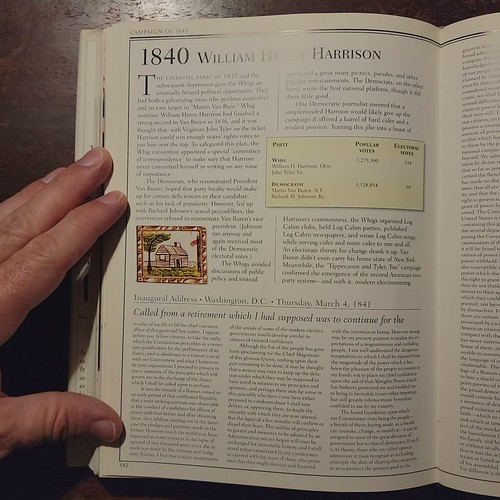
He gave the longest Inaugural Address in history. It was over 8000 words long, it took him two hours to deliver, and he refused to dress warmly for the weather, which was cold and damp.

I own a book of Presidential history that includes the texts of all the Inaugural addresses (up to, I think, Barack Obama’s first), and here’s the text of President Harrison’s speech:

20220304_064109

Imagine standing there for two hours in wet cold drizzle listening to this! Imagine standing there for two hours in wet cold drizzle, with no overcoat, delivering this speech! A stemwinder, it ain’t.

And from this, Harrison went on to a very long (three hour) parade, and then he attended Inaugural Balls late into the night. So of course…he caught cold.

The cold became pneumonia.

President Harrison became, one month later, the first President to die in office. This resulted in a Constitutional crisis because the Founding Fathers hadn’t specified exactly how presidential succession, outside of an election, was supposed to work. (Quite honestly, there’s really way too much ambiguity in our nation’s founding documents for me to worship the guys who wrote them all that fervently, but that’s just me.)

Harrison’s successor, John Tyler, is also mainly known for being a trivia answer: the first Vice President to become President, a President who was elected to the Confederate Congress later on, and–as of this writing, anyway–a President who was born in 1790 but who, thanks to an apparent habit of men in his line to father children late in life, has a living grandson to this day.

More recently, I noticed several years ago, when I was obsessively listening to Lin-Manuel Miranda’s great musical Hamilton obsessively, that for scansion purposes, “William Henry Harrison” has the same number of syllables as “Alexander Hamilton”! This has led me to try to get Mr. Miranda’s attention on Twitter now and again:

So far, Mr. Miranda has resisted my suggestion…but I know it has to be eating away at him! It just has to!


Share This Post