I will not be taking questions at this time.


The official site of Kelly Sedinger: Reader, writer, photographer, and dreamer
The Buffalo Bills beat the Kansas City Chiefs last week, which they do just about every season when they play each other. But the last bunch of years, when the two teams have met again in the playoffs, the Chiefs have won. Two of those have come in the AFC Championship Game, and one of them is one of the most notorious playoff games in NFL history, the epic shootout in which the Bills took a 36-33 lead with 13 seconds left in the 4th quarter, but somehow they allowed the Chiefs to get to field goal range in those 13 seconds, tying the game and sending it to overtime, where the Chiefs promptly scored a touchdown to win 42-36. (In an illustration of the NFL’s ongoing stupidity when it comes to overtime rules, if the first team with the ball scores a touchdown, it’s game over…so Josh Allen never touched the ball again after he left the field with a lead.)
Even though Josh Allen has played very well in all of those playoff games, the narrative has formed: Allen is basically nothing until he beats the Chiefs in the playoffs. None of his accomplishments matter until he beats the Chiefs in the playoffs. He’s just another guy until he beats the Chiefs–no, until he beats Patrick Mahomes–in the playoffs. Try to point out that he has played more than well enough to win every one of those games, and it’s been the defense allowing Mahomes and the Chiefs the victory every time, and you get ignored. No, Allen has to beat the Chiefs. Allen has to beat Mahomes. So it must be, or he will forever be judged as less than.
Setting aside the increasingly annoying tendency in American sports discourse to vastly overrate championships as the only things that matter, the only true marks of greatness, and the only valid measure of worth…it’s been very strange to me to see this clunky narrative be forced upon Josh Allen and the Bills. It has almost reached a point where I genuinely believe that if the Bills (a) put together a playoff run, reached the Super Bowl and won it, but (b) didn’t meet the Chiefs in the playoffs during that run, the country’s sports discourse would put a virtual asterisk on the Bills’ win. I really believe that the Bills could win multiple Super Bowls, but if they somehow don’t beat the Chiefs during any of those title runs and get beat by the Chiefs every other time, their accomplishments would be downgraded. It sucks, but that’s just the way it is. It would literally almost be better for the Bills to beat the Chiefs in the playoffs but not win a Super Bowl, than to win the Super Bowl but never knock the Chiefs out.
Basically, American sports discourse is simply insane. I guess that’s reflective of the society itself, innit?
Here we go again! No, I’m not watching. I haven’t actually watched a Super Bowl since Seahawks-Broncos, and that was eleven years ago. (And I doubt I’d have watched had the Bills made it, in all honesty. That would be way too stressful!) Anyway, here’s some random trivia if you want to show off to your friends at your Super Bowl party.
That’s all! Enjoy the game, or whatever you end up watching instead of the game!

I don’t blog about football much at all anymore, obviously. I used to be the kind of obsessive football fan who watched every down of every game the Buffalo Bills played, and then I’d write an extensive blog post about the game after. By the time I was blogging, the Bills were mostly not very good, and most of those posts were post-mortems for a loss. Eventually I stopped watching the games entirely and I almost never blog about the Bills anymore.
So this post is not going to be a resumption of regular Buffalo Bills content. However, I just have to say something about the season that ended last weekend with yet another colossal disappointment at the hands of the Kansas City Chiefs. The AFC Championship Game wasn’t quite as galling a defeat as the infamous “Thirteen Seconds” game from three years ago, but it’s pretty close, and yesterday at work I overheard on the radio one of the local sports talk guys hinting that the community may soon be done talking about this one. I scoffed at that, noting to a friend that locals will be dissecting this game all the way up to kick-off of next season’s opener. Hell, we’re still talking about Thirteen Seconds.
Hell, we’re still talking about Wide Right.
So, here are some random and uncollected thoughts about the game and the season that’s now over:
:: This year was supposed to be a temporary step back for the Bills as they reloaded and spent time developing some young players into hopefully the core of the next sequence of contending teams. A bunch of the core players from the last few years of constant Super Bowl contention parted ways with the team due to age or money, and those that remained are noticeably on the tail end of their careers. The Bills have a bunch of very promising young guys coming up, but the overwhelming feel was that the Bills would have an “off” year this year. Preseason predictions of a 9-8 season, missing the playoffs entirely, were common. The Jets and Dolphins were both popular picks to win the AFC East. Instead, both of those teams sucked and the Bills roared to a 13-4 record, winning the division easily as a lot of those “not ready yet” players stepped up.
Given that, and the fact that the Bills have a lot of picks in the upcoming draft and they’ll have some more salary cap room to play with (for several reasons I’m not bothering going into, their cap situation this season was not ideal), it’s not at all hard to see the Bills managing to improve their already talented roster for 2025. It’ll take some time, but eventually the sting of the AFC Championship Game will give way to the brightness of the future.
:: So, what do they need to do in the offseason? Well, everybody’s got opinions. Here’s mine: the offense is mostly fine. Maybe a true “Number One” receiver could be added, someone to reliably make the big plays and attract the double teams that allow the rest of an already-talented receiving corps to step up even more than they did this season. Basically, they could use Stefon Diggs 2.0, a younger version of the Diggs they had in 2020 and 2021. (Not so much the 2023 incarnation, whose production tailed off and who was notably cantankerous on and off the field.)
There’s been a lot of kvetching about how to “fix” the offense so it can beat the Chiefs, but thing is, the offense is good enough to beat the Chiefs. They’ve beaten the Chiefs in the regular season matchups each year over the last few seasons, and while yes, they’ve gone on to lose to the Chiefs in the playoffs, in those last three games they have scored 29, 24, and 36 points each. Yes, in each game they got fatally outscored, but those numbers do not paint the picture to me of a team that needs more firepower. And besides, historically the NFL team that has the most scoring firepower in the regular season often ends up getting beaten eventually in the playoffs or in the Super Bowl because at some point defense actually becomes important. Remember that Broncos team that scored something like 947 points in the regular season and then got smoked in the Super Bowl by the Seahawks by something like 48-8? Or the “Undefeated Patriots” who piled up points at will in the regular season and then got held to 14 points in the Super Bowl by the Giants? So yeah, I’m skeptical about the whole “Put all the eggs in the offensive basket” approach.
So obviously, I think the defense needs the most attention. This year the D lived and died by the created turnover, which is never a confidence-inspiring thing. The pass rush was generally inconsistent, and the linebackers were often banged up. The secondary did what it could, but eventually the injuries piled up there, too, and even a good secondary is going to have a rough time if the front seven aren’t rushing the passer. A lot of people want the secondary improved, but my personal focus would be the front seven. Add a couple pieces to the D-line, particularly a solid and consistent edge rusher, and maybe another linebacker.
For people who say that the way to win is to pile up offensive talent, I point to the Chiefs themselves. They were a score-score-score kind of team the last few seasons, but this year they shifted to a more defensive philosophy, which yielded a 15-2 season, and yet another Super Bowl appearance, in a year in which they scored 30 or more points exactly twice all year.
And another way to look at it is this: improving on defense can actually help your offense score more, by virtue of taking pressure off the unit to score every time and by giving it more chances to take the field.
:: It needs to be noted that the 2024 Bills were really, really good. They set all manner of team records. There’s no need for a major re-tooling here. There’s always a danger in thinking otherwise, especially when it’s the same team that seems to be eliminating you each and every year. But aside from the 2022 season, when the Bills just ran out of emotional gas after the Damar Hamlin injury and got thumped at home by the Bengals in the playoffs, each playoff loss comes down to just a couple of plays that could have gone the other way, or just a couple of instances where a shift in tactics might have produced a winning result. I don’t envy trying to figure out how to “get over the hump” when you’re just that close to doing it.
:: I have no idea how to solve this problem, but it seems like the Bills’ defense is an injury-riddled M*A*S*H unit every year at playoff time, while everybody else is getting healthy for their Super Bowl run.
:: And then there’s the officiating. Yeah, the NFL has a problem here. No, I don’t believe that the NFL is “scripted”, but there’s a definite sense to which there’s a thumb on the scale. Calls are made for the Chiefs that aren’t made for anyone else, or vice versa, and situational calls almost always seem to favor the Chiefs. The Chiefs know this, too; there was a play in last week’s game where the Chiefs got a big catch, and the Nationally Beloved Travis Kelce came running in after the play to get in the face of one of the Bills’ defensive backs for some taunting. It was incredibly obvious taunting, too…but no penalty flag was forthcoming, until another of the Bills got in Kelce’s face to tell him to knock it off, at which point Kelce threw up his arms and flopped to the ground on his back, as if he’d been clobbered (which he hadn’t), and then the refs tossed the flag. Against the Bills. That kind of shit is supremely irritating, and the Chiefs are widely known to engage in flag-baiting. And there really does appear to be an unwritten NFL policy of “When the Chiefs ask for the flag, give it to them.”
I saw a commentator on Tiktok at some point this week (sorry, I can’t remember who), who made the point about the officiating this way, roughly paraphrased: “Take away this contested catch that was awarded the Chiefs, or that first down which was denied the Bills. Take away all those specific calls, and you still have a problem, because in this game you had one team whose defense had to play with the feeling that they were not allowed to hit the other quarterback, and another team whose defense played knowing that they could hit the other quarterback with impunity. If the NFL doesn’t think that’s a problem that needs to be addressed, I don’t know what to say, other than, I’m glad I’m not watching the games anymore.
:: I wonder: do the Bills have to beat the Chiefs to be taken seriously at this point? If they go out next season and somehow end up winning the Super Bowl but their playoff run somehow does not include Kansas City, how much downplaying of their championship will end up happening?
:: If there’s a more endearing out-of-nowhere team-and-fan tradition than the entire stadium singing “Mr. Brightside” at some point, I don’t know what it is.
:: The mood surrounding this team this year has been absolutely infectious, and it’s easy to see why it hurt so many people so badly when it ended before it felt like it should have. This was probably the most genuinely likeable Bills team ever, and I don’t know if I’ve ever seen a pro athlete more adept at always saying the right things than Josh Allen. All of that said, I continue to wish that the Buffalo Niagara region didn’t invest so much of its emotional well-being in the NFL team.
:: As noted above, I’m still not watching the games, and in general I keep the NFL at arms-length nowadays. To check out of football completely probably isn’t feasible, because I do still like talking to people and football is a major topic around here. I’m as suspicious of the NFL in particular and football in general as I’ve always been, though: the public money being used to build the stadium, the increasingly uncomfortable partnership between the NFL and the military (look, I get as excited as anybody for big military planes flying overhead, but every game now gets a flyover???), and the brain-injury thing isn’t going anyway (sometime in the next 20 years we’ll probably be reading some very sad news stories about Tua Tagovailoa). Not watching the games and investing 3 hours a week in closely observing the NFL has done wonders for my mental health. Even last week, when the score went final, I was able to say, “Well, they lost. Wanna watch another episode of Scrubs?”
:: Finally, there’s a thing you hear sometimes when your team loses in the playoffs: “Root for the team that beat your team, so you can say that at least your team lost to the best.” That’s where all of my old football (and sports in general) fan mindset comes out, because screw that. I want the team that beats my team to get the shit kicked out of them, as quickly as humanly possible. So, as I think they say in Philly, Fly Eagles fly!
And it might just happen. I don’t know that the Chiefs have faced a team as balanced as the Eagles all season, and that sadly includes the Bills.
:: More finally, pitchers and catchers report for the 29 teams of Major League Baseball (and their AAAA affiliate Pittsburgh Pirates) anywhere from 8 to 12 days from this writing. Play ball!
:: Oh, and last finally, I’m officially sick of the Kelces (both of them) and I wish they’d go away.
(Every year now, social media around the 716 lights up on the anniversary of the Bills-Oilers wildcard playoff game in January 1993, almost always simply called “The Comeback Game”. I wrote these thoughts a couple years ago when that record comeback was finally exceeded. I’ve been thinking a lot, more recently, about the degree to which numbers have taken over sport discourse in this country, and some of these thoughts might be pertinent to the current “race” for the NFL MVP award.)
From The West Wing, Season Three, “Stirred”:
VICE-PRESIDENT HOYNES: I heard you had Caps tickets.
SAM: Yes, sir.
HOYNES: How was the game?
SAM: Not very good.
HOYNES: Have you ever seen a good hockey game?
SAM: No.
HOYNES: Me neither. I love sports, I just can’t get next to hockey. See, I think Americans like to savor situations: One down, bottom of the ninth, one run game, first and third, left handed batter, right hand reliever, infield at double play depth, here’s the pitch. But scoring in hockey seems to come out of nowhere! The play-by-play guy is always shocked. “LePeiter passes to Huckenchuck who skates past the blue line. Huckenchuck, of course, was traded from Winnipeg for a case of Labatts after sitting out last season with–Oh my God, he scores!”
A warning for those who don’t care about football: Football blathering ahead!
In the Wild-Card weekend following the 1992 NFL season, the Buffalo Bills famously fell behind by 32 points, 35-3, to the Houston Oilers before coming back to eventually win the game in overtime, 41-38. The comeback was the greatest in NFL history…until just a few weeks ago, when the Minnesota Vikings fell behind 33-0 to the Indianapolis Colts before coming back to win, 39-36. So the Vikings now hold the record for the greatest NFL comeback of all time.
But…do they?
Well, obviously in one very key sense, yes, they do. The numbers don’t lie: a 33-point deficit is greater than a 32-point deficit. And much of the “debate” that followed as to whether this was really the greatest comeback of all time centered on Buffalo fans who just don’t want what’s probably their franchise’s greatest singular on-field accomplishment erased. That’s the problem with records like that: every record can be erased, or pushed to second place, eventually. Championships are forever, but records are transitory, and a record that stands for 30 years before being pushed to second place is still the second-place record. So yeah, I get it.
But…that’s a pretty starkly numerical way of looking at things, isn’t it?
You can’t escape numbers in sports. Numbers are bound up in sports. They are inescapable…probably because numbers are inescapable in life, but really, numbers are sometimes everything in sports. Tom Brady’s 7 Super Bowl rings, Nolan Ryan’s 7 no-hitters. Ted Williams, last guy to hit .400. The idea then shapes out that numbers, more than anything else, tell us everything about what happens on the field. I remember quoting Fox Mulder from The X-Files a while back, talking about how he can look up a fifty-year-old box score in a yellowing newspaper and know exactly what happened on the field that day, all because of the numbers captured in that box score.
But…can he?
I mean, he can, to a certain degree. But the numbers don’t tell everything.
You can’t look at a box score and tell how blue the sky was that day, or what it smelled like in the park because maybe the breeze was coming from the lake or the industrial park the other way (in Buffalo, with the cereal plants downtown, it often smells of Cheerios). A box score won’t tell you how scuffed up the first baseman’s jersey is after several close plays, or how the catcher is still trying to work off the gimpy ankle from that play at the plate last Tuesday night. The box score won’t tell you the crowd’s mood: Are they giddy and jubilant, or are they kind of grumblingly negative because the team’s having a rough season and they’re sarcastically cheering the guy hitting .197 who just managed to leg out a weak grounder safely to first?
The box score won’t tell you if the players are attacking an early season game with vigor, or if they are visibly just playing out the last few weeks of the schedule, mired in fifth place and just wanting nothing more than to go home and rest for about a month. The box score will tell you that a particular player homered in the sixth, but it won’t tell you that he was on a hot streak and he came up against a tiring pitcher who probably should have already been pulled and who had of late been surrendering homers to right-handed hitters at a surprising rate for a guy who, up to a few weeks before, had been almost unhittable.
Numbers are great and important and useful…but they are also a flattening force, a force that tends to flatten out story. A baseball player who collects more than 3000 career hits is almost guaranteed a spot in the Hall of Fame…but is that all that player does? All I really know about Robin Yount is that he hat 3000 hits in his career. That’s numbers: for me they reduce a Hall of Fame player to a guy who had roughly 150 hits a year over his 20-year career.
But, what if I ask a person who has been a Milwaukee Brewers fan their whole life, “Hey! Tell me about Robin Yount?” Then, I’m not going to hear about 3000 hits. Then, I’m going to hear stories.
Sport isn’t just numbers, it’s also stories. I think that’s why we follow sport so adamantly as a species–well, partly, anyway. I don’t want to discount numbers, after all. But numbers aren’t the whole story.
This suggests to me that there’s another kind of greatness at play here, when we talk about “Greatest Comebacks”: situational greatness, we can call it. Or storytelling greatness? The New England Patriots trailed the Atlanta Falcons 28-3 a few years back in the Super Bowl–and they came back to win it. That’s a 25-point comeback, still a full touchdown “less” than the Bills’ against the Oilers…but 25 points down in the Super Bowl? You have to give that some special consideration, I think, because comebacks just don’t happen in the Super Bowl. The previous record for biggest comeback in a Super Bowl had only been 10 points. That means something.
And it also means something that the Bills’ comeback against the Oilers was a playoff game, at home, after a season that had been a bit of a struggle, when the Bills were banged up and missing several starters (including their quarterback and running back), and had been beaten soundly just the week before by that very same Oilers team. The Vikings’ comeback? A regular season game, at home, relatively healthy, against one the worst teams in the NFL that built its lead on a pile of field goals. The box score will tell you the Vikings overcame the biggest numerical point deficit in an NFL game to date. The box score won’t tell you the other stuff, and the other stuff is what we talk about when we sit over a beer and discuss old sports memories.
So. Is the Vikings comeback the greatest in history? Numerically, yes. Absolutely. Thirty-three points is more than thirty-two points.
But I doubt as many people will still be talking about that game thirty years from now as are still talking about that game in January 1993 when a backup quarterback erased a 32-point deficit in a playoff game.
(Credit for West Wing quote. Disclaimer: I do not endorse the fictional Vice President’s opinion of hockey.)

I rarely write about sport on this site anymore, but I’m going to broach the topic here just for a few minutes because there’s an interesting debate raging across social media right now regarding the NFL MVP award, and which players are worthy. As of this writing, there are four players I see mentioned most frequently. The two that I think aren’t likely to win it are Bengals quarterback Joe Burrow and Eagles running back Saquon Barkley. The debate is really swirling around the other two guys: Bills and Ravens quarterbacks Josh Allen and Lamar Jackson.
I’m not going to actually lay out the case for either player here. As a Buffalonian and someone who roots for the Bills, I openly admit that yes, I think it’s perfectly clear that Josh Allen is the MVP this year. It’s obvious, you weirdos! Just give it to him already. It’s a done deal. It’s in the bag.
But…is it?
Obviously, not really. Lamar Jackson is having an amazing statistical season; in fact, if you were to only look at the numbers, Jackson is obviously the MVP. It’s a done deal. It’s in the bag.
Only, it’s not.
The problem is with the nature of the MVP award itself. It’s an award that’s voted on by a number of sports journalists, and like all such things, it’s a weird blend of stats and narrative. Some years the stats win out, sometimes it’s the narrative that wins out. Sometimes the MVP is given to the player who obviously had the best statistical season, while others it’s a vaguer justification–the best player on the best team, perhaps. That last is one of the bigger reasons for supporting Allen over Jackson this year: as of this writing the Bills have the better record, having already won their division and being on the brink of clinching the Number Two seed in the AFC playoffs, while Jackson’s Ravens have lost more games and may not even end up winning their division (though that looks likely at this point).
It’s the word in the award itself: the most valuable player. And that makes the whole thing a judgment call, basically an opinion. Is Lamar Jackson more valuable to his team than Josh Allen? I don’t know that he is. I also don’t know–really know–that he isn’t. So what we end up with is conflicting opinions, and let’s be honest here: those opinions can shift and change depending on who it is we’re rooting for. (Right now we’re not even going to mention the fact that NFL MVP is now a de facto award for quarterbacks alone; it’s been 12 years since anyone other than a QB won it, and it’s been 38 years since anybody on the defensive side of things won one. And in a pass-whacky league, a wide receiver has never won it.)
Here’s a thought experiment: consider all the argument for Josh Allen for MVP, and all the arguments for Lamar Jackson as well. Now imagine if these two guys were having the exact same seasons–but they played on the opposite teams. Imagine Allen leading the Ravens to a 12-3 record (again, as of this writing), having set all manner of offensive records over his first bunch of years, and the stunning individual performances he’s had in single games this season. And imagine Lamar Jackson playing for the Bills, and putting up the passing numbers he’s put up this year.
If that happened, you would see each camp still advocating strongly for their guy–but with the exact opposite set of arguments.
I do tend to react strongly against purely statistical justifications for MVP awards. I’m not a fan of reducing everything to stats, because I’m a storyteller and a story-lover at heart, and stats aren’t stories. Stats can be a part of stories, but they’re not the whole thing. Josh Allen’s story in Buffalo is amazing and compelling, and when one considers the degree to which he’s played a role in the resurgence of a franchise and the emotions of a fandom (we can talk another time about how maybe a football team’s fortunes in the field probably shouldn’t be this big of a factor in a region’s emotional life), and the role he has come to inhabit in this community, it’s hard to make a case that he’s not incredibly valuable. And most people agree on this point. So is he the most valuable? Maybe, maybe not.
The NFL MVP award turns out, in some ways, to be similar to the Oscars: it’s all about aesthetics and recognition, as opposed to rewarding a true “objective” standout. It’s clear that even with the statistical arguments, there’s no real “objective” standard of a player’s value, so again it’s the narrative that comes in to play. That also happens with the Oscars, where sometimes an actor is awarded an Academy Award less for the particular role for which they’re nominated but as a nod of respect to a career. For Josh Allen, the narrative case is strengthened when various aspects of his career are noted: the degree to which he has been responsible for the Bills winning a lot, the fact that the Bills have enjoyed an even better season this year after an offseason that left many thinking the Bills would take a step back, the further fact that Allen has significantly improved the major aspect of his game that was often criticized before this year (his turnovers).
The other problem with stats is that if a player with gaudy stats is truly the most valuable, then surely it should show up in the win-loss column. One standout weird example of this is from Major League Baseball, which in 1987 awarded National League MVP to Andre Dawson, because he had an outstanding season at the plate (49 HRs). Never mind that his team that year, the Cubs, finished dead last. Was Dawson “valuable”? Well, I’ve seen that debated here and there over the years. The NFL does have ways of avoiding this sort of thing, with its additional awards of “Offensive Player of the Year” and “Defensive Player of the Year”. MVP, then, becomes something else. Something more elusive, dealing with those pesky “intangibles”.
So, what’s my solution? Obviously, I’m a Josh Allen guy. However, there is precedent for doing something more daring: in 2003, the NFL MVP was split, and we had co-MVPs in Peyton Manning and Steve McNair. If that happened again, it would not bother me at all. (Nor, really, would Lamar Jackson winning MVP outright.) Another thing that’s always struck me as odd is why the NFL’s awards are singular. Baseball has multiple sets of awards for each league, so there is no one Baseball MVP; there’s a NL MVP and an AL MVP. Why not a AFC and an NFC MVP? (This wouldn’t help the current situation, obviously, since Allen and Jackson are both AFC guys.)
But ultimately, aside from my thinking there should be awards from both conferences, I don’t much have a problem with any of this. It gets people talking about sport and it shows the passion in the fanbases. More than anything, all these MVP candidates show what a glorious period of football this is, and how much it’s an embarrassment of riches right now. Unfortunately not many people are taking it this way, and that’s a shame. Rooting for Josh Allen surely doesn’t have to mean that I can’t appreciate the amazing football that Lamar Jackson is playing right now.
One last point: sooner or later in all of these discussions one point inevitably gets made: “Neither Allen nor Jackson has ‘won anything’ yet.” This refers to the fact that neither guy has won the Super Bowl (or even been to it) yet. And yes, that does suck. One thing I dislike about the NFL is that for whatever reason, it’s much more conducive to dynasties forming, and this is compounded by the weird way that sports fans (and some commentators) overvalue championships above all else. This is natural, I suppose–winning the Super Bowl is everybody’s goal–but I have a problem with looking at someone’s career as “lesser” if they simply never managed to win it. There’s only one Super Bowl every year, after all, and many fine careers play out in the NFL (or in any sport) that don’t include a championship. Every time I see the “Allen doesn’t have a ring!” thing on social media, I like to respond along these lines: “I have bad news for you if you ever visit the Pro Football Hall of Fame, because I’ll bet most of the guys in there never won a Super Bowl.”
So much of sport is narrative, as much as the folks who love stats would pretend otherwise. Look at Aaron Rodgers and the narrative over the course of his career. Of course, right now the narrative on Rodgers is pretty much that he’s a washed-up weirdo who is going to leave the Jets on the verge of a full-on rebuild, but for years, his story was that he’d have a great regular season, lead the Packers to one of the best records in the NFC, and then faceplant in the playoffs. Year in and year out, that’s what happened…and if any other player had that kind of record, our sporting world would label him a “choker”, fairly or not. So why was Rodgers never labeled a “choker” at all? Because one time, early in his career, he actually won a Super Bowl.
Winning a championship completely changes the narrative of a player and a coach. Win one, and all previous “failures” (and again, it’s a hell of a thing to view all sporting effort that doesn’t produce a championship a “failure”) are forgiven and forgotten. Win one early in your career, and nothing that happens after will ever diminish your sheen: you are a Champion forevermore. Rodgers illustrates the latter, and the former is illustrated perfectly by Chiefs coach Andy Reid. Reid coached the Philadelphia Eagles in the late 90s and the 2000s, and he took them to multiple NFC Championship games (losing all but one) and to one Super Bowl (which he lost). Until Reid won his first Super Bowl with the Chiefs, he was the most recent poster child for the “He can’t win the big one! He coaches small in big moments! He can’t manage a game! He can’t get the team ready to win a Super Bowl!” crowd. But all those years of falling short still happened! They’re right there in his record! But he won a Super Bowl finally (along with, as of this writing, two more), so all of that is forgotten and ignored.
Ultimately, the NFL MVP is a shifting blend of narrative and statistical excellence. This season, there’s enough of both to go around for multiple players, so much so that the award will honestly feel partially incorrect, no matter to whom it’s given in the end.
Unless it’s Josh Allen. If that happens, everything is right in the world.
He retired. Again.
Will this retirement stick?
Maybe, maybe not. Maybe He’s retiring so he can just wait until the first week of August, after training camps are half over, and then sign wherever He feels like signing to keep on keeping on.
Do I want Him to go? Sure. He’s been an annoying presence in the part of my brain that can’t quite give up on football (stupid part of my brain, I hate it so much) for twenty-three years. Put it another way: He has been an irritating presence for forty-five percent of my life. It’s long past time for that percentage to start going down.
Is He the “greatest of all time”? I suppose He is, for multiple ways of defining “great”. But remember, numbers aren’t the only measure of greatness, and I’m a storyteller at heart anyway. For me, all of This Guy’s stories were annoying stories, maddening stories, stories that shouldn’t have ended the way they did if not for the people opposing Him doing stupid shit at key moments.
He didn’t make the other head coach decide to only hand the ball off to his running back, who at the time was the best RB in the game, only 17 times against a defense that was bad against the run, thus playing into His own head coach’s defensive scheme.
He didn’t make the other team’s kicker boot the ball out of bounds immediately after the other team tied it up with a minute to go, thus giving Him only needing to move the ball about 25 yards in 60 seconds to set up a game-winning field goal.
He didn’t make the other head coach engage in very odd clock management in a close game, thus seriously damaging his team’s ability to overcome in the end. (That particular head coach is an interesting case, because he was once the poster-child for the “Can’t win the big game!” trope, but now, since he did win the big game a single time three years ago, he is currently viewed as one of the reigning super-geniuses of football.)
He didn’t make the other team decide to, in Gregg Easterbrook’s terminology, go “pass-wacky” with a big lead in the second half and thus manage to kill no time and wear out its defense so He could execute a 34-28 win after being down 28-3. (A reminder: as thrilling as it is when your team executes a big comeback, big comebacks are always at least partly due to the losing team getting dumb when it has the lead.)
He didn’t make the other team decide that throwing the ball from a goal-to-go situation when they had a RB who was, at the time, one of the very best RBs in football, was a good idea, and He further didn’t make the other team decide that the passing play to call was a low-success rate play that ended up getting picked off by His team.
He didn’t…well, you get the idea. And yes, anyway, those dumb errors are (for the most part) gifts of situations, and it was still up to Him to make the best of those situations. But it certainly felt that He got way, way, wayyyyy more than his fair share of flukey situations.
He didn’t somehow manage to make the other three teams in the division he played most of his career suddenly get very bad at drafting talent for the better part of two decades.
He was involved in multiple significant cheating scandals, resulting in His team getting a couple of wrist-slaps from the league. That first wrist-slap was particularly egregious, with the Commish destroying all the evidence without letting anybody else see it and then handing down a punishment designed to seem harsh but really amounted to, yes, a wrist-slap.
He also somehow managed to play 23 seasons (He missed one entire season with an injury sustained in Week One, and the next year He came back like he’d never missed a beat), but more than that, He played 47 playoff games as well, which means that He played almost 26 seasons worth of football over those 23 years, which is mind-boggling given the nature of this particular game. I’ve heard it said that “Everyone has a conspiracy theory that they actually believe,” and mine is that there’s no way His longevity is explained by good offensive lines, His getting the ball out quickly, His avoiding inflammatory foods, and His going to bed every night at 8pm. Maybe at some point Gisele lets something slip about weird medical procedures he had done every off-season in Buenos Aires or some such thing.
He also benefitted greatly from a gradually-shifting NFL rulebook that literally made beating him harder. The book on beating Him has always been pretty simple to state, if hard to do in practice: get physical pressure on Him, especially from up the middle. He hated getting hit, and in any game where He started getting hit more than usual, He would start getting jittery in the pocket and His accuracy would suffer and if the pressure kept coming He would eventually just start making bad decisions. The best example of this was Super Bowl 42, where He played under pressure all game, His NFL-best offense could only muster 14 points, and when He got the ball back with a minute to go and down by three, He couldn’t even get His team to field-goal range. (A similar scenario unfolded again just four years later, against that very same Giants team, and when he missed a key pass by throwing the ball behind his intended receiver, his wife came out after the game and criticized the receiver publicly!) If I had Aladdin’s lamp, I might well burn one of my three wishes to see Him start a full NFL game against, say, the ’85 Bears, the ’89 49ers, or the ’91 Redskins. I do not believe He would have flourished quite so well against a defense built to succeed under that NFL rulebook.
(An aside here about His most recent Super Bowl defeat, in Super Bowl 52: Is there any more flukey championship in recent sports history than that one? The Eagles rolled through the regular season behind a quarterback who was having a terrific year until he got hurt, and then the backup quarterback stepped in and kept right on rolling all the way to victory in that Super Bowl, despite the fact that He had probably the best single passing game in Super Bowl history that day, throwing for more than 500 yards, 3 touchdowns, and zero interceptions! He lost that game, and after that, both of the Eagles’ quarterbacks from that season regressed to the point where now they’re just journeymen guys knocking around the league and not really doing anything impressive at all. The one game He had where I have to admit His greatness was an unbelievably improbable loss.)
Oddly, He recently got some very odd flak on social media when He posted something about spending time with his kids. I guess even that was a bridge too far for the self-appointed alpha-males of the world. Even I have to admit that when He isn’t “alpha” enough, maybe we need to rework the concept a little.
So, assuming that He is actually ending his career now, He is moving on to a broadcasting gig at FOX. This means that I will rarely see him, since I watch almost zero football on teevee these days. (I don’t know what the nature of His broadcasting work is supposed to be–whether He is going to be a studio guy or one of the booth commentators on game day.) I’m sure He’ll be fine at that job, and I certainly don’t wish Him ill…but like many other fans, I certainly wish Him off the field for good, because He was just that annoying.
And yes, He was great. Sheesh.
From The West Wing, Season Three, “Stirred”:
VICE-PRESIDENT HOYNES: I heard you had Caps tickets.
SAM: Yes, sir.
HOYNES: How was the game?
SAM: Not very good.
HOYNES: Have you ever seen a good hockey game?
SAM: No.
HOYNES: Me neither. I love sports, I just can’t get next to hockey. See, I think Americans like to savor situations: One down, bottom of the ninth, one run game, first and third, left handed batter, right hand reliever, infield at double play depth, here’s the pitch. But scoring in hockey seems to come out of nowhere! The play-by-play guy is always shocked. “LePeiter passes to Huckenchuck who skates past the blue line. Huckenchuck, of course, was traded from Winnipeg for a case of Labatts after sitting out last season with–Oh my God, he scores!”
A warning for those who don’t care about football: Football blathering ahead!
In the Wild-Card weekend following the 1992 NFL season, the Buffalo Bills famously fell behind by 32 points, 35-3, to the Houston Oilers before coming back to eventually win the game in overtime, 41-38. The comeback was the greatest in NFL history…until just a few weeks ago, when the Minnesota Vikings fell behind 33-0 to the Indianapolis Colts before coming back to win, 39-36. So the Vikings now hold the record for the greatest NFL comeback of all time.
But…do they?
Well, obviously in one very key sense, yes, they do. The numbers don’t lie: a 33-point deficit is greater than a 32-point deficit. And much of the “debate” that followed as to whether this was really the greatest comeback of all time centered on Buffalo fans who just don’t want what’s probably their franchise’s greatest singular on-field accomplishment erased. That’s the problem with records like that: every record can be erased, or pushed to second place, eventually. Championships are forever, but records are transitory, and a record that stands for 30 years before being pushed to second place is still the second-place record. So yeah, I get it.
But…that’s a pretty starkly numerical way of looking at things, isn’t it?
You can’t escape numbers in sports. Numbers are bound up in sports. They are inescapable…probably because numbers are inescapable in life, but really, numbers are sometimes everything in sports. Tom Brady’s 7 Super Bowl rings, Nolan Ryan’s 7 no-hitters. Ted Williams, last guy to hit .400. The idea then shapes out that numbers, more than anything else, tell us everything about what happens on the field. I remember quoting Fox Mulder from The X-Files a while back, talking about how he can look up a fifty-year-old box score in a yellowing newspaper and know exactly what happened on the field that day, all because of the numbers captured in that box score.
But…can he?
I mean, he can, to a certain degree. But the numbers don’t tell everything.
You can’t look at a box score and tell how blue the sky was that day, or what it smelled like in the park because maybe the breeze was coming from the lake or the industrial park the other way (in Buffalo, with the cereal plants downtown, it often smells of Cheerios). A box score won’t tell you how scuffed up the first baseman’s jersey is after several close plays, or how the catcher is still trying to work off the gimpy ankle from that play at the plate last Tuesday night. The box score won’t tell you the crowd’s mood: Are they giddy and jubilant, or are they kind of grumblingly negative because the team’s having a rough season and they’re sarcastically cheering the guy hitting .197 who just managed to leg out a weak grounder safely to first?
The box score won’t tell you if the players are attacking an early season game with vigor, or if they are visibly just playing out the last few weeks of the schedule, mired in fifth place and just wanting nothing more than to go home and rest for about a month. The box score will tell you that a particular player homered in the sixth, but it won’t tell you that he was on a hot streak and he came up against a tiring pitcher who probably should have already been pulled and who had of late been surrendering homers to right-handed hitters at a surprising rate for a guy who, up to a few weeks before, had been almost unhittable.
Numbers are great and important and useful…but they are also a flattening force, a force that tends to flatten out story. A baseball player who collects more than 3000 career hits is almost guaranteed a spot in the Hall of Fame…but is that all that player does? All I really know about Robin Yount is that he hat 3000 hits in his career. That’s numbers: for me they reduce a Hall of Fame player to a guy who had roughly 150 hits a year over his 20-year career.
But, what if I ask a person who has been a Milwaukee Brewers fan their whole life, “Hey! Tell me about Robin Yount?” Then, I’m not going to hear about 3000 hits. Then, I’m going to hear stories.
Sport isn’t just numbers, it’s also stories. I think that’s why we follow sport so adamantly as a species–well, partly, anyway. I don’t want to discount numbers, after all. But numbers aren’t the whole story.
This suggests to me that there’s another kind of greatness at play here, when we talk about “Greatest Comebacks”: situational greatness, we can call it. Or storytelling greatness? The New England Patriots trailed the Atlanta Falcons 28-3 a few years back in the Super Bowl–and they came back to win it. That’s a 25-point comeback, still a full touchdown “less” than the Bills’ against the Oilers…but 25 points down in the Super Bowl? You have to give that some special consideration, I think, because comebacks just don’t happen in the Super Bowl. The previous record for biggest comeback in a Super Bowl had only been 10 points. That means something.
And it also means something that the Bills’ comeback against the Oilers was a playoff game, at home, after a season that had been a bit of a struggle, when the Bills were banged up and missing several starters (including their quarterback and running back), and had been beaten soundly just the week before by that very same Oilers team. The Vikings’ comeback? A regular season game, at home, relatively healthy, against one the worst teams in the NFL that built its lead on a pile of field goals. The box score will tell you the Vikings overcame the biggest numerical point deficit in an NFL game to date. The box score won’t tell you the other stuff, and the other stuff is what we talk about when we sit over a beer and discuss old sports memories.
So. Is the Vikings comeback the greatest in history? Numerically, yes. Absolutely. Thirty-three points is more than thirty-two points.
But I doubt as many people will still be talking about that game thirty years from now as are still talking about that game in January 1993 when a backup quarterback erased a 32-point deficit in a playoff game.
(Credit for West Wing quote. Disclaimer: I do not endorse the fictional Vice President’s opinion of hockey.)
I promise that even as the local football club, the Buffalo Bills, may possibly be enjoying their best season ever, I will not turn this blog into a place for frequent football-ish commentary. For one thing, I’m not watching the games anymore; for another thing, football opinion often turns out to be dead wrong, and I’m wrong enough without tempting the Wrong Gods.
But…well, the Bills played at Kansas City the other day, and that is a matchup that many see in today’s NFL as being possibly equivalent to Patriots-Colts back in the 2000s, when those two teams always seemed to be squaring off in memorable contests pitting Tom Brady (boooo!) against Peyton Manning. And in the contest the other day, which ended with a 24-20 Bills victory (at Kansas City, which is amazing enough), there was a play toward the end of the game that typifies the Bills now. Quarterback Josh Allen took the ball and ran with it. Allen is quite the running quarterback, and he doesn’t just “take off and slide before he gets hit”; Allen runs the ball. Earlier in the season he stiff-armed a defender, which was amazing to see, but there’s another thing he does that he’s kind of made his calling-card:
Josh Allen hurdles guys.
He literally jumps over defenders, and he does so in such a way that he comes down and keeps running.
On this particular play, Allen took off. He was running toward the sideline, and then he turned upfield. Chiefs safety Justin Reid–wearing number 20–executed perfect technique to bring down a ball-carrier in this situation. Reid got in front of Allen’s lane, squared his shoulders, lowered himself to make the tackle, and brought up both arms. His arms closed–on nothing.
Because as Reid executed his perfect tackling technique, Allen went airborne and flew right over Reid’s head. Allen then landed and kept running, picking up another few yards, while Reid grappled with nothing but air. It was the kind of play that you almost always remember.
No, I’m not going to be a regular football blogger again. But I have to tip my blogging hat once in a while when something like this happens.

Just…wow.
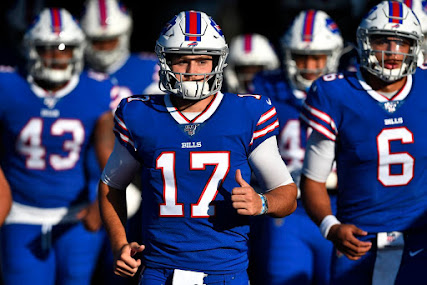

Unless you live in a cave–and a particularly deep, nasty cave with trolls and snakes and giant spiders and whatnot–you probably have heard that in 2020, the Buffalo Bills finally returned to the ranks of the Indisputably Good Teams, after an 18-year stretch of almost unrelentingly bad teams that finally ended with a Pretty Good Team in 2019. This year, the team blossomed in full fire, scoring more points in one season than at any other point in team history. They finished 13-3, and they would have been 14-2 if they had managed to knock down a last-play Hail Mary pass against the Arizona Cardinals. They took the second seed in the AFC, and as I write this, tomorrow night (Saturday night), they play their second playoff game of the year, this time facing the Baltimore Ravens after defeating the Indianapolis Colts last Saturday. That game against the Colts was the Bills’ first playoff win since January 1996.
Longtime readers might remember that I used to be very staunch in my Bills fandom. This began in 1988, to be quite specific. Prior to that, as a kid I’d never been terribly interested in sports, even though my father enjoyed sports quite a lot. I’d root for the Steelers along with him, especially in 1978 and 1979, the final seasons of their 1970s NFL dominance, but once they declined and we moved a few times and both the Steelers and the Pirates went into the doldrums, I stopped caring much at all. Plus, there was probably a bit of the whole “teenage kid doesn’t want to be interested in the same things Dad likes” thing, though I think in my case that was more of getting really into stuff that I loved more than rebelling against stuff that he loved.
I also wasn’t about to get all that interested in football during the mid-80s, when the Buffalo Bills were utterly awful, going 2-14 two years in a row, and drafting a quarterback named Jim Kelly who hated the idea of coming to Buffalo so much that he opted to go play in the USFL instead for a few years, only finally relenting and accepting his Buffalo fate when the USFL folded and he realized that if he wanted to keep on living as a football player, his choices were either Canada or Buffalo. A funny thing happened then, though: the Bills got good, and in 1988, they got really good, and everybody in the region got really happy and excited. I found it hard to be around that and not join in, so that’s about when my football fandom blossomed. Plus it was then that I finally had to ask my father things like “What does ‘first down’ mean?” and “What’s the difference between a field goal and an extra point?” and stuff like that. Took me a while, but I got there. (Likewise, two years later the Pittsburgh Pirates would get good, so all this happened again, with baseball.)
Now, 1988 was the first half of my senior year in high school; in 1989 I went off to Iowa for college, and while it didn’t happen instantly, I did get homesick on occasion. That was when the Buffalo Bills being really good became a godsend: they were on teevee a lot then, because they were really good–four consecutive Super Bowl appearances good. And when they were on teevee, it felt like I was seeing a little bit of home, even if they were playing a road game. I didn’t get to see them on teevee all that much, because they weren’t local, obviously. But they were on a decent amount, and it meant a lot to me at the time, even if they would lose the Super Bowl ever single season.
The Bills stayed good (mostly) through the 1990s, all the way up to the 1999 team, which lost a playoff game on that knife-to-the-heart kickoff return against the Titans, and then they got bad and stayed bad for seventeen years. When I started blogging, though, I was still watching the Bills religiously, and I’d post extensive thoughts about how they played after each game, along with ruminations about how they might improve or…as it happened, not improve. Over time I got less and less interested in blogging about the Bills’ every game, and as the losing mounted, I got less and less interested in watching the Bills. There was a game in the 2009 season where the Bills hosted the Cleveland Browns, and in this game they managed to hold the Browns’ quarterback to just two completed passes. And yet they lost that game, 6-3. Later that same season, they had a game at Atlanta where, having completely fallen out of playoff contention, they decided to start some young quarterback they’d found from somewhere else, and the resulting game was one of the most boring games in football history, a reverse-routing that probably wasn’t even entertaining for Atlanta fans, even though their team beat the Bills 31-7 or something like that.
It was right around then that I started realizing that I wasn’t really enjoying watching the Bills very much, and I likewise started wondering if maybe I shouldn’t stop devoting three hours a week to watching something that didn’t make me happy at all. The next season I decided that I’d watch the games until I started finding them annoying, at which point I’d switch to watching movies or reading or writing. This point came sometime around, oh, week nine or ten of the season (a season is seventeen weeks, with sixteen games played and one week off for each team). The next couple of seasons my point of abandoning the team came earlier each year, until finally I decided to stop watching entirely. Initially I adopted a personal rule of not watching them until they were at least four games over .500, but the last couple of seasons they’ve actually hit that mark, and it turns out that I am so broken of my football-watching habit that I have quite simply stopped watching entirely.
Other fans used to mock this idea; some even called me a “fair weather fan”, as if there’s some kind of obligation involved with being a fan. I continue to resist this notion, as I find the idea that being a “fan” requires that one subject themselves willingly to something that doesn’t bring anyone happiness deeply odd. If watching your football team being bad is making you angry, why keep watching it? I never understood this, and I still don’t.
Nowadays, I still root for the Buffalo Bills and I’m glad that they are doing well right now, with a future that as of right now looks very bright. It’s kind of like that 1988 season all over again: it’s hard not to be excited when so many people around me that I love a great deal are themselves really happy and excited about something, and there’s still a part of me that really does consider itself a “Bills fan”, so even as I’m not watching the games, I’m refreshing the box scores online and checking Twitter once in a while to see what’s going on. Am I back on the bandwagon? I have to admit that I am…a little. I still have a lot of problems with the NFL, things that started standing out like sore thumbs to me when I stopped feeling the need to attend upon the NFL’s product on a weekly basis out of fandom obligation. The NFL’s foot-dragging as the reality of repeated head injuries became clear was very disappointing, as was the reaction by some fans to this, along the lines of “So what? They signed contracts, let ’em get jobs if they don’t want to play football.” Wow, really?
I was also troubled by the NFL’s reliance on patriotic military fetishism as a major part of its marketing strategy, and by the collusion the teams engaged in blacklisting Colin Kaepernick; and I continue to be frustrated by cities using public funds to build palaces for football teams to play in, thus ensuring gigantic profits for their owners for years or decades to come, while those same cities plead poverty when it comes to schools, infrastructure improvements, the arts, or anything at all that’s not a shiny weapon for the police department. I doubt I’ll ever again be the football fan I was when I was in college and watching Jim Kelly, Thurman Thomas, Andre Reed, Bruce Smith, Darryl Talley, and all the rest of those guys on television. I haven’t watched a full football game in at least five years, but I’ll still root for the team and look at replays and read boxscores. And what of that? That’s how baseball fans had to follow their teams’ fortunes before they ever invented teevee, after all.
And it does help that the current Bills team is a pretty likeable batch of players, so for what it’s worth, from this occasional bandwagon fan who finds the NFL kind of creepy…Go Bills!
