At the end of my adventures I was drinking a case of sixteen-ounce tallboys a night, and there’s one novel, Cujo, that I barely remember writing at all. I don’t say that with pride or shame, only with a vague sense of sorrow and loss. I like that book. I wish I could remember enjoying the good parts as I put them down on the page.
At the worst of it I no longer wanted to drink and no longer wanted to be sober, either. I felt evicted from life. At the start of the road back I just tried to believe the people who said that things would get better if I gave them time to do so. And I never stopped writing. Some of the stuff that came out was tentative and flat, but at least it was there. I buried those unhappy, lackluster pages in the bottom drawer of my desk and got on to the next project. Little by little I found the beat again, and after that I found the joy again. I came back to my family with gratitude, and back to my work with relief–I came back to it the way folks come back to a summer cottage after a long winter, checking first to make sure nothing has been stolen or broken during the cold season. Nothing had been. It was still all there, still all whole. Once the pipes were thawed out and the electricity was turned back on, everything worked fine.
—Stephen King, ON WRITING: A MEMOIR OF THE CRAFT
So I actually did some writing today, and oddly…that’s something I haven’t been able to say a whole lot lately.
What’s going on? Am I slowing down? Am I losing my passion for trying to tell stories and create literary tales and whatnot?
Am I losing touch with the written word?
At times that’s what it’s felt like, and it’s been deeply disconcerting, I must admit.
Part of it is the “big elephant” in the room of my recent life over the last, oh, year-and-a-half: Photography. I suppose it’s to be expected that when you find a new passion; the other ones tend to fade a bit. I suppose it’s like that famous meme of the guy taking a second look at a pretty passing woman while his current pretty woman looks at him in consternation. And yes, photography has become a huge passion, that much I can’t deny; and it’s not just that it’s the shiny new thing. It’s that it has given me something new to learn. That’s huge.
Of course, it’s not like I have nothing to learn from writing! How silly would it be for me to claim “That’s it, I’ve learned all there is to know about writing, I now know it all and will go forth and learn no more! All that’s left is just putting down the words!” Of course that’s nonsensical…but writing isn’t new anymore, is it?
I expect that as the weather turns to the colder and more unpleasant, and as my main camera is currently a device that lacks weather-sealing, I will find myself turning back to the literary once again. But there’s something else that’s probably at the heart of my reluctance–no, not that, not reluctance, but rather a lack of enthusiasm for writing of late.
It’s that Mom is gone.
My mother wasn’t huge into enthusiastically cheerleading for my writing. That just wasn’t her style. But she always believed in my ability, and she always made that known. Mom believed in me as a writer probably more than anybody else in my life, and now that source of encouragement and belief is gone. I wonder if that’s a part, in any way, of my general feeling of “Meh” when I would otherwise have been sitting down to write. It’s hard, I think, to keep doing a thing that you’re not always sure you’re really good at when one of your constant sources of possible belief that keeps you going is gone.
But then…the stories get a vote too, don’t they? And they’re not done. Forgotten Stars V is languishing in a holding pattern between edits; I need to get it out to some readers. The Adventures of Lighthouse Boy (not the actual title) is unfinished, and that’s the one I’ve been starting to work on again. Others remain: the second John Lazarus book, The Jaws of Cerberus (my demonic kayak adventure novel), Orion’s Huntress (space opera set in the same world as The Song of Forgotten Stars, but with no overlap), among others. A story cycle set on a fictional Finger Lake in New York, an essay book about Star Wars, another essay book about James Bond…these things aren’t gonna write themselves.
Yesterday I finally completed the first round of The Song of Forgotten Stars, Book Five: Embers of Future Flames. This book has taken a lot longer than I expected, but this phase is finally done.
Also, even though there is a lot more to be done, this entire story is now more than half told. That’s quite a feeling. I embarked on this particular journey roughly 14 years ago, after all.
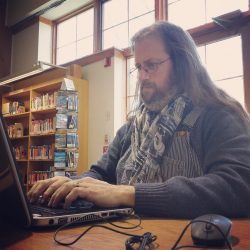
My right hand is a blur, while my left just sits and watches….
Actually, this photo is from yesterday. After taking a couple weeks off from even opening Scrivener once I finished the Forgotten Stars V draft, I launched it yesterday on a project that I’d been noodling with a bit during 2022, but now I want to actually get it done: a collection of various Star Wars-related essays I’ve written over the years, many in this very space! I figure, other folks have gathered their blog entries for collections, why shouldn’t I? I’m starting with Star Wars because it’s personal, and because I’ve written a lot about it. Should be fun!
I’m going to try targeting March 31 for completion of this draft, and then my hope is to return to The Adventures of Lighthouse Boy, the fantasy duology I’ve had shelved for entirely too long. There are another few projects I’d like to get to this year, but I won’t mention those this far out. And then, in 2024, a return to The Song of Forgotten Stars, as well. Lots of work ahead!
Occasionally I find myself discussing the merits of Scrivener, the software I use for novel writing, to other writers who are curious about possibly making the switch (or they haven’t even heard of it), so I thought it might be useful to have a post here to which I can point in the future.
I’ve been using Scrivener for seven years or so, and…well…huh. I wonder if I already wrote about Scrivener back in the day? Let’s go check!
And it turns out that…why yes, I did. And I’m just going to quote that entire post below (at least the part about Scrivener).
Stick around after all of that for a few updated thoughts!
[ahem]
If you’re a writer, and if you share the fact that you’re a writer online and interact with other writer-folks on social media, very quickly you will start hearing about a program called Scrivener. Scrivener changes lives. It revolutionizes. It makes everything better. Scrivener is the Disney World of writing programs: it’s the happiest place on Earth, man.
At least, that’s what I’m told. I’ve been using it for nearly a month, which means that I’m about to exhaust my free trial of the program, at which point I’ll have to decide if I want to pony up $40 to buy the program outright. (You get a thirty-day trial with Scrivener. What’s cool is that the thirty days are non-consecutive; if you use it for the first time on Friday and then you don’t use it again until the next Friday, you’ve only lost 2 of your 30 days, not 7.) So, how’s it going?
Well, the first time I used it, I stared at it for five minutes before recoiling in horror and turning it off. Then, figuring that I needed to actually give it a shot, I launched it again and this time played with the tutorial it comes with. This helped, but not terribly much. I still spent the first few days of my Scrivener use staring at it and wondering how on Earth anyone could possibly use this program to do actual work.
I’m generally a start-and-stop kind of writer. I start writing, I write, and then I stop. I work in linear fashion, only retracing my steps when I need to: if the Muse tells me that I’ve made an error previously, either an error of omission or of simply writing the wrong thing. And I don’t outline. I just don’t, except for in certain very specific circumstances, and then in very limited fashion. I like to launch a writing program and start writing.
But here’s Scrivener, with its cork board and its “binder” and its “inspector” and…oh, the features, man! It’s like if you took someone who has only ever driven a 1975 Chevy Nova and then dropped them in the middle of downtown Pittsburgh with the keys to a 2015 Subaru Outback and said, “OK, get yourself home.” Sure, the steering wheel and the pedals and the shifter would look the same, but our marooned driver would almost certainly look around the dash and say, “Huh-whuh?!” That’s kind of how I felt about Scrivener, and even after nearly a month of getting used to it, I still find myself hopelessly confused by some of its features.
Here’s a screenshot of Scrivener, when you’re in its native writing environment:
But that’s not all! Here’s the corkboard:
Like I said, I really haven’t even begun digging into the various things Scrivener does. But I can say this: Scrivener allows a writer to take a more wide-angle view of their story’s structure, if they are so inclined. By use of the corkboard and the binder (that sidebar on the right that shows all the various chapters and whatnot), you can really see how your story is put together, and you can make changes thusly. Again, I’m not sold on all this as being useful to me, but then, I’m still very new to this program.
I do know other writers who are very much committed to outlining and who will produce detailed outlines of their entire novels (or stories or screenplays or whatever), and then they will write a scene at a time, and sometimes they will work on scenes in nonlinear fashion: ”Let’s see, what am I in the mood to work on today? Well, I need to do the scene where Our Hero confronts the villain in the Carbon-Freezing Chamber, without knowing yet that the villain is actually his father…I think I’ll write that today!” Scrivener makes doing that very easy, as you can lay everything out in terms of structure before you start actually producing copy, and then it’s all just bricklaying. This is interesting, but it’s not the way I work, at all.
However, this attention to structure does make it a lot easier to hop around for reference. Many’s the time when I’ll be happily writing along in, say, Chapter 16 of one of the Forgotten Stars books and I’ll realize I need to look something up that happened in Chapter 12. Scrivener puts Chapter 12 a single mouseclick away, which is quite useful.
Scrivener is also highly useful in that it will archive research materials and images and that kind of thing. For the Lighthouse book, I have a number of maps I drew and then digitized (by way of photographing them with my camera – the things we can do these days!), and instead of having to keep an Image Viewer program up and running, I just import those into the Scrivener project for that novel and presto! They’re available at a single mouseclick, too.
What I really like Scrivener for thus far, though, is the formatting. You can cheerfully write along and then have Scrivener automatically format your manuscript into submission style, if you want – or have it compile your manuscript into an EPUB file, which for independent writers like me is pretty dang huge. This is the main reason I got the program in the first place: because of a problem I noticed with the Kindle edition of Stardancer.
Every Kindle book is required to have a Table of Contents, so readers can get back and forth easily. And Stardancer has one. The problem is that its Table is in the book itself. This is because when I published it on Kindle, I used CreateSpace’s automated process whereby they take the files you uploaded for the physical book and base the Kindle MOBI file on them. This worked, for the most part, except for the Table of Contents. In most Kindle books, when you tap the icon in the upper left corner as you read inside a book, the resulting drop-down menu includes a Table of Contents right there, so you can access any chapter as you like. The original version of Stardancer doesn’t have this, and it bothered me. I tried figuring out how to solve the problem using OpenOffice, but this was simply not feasible. Hell, I’m not sure if the problem even can be solved using OpenOffice. Scrivener, however, is designed with the needs of independent writers at least partially in mind, and its compiler made an EPUB file which I was then able to easily convert to MOBI using another program called Calibre. (That’s all I’ve used Calibre for, which is why I’m not much talking about it here. It’s a pretty powerful program, though, and should definitely be in the indie writer’s arsenal.)
Scrivener is a powerful and impressive program. It’s also highly confusing at first, and using it effectively may require some writers to change the way they look at their own work. It’s not perfect for me, by any means. Sure, the corkboard thing looks cool, but I’m generally not one to move scenes around much, so I’m not sure how much mileage I’ll get out of that. The program’s autocorrect lacks one key bit of functionality, too: My most common typo is double-capitalization, like THis. Every other program I’ve ever used automatically fixes those, so I rarely notice that I did it. Scrivener doesn’t fix those, unfortunately; maybe a future revision will. (And maybe I simply haven’t figured out how to make Scrivener do that.)
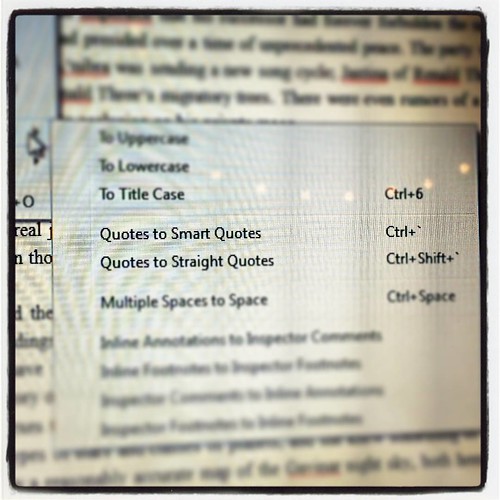
But Scrivener does have a nifty drop-down menu whereby you can toggle every single dumb quote in your manuscript to a smart quote, and back again if you so desire!
Hey, sometimes it’s the little things. And I really dig the Fullscreen mode, which really puts your current writing front-and-center:
I’m not in love with Scrivener, but hey, who knows. So far I’ve been using it on pre-existing projects and manuscripts, and that’s a pattern that will remain in place for a while. Maybe my views will shift farther in its favor as I learn more about it, use it more, and most importantly, use it to create an entire project from scratch.
But at the very least, they will be getting my forty bucks.
[back to 2022]
OK, you still with me? Basically, all of what I said above still stands, and moreso, in fact. Since I wrote this, the folks at Scrivener finally got Scrivener for Windows up to speed with Scrivener for Mac. This was huge, as the Mac version always got important updates, if not whole new release versions, well before Windows folks. For a number of years Mac users were on Scrivener 3, while Windows users were stuck on Scrivener 1. I won’t rehash all of that–the Scrivener folks did not come out the best in that, but they got it done in the end, so that’s water under the bridge–but I do note that Scrivener 3 really was worth waiting for, in a lot of ways.
Here are screencaps from Amongst the Stars, in Scrivener 3.
This is what the program usually looks like when I’m working. I have it in three sections. On the left is the “Binder”, which gives you your “wide-angle lens” of your entire project. In this way I can see how many chapters fall into each part of the novel, and also, I can very easily hop between them. If I’m working on, say, a Margeth chapter in the second book and I need to look something up that happened way back in Part One, I can just click where I want to go. Having written two Forgotten Stars novels in LibreOffice, first with each chapter in one file and then as one giant file, looking stuff up is hard.
In the middle pane is the section on which I happen to be working at the moment. Scrivener calls this the “editor”. That’s the main writing pane. On the right? Well, by default Scrivener has that third screen set up for something called the “Inspector”, which contains notes and metadata and other stuff.
I do not use the Inspector. I don’t really understand it or know why it’s useful. More useful to me is just setting up a second Editor pane, where I can load up a previous (or future!) chapter of the book, or toggle to my character notes, or whatever. Since the Forgotten Stars books are told using one viewpoint character in each chapter, I find it useful to have the current chapter’s viewpoint character’s last chapter in the rightmost pane, so I can easily look up what was going on with that character. (And you can type there, thus modifying whatever you have in that window!)
I mention the Corkboard feature above, and I have never much used it, to this day.
Scrivener 3 has a name generator, though I haven’t figured out how to use it yet. I have some other online name generators that I’ve relied on for years.
Let’s see, what else? I love Scrivener’s full-screen view. You can set that up so your text literally takes the entire screen, or you can narrow your “paper” and shift it to one side or the other. You can set up background images for your full-screen view, or just leave it. But that’s pretty cool; it’s nice to be able to really immerse myself in the work. Scrivener 3 added themes, including dark modes and other customizable color schemes, so you can really dial in your preferences now. You can also set up goals for your projects, both for the entire project and for your individual writing sessions. That really helps with the numerical side of keeping the words cranking. And a little pop-up appears when you make your daily quota! That’s pretty cool.
It’s important to note that Scrivener is a content-creation application. It is not a word processor, in that you do not use Scrivener for formatting your work, setting margins, and all of that. I may write the books in Scrivener, but I use LibreOffice for editing and for book design. If you charge into Scrivener expecting Word, you’ll be frustrated. But if you’re grappling with a larger project, Scrivener’s organization tools are really unmatched. And there are many templates available, depending on what you are producing.
The biggest thing I like about Scrivener thus far, though, is the fact that it has yet to choke at all, given how big the projects are that I throw at it. LibreOffice and Google Docs both get a bit tetchy once my projects reach or pass a certain length, and honestly, all of my projects hit that length. Scrivener can handle my work and it allows me the easiest time of managing that work while I’m producing that work. That’s why I love it.
If your writing tool(s) are getting you through your work just fine, there really isn’t any reason you have to switch to Scrivener. There are lots of writers who are just happy as clams in Word, or Docs, or whatever. (I read once that George RR Martin uses something like WordPerfect or WordStar, something that’s really really old on a machine that is likewise really old, because that minimizes his distractions. If it works for you, there’s no reason to try Scrivener except out of curiosity. But if you’re not quite happy with your output, or if your work is of the type where you really have to work on organization, Scrivener might very well help.
And at the end of that session, I got to type up these words:
Yes, the first draft of The Song of Forgotten Stars, book five: Embers of Future Flames is finally done.
I started drafting this book at the beginning of 2021. My goal was to have it done before we took off for Waikiki…a year ago. That didn’t happen, obviously. This one was a very difficult write, and I had to stop completely quite a few times just to think out what was happening and why. This book was hard. A lot goes on in this book, as you might tell; it’s the fifth book in a nine-book series, and it has a lot of heavy lifting to do. The conflicts that unfold over the last four books in the series have to be established, and the various building blocks of story that I’ve been putting in place in the first four books have to start coming together. And as I’m the kind of writer who throws things into the books because “Hey, this sounds cool!”, I have to figure out ways to make at least some of those things relevant and important.
When you get this deep into a series, the “pantsing” approach has some pitfalls…but I’ll get through it.
Oh, and the book has to be a fun and engaging read on its own! These are still space adventures, so we need space adventure! I’m happy to say that this book has a lot of adventure in it. And new villains. New powers. New discoveries.
You might note that the manuscript ended up being just shy of 250,000 words. That is, by quite a chunk, my longest first draft manuscript by a good margin. That will get a lot shorter when I do edits–I am very good at making cuts–but still, this one may end up being the longest Forgotten Stars novel yet by the time it’s all said and done. The Savior Worlds currently holds that title at just over 184,000 words, roughly; I don’t see myself editing this one down by that much. Cutting 60,000 words is, ahem, unlikely.
So, what’s next? A break from book writing, for one thing! I’m only writing blog posts and the like over the next couple of weeks, and then when the New Year starts, I’ll start doing something else. I’ve been thinking about putting together an ebook of my various writings about Star Wars over the years, and that might be a fun diversion. Then I’ll likely return to my fantasy duology, The Adventures of Lighthouse Boy, in hopes of finishing the entire draft of that series. Then, in 2024 some time, back to Forgotten Stars.
As for publishing Embers of Future Flames? Maybe in late 2023. Maybe. We’ll see.
As of this morning, I am pretty much completely symtom-free. Huzzah! Unfortunately, as of this morning, according to the test I took when I got up, I am not yet COVID-free. Boo! I assume this just means that my immune system still has some work to do in escorting the hangers-on and the squatters off-premises. It’s a work-in-progress, and all that.
So the timeline was basically this:
Last Friday: Attended the Erie County Fair. Toward the end of the day, noticed a throat tickle and a bit of stuffiness. Attributed this to occasional seasonal allergies and being outside and not having drunk nearly as much water as I usually do.
Saturday: Started thinking, “Huh, this is starting to feel suspiciously like some kind of crud. Might wanna keep an eye on this.”
Sunday: Got up after a night of sneezing, coughing, and a mild sore throat. Thought, “Huh. This is definitely some crud. Better test. Oh look, COVID. Well, shit.”
Monday: This was when I felt the worst. Slept downstairs, and then when The Wife (who has tested negative this whole time, Huzzah!) headed into her home office for work, I went to our bed and crashed for several hours. The worst of the sneezing and coughing was this day. Even so, it never got worse than any other normal cold I’ve ever had. By dinner time on Monday, I felt noticeably better. (Oddly, the way my colds usually progress, when I’m starting to feel better is when I sound the worst to other people!)
Tuesday: Definitely on the mend, feeling significantly better. Much less sneezing and coughing. Also, by this point the usual cold-related brain fog is starting to dissipate, so I’m starting to really think about writing again. In fact, on Tuesday afternoon I opened Scrivener and actually did get some writing done:
Not the easiest 500 words I’ve ever done, but I got them down.
Wednesday: Back to, I dunno, we’ll call it 80 percent. And I got more writing done!
By the way, another milestone fell on Wednesday:
Yup. When I started writing Forgotten Stars V, I hoped to be somewhere near the book’s end around the 180K mark. That is not going to happen. As I’m writing now, I’m finishing up the Second Interlude before I write all of Act III. Ouch. More on that below….
Thursday: Feeling 90 percent normal! And the floodgates opened up:
Yup, yesterday was a really good day for writing. The goal now is to have more and more days like yesterday.
Also, I had planned our dinner on Sunday to be grilled chicken wings, but obviously the COVID arrival screwed that up. Last night, though, our desire for wings would not be denied. Because, in the immortal words of John C. Reilly in the comedy classic Stepbrothers, “But what if I want wings?”
Shot…
…and chaser.
The sauce, by the way, is The Store’s brand of Korean barbecue sauce. I love this stuff. Just love it. It’s got that sweet-and-salty Asian soy thing going on, and it’s gluten-free, so The Wife gets to enjoy it. And yes, All You Grillers, I do apply the sauce at the end of the cook and let it caramelize and char a bit. There’s a whole school of thought out there in which this is heresy and you never put sauce on (“if you use sauce at all, and why would you, that’s what rubs and pre-seasonings are for, you heathen!” as another sub-school of grillers would say) until the meat is at the table, but I disagree, and it’s my grill and my kitchen.
(Oh, I would never put sauce on a steak on the grill. Steak gets S&P and that’s it. After all, “S&P, the choice for me!”)
So now it’s Friday, which means my forced vacation is coming to an end. Now, I’m thinking a bit about how I use my vacation time. Because I only get a few weeks of it (though I’m a couple years out from earning more), I tend to stretch it out through the year on vacations that are mainly long weekends. The exceptions to this are if we happen to have an unusually lengthy trip planned, such as our Hawaii trek last December, but as a rule, I rarely take an entire week off. But having done so now, I’m kind of thinking…I might start doing so. Especially once I hit the four-week plateau.
And now, I’ve got Friday’s writing to do, and since I’ve got some momentum going, I’m also going to get some plans in place for next week once I’m back to work. Also, look for an announcement on Monday! Hmmmmm!!!
I close with this funny thing I stole from Facebook this morning. Peace out, y’all!
Crash Davis: I never told him to stay out of your bed. Annie Savoy: You most certainly did. Crash Davis: I never told him to stay out of your bed. Annie Savoy: Yes you did. Crash Davis: I told him that a player on a streak has to respect the streak. Annie Savoy: Oh fine. Crash Davis: You know why? Because they don’t – -they don’t happen very often. Annie Savoy: Right. Crash Davis: If you believe you’re playing well because you’re getting laid, or because you’re not getting laid, or because you wear women’s underwear, then you are! And you should know that!
There are two main reasons I’ve been posting more tersely here of late. First, because Daily Life has been unusually busy the last week-and-a-half. Last weekend we were out of town for four days (more on that to come!), and then we were out of town again yesterday (for the Rochester Lilac Festival, more on that to come!). I had a special project at The Store that required me to go back in for a few hours at night in addition to working my usual shift. Guy Gavriel Kay, my favorite living author, had a new book come out (and I still haven’t dug into it much, but that’s on the docket for later today). Other books needed finishing and returning to the library. I cooked dinner a bunch. My mother needed some stuff carried from here to there, or from there to here. Doggos needed walking. Episodes of The Repair Shop (more on that to come!) and Letterkenny (more on that to come!) needed watching. And more!
Second, and more importantly, I’ve been on a streak regarding the work-in-progress (or ‘WIP’, as writer-folks refer to them), the unusually frustrating fifth book in The Song of Forgotten Stars. And as our hero, perpetual minor-league catcher Crash Davis, tells us in the movie: “A player on a streak has to respect the streak.”
This book has been frustrating in ways that are unusual to me. The problem hasn’t been that I don’t know what happens next; the problem has been that I do know what happens, but I’ve struggled to figure out how to write it. There were structural difficulties that I had real problems un-knotting: in this book, as in the last couple volumes in this series, my main characters are all living their own stories, but their own stories interconnect and influence one another, because they live together and that’s how these things work. It’s that interconnectedness that has been my sticking point. But starting two weekends back, I actually started moving the ball forward again.
Which meant that I had to respect the streak.
So, on days when I knew there would be little time for writing amongst all the other things I had going on, I prioritized the novel over this space (and also social media, where I’ve also been posting lightly the last few days). I’m not sure how things will go moving forward, but…well, we’ll see! I’ve got some other plans on the horizon that I intend to spend time ironing out this week and next weekend (Huzzah, three-day weekend!), so, onward and upward!
Another short observation about the current WIP: as noted, this is the fifth book in this series. The Song of Forgotten Stars is planned to be nine books long, and I’ve got quite a lot of the larger story mapped out in my head or in notes. (By “quite a lot”, I mean, well, “some”.) There are things that I know will happen, but I don’t quite know how those things will end up happening. Some of these things I’ve known would happen since I was writing Stardancer back in 2011 and 2012, while others have come up in my head since then.
The interesting thing is that here in Forgotten Stars V, I am for the first time writing scenes that I envisioned two, three, even four books ago, all the way back to the beginning. It’s surreal, knowing that I’m finally reaching a point now there I knew years ago what was going to happen, is happening. I’m writing scenes that I envisioned a long time ago. It’s like finding signposts along the way that were only ever ahead of you, only…now, they’re here.
Time now to wrap up this post, because the streak ain’t over and I have to respect the streak. Back to writing!
(Oh, and in case anyone asks just because in the movie Tim Robbins thinks he’s on a streak because he’s been wearing Susan Sarandon’s underwear while he pitches, no, I have not been wearing…oh, forget it.)
The tale is in the numbers. For perspective: I count anything over 1000 words in a day as a really good day.
Saturday:
Sunday:
I feel like I’ve finally cracked the nut that is the plot of Forgotten Stars V. This one has been giving me fits for several months now, and I’ve rewritten the same four chapters at least three times now, with two of those rewrites being from scratch. I’m not sure if this means I need to start being an outliner, or what. I just want to get this draft done.
I’m also kicking myself for having decided to write a nine-book series, because even though I’m in the back half of the series now, it’s just getting harder and harder.
Diving a bit deep into the weeds of the writer brain, I’m always thinking about…quotation marks. Because my way of using them is, for most Americans, incorrect. This drives my poor friend and editor, Jason Bennion, to distraction each and every time I send a manuscript his way. And I am always sympathetic, apologetic, and…unwilling to change.
What’s the issue?
The problem isn’t quotation marks in passages of dialogue; those I deploy correctly (or when I mess up, it’s a genuine typo). My problem comes when using quotation marks when denoting words or phrases specifically, at the end of a sentence. Because now the question becomes, Where does the punctuation go?
In American usage, punctuation always goes inside the quotation marks, no matter what:
“Surely you’re joking,” he said. “You cannot seriously think we’re going to let Mr. Bond live.”
Now, that example I get right. But here’s an example where I differ with many:
He passed her a slip of paper on which he had written a single word: “Monopoly”.
See the difference? In American usage that should be:
He passed her a slip of paper on which he had written a single word: “Monopoly.”
To me, though, that looks wrong. And it always has looked wrong to me. In my brain, what’s in the quotes is itself a single unit, and I honestly don’t get why the period should be inside. This holds even for phrases in quotes:
We were playing Hearts, and as I looked at my hand, I realized I could take all the tricks in this hand. This is called “Shooting the Moon”.
But, if that phrase where in a sentence that is itself a quote? I get even messier:
I looked at my hand and I thought to myself, “Look at this hand! I might try…’Shooting the Moon’!”
Again, this drives my editor friend crazy.
To my great delight, though, a while back I did some searching to see just how badly incorrect I am on this–not that I had any intention of correcting my habit, because at this point in my life the die is cast, I can budge no farther on this, and it will have to be my way of things, one of my authorial and personal editorial quirks, not unlike how The New Yorker always employs a diaresis in words containing diphthongs (not to be confused with the umlaut)–I found an article that makes the point very nicely. It turns out that my preferred usage of quotation marks aligns with the British:
Since a period marks the end of a sentence, it should not be placed before marking the end of the quotation. You can compare this with nested or hierarchical structures, or with stacks, or even with first in, first out methods of computing, systems theory or asset management. Under any comparison, the British style will seem preferable to the American. You resolve the nested item first, before resolving the parent.
While I certainly do not align with the British in all such matters, in this one, their approach seems much more logical and sensible, as well as more consistent. But reading this post, I suddenly realize where my tendency on this comes from: way back when I was a computer nerd (in another universe I’m something of a computer programmer), I learned that in programming, parentheses must always be closed, and if you closed them incorrectly, bad things would happen to your program. If you had a program section or line with multiple parentheses-usages inside each other, you had to close them out. This results oddly (in passages that (might look kind of (if you’re not used to it) strange)). This also made debugging programs a lot of fun, if the bug that was killing your program was that somewhere in Line 63 you had three left-parentheses but only two right-ones.
So I treat quote-marks as programmers do parentheses: You close one out before doing anything else, and that includes any punctuation that does not specifically belong to the word or words in the quotation marks.
I shall therefore continue using my quotation marks in the British manner, and I shall continue to “eschew the American”.
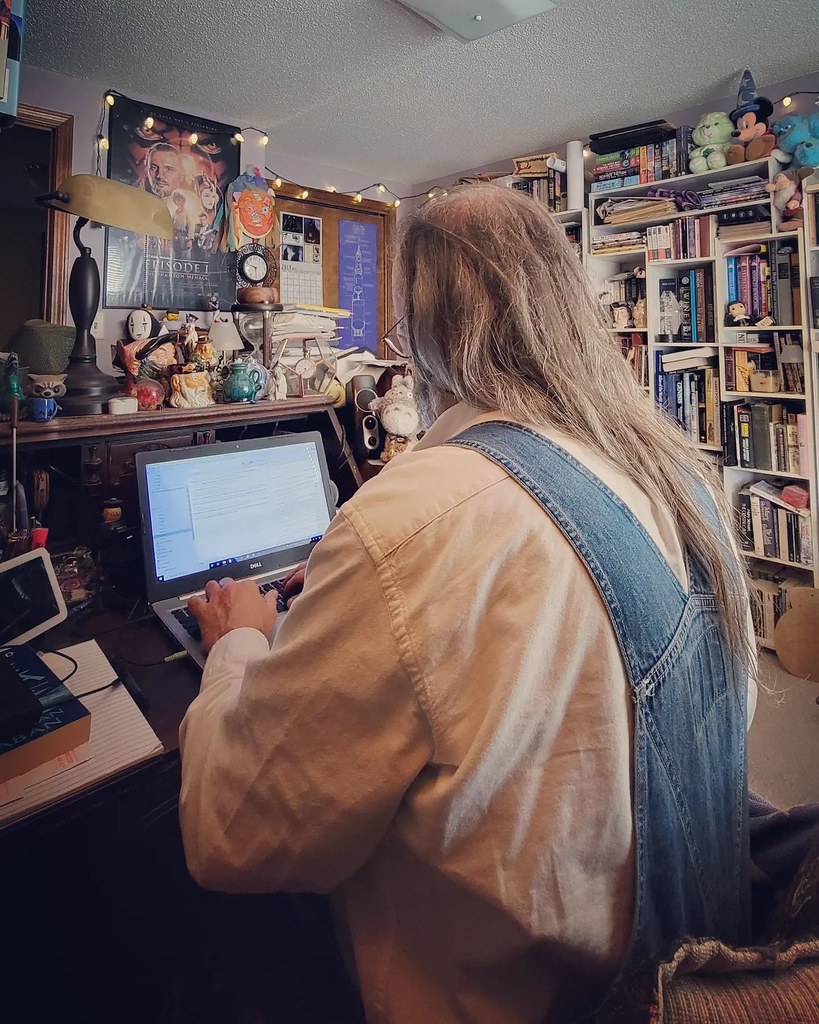
Writing longhand with a fountain pen, in a puffy shirt and vintage overalls. If this picture only included a dog and/or a cat, this would be my ideal.
I have recently finally started to unravel the plot of Forgotten Stars V: The Final Frontier (not the actual title), much to my pleasure. This one has been giving me fits, to the point that I’ve been seriously considering making the shift from Pantser to Plotter. This is because the key turns out to have been…plotting.
OK, an aside if you’re not familiar with the terms ‘pantser’ and ‘plotter’. Some writers plot everything out, writing extensive story outlines of varying degrees of complexity from writer to writer, in order to get the story shaped before they ever start drafting. The idea then is that the drafting can go quickly, according to plan.
‘Pantsers’, on the other hand, don’t do this. They write ‘by the seat of their pants’, basically starting at Chapter One with some characters and maybe a situation and charging full speed ahead. Such writers feel constrained or even handcuffed by the use of outlines, preferring to discover organically what happens along the way.
I’ve always been mostly a pantser, with the proviso that I eventually get to a point in many of my novels (OK, all of them) when I’m not able to figure out the story’s development beyond a certain point. This usually comes up sometime between halfway through Act II and the beginning of Act III. At this point…I turn plotter, because by this point I’ve got my story started and revved up to the point where a plot is actually going to help. In the past, when I’ve plotted before drafting, I’ve always run into a much better story idea sometime along the way, so why waste my time plotting a story that I know will deviate wildly from the original plot?
Lately I’ve been plotting the last 2/5, roughly, of Forgotten Stars V, and I’ve really managed to hack open the plot to the point where at last I’m getting it all to work out nicely. In the future I probably need to react a bit more quickly, recognizing faster when I’ve reached the point where I need to step away from Scrivener and instead pick up the pen and paper for plotting. (I plot best using pen and paper; it slows my process down enough that I can think it through.)
But that’s not the only thing I do in these cases. There’s something else, and even though I’ve done it on each thing I’ve written on which I’ve eventually blocked up a bit–including stuff y’all haven’t even read yet!–I never really recognized this step in the process until this time through it. So this is my big advice for pantsers, if they find themselves oddly blocked:
The key probably lies in what you’ve already written, so go back and re-read the book to that point. You very well might have the answer staring you in the face.
If you’ve read any science fiction or fantasy, you’ve probably noticed that those genres can seem like dense piles of almost random stuff mentioned in the beginning chapters, as ancient heroes and cities and empires and wizards and historical figures and other things get mentioned, name-checked, hinted around, and so on. Think of all the name-dropping that happens at the beginning of The Lord of the Rings, or even in Star Wars. I do the same kind of thing, sticking all kinds of weird details in my stuff, because weird background stuff that never gets mentioned much again is a great way of making your world seem larger.
But here’s the thing: there may be a detail you’ve tossed in there for no other reason than it sounds cool, that ends up being the key to unlocking your plot and giving it the conclusion it deserves. I call this “The Usual Suspects” syndrome, from the classic story of how Casablanca got one of the great endings of all time.
(Spoilers for Casablanca, by the way.)
Casablanca famously went into production without the script really being quite finished, so as the film got closer and closer to having to shoot the ending, the pressure amped up on Julius and Philip Epstein, the film’s writers. The question was: How can they get Rick off the hook for killing Major Strasser, with Captain Renault just standing there, watching the whole thing? What’s Rick’s “out”? It turns out that they had already given themselves that out in the film’s first minutes, in which they established that in Vichy-controlled Casablanca, Captain Renault didn’t always take his duties very seriously; in response to various Resistance activities, Renault simply orders his men to “round up the usual suspects”. In short, his whole job is largely theater. Renault isn’t anti-Nazi at first, but he’s not particularly for them, either. As he notes, “I have no conviction, if that’s what you mean. I blow with the wind, and for now, the prevailing wind happens to be from Vichy.”
But the Epsteins still needed a way for Rick to get out of trouble for killing the villainous Major Strasser. The classic story is that they were out for a drive in LA one night when suddenly they both had the same epiphany, looking at each other and saying at the same time, “Round up the usual suspects!” And that’s what happens: Major Strasser is killed, only Rick and Captain Renault are present, tension abides…Renault’s men arrive, and Renault says, “Major Strasser’s been shot!” Looks are exchanged–Rick to Renault and back again–and we wonder what Renault will do. Will he say, “Arrest Rick, he killed the major”? No. He says, “Round up the usual suspects.”
And just like that, the story is resolved. Because the writers remembered a small detail they had thrown into their script early on, probably for character and humor reasons. It turns out to be the key to the film’s satisfying ending.
So go back and re-read your draft if you’re stuck, folks. Because the key to getting yourself unstuck may well be in there. As it was with the current book! Maybe someday when it’s been released I’ll flesh it out a bit in this space….