“Ho! Ho! Ho! To the bottle I go….”

Your Humble Narrator, decked out in Renfest-cottagecore regalia for an evening’s reading in Middle Earth. Note that I’m quaffing a beer, as rum isn’t a thing in Middle Earth, so far as I can tell!

Ho! Ho! Ho! to the bottle I go
To heal my heart and drown my woe.
Rain may fall and wind may blow,
And many miles be still to go,
But under a tall tree, I will lie,
And let the clouds go sailing by.

Drinking Song from The Fellowship of the Ring, JRR Tolkien.

A while back I embarked on a re-read of The Lord of the Rings. My progress has been slower than usual, because of reasons, but as ever I find myself loving this story deeply, and Tolkien’s luminous, lyrical writing continues to astonish and amaze me. I am as drawn in as ever, and this time I’m paying special attention to the poetry, of which JRRT writes many different kinds…including a drinking song or two.

The Peter Jackson movies did a decent job of incorporating Tolkien’s poetry, as much as they could for mass audiences, and here’s an artist who compiles some of the drinking songs from the films into one medley. The songs aren’t entirely Tolkien, but they contain enough of him that I don’t think he’d object to any of this.

Share This Post

Recent Reading!

 It’s been a while since I posted an update on books I’ve been reading, so here’s a bit of catch-up!

::  Edge of Sundown is a noir-mystery set in Chicago, by indie writer Jennifer Worrell. A writer who was once a fixture on the bestseller lists for his genre potboilers has spent the better part of a decade in the creative doldrums, until he starts writing what is a marked departure for him: a dystopian thriller in which alien beings are ridding the city streets of “undesirable” elements. But when real-world events start to mirror those in his novel, our hero starts to wonder where the boundary between fiction and reality lies…and that boundary blurs even more when the murders start.

I don’t often read this sort of thing, so I was surprised how compelling it was. There is a palpable sense of dread hanging over the story, even as the climax nears, and Worrell really creates a sense of dark place as she explores Chicago’s seedy underbelly. Highly enjoyable!

::  For my ongoing project of listening to (and writing about) the music of Jean Sibelius, I figured I should bone up on the composer’s life and times. I got a book out of the library, called Finlandia: The Story of Sibelius, by Elliott Arnold. This is an older book, published in 1941 while the composer was still very much alive (and, in fact, Sibelius himself appears to have had input into Arnold’s book). As such, the writing style is very much a throwback, and the tone of the book is one of somewhat relentless praise. If you are looking for a critical study of Sibelius and his music, you won’t find that here. But I just wanted a readable treatment of the composer’s life and times, and this is certainly that. In fact, I found the book valuable for its descriptions of the historical events in Sibelius’s homeland, Finland, a country which wasn’t even an independent nation when Sibelius was born. Sibelius was a highly nationalistic composer (even if he denied ever using actual Finnish folk material in his works), so this book gives a good sense of the events that shaped Sibelius’s attitudes and patriotic fervor.

::  Two rival sea-faring clans try to put their long feud behind them by marrying their two youngest nobles in Daughter of the Deep, a fantasy novel by Lina C. Amarego. The problem is that our heroine, Keira Branwen, is convinced that her new husband, Ronan Mathonwy, is the one who murdered her father. She is expected to push those feelings aside in the name of peace on the seas, but obviously that isn’t about to happen, and Ronan relentlessly insists on his own innocence. There’s no way that peace between the Branwens and the Mathonwys is going to be easily attained by any marriage, and so unfolds a novel full of character and conflict. I enjoyed this one immensely! Daughter of the Deep is the first volume of a duology called The Children of Lyr, and I absolutely intend to read the follow-up. Recommended!

::  For the Love of Music: Invitations to Listening by Michael Steinberg and Larry Rothe is a collection of essays that ran in the magazine of the San Francisco Symphony Orchestra, along with that magazine’s shorter program notes for specific concerts. As such, the book can be dipped into at will, which I recommend doing. There are chapters on Erich Wolfgang Korngold and on Sergei Rachmaninov and the great Chicago impresario Theodore Thomas, along with many more. The essays are often personal reflections on the part of Steinberg and Rothe, informed by many years of love of and listening to classical music. It’s an excellent collection of recent classical music writing.

::  A sadly necessary book, Under a White Sky: The Nature of the Future by Elizabeth Kolbert looks at the state of science today, in this time of climate change and the threats it poses to the natural world and to human civilization in general. This is not a general look at climate change, but rather an examination of a number of “case studies” in which scientists are working on very specific environmental issues, such as preserving a fish that only lives in tiny pools in caves in the Mojave Desert. In another example, Australian researchers are trying to engineer a coral that can thrive in the hotter oceans to come, hoping to somehow preserve the Great Barrier Reef. She ultimately arrives at the folks who are studying the possibilities of direct geoengineering to combat the ongoing warming of our planet, in such ways as dispersing huge quantities of reflective aeresols into the upper atmosphere, hopefully increasing the planet’s albedo in hopes of putting the brakes on continued absorption of solar heat. Who knows if that will work, but the fact that it’s being more seriously analyzed is itself an indictment of humanity’s utter failure to take any major steps to alleviate the problem. Under a White Sky isn’t an optimistic book, that’s for sure…but oddly, it’s not exactly pessimistic, either. My overwhelming feeling is that we’ll just keep not making things exactly better, but just continuing to make things different and figure out how to live with it down the road.

More reading notes to come!

Share This Post

Recent Book Notes!

 Here’s some recent reading I’ve done! I don’t have pictures of the covers, unfortunately. (Several of them I forgot to snapshot before I whisked them back to the library.)

::  Maybe you didn’t know that you needed a graphic novel about the Bronte sisters, their brother, and the imaginative life they lived in their youth, but you do need that graphic novel, and thankfully for you, it exists! It’s called Glass Town: The Imaginary World of the Brontes, by Isabel Greenberg. Apparently in their younger years, the Bronte sisters (Charlotte, Emily, and Anne) and their brother Branwell passed the time by creating a fantasy world called Glass Town, which they populated with all manner of interesting characters (no doubt providing the girls with valuable experience in character creation that would serve them well when they turned to their own literary works years later). As the siblings fight over the nature of their world, two break off and make their own world, and in Greenberg’s graphic novel–based on extensive research into the materials left behind by the Brontes themselves about this period of their lives–Charlotte Bronte becomes the focus. She seems to have the strongest relationship with the people of Glass Town, to the point where she actually speaks to them and finds herself drawn into their struggles.

Greenberg’s art is unusual; I’m not sure how to describe it. It took me some work to get used to, and even until the end I didn’t always find it easy to tell which character was which. But the narrative as a whole has some interesting things to say about stories, how we relate to them, and the difference between how adults relate to stories and how kids do. If you’ve never seen a couple of kids get in a fight over a fictional character or world, well…that can be some serious stuff. Good book.

:: I’ve read of the graphic novel series Monstress over the years, so I decided to give the book a try. It’s a highly regarded fantasy set in a steampunk Asia kind of world…and honestly, even though I read the whole first volume (collecting issues 1-6), it was long enough ago that I honestly remember very little of the story at all. I do remember the series’s incredible art–the book is worth looking at on that basis alone–but I also remember finding it very hard to care about the characters, and disliking the story’s tone. This is along the lines of SAGA and A Song of Ice and Fire: tons of violence and rape and murder and cruelty. Monstress isn’t remotely my cup of tea, but if you like your fantasy full of horrible people being awful, there it is.

::  More my speed was Elizabeth May’s The Falconer, the first book in a trilogy set in Edinburgh about a willful young lass named Aileana who has to contend with societal expectations, her father’s desire to see her wed, and the fact that she can see the magical beings who are obsessed with killing humans, so she has made it her mission to kill them first. Yup!

May (who I’ve been following for years on Twitter, she’s awesome) writes a really fun book here, with enough humor and “comedy of errors” kind of stuff, along with crackling dialogue, to offset the story’s occasionally grim tone. There are steampunk elements and cool magical doings, fairy beings whose loyalties aren’t entirely clear, and on our side of the magic-realism divide, people who want what’s best for Aileana and people who think what they want is best for Aileana and people who just want her married off so they don’t have to think about her anymore.

Aileana’s efforts to balance her “Magic hero” thing with her societal obligations put me in mind of the best Spider-Man stories, when Peter Parker was always this close to getting his high school or work or romance shit together, only to have to run off to fight Green Goblin when he was just on the cusp of getting a job or a date with Mary Jane or some such thing. May keeps that whole pot boiling nicely. I liked this book immensely and I look forward to the other two books in the trilogy. (They’re all out already; this series has been out for a few years.)

All for now! Keep reading, folks!

Share This Post

Recent reading: Space wizards, zombie apocalypses, reflections of Paris, universes ending, and a LOTR-but-not-LOTR fantasy

 A few more books I’ve read of late:

::  I can’t possibly keep up with the eternal flood of new books that is Star Wars publishing, but I do try to pick and choose the ones that sound good or come with good referrals. Last year, Lucasfilm announced a new project in their Star Wars publishing empire: a new series within the larger overall tale that focuses on life in our favorite galaxy far, far away two hundred years before the rise of the Sith, the fall of the Republic, and the arrival on the scene of a couple generations of Skywalkers. This series is called The High Republic, and it depicts the Republic at is height and the affairs of the Jedi as they act as the guardians of peace and justice and all that.

Light of the Jedi, Charles Soule

The High Republic is going to play out in books, comics, and who knows what else (no filmed entertainment set thusly has been announced yet, but who knows what the future may bring, as currently Star Wars is changing directions on an almost monthly basis). It all starts with Light of the Jedi by Charles Soule, and…well, it’s not bad, but it’s got a lot of room to get better.

Light of the Jedi has to do a lot of heavy lifting: it has to establish the time period we’re in, which means that it has to show all the ways this time period contrasts with the one with which we’re most familiar. It also has to establish the new threat that the Jedi are going to be facing through all this, which can’t be the traditional Sith because canon has already established that the Sith have been gone for centuries and they stay gone until Darth Sidious steps into the open around the time of The Phantom Menace. Light also gives us a lot of viewpoint characters, probably too many, all having adventures that play out over relatively short chapters.

The sad result is that Light of the Jedi ends up feeling overstuffed and underfocused, so that in its attempt to be really exciting it ends up under-engaging. I have to admit that I came close to DNFing this book halfway through, and ended up skimming a lot of the last act. It’s a shame, because there is interesting stuff here and it does set up some possibly exciting story possibilities to come. The book does the job of getting The High Republic out of the gate, but it’s not the galloping start it should have been.

::  I’m reading more indie books of late, which I should do because I’m an indie author myself, and which everybody should do because there’s a lot of great writing out there beyond the world of the standard publishers. I’ve been following author Anna Vera on social media for a while, and I finally got around to reading her book When Stars Burn Out, a dystopian science fiction novel about the zombie apocalypse and the human response to it.

When Stars Burn Out, Anne Vera

I freely admit that this genre is not generally my cup of tea, which is to say, it’s almost never my cup of tea. But I do enjoy it on a selective basis when it’s handled well, and Vera is one of the ones who handles it well. There is darkness and grim death here, because how could there not be, but for once it’s not wildly overdone with spectacular deaths just for the sake of deaths (like in, say, The Walking Dead). There are intriguing mysteries and an interesting society of people trying to live without becoming zombies themselves, and the character work is particularly good. Heroine Eos Europa is a fascinating person, and I hope to read more of her adventures soon.

::  I’ve had Paris to the Moon by Adam Gopnik on my shelf for years, and I finally got around to it. I have to admit to finding it slightly disappointing. I was expecting a travel book, but it’s really not that; it’s a collection of essays Gopnik wrote in the 1990s for The New Yorker about his and his family’s experiences in Paris when they packed up and moved there. It’s all well-written and all, but unlike the best travel writing, Paris to the Moon‘s essays feel distinctly rooted in a particular time and place, and from a particular vantage point. I felt an odd disconnect while reading it, like perusing the mundane dispatches from someone’s life decades ago.

Paris to the Moon, Adam Gopnik

It’s not bad, though! Not at all, and if life in Paris interests, there’s much here that’s interesting. I cite one passage, which I found particularly amusing:

Late last year the French government assembled a committee to choose a name for the vast new stadium that’s being built in a Paris suburb. The committee included an actor, and “artiste”, some functionaries, and even a few athletes. It took a long time deliberating over its choice. Names were submitted: Some people liked the idea of naming the stadium after Verlaine or Saint-Exupery, and lots of others liked the idea of calling it Le Stade Platini, after Michel Platini, the great French soccer player. At last, late in December, the committee announced that it had come to a decision, and the government decided to broadcast the verdict on television. The scene was a little like the end of the Simpson trial: the worried-looking jurors filing to their seats, the pause as the envelope was handed to the minister of youth and sports, the minister clearing his throat to read the decision to the nation. The stadium that would represent France to the world, he announced, would be called (long, dramatic pause) Le Stade de France. The French Stadium. “Banal and beautiful at the same time,” one journalist wrote. “Obvious and seductive. Timeless and unalterable.”

I suppose there is something oddly comforting, albeit in a kind of depressing way, in learning that the bureaucratic way of spending a lot of time and money coming to a perfectly boring decision isn’t something unique to the United States.

::  Katie Mack’s The End of Everything (Astrophysically Speaking) is a book about the end of our universe.

The End of Everything, by Katie Mack

Apparently the current state of science has a handful of scenarios by which our brightest minds think our universe will end, and Dr. Mack has written this helpful, clearly-written, and humorous (given the subject matter) book summing it all up. If you like a bit of science to help back up your low-level existential dread, The End of Everything is the book for you! Yes, there are passages that I didn’t entirely understand, but Mack does a very good job of explaining how we came to our current theories of how the universe began, and given our understanding thereof and of how the universe works now, how we might expect it to end. Her ultimate takes aren’t terribly optimistic (for ideas on what the end of the universe might look like from the standpoint of sentient starfaring civilizations, Michiu Kaku is the author to seek out), and there’s something particularly chilling about what’s called the “Heat Death” of the universe, as ultimately the unending expansion of space results in our skies growing ever, ever darker as the stars become too far from us for light to ever arrive. But, as Dr. Mack writes:

In fact, the one thing that all the universe-ending scenarios we’ve already discussed have in common is that they definitely aren’t coming around anytime soon. As far as we can tell from our best understanding of physics, we have at least tens of billions of years before even the most extreme version of a sudden Big Crunch reversal could occur, and no Big Rip could be less than a hundred billion years off. A Heat Death, considered by most to be even more likely, would be so far into the cosmic depths of the future that we hardly have terms to describe it.

So there’s that. Of course, she writes this just before sequeing into a chapter about a “Vacuum Decay”, in which a bubble of true vacuum forms someplace and expands at the speed of light, destroying everything it takes in as it expands. This, apparently, is a thing that can happen at any time, and since the horizon of the destructo-bubble’s edge moves at the speed of light, we’d never know it was coming. For all we know, there could be a universe-destroying bubble right now someplace, expanding toward us at the the speed of light…and depending on where it is, that’s how much time we’d have left. So…sleep tight, I guess!

::  Finally, a re-read of a book I liked a lot as a kid. Between 7th and, I think, 9th grades, I went on a huge epic fantasy reading kick. I read a lot of epic fantasy back then, between roughly 1982 and 1986. (After that I fell into spy and espionage fiction in a big way.) In those years, epic fantasy was far more dominated by the JRR Tolkien model than it is now, thankfully. I love JRRT, but wow, did the genre need some new thinking for a long time. Luckily that new thinking has long since arrived and the genre is healthier for it…but for years fantasy novels seemed really stuck in the same trope wonderland, and the biggest title in the post-JRRT swords-and-dwarves-and-elves type of fantasy was Terry Brooks’s The Sword of Shannara. I read Sword once, back in my junior-high days (along with its two immediate sequels, The Elfstones of Shannara and The Wishsong of Shannara), but I’ve never revisited them since…until now. A while back I was shopping at my local Savers store and I found the original three Shannara books in the Used Books section*, so I picked them all up. Last week I finally re-read Sword, and…well, it was like dipping my toes in Heraclitus’s river. It’s not the same river it was when I was thirteen.

The Sword of Shannara, by Terry Brooks

It’s close to forty years since I read Sword all the way through, so I don’t remember much of it at all from back then, except that I do remember finding it kind of padded back then. Nothing specific, but I definitely recall skimming through chapters I didn’t really care that much about. And lo and behold…that happened again.

In Sword you have the Tolkien model almost in its entirety: a malevolent Dark Lord is threatening the existence of everything, while the races of Man (it was the 70s, so yes, it’s called “Man”), Dwarves, and Elves don’t really get along terribly well. There’s a single magical weapon, though, that can prove the Dark Lord’s undoing, and it can only be wielded by a specific individual who happens to be a member of a peaceful, pastoral people who live about as far away from the Dark Lord’s palace as you can get. A wizard-like figure who is known all over the world for his strange comings and goings arrives to send our young hero on his quest, which after many dangers leads him to a single quest to find the magic weapon. On this quest he is joined by a…what should we call it? A “fellowship”?…helpful team comprising men, Elves, Dwarves, and our hero and his pastoral buddy.

Off they go to deal with the weapon and the Dark Lord, but eventually their “fellowship” is forced to break apart, and the others go off to deal with specific wars and stuff while Our Hero proceeds to his ultimate journey into the Dark Lord’s realm, which is a barren desolate wasteland of dust and sharp mountains.

I don’t want to sound dismissive, but Sword really really does read like a Tolkien clone for people who wanted more Tolkien but who didn’t want to re-read Tolkien for the 80th time. All the tropes are here, with just about all the story beats; what Sword seems most to accomplish is reducing the Lord of the Rings from its 576,000 words down to about 226,000. This isn’t always a good thing, as I found it very hard to care about some of the “side adventures” that Brooks takes us on in the back half of the book. We meet a guy named Balinor early on, but we get little of his backstory until much later, which we get right before the book diverts us to his struggles against his crazy jealous brother. I found it nearly impossible to care about any of that.

Ultimately I found Sword a slog to get through this time. Brooks overwrites and overdescribes to an amazing degree, and from a stylistic standpoint, his paragraphs are way too long, sometimes lasting entire pages. And look, I know he wrote this in the 1970s, but still: it’s a 726 page book, and our first (and only) female character doesn’t show up until we’re well past page 400.

I do plan to read the other two books in the trilogy at some point. I remember liking Wishsong most of all from these, and I’ve also heard that Brooks’s various explorations in the Shannara universe after these initial volumes perk up quite a bit. I don’t know if I’ll go any farther past Wishsong, but…you never know.

* I don’t know about anybody else’s Savers location, but the Used Books section at my local one almost always has something worth grabbing. I never leave that place without a book or two. Not huge hauls, but there’s always something!

Share This Post

2021 in the Books: Beethoven, Merlin, and the Hardy Boys meet Veronica Mars

 Here’s some of my recent reading!

::  Beethoven: The Relentless Revolutionary by John Clubbe is simply superb. I wanted to get this one done in time to blog about it during 2020, but getting it done this year is fine.

Beethoven: The Relentless Revolutionary, Clubbe

While not really a “life and works” biography, Clubbe’s book has enough of that within its pages that it would suffice if one was looking for a single-volume account of Beethoven’s life. Clubbe is more interested in tracing through Beethoven’s life and music the influences of late-18th and early-19th century revolutionary history and politics. Beethoven emerges not just as a towering figure in art, then, but as an important historical figure in his own right. Many histories of music and biographies of artists don’t really do this kind of heavy lifting; any history is often treated as incidental. Mozart, for example, is often shown not as a part of history, but as a force of his own, only occasionally interacting with history, such as in his dealings with Emperor Joseph II of Austria.

Beethoven, on the other hand, was profoundly impacted by history, and Clubbe shows this readily by tracing Beethoven’s artistic influences and artistic goals in the light of the revolutions in human rights and political philosophy that shaped that time. Napoleon Bonaparte turns out to be a deeply important figure in Beethoven’s world, going far beyond the famous anecdote of the great composer initially dedicating his Symphony No. 3 in E flat major to Napoleon, and then ripping the dedication away when the Frenchman declared himself Emperor.

Clubbe writes:

Beethoven’s music thus reflects both the turmoil of the age in which he lived and no less the turmoil within himself. As he matured, he affirmed ever more passionately the ideals in which he believed. By focusing on the revolutionary origins of his music, itself a response to the revolutionary age in which he lived, we enter the heart of his genius. For listeners, past and present, who have yearned for political and social change, Beethoven’s music has been and remains an inspiration.

This book is outstanding and I highly recommend it.

::  The Crystal Cave, by Mary Stewart.

The Crystal Cave, Mary Stewart

This was a re-read of the first book in Stewart’s Merlin trilogy, which I first read almost thirty years ago when I went on a massive Arthurian binge during my collegiate years. I was obsessed with “the Matter of Britain” back then, and those stories have held a special place in my heart ever since. I remember finding Stewart’s trilogy, with a fourth book she added on later, in a boxed set in a shopping mall bookstore while on a tour with my college band, someplace in Wisconsin, and I read the four books the following summer. I remember loving them as I read them, but I never re-read them until now, although I’ve intended to re-read them for several years now. Time to get that job done!

Stewart wrote The Crystal Cave in 1970. How does it hold up fifty years later? Quite well, in all honesty. Stewart writes a very historically-focused story here, keeping the fantastical elements to a minimum. The Arthurian saga has always presented problems to those who would write stories based on it, seeing as how there is no single “Arthurian saga”; what we call that, or “the Matter of Britain”, is a collection of tales and stories that accrued and gathered and evolved over hundreds of years. This can result in a lot of versions to take on a disjointed feel, which Stewart avoids by making Merlin, not Arthur, her main character; in fact, Arthur himself doesn’t arrive on the scene, and then only by virtue of being born, until the very end of The Crystal Cave. Everything up to then is Merlin’s story: his questionable birth, his entry into the world of post-Roman Britain mysticism, and his dealings with the pre-Arthurian Kings like Vortigern and Uther.

Stewart’s prose is cooler than I remember, heavy on description and with long paragraphs. In this she might not appeal quite as much to modern readers, but I like this Tolkienesque approach. Her characters are sharply drawn, though, and Merlin’s adventures are interesting throughout. There’s a lot of military maneuvering in this book as armies tromp all over Wales, which is something I didn’t remember from my first reading, but then…it’s been a while!

I will be reading the other two books in the trilogy later this year.

::  The Montague Twins: The Witch’s Hand, by Nathan Page and Drew Shannon.

I checked this out of the library on a whim, because I like to use graphic novels as way to cleanse my reading palate from time to time. This one is an absolute delight. I loved it!

The Montague Twins: The Witch's Hand, Page and Shannon

Basically, what you have here is something that reads like The Hardy Boys mashed up with Veronica Mars, set in a small New England town in the 1960s, with magic and witchcraft thrown in. Actual magic and witchcraft, mind you, not the Scooby-Doo fake magic-and-monsters that always turns out to be Old Man Carruthers in a rubber suit and latex mask, who “woulda got away with it if it hadn’t been for you meddlin’ kids.”

Our leads here are, yes, “the Montague twins”, but they have a larger supporting cast to the point where it seems like actually calling the book The Montague Twins feels like a bit of a misnomer. But they’re two late-teen twin brothers who wear their hair in stylish pompadours and who investigate local crimes. As the book opens, they’ve successfully located the missing dog of the local Very Rich Family Who Owns Everything, and yet oddly, the Very Rich Family doesn’t seem quite as happy with this as they should, which does play in later in the book. There’s a lot of bad-blood history in this book that comes out over the course of its story, not all of which is exactly surprising but a lot of which is satisfying in the “A-ha, I knew it!” way.

What I loved most about this one is that it takes its time. We live in a storytelling epoch in which pacing is seemingly everything, in the sense that the faster-paced the better. One bit of writing advice I see all the time is “Every word must advance your story, and if it doesn’t, cut it!” This has resulted in stories that are constantly rush rush RUSHing their way through their plot beats, with no time for the reader to digest or think or linger in the world or enjoy a quiet moment here or there with characters. The Montague Twins: The Witch’s Hand does not rush, which pleased me greatly. Not every story has to whip by like a damn episode of a CBS procedural, folks!

I read that a sequel is forthcoming to this book. I hope it’s a success and there are more to come!

Share This Post

From the books: THE HIGH KING

Today, a passage from one of many books that my mother required me to read in moments when my behavior wasn’t the best. Actually, though–this isn’t from one of those books, but a book downstream in the series that she made me start with Book One. Funny how often those books she made me read were Book One…it’s like she knew what she was doing.

This is the closing two paragraphs from Lloyd Alexander’s The High King, itself the final volume in Alexander’s series The Prydain Chronicles, which was my gateway into epic fantasy and adventure stories. I suppose there are spoilers here, but these books have been around forever, so I make no apologies.

This ending is one of the most perfect endings I know. I hope I can end at least one story half so well as Alexander ended this one.

In the waiting throng beyond the cottage, Taran glimsed Hevydd, Llassar, the folk of the Commots, Gast and Goryon side by side near the farmer Aeddan, King Smoit towering above them, his beard bright as flame. But many were the well-loved faces he saw clearly only with his heart. A sudden burst of cheering voices greeted him as he took Eilonwy’s hand tightly in his own and stepped through the door.

And so they lived many happy years, and the promised tasks were accomplished. Yet long afterward, when all had passed away into distant memory, there were many who wondered whether King Taran, Queen Eilonwy, and their companions had indeed walked the earth, or whether they had been no more than dreams in a tale set down to beguile children. And, in time, only the bards knew the truth of it.

Sigh….

Share This Post

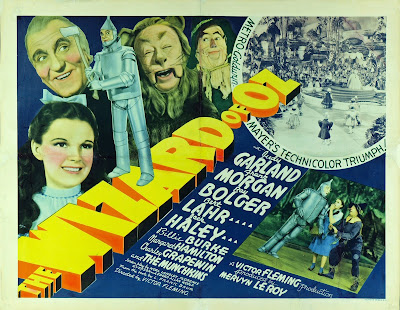
Travels Along the Yellow Brick Road

I suppose I am hardly unique among Americans in that The Wizard of Oz has been a part of my life almost as long as I can remember. I grew up during that hazy prehistory when the only way to watch Wizard was to wait an entire year for one of CBS’s annual airings of the movie—usually in springtime, as I recall. When you’re a kid that wait is so long that you’re barely aware of it. Suddenly one day it’s spring again, and one day you’re in front of the teevee to watch The Wizard of Oz.

I don’t remember much about those viewings of the movie when I was very young; just a few images here and there. I remember the early moment when Dorothy falls into the pig pen. I remember the Scarecrow pointing in both directions, and the Tin Man’s oil can, and the crown the Lion wore for his big song number, a crown made from a shattered flower pot. I remember the Wicked Witch melting, and Dorothy’s farewells to her friends. I always cried at those, and I’ve had a terrible time with “forever farewells” in stories ever since. The worst, though? I remember one year—maybe this was when we lived in Oregon, when I would have been a preschooler—that I burst into tears when the words “The End” appeared on the screen.

The Land of Oz, as shown in The Wizard of Oz, was my earliest fantasy world, and certainly the first one that I didn’t want to leave when it was time. More of those would come. I’ve always thought of Lloyd Alexander’s Prydain as my proto-fantasy world, but in truth, two came earlier: Middle Earth, via the animated version of The Hobbit, and the kingdom of Oz.

Nowadays, of course, I find that as a writer I too can be “that man behind the curtain.” In the end, after Dorothy’s adventures with her wonderful friends (who, I am sorry to admit, took me adulthood before I realized their strong resemblance to the farmhands of Dorothy’s Kansas home), the character with whom I identify most may well be the Wizard, that kindly and wise man who is still something of a charlatan.

Of course, experiencing The Wizard of Oz as a fleeting, once-a-year thing is long a thing of the past. First there was VHS and then DVD and then Ted Turner bought the rights so the movie showed up on TBS only a little less often than The Beastmaster. Now, you can pretty much watch The Wizard of Oz whenever you want. I don’t much pine for the “old days”, but there was a certain charm back then of going to school the next day knowing that you and all your friends would be equally basking in the post-Oz afterglow.

Several weeks ago, The Wife, The Kid, and I attended a screening of Wizard as part of its 80th Anniversary Celebration at one of the Fathom Events. (These are special screenings of many artistic presentations—classic films, live operas, and more—shown digitally at certain movie theaters.) Eighty years of The Wizard of Oz astonishes me on many levels. The movie came out in 1939, the year my father was born. I have a solid chance of seeing Wizard hit 100. The theater was packed on the day we attended, which for some reason we found surprising. We’ve been attending Fathom Event films off and on for a couple years now, and we’ve never seen the theater sold out. There were even families with children in costume, little girls in blue gingham dresses and “ruby slippers”.

This was the second time The Wife and I saw Wizard on the big screen, with the last time coming twenty years ago for the film’s 60th jubilee. Like any great film, the experience of seeing it on a big screen in a darkened theater crowded with people who are sharing the same journey is deeply different from watching it on the finest teevee or computer screen. The crowd laughs, hisses, and tears up at all the right moments. I found myself fearing a little that some of the film’s moments that have become so ingrained in popular culture as to become cliché might be met with laughter, but not so. No one sniggered at the Wicked Witch’s cackling threat: “I’ll get you, my pretty—and your little dog, too!”

I was struck at how funny this movie is, too. When Dorothy, running away from home early on in order to save her poor Toto’s life, encounters a man who is clearly a charlatan, he puts on a display of cold-reading that is dead-on, and the scene is intelligent and full of wit. This goes on throughout the movie, with laughs both famous and laughs that are only remembered when one encounters them, like a forgotten acquaintance for whom we once felt a particular fondness.

Wizard’s opening act is so engrossing that the famous moment when Dorothy enters Oz and steps into a Technicolor world, the enchantment is as spellbinding as ever. I do wonder what that moment must have felt like to the movie’s first audiences, back in 1939. Surely those audiences gasped loudly, because today’s audiences still do, even when they know it’s coming.

From that moment on The Wizard of Oz marches on, building its world quickly and confidently. It weaves its magic so completely that we never really stop for a moment to consider what we’re not being told: What’s so amazing about those Ruby Slippers, anyway? Why does the Wicked Witch want them so badly? What will she do when she gets them? And…do we care about any of that? Of course not. It’s fine. And when Dorothy meets the Scarecrow it’s at a fork in the Yellow Brick Road, so how do they know which way to go? Who cares! None of these things are lapses in the storytelling, just things left unexplained because they don’t need explanation. And so it goes.

(I do, though, wonder just where Scarecrow got the gun he’s holding in one scene. Once you realize the Scarecrow is walking around with a pistol, you can’t unsee it.)

I also rediscovered the delight of the music of The Wizard of Oz. Obviously “Over the Rainbow” is the film’s most iconic song (and how stunning that the producers briefly thought to cut it!), but every song in this movie is distinctive and cleverly written. The Munchkins’ “Follow the Yellow Brick Road” segues perfectly into “We’re Off To See the Wizard”, which becomes a recurring anthem as Dorothy progresses through Oz. And the introduction of the Munchkins themselves contains some incredibly witty wordplay, from the representatives of the Lollipop Guild to the Munchkin Coroner:

As Coroner I must aver,
I’ve thoroughly examined her;
And she’s not only merely dead:
She’s most sincerely dead!

A more cheerfully morbid lyric might exist, but as of this writing I’ve no idea what it might be.

The film’s songs and musical styles shift throughout the film, too. The Munchkins have their childlike sound, contrasted with the good cheer of the denizens of Emerald City as they welcome Dorothy and company to the “Merry Old Land of Oz”. Surprisingly, after the Cowardly Lion’s “If I Were King of the Forest,” the movie stops being a musical: there are no more numbers at that. I wonder why that might be the case. Maybe the producers didn’t feel the need for any, or maybe they felt that any songs past that point might slow down the narrative. I don’t know that any other songs might have worked. Maybe a reprise of “Over the Rainbow” as Dorothy sits captive in the Wicked Witch’s tower, which might be when she seems to really start to learn the film’s central message that “There’s no place like home.” I don’t know if that would have worked, but it is interesting that Dorothy’s initial dream of going “Over the Rainbow” is not bookended in song with her learning that she doesn’t really need to go over the rainbow at all.

This screening was also the first time I’ve seen The Wizard of Oz after we saw the Broadway show Wicked, which tells the story of the Wicked Witch, whom we learn is named Elphaba. The movie is, of course, very much its own thing, and I found that at no point was I envisioning the events of Wizard in light of the events of Wicked. The Wizard of Oz is such a classic as to maintain its own storytelling heft, which stands alone, unshared by such follow-ups as The Wiz, or Wicked, or the 1980s movie The Return to Oz.

Ultimately The Wizard of Oz remains what it always was, what it always has been: a grand fantasy, a touching story, a thrilling adventure, a witty and sophisticated tale, a wonderfully tuneful musical, and ultimately a sublimely well-made film that is a constant touchstone for the youth in all of us. And why shouldn’t it be that? It is, after all, dedicated on screen to the “young in heart.”

Share This Post

From the Books: Ursula K. Le Guin on Tolkien

Author Ursula K. Le Guin has died.

Calling Le Guin an “author” is true, but it doesn’t do her justice, and that’s coming from one who has not read nearly enough of her work. Not even close. Le Guin was a cultural force, particularly in the genres of fantasy and science fiction where her influence is felt so keenly that her name ranks with the very highest of titans in the fields. Le Guin’s brilliance shone for decades, not just in her fiction but in the examples she set in her interactions with the rest of the field and in her thoughts to which she gave voice in many essays. Le Guin was one of the absolute giants, and her passing at the age of 88 is one more milestone in the history of two genres that still strive for respect and acceptance.

I have a small book that I got years ago as a reader’s companion volume to the Book of the Month Club’s editions of The Lord of the Rings. (The book is cleverly titled, A Reader’s Companion to THE HOBBIT and THE LORD OF THE RINGS.) It contains a number of short essays about JRR Tolkien and his writing, and the final essay in the book, called “The Staring Eye”, is Le Guin’s. Here is a part of it:

They were displayed on the new acquisitions rack of the university library: three handsome books, in the Houghton Mifflin edition, with beige and black dust jackets, each centered with a staring black and red Eye.

Sometimes one, or two, or all three of them were out; sometimes all three were together. I was aware of them every time I was in the library, which was often. I was uneasily aware of them. They stared at me.

The Saturday Review had run a special notice upon the publication of the last volume, praising the work with uncharacteristic vigor and conviction. I had thought then, I must have a look at this. But when it appeared in the library, I shied away from it. i was afraid of it. It looks dull, I thought–like the Saturday Review. It’s probably affected. It’s probably allegorical. Once I went so far as to pick up Volume II, when it alone was on the rack, and look at the first page. “The Two Towers.” People were rushing around on a hill, looking for one another. The language looked a bit stilted. I put it back. The Eye stared through me.

I was (for reasons now obscure to me) reading all of Gissing. I think I had gone to the library to return Born in Exile, when I stopped to circle warily about the new acquisitions rack, and there they were again, all three volumes, staring. I had had about enough of the Grub Street Blues. Oh well, why not? I checked out Volume I and went home with it.

Next morning I was there at nine, and checked out the others. I read the three volumes in three days. Three weeks later I was still, at times, inhabiting Middle Earth: walking, like the Elves, in dreams waking, seeing both worlds at once, the perishing and the imperishable.

Tonight, eighteen years later, just before sitting down to write this, I was reading aloud to our nine-year-old. We have just arrived at the ruined gates of Isengard, and found Merry and Pippin sitting amongst the ruins having a snack and a smoke. THe nine-year-old likes Merry, but doesn’t much like Pippin. I never could tell them apart to that extent.

This is the third time I have read the book aloud–the nine-year-old has elder sisters, who read it now for themselves. We seem to have acquired three editions of it. I have no idea how many times I have read it myself. I reread a great deal, but have lost count only with Dickens, Tolstoy, and Tolkien.

Yet I believe tha tmy hesitation, my instinctive distrust of those three volumes in the university library, was well founded. To put it in the book’s own terms: Something of great inherent power, even if wholly good in itself, may work destruction if used in ignorance, or at the wrong time. One must be ready; one must be strong enough.

I envy those who, born later than I, read Tolkien as children–my own children among them. I certainly have had no scruples about exposing them to it at a tender age, when their resistance is minimal. To have known, at age ten or thirteen, of the existence of Ents, and of Lothlorien–what luck!

In the essay Le Guin goes on to think about what her experience with Tolkien might have meant to her as a writer of the fantastic had she come to it earlier in life than when she did. It’s interesting to consider. For myself? I came to Tolkien first when I was eight or so, via the animated The Hobbit, and three or four years later via the books. I have no idea how it affect me, as a writer of the fantastic, but then, Ursula Le Guin was a genius, and I’m only me.

I have intended to re-read Le Guin’s A Wizard of Earthsea this year already; I have now moved it up in the planned rotation. I read it in eighth grade, I think; I recall liking it, but I never read past it. To this day my familiarity with Ursula Le Guin is more through her essays and nonfiction than through her fiction (I also read The Dispossessed, and remember it about as well, which is more reflective of me as a young reader than her as a writer). This needs to change.

Ursula K. Le Guin lived to be 88, and she leaves behind an enormous legacy not just in her own works but in all the authors on whom she was a huge influence. Her life may be over, but the ripples in time left by her having been here? Those are just beginning.

Thank you, Ursula K. Le Guin. You’ll be read for a long, long time.

Share This Post

From the Books: THE COMING OF THE KING

So yesterday I saw a New York Times article linked on Twitter in which apparently some members of former European aristocracy are starting to raise the notion that maybe, just maybe, world problems might be helped somewhat by a return to monarchy. I confess I didn’t bother reading the article because…well, the whole notion just sounds goofy. But I did note the name of the first person quoted in the article: one Count Nikolai Tolstoy, who is a member of onetime Russian nobility, a distant cousin of Leo Tolstoy of War and Peace fame, and the writer of a fantasy novel about the wizard Merlin called The Coming of the King.

As it happens, I bought this book way back when I was in college and going through the big Arthurian phase of my reading life. There was a couple of years where if I was reading a book not related to any of my classes, it was an Arthurian book of one sort or another: either fantasy novels retelling the tale, or a nonfiction book about the legends or the larger category of British folklore from which the Arthurian matter springs. Tolstoy’s novel is…well, I started it and got about seventy pages in before I gave up. His writing style was very formal and almost stilted (not unlike The Silmarillion), but what got me was a passage that ranks as one of the strangest passages I have ever read in a fantasy novel. I thought that I had shared this before, but I did a cursory search of the archives and couldn’t find it, so here is is anew.

I don’t even recall the contextual events in which this takes place, save that it is a big feast-type party or something at the King’s great hall. Tolstoy is describing some of the evening’s entertainment here, and…well, this happens. I swear that this is from a novel that actually got published.

Low before the king bowed the seven newcomers; and bowed low they remained, with buttocks bare gleaming from the ruddy glare of the king’s hearth. For they were the far-famed farters of the Island of the Mighty, whose skill in farting surpassed any that might be found in Prydyn, or Ywerdon, or distant Lydau across the Sea of Udd.

Wonderfully loud was the farting of the royal farters at the feasting of King Gwydno Garanhir upon the Kalan Gaeaf; wonderfully lour, skillfully sonorous, and evil-smelling beyond the achieving of all others of their calling. At first they emitted with rare delicacy the seven notes of the scale, moving up and down the line in harmony, high and low. Then they blew forth tunes such as cowherds and milkmaids sing. They whistled high and they whistled low in semblance of the whistling of the keepers of the king’s kennels. or of unseen birds that pipe in the brake.

But these wonderful feats were as nothing to what followed, and an ecstasy came upon the Men of the North as each of the performers excelled his fellow with some new and marvelous display of art and skill. Marvelously true to reality was the snorting of war horses, the braying of trumpets, the roaring of stags, the rumble of thunder, the bellowing of bulls, the snarling of wildcats, and long, low drone of a homing cockchafer on a summer’s eve.

Well-fed were the performers upon dulse and lentils and beans, but not beyond the space of half an hour were they able to sustain their skillful performance. There came a moment when their conductor gave vent to a long, low whistling sound like a serpent retiring to its heathery laid; so sibilantly soft, stealthy-sounding, and stalely stinking as to instill an awed silence upon the assembled company. It was a signal for the departure of the troop, and with a final effort of such loudness and force and vigor that men swore afterward it set the goblets rattling upon the royal board, and all but extinguished the pine torches flaring in their sockets and even the great hearth burning beneath the royal cauldron.

Like the gale before which no man is able to stand upright, which blows without ceasing from the mouth of that Cave in the land of Gwent which men call Chwith Gwent, was that mightiest of farts which was in the North at that time. There were those in the king’s hall, however, who feared lest the performance might arouse storms and tempests in the winter sky, avowing they could hear afar off in the mountains the rolling of Taran’s wheel.

It was amid smoke and confusion and stench that the king’s farters flew from the banquet hall to the hostel set apart for them. It was long before the pleasure passed and laughter died away and tongues were stilled, so delightful was their performance to the Men of the North.

As noted, I have little idea what to make of this, and I recall that I read very little farther in the book after this.

As for the novel itself, it was apparently at one point to be the first book in a trilogy of novels about Merlin, but the next books never appeared. Count Tolstoy was apparently involved in some sort of legal action involving libel, which put a bit of a kibosh on his writing at the time. To my knowledge these books have never appeared.

And there, folks, is the strangest thing I’ve ever read in a fantasy novel.

Share This Post