Something for Thursday (Black History Month)

The other day, someone posed an interesting question over on the Threads platform:

Dear white people, It’s Black History Month. Who made you see us? Who was your first Black celebrity crush?

It didn’t take me long to figure out my answer, because it was Donna Summer. What follows is the post I wrote when Donna Summer died. I remember that day very well, and when I learned she was gone, I had to go outside and…well, here’s the post.

Donna Summer was my Whitney Houston.

I never realized that, until earlier today, when I went outside toward the end of my work day for a last brief break. I pulled out my phone, and before I even realized I was doing it, brought up “Last Dance” on it. And then I stood there, listening to that great disco song, for all eight minutes of its long version. It was a gorgeously sunny day, and there in the cool shade I listened to a song that I’ve loved since I was seven or eight years old, over the tiny speakers on my phone. The sound wasn’t very good, of course. The phone’s not designed for that. It sounds nice as a portable music player over earphones, but the speakers on the phone don’t produce any bass to speak of. It did not do Ms. Summer justice.

And she still sounded utterly, utterly astounding.

Because of my unusual relationship with pop music, I never owned a recording of Donna Summer’s, aside from “Last Dance”, until only just in the last few years. I rarely listened to rock or pop as a kid, preferring to stick with film music and, later on, classical. In fact, I didn’t really start to engage with pop music until I was already actively engaging with classical music. Interesting that both interests blossomed right around the same time…but just because I wasn’t buying pop and rock records or tapes until I was 14 doesn’t mean that I had zero idea of what was going on, mainly because of my sister, who listened to a lot of pop and rock (in addition to classical herself). The soundtrack of my world back then had that music in it, and I keenly remember hearing a lot of Donna Summer for a few years.

But she’d first come to my attention cinematically, through her acting debut in the disco movie Thank God It’s Friday (which I may well watch again this weekend in her memory). In the movie Ms. Summer plays Nicole Sims, an aspiring disco singer who is trying to get her big break by getting the deejay at the disco in the movie to let her sing. He refuses, and refuses, and refuses; he tries to kick her out of the disco and she keeps getting back in. Of course, there’s no doubt in our minds that she’s going to get her shot, but Summer plays her ably as a kid with some skill and just enough confidence to stick with it but also a bit of fear that once her shot is done, that’s it. Finally, the deejay realizes with horror that he has to kill a few minutes of airtime until the Commodores show up, and he’s got nothing to fill it with…so Nicole takes over and starts singing. What’s she singing? “Last Dance”. And of course, after a rough start, she comes into it, and it becomes a performance that has the entire disco dancing and cheering and so on.

Yeah, it’s predictable as hell. But Donna Summer is so beautiful and vulnerable and cocky and confident and willing to stake her life on this one opportunity that doesn’t so much present itself as make itself available to be stolen, that the moment totally works.

And it helps, of course, that “Last Dance” is such a great, great, great song.

Yes, it is. It really is.

Look, it’s fun to laugh at disco, and for a whole lot of reasons. It was music of excess and rhythm-above-all, music that seemingly existed for no reason other than to trumpet a very casual approach to sex that would seem not just quaint but downright dangerous just a few years later. The music, the clothes, the discos with their glowing lights in the darkness, all of it. But there’s never been anything, not one thing, that no matter how fierce the backlash against it, didn’t produce at least something worthwhile. And that was Donna Summer.

“Last Dance” has been a favorite song of mine ever since I saw that bad-but-fun movie (that a seven-year-old kid probably shouldn’t have been watching, but thank God for liberal parents). It sounds like typical overlong disco, with its throbbing beat. But it has real melody behind it, and its master stroke lies in its slow introduction, where Ms. Summer imbues the lyrics with more than a touch of sadness.

Last dance
Last dance for love
Yes, it’s my last chance
For romance tonight

I need you by me
Beside me, to guide me
To hold me, to scold me
‘Cause when I’m bad
I’m so, so bad….

The way Ms. Summer sings this, it’s not a woman trying to be seductive. It’s a woman feeling desperate. She is being seductive, but she’s also pleading. How many others have there been this night? It doesn’t matter; this is the last one. She needs you, but not because of anything special about you…it’s just the fact that the place is closing and they’re playing the last song of the night. This is it — last call, the last dance.

The beat starts now, and the dance part of the song begins.

So let’s dance the last dance
Let’s dance the last dance
Let’s dance this last dance tonight

The lyrics repeat, now over the thumping disco beat and the synths and the strings and the brass. This all plays out like a dance on the floor, quick and thumping and seductive, but then there’s a very brief B section where Ms. Summer sings this:

I can’t be sure
That you’re the one for me
But all that I ask
Is that you dance with me….

That bit right there, that brief, brief moment, elevates the song to something more than just a “Hey let’s dance and then go screw” kind of song. (And the fact that the short version that you hear on the radio omits that part is a major reason why that short version should never be listened to by anybody.) The song takes on a secondary melody, with a break of several seconds in the singing between the second and third lines. What Ms. Summer is saying here is: “I’m looking for someone, I’m looking for the one…and I don’t know if you’re the one and for right now, I’m not asking you to be.” The dance is all there is…the dance on the floor, and maybe the dance to come, the one in bed.

That tiny B section is so blunt in its desperation, and Ms. Summer sounds so vulnerable as she sings it, that “Last Dance” rises, right there, above its genre and its poor reputation that lingers to this day.

The song includes a second slow section, which repeats the lyrics of the opening. It’s an interesting structural shift, and I wonder if it’s not partially meant to depict that second dance, the one that the singer hopes the last dance is leading to. As the song shifts back yet again to the faster tempo, Ms. Summer delivers one of the most amazing high notes I’ve ever heard from a singer (at about the 6:20 mark in the song). It’s the perfect, glorious, vocal climax of a wonderful song.

Donna Summer’s voice was an absolute miracle, as was the complete and utter command she had of that instrument when she was at the peak of her powers. Here’s how good she was, just three years ago, performing “Last Dance” live:

And here she is performing The Star-spangled Banner before a Red Sox game. I didn’t know this performance existed until just tonight.

Donna Summer was a beautiful, transcendently wonderful singer and artist. I truly, deeply hate that she’s gone from this world, and it’s people like her that make me wish so hard that there’s a next one.

Share This Post

“Chim chiminey, chim chiminey, chim chim cher-ee….”

By Gage Skidmore, CC BY-SA 3.0, https://commons.wikimedia.org/w/index.php?curid=59420708

I do not remember a time in my life when I was unaware of the existence of one Richard Wayne Van Dyke. The man has just always existed, you know? Likewise, I couldn’t begin to tell you what the first thing is that I ever saw him in. It may well have been this: 

But it also might have been this:

The most recent thing I’ve seen him in is this:

I can’t say that I’ve been a huge fan of Dick Van Dyke, but neither have I ever been a detractor in any way, and maybe I haven’t been a huge fan simply because I just haven’t seen as much of him as I’ve seen of other people. His presence is always a sign that happiness is still around, that good cheer is in the offing. I certainly can’t fathom anyone being bothered when he shows up. And he’s been keeping those fires burning for a hundred years.

Amazing.

Share This Post

“When the waves turn minutes to hours”

Sunset over Lake Erie

Fifty years ago today, one of the most notorious maritime disasters in American history happened when the Edmund Fitzgerald, a mighty freighter of the Great Lakes, foundered and sank near the eastern end of Lake Superior. The story is well known, of course: the huge ship with the long and distinguished career, famous for being one of the biggest ships on the Great Lakes, and the way it sailed into one of the most ferocious storms in memory, finding itself in a more and more harrowing position, and striving against time to reach the relative safety of Whitefish Bay, and Captain McSorley’s haunting last radio message–“We are holding our own”–likely send just seconds, maybe minutes, before the ship went down with all hands.

The exact cause of the Edmund Fitzgerald‘s sinking has never been precisely determined. Can it be, at this point? I don’t know. It would likely take a lot more inspection of the wreckage on the bottom of Lake Superior, but there have been no expeditions to the ship in thirty years and I don’t imagine it’s exactly anyone’s priority. There are a number of theories: the ship’s hull might have been damaged when she hit a shoal, or the ship might have been swamped by a set of rogue waves that overwhelmed her. One account I once read (I can’t remember where, unfortunately) speculated that the Fitz encountered seas so violently rough that she plowed downward into the trough of a giant wave and then…kept plowing down. According to this account, the ship went straight down so fast that the engines were still running as it surged downward to the bottom. I find that prospect rather terrifying, to be honest. The Edmund Fitzgerald is haunting, I suspect, partly because its wreck is so unexplained and because it happened so quickly. This was no sinking, like the Titanic, that played out over an hour and a half and allowed for human dramas based on class to take place. The crew of the Edmund Fitzgerald had no time to think about their fate and to consider their impending mortality. The sinking was likely so quick that at least some of the crew didn’t know what was happening until they were already underwater.

Like all shipwrecks, large or small, the sinking of the Edmund Fitzgerald provides yet another data point supporting one of my favorite adages: “Nature always bats last.” No matter how strong the fruits of our industry may be, nature will always have the final say. It may take years and years, centuries even, but eventually nothing made by the hand of humans can withstand the forces of the universe. And if you want to see those forces in action, well, just go look on any of the Great Lakes.

I’ve lived near the Great Lakes, in one way or another, for most of my life. Except for the years we lived in Hillsboro, OR when I was a kid, one Great Lake or another has pretty much always been at most a few hours’ drive away. Of course, since 2000, I’ve lived minutes away from Lake Erie, a stretch broken only in the winter of 2002-2003 when we lived in Syracuse, closer to Lake Ontario. These waters are easy to take lightly…but they are what they are. They are inland seas, and any of the five are capable of plunging a ship to the depths with all on board.

Plaque honoring Gordon Lightfoot’s classic song “The Wreck of the Edmund Fitzgerald“, on display at the Ripley Aquarium, Toronto, ON

Share This Post

Dispatches from Planet Monti!

Way back in Season Three of MasterChef, there was a competing cook who quickly became one of my favorite people ever on any food-related show. Her name is Mairym Carlo, but she goes by “Monti”, to which Joe Bastianich reacted with quite a bit of skepticism when she introduced herself to him on the show. He quickly came around on her, though, and she lasted deep into the competition. She didn’t win (honestly, nobody was going to beat Christine Ha that year, Christine was the ’91 Redskins of MasterChef contestants), but she lasted and since then she has gone on to quite a lovely career as a food blogger, podcaster, occasional judge on other food competitions, and so on. (She appeared on an episode of Cutthroat Kitchen where she told one cook that their dish “tasted like divorce”. Ouch! That must have been a terrible dish.)

More recently, Carlo has made a nice career for herself as a food influencer, particularly on Instagram, where she posts videos of her visiting restaurants that feature a specific thing they’re really good at, and also where she shares a ton of information about product recalls in the food world. This last service seems especially important right now, seeing as how we have a government that I’m not sure, ahem, has our best interests at heart.

Yesterday, Carlo shared a slideshow on Instagram in which she describes a lot of what’s happened in her life over the last quarter-century, starting with this:

“Twenty-six years ago today, I was run over by a dump truck.”

That is not a metaphor. From that horrible moment that could have ended her life, she emerged laser-focused and has done all the things I mention above, and more…and all of that leads up to her announcement that she has a book coming out next year, called Spanglish: Recipes and Stories. I, for one, will be buying that book on sight. Watching Monti Carlo forge a career and identity for herself out of passion, warmth, and unending energy has been truly inspiring, and I can’t wait to see what she has in store next.

And oh, imagine my delight earlier this year in seeing that she is also apparently a member of Team Poofy Shirts And Overalls!


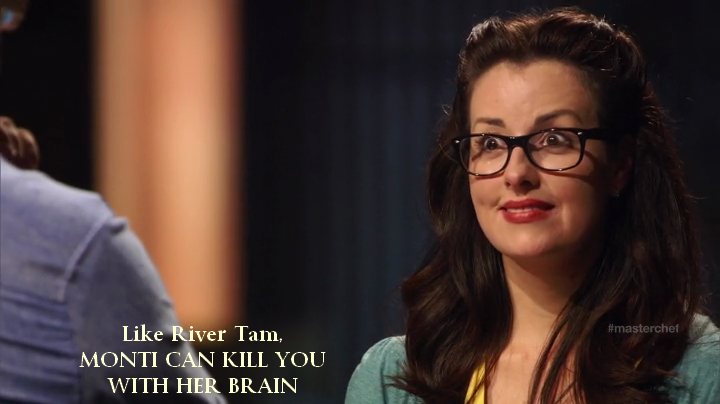
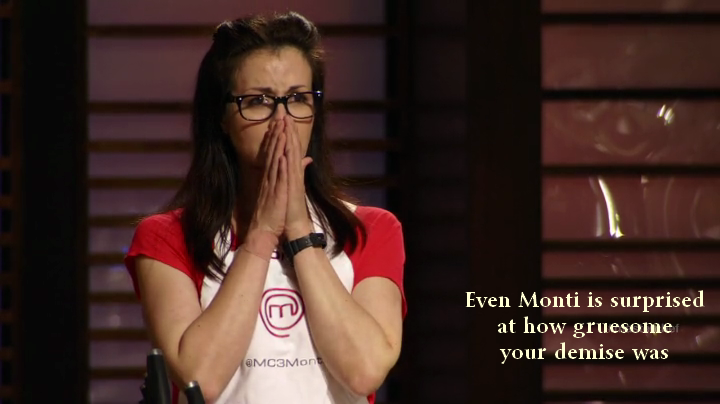
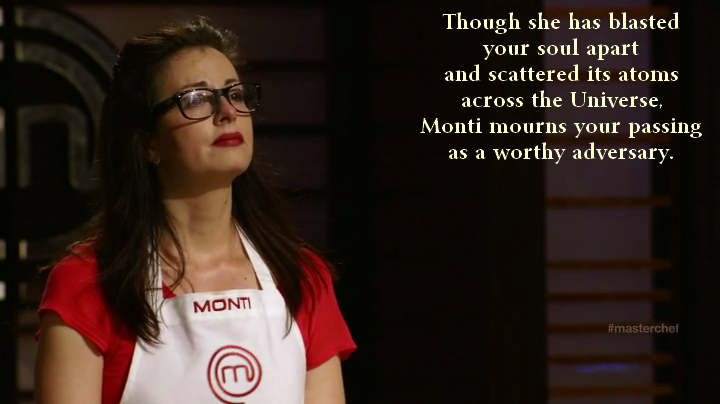
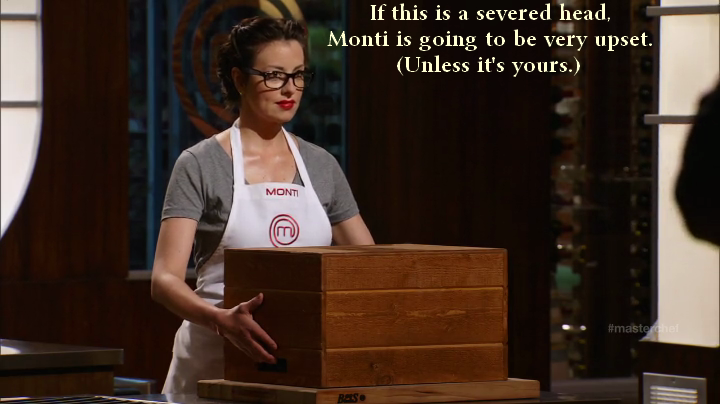
And as long as I’m celebrating Monti Carlo, let me repost something I put together way back in 2012 when her run on MasterChef came to too soon a finish. (I still don’t understand why Josh didn’t get sent home on that dish, when he actually won a basket of the exact ingredients in the dish the cooks were supposed to replicate and he didn’t get it done.) I have to admit that I miss the early years of MasterChef, when the personalities seemed bigger. There are cooks I remember from those seasons even though they were a decade ago, and yet I have to really try hard to remember anybody from the season that just finished. Anyway, the balance of this post is a time capsule of sorts…let’s go back to August 2012….

[Insert weird time travel music and wibbly-wobbly timey-wimey sound effects and shimmering here]

Well, I will find whatever episodes of Master Chef remain a lot less interesting, because my favorite contestant, Monti Carlo (yes, that is her real name), has been eliminated. Her departure was pretty upsetting: it was the first time in the whole season she ever found herself in the Bottom Two, and the other one there, Josh, had managed to completely screw up the assigned dish despite having won the earlier challenge and thus having literally been handed a box of the exact ingredients for the dish they were supposed to replicate.

Oh well. I thought Monti was just terrific. She was smart, skilled, and funny. She clearly didn’t know as much about food as some of the other contestants, but she made up for it with an adventurous spirit and a self-confidence that grew as the season went on. I loved the episode where she was given a John Dory fish to filet and cook, and she’d never even heard of that fish before, much less cooked one. The judges noted how long it was taking her to start fileting it, but when she did, she took the knife right to it and muttered, “I’m gonna figure you out.” I loved that.

I don’t think she was destined to win, really; I expect the finale to boil down to Frank (the Italian stockbroker with mad kitchen skills) and Christine (the blind woman with mad kitchen skills). Becky is annoying with her oddly inflated sense of self-worth, and so is Josh, with his pouting whenever he doesn’t get what he wants. I don’t think Monti was going to win, but I think she should have come closer than this. And if Graham (the fat judge) was going to offer the last guy to get eliminated a job in one of his restaurants, why no offer to Monti? Why didn’t Gordon Ramsay offer her the money for a down payment on the food truck that she wants to run?

Oh well.

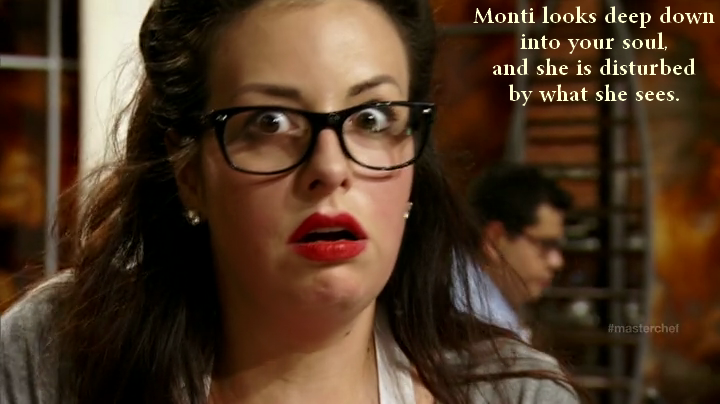
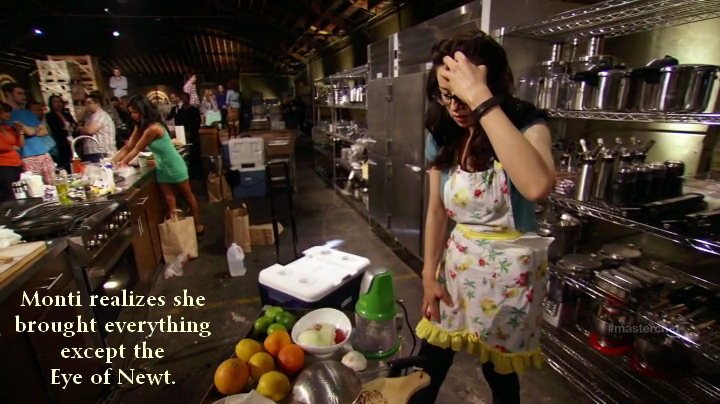
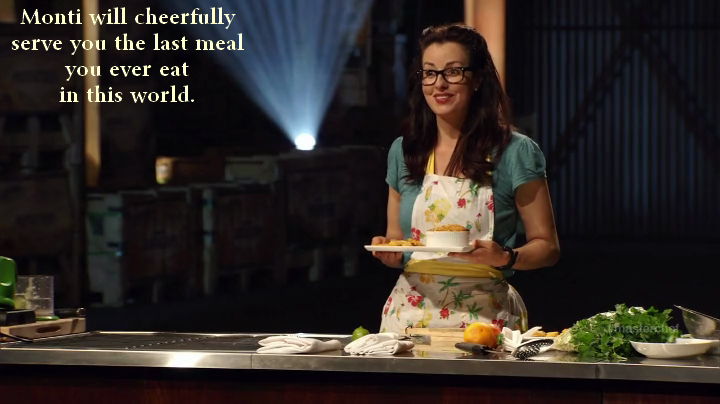
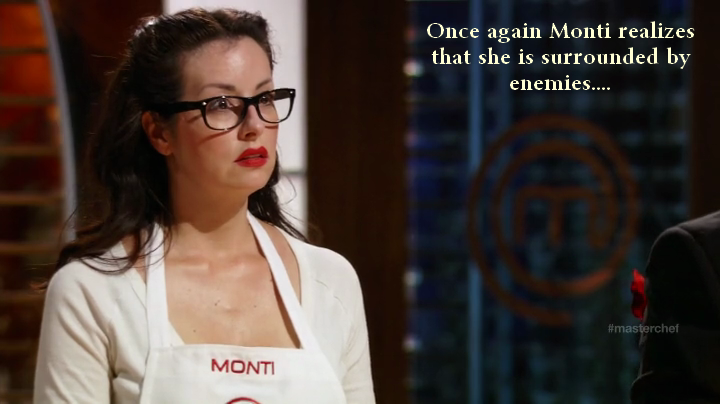
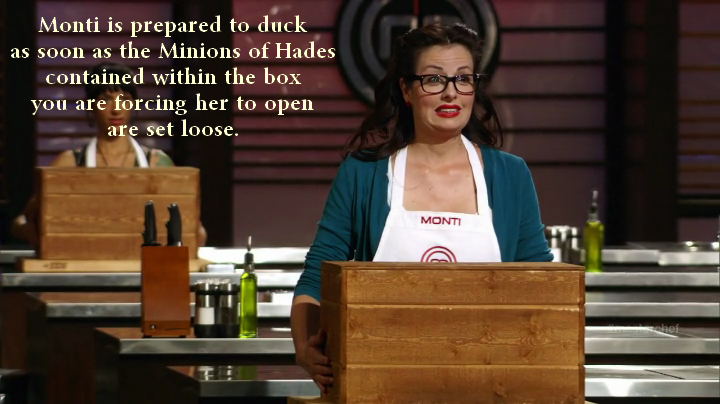
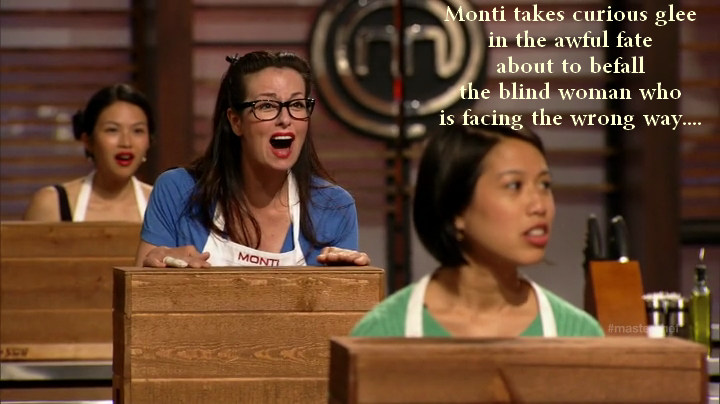
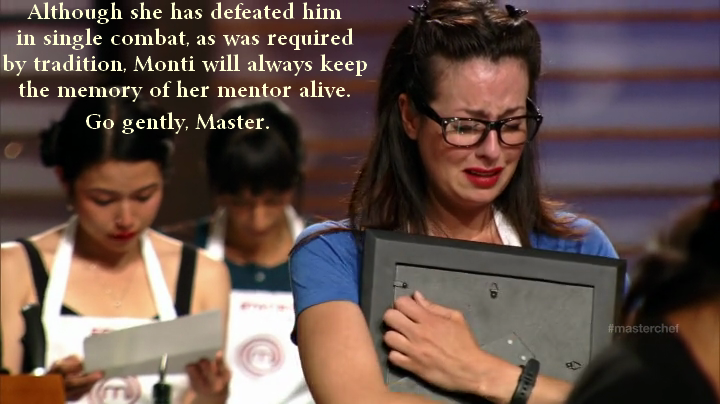
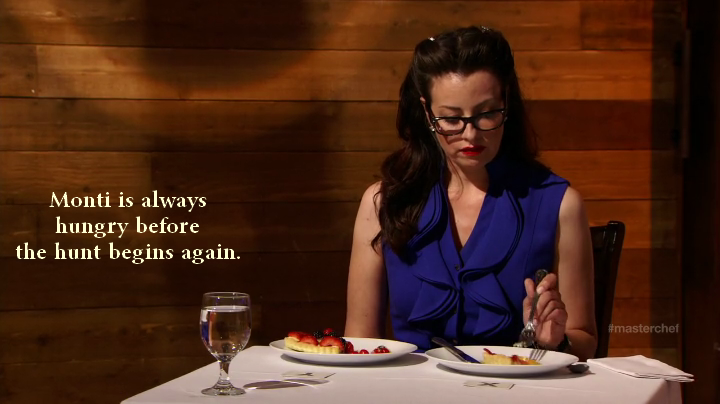
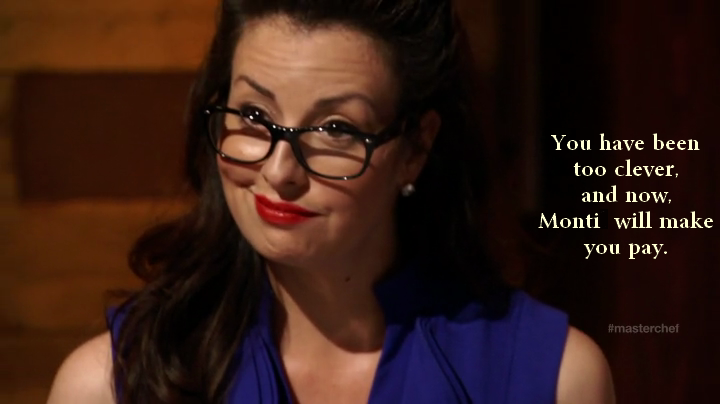
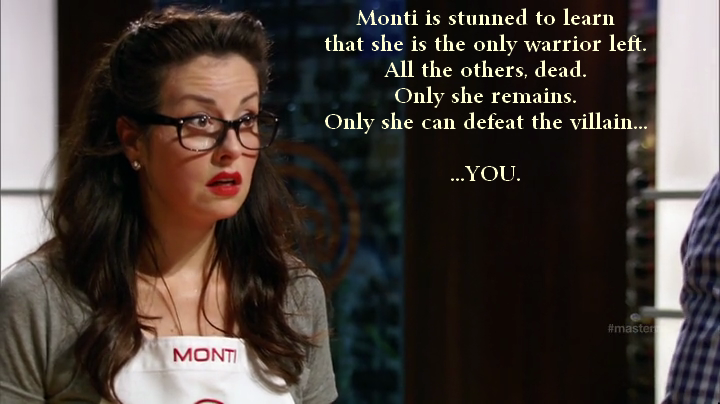
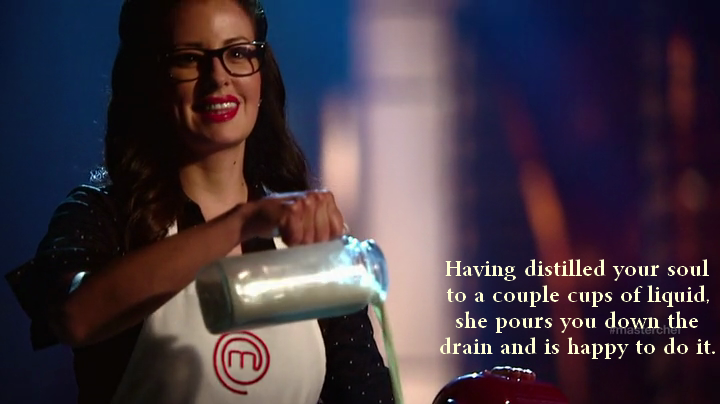
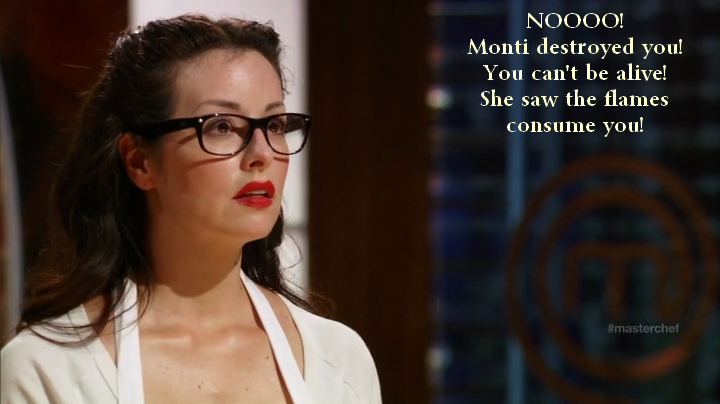
I also loved Monti because she had fantastic facial expressions. She mugged for the camera wonderfully, so I took some screengrabs and captioned them…as if Monti was the heroine in some kind of cheesy Asian martial arts/fantasy flick. At least, that’s the notion.

[Wow, I used to generate some really weird content, didn’t I??? –Present Day Me]

It’s Monti Carlo’s world, and we’re all living in it, is all I’m saying.

Share This Post

How to Not Freeze to Death

I don’t remember when the YouTube algorithm started serving these up to me, but over the last year I’ve started seeing “Survival” videos, in which an intrepid creator will purposely venture out into a difficult situation to see if they can survive. They’ll have titles like “30 below in a snowstorm with NO SLEEPING BAG and NO TENT!!!”…but when you watch a few, a lot of them turn out to be surprisingly watchable as relaxing nature videos. And you learn a few things along the way.

Here’s one of my favorites, by a channel called “Outdoor Boys”, which is apparently one of the biggest and most prolific producers of this sort of thing. This kind of survival is fascinating to watch, and I like this particular video because a lot of what our hero does here is not what I’d expected. He does not find a nice large fallen tree against which he makes a lean-to out of branches, and while he does make a fire, it’s not just a little campfire which he uses for warmth and for cooking food. He uses the fire as a tool, and how he does it is really fascinating. Have you watched any survival videos? Do you find them as interesting as I do?

Share This Post

“Dick, sometimes I understand why they hate you.” Nixon, 30 years gone

A few days after Richard Nixon died (on this date, 1994), I was out riding around with my father as he did some errands. We stopped at the post office in the town where we lived, and Dad noticed that the flag was at half-staff. He asked why, and I said something like, “Well, a former President died–“

At that my father sputtered and said, “The flag’s down for NixonThat piece of shit?!”

Dad hated Richard Nixon. Hated him. Mom did too. Dad hated Nixon so much that he was angry at Gerald Ford for the rest of his politically-aware life (“Nixon should have gone to jail,” he would often say), and in his office at St. Bonaventure he had on the wall a poster (or maybe it was something he trimmed from a magazine or newspaper) that was a fairly unflattering picture of Nixon, captioned with “Everything he is today, he owes to a free press.”

When I went to college in Iowa, I met people who thought Nixon was just A-OK in their book. He did the same kind of shady shit they all do, you see! Nixon just got caught! That was my first real encounter with the deep cynicism of the American right.

Nixon was President when I was born, and he was gone from the scene before I even turned three, so I was never aware of Nixon as a political figure in any real capacity. I remember seeing him in interviews and wondering how that guy, with his gravely voice and complete lack of any real charisma, not only got elected but then reelected in one of the biggest victories ever. But Nixon was never a reality for me. Nixon was an abstract thing, to be honest.

Nixon was the first President of my lifetime, and he was also the third to die in my lifetime; Truman and Johnson were the first two. His passing in 1994 was a surprisingly big story, as I recall.

My main feeling on Nixon is shaped by, of all things, a film: Nixon, by Oliver Stone. I was excited when the film came out, as I already counted JFK among my favorites (I still admire it greatly, as paranoid and insane as its history actually is). I had to see Nixon by myself, as The Girlfriend (now The Wife) was not interested in another three-hour Oliver Stone political potboiler, and my mother scoffed at the concept, too: “I lived through that bastard once, I don’t need to sit through a goddamned movie about him.”

Nixon remains for me something of a classic. Here is a post I wrote back in 2010 after I rewatched it. I wouldn’t change a word of this.
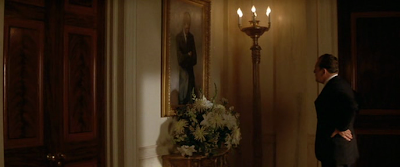
Oliver Stone’s Nixon is an amazing film. I kind of wish Stone was still making movies like this: densely packed films that overwhelm the audiences with information and tell their tales in complex, non-linear ways. Well, maybe Stone still is making movies like this; in truth, I haven’t kept up with his career much over the last ten years.

It’s easy to see Nixon as a companion piece to the earlier JFK, and in many ways, it almost is. But it’s also a very different film, even while using many of the same techniques of the earlier film. Nixon is more meditative, more of a character study, than a film interested in posing a particular hypothesis, as was JFK. (To a certain extent, anyhow – people often refer to “Oliver Stone’s conpiracy theory” regarding the JFK assassination, but when you actually watch the film, no real, concrete hypothesis is ever actually advanced.)

Nixon seems generally focused on the way that the very strengths, or gifts, or skills that allowed Richard Nixon to ascend to the highest political office in the United States were the ones that brought about his downfall. A “tragic hero” will often have a bunch of good qualities, and one not-so-good quality that causes everything to fall apart. Nixon, however? His power came via his paranoia, and deserted him by the same route.

The film opens with a brief educational film about salesmanship (“What you’ve got to remember, Bob, is that you’re selling yourself!”), and then we’re into the story proper. The overall device of the film is Nixon, alone in his study during a series of nights toward the end of his Presidency, reflecting on the events of his past, most often by listening to his infamous tapes of his Oval Office conversations. The film is told in a series of flashbacks, then, and not always in the real order of events, but in the more real way in which we tend to remember things: the memories that surface as they seem relevant to the events of our present-day lives. At times, Nixon is remembering past political events, and at others, he is remembering past personal moments with Pat, the love of his life.

To me, the question of authenticity with regard to a film like this misses the point. I remember watching discussions of the film on news shows when it came out, back in 1995, and the topic always seemed to revolve around the extent to which Stone captured the “real Nixon”. Some folks attacked the film on that basis, others praised it; I remember one commentator – I think it may have been Bryant Gumbel – who said, “I don’t think it’s the Nixon, but rather a Nixon”. That seems pretty astute to me. Those closest to Richard Nixon seemed fairly adamant that Stone did not depict the “real Nixon”, but even those closest to us don’t know our real selves as well as they might think. Is Stone’s Nixon a “real” Nixon? I suspect that he captures some of Nixon’s qualities well, others not so well. I also suspect that Stone emphasizes some of Nixon’s qualities a bit in the interest of making a better movie. I think that Nixon is to Richard Nixon as Henry V is to King Henry the Fifth.

Of special interest to me when I watched Nixon a couple of weeks ago was the way no one ever really spells anything out directly. Nixon himself seems to be talking in code with his assistants much of the time, and at no point does anyone say, “Hey, we should break into the DNC offices at the Watergate and see what we can find out.” At no point does Nixon say, “We need to cover this up!” Everything is happening, or has already happened. This plays into one of Stone’s themes of the film, which is stated outright in the scene of the odd moment (which really happened) when Nixon left the White House in the middle of the night, went to the Lincoln Memorial, and ended up interacting with the protesting kids there. Referring to the war, one girl says: “You can’t stop it, can you? You’re powerless.”

Stone conveys this as well with a lot of fascinating cinematography. As in JFK< he employs a lot of different looks and styles throughout the film, sometimes shooting things “straight”, while other times using black-and-white, or making the film very grainy in spots, or using lots of fades and superimpositions of stock footage to convey the magnitude of the issues Richard Nixon faced or the hugeness of his character. In many “Presidential” films or teevee shows, such as The American President or The West Wing, the White House is shot as a beautiful place where our patriotism and commitment to democracy is literally made physical. No so in Nixon; the White House here is an ominous place, and place of fear and dread in the face of historical forces that cannot be tamed.
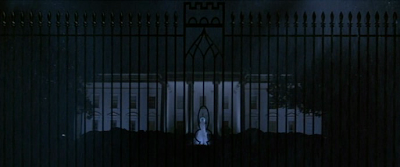
Stone often frames scenes from odd angles, and many scenes depict dark shadows contrasting with brilliant light streaming in through windows. An early scene shows Nixon in his personal study, sitting beside a roaring fireplace while the air conditioning is on at full blast.

Nixon seems increasingly shocked, over the course of the film, to learn just how little control even a President gets to have over the forces around him, and by the time he really comes to grips with this, he is on the brink of ending his Presidency. Even late in that particular game, though, he continues to assert that a lack of control was what got them, in the end: “We never got our story out,” he says to Alexander Haig. Nixon relishes the moments, all too few, when he gets to feel as though he is in control, such as when he puts a wealthy donor in his place or chews out Henry Kissinger. But he also reacts with increasing anger when his efforts at control fail, such as when a press conference goes awry or when his own wife tries to criticize him over dinner.
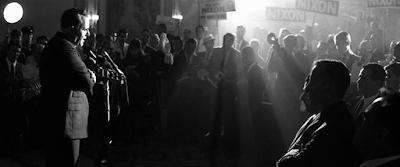
That brings me to the film’s central relationship, that of the marriage of Richard and Pat Nixon. It’s really an amazing relationship, as movie marriages go; it is not depicted as a relationship of blind love that is independent of everything else in Richard Nixon’s life, nor is it depicted as Pat’s Lady Macbeth to Richard’s Macbeth, with Pat being ambitious and desiring of power all her own and only being in the marriage because it’s the best route for a woman to real power in mid-20th century America. Pat Nixon is shown as being literally the only person in Richard’s life who is ever willing to criticize him or tell him when he’s wrong, but she is also there for him through everything, except for one brief period when she considers divorce. Even then, however, Richard brings her back from the brink, and even after all of her disgust during the long unfolding of Watergate, when Richard at last stands alone in the White House on that last night of his Presidency, ruined and emotionally drained and devastated, it’s Pat who comes to him and gives him the only consistent shoulder he’s ever known on which to lean.

Nothing in this movie would work without some great performances by the cast, and there isn’t a single weak link among them. Stone assembles an astonishing supporting cast here; so much so that if this movie had been made in the 1970s, the posters would have included one of those rows of thumbnail photos of the stars along the bottom. James Woods, Bob Hoskins, M. Emmet Walsh, Saul Rubinek, EG Marshall, Madeleine Kahn, Tony Goldwyn, Mary Steenburgen, David Hyde Pierce, Ed Harris, and the like – Nixon might be the single most star-studded film of the 1990s to not feature Kevin Bacon in any role at all. But the two performances that center the film, that absolutely ground it, are Joan Allen as Pat Nixon, and Anthony Hopkins as Richard.

The film made a pretty wise choice as regards the “look” of Richard Nixon. They didn’t go overboard in trying to make Hopkins look like the genuine article; they gave him roughly the same haircut and I assume some prosthetic teeth to make his smile look more Nixonian, but after that, they relied on Hopkins to do it all through the magic of acting. He plays Nixon as a somewhat hunched-over, physically awkward, gravelly-voiced man who never seems to exude much by way of charisma, but rather gets what he wants from others because he simply won’t accept anything else. Nixon is a bundle of nervous energy, and Hopkins plays him as a man who sweats too much, grins at odd moments, and can’t figure out what to do with his own hands.
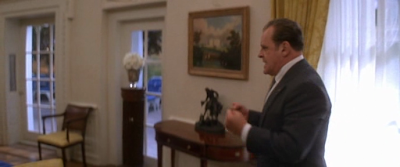
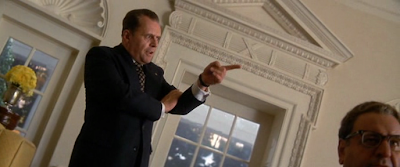
Hopkins’s performance is endlessly fascinating to me, coming as it does in the same period as a number of other performances by him that are all unique: there is nothing of Hannibal Lecter to be found in Hopkins’s Richard Nixon; nor is there to found any of Mr. Ludlow from Legends of the Fall, CS Lewis from Shadowlands, or anyone else. Hopkins’s Nixon is really a singular creation, so much so that the spell is actually broken twice over the course of the film, both involving Oliver Stone’s use of archival footage from the Nixon years. One is of a Nixon mask, being paraded about at a protest rally; the features are distorted, but we can still see that it’s a mask of the real Nixon; the other is at the very end of the movie, when Stone shows us footage of the real Mr. And Mrs. Nixon walking to Marine One for their final departure from the White House.

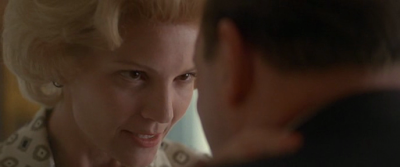
Joan Allen’s Pat Nixon is equally remarkable, because hers is a quieter performance as the only person who gets to talk back to Dick Nixon and not only get away with it but be able to stick around afterwards. She is, by turns, thrilled by him, devoted to him, angered by him, disgusted with him, and in the end, deeply empathetic to him. We can see the pain on her face when she sees him, alone in the White House, talking to the portrait of John F. Kennedy, in one of the film’s finest moments (“When they look at you, they see what they want to be. When they look at me, they see what they are.”) The keenest moment of insight as to Nixon’s character – as the film depicts it – comes when Dick is gearing up for his 1968 run for President, six years after he’s sworn to Pat that he’s done running for office. She is angry that he has been making plans without telling her, but she still feels the old hunger and the pain from the last two losing campaigns has mostly faded, so she is willing to stand with him once again – in fact, she even hungers for it herself, telling him “This time, we’re gonna win. I can feel it.” And Dick takes her in his arms and dances, in the best Nixonian fashion: awkwardly and gracelessly.
John Williams’s score for Nixon is, to my mind, one of his more underrated efforts. He juxtaposes a cheerfully optimistic Americana sound with more downbeat and dark music as Nixon begins to spiral out of control. Stone closes the film with a musical choice that seems odd, at first, but is really amazingly fitting: the Mormon Tabernacle Choir’s a capella rendition of Shenandoah. There isn’t much in the film by way of period popular music, as instead Stone relies on Williams’s sound world to help immerse us in the world of Dick Nixon.

As with JFK, a companion book was released for Nixon, containing the film’s screenplay, a number of archival documents (including transcriptions of the Nixon tapes), and essays by the filmmakers, historians, and figures from the Nixon administration (John Dean and E. Howard Hunt). Here is an excerpt from an essay by Christopher Wilkinson, one of the film’s writers:

The more we got to know Nixon, the more it struck us how odd he was. He was a man who referred to himself in the third person and called his wife “Buddy”. He was physically awkward, socially graceless, and sexually repressed. Other than Bebe Rebozo, he had no real friends. When he needed to relax, he would just sit silently with Rebozo. For hours. Bob Haldeman was with him for nearly twenty years and never shook his hand.

The was a strange man, an extremely strange and mysterious man.

I cannot remember the precise moment when we started to empathize with Nixon. To begin to understand the tragedy of his life. To appreciate the true dimensions of his character.

Nixon came from nothing – the wrong schools, the wrong clothes, the wrong parents – and, by dint of hard work and self-sacrifice, rose to the heights. In many ways he is the American Dream incarnate, the self-made man who tortured himself to be a Somebody. And he never gave up. He came off the canvas again and again, rehabilitating himself, reinventing himself. Admittedly, the notion of Nixon the Indestructible is often trotted out to evoke sympathy for him.

But it’s true.

There are other poignant and peculiar details that reached us, that slowly eroded our contempt. The emotionally distant mother who rarely touched him. The brutish father who directed fits of blind rage at him. The lonely, clumsy boy who was sure that no matter what he did, he would never be good enough.

And the dead brothers. First his beloved little Arthur. Then Harold, outgoing, attractive, a boy Richard idolized. A boy whose lingering death allowed the family to afford Richard’s tuition to law school.

The guilt.

When Nixon fell in love with Pat, he drove her on dates with other boys to prove himself to her. He wore her down with a barrage of flowers and letters. He would do whatever it took to win her and he never let up until she was his.

Classic Nixon.

The only clean campaign he ever ran was 1960. Kennedy (like Harold) was everything Nixon was not – handsome, charming, articulate, witty. Nixon could have used any number of smear tactics against him; the religion, the Mob connections, the women. But he didn’t. He respected Jack Kennedy more than any opponent he had ever faced. So, for the only time in his political life, Nixon played it straight.

And Kennedy stole the election from him.

The fact that he didn’t completely come apart during the crushing pressure of the final days of Watergate is a testament to his bullheaded resolve. To his perverse brand of courage. Everyone was against him. The country wanted his head on a pike and he wouldn’t give it to them. A lesser man might have run screaming and drooling down Pennsylvania Avenue. Or had a stroke. Or committed suicide. But not Nixon. He wouldn’t give them the satisfaction.

As President, he did more to desegregate the schools than any of his predecessors. He created the first and most effective Environmental Protection Agency. He has few (if any) Presidential peers in foreign policy: the spectacular opening of China, achieving detente with the Russians. Accomplishments that Nixon, the quintessential Commie hunter, was uniquely suited for. If a liberal Democratic President had tried it, he would have been crucified.

And Nixon would have brought the nails.

Nixon stretched our idea of what greatness is. He is a huge character who embraces the entire American landscape from its loftiest ambitions to its most malignant schemes. To understand Nixon is to understand what we have been. To understand Nixon’s destiny is to understand what has happened to us. To understand Nixon’s life is to understand the history of our times.

What strikes me now, on reflection, is the way the Nixon political playbook has come to dominate American politics in our day, forty years after Nixon held office, with its dirty tricks and coded appeals to our baser instincts. But Nixon’s actual policy goals now form the farthest boundary to the left that our politics are willing to allow voice. It’s amazing to me that if a Republican candidate came along now, espousing Richard Nixon’s policy goals, that candidate wouldn’t even make it out of the primaries. Things that a Republican President did forty years ago would be labeled as unforgivably liberal — Socialist, even — if a Democrat did them today.

What a great, disturbing film this is. Just like Richard Nixon himself.

Share This Post
Mr. Ebert, ten years gone

Roger Ebert died ten years ago today. I’m more of a mind to honor the anniversary of someone’s entering the world rather than their leaving it, but Ebert was such a force in the back of my mind almost all the time I knew of him, constantly shaping not just my love of movies but also my way of thinking about movies and relating to movies. And it’s not just movies: it’s the way he related to art.

Here is what I wrote on the day he died:

I was trying to figure out something to write on the passing today of Roger Ebert, but nothing was leaping to mind, so I figured I’d just repost my original thoughts, from January 2012, on his book, Life Itself. I have loved and admired Ebert since I was nine, and his output of thoughtful writing even in the face of debilitating disease the last few years has been truly astonishing. It’s something of the ultimate motivator: When I think “I don’t really wanna write today”, I then thing, “Roger Ebert’s writing today, and that guy’s got some hardcore difficulties. So get in the chair and write.”

When I saw the news today — my first report came via Sheila O’Malley on Facebook, and she is frankly the exact person I would have wanted to hear this from — I commented thusly:

Amazing how something you totally expect and don’t find a surprise can still hit you between the eyes and make the world a little less shiny

Farewell, Mr. Ebert. If there is some realm beyond this one…well, whatever. At least on this side we’ll have your years and years and years of writings. I’ve come to see you as being to film what Carl Sagan was to science, and I mourn and salute you in the same manner. Congratulations on a life well-lived!

I was nine years old, and I wandered into the living room to find my mother watching some show on PBS. It was a show about movies – there would be a clip of a new movie that was out, and these two guys would then talk a bit about whether the movie was any good or not. One of these guys was a thin, lanky guy. The other was a squat, fat guy. The thin guy was named Gene. The fat guy was named Roger.

“What’s this?” I asked.

“It’s called Sneak Previews,” my mother answered. “Those two men are film critics. They tell us if movies are good or not.”

“Oh.”

And I watched the thing. I didn’t know anything about movies, but these two guys were interesting to watch. Another year or two later, their show was off PBS, which struck me as a bummer…but they turned up again, in a syndicated show that was on, like many syndicated shows, at whatever time some station or other felt like putting it on. No matter, it was fun seeing these two guys, Gene and Roger – who worked for newspapers in Chicago – talk about movies.

So I watched Gene Siskel and Roger Ebert for years, off and on, right up until Siskel’s deeply saddening death in 1998. Then I watched Ebert and Richard Roeper (a good enough fellow, but no substitute for Siskel) for a few more years, until we no longer had cable and thus the show was beyond my grasp. And then, a few years after that, Ebert himself started to have health issues, which eventually resulted in unsuccessful surgeries that have famously left him unable to speak or eat (he takes meals through a G-tube, which is something I understand all too well, thanks to Little Quinn).

Siskel and Ebert were, in my view, one of the great duos in the history of anything. Those two had such astonishing chemistry together, that it was a joy to watch them agree positively on a movie, an even bigger joy to see them agree negatively on a movie (seriously, watching the two of them tag-team on a bad movie was always great), and the biggest joy of all when they disagreed. Then you could see some fireworks. I remember Ebert being astonished at Siskel’s thumbs-down review of Scorsese’s Casino; “Thumbs down?!” Ebert yelped. And there was another time – I can’t remember the movie – where Ebert liked it and Siskel did not, and Ebert said something like “I don’t think you wanted to like this movie”, a suggestion that seemed to physically hurt the usually more acerbic Siskel. “I love to like pictures!” he protested.

One time on Late Night with David Letterman, there was a segment that had Mujibur and Sirajul, the two Indian owners of a local store, reporting to Dave from somewhere in the country. And Dave says, “If you two are out there, who’s watching the store? Can we send a cameraman to see who’s in charge at the store?” So a cameraman goes into the store, to reveal a very stern-looking Siskel and Ebert. OK, I guess you had to be there.

Anyway, Ebert has been writing about the movies for decades now, and he is, by nearly any measure, the critic whose work I find the most illuminating and the most evocative. I’ve been reading him nearly almost as long as I’ve been watching him on teevee, and for a number of years, his annual review collections were required book purchasing of mine. Now he has produced a memoir, which he has titled Life Itself.

Ebert’s health struggles in recent years are well-known, and it’s been truly fascinating to watch him take to blogging in the wake of the loss of his physical voice, a medium he had initially viewed with suspicion but which allowed his authorial voice to finally blossom to its greatest strength. Ebert has always been a fine writer, but oddly, his disability-due-to-cancer has, for many, made him even better. Maybe it’s similar to that old saw about how when you lose one sense, the others somehow make substantial gains in acuity.

Reading his blog, I’ve mostly been struck by Ebert’s ongoing zest for life, even when there were occasional posts that took an especially elegiac tone that made me wonder if he was preparing for his own departure from this world. Ebert is still with us, though, and now we have Life Itself.

The book is more a series of vignettes than a straight telling of Ebert’s life. The vignettes are more or less in chronological order, but Ebert seems to be more exploring various themes in his life than the chronology of events. The book is something of a memory album that gives an impression of a life, which seems to me a good way to structure a biography. Sometimes when I read biographies, I get a sense of “plot” that couldn’t possibly be there. Ebert is well aware that life is plotless, and that many of the things that shape the paths of our lives for good or ill are often accidental, a function of our coming into the circle of this person instead of that person, or even something so prosaic as taking this flight instead of that one.

It’s telling that the book gives more of a sense of his development as a writer than as a critic; I suspect that Ebert believes that he would have been a writer no matter what, and it was just an accident of various circumstances that led to him writing about movies for the last forty years. There’s no “Through all my life the cinema has grounded my being” or anything like that; Ebert grew up as a talented kid who liked going to movies with his buddies on Saturdays. I love when he recounts his first reviews of avant garde films; finding himself in confusion as to what the films were about, he took the approach of simply recounting his experience in watching the film. This is an approach that has gone on to inform his entire approach to movie reviewing and film criticism.

Sometimes, in the course of his blogging over the last few years, a tone has crept into Ebert’s writing – that he seems to deny whenever it is pointed out, but it is there – that he is, in long form, saying goodbye to his life. I deeply hope that this is not the case. Ebert is, for me, to film as Carl Sagan is to science, and he’ll be missed by me in equal measure when he is gone.

Here are some excerpts from Life Itself.

On Mike Royko:

At about six p.m. On New Year’s Day of 1967, only two lights on the fourth floor were burning – mine and Mike Royko’s. It was too early for the graveyard shift to come in. Royko walked over to the Sun-Times to see who else was working. A historic snowstorm was beginning. He asked me how I was getting home. I said I’d take the train. He said he had his old man’s Checker car and would drop me at the L station. He had to make a stop at a twenty-four hour drug store right where the L crossed North Avenue.

Royko at thirty-five was already the city’s most famous newspaperman, known for complex emotions evoked with unadorned prose in short paragraphs. Growing up as the son of a saloon keeper, he knew how the city worked from the precinct level up, and had first attracted attention while covering city hall. He was ten years older than me and had started at the old City News Bureau, the cooperative supported by all the dailies that provided front-line coverage of the police and fire departments. Underpaid and overworked kids worked under the hand of its editor, Arnold Dornfeld, who sat beneath a sign reading: If your mother says she loves you, check it out. When I met him he’d been writing his Daily News column for two years. It was his writing about Mayor Richard J. Daley that took the city hall word clout and made it national. He chainsmoked Pall Malls and spoke in a gravelly poker player’s voice. He drank too much, which to me was an accomplishment.

That snowy night the all-night drugstore was crowded. “Come on, kid,” he said. “Let’s have a drink at the eye-opener place.” He told me what an eye-opener was. “This place opens early. The working guys around here, they stop in for a quick shot on their way to the L.” It was a bar under the tracks so tiny that the bartender could serve everyone without leaving his stool. “Two blackberry brandies and short beers,” he said. He told me, “Blackberry brandy is good for hangovers. You never get charged for a beer chaser.” I sipped the brandy, and a warm glow filled my stomach. It may have been the first straight shot of anything I’d ever tasted. I’d been in Chicago four months and I was sitting under the L tracks with Mike Royko in the eye-opener place. I was a newspaperman. A blackhawks game was playing on WGN radio. The team scored, and again, and again. This at last was life.

“Jeez, they’re scoring like crazy!” I said, after the third goal in less than a minute.

“Where you from, kid?”

“Urbana,” I said.

“Ever seen a hockey game?”

“No.”

“That’s what I thought, you asshole. Those are the game highlights.”

On books:

Chaz [Ebert’s wife] and I have lived for twenty years in a commodious Chicago town house. This house is not empty. Chaz and I have added, I dunno, maybe three or four thousand books, untold numbers of movies and albums, lots of art, rows of photographs, rooms full of comfortable furniture, a Buddha from Thailand, exercise equipment, carved elephants from India, African chairs and statues, and who knows what else. Of course I cannot do without a single one of these possessions, including more or less every book I have owned since I was seven, starting with Huckleberry Finn. I still have all the Penrod books, and every time I look at them, I’m reminded of Tarkington’s inventory of Penrod’s pants pockets. After reading it a third time, as a boy, I jammed my pockets with a pocketknife, a Yo-Yo, marbles, a compass, a stapler, an oddly-shaped rock, a hardball, a ball of rubber bands, and three jawbreakers. These, in an ostensible search for a nickel, I emptied out on the counter of Henry Rusk’s grocery, so that Harry Rusk could see that I was a Real Boy.

My books are a subject of much discussion. They pour from shelves onto tables, chairs, and the floor, and Chaz observes that I haven’t read many of them and I never will. You just never know. One day I may nee to read Finnegans Wake, the Icelandic sagas, Churchill’s history of the Second World War, the complete Tintin in French, forty-seven novels by Simenon, and By Love Possessed. That 1957 bestseller by James Gould Cozzens was eviscerated in a famous essay by Dwight Macdonald, who read through that year’s list of fiction bestsellers and surface with a scowl. I remember reading the novel late into the night when I was fourteen, stirring restlessly with the desire to be possessed by love.

I cannot throw out these books. Some are enchanted because I have personally turned all their pages and read every word. They’re shrines to my past hours. Perhaps half were new when they came to my life, but most were used, and I remember where I found every one. The set of Kipling at the Book Nook on Green Street in Champaign. The scandalous The English Governess in a shady bookstore on the Left Bank in 1965 (two dollars, today ninety-one). The Shaw plays from Cranford’s on Long Street in Cape Twon, where Irving Freeman claimed he had half a million books. Like an alcoholic trying to walk past a bar, you should see me trying to walk past a used bookstore. Other books I can’t throw away because, well, they’re books, and you can’t throw away a book. Not even a cookbook from which we have prepared only a single recipe, for it is a meal preserved, in printed form. The very sight of Quick and Easy Chinese Cooking by Kenneth H.C. Lo quickens my pulse. Its pages are stained by broth, sherry, soy sauce, and chicken fat, and so thoroughly did I master it that I once sought out Ken Lo’s Memories of China on Ebury Street in London and laid eyes on the great man himself, dining alone in a little room near the entrance. A book like that, you’re not gonna throw away.

On his wife:

I sense from the first that Chaz was the woman I would marry, and I know after twenty years that my feelings were true. She had been with me in sickness and in health, certainly far more sickness than we could have anticipated. I will be with her, strengthened by her example. She continues to make my life possible, and her presence fills me with love and a deep security. That’s what a marriage is for. Now I know.

On Siskel:

One of the things I miss about Gene Siskel is that he’s not around to make jokes about my current condition. He would instinctively know that at this point I wouldn’t be sensitive, having accepted and grown comfortable with my maimed appearance. He wouldn’t have started joking too soon. His jokes would have the saving grace of being funny. Here’s one I’m pretty sure he would have come up with: “Well, there’s one good thing about Roger’s surgery. At least he no longer needs a bookmark to find his chin.”

On movies:

I have seen untold numbers of movies and forgotten most of them, I hope, but I remember those worth remembering, and they are all on the same shelf in my mind. There is no such thing as an old film. There is a sense in which old movies are cut free from time. I look at silent movies sometimes and do not feel I am looking at old films; I feel I am looking at a Now that has been captured. Time in a bottle. When I first looked at silent films, the performers seemed quaint and dated. Now they seem more contemporary. The main thing wrong with a movie that is ten years old is that it isn’t thirty years old. After the hairstyles and the costumes stop being dated and start being history, we can tell if the movie itself is timeless.

What kinds of movies do I like the best? If I had to make a generalization, I would say that many of my favorite movies are about Good People. It doesn’t matter if the ending is happy or sad. It doesn’t matter if the characters win or lose. The only true ending is death. Any other movie ending is arbitrary. If a movie ends with a kiss, we’re supposed to be happy. But then if a piano falls on the kissing couple, or a taxi mows them down, we’re supposed to be sad. What difference does it make? The best movies aren’t about what happens to the characters. They’re about the example that they set.

Casablanca is about people who do the right thing. The Third Man is about two people who do the right thing and can never speak to each other as a result. The secret of The Silence of the Lambs is buried so deeply that you may have to give this some thought, but its secret is that Hannibal Lecter is a Good Person. He is the helpless victim of his unspeakable depravities, yes, but to the limited degree that he can act independently of them, he tries to do the right thing.

What I miss, though, is the wonder. People my age can remember walking into a movie palace where the ceiling was far overhead, and balconies and mezzanines reached away into the shadows. We remember the sound of a thousand people laughing all at once. And screens the size of billboards, so every seat in the house was a good seat. “I lost it at the movies,” Pauline Kael said, and we all knew just what she meant.

When you go to the movies every day, it sometimes seems as if the movies are more mediocre than ever, more craven and cowardly, more skilfully manufactured to pander to the lowest tastes instead of educating them. Then you see something absolutely miraculous, and on your way out you look distracted, as if you had just experienced some kind of a vision.

May Ebert’s spot in the balcony remain reserved for years to come.


Share This Post
Happy Birthday, Jeff Goldblum!

Roger has alerted me that today is Jeff Goldblum’s 70th birthday! Huzzah!!!

I’ve been a fan of Mr. Goldblum’s for quite a few years, but looking at his filmography, he’s been on my radar even longer than I’ve been aware that he’s been on my radar. I first encountered him in the movie Thank God It’s Friday, the camp disco classic (and yes, I stand by those words, Thank God It’s Friday is glorious disco camp and it’s a rollicking blast to watch even now and I do not apologize for that opinion for one damned second).

Goldblum worked slowly and steadily up the Hollywood food chain, until he was finally a viable lead, probably starting with The Fly, which is an undisputed horror classic and, for my money, the greatest of the 1980s splatter-gross-out horror movies. (I will take The Fly over Alien one hundred times out of one hundred chances. I know, technically Alien isn’t an 80s movie, but I said what I said.)

Finally in the 90s, Goldblum hit it big and was seemingly everywhere. And I was always happy to see him in stuff! Jurassic Park, obviously. Independence Day, which always makes me happy, since it’s like if you took a golden retriever and made them into a goofy sci-fi alien-invasion blockbuster popcorn flick. Goldblum wasn’t just about quirky characters in effects blockbusters, though; he’s done a lot of serious and darker work, too. I’m still sad that his NBC noir-procedural show Raines didn’t score good ratings, because Goldblum was very effective in that show as a troubled detective.


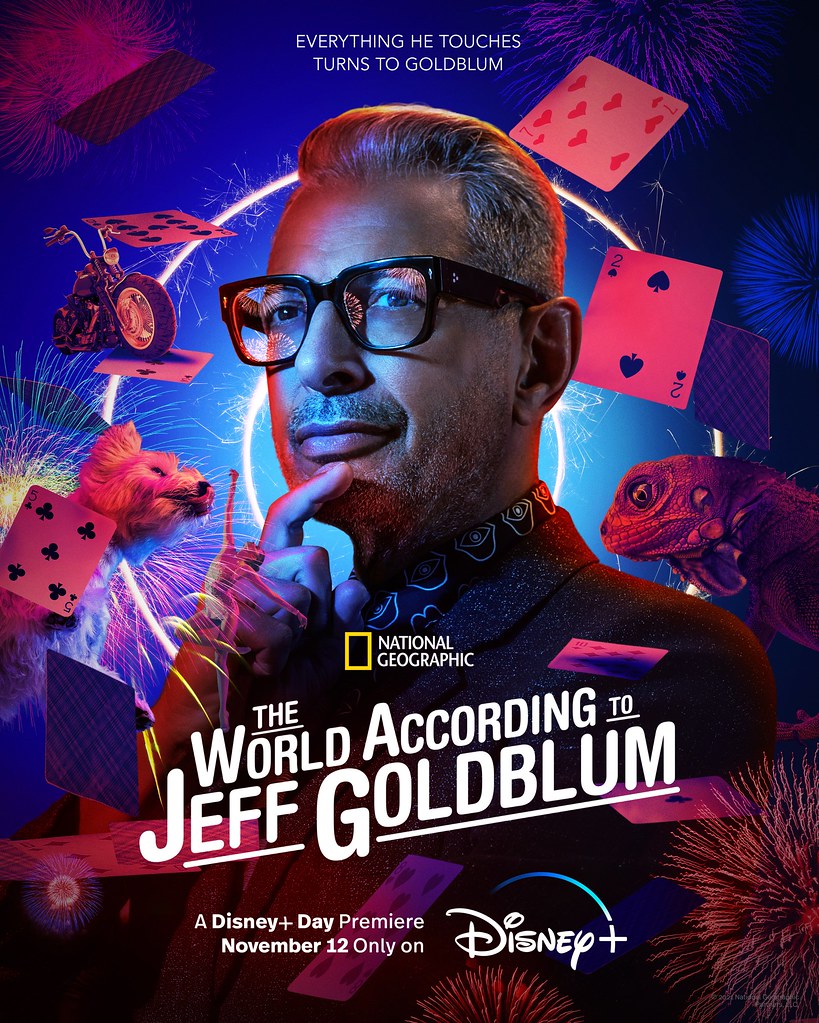
More recently–very recently, actually–we’ve been watching Goldblum’s DisneyPlus show, The World According to Jeff Goldblum. If you haven’t seen this, figure out a way to see this! So far there are two seasons (I hope they do more!) of episodes that are always around 25 minutes long, and each is a min-documentary about some aspect of popular culture. Topics addressed thus far include sneakers, denim, dogs, puzzles, and motocycles. Each episode is a delight as Goldblum does his “quirky cheerful weirdo” thing. We’ve been loving this show. More and more, we need cheerful content that reminds us that our world, with all its problems, really can be a cool place, too.

Two final amusing Goldblum-related items. If you remember his first scene in Jurassic Park, there’s a moment where Goldblum gives this laugh that instantly, and perfectly, establishes his character as being just this side of a madman. (It’s about 25 seconds into the clip that I just linked.) Well, some brilliant soul actually took that almost-maniacal cackle and turned it into a song sample. Sometimes I just love the Internet.

And finally, there is apparently some occasional confusion as to how Mr. Goldblum’s surname is pronounced. Well, here he clears it all up:

Happy birthday,

Share This Post

Lessons from Fictional Fathers

  1. It doesn’t matter if you were the worst father in Galactic history! You can still redeem all of that by throwing the evil Emperor down a reactor shaft before he can kill your son and destroy the Rebellion.
  2. Maybe you grew up estranged, but if the last thing your son said to you before walking out was to cast aspersions on your personal sports hero, a mysterious cosmic force might mess with his head in order to allow you to reconcile. (First it will make him do weird stuff like build a baseball diamond in the middle of a cornfield.)
  3. It’s OK to be a shadowy presence cutting an impressive figure on a distant hill, just as long as you’re ready to step up and take over when your kid’s mother is shot by a hunter.
  4. If a comet’s about to obliterate the world and there’s no hope for you, go wait on the seashore where you took your kid when she was young. She’ll come join you, before the end.
  5. But! If you’re one of the folks ON a comet that’s about to strike the earth, sacrifice yourself to blow it up! She’ll never forget you.
  6. Give your kid privacy and independence! Let him go out and have adventures in the wilderness while you work at your academic pursuits! Later in life, he just might show up to help you find the Holy Grail.
  7. Downplay when you are doing dangerous shit that would freak your kid out, like when you go to hunt a great white shark. Tell him you’re “going fishing”.
  8. Let your kid join Starfleet. His associates will be people of good character.
  9. When your youngest comes home all excited because he met a forest god who’s basically a giant teddy bear and she took a nap on him, take that seriously! Not every kid gets to meet a Totoro.
  10. Maybe the kid isn’t your actual son, but you’re the one who raises him, even though he doesn’t realize it for a long time. That other guy might have been his father, but he wasn’t the kid’s daddy.
  11. It’s not cool to be so open about having a preference between your two daughters. It’s also not cool to pit them against one another in combat. Eventually, both of them might team up with others to stop your jewelry-centric evil plan.
  12. Your kid may one day end up with that poor student you spent all of high school bullying as his teacher, and he may even end up depending on your poor victim to help in defeating the greatest evil wizard of all time, so…maybe don’t be a bully in high school.
  13. Drawing up your will? And you can’t decide which of your two sons should inherit the controlling shares of the oil company you founded? Maybe don’t set up a year-long contest between the two of them to see which deserves it. That shit will cause all kinds of grief for your family.
  14. Defer to your wife on your son’s middle name, if you’ve already decided his first. That means going with “Tiberius” if that’s what she wants.
  15. Look, it happens: Your eldest of three moves out early on, and you live with your other two for many years after. But when your youngest, your daughter, gets married, it’s kind of weird to talk about “your two beautiful children.”
  16. Seems kind of odd to insist on having a big den all to yourself when your house only has two bedrooms to accommodate the three sons you’re bringing to the marriage and the three daughters she is bringing.
  17. That plan your son has cooked up to impress a girl by learning to be a rock drummer in the space of five weeks? Go with it. Your kid’s dealing with some shit, and it just might work. (You’re dealing with some shit too, you know.)
  18. It’s OK if your son has a whole ton of hobbies that you don’t understand, like growing roses and cooking Jewish food, and that he doesn’t really understand you all that well. He’ll get the important stuff (like grilling with propane).
  19. Be creative with your catchphrases. Don’t just threaten to kick your son’s ass. Say things like “Your ass just hung out a Vacancy sign, and my foot’s lookin’ for a room!”
  20. Even as you try to hew out a simple life in your house on the prairie (which is surrounded by hills, strangely enough), you can absolutely have your perfect white teeth and your head of thick curly hair. (Oh, and maybe reconsider having your entire house be essentially one room. I assume you’ll want to occasionally “get friendly” with your wife, and consider that your daughters are trying to sleep in a loft about seven feet above your heads, to judge by the ladder they use to get up there.)
  21. Just because your son turned evil and wants to kill you is no reason to fly off and be a space loser.
  22. So your son’s best friend is a stuffed tiger. Find ways to encourage his imagination! (And stop telling him that everything in the world that sucks “builds character”.)
  23. After a traumatic event, move with your son to Seattle. But maybe get some therapy or something before he calls a radio talk show to discuss your problems.
  24. I know it’s tempting to go with the aliens! They planted the psychological visions in your head! It’s not your fault everyone thinks you’re crazy! But…maybe don’t abandon your family to go with the aliens.
  25. If your son comes of age and wishes to go off to Paris to find his fate and fortune with the King’s Musketeers, let him do so, with the blessing of a kiss–but also give him a horse and a sword.

Of course, some of these lessons are unlikely to be specifically applicable to the situations in which one might reasonably expect to find oneself, but you never do know, do you?


Share This Post