I wanted to get back to Japanese music, but I didn’t get a lot of the pre-listening done this week that I like to do when I’m presenting music I’m not familiar with, so this week I’m going with something I’m very familiar with…but still Japanese! This is a cue from Kiki’s Delivery Service, music by the great Joe Hisaishi. It’s called “A Town With an Ocean View”. This is heard when young witch Kiki, on her first journey out into the real world, ends up in a city that’s much larger than anything she’s known before. She is amazed by its energy and bustle and beauty, and the music shows this so wonderfully.
I’ve noticed over the years that I gravitate toward stories that show cities as places of genuine magic….
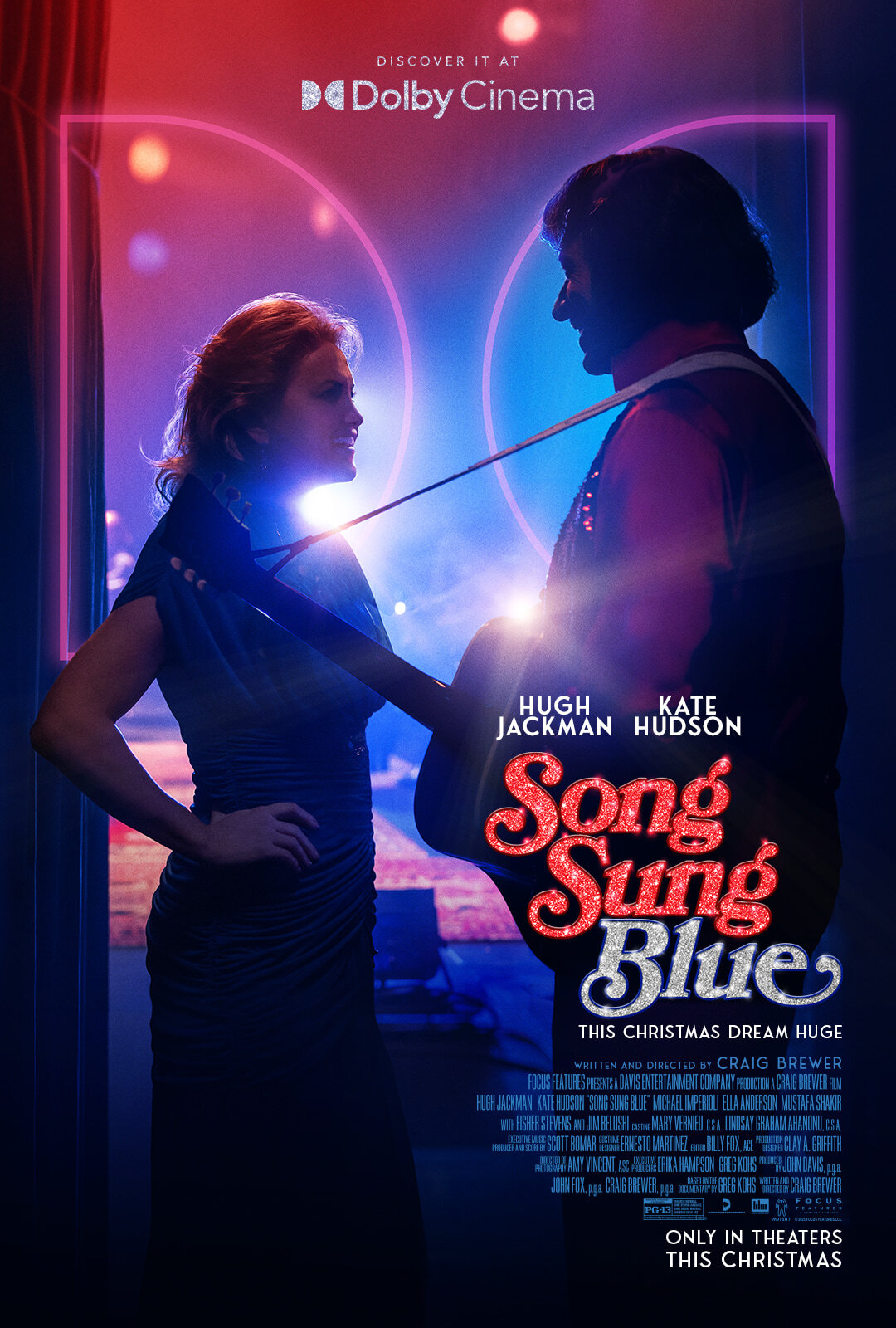
SONG SUNG BLUE movie poster. Via: https://www.dolby.com/experience/song-sung-blue/
We watched Song Sung Blue last night. I honestly didn’t know much about it at all. When I first saw ads for it last year, I truly thought it was a biopic about Neil Diamond, with Hugh Jackman in the starring role. Later I learned it was not about Mr. Diamond at all but about a Neil Diamond tribute band, so I figured it was a rom-com with Mr. Diamond’s music forming the main “hook”. Even though there is a lot of humor in the film, it’s not a rom-com. It’s a somewhat fictionalized (though as far as I’ve read, relatively accurate) biopic of a real-life Neil Diamond tribute band called Lightning and Thunder.
In the late 80s, a guy named Mike Sardina (Hugh Jackman) is a barely-scraping-by blue-collar dude who has dreams of being a rock singer, but is relegated to the “Impersonator” circuit to play county fairs and bingo halls and that sort of thing. In the opening scene he has an argument with a friend, a guy whose schtick is impersonating Buddy Holly (even though his hair is full gray and he makes no effort to color it), because he wants to do his own music as an act he calls “Lightning”, instead of doing his Don Ho act that he had agreed on. Before storming out he meets Claire Stengl (Kate Hudson), who is about to take the stage as Patsy Cline. Long story short, these two meet again and form a Neil Diamond tribute duo, called “Lightning and Thunder” (“Wait…I’m ‘Thunder’?” Claire asks before planting a long, hard kiss on Mike), and off we are into the lives of these talented people in a world that doesn’t really reward talent all that much, who are constantly behind on the mortgage, and whose health isn’t the greatest (boy, isn’t it).
Here are some random thoughts about the movie:
:: I think that your enjoyment of Song Sung Blue almost certainly hinges on your degree of appreciation for the songs of Neil Diamond. I love me some Neil Diamond, so I loved the movie. If you’re one who runs for the hills at the opening chords of “Sweet Caroline”, this isn’t for you.
:: That said, I love how this movie keeps having Mike fight against doing “Sweet Caroline” all the time. He keeps insisting, and rightly so, that there’s so much more to Neil Diamond than “Sweet Caroline”.
:: But yes, you get a full-on rendition of “Sweet Caroline” in this movie. I’ll say this: the movie earns it.
:: The Buddy Holly guy looked familiar to me. I kept thinking “Wow, he looks like an older version of Christopher from The Sopranos.” That’s because it is Christopher from The Sopranos. I keep forgetting that show is more than 20 years in the rear-view-mirror now. Michael Imperioli is a really good actor, by the way.
:: No spoilers, but if you want a movie about good people struggling through some real shit, this is the movie for you. Doubly so if you want a movie that shows how we’re all just one awful moment away from disaster.
:: Mike is an alcoholic and has been going to AA for years; as the movie opens he’s celebrating twenty years of being sober. I really really really like how the movie never does the supremely obvious thing of having him fall off the wagon. There are a couple of conversations of the “You haven’t been to a meeting in a long time” variety, but they’re more of the “You need support right now” thing than him spiraling back into addiction. At one point he’s working in his garage and he finds, buried in the bottom drawer of a tool chest, a bottle he’d stashed away at some point, because alcoholics stash away bottles. I thought, “Crap, he’s gonna drink now, isn’t he?” He didn’t. The next scene has him pouring it down the drain.
:: When Mike and Claire meet and come together, they each have kids from previous relationships. The movie avoids the usual “Our kids hate each other” stuff, which is nice.
:: The level of “meta” in a movie like this is impressive: Hugh Jackman is playing a guy who played at being Neil Diamond. Jackman does a pretty amazing job of doing what the best “tribute acts” do of sounding enough like the original thing to feel like it, without ever trying to sell anyone on the idea that he is the original thing. There’s a fine line between good and honorable tribute acts and impersonator kitsch, after all.
:: Hugh Jackman is incredibly good in this movie.
:: Kate Hudson is also incredibly good in this movie. It’s interesting to me that my two favorite Kate Hudson movies are music centric: this one, and Almost Famous.
:: In one scene, Kate Hudson is wearing overalls! But…be warned, when you get to that point in the movie, things are about to take a very serious turn.
:: Movies like this have a fine line to walk, in terms of how they look. They need to make the time period convincing without looking like they’re making fun of it, especially when the people populating this world pretty much stopped advancing in terms of fashion sometime at least a decade before this movie even starts. Song Sung Blue never once looks fake or false or like an artifice. I never once felt like I was looking at a set.
:: I don’t want to spoil one of the movie’s best jokes, but I have to admire it because it’s exactly the kind of quasi-morbid humor inside-joke that every family has, based solely on that family’s lore. It’s really a “You had to be there” kind of thing. But it works so, so well, and it really made me happy that the movie went there.
:: To reiterate, if and when you watch Song Sung Blue, have at the ready whatever your particular tear-management device of choice happens to be. Kleenex? Handkerchief? Paper towels? You’ll need it, and you’ll need it several times throughout the movie.
:: The movie sounds great, too. It just does. You’ll be humming nothing but Neil Diamond songs to yourself afterwards. I assume this phase will last for days.
:: I’m glad the movie resisted the…opportunity, maybe?…to have a special appearance by Neil Diamond himself. Maybe that wouldn’t have been feasible at Mr. Diamond’s age, but lesser movies would make that exact kind of indulgence. Song Sung Blue is an immersive film; an actual appearance by Mr. Diamond would have broken the illusion.
:: To recap: Song Sung Blue is really good and I’m glad they made it.
(Reposting this because JAWS. Do I need a better reason than that? JAWS! I wasn’t allowed to watch JAWS until I was a teenager, which is both probably a wise move on my parents’ part and also really lame. I mean, come on! JAWS! But hey, it instantly became one of my favorite movies ever when I finally did get to watch it all the way through, instead of seeing little bits and pieces through sneaky glimpses at this or that telecast. Anyway, here’s a bit of silliness….)
I’ve seen a few of these photos surfacing online the last few months, and they make me really happy because there’s a kind of absurdity going on. These are behind-the-scenes snapshots from JAWS, featuring actor Robert Shaw and “Bruce” the Shark, in between takes. Bruce, if you didn’t know, was the name lovingly bestowed upon the mechanical shark they made for the movie, which ended up not working half the time, forcing director Steven Spielberg to rely on implied-shots, shadows, oblique techniques and other ways of creating the sense that the shark was there without actually showing that the shark was there. It’s generally accepted that the difficulties with the model are a big reason why the movie ended up as good as it is. I love these shots because they have a kind of absurdity to them, as if Bruce was really a living part of the cast, waiting for his next take like everyone else. They just scream out to be captioned, so:
“Come on, Bob, sing it with me! ‘Farewell and adieu to you fair Spanish ladies….” “Shut UP, Bruce.”“I mean, it was a great fight scene and all, but you gotta admit, Bob, the way your character in FROM RUSSIA WITH LOVE lets James Bond get one up on him is kinda lame.” “I didn’t write it, Bruce.”
“Haha, in your big speech you’re supposed to say ‘We delivered the bomb’ but you make it sound like ‘We delivered the bum’! Hahaha…ouch, please get your hand off my eye! It’s not REALLY like a doll’s eye!” “Too bad, Bruce.”
What’s it like when the music and the visuals of a film meld together perfectly? Well, here’s one such example, which is simply the greatest opening credits sequence history ever. Yes, I said it.
(This is a repost from a number of years ago. I recently saw the movie Cousins for free on YouTube, so watched it over several breaks and lunches at work, as I hadn’t seen it in quite a few years. It actually holds up pretty well, and when I looked up my earlier post, I realized that I honestly wouldn’t change much of it at all, except to maybe accentuate more the point that the movie really is a fantasy of sorts, and if a situation like this movie’s came to pass in real life the participants would all need extensive therapy. Still…I love the damned movie. Here’s the post!)
(Oh, and I’m adding a new “Romance” tag, because I’m watching and reading more romance of late, so I may well find myself talking about those things in the future….)
I’m not sure if I’ve ever held forth on the movie Cousins before in this space, but I recently watched it again and wanted to flesh out my thoughts on it a bit.
Cousins is a remake of a French movie that I’ve never seen. It came out in 1988 or 1989, somewhere in there, so by this time it’s full of the kinds of fashions we like to laugh at nowadays. (Mullets and big hair, chiefly. I actually like the big hair, but the mullets, not so much.) It’s directed, very well, by Joel Schumacher, a guy who isn’t on anybody’s list of great directors but whom I think tend to produce well-made films (from a technical standpoint).
In the movie, Ted Danson plays Larry, a dance teacher who is married to Tish (Sean Young, who never looked more beautiful). Isabella Rossellini plays Maria, who is married to Tom (William Petersen, ten years before he started following the evidence). In the opening scene, Larry’s Uncle Phil marries Maria’s mother, so Larry and Maria become cousins of some sort. They also meet in the reception hall after the reception has ended, because neither is sure where their respective spouses have disappeared to. Well, it turns out Tom and Tish have been doing the dirty (Tom turns out to be quite the philanderer), and after Larry and Maria realize this, they decide to pretend to be having their own affair in order to get back at them. It’s a little joke…except they end up becoming close friends and then falling in love with one another. Hilarity ensues.
Of course, this is a remake of a French movie, so it all gets more complicated than that. Uncle Phil dies of a heart attack after being married for a couple of weeks, and then Larry’s father Vince (Lloyd Bridges, who has most of the film’s best lines) shows up and starts to woo Maria’s mother. More hilarity ensues.
It’s hard to honestly appraise a movie like this, since one must acknowledge that a state of affairs anywhere remotely resembling this one would result in all manner of emotional trauma for all concerned. (The movie does address, in passing, the effects of all this on Maria and Tom’s daughter.) But the movie itself is awfully well-made, with chemistry positively dripping between virtually every couple it shows us, so I end up looking past a lot of that. Of course Danson and Rossellini have great chemistry; the movie wouldn’t work at all if they didn’t. But so do Danson and Young, and so do Rossellini and Petersen, and so do Young and Petersen. Heck, in a couple of scenes, even Danson and Petersen have good chemistry (although as rivals). It’s also to the film’s credit that its characters do bad things without being bad people. Even Petersen’s Tom, the “cheating husband”, is a fairly low-grade jerk who is genuinely hurt when he realizes that he’s losing his wife. “Are you in love with him?” he asks; “If I am I’ll get over it,” she replies. “Yeah,” he says, in return. “We were in love once, and we got over it.” (It is kind of unfair the way the movie’s finale leaves Tom in a limbo state; we get some idea that Tish will be just fine, but Tom’s just tossed aside.)
Of course, this is a romantic comedy, so one must also judge it by if it makes one laugh, and it certainly makes me laugh. The Lloyd Bridges character has zinger after zinger (“At my age, you don’t want to get too close to an open grave”, “I’d rather have a case of the clap than a case of that wine.”), and there’s a hilarious scene set inside a wedding theme park where one of the cherubs is shown smoking behind a bush.
And the score is wonderful. Angelo Badalamenti writes a very French-sounding score (apropos, obviously), bound by two main themes: a love theme in waltz time (heard in a big way when Larry and Maria run away on Larry’s motorcycle), and a simpler, beautiful theme for Maria. In a very nice touch, Maria’s theme turns up throughout the film as diagetic music, played by street musicians as Larry and Maria wander by. The movie is also great looking, filmed in Vancouver, with lots of sweeping shots of that city’s environs. Cousins is wonderful froth, if that’s what you’re looking for.
Here’s the love theme I refer to above. I mean, isn’t this great stuff? This is easily one of my favorite movie melodies ever.
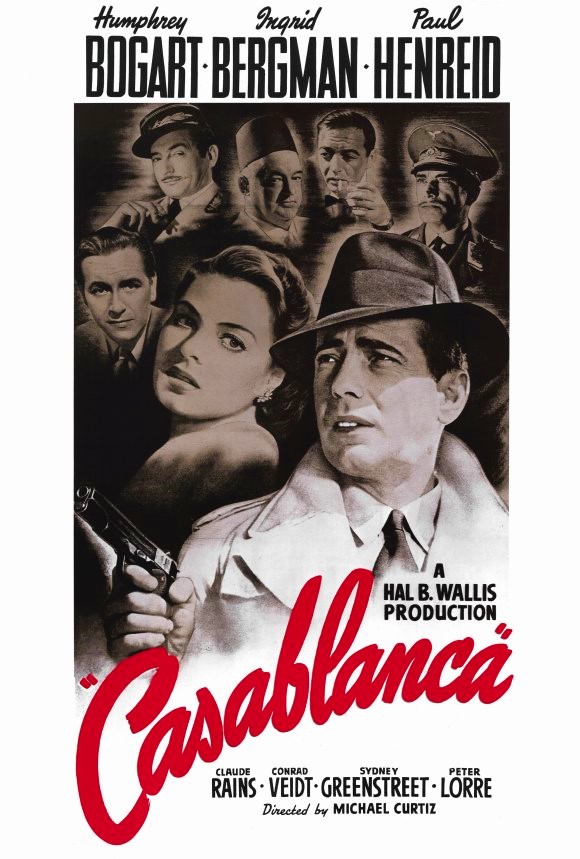
This morning I got in the car, turned on the radio, and as I was preparing to switch it over to my phone’s output so I could listen to a podcast, the announcer on WNED indicated that they were about to play a suite of Max Steiner’s wonderful music for Casablanca, because the film opened eighty-three years ago today.
That movie has been a part of my world my entire life. I didn’t watch it myself until sometime during, or immediately after, my freshman year of college, but I was always aware of it, and my parents always spoke very highly of it. I remember when I watched it the first time I thought, “Yeah, that’s pretty damned good, I don’t know if it’s quite as good as everyone makes it out to be, but that’s a damned good movie.”
A while later I watched it again, though…and I discovered something that Roger Ebert would later write about: the fact that Casablanca is, somehow, always better the second time. There’s just something about it that makes it a “pretty good” watch the first time and makes it utterly engrossing the second time around…and each and every time thereafter.
Eighty-three years.
When I was a kid, Casablanca was my benchmark for “an old movie”. Since it was only 29 years old when I was born, I guess I kind of set “twenty-nine years old” as my thought for what constituted an “old movie”. So, using that metric, here in the Year of Our Lord 2025, new “old movies” include Independence Day, Scream, Jerry Maguire, and the first Mission: Impossible movie.
Anyway, here’s the Max Steiner suite I listened to this morning on my ride to work. This is music to put you in the mood to be a big inconvenience to Nazis…which honestly, is saddeningly needed right now, innit?
We all have those movies, don’t we? They’re the movies where we’ll be going about our day, doing stuff that we’ve planned out and intended to get done…but then we’ll see that one of those movies is on teevee or something, and that’s that, screw the To Do List, we’re watching that movie again!
One of those movies for me is The Hunt for Red October, that wonderful submarine thriller based on the Tom Clancy novel. (I never read that particular Clancy book. I read a couple other ones and honestly, I wasn’t super-impressed beyond an appreciation for his plotting. My drug-of-choice for late-80s-early-90s spy fiction was Robert Ludlum.) Hunt came out in spring 1990, and I remember a bunch of friends and I in college going to see it. The movie rocked my world even then, and it has never declined in my estimation. It really is a masterpiece, as far as I’m concerned; it sets up every single plot twist in advance but doesn’t do so in such an obvious way that you can see the foreshadowing as it happens. It’s incredibly well-acted and superbly paced, and for an action adventure thriller, it has some absolutely crackling dialog. I just love it.
The music is also great, by the wonderful Basil Poledouris. Its main melodic material is distinctly Russian, and he makes extensive use of choir throughout, along with some techno material in the tense parts of the film. Here is a suite culled together from the soundtrack.
Like I said the other day, there’s a kind of perfect storm of STUFF all coming to a head at once that isn’t leaving me with a ton of time for posting, so posting much, I have not. This is likely to continue for the next week, maybe even two, depending on how things transpire. None of this is bad, by any means: we have a big work event that’s taking up tons of time to prep coming up, and then next weekend is our annual getaway to Ithaca and the Finger Lakes, and right after that, The Wife has a medical procedure that will occupy a lot of mental cycles and energy.
But, I do need to get something up here at least once in a while, don’t I? And I’m still saddened by the passing earlier this week of Robert Redford, so I’ll discuss my personal favorite Redford movie, to which the title of this post alludes. The film is the 1992 caper film Sneakers.
Here’s the text of a post I wrote some years ago about the film, and then I’ll come back and say a few things more about it:
COSMO: You could have shared this with me.
MARTIN: I know.
COSMO: You could have had the power.
MARTIN: I don’t want it.
COSMO: Don’t you know the places we can go with this?
MARTIN: Yeah, I do. There’s nobody there.
COSMO: Exactly! The world isn’t run by weapons anymore, or energy or money. It’s run by ones and zeroes, little bits of data. It’s all just electrons!
MARTIN: I don’t care.
COSMO: I don’t expect other people to understand this, but I do expect you to understand this! We started this journey together!
MARTIN: It wasn’t a ‘journey’, Coz. It was a prank.
COSMO: There’s a war out there, old friend, a world war. And it’s not about who’s got the most bullets. It’s about who controls the information: what we see and hear, how we work, what we think. It’s all about the information!
MARTIN: If I were you, I’d destroy that thing.
I saw Sneakers when it first came out, back in 1992 or thereabouts. It quickly became one of my favorite movies, and I saw it several more times theatrically before it became a fixture in my rotation of movies to rent on occasion, and later, when I had a sizeable collection of movies on VHS. But for one reason or another – mainly because I just never got around to it – Sneakers never got into my DVD collection, so I haven’t seen it in…holy crap. More than ten years. That seems rather wrong to me now, in retrospect, but never fear – I finally watched it recently, with some fear and trepidation that, like many a techno-thriller made more than a decade ago, it wouldn’t hold up very well.
Surprisingly – and satisfyingly – it does hold up, very well. And more than that: it’s striking to me now, twenty years later, just how eerily prescient this movie was.
Sneakers is one of the most entertaining cyberthriller-espionage movies I’ve ever seen. Robert Redford stars as Martin Bishop, the head of a security firm consisting of a group of men whose backgrounds mostly include shady dealings or outright brushes with the law. Their main job is simply to break into places that are supposedly highly secure, in order to demonstrate the lax areas in the security. They seem to be mostly just eking by: when they complete a job for a bank early in the film, a bank officer fills out the payment check, looks at it, and comments that it’s not a very good living. The team gets hired for another job, this time by two men claiming to be NSA agents, who happen to know who Martin Bishop really is (for which he could go to jail). They are to steal a device that decrypts codes which are supposedly unbreakable, which they do, and then give to the NSA guys – only to learn that they’re not NSA guys at all, and that they’ve murdered the mathematician who invented the device.
In a deeply eerie scene, Bishop’s hacker buddies start probing around with the little black box, just to see what it can do – and they discover that it can allow anyone to hack into extremely sensitive computer systems. The power grid of the entire Northeast…the Federal Reserve…air traffic control. They couldn’t have known it, writing this movie ten years before 9-11, but hearing one of the hackers jokingly say, “Anybody want to crash a few passenger jets?” is deeply chilling.
The entire movie is about security in an increasingly digital world, and at the end of the film, the exchange quoted above takes place, between Bishop and his onetime college buddy Cosmo, who has become a villain since doing time in prison for a crime that he committed with Martin at his side (but who eluded capture by the police simply by going out for pizza when they showed up with the guns). The idea of the world become increasingly governed by, and even defined by, the processing of data was a pretty bold one back in 1992. When I saw this movie, I had not yet even heard of the Internet, and the digital infrastructure that Sneakers portrays – with dial-up modems and not a cell phone in sight – seems utterly quaint. And yet, the movie is somehow fresh, despite all that, largely owing to the charm of the cast, the sparkling dialogue, the engaging direction, the brisk pacing, and – in terms of the technology – the nicely non-specific way the technology is depicted.
There are a lot of very clever touches in Sneakers: the reverse ‘race against time’, for example, in which Martin Bishop has to get a job done and yet literally can only do it at a very slow pace, lest the motion detectors notice his presence. Also the way they enlist Martin’s former (and yet still friendly) girlfriend to help with the problem of recording a particular scientist’s voice for use against the voice-print ID gizmo. (If the phrase “My name is Werner Brandes. My voice is my passport. Verify me.” is in your geek lexicon, then you are my kind of people.) I also like how vague the movie is about Cosmo’s villainy. We never learn who he works for, or if he is the main ringleader; we never learn what exactly it is that he wants to accomplish with the little black codebreaking box. In fact, it’s entirely possible that Cosmo doesn’t even have a specific plan in mind at all, and that he just wants the codebreaker because it will give him power that he as yet doesn’t really know how he intends to use it. He’s almost purely a theoretical villain, which is what makes him even scarier — as well as the sheer optimism of his villainy, which is what makes the quote above so memorable. It’s not about making threats or committing crimes or any of that dirty stuff. It’s about the possibilities inherent in controlling the world’s data.
And that is really makes this twenty-year-old film stay relevant.
OK, that’s the old post. I notice that I didn’t mention the film’s acting much in my original post, so I’m addressing that now, because Sneakers is one of the best-cast movies ever made, in my opinion. If they handed out Oscars for casting, Sneakers would have won it that year. You have River Phoenix as a young hacker, and Dan Aykroyd as an old hacker who is deeply invested in paranoid conspiracy theories. (This was a considerably more charming and entertaining character trait thirty years ago. Now, not so much.) You have Sidney Poitier as a retired CIA spook who hasn’t given up the game just yet, and David Strathairn as a blind hacker. Leading them all is Mr. Redford, a hacker with a past that has led him to assume a false identity. Joining them is Redford’s old girlfriend, played by Mary McDonnell, and the villain is Ben Kingsley as an old friend of Redford’s who went to jail for their escapades while Redford did not.
It’s really something to watch this movie and note the complete chemistry among the cast. At no point is there any break in the illusion; we really believe that this motley crew of hackers and law-benders has spent years working with one another at the weird intersection of legality and morality and…neither of those things. And they really do seem to enjoy doing it; they’re having fun, up until the moment when they realize that they have somehow become embroiled in something very real and very dangerous. But even then, once they sense that the winds have shifted in their direction again…the sense of fun returns.
Speaking specifically of Mr. Redford’s performance, he is doing more than having fun. There’s a sense right from the start that he’s been at this longer than anyone else, and that he’s starting to get a bit weary of the whole business. Redford shows us a Martin Bishop who is genuinely sorry for what happened to his old friend back in college, and who does want to move past the hackery part of his life. He’s also skeptical of what is to come and what Cosmo seems to be embracing, as shown in the exchange quoted above; Bishop’s hesitance to embrace a world where everything is determined by information and who controls it is notable, and in Redford’s hands, very, very real. Redford does things in this film with simple facial expressions that are just wonderful: a rolling of his eyes when he’s told to hurry up when doing a job where moving as slowly as possible is required, or a sudden snarl when he decides to punch out the thug who has been inconveniencing him all movie long. Or his mischievous smile that lets us know he’s pulled a fast one on somebody.
Most of all, though, Redford captures that Bishop is the brains and the heart of this whole operation. He’s the one who suspects first that this whole business with the code-breaking machine is more than he bargained for and that he and his team are involved in something more deep and sinister than they have ever dealt with before. This is something that Robert Redford was always great at, something that made him one of the best. He was always able to suggest, often without even saying anything, the emotional and intellectual lives his characters were leading.
And he was just so damned cool about it. Who wouldn’t want to be Robert Redford, after all?
Oh, this is a delayed Something for Thursday post as well, so here’s a nice suite culled together from the soundtrack to Sneakers, with music composed by the late, great James Horner. This is one of the great “caper film” scores of all time.
Social media has been abuzz lately over the trailer for a new film of Emily Bronte’s novel Wuthering Heights. I mean, look at this thing:
Yeah, that’s…quite something, isn’t it? Will I watch that? Maybe. I think it will be viewed best at home, after several drinks.
But anyway, here’s a suite of music by film score great Alfred Newman, composed for the 1939 film of the same book.
Of course, I suppose as time marches on it becomes less and less known that the greatest single adaptation of Wuthering Heights is the semaphore version!
The Music Man doesn’t get enough credit for how inventive it is, methinks. The Music Man is known for its Iowa setting, and it generally seems to be viewed as safe Americana. But it makes a lot of interesting choices, and those include its music numbers. This one, “Lida Rose and Will I Ever Tell You”, blends two different songs together, sung by entirely different characters, who aren’t even in the same place. How does that work?
It starts as our hero, con man Professor Harold Hill, is returning to his hotel room where he is met by the local school board, four guys who used to hate each other until Hill noticed that their voices lent themselves to music–and he somehow converted them into a barbershop quartet. The board members are tasked with getting Professor Hill’s educational credentials (which he has entirely made up); he keeps distracting them by tricking them into singing, whereupon he slips away. He does that again here, with a song called “Lida Rose”. But then we shift to Marian Paroo, the woman who is falling for Professor Hill, who is singing a love song called “Will I Ever Tell You”. And then, via the magic of some very inventively-done split screen, we hear both songs together.
The Music Man is a much more sophisticated musical than I think it gets credit for! That’s all I’m saying.