
STAR TREK and Me (a repost)

Today is the 58th anniversary of Star Trek‘s first appearance on teevee. On this date in 1966, an episode called “The Man Trap” of a new science-fiction show aired, and I guess that at the time this seemed like just another airing of some new show. New shows arrive every year, most of which are completely forgotten eventually…but somehow that particular new show made enough of an impact that it lives on as a huge franchise, over half a century later. Most of the people involved with making that very first episode are gone now…but their memory endures through the legacy of this great show. This is a post that I wrote on my old blog for the occasion of Star Trek‘s fiftieth anniversary, and it seems that I am now posting it on a yearly basis. Happy birthday, Star Trek!

And you people, you’re all astronauts on…some kind of star trek?

–Zefram Cochrane, Star Trek First Contact

Wow. Star Trek made its official US debut fifty years ago today. That’s…amazing. (The show aired for the first time anywhere on September 6, 1966, in Canada.)

Star Trek came and went and was already in syndication when I was born, but my sister loved it, so I quite literally do not remember a time when Star Trek wasn’t a thing. One of my earliest teevee memories is, in fact, the brief bit at the end of the episode “Friday’s Child”, when Dr. McCoy is saying “Oochie woochie coochie coo” to a newborn baby, to Spock’s great confusion.

It’s often taken as an article of faith in the geek universe that one is either a Star Wars fan or a Star Trek fan, and I can kind of see why. It’s a Yankees-Red Sox kind of thing, I suppose. Or Bears-Packers. But for me, it’s complicated. I have to be honest: push me to answer, hold a gun to my head, and I will almost certainly choose Star Wars. But the margin of victory is not large, and in truth, there’s no way I’m the writer I am now without both of them.

“Let me help.” A hundred years or so from now, I believe, a famous novelist will write a classic using that theme. He’ll recommend those three words even over “I love you.”

–James T. Kirk, “The City on the Edge of Forever”

Star Trek shaped my view, in a lot of ways, of what the future can and should be. It should be a time when humans are not afraid to explore the universe and, in fact, do so with enthusiasm. It should be a time when the diversity of humanity should be celebrated and not resisted. It should be a time when beautiful ships fly the stars, instead of rusting dingy hulks. It should be a time of wonderful cities, not dystopic nightmares. It should not be a time of universal peace without conflict, because that’s almost certainly impossible, but it should be a time when we approach conflict from a much more mature standpoint than we do now.

Of course, when I was a kid, Star Trek was none of that. It was just a show about nifty adventures in space, a way for me to scratch that particular itch in the years between releases of Star Wars movies. It didn’t ever occur to me back then that I was supposed to like one over the other; they were different things, and I liked ‘em both. If Star Wars hit me like a bolt from the blue, Star Trek was the thing that was there, day in and day out. Star Trek was what was on during the afternoon hours after school. I’d get home and watch it and thrill to the adventures of Captain Kirk and crew on the black-and-white teevee set I had in my room. This was before the Internet, obviously, and I didn’t have any access to an episode guide, so the only way to learn the episodes was to watch and watch and rewatch them as they came. I got pretty good at recognizing the episodes by sight, usually within seconds. (Often I had to wait until the first shot after the obligatory opening shot of the Enterprise.)

I don’t know if the station had some kind of plan for airing the episodes in any particular order, but I recall that you could go upwards of a year without seeing “Mirror, Mirror” or “The Trouble with Tribbles”, but other episodes – “The Return of the Archons”, “Errand of Mercy” – would show up more frequently. A certain “This one again?!” factor crept in at times, especially with some of the crappier episodes. (I can live the rest of my life to a rich old age and never watch “The Alternative Factor” again.) But the great episodes? Those live on forever. I still laugh at “The Trouble with Tribbles”, and I live for a moment when someone near me uses the phrase “storage compartments”, so I can respond as Kirk does: “STORAGE compartments? STORAGE compartments?!” And I still feel that sense of doom slowly unfolding as “The City on the Edge of Forever” spins its tale, toward the awful moment when, in order to fix history after it has been changed, James Kirk must stand and watch as a 20th century woman with whom he has fallen in love is killed.

MCCOY: You deliberately stopped me, Jim! I could have saved her. Do you know what you just did?

SPOCK: He knows, Doctor. He knows.

–”The City on the Edge of Forever”

As a kid, I attended two Star Trek conventions with my older sister – or at least, one Trek convention and one general sci-fi convention. At the latter, “The Trouble with Tribbles” was aired, followed by 2001: A Space Odyssey. Those were fun. George Takei was the guest of honor at the first one, in 1977 or 1978. I was in first grade at the time. I remember Takei wearing a gleaming white suit. (Peter Mayhew was guest at the next one.)

I eventually lost track of daily Star Trek reruns by the mid-1980s, but also by this point, the movies were a thing. I remember being terribly excited for The Motion Picture, and even though I didn’t quite understand all of the plot, I have never – not once – disliked that often-maligned film. I recall being mildly disappointed that the Enterprise never fires its phasers once in that film, and in fact it only dispatches a single photon torpedo, and that’s at an errant asteroid that’s about to collide with the Great Bird. I didn’t realize it at the time, but I think The Motion Picture is the first real science fiction story I saw on the big screen that wasn’t about a galactic war or some other action-based adventure. I wasn’t thinking in those terms, but yes, the movie primed that particular pump.

I liked all of the movies that came, and I saw every one in the theater over the next decade. This was an odd time for Trek, when a movie every couple of years was all there was. Sure, every once in a while there would be a tidbit in Starlog (the late, great SF fandom magazine) about how somebody somewhere wanted to make a new Trek teevee series, but it never amounted to much until we learned that we were finally getting The Next Generation. This was for several reasons, not the least of which was that Paramount wanted to keep making money off Trek but the original cast was starting to show its age.

Through the 1980s, as Star Wars seemed to fade away, Trek was still there, churning out a movie every couple of years and then a new teevee show. That’s what Trek always was for me. It didn’t fuel my imagination in quite the same way that Star Wars has always moved me at a very basic level of storytelling taste, but Trek has always been around. Always, always there. In fact, it was always there to such an extent that in the late 1990s, I started letting Trek go…but I’m getting ahead. During this time I read a number of Trek novels, and there was a fanzine called Trek that would annually publish a paperback book filled with its best articles. These I read with zeal, and I’ve lately started regathering them all via eBay. Maybe this winter I’ll spend some time reliving some fine old fan writing.

I loved The Next Generation, and watching it religiously formed a tradition in college among my mates and I. TNG aired reruns every weeknight, and the new episodes ran every Sunday night after the 10:00 news. That station even went so far, as TNG’s popularity grew, of including a very brief astronomy segment in its 10:00 Sunday newscast – “Tonight you can see Mars in the eastern sky!”, that sort of thing – complete with an Enterprise fly-by animation. And then, in our senior year, the next show, Star Trek: Deep Space Nine, arrived. That premiere was an event, and I still think that premiere was an amazing episode.

Never trust ale from a god-fearing people, or a Starfleet Commander that has one of your relatives in jail.

–Quark, Star Trek: Deep Space Nine

It took a little while for TNG to really get going, but once the writers had the chemistry down, the show was more than ready to carry on the Trek tradition, with many a fine and thought-provoking story, about love and loss and what it means to be human even as we take to the stars.

If you can’t take a little bloody nose, maybe you ought to go back home and crawl under your bed. It’s not safe out here. It’s wondrous, with treasures to satiate desires both subtle and gross. But it’s not for the timid.

–Q, Star Trek: The Next Generation

And still the movies came. The Wrath of Khan and The Search for Spock, which I saw with school friends. The Voyage Home, with its goofy and infectious joy. Even the much-maligned (and mostly deservedly so) The Final Frontier had its charms for me. That poor movie may have failed, but I really give it credit for trying to be about something.

The Undiscovered Country came along in 1991, when TNG had hit its stride. We saw it in the theater the night it opened, which happened to be the same night as our annual Christmas concert performance at a big church in Cedar Falls, IA. We did the concert, quickly changed clothes, and bolted down the street to catch the show. I loved that movie, and in fact, to this day Star Trek VI is my favorite Trek film. I remember a lump in my throat at the closing scene, which boiled down to just the classic crew onscreen (minus Sulu, who finally got his promotion to Captain and got to fly away on his own ship, the Excelsior), followed by the animated signatures of the original cast. Their time was done. (Although, in classic Trek and science fiction fashion, not quite.)

CHEKOV: Course heading, Captain?

KIRK: (smiles) Second star to the right…and straight on ‘til morning.

Star Trek VI: The Undiscovered Country

College ended and the real world began, and there was still Star Trek, even as Star Wars started making rumblings again. The TNG crew graduated to movies, and DS9 soared in quality. Another series began, Voyager…which is when I started to lose a bit of energy with respect to Trek. For one thing, I had a lot of other interests by this time, but for another, it was pretty clear as Voyager got going that the creative folks behind Trek were starting to lose steam. I stopped watching Voyager about the fourth season, and the next series? Well, to this day, I have never watched a single episode of Enterprise.

But now Trek is coming back. Three new movies, with varying degrees of success. A new series on the way, reimagined to seasons of thirteen episodes each. The Trek continues. (I haven’t seen Star Trek Beyond yet. It came and went from the theaters too quickly this summer, and it came out during our busiest time of the summer as well, so I simply was never able to squeeze it in. Beyond and Nemesis are, to date, the only Trek films I did not see in the theaters.) Will Trek eventually reach similar heights again? Are there more stories in the offing to match tales like “The Devil in the Dark,” “The Doomsday Machine,” “A Piece of the Action,” “The Best of Both Worlds,” “Yesterday’s Enterprise,” “Tapestry,” “The Visitor”? Who knows…but I look forward to finding out.

Star Trek is, was, and has been many things. It will continue to be many things, too. I don’t know that I’ll ever have the same old investment in it that I did in the late 70s and through the 80s. I don’t know that I’ll ever feel that same enthusiasm for Star Wars either, so the two tentpoles of my science fiction life have that much in common, don’t they? But I’ll always owe a debt to Star Trek. It shone a bright light on a future that doesn’t have to be awful, and it showed beautiful space ships. It put a new light on the idea of space adventure, and it showed a military organization that was devoted truly to peace. Star Trek did time travel better than just about anybody else. Star Trek gave us amazing characters, and it let those characters do amazing things.

They used to say if man could fly, he’d have wings, but he did fly. He discovered he had to. Do you wish that the first Apollo mission hadn’t reached the moon, or that we hadn’t gone on to Mars and then to the nearest star? That’s like saying you wish that you still operated with scalpels and sewed your patients up with catgut like your great-great-great-great grandfather used to. I’m in command. I could order this, but I’m not because Doctor McCoy is right in pointing out the enormous danger potential in any contact with life and intelligence as fantastically advanced as this, but I must point out that the possibilities – the potential for knowledge and advancement – is equally great. Risk! Risk is our business. That’s what this starship is all about. That’s why we’re aboard her.

–James T. Kirk, “Return to Tomorrow”

Star Trek is fifty. Amazing. Long live Star Trek.

Space: the final frontier. These are the voyages of the starship Enterprise. Her ongoing mission: to explore strange, new worlds; to seek out new life and new civilizations; to boldly go where no one has gone before.

Share This Post

“The Force will be with you. Always.” (a repost)

Today marks the 47th anniversary of the release of George Lucas’s “little space movie”, which wasn’t even 20th Century Fox’s projected “Big Movie” of that year. Little did the world know what was about to happen…and certainly a five-year-old kid in LaCrosse, Wisconsin had no idea how his world was about to be shaped forever. I wrote this post in 2017 for the 40th anniversary of Star Wars, and I wouldn’t change anything. I’ll probably write something completely new for the 50th, though…my God, we’re almost at fifty years of Star Wars….


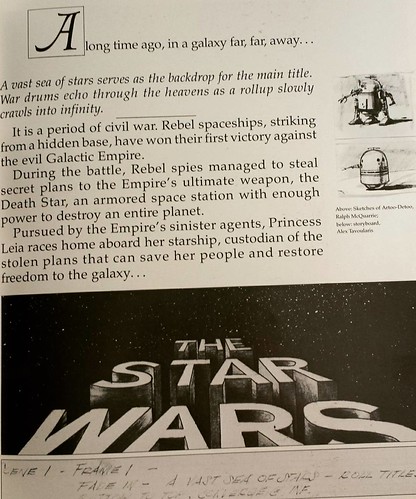
D19 of #IGWritersMay: Novel aesthetics. I make no secret that at its heart, THE SONG OF FORGOTTEN STARS is really my love letter to STAR WARS. (This is a page from the book THE ART OF STAR WARS.) #amwriting #starwars #sciencefiction #spaceopera #Forgotten


I didn’t see Star Wars on opening day. In truth I don’t even remember exactly when I saw it, but it was later in the summer of 1977. We had just moved from Wisconsin to Oregon, and in that time I was not even aware of this enormous movie phenomenon whose popularity was sweeping the nation.

I finally saw it, though, with my sister, who is six years older than me.

I didn’t like it.

It was very loud. It opened with big words flying through space and then there was loud spaceships and talking robots (one of whom only talked in beeps and whistles). There was a girl in white and a bad guy in black whose breath sounded weird. There was a desert planet with weird dwarf-creatures and a kid named Luke who lived with his aunt and uncle. (The uncle could be pretty gruff if Luke was goofing off, to which I could relate.) There were more loud spaceships and one really really big spaceship shaped like a giant ball. There was a guy dressed in black and white who helped the farm kid, and this guy had a giant ape-man friend. There were swords made of light and even more spaceships and a big battle in space.

All of that, and I didn’t understand a lick of it.

In my defense, I was all of five years old at the time.

Until Star Wars, my movie experience was pretty much limited to stuff like Bugs Bunny Superstar and Disney live-actions like The Shaggy DA (which contained a hoot of a pie fight). Then there was this movie with loud spaceships and robots and a farm kid and a bad guy in black and…well, I had no idea what to make of this movie.

Luckily for me I had my sister, who is six years older than me.

She went all-in for Star Wars. She ate it, drank it, breathed it. She talked about it a lot, and gradually her enthusiasm began to win me over. She explained the story to me because I hadn’t understood it all that well, and I decided that I wanted a part of her enthusiasm for my own. So I went with her to see the movie a second time.

I have never ever ever recovered.

I’ve been thinking a lot about Star Wars as it nears and achieves 40 years, and I find myself relating to it most as a storyteller myself. As a writer I tend most to look at Star Wars through the prism of story. Many stories have had a deep effect on me, on the stories I want to tell, and the way I go about telling them, but none moreso than Star Wars, even as the Star Wars story itself has changed over the course of its four decades. Most of the core ideas are still there, though, as Star Wars is now no longer in the hands of its creator, George Lucas. Star Wars is still a tale of heroic adventure unfolding in the sky. It is still a tale not just of the wars but more well-focused on the people fighting that war. It is a tale of improbably redeemable villains, of the way our paths mirror those of our parents, and of finding love in the face of desperation. It is a tale of family.

I can’t help thinking in most, if not all, of these terms every time I write a story, no matter which genre it’s in. Star Wars made me want to be a storyteller (what is playing with action figures, if not storytelling?). It also taught me that stories can focus at times on more mystical matters, and it taught me that story is an excellent way of addressing the challenges people face in their hearts. Most importantly, though, Star Wars taught me about heroes and quests and the wise elders who try to guide the heroes on their way.

Other stories have come since Star Wars arrived, and many have come to places almost as near to my heart. It’s not only stories, either; it’s all of creative art, really:

Lloyd Alexander’s Prydain Chronicles
The Lord of the Rings
Casablanca
On Her Majesty’s Secret Service
My Fair Lady
Cosmos
Much Ado About Nothing
The House with a Clock in its Walls
The Lions of Al-Rassan
Mary Stewart’s Arthurian trilogy (plus The Wicked Day)
Berlioz’s Symphonie fantastique
Rachmaninov’s Symphony No. 2 in E minor
Invisible Touch by Genesis
Once and Again
Princess Mononoke

These are all things — and there are more — that are at the center of my creative life, but none has ever quite dislodged Star Wars as my Prime Mover. Star Wars is, and continues to be, my Platonic Ideal of what story is.

Even so, I haven’t always kept as close an eye on Star Wars as a massive universe as many. I’ve read only a small handful of all the many novels and comics written over the years, and I haven’t played any of the video games. For me, my appreciation focuses pretty exclusively on the movies themselves, and not just the wonderful Original Trilogy but also the admittedly uneven — but still, in my eyes, uniquely compelling — Prequel Trilogy and even to a smaller extent the recent “Rebirth” movies, The Force Awakens and Rogue One. Those form the core.

Star Wars is as strong now as it ever was, and it is very likely even stronger. It has more fans than ever, and it is now in the hands of a corporate power whose pockets are deep enough to maintain it at a very high level for decades to come. More fans are created every day, it seems, and yet…I do have to admit to feeling a certain level of possibly grumpy oldsterism. Sure, you kids can love Star Wars and in fact I hope that you will, and that your love for Star Wars will lead you to other things. But I came in on the ground level. My memories may be hazy, but I do remember a time before Star Wars.

I believe that every story one writes — or rather, every story that I write — should be, in one way or another, a love letter, either to someone or something. The Song of Forgotten Stars has many influences, but it is ultimately my love letter to Star Wars. If not for Star Wars, there’s no way I would be writing this story. It’s not just about the internals of Star Wars, though: it’s about the way Star Wars impacted me and shaped my life and helped reflected certain relationships in my life. Put it this way: There’s a reason why the two main characters in my Forgotten Stars books are two Princesses, one of whom is six years older than the other. It’s a dynamic that makes sense to me on a lot of different levels.

I also know, from reading a lot about the making of Star Wars over the years and about the life of George Lucas in particular, that the way by which a creative work comes into existence is often a messy one. Lucas’s manner of creation is eerily similar to my own, or maybe vice versa. Lucas is someone who starts out by following ideas in any direction they might go, and only gradually whittles things down and discards this notion or that idea until a streamlined story starts to emerge. I work the same way, at least in part. My rough drafts are often very messy and they always contain entire ideas that I remove entirely, for one reason or another. Lucas has done so much mixing and matching of ideas over the decades (remember that for him, Star Wars is 47 or 48 years old, depending on where he dates The Beginning) that he at times seems to be misremembering his own history. I know how he feels. There are times when an idea seems so organic that it’s hard to claim it for my own. Even if it is.

So thank you for forty years, Star Wars! And may the Force be with you, forevermore.


Share This Post

“I have come to conquer you!” A repost in honor of the great Roger Corman

Filmmaker Roger Corman died the other day. It was always easy to poke fun at Corman’s films, but he strove to make them as good as he could, and on his own terms. Corman’s studio was not only prolific but also a starting point for many filmmakers who later went on to great careers of their own.

Below is the text of a post I wrote a number of years ago, praising my favorite Corman film, the 1980 obviously-STAR WARS-inspired “Magnificent Seven In Space” flick, Battle Beyond the Stars. I stand by every word of this. Is the movie good? Yes, because while its objective qualities may be debatable, what cannot be debated is that it’s a freaking delight.


Battle Beyond the Stars is a movie that seems to confound expectations. If you watch it expecting a good movie, you’ll be disappointed. But on the other hand, if you watch it expecting a bad movie, you may be disappointed in the other direction.


Battle came out in 1980, one of a string of flicks to come out in the years after something happened in 1977 to suddenly make the entertainment industry think that there was a market out there for science fiction, especially in the form of explodey-spaceshippy-goodness. Battle was produced by Roger Corman, the king of the low-budget movie who nevertheless also served as a talent scout for later Hollywood geniuses, the most notable being a special effects artist who designed the spaceships for this movie and who later went on to bigger things. His name? James Cameron.


I saw Battle when I was in fourth grade. It was part of a double feature at the local movie house, the first film being a flick called Starcrash. I’ve never seen Starcrash since [UPDATE: After writing this post, I did in fact watch Starcrash again, the results of which you can read about here. Is Starcrash bad? Oh Gods, yes. Have I seen it once or twice even since then, because it’s lovably bad? Oh Gods, yes! –Ed.], although I do have a downloaded copy on one of my hard drives. Starcrash is legendary for being a bad movie, although I recall liking it when I saw it. Battle was the main event of the feature, though, and I was really looking forward to it, mainly because the nine-year-old me had thought that this trailer just looked awesome:


That trailer had run on a bunch of movies leading up to the release of Battle so I was really stoked when it came out. And when I saw it? Well, I was nine. I loved it. It had aliens and spaceships and lasers and things exploding and a cute girl. I got the soundtrack album, featuring music by a composer named James Horner, and I played that album a lot over the years, wearing it out and grooving to what I thought was the best explodey-spaceshippy movie music I’d heard outside of a Star Wars film. (Of course, my sample size was very small, I didn’t know film music enough to hear Horner’s huge debt to Jerry Goldsmith in the score, and I didn’t know enough about orchestration or performance to recognize a score that was recorded on a shoestring budget and which featured some really bad orchestrations, such as the track “Cowboy and the Jackers” which does things to the trumpet section that may be in violation of several international treaties.)


I saw Battle once more when it showed up on network teevee a few years later, and still liked it, and then I didn’t see it again for many years. I may have caught it in a cable broadcast sometime in the 1990s, but I’m not sure. I didn’t see it again in its entirety until just last week. How does it hold up? Well, movies like this don’t really “hold up” – that’s the wrong way to look at them. I had no illusions that it was some unheralded gem of SF moviemaking, but I was pleasantly surprised that it’s not that bad, either.


So, what about Battle Beyond the Stars, anyway? What’s it about? It’s very simple: The Magnificent Seven in space. That’s it. Literally.


We open with a giant enemy ship traveling through space (at a very slow pace, even though it has six enormous thrusters that are constantly firing).


The ship is ruled by our villain, Sador of the Malmori. Who are the Malmori? Are they a race of aliens? An empire? A family? We’re never told. Anyway, his ship approaches a planet called Akyyr (that’s how I’m spelling it, anyway), which, seeing that it is inhabited by peaceloving folk who only own one spaceship (which is a weather station), decides that he’s going to conquer it. So he hovers his enormous ship over them, projects his enormous face over their heads, and says, “I have come to conquer you.” (This he does after destroying the weather ship, just because he’s evil. The weather ship had been occupied by two guys who display the Akyyrian attitude by greeting an enormous and malevolent-looking spaceship by grinning, saying “Look! Visitors!”, and then contacting it by asking, “Could you identify yourself, please?”)


Anyway, Sador gives the Akyyrians seven days (“risings of your red giant”) before he’ll come back and finish conquering them. Why the delay? Who knows, but it gives the Akyyrians time to send one of their local young men, a boy named Shad (played by Richard Thomas as John-Boy Walton in space), off in the other ship they own, the secret one once piloted by the old blind guy who used to be an adventurer, to round up some help in the form of mercenaries.


The ship Shad flies is probably the single most famous thing from Battle Beyond the Stars. The ship is simply named “Nell”, and sure enough, it’s run by a computer by that name who speaks with the voice of a cranky lady. What’s most memorable about the ship, though, isn’t her personality; it’s her shape:


This ship is one of the more famed B-movie spaceships in movie history. You know you’re talking to a knowledgeable geek when the mention of the movie Battle Beyond the Stars draws the rejoinder, “Oh yeah, the movie with the ship that’s shaped like a pair of breasts!” The ship is more than that, though – it looks like a feline body with female breasts and then a couple of wings where the ship’s guns are, which sweep up and out, spread out to look like…well, it’s a very feminine ship. (And it was designed by a young filmmaker who was cutting his chops with Corman’s production crew, the afore-mentioned James Cameron.)


Anyway, Shad goes off in search of mercenaries he can hire to fight off Sador. On the way he meets a taciturn fellow named Gelt (Robert Vaughn), who only wants a meal and a place to hide from the apparent galaxy’s worth of folks who are after him:


He meets a ship commanded by a group of aliens who have third eyes on their foreheads and who use telepathy to do stuff:


He meets a “Warrior Valkyrie” named “St. Exmin”, played by Sybil Danning:


Given that her screentime involves her looking like this, it’s almost a crime that Danning doesn’t get more of it. She does, however, have one of the goofiest lines in movie history, and boy, does she deliver the hell out of it:


The other girl there is Nanelia (Darlanne Fluegel), who is every bit as naïve about people as Shad is, which makes her a perfect fit for him. She, too, gets far too little screentime, because she’s really cute. I remember her being one of the first females onscreen to impress me with her cuteness. I mean, look how cute she is in that clip, when she giggles at the prospect of learning how to “tingle, tangle, prangle” her new love interest from this warrior in the goofy headdress! Yeah, Nanelia is really, really cute:


Most memorable, probably, is the Space Cowboy Shad recruits who goes by the name “Space Cowboy”, played by George Peppard:


Cowboy is an arms runner who ends up leading the Akyyrian planet defense with the weapons he’d been running to a planet that Sador has just wiped out. Cowboy is extremely cool, although it’s hard not to expect him to grin and say, “I love it when a plan comes together!” But he does have one of the niftiest gadgets I’ve ever seen in a skiffy movie: he has a gizmo on his belt that dispenses Scotch and ice. (Why a Space Cowboy is drinking Scotch and not bourbon is never explained.)


And there are some aliens who are basically actors in rubber suits. You know how it is. Anyway, a big battle ensues (the Battle beyond the stars!), in which quite a few of the recruited mercenaries die heroically before Shad and Nanelia finally figure out how to do Sador in. I know, I just spoiled the movie, but what of it? Who would watch a movie like this and even consider the possibility of a bummer ending?


The clip above aside, there’s some witty stuff in the course of the flick, and one nicely done moment after Gelt (Robert Vaughn) dies, involving Shad’s bargain with him (a meal and a place to hide). There are also some exceedingly goofy moments, and like all B-movies, some of the stuff that happens isn’t explained very well at all (such as a scene in which the telepathic-collective aliens make their own stealth attack on Sador that involves sacrificing one of their own and a transplant of arms, believe it or not).


Of course, we have to have a romance between Shad and Nanelia, and it’s your typical awkward stuff (“Do they have kissing on your planet?”), but at the end, when victory has been won and all that are left are our hero and heroine returning to Akyyr, instead of ending with some neat dialog and some delightful snogging, we get Shad quoting at length from the “Varda”, the sacred text that the denizens of Akyyr are constantly quoting throughout the film. Weird stuff – the kid should be finally taking his big step into manhood, and instead he wants to recite from the holy book of a pacifist planet that sounds like The Art of War.


Battle Beyond the Stars is not a good movie. Nor is it a bad one. If you’re attuned to it and willing to go where it wants to go, it’s a fun little flick, if you’re into movies where the villain who is trying to conquer the planet Akyyr gets to shout in triumph at the end, shortly before his unimagined demise, “Akyyr is mine!”, followed by leading his entire bridge crew in sinister bad-guy-who’s-just-won-the-lottery laughter.


In other words, it’s the kind of movie that can only appeal to your inner nine-year-old. And that’s not a bad thing to be, is it?

Share This Post

Whoa….

I’ll have more to say later at some point, but I’ve just read one of the earliest Star Trek novels, a 1974 book called Spock, Messiah!. And it is both super weird and not weird enough.

I need to think about this one.

That is all

Share This Post

STAR TREK and Me (a repost)

Today is the 57th anniversary of Star Trek‘s first appearance on teevee. On this date in 1966, an episode called “The Man Trap” of a new science-fiction show aired, and I guess that at the time this seemed like just another airing of some new show. New shows arrive every year, most of which are completely forgotten eventually…but somehow that particular new show made enough of an impact that it lives on as a huge franchise, over half a century later. Most of the people involved with making that very first episode are gone now…but their memory endures through the legacy of this great show. This is a post that I wrote on my old blog for the occasion of Star Trek‘s fiftieth anniversary, and it seems that I am now posting it on a yearly basis. Happy birthday, Star Trek!

And you people, you’re all astronauts on…some kind of star trek?

–Zefram Cochrane, Star Trek First Contact

Wow. Star Trek made its official US debut fifty years ago today. That’s…amazing. (The show aired for the first time anywhere on September 6, 1966, in Canada.)

Star Trek came and went and was already in syndication when I was born, but my sister loved it, so I quite literally do not remember a time when Star Trek wasn’t a thing. One of my earliest teevee memories is, in fact, the brief bit at the end of the episode “Friday’s Child”, when Dr. McCoy is saying “Oochie woochie coochie coo” to a newborn baby, to Spock’s great confusion.

It’s often taken as an article of faith in the geek universe that one is either a Star Wars fan or a Star Trek fan, and I can kind of see why. It’s a Yankees-Red Sox kind of thing, I suppose. Or Bears-Packers. But for me, it’s complicated. I have to be honest: push me to answer, hold a gun to my head, and I will almost certainly choose Star Wars. But the margin of victory is not large, and in truth, there’s no way I’m the writer I am now without both of them.

“Let me help.” A hundred years or so from now, I believe, a famous novelist will write a classic using that theme. He’ll recommend those three words even over “I love you.”

–James T. Kirk, “The City on the Edge of Forever”

Star Trek shaped my view, in a lot of ways, of what the future can and should be. It should be a time when humans are not afraid to explore the universe and, in fact, do so with enthusiasm. It should be a time when the diversity of humanity should be celebrated and not resisted. It should be a time when beautiful ships fly the stars, instead of rusting dingy hulks. It should be a time of wonderful cities, not dystopic nightmares. It should not be a time of universal peace without conflict, because that’s almost certainly impossible, but it should be a time when we approach conflict from a much more mature standpoint than we do now.

Of course, when I was a kid, Star Trek was none of that. It was just a show about nifty adventures in space, a way for me to scratch that particular itch in the years between releases of Star Wars movies. It didn’t ever occur to me back then that I was supposed to like one over the other; they were different things, and I liked ‘em both. If Star Wars hit me like a bolt from the blue, Star Trek was the thing that was there, day in and day out. Star Trek was what was on during the afternoon hours after school. I’d get home and watch it and thrill to the adventures of Captain Kirk and crew on the black-and-white teevee set I had in my room. This was before the Internet, obviously, and I didn’t have any access to an episode guide, so the only way to learn the episodes was to watch and watch and rewatch them as they came. I got pretty good at recognizing the episodes by sight, usually within seconds. (Often I had to wait until the first shot after the obligatory opening shot of the Enterprise.)

I don’t know if the station had some kind of plan for airing the episodes in any particular order, but I recall that you could go upwards of a year without seeing “Mirror, Mirror” or “The Trouble with Tribbles”, but other episodes – “The Return of the Archons”, “Errand of Mercy” – would show up more frequently. A certain “This one again?!” factor crept in at times, especially with some of the crappier episodes. (I can live the rest of my life to a rich old age and never watch “The Alternative Factor” again.) But the great episodes? Those live on forever. I still laugh at “The Trouble with Tribbles”, and I live for a moment when someone near me uses the phrase “storage compartments”, so I can respond as Kirk does: “STORAGE compartments? STORAGE compartments?!” And I still feel that sense of doom slowly unfolding as “The City on the Edge of Forever” spins its tale, toward the awful moment when, in order to fix history after it has been changed, James Kirk must stand and watch as a 20th century woman with whom he has fallen in love is killed.

MCCOY: You deliberately stopped me, Jim! I could have saved her. Do you know what you just did?

SPOCK: He knows, Doctor. He knows.

–”The City on the Edge of Forever”

As a kid, I attended two Star Trek conventions with my older sister – or at least, one Trek convention and one general sci-fi convention. At the latter, “The Trouble with Tribbles” was aired, followed by 2001: A Space Odyssey. Those were fun. George Takei was the guest of honor at the first one, in 1977 or 1978. I was in first grade at the time. I remember Takei wearing a gleaming white suit. (Peter Mayhew was guest at the next one.)

I eventually lost track of daily Star Trek reruns by the mid-1980s, but also by this point, the movies were a thing. I remember being terribly excited for The Motion Picture, and even though I didn’t quite understand all of the plot, I have never – not once – disliked that often-maligned film. I recall being mildly disappointed that the Enterprise never fires its phasers once in that film, and in fact it only dispatches a single photon torpedo, and that’s at an errant asteroid that’s about to collide with the Great Bird. I didn’t realize it at the time, but I think The Motion Picture is the first real science fiction story I saw on the big screen that wasn’t about a galactic war or some other action-based adventure. I wasn’t thinking in those terms, but yes, the movie primed that particular pump.

I liked all of the movies that came, and I saw every one in the theater over the next decade. This was an odd time for Trek, when a movie every couple of years was all there was. Sure, every once in a while there would be a tidbit in Starlog (the late, great SF fandom magazine) about how somebody somewhere wanted to make a new Trek teevee series, but it never amounted to much until we learned that we were finally getting The Next Generation. This was for several reasons, not the least of which was that Paramount wanted to keep making money off Trek but the original cast was starting to show its age.

Through the 1980s, as Star Wars seemed to fade away, Trek was still there, churning out a movie every couple of years and then a new teevee show. That’s what Trek always was for me. It didn’t fuel my imagination in quite the same way that Star Wars has always moved me at a very basic level of storytelling taste, but Trek has always been around. Always, always there. In fact, it was always there to such an extent that in the late 1990s, I started letting Trek go…but I’m getting ahead. During this time I read a number of Trek novels, and there was a fanzine called Trek that would annually publish a paperback book filled with its best articles. These I read with zeal, and I’ve lately started regathering them all via eBay. Maybe this winter I’ll spend some time reliving some fine old fan writing.

I loved The Next Generation, and watching it religiously formed a tradition in college among my mates and I. TNG aired reruns every weeknight, and the new episodes ran every Sunday night after the 10:00 news. That station even went so far, as TNG’s popularity grew, of including a very brief astronomy segment in its 10:00 Sunday newscast – “Tonight you can see Mars in the eastern sky!”, that sort of thing – complete with an Enterprise fly-by animation. And then, in our senior year, the next show, Star Trek: Deep Space Nine, arrived. That premiere was an event, and I still think that premiere was an amazing episode.

Never trust ale from a god-fearing people, or a Starfleet Commander that has one of your relatives in jail.

–Quark, Star Trek: Deep Space Nine

It took a little while for TNG to really get going, but once the writers had the chemistry down, the show was more than ready to carry on the Trek tradition, with many a fine and thought-provoking story, about love and loss and what it means to be human even as we take to the stars.

If you can’t take a little bloody nose, maybe you ought to go back home and crawl under your bed. It’s not safe out here. It’s wondrous, with treasures to satiate desires both subtle and gross. But it’s not for the timid.

–Q, Star Trek: The Next Generation

And still the movies came. The Wrath of Khan and The Search for Spock, which I saw with school friends. The Voyage Home, with its goofy and infectious joy. Even the much-maligned (and mostly deservedly so) The Final Frontier had its charms for me. That poor movie may have failed, but I really give it credit for trying to be about something.

The Undiscovered Country came along in 1991, when TNG had hit its stride. We saw it in the theater the night it opened, which happened to be the same night as our annual Christmas concert performance at a big church in Cedar Falls, IA. We did the concert, quickly changed clothes, and bolted down the street to catch the show. I loved that movie, and in fact, to this day Star Trek VI is my favorite Trek film. I remember a lump in my throat at the closing scene, which boiled down to just the classic crew onscreen (minus Sulu, who finally got his promotion to Captain and got to fly away on his own ship, the Excelsior), followed by the animated signatures of the original cast. Their time was done. (Although, in classic Trek and science fiction fashion, not quite.)

CHEKOV: Course heading, Captain?

KIRK: (smiles) Second star to the right…and straight on ‘til morning.

Star Trek VI: The Undiscovered Country

College ended and the real world began, and there was still Star Trek, even as Star Wars started making rumblings again. The TNG crew graduated to movies, and DS9 soared in quality. Another series began, Voyager…which is when I started to lose a bit of energy with respect to Trek. For one thing, I had a lot of other interests by this time, but for another, it was pretty clear as Voyager got going that the creative folks behind Trek were starting to lose steam. I stopped watching Voyager about the fourth season, and the next series? Well, to this day, I have never watched a single episode of Enterprise.

But now Trek is coming back. Three new movies, with varying degrees of success. A new series on the way, reimagined to seasons of thirteen episodes each. The Trek continues. (I haven’t seen Star Trek Beyond yet. It came and went from the theaters too quickly this summer, and it came out during our busiest time of the summer as well, so I simply was never able to squeeze it in. Beyond and Nemesis are, to date, the only Trek films I did not see in the theaters.) Will Trek eventually reach similar heights again? Are there more stories in the offing to match tales like “The Devil in the Dark,” “The Doomsday Machine,” “A Piece of the Action,” “The Best of Both Worlds,” “Yesterday’s Enterprise,” “Tapestry,” “The Visitor”? Who knows…but I look forward to finding out.


Star Trek is, was, and has been many things. It will continue to be many things, too. I don’t know that I’ll ever have the same old investment in it that I did in the late 70s and through the 80s. I don’t know that I’ll ever feel that same enthusiasm for Star Wars either, so the two tentpoles of my science fiction life have that much in common, don’t they? But I’ll always owe a debt to Star Trek. It shone a bright light on a future that doesn’t have to be awful, and it showed beautiful space ships. It put a new light on the idea of space adventure, and it showed a military organization that was devoted truly to peace. Star Trek did time travel better than just about anybody else. Star Trek gave us amazing characters, and it let those characters do amazing things.

They used to say if man could fly, he’d have wings, but he did fly. He discovered he had to. Do you wish that the first Apollo mission hadn’t reached the moon, or that we hadn’t gone on to Mars and then to the nearest star? That’s like saying you wish that you still operated with scalpels and sewed your patients up with catgut like your great-great-great-great grandfather used to. I’m in command. I could order this, but I’m not because Doctor McCoy is right in pointing out the enormous danger potential in any contact with life and intelligence as fantastically advanced as this, but I must point out that the possibilities – the potential for knowledge and advancement – is equally great. Risk! Risk is our business. That’s what this starship is all about. That’s why we’re aboard her.

–James T. Kirk, “Return to Tomorrow”

Star Trek is fifty. Amazing. Long live Star Trek.

Space: the final frontier. These are the voyages of the starship Enterprise. Her ongoing mission: to explore strange, new worlds; to seek out new life and new civilizations; to boldly go where no one has gone before.


Share This Post

STAR TREK and Me (a repost)

I first wrote this on the old blog six years ago, on the 50th anniversary of STAR TREK’s first airing. Today that anniversary rolls around again, now the 56th, and all these words still apply, so here they are!

And you people, you’re all astronauts on…some kind of star trek?

–Zefram Cochrane, Star Trek First Contact

Wow. Star Trek made its official US debut fifty years ago today. That’s…amazing. (The show aired for the first time anywhere on September 6, 1966, in Canada.)

Star Trek came and went and was already in syndication when I was born, but my sister loved it, so I quite literally do not remember a time when Star Trek wasn’t a thing. One of my earliest teevee memories is, in fact, the brief bit at the end of the episode “Friday’s Child”, when Dr. McCoy is saying “Oochie woochie coochie coo” to a newborn baby, to Spock’s great confusion.

It’s often taken as an article of faith in the geek universe that one is either a Star Wars fan or a Star Trek fan, and I can kind of see why. It’s a Yankees-Red Sox kind of thing, I suppose. Or Bears-Packers. But for me, it’s complicated. I have to be honest: push me to answer, hold a gun to my head, and I will almost certainly choose Star Wars. But the margin of victory is not large, and in truth, there’s no way I’m the writer I am now without both of them.

“Let me help.” A hundred years or so from now, I believe, a famous novelist will write a classic using that theme. He’ll recommend those three words even over “I love you.”

–James T. Kirk, “The City on the Edge of Forever”

Star Trek shaped my view, in a lot of ways, of what the future can and should be. It should be a time when humans are not afraid to explore the universe and, in fact, do so with enthusiasm. It should be a time when the diversity of humanity should be celebrated and not resisted. It should be a time when beautiful ships fly the stars, instead of rusting dingy hulks. It should be a time of wonderful cities, not dystopic nightmares. It should not be a time of universal peace without conflict, because that’s almost certainly impossible, but it should be a time when we approach conflict from a much more mature standpoint than we do now.

Of course, when I was a kid, Star Trek was none of that. It was just a show about nifty adventures in space, a way for me to scratch that particular itch in the years between releases of Star Wars movies. It didn’t ever occur to me back then that I was supposed to like one over the other; they were different things, and I liked ‘em both. If Star Wars hit me like a bolt from the blue, Star Trek was the thing that was there, day in and day out. Star Trek was what was on during the afternoon hours after school. I’d get home and watch it and thrill to the adventures of Captain Kirk and crew on the black-and-white teevee set I had in my room. This was before the Internet, obviously, and I didn’t have any access to an episode guide, so the only way to learn the episodes was to watch and watch and rewatch them as they came. I got pretty good at recognizing the episodes by sight, usually within seconds. (Often I had to wait until the first shot after the obligatory opening shot of the Enterprise.)

I don’t know if the station had some kind of plan for airing the episodes in any particular order, but I recall that you could go upwards of a year without seeing “Mirror, Mirror” or “The Trouble with Tribbles”, but other episodes – “The Return of the Archons”, “Errand of Mercy” – would show up more frequently. A certain “This one again?!” factor crept in at times, especially with some of the crappier episodes. (I can live the rest of my life to a rich old age and never watch “The Alternative Factor” again.) But the great episodes? Those live on forever. I still laugh at “The Trouble with Tribbles”, and I live for a moment when someone near me uses the phrase “storage compartments”, so I can respond as Kirk does: “STORAGE compartments? STORAGE compartments?!” And I still feel that sense of doom slowly unfolding as “The City on the Edge of Forever” spins its tale, toward the awful moment when, in order to fix history after it has been changed, James Kirk must stand and watch as a 20th century woman with whom he has fallen in love is killed.

MCCOY: You deliberately stopped me, Jim! I could have saved her. Do you know what you just did?

SPOCK: He knows, Doctor. He knows.

–”The City on the Edge of Forever”

As a kid, I attended two Star Trek conventions with my older sister – or at least, one Trek convention and one general sci-fi convention. At the latter, “The Trouble with Tribbles” was aired, followed by 2001: A Space Odyssey. Those were fun. George Takei was the guest of honor at the first one, in 1977 or 1978. I was in first grade at the time. I remember Takei wearing a gleaming white suit. (Peter Mayhew was guest at the next one.)

I eventually lost track of daily Star Trek reruns by the mid-1980s, but also by this point, the movies were a thing. I remember being terribly excited for The Motion Picture, and even though I didn’t quite understand all of the plot, I have never – not once – disliked that often-maligned film. I recall being mildly disappointed that the Enterprise never fires its phasers once in that film, and in fact it only dispatches a single photon torpedo, and that’s at an errant asteroid that’s about to collide with the Great Bird. I didn’t realize it at the time, but I think The Motion Picture is the first real science fiction story I saw on the big screen that wasn’t about a galactic war or some other action-based adventure. I wasn’t thinking in those terms, but yes, the movie primed that particular pump.

I liked all of the movies that came, and I saw every one in the theater over the next decade. This was an odd time for Trek, when a movie every couple of years was all there was. Sure, every once in a while there would be a tidbit in Starlog (the late, great SF fandom magazine) about how somebody somewhere wanted to make a new Trek teevee series, but it never amounted to much until we learned that we were finally getting The Next Generation. This was for several reasons, not the least of which was that Paramount wanted to keep making money off Trek but the original cast was starting to show its age.

Through the 1980s, as Star Wars seemed to fade away, Trek was still there, churning out a movie every couple of years and then a new teevee show. That’s what Trek always was for me. It didn’t fuel my imagination in quite the same way that Star Wars has always moved me at a very basic level of storytelling taste, but Trek has always been around. Always, always there. In fact, it was always there to such an extent that in the late 1990s, I started letting Trek go…but I’m getting ahead. During this time I read a number of Trek novels, and there was a fanzine called Trek that would annually publish a paperback book filled with its best articles. These I read with zeal, and I’ve lately started regathering them all via eBay. Maybe this winter I’ll spend some time reliving some fine old fan writing.

I loved The Next Generation, and watching it religiously formed a tradition in college among my mates and I. TNG aired reruns every weeknight, and the new episodes ran every Sunday night after the 10:00 news. That station even went so far, as TNG’s popularity grew, of including a very brief astronomy segment in its 10:00 Sunday newscast – “Tonight you can see Mars in the eastern sky!”, that sort of thing – complete with an Enterprise fly-by animation. And then, in our senior year, the next show, Star Trek: Deep Space Nine, arrived. That premiere was an event, and I still think that premiere was an amazing episode.

Never trust ale from a god-fearing people, or a Starfleet Commander that has one of your relatives in jail.

–Quark, Star Trek: Deep Space Nine

It took a little while for TNG to really get going, but once the writers had the chemistry down, the show was more than ready to carry on the Trek tradition, with many a fine and thought-provoking story, about love and loss and what it means to be human even as we take to the stars.

If you can’t take a little bloody nose, maybe you ought to go back home and crawl under your bed. It’s not safe out here. It’s wondrous, with treasures to satiate desires both subtle and gross. But it’s not for the timid.

–Q, Star Trek: The Next Generation

And still the movies came. The Wrath of Khan and The Search for Spock, which I saw with school friends. The Voyage Home, with its goofy and infectious joy. Even the much-maligned (and mostly deservedly so) The Final Frontier had its charms for me. That poor movie may have failed, but I really give it credit for trying to be about something.

The Undiscovered Country came along in 1991, when TNG had hit its stride. We saw it in the theater the night it opened, which happened to be the same night as our annual Christmas concert performance at a big church in Cedar Falls, IA. We did the concert, quickly changed clothes, and bolted down the street to catch the show. I loved that movie, and in fact, to this day Star Trek VI is my favorite Trek film. I remember a lump in my throat at the closing scene, which boiled down to just the classic crew onscreen (minus Sulu, who finally got his promotion to Captain and got to fly away on his own ship, the Excelsior), followed by the animated signatures of the original cast. Their time was done. (Although, in classic Trek and science fiction fashion, not quite.)

CHEKOV: Course heading, Captain?

KIRK: (smiles) Second star to the right…and straight on ‘til morning.

Star Trek VI: The Undiscovered Country

College ended and the real world began, and there was still Star Trek, even as Star Wars started making rumblings again. The TNG crew graduated to movies, and DS9 soared in quality. Another series began, Voyager…which is when I started to lose a bit of energy with respect to Trek. For one thing, I had a lot of other interests by this time, but for another, it was pretty clear as Voyager got going that the creative folks behind Trek were starting to lose steam. I stopped watching Voyager about the fourth season, and the next series? Well, to this day, I have never watched a single episode of Enterprise.

But now Trek is coming back. Three new movies, with varying degrees of success. A new series on the way, reimagined to seasons of thirteen episodes each. The Trek continues. (I haven’t seen Star Trek Beyond yet. It came and went from the theaters too quickly this summer, and it came out during our busiest time of the summer as well, so I simply was never able to squeeze it in. Beyond and Nemesis are, to date, the only Trek films I did not see in the theaters.) Will Trek eventually reach similar heights again? Are there more stories in the offing to match tales like “The Devil in the Dark,” “The Doomsday Machine,” “A Piece of the Action,” “The Best of Both Worlds,” “Yesterday’s Enterprise,” “Tapestry,” “The Visitor”? Who knows…but I look forward to finding out.


Star Trek is, was, and has been many things. It will continue to be many things, too. I don’t know that I’ll ever have the same old investment in it that I did in the late 70s and through the 80s. I don’t know that I’ll ever feel that same enthusiasm for Star Wars either, so the two tentpoles of my science fiction life have that much in common, don’t they? But I’ll always owe a debt to Star Trek. It shone a bright light on a future that doesn’t have to be awful, and it showed beautiful space ships. It put a new light on the idea of space adventure, and it showed a military organization that was devoted truly to peace. Star Trek did time travel better than just about anybody else. Star Trek gave us amazing characters, and it let those characters do amazing things.

They used to say if man could fly, he’d have wings, but he did fly. He discovered he had to. Do you wish that the first Apollo mission hadn’t reached the moon, or that we hadn’t gone on to Mars and then to the nearest star? That’s like saying you wish that you still operated with scalpels and sewed your patients up with catgut like your great-great-great-great grandfather used to. I’m in command. I could order this, but I’m not because Doctor McCoy is right in pointing out the enormous danger potential in any contact with life and intelligence as fantastically advanced as this, but I must point out that the possibilities – the potential for knowledge and advancement – is equally great. Risk! Risk is our business. That’s what this starship is all about. That’s why we’re aboard her.

–James T. Kirk, “Return to Tomorrow”

Star Trek is fifty. Amazing. Long live Star Trek.

Space: the final frontier. These are the voyages of the starship Enterprise. Her ongoing mission: to explore strange, new worlds; to seek out new life and new civilizations; to boldly go where no one has gone before.


Share This Post

“The Force will be with you. Always.”

Forty-five years ago today, Star Wars opened in theaters. Here is a post I wrote in 2017 for the movie’s 40th anniversary.


D19 of #IGWritersMay: Novel aesthetics. I make no secret that at its heart, THE SONG OF FORGOTTEN STARS is really my love letter to STAR WARS. (This is a page from the book THE ART OF STAR WARS.) #amwriting #starwars #sciencefiction #spaceopera #Forgotten
I didn’t see Star Wars on opening day. In truth I don’t even remember exactly when I saw it, but it was later in the summer of 1977. We had just moved from Wisconsin to Oregon, and in that time I was not even aware of this enormous movie phenomenon whose popularity was sweeping the nation.

I finally saw it, though, with my sister, who is six years older than me.

I didn’t like it.

It was very loud. It opened with big words flying through space and then there was loud spaceships and talking robots (one of whom only talked in beeps and whistles). There was a girl in white and a bad guy in black whose breath sounded weird. There was a desert planet with weird dwarf-creatures and a kid named Luke who lived with his aunt and uncle. (The uncle could be pretty gruff if Luke was goofing off, to which I could relate.) There were more loud spaceships and one really really big spaceship shaped like a giant ball. There was a guy dressed in black and white who helped the farm kid, and this guy had a giant ape-man friend. There were swords made of light and even more spaceships and a big battle in space.

All of that, and I didn’t understand a lick of it.

In my defense, I was all of five years old at the time.

Until Star Wars, my movie experience was pretty much limited to stuff like Bugs Bunny Superstar and Disney live-actions like The Shaggy DA (which contained a hoot of a pie fight). Then there was this movie with loud spaceships and robots and a farm kid and a bad guy in black and…well, I had no idea what to make of this movie.

Luckily for me I had my sister, who is six years older than me.

She went all-in for Star Wars. She ate it, drank it, breathed it. She talked about it a lot, and gradually her enthusiasm began to win me over. She explained the story to me because I hadn’t understood it all that well, and I decided that I wanted a part of her enthusiasm for my own. So I went with her to see the movie a second time.

I have never ever ever recovered.

I’ve been thinking a lot about Star Wars as it nears and achieves 40 years, and I find myself relating to it most as a storyteller myself. As a writer I tend most to look at Star Wars through the prism of story. Many stories have had a deep effect on me, on the stories I want to tell, and the way I go about telling them, but none moreso than Star Wars, even as the Star Wars story itself has changed over the course of its four decades. Most of the core ideas are still there, though, as Star Wars is now no longer in the hands of its creator, George Lucas. Star Wars is still a tale of heroic adventure unfolding in the sky. It is still a tale not just of the wars but more well-focused on the people fighting that war. It is a tale of improbably redeemable villains, of the way our paths mirror those of our parents, and of finding love in the face of desperation. It is a tale of family.

I can’t help thinking in most, if not all, of these terms every time I write a story, no matter which genre it’s in. Star Wars made me want to be a storyteller (what is playing with action figures, if not storytelling?). It also taught me that stories can focus at times on more mystical matters, and it taught me that story is an excellent way of addressing the challenges people face in their hearts. Most importantly, though, Star Wars taught me about heroes and quests and the wise elders who try to guide the heroes on their way.

Other stories have come since Star Wars arrived, and many have come to places almost as near to my heart. It’s not only stories, either; it’s all of creative art, really:

Lloyd Alexander’s Prydain Chronicles
The Lord of the Rings
Casablanca
On Her Majesty’s Secret Service
My Fair Lady
Cosmos
Much Ado About Nothing
The House with a Clock in its Walls
The Lions of Al-Rassan
Mary Stewart’s Arthurian trilogy (plus The Wicked Day)
Berlioz’s Symphonie fantastique
Rachmaninov’s Symphony No. 2 in E minor
Invisible Touch by Genesis
Once and Again
Princess Mononoke

These are all things — and there are more — that are at the center of my creative life, but none has ever quite dislodged Star Wars as my Prime Mover. Star Wars is, and continues to be, my Platonic Ideal of what story is.

Even so, I haven’t always kept as close an eye on Star Wars as a massive universe as many. I’ve read only a small handful of all the many novels and comics written over the years, and I haven’t played any of the video games. For me, my appreciation focuses pretty exclusively on the movies themselves, and not just the wonderful Original Trilogy but also the admittedly uneven — but still, in my eyes, uniquely compelling — Prequel Trilogy and even to a smaller extent the recent “Rebirth” movies, The Force Awakens and Rogue One. Those form the core.

Star Wars is as strong now as it ever was, and it is very likely even stronger. It has more fans than ever, and it is now in the hands of a corporate power whose pockets are deep enough to maintain it at a very high level for decades to come. More fans are created every day, it seems, and yet…I do have to admit to feeling a certain level of possibly grumpy oldsterism. Sure, you kids can love Star Wars and in fact I hope that you will, and that your love for Star Wars will lead you to other things. But I came in on the ground level. My memories may be hazy, but I do remember a time before Star Wars.

I believe that every story one writes — or rather, every story that I write — should be, in one way or another, a love letter, either to someone or something. The Song of Forgotten Stars has many influences, but it is ultimately my love letter to Star Wars. If not for Star Wars, there’s no way I would be writing this story. It’s not just about the internals of Star Wars, though: it’s about the way Star Wars impacted me and shaped my life and helped reflected certain relationships in my life. Put it this way: There’s a reason why the two main characters in my Forgotten Stars books are two Princesses, one of whom is six years older than the other. It’s a dynamic that makes sense to me on a lot of different levels.

I also know, from reading a lot about the making of Star Wars over the years and about the life of George Lucas in particular, that the way by which a creative work comes into existence is often a messy one. Lucas’s manner of creation is eerily similar to my own, or maybe vice versa. Lucas is someone who starts out by following ideas in any direction they might go, and only gradually whittles things down and discards this notion or that idea until a streamlined story starts to emerge. I work the same way, at least in part. My rough drafts are often very messy and they always contain entire ideas that I remove entirely, for one reason or another. Lucas has done so much mixing and matching of ideas over the decades (remember that for him, Star Wars is 47 or 48 years old, depending on where he dates The Beginning) that he at times seems to be misremembering his own history. I know how he feels. There are times when an idea seems so organic that it’s hard to claim it for my own. Even if it is.

So thank you for forty years, Star Wars! And may the Force be with you, forevermore.


Share This Post

January Reading (From the Books)

I’m going to try, in 2022, to write a monthly recap of the books (and other things) I read each month. I had a good reading month and am well on my way to meeting my annual goal of 52 books! I track this on Goodreads, and I feel no qualms in including graphic novels in my reading; a good graphic novel is its own challenge and reward because the art demands attention as much as the words. I will also admit that I’m trying to get ahead of my Goodreads challenge a bit because I have some long “doorstop” kinds of books that I’d like to read this year, and those can really get time-consuming. (We’re talking Brandon Sanderson-sized epic fantasies and space operas later this year.)

So here’s what I read in January (or, a few items I started in December but only finished in January):

::  The God Equation: The Quest for a Theory of Everything, Michio Kaku. I’ve become a big fan of Kaku’s science writing over the last few years. As a science fiction writer (even one who tends to play at the George Lucas end of the pool, rather than the Arthur C. Clarke end), I feel it important to read some science every year, and Kaku’s work always keeps the “sensawunda” flowing. He writes big-scale, wide-eyed books about the Really Big Questions, and this one is no exception. If you want the kind of optimistic science writing that gives you the kind of feeling you might have had as a kid when you emerged wide-eyed from the planetarium show, Michio Kaku is your writer. (I confess that at times in his books I really can’t quite understand the more esoteric details of the things he writes about.)

::  Salt, Fat, Acid, Heat: Mastering the Elements of Good Cooking, by Samin Nosrat. This is the best kind of cookbook. Only about half of it is an actual collection of recipes; the rest is like a textbook in Cooking 101, in which Nosrat writes extensively about the how and why these four facets of cooking work the way they do to make food taste good. Reading this gave me much greater appreciation and insight into how to salt my food, why and when to add acid, what I can do with fat to enhance flavor, and the ways heat, applied in different ways, impacts flavor.

The book is richly illustrated, and it has fold-out charts that show how various ethnic cuisines around the world approach each individual element of cooking. Nosrat writes wonderfully, with a strong personal element in which she brings her personal experiences from working in the food world to bear. If you cook, you should check this book out.

::  For Small Creatures Such As We: Rituals for Finding Meaning in Our Unlikely World, by Sasha Sagan. Sagan is the daughter of Carl Sagan, who is one of my all-time heroes for many reasons: his scientific curiosity, his unyielding skepticism which was also bonded tightly to his unending ability to find wonder in what really is. Maybe some people were disappointed to learn that the surface of Mars is not segmented by great canals whisking water around the planet, but is instead rocky and thus far barren of liquid water and life; not Carl Sagan, who found the fact of the Martian surface even more wondrous than the dreamed-up version from the Edgar Rice Burroughs novels he read as a kid.

One common objection to atheism, especially the rigorously empirical version of atheism as endorsed by Carl Sagan, is the idea that absent any kind of spiritual force, our lives are directionless and meaningless. This is false for any number of reasons, but Sasha Sagan answers that objection in this book, and more than that, she endorses the embracing of rituals in our lives, even the ones that have religious origins, as a way of giving our lives meaning, direction, and purpose. Sasha Sagan is every bit as skeptical as her parents (her mother is Carl Sagan’s former wife, scientist and writer Ann Druyan) were as far as religion and spirituality go, but she writes refreshingly that skepticism need not mean a life devoid of ritual and the comfort that ritual provides.

Ms. Sagan writes with a lyricism that at times echoes Carl Sagan so strongly that it does feel, occasionally, like he is writing from “the beyond”. Of course, he isn’t…but his influence lives on, which is one of the points Ms. Sagan makes here.

A few quotes:

We all deserve holidays, celebrations, and traditions. We all need to mark time. We all need community. We all need to bid hello and goodbye to our loved ones. I do not believe that my lack of faith makes me immune to the desire to be part of the rhythm of life on this planet.

An old tradition is not intrinsically better than a new one. Especially when it is such a joy to make new ones up—ones that reflect exactly what you believe, ones that make sense of your life as you experience it, ones that bring the world a little closer to the way you wish it could be.

Gifts were exchanged, but the biggest gift was the idea that celebrations could be invented, that we could choose to honor what was most meaningful to us, that and the knowledge that spring was finally here.

On the scale of our human history, rituals like putting up Christmas trees, lighting menorahs, reading Hafiz, and baking rice dumplings are new. We humans have celebrated the earthly repercussions of our orbit longer than we’ve celebrated virtually anything. Before Christmas and Hanukkah, before monotheism or any other kind of theism, our ancestors were staring up at the stars, trying to gather clues about the changing of the seasons, the passing of time, and what the darkness might bring. The idea of marking the longest, coldest night with the knowledge that the warmth and light is not too far off, that is ancient. And no matter where we’re from, what religion we are, or to what ethnic group we belong, we can be sure that our ancestors, all of our ancestors, contemplated Earth’s place in the universe with awe. For them, it was sacred. And it still can be for us. Even more so because science has brought us a deeper understanding of the mystery and beauty of nature than our ancestors could have ever dreamed.

Sasha Sagan is not a scientist by trade, but she shows how you don’t have to be a scientist by trade to allow science and the rational approach to life govern you and guide you toward meaning that isn’t based on superstition or religion.

::  Eve’s Hollywood, by Eve Babitz. I read this on the strength of Sheila O’Malley’s paean to Babitz on the occasion of her passing last year. I really had no idea what I was getting into with this book, but after reading this by Sheila:

Let’s hear it for the outlaws of this world, particularly women outlaws. Let’s hear it for the swashbuckling romantics, the adventuresses dancing outside the perimeter of the picket fence, unprotected but free. Eve Babitz was their patron saint.

had to read something by Babitz.

I started this book, actually, on the plane to Hawaii, the last leg of that journey, which stared from LAX, so I think it fitting that I started Babitz’s memoir about growing up in LA while I was however-so-briefly in LA. My first hint that I was in for something very different was the dedication. There isn’t just one. Or two. Or three. Babitz dedicates her book to a cast of hundreds, in a dedication section that spans pages. Here is just one of her dedications:

And to the word, brouhaha.

Wow.

I wouldn’t dream of trying to sum up what Babitz writes about here. All of it is personal remembrance of a woman whose parents were friends with Igor Stravinsky, among others. (That’s the part that kept catching my eye. My entire life, Stravinsky is a genius composer who helped classical music kick Romanticism to the curb and embrace Modernism, the composer whose ballet The Rite of Spring cause a riot when it was premiered, but for Eve Babitz, he was a guy whom Dad knew and who showed up at parties.) Babitz’s Los Angeles isn’t a glitzy Beverly Hills experience, but it’s not the gritty place of Jake Gittes, either. It’s an interesting combination of the two, along with other incarnations of the same place. I’ve certainly never had the sense of LA that this book gives me. As the introduction (by Holly Brubach) states:

With a father who was a baroque musicologist and violinist under contract to Twentieth Century-Fox, a mother who was an artist, and a godfather who was Igor Stravinsky, Babitz grew up surrounded by a circle of illustrious family friends that included Edward James, Joseph Szigeti, Eugene Berman, Marilyn Horne, Kenneth Rexroth, and Kenneth Patchett, with poetry readings in the living room and premieres of works by Arnold Schoenberg under the palms.

A few quotes:

Studio musicians and musicians in general, men who have grown up practicing minute things their whole lives, are special. The general rules accepted by the players are that violin players are all lovers of women to an extravagant extent, oboe players are crazy and French horn players are sexy. Everyone else is square as square can be as far as I’m concerned, and if you go to an L.A. Philharmonic rehearsal you’ll see a bunch of accountants sitting around in plaid shirts and you’ll realize that musicians are the most innocent benders to Art there are. Imagine binding yourself into the confines of an orchestra, under the stick of a conductor, having to play what someone has written 200 years ago!

Stravinsky himself was Stravinsky. He was tiny and happy and brilliant and drank. He used to slip glasses of scotch to me underneath the coffee table when my mother wasn’t looking when I was 13. At my 16th birthday party, I wore white (very low necked white, of course) and he slipped rose petals down my top when my mother wasn’t looking.

Of course, gym teachers being what they are, they couldn’t just let us alone, they had to tell us what to do so they used to have “dance contests” with processes of elimination and envy and all that other stuff they have. The idea was to applaud who you thought was best—judgment by your peers, it’s called—and the ones who got the loudest applause won. Only the gym teachers decided which applause was loudest and it was never for the Pachuco couple no matter how obvious it was. Because how could kids who weren’t white and who’d been sent to Le Conte because they’d been expelled from other schools win? So the runner-up always won.

We were hot, the sea was one long wave to be ridden in, our skins were dark, and time even stopped now and then and let things shimmer since time, too, is affected by beauty and will stop sometimes for a moment. We didn’t know, as kids in other schools seemed to, what we were supposed to be, but we knew that somehow we were being taught something about life and that it couldn’t get much better. And when the sun began to set and we’d gather our things and walk silently back to the cars, we only wondered how the waves would be tomorrow in baked, half-conscious curiosity.

I remember reading something George Carlin wrote once, in which he talked about how much he loved and adored the New York City of his home; he closed by saying something like, “So why do I live in Los Angeles, then? Because the sun sets across the street from my house!” That’s the kind of sense I get of LA from Eve Babitz, only she’s kicking over rocks to see what’s underneath, and honestly, what’s underneath those rocks is utterly fascinating. I loved this book and I savored reading it.

::  The 13 Clocks, by James Thurber. I’m an old fan of Thurber’s, though I confess I’ve not read him in a very long time. I found this hardcover…someplace. I don’t honestly recall where: maybe a used bookstore in Ithaca, maybe one of the library book sales, I’m not sure. The story is a fantasy fable about a Princess whose father is an evil wicked Duke who promises her hand to the Prince who can complete the impossible quest set by the Duke. The book abounds with Thurber’s wordplay, so much so that it reads like a prose poem or actual formal verse, complete with rhyme schemes, set in type to look like verse. It’s frankly a delightful read, and it might be a good gateway for younger readers to Thurber’s kind of urbane wit that bites a little bit harder than you realize. I loved it.

If you can find a copy with the illustrations, please do so. The text is available in the Library of America’s Thurber volume, but without the illustrations, alas. (Thurber was also an artist who famously illustrated his own works, but apparently by the time he wrote this his eyesight had deteriorated too far for him to be able to do it himself.) Here’s an example of the illustration (by Marc Simont) in The 13 Clocks:

::  The Starship and the Canoe, by Kenneth Brower. Billed on the cover as “In the spirit of Zen and the Art of Motorcycle Maintenance, this is an exploration of the lives of two men, astrophysicist Freeman Dyson and his son, George. The elder Dyson is transfixed by the idea of the Orion Project, a proposal from the 70s for an interplanetary (or even interstellar) spacecraft that would use nuclear bomb detonations for propulsion. Basically the ship would have a very large shielding plate on its back end, and every once in a while a nuclear bomb would be chucked behind the ship to explode, giving the ship a kick forward. There’s something about that idea that sounds a bit absurd, but it would actually work and was seriously studied (Carl Sagan himself noted its potential in Cosmos) before international treaties banned the detonation of nuclear bombs in space.

Orion is the “Starship” of the title; the “Canoe” is a project of George Dyson’s. The Younger Dyson lives in the Pacific Northwest, as something of a quasi-hermit who builds a treehouse and uses paddle-boats (canoes, kayaks) to get around the hundreds of islands and island communities off the coasts of Alaska and British Columbia. As Brower gets to know him, Dyson the Younger is building a large sea-canoe that will accommodate six adults; Brower follows Dyson on various journeys up and down that coast as he meets people and acquires raw materials for his project.

The Dysons were somewhat estranged for many years, while Brower traces their lives in parallel, highlighting the ways their respective journeys mirror each other even while seeming wildly divergent. I found myself enjoying the chapters focusing on George more, mainly because of Brower’s nature writing, but Brower also does a good job of highlighting the ways these two men are very much alike.

There is very much a kind of 1970s “Search for oneself” vibe here, the kind of thing that makes me think of John Denver songs (not disparagingly, either, I love John Denver), but nevertheless, I was surprised at how much I liked this one.

Not a day passed without whales. The sound of their blowing was always around us, like the respiration of gods. We were trespassing, but with indulgence, I felt. We were like small boys who have sneaked into Neptune’s room and hear him breathing in his sleep.

::  The Sea of Trolls, by Nancy Farmer. I read this aloud to The Daughter years ago, and I remember enjoying it greatly. In fact, it might be the last book I ever read aloud to her, before she declared that she wanted to read herself at night–a wish I granted, though it made me sad to do so!–and we never finished reading the trilogy of which this is Book One. I found all three books on the Used Books section at Savers a while back (I always find something of value in the Used Books at Savers!), so I snapped up all three, and I’m reading the entire trilogy this year. It’s a Young Adult fantasy about a boy named Jack in Dark Ages Britain, who is learning from the local mystic when the Vikings come raiding. Jack and his little sister Lucy are abducted by the Vikings and proceed to have adventures and quests.

The Sea of Trolls is an exciting book, full of violence and magic and ghastly creatures and evil Queens and trolls and magic wells and enemies who become allies and allies who become enemies. It’s a complex tale full of memorable characters, and Farmer doesn’t sugarcoat things while also maintaining a sense of youthful fun. It reads like a more violent, slightly-more-adult Lloyd Alexander novel. I’m looking forward to the next two books.

::  Sergei Rachmaninov: An Essential Guide to His Life and Works, by Julian Haylock. I read this as part of my perparation for this coming April, during which I plan to do a bit of a “deep dive” into the music of Rachmaninov. This book is a short (under 100 pages) bio of the composer, well written but obviously not terribly deep. It’s a good starting point for exploring Rachmaninov’s life and world. (The book carries a label reading “Classic FM Lifelines”, so I assume there’s a whole series of these for various classical composers, to fill the need for bios longer than a single chapter in, say, The Lives of the Great Composers but shorter than long-form biographies.)

::  Firefly graphic novels: Watch How I Soar and The Unification War, vols 1 and 2. I love and adore the Firefly universe, and I’ve long had the sense that if further teevee or film tales from that universe are not forthcoming (and at this point, short of a straight reboot, the moment has probably passed), comics were the ideal medium for further storytelling in The ‘Verse. And lo, that’s exactly what’s happened! After some fits-and-starts, there has been a steady stream of Firefly comics tales over the last couple of years, which I’ve started exploring.

Watch How I Soar is a story, or rather a collection of vignettes, involving our beloved pilot Hoban Washburn (or “Wash”), as his life flashes before his eyes in the moments before…what happens to him toward the end of the movie Serenity takes place. This one might not be rewarding for anyone who isn’t already a fan of this universe.

The Unification War is the kind of tale Firefly did best: a story in which our heroes, who are just trying to keep on flying in the present, find their past deeds still coming back to haunt them. The story alternates between the present day and flashbacks to the “Unification War”, the big conflict that took place a decade or so before our “present day” in which the overbearing Alliance secured victory over the freedom-loving “Browncoats”. (I admit that as much as I love Firefly and its universe and characters, sometimes the whole thing feels like Star Trek for libertarians.)

Part of the delight of The Unification War is in the way the story keeps getting more and more complicated as things progress. Writer Greg Pak splits the crew up, sending each person into various perils that spin more and more out of control, until…well, there’s my problem. I thought that The Unification War was a two-part story. Turns out…it’s three. And I don’t have the third volume yet.

Sigh.

::  Alice in Sunderland by Bryan Talbot. I can barely describe this book. It’s billed on the cover as “An Entertainment”, and it certainly is that: a lone reveler wanders into a seemingly abandoned theater, whereupon he is present with a one-man show that incorporates a literary history of Alice in Wonderland, a biography of Lewis Carroll, a travelogue of Sunderland (a city in the UK), a meditation on stories and storytelling, and an exploration of history and meaning and the intersection of art and life. Alice in Sunderland is a staggering work where you never have any idea what’s around the next page turn: a tale about the ghosts that haunt old theaters? a tour of a tavern that’s a couple hundred years old? the life tale of an industrial robber-baron whose fingerprints are still on the landscape of this old city? a comics creator’s ruminations on the famous illustrations of John Tenniel? Who knows!

Talbot writes an immersive and dizzying work here, and the art–comprising traditional comics art, photographic collage, and other styles–is first-rate. I hold Alice in Sunderland as a masterpiece of the graphic novel form and a stunning example of the very best possibilities of the format.

Here is one spread from the book:

(Go here to embiggen.)

That’s all for January for me. What have you been reading?


Share This Post

“Can you tell me how to get to Mandalore?” “This is the way.”

 A couple weeks ago, we finished watching Season Two of The Mandalorian, so here are my thoughts on the show, including thoughts on Season One. None of this is in any particular order. In fact, it’s pretty damned random, because that’s how I blog. This is the way.

(Note: I know that his name is actually “Din Djarin”, but I’m going to refer to him as either “The Mandalorian” or “Mando”, as he is dubbed by the Carl Weathers character.)

ITEM the ZEROTH: OK, before I begin talking specifically about The Mandalorian, I have to once again complain about how lax the Internet is with spoilers. Many are careful, but it seems to me that most are not, and even if the ones who are not do not actually constitute a majority, there are enough of them out there that it really doesn’t matter. We did not watch The Mandalorian as it unfolded; we waited until the seasons were complete to enjoy them. This, of course, meant that nearly every major development was spoiled for us.

When the era of streaming shows began, the original Netflix-led model was to make the entire show and then put all the episodes online at once, so you could watch the entire series in a weekend if you wanted to. Now, the streaming services seem to be leaning more toward an adaptation of the original broadcast model, in which one episode is dropped a week for however many weeks it takes to get the entire thing out there. That’s how The Mandalorian worked, with the result that within a day or two of each episode appearing online, the major events would be spoiled. And brazenly so! I’m not talking about people posting “WHOA!!! Did you SEE what happened on MANDALORIAN tonite!!!” and then discussing in the threads. No, they would post the spoiler right in the text so you had no chance to avoid it…or they’d post “SPOILERS!” but then also attach a screenshot from the show that had the spoiler right in it.

Disney very clearly structured the marketing of The Mandalorian, before Season One, to keep the appearance of Grogu (then dubbed by fandom “Baby Yoda”) a surprise at the end of Episode One. That surprise lasted, I think, mere hours. I knew about “Baby Yoda” before noon of the very next day, and this went on for every major development in the show, over both seasons, right up to the appearance of Luke Skywalker.

I don’t know that there’s a solution to this, but it is most definitely an irritating aspect of 21st century fandom and geek culture. I’m not super-militant about maintaining my spoiler-virginity on everything I watch, but I would like the choice there to be mine.

On to actual stuff from the show:

ITEM THE FIRST: It’s cool how this show has easily added its catchphrase, “This is the way”, to the Star Wars lexicon. A lot of Star Wars teminology eventually does so, starting with “May the Force be with you!” being on everybody’s lips way back in 1977, and leading up to Prequel terms like padawan and youngling showing up in general conversation. Now we have “This is the way”. I also liked [character]’s habit of finishing his thoughts with “I have spoken!”. This one hasn’t caught on as well, but I like it and I try to use it from time to time.

This is a good thing for writers of sci-fi and fantasy to do, I think. People have things that they say repeatedly, out of ritual or habit, and I like it when writers of such material create such–is there a word for what I’m talking about?–slogans. George RR Martin is really good at this in A Song of Ice and Fire, as an example.

Having Mandalorians salute each other with “This is the way” is a really cool way of establishing their insular, internal culture.

ITEM THE SECOND: It’s something of an article of faith that Star Wars, at least at first in A New Hope, was essentially a Western translated into a space opera. I’ve never quite bought into this notion. It seems to me less that Star Wars was a space Western than Star Wars used older tropes that many Westerns use as well. Star Wars‘s influences do include Westerns, but they also include the films of Akira Kurasawa, many of which also share tropes with Westerns without actually being Westerns. This show, more than any other of the Star Wars projects of the post-George Lucas era, put those tropes on display. You have the lone hero who lives his lonely life going from place to place, you have the dusty frontier outposts, you have the minor chieftains or warlords or outlaws who are ruling their little regions.

But again, I wouldn’t say that The Mandalorian is a Western. I’d say that it shares a similar feel, with all those tropes. The closest analogue is the great Japanese manga Lone Wolf and Cub, which has a lone Samurai warrior traveling throughout old Japan, as he cares for his infant companion.

ITEM THE THIRD: In all honesty, I was never a big Boba Fett fan (more on him below). That said, it’s interesting to finally get some of the backstory about the Mandalorian warriors. Our hero’s commitment to his order’s rules and laws gives him plenty of opportunity for internal conflict as he negotiates a deeply dangerous universe.

ITEM THE FOURTH: This story is set in the years after Return of the Jedi, when the Empire has fallen but the New Republic is still trying to gather its strength. This is a largely unexplored part of Star Wars lore. I liked seeing pockets of remaining Imperial strength, as surely much of the old infrastructure will keep on functioning, even in the absence of the Emperor. Factions will be jockeying for power, which is definitely something we see in this show. The show’s structure dealt with this better in Season One, I think, as it showed our hero and baby Grogu moving into and out of these stories that are still going on.

But in Season Two, we start off with thrilling episodic adventures that take us from one world to another as Mando and baby Grogu have interesting adventures. This part of the series felt like the old Marvel Star Wars comics, the ones that were the first-ever tales told in the Star Wars universe beyond the scope of any movie. At that time, there was only one movie and just the barest beginnings of all the mythology that would unfold over the next four-and-a-half decades of Star Wars storytelling, so you had tales that had Han and Chewie going to a dusty backwater world for a Magnificent Seven type of adventure (and that was way more of a “space Western” than A New Hope ever was!), and then Luke and company had an adventure in a little local war on a planet that was nothing but oceans, and then there was some intrigue on a space casino…well, you get the point. Back then, the only Star Wars storytelling in town was a sequence of fun space adventures. In its best episodes, for me, The Mandalorian hearkened back to that feel.

Toward the end of Season One, our hero and his young charge run afoul of an Imperial official and his still-loyal soldiers who are looking for young Grogu (who hasn’t been named yet, by this point), and the first season ended with a bit of a cliffhanger that made clear that our Imperial official, Moff Gideon, was going to be a continued problem. And that was pretty cool, as it’s still interesting that all the Big! Grand! Events! that have redefined Galactic history elsewhere (Vader killing Palpatine, the Rebels defeating the Empire) really haven’t had that great an effect in the Outer Rim. Still, my hope was that all the Empire-versus-New Republic stuff would be kept firmly in the background.

Sadly, about halfway through Season Two, the tone shifts completely, away from the cool adventures and into Bigger Mythology, which is when I started to lose a bit of my enthusiasm. Mando learns that Grogu is clearly a powerful being, and that he can only be safe with a member of a race of wizards called “Jedi”, who were apparently a major enemy of the Mandalorians at one point. This quest, for Mando to deliver Grogu to “his people” (not necessarily his species, which has still never been named!), forms the backbone of the second season: Moff Gideon is still searching for Grogu for his own purposes, while Mando is trying to get him to the Jedi. As this story takes over, we’re squarely back in Empire-versus-Jedi again, albeit looking in from the outside.

Structurally, this quest takes on a repetitive note: someone tells Mando that they’ve heard of a Jedi or something Jedi-like on some planet; he goes to that planet and finds what he can find, but it’s not the right place, so he’s told…”Go to this planet instead.” There’s a kind of lather-rinse-repeat feel in the middle episodes of Season Two because of this.

Then there’s an episode which a lot of fans were really looking forward to: Mando goes to a planet where he’s heard there’s a Jedi, but it’s actually Ahsoka Tano, a character from the Clone Wars animated series (which I haven’t watched). Ahsoka was a Jedi padawan way back when, but since the fall of the Jedi and the rise of the Empire she’s been on her own (and my understanding is that she’s actually left the Jedi order, for whatever reason). There’s an adventure here, and then at the end of the episode, Ahsoka says that no, she can’t take Grogu and train him, but if Mando goes to [insert planet], he’ll find someone! So off we go again. Meanwhile, Ahsoka captures the episode’s Villain-of-the-Week and demands, before the episode ends, “Where is Grand Admiral Thrawn?”

Nothing ever comes of that. It’s just there.

And that’s my main problem with the back half of Season Two: just about all of it feels like set-up for stuff to come later, or fan service, or an odd tying together of seemingly every story and every character who is already out there.

This has actually been a long-time problem with Star Wars, and it can infect other large franchises, too: for worlds that are supposedly incredibly vast, it sure is odd how everyone ends up knowing everyone else. When Boba Fett showed up in Season Two, I had to go look up the character’s history post-Return of the Jedi, because I just haven’t kept up with a lot of it. (Remember, if all you watch is the movies, the last word on Boba Fett was that he got eaten by the Sarlacc, so to find him quite alive and well is a bit of a shock…but then, in every post-ROTJ story ever, starting with Marvel’s own comics back in 1983, he’s gotten himself spit out by the Sarlacc, because writers just can’t quit the guy.) In The Mandalorian, it’s never mentioned how Fett got out of the Sarlacc, so I figured I’d check it out. It turns out that in all the comics and books (and maybe shows too, which I haven’t watched), Boba Fett has had a long history in which he has interacted at one point or another with everybody in the Star Wars universe.

Surely not all of Star Wars needs to boil down to “Ain’t nothin’ but a family thing.”

But to go back to Ahsoka Tano’s mention of Grand Admiral Thrawn…that’s nothing but set-up for something to come. Ditto all the mentions of retaking the Mandalorian home planet, or whatever. For the entire back half of Season Two, I felt like I wasn’t watching a story but rather a long sequence of set-up events, like the end-credits scenes from MCU movies, each expanded to episode length.

ITEM the FIFTH: There’s a lot more fan service in Season Two than there is in Season One, but for the most part I was cool with it…until the very end. It was nice seeing Boba Fett’s ship again, and yes, I’ll admit an internal squeal when I realized he was going to deploy the seismic charges (the most underrated weaponry in all of Star Wars: how can you not love a bomb that detonates with a colossal electric-guitar TWANGGGGG!) But this show really went way too far with the idea that Imperial Stormtroopers are terrible shots. In scene after scene after scene after scene, we see Mando and his allies picking off the Stormtroopers one by one, while the Stormtroopers flail and fire randomly and seemingly can only win by virtue of sending hundreds of themselves into battle against two people.

But the worst fan service comes at the very end of the last episode.

Judging by the reactions I saw online after this episode aired, I am in a very small minority here…but I did not like Luke Skywalker’s appearance.

First, from a pure storytelling stance, it was pure Deus ex machina. Our heroes are backed into the corner, there seems to be no way out…and along comes, at just the right moment, the Greatest (and, currently, Only) Jedi in the Galaxy to bail them out, carving his way effortlessly through the legion of battle droids (who, having been disposed of earlier in episode, manage to turn around and show back up again, in a kind of Diabolis ex machina to make the Deus necessary). This whole scene seems visually designed to echo the Darth Vader scene at the end of Rogue One, which is another scene that I, contrary to just about everyone else, greatly dislike.

Now, by the time I got around to watching this I had been long-spoiled (thanks, Internet!), but even so…while everyone else was cheering at this, I found it just…well, sigh. And not just because it was Deus ex machina, but it put me in mind of the Sequel Trilogy of movies, whose events lie a decade or two in the future of these characters. Luke takes Grogu off to properly train him in the ways of the Force…but here’s the thing. We know from those movies (about which I need to write some final thoughts, I guess) that Luke’s efforts to establish a new Jedi order come to spectacular ruin. It’s entirely possible that Kathleen Kennedy, Jon Favreau, and Dave Filoni (the current High Poobahs of the Star Wars enterprise) have ideas to the contrary, but since we know that eventually Luke Skywalker ends up depressed and dejected on Ahch To as the Empire’s remnants rise again as the First Order and come very close to retaking the Galaxy, and since in none of those events does an older and fully-trained Grogu show up to do useful stuff, I have to assume for now that Grogu is simply one of Luke’s students who is later murdered by Ben Solo/Kylo Ren.

I know, there’s a lot of story that can unfold between now and then, and maybe we do get a story later on someday of Grogu’s Last Stand…or maybe the Star Wars writers can actually come up with a satisfying way of sparing Grogu the fate of falling before the Knights of Ren and also not playing a part in the whole First Order War. (Or maybe they end up just retconning those movies out of existence, which would in all honesty not bother me at all, as much as I love The Last Jedi.)

ITEM the SIXTH: To bring this back to a positive note, since I really did enjoy both seasons on balance even with my reservations and my genuine distaste for Season Two’s ending, I love this show as a production. It just looks fantastic, with a lot of imagination in its visuals and yet still firmly tied to familiar Star Wars aesthetic. The end credits are even worth watching, as they scroll over illustrations of scenes from each episode that stylistically hearken back to the great Ralph McQuarrie paintings that helped George Lucas establish his visual vocabulary for Star Wars in the first place. The music is neat, adding a whole new sound world to the Star Wars universe and moving well beyond the general John Williams sound. And despite my misgivings noted above, the writing is often excellent! Individual episodes move quickly and the dialogue is surprisingly crisp and witty.

What really makes The Mandalorian work as well as it does is the acting, though. There’s not a bad performance to be had here, and each actor in this show creates a unique character. I would single out Pedro Pascal for special mention here, since except for a couple of scenes, he has to convey everything through body language and his voice work…and it works completely. Mando is as vivid a character as any in the Star Wars universe.

As for the other main lead? Grogu is terribly well-done, isn’t he? I haven’t looked it up at all, but I assume that he is a blend of CGI and puppetry. He’s cute, but not nauseatingly so; he has real facial expressions and at times his behavior is not cute at all. I have to admit that I hope Season Three somehow manages to reunite our Lone Wolf with his cub.

ITEM the SEVENTH: I also want to note the nifty spaceship design in The Mandalorian. The aesthetic here is much more Original Trilogy Star Wars than Prequel Trilogy Star Wars; everything here is old and used and lived-in and beaten up. Living spaces are tight and cockpits are cramped and ships look and sound like what they are: machines that have been put through their paces and asked to do things that they were never built to do in the first place. Mando’s ship, in particular, is great, and it’s quickly become one of the iconic ships in all of Star Wars. It’s sad that it got destroyed at the end of Season Two. (I do note that its outboard thrusters, which rotate on their axes depending on where the thrust is directed to go, owe a conceptual debt to the Serenity of Firefly fame.)

ITEM the EIGHTH: I loved the music for this show! It’s Star Wars meets the spaghetti westerns, indebted both to John Williams and to Ennio Morricone.

IN CONCLUSION, YOUR HONOR: I really did enjoy both seasons of The Mandalorian and I’m looking forward to what is to come. I do hope, however, that the show steers back toward being its own mostly-self-contained thing, and not a vehicle for backdoor-piloting other Star Wars stories. I also hope that it doesn’t delve too much into larger stories about Galactic politics and ancient wars. I have absolutely nothing against those things! But…I’d like to think that Star Wars can still be more than that. There’s nothing wrong with smaller stories where the stakes aren’t galactically high. In fact, sometimes the most compelling stakes are the small ones, and I prefer The Mandalorian when it’s concerned with a few people trying to hold on to what they have.

Like a Western. In space.

I have spoken.

(art credit)

Share This Post

Of Cackling Emperors and other things….

OK, so now that I’m done cranking out the words every day in a final push to complete a novel draft, what should we talk about? Why…how about the teaser trailer to Star Wars Episode IX that dropped a few weeks ago?

If you haven’t seen it, here it is:


As with all teasers, there’s simultaneously a lot to unpack there and…there’s nothing to unpack there. Teaser trailers are designed to tantalize in any of a hundred different ways, and since this thing showed up online during the Star Wars Celebration fan festival, the Interwebs have been all a-tizzy as they try to read the tea leaves.

Well, never one to leave a muddle of wet tea unscrutinized, here are some random thoughts of my own!

1. As the Lucasfilm logo fades in we hear breathing. It’s Rey, and our first glimpse of anything in the trailer is Rey herself, standing alone in the middle of a desert wasteland. This is already reminiscent of the first shot of the trailer for The Force Awakens, in which we saw Finn also standing alone in the middle of a desert wasteland…but where Finn looked visibly afraid and distraught, Rey’s manner is one of calm. She is relaxing into…a moment.

2. Luke Skywalker’s voice: “We’ve passed on all we know,” and Rey pulls out her lightsaber. It’s the Anakin-and-Luke model that she’s been sporting through this trilogy, but…it was broken in two when she and Kylo Ren Force-battled to claim in in The Last Jedi, so now it’s been reforged. The lightsaber is now Anduril to the original Narsil, if I may.

3. Luke, continued: “A thousand generations live in you now.” This establishes that Rey is, after all, the last Jedi. It’s all down to her.

4. Onscreen text: “Every generation has a legend.” This calls back to the “Every saga has a beginning” line in that first trailer way back in 1998 for The Phantom Menace. Interesting choice, given the lengths this creative team went during the TFA build-up to differentiate their movie from the Prequels.

5. A TIE ship zooms across the same landscape, approaching Rey. It’s flying right-to-left, kicking up a cloud of dust. This echoes the pod race from TPM, but reversed (the pod race mostly went left-to-right), and also the attack of the Resistance X-wings from TFA, when they streaked across a lake and kicked up water spray (and also went left-to-right).

6. The TIE ship bears down, Rey runs, we don’t see who’s flying the ship although I guess we’re supposed to assume it’s Kylo Ren, and then…Rey does this big slow-motion backflip toward the ship, with her lightsaber ignited. Hmmmm. This is not the type of action move we’ve ever really seen in a Star Wars movie. We cut away as the music erupts into a powerful rendition of Princess Leia’s theme, which is, for all intents and purposes, the Star Wars music of choice for really big emotional beats.

7. A ship flying through mountains to a city at night on some planet. No idea. Someone online noted a similarity between that ship and the one that Rey envisioned during her Force-dream in TFA, the ship that presumably carried her parents away as young Rey screamed “Come back!” But I don’t know.

8. Kylo Ren in action. I guess we have to see him, but Kylo Ren remains for me one of this trilogy’s least well-executed factors. He’s reforging his mask, he makes a power move in a fight with his goofy lightsaber.

9. Finn and Poe on some desert planet. The same one Rey’s on? Maybe. Finn seems to be holding Rey’s staff, and Poe Dameron is standing behind him on a rock outcropping that looks a bit like one of those from Obi Wan Kenobi’s skulkings-about on the planet Geonosis way back in Attack of the Clones. Hmmmm….

10. The Millennium Falcon, flying through hyperspace as LANDO F***ING CALRISSIAN laughs with glee. I’m not gonna tell you I’m not excited to see Lando in action again, because I am! I do continue to think that this trilogy’s use of the classic characters has not been handled as well as I would like. But anyway, the Falcon exits hyperspace but we don’t get to see where. Hmmmm….

11. Onscreen text: “The Saga comes to an end.” Well, yup, I suppose. I continue to view this story as not the third part of a saga but as a tacked-on thing added on by someone other than the author. Unfair? Maybe. But this trilogy, even with all its merits (and it does have them, even if most of them are in The Last Jedi), just doesn’t feel to me like an organic continuation of what went before.

12. A series of quick cuts: speeder vehicles including ones so small they look like Quidditch brooms, Poe and Finn and C-3PO in some kind of action shot, and then…fingers caressing what looks like one of the medals Luke and Han got for blowing up the Death Star in ANH, and Rey hugging Leia. I’m interested to see how this movie constructs a satisfying narrative for Leia out of pre-existing cut footage from the last two movies, now that Carrie Fisher is gone.

13. A wide shot of our heroes! Rey in the foreground, with Finn, Poe, C-3PO, BB8, some new droid, and Chewbacca all behind her. They have the classic “There it is!” expression that all movie adventurers get when they crest the last rise before whatever it is they’re looking for.

14. Then we cut to the other view: what they’re looking at. It’s an ocean shore, with crashing waves and…way out amongst the rocks…a giant piece of metal wreckage with a particular indentation in it, circular. It’s a crash chunk of a Death Star.

15. Luke: “No one is ever really gone.” Cut to black, and….

16. The unmistakable laughter of Emperor Palpatine.

17. The trailer ends with the title card: STAR WARS, and then the episode’s subtitle: The Rise of Skywalker.

OK. Operating under the assumption that this teaser is designed to create all kinds of misdirection and speculation-fodder for thoughts that will turn out false, we should go down the rabbit hole anyway! But first, here’s a cool moment from the trailer’s first screening at STAR WARS Celebration. The fans are cheering and going nuts…and then the lights come back on and there, on stage, all by himself, is actor Ian McDiarmid, who played Palpatine in the first six films. It’s a great moment, and really, shouldn’t we all admit now that McDiarmid created one of the iconic villains in movies in Palpatine?

Watch:


“ROLL IT AGAIN!” Love it!

All right. So. The trailer.

Again, most of this will almost certainly be false.

First, the title: The Rise of Skywalker. What does that mean?

Well I don’t know, but I do not think it will mean that Rey’s backstory from TLJ, of being a nobody born to worthless parents, will be retconned. A lot of fans seem to think that JJ Abrams is going to be using this movie to walk back all the stuff that many fans recoiled against in the last film, but Abrams was involved in TLJ‘s production. He executive produced it, and Kathleen Kennedy has overseen all of these movies. Rian Johnson was not simply handed a wad of cash and told “Come back to us with a Star Wars movie.”

Plus, the creative team has made no bones about their using this trilogy to put the entire “Skywalker Saga” to bed, so that moving forward after Episode IX, any new Star Wars stories will be non-Skywalker tales. I’m fine with that, to be honest. It’s a big galaxy, after all. Lots of stories to be told.

But the title is The Rise of Skywalker, so if the saga is ending, what can be rising? One fan theory has the Jedi ending entirely with a new brand of Force-users coming in the wake of these events, called “Skywalkers”. Maybe. Or maybe this title simply refers to the Skywalker family’s final coming-down on the light side of the Force, after decades of being good then bad then good then bad again.

The problem there is that in this movie there’s only one Skywalker descendant left, and that’s Kylo Ren. If he’s the one who is supposed to balance the Skywalker clan’s books with regard to the Force, it implies that he gets a redemption arc, which I’m not that interested in seeing, on pure story grounds: We already had a Sith redemption arc with Darth Vader. And these films have been a lot more up front with Kylo Ren’s evil, right down to his murdering his own father, Han Solo. Can Kylo Ren be redeemed? Of course he can. These movies have already established it. But for me, a Kylo Ren redemption arc would feel like one more echo of the Original Trilogy in a trilogy that has too many such echoes already.

Maybe Rey, when all is said and done and all of the remaining Skywalkers have died, takes on the name herself, kind of like how in Titanic Rose took the surname Dawson when she arrived in New York on the Carpathia, in tribute to Jack Dawson who died saving her from the sinking ship. In that way the Skywalkers would end…but they would also rise. Maybe.

Second, what about that Death Star?

I’d hoped that we could have a Star Wars story that does not involve a giant planet-destroying weapon, and yet, here we’ve got a wrecked Death Star. Fan speculation here centers on just which of the two Death Stars we’ve seen destroyed this is: Is it the one from A New Hope, crashed on Yavin IV or another of Yavin’s moons? Or is it the one from Return of the Jedi, crashed on Endor after its destruction? And if that’s Endor we’re looking at, are the Ewoks all dead, having been wiped out in a planetary calamity of a big piece of Death Star falling out of the sky?

Maybe it’s neither.

There was a lot of galactic history outside of just the movies. Remember that the Prequels established that the Death Star was at least in the conceptual stage as far back as Attack of the Clones, and that we saw the very beginnings of a Death Star shell under construction at the very end of Revenge of the Sith, whose events took place a full two decades before the Original Trilogy.

That shot has always been slightly problematic, hasn’t it? Is that supposed to be the very Death Star that would later show up in A New Hope? Did it really take twenty years to build it?

Maybe the one in the Episode IX trailer is neither of the two Death Stars from the OT. Maybe it was a prototype. Remember above, when I noted that the rock formation that Poe is standing on looks more than a little like some of those seen on Geonosis, the planet where the Death Star was first designed.

From The Rise of Skywalker

From Attack of the Clones

Again, I’m probably completely wrong in this, but this is what makes it fun!

So, what if our heroes are on Geonosis, where construction first began on the Death Star? According to the new canon established by Disney after their kinda-reboot, the Empire eventually moved Death Star construction away from Geonosis and sterilized the planet, killing all of the Geonosans. But maybe a prototype that was never operational was scuttled, and maybe that wreckage fell onto an already-dead planet, winding up at the edge of a Geonosan ocean.

Remember, from Rogue One we know that Death Star development took many years and ran into huge technical problems that were only surmounted once Galen Erso was brought in by Orson Krennic to figure out how to make the superlaser work. So maybe the crashed Death Star is one that was never close to working…but there’s something important about it.

Maybe…Kyber crystals, which power many weapons in the Star Wars universe, from lightsabers to Death Star superlasers.

Much rumor about Episode IX has at least part of the plot revolving around a secret mission that our heroes are entrusted with by General Leia Organa. Maybe that mission is to find the crashed Death Star and recover its Kyber crystals, for the Rebellion to use against the First Order. Maybe this time it’s the Rebellion that’s trying to build a super weapon, which would actually make sense, given how the Rebellion’s numbers were reduced in TLJ to the carrying capacity of the Millennium Falcon.

So, enough about Death Stars. What about our friend the Emperor? Old Papa Palpatine? Well, I was a bit surprised to head his laughter, along with everybody else. I’m less thrilled about this, since we’ve already had a Palpatine-back-from-the-dead story (in Dark Empire, a comics series that came out in the 90s and became an accepted part of the “Star Wars expanded universe,” as the non-film content before Disney’s Lucasfilm purchase came to be known). Also, a very-much still-active-after-all-these-years Palpatine negates yet another of the happy-ending outcomes of Return of the Jedi, if it turns out that Darth Vader’s self-sacrifice wasn’t to kill Palpatine but to just inconvenience him for a few years.

No, I’m not in love with the idea of Palpatine showing up again. But…here he is, apparently. In some form.

Backing up a bit, we have Supreme Leader Snoke, murdered by Kylo Ren in TLJ. I’ve been pretty open about my frustration regarding Snoke and his personification of what I see as some serious worldbuilding errors in this trilogy. Snoke is completely without backstory of any kind, which has always annoyed me. I’ve always been bothered by the fact that these movies give no explanation for how the triumph at the end of Return of the Jedi ended up being pretty much meaningless and that the galaxy went to shit anyway. We’re given this evil Force user (Snoke never actually claims the mantle of “Sith”), with no hint of where he came from or who he is or anything at all. And then he’s killed and that’s that for Snoke.

Or is it?

First of all, I’ve wondered if Snoke actually was killed in TLJ, because Luke Skywalker clearly establishes that for a Force user of sufficient power, projecting a physical copy of oneself across the universe is a thing. Maybe Snoke was doing that and thus was never in that Throne Room.

But maybe Snoke was just a simulacrum operated by Palpatine, or a mere puppet for Palpatine…or maybe Snoke actually was Palpatine. Maybe Palpatine has been a disembodied Force spirit who moves from one body to the next. Heck, springing off my point just above…maybe Palpatine was Force-projecting a copy of himself into the Throne Room in Return of the Jedi! Maybe Vader wasn’t throwing anybody into the shaft at all!

Well, probably not. But if Palpatine’s around in a way similar to the way that Yoda and Luke and others are, maybe this makes Kylo Ren the proxy stand-in for the entire line of Sith, just as Rey is for the Jedi.

You never know…and all this navel-gazing may end up completely refuted by the next trailer. I guess we’ll see…but we’re a mere eight months away from this movie’s release. Revealed, all shall soon be….

Share This Post