
Yet more on SpaceShipOne, complete with the best picture yet of the actual spacecraft. The current article deals with the movers-and-shakers behind the private spaceflight movement, including Amazon’s own Jeff Bezos.

The official site of Kelly Sedinger: Reader, writer, photographer, and dreamer
I don’t have a whole lot of experience with Libertarians, but they always strike me as living in something of a strange alternate world, exactly like ours except that everything’s been moved eight inches to the left. They seem to have normal lives and normal experiences, and yet the conclusions they draw from their experiences of the world we seem to share are…well, I’m not sure how to describe it, really. Libertarians strike me as holding a mix of lofty idealism leavened with a strange faith that since their lives turned out A-OK, everyone else’s will, as well, if only we could get that pesky government out of things. I think that libertarianism is a very useful “balancing” principle — weighing the desirability of a new law versus its implications for freedom — but as a basis for one’s entire worldview, that’s something else.
An item recently linked by Kevin Drum is a case in point: a scheme by some Libertarians to pick a state, pack up and move there. By “some Libertarians”, we’re talking about thousands — they want to gather up enough of the flock to be able to force their agenda in whatever state they choose. I read Kevin’s post but didn’t follow the links, because it just struck me as the kind of harmlessly flaky thing that appeals to Libertarians.
But then I’m driving along on Friday evening, listening to This American Life and lo, there’s a story on these very Libertarians. (The whole program can be heard here, but it’s not segmented, so you’ll need to advance to about twenty-seven minutes in.) It’s one thing to read about them third-hand on a blog, but to hear them actually talking about this stuff is kind of weird — it could even approach scary, such as when one fellow speculates on whether they should choose a state with a coastline to make it easier if “the S-word” should ever come up. Yup — secession.
The story focuses on one particular Libertarian, an earnest and intelligent young fellow who is steeped in Libertarian theory, and yet he strikes me as so steeped in theory that he doesn’t seem to have a handle on some of the more mundane concerns of life. He completely downplays the inevitable local resistance that his movement is certain to face whenever his twenty-thousand brethren arrive in Vermont or Delaware or Wyoming. His faith in the marketplace strikes me as scary — private companies will pick up the cigarette butts and maintain all the roads, for instance. We’re told that since zoning laws won’t exist in Liberatopia, McDonald’s will be able to build next door to your house if they so desire. But it’s all good, because you’ll be allowed to paint your house any color you want. Well, OK…but I fail to see how being allowed to treat my aluminum siding as a Jackson Pollack canvas really compensates for having what goes on behind fast-food restaurants doing so beside my back yard. (I worked in restaurants for years, and I know damn well what goes on outside the back door when the employees are bored. Especially since Liberatopia will have no drug laws.)
Then there is the surreal moment when the guy discusses, as an example of what he doesn’t like about public parks. He breezily says, “We’ll privatize this common area”. He scoffs at all the regulations typical of a town park — no skateboarding, for instance (this one I can somewhat agree with; there should be more places for skateboard and rollerblade use in this world). But he also scoffs at “No alcohol and no glass containers”, which he thinks is Draconian — but any parent who has ever encountered broken glass around the swings at the playground won’t quite share the same view, I suspect. “Parks” equal “theft”, he tells us: governmental funding of parks equals theft. When the interviewer points out that no private company is simply going to want to operate a free public park, he concedes, “Yeah, it’ll be gated”, and then states broadly that there will be no purely public spaces in Liberatopia. I’m glad the interviewer didn’t ask what happens to the library. I probably would have broken down in tears at this guy’s answer to that one.
This Libertarian travels around Vermont, one of the candidate states for Liberatopia, talking to the locals and trying to get them to sign the pledge promising to move once enough folks are signed up. One guy seems to be hearing these ideas for the very first time, and yet signs on the dotted line almost immediately — we get to hear the scratching of his pen — leaving me to wonder if he’s really thought things through. I wonder what happens when some of these people move and discover just how much they really, truly, deep-down love little things like parks for the kids and libraries and not having to worry about some company putting a set of dumpsters on the other side of their driveway. I don’t know, but something about this whole endeavor makes me envision Bart, after one of Homer’s schemes has predictably turned out poorly, saying: “Bet you wish you’d researched this plan a little, eh, Dad?”
A state consisting of nothing but private property, then. Sure, it’s completely unrealistic. But if it ever does come to pass, I guess there’s one bright spot: stock in companies that make fencing is going to absolutely soar, because if there’s one constant in a community where “private” is the prevailing social value, it’s that fences will dominate the landscape. Maybe I’ll invest in Home Depot now.
(BTW, “Liberatopia” is my word. It doesn’t occur in the interview.)
OK, let me try to understand this. You’re the Buffalo Bills. You had a decent year in 2002, bounding from a 3-13 year in 2001 to 8-8, with a new quarterback and a new offensive line. Your running back, in his second year, has a Pro-Bowl season, gaining more than 1400 yards behind this youthful, inexperienced O-line that had its share of problems but everyone agrees is just going to get better and better. And in the offseason, you signed one of the better blocking backs in the league (Sam Gash, who had an earlier and very successful tour-of-duty with the Bills a few years back) and a talented back to be his backup (Olandis Gary, who had an excellent year as a rookie with Denver and has played well in a second-string position there lately).
But you defense was another story: the line generated few sacks, your linebackers were overmatched (except for London Fletcher), and your talented secondary was overwhelmed because of the incredible lack of front-seven pressure. Opposing teams ran though your defense like a hot knife through warm butter, and you twice gave up more than 200 yards to the opposing running back. So you signed a few defensive lineman, and in a draft that is very deep on defensive linemen, you traded a bit of offensive firepower in one of your two excellent receivers to get a first-round pick, which you didn’t previously have. So obviously you’re going to use that pick to get another young defensive lineman – if not an outright starter, at least someone who can help in pass-rush situations and grow into a starting role. Maybe you’re not going to get a Bruce Smith, but you can at least try to pick up another Dana Stubblefield or a Marcellus Wiley, a guy who can help out now and get really good later on.
That’s obvious, isn’t it? I mean, you’re set at running back, right? So the last thing you’d do is use that precious first-round pick on Willis McGahee, a running back who in his last college game, the Orange Bowl, suffered a horrid knee injury that it’s unclear he’ll recover from; that if he does recover from it, it’ll take a while – perhaps not until the 2003 season; that if he does recover from it, playing his home games in a cold-weather, artificial turf stadium isn’t going to help keep it healed; and a guy who plays a position that’s not a need right now.
You sure wouldn’t do that. That would be silly.
I hope Tom Donahoe, the Bills’ GM, has some idea as to what he’s doing. Because I sure don’t.
(EDIT: I wrote this yesterday and saved it for posting today, just to see what some other folks make of this who probably know more about football than I do. ESPN’s John Clayton thinks highly enough of what the Bills did yesterday to call them a “winner” in the draft, on the basis that they were lucky enough to still be able to pick a defensive lineman with the second-round pick whom many thought would go in the first round. According to Clayton, with McGahee’s injury making him damaged goods, the Bills may make out financially by being able to basically give both players second-round money at contract time. Or something like that.
But two of the guys on ESPN’s “Veterans’ Roundtable” are as nonplused as I about the McGahee pick: running back is a position at which the Bills seem to have no needs whatsoever, and they have a lot of pressing needs elsewhere, so why use the first round pick for one?
Maybe Donahoe is thinking back to his tenure with the Steelers, when that team was a free-agency revolving door, losing good players every year. That required Donahoe to get really good at drafting, since he was constantly having to reload. And Donahoe’s a pretty crafty guy, so maybe there’s some trade or something cooking in his mind. I just don’t know. I’m simply not understanding this pick.)
All right, is there any way to fix permalinks that suddenly aren’t working? Or do I just have to wait and hope the problem resolves itself, or worse, just become one of those “Scroll down until you find it” blogs? Arrgghhh….
(UPDATE: Republishing my archives seems to have fixed the problem. I can only hope.)
Time for some lazy, random linkage….
:: In major news, certain to push Iraq, SARS, and North Korea off the front pages, Peter Mayhew has been signed to reprise his role as Chewbacca in Star Wars Episode III. Rumors that Chewie will be doing the “Who’s On First” routine with Jar Jar Binks are apparently unfounded, although producer Rick McCallum refuses to rule out those two characters performing a version of Monty Python’s “Dead Parrot” sketch.
Rumors are also unfounded that Callista Flockhart has been signed to play Han Solo’s mother.
:: SDB is wondering just what happens if terrorists find a way to take out a significant number of US Representatives. His solution is to allow Governors to appoint Representatives in the event of their demise, as opposed to holding special elections, which would not really be a tenable solution if enough of them were to be done in at the same time, as SDB envisions. Of course, in the event of, say, the slaying of the entire New York Congessional delegation, I’m not sure I’d want Governor Pataki naming a full slate of Republicans, but extraordinary times would probably call for extraordinary measures.
And besides, if such a catastrophic disaster were to befall the United States, it seems to me the Constitution might end up being set aside for a while.
:: Some writers have chosen the best adventure books of all time. I’m not sure I’d call The Perfect Storm an adventure book, though.
:: Mike Finley talks a bit about teamwork, probably the most popular management concept in recent years. If you’ve worked in pretty much any corporate setting at all in the last decade, chances are you’ve had to attend at least one seminar/meeting/pow-wow related to how wonderful teamwork is and how it can make things better. Of course, that’s true, but of all the organizations I worked in, “teamwork” either happened or it didn’t based on how the immediate supervisor behaved, and it generally had little to do with the people on the team. I saw the same group of people function as a cohesive unit under one manager, only to become back-stabbing twits under a different one. So I generally thought that maybe the corporate trainers’ time would be better spent getting the managers together and teaching them about how to foster teamwork, instead of gathering the employees and lecturing them about it.
The funniest thing was that in the organization where I worked where teamwork was always bad, one of upper management’s attempts to change this was to change management titles. So we no longer had “Managers”, but “Coaches”. That’s right. Our “District Manager” became our “District Coach”; the “Training Manager” was now the “Training Coach”, et cetera. As if by changing the person’s title, you somehow change the person. Uh-huh.
:: Invoking Senator Santorum’s logic, I suppose I could claim that I have no problem at all with murderers, as long as they don’t actually kill anybody. (No link, since links to the whole Santorum affair can pretty much be found by randomly clicking just about any of the people on my blogroll.)
:: According to the Ecosystem, I am currently a “Crawly Amphibian”. I’d sure love to move up the evolutionary ladder, people….hint, hint….(William Burton is a “Large Mammal” — four levels above me — and he hasn’t written a single post in over two months! Ach, the pain….)
:: And finally, in other major news, I’m taking a breather from blogging for the rest of today and tomorrow. I’ll probably return with even more stunning content on Sunday.
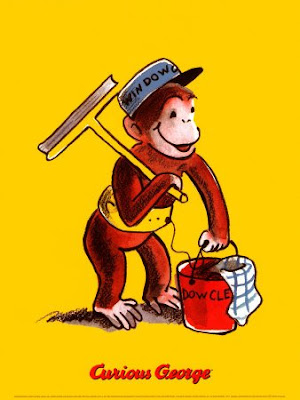
IMAGE OF THE WEEK

Curious George, from Curious George Takes A Job.
Curious George, the creation of Margaret and HA Rey, was a favorite of mine when I was a kid, and we’ve managed to pass it on to our daughter. This little monkey’s adventures are always surprising and fun, with a delicious sense of “What wonderments are lurking around the next corner?” on every page. Even when things turn out badly for a time — George breaks his leg, George swallows a puzzle-piece, George gets locked up in jail — the overall desirability of curiosity is never eliminated. The bad stuff can just lead on to even more good stuff, which is, I think, a valuable lesson these days.
Since the original books were written many decades ago, it’s interesting to note the sensibility of those times as contrasted with our own. Just the very first book, where the Man in the Yellow Hat spots a monkey and, suddenly wanting a pet monkey, decides to trap him and toss him in a sack for the boat-ride back to America is less than “p.c.”, but somehow we accept it. Of course, these days the Man in the Yellow Hat would use his money to establish a wildlife refuge in the jungle so that George can always live in his normal habitat…but then, we’d never get to see what happens when George takes a job as a highrise window washer, or what he’d do if he spilled bottled ink all over the floor, or how he’d apply his new-found knowledge after his friend teaches him a bit of spelling.
There have also been newer Curious George books, written and illustrated in much the same style as the Rey’s. We have one of them out of the library just now. I can’t remember the title, but part of the story involves George falling asleep during a movie and dreaming that he’s really big. At the end, when the Man in the Yellow Hat wakes George up, we can see on the TV screen the movie’s final frame — which the illustrater has depicted as an old-style “The End” card with the RKO Pictures logo and radio-tower icon, like RKO did in the 1930s and 40s. Now there’s a little bit of throwaway detail that no kid is going to appreciate — hell, few enough adults would appreciate it — but I sure loved it.
Today is apparently “Take Your Kid To Work Day”. In honor of this, I’ve plunked my daughter in the armchair to watch movies while I work on writing. How easy was that! “See, honey? Now I’m entering names and addresses of local business people into my scheduling program, so I can generate a mass-mailing later in the week….and now I’m working on a personal essay I’m submitting to the local paper….and then I’m going to do rough-drafts of two sample sales letters. Fun, huh!”
(Well, no, I don’t have her watching movies. But I find something funny about “Take The Kid To Work Day” now that I’ve decided I’m a freelancer. Later on I’m substituting a walk to the playground for my afternoon coffee-and-Tetris break.)
Want some handy writing-related generators? Sheila Viehl‘s got the goods, here and here.
Oh, dear. Another liberal celebrity has opened her mouth, and that’s set my favorite conservative, Rachel Lucas, to the usual foaming at the mouth. She takes exception to Janeane Garofalo’s characterization of the boycott against the Dixie Chicks as “Nazi stuff”.
She’s got something of a point. It’s a long-standing bit of Net-lore that in any online conversation (probably, any conversation in general, but I’ve only seen this discussed online) that the first person to invoke Hitler or Nazism automatically loses. This is usually cited as “Godwin’s Law”, although the precise formulation of Godwin’s Law indicates otherwise. But the point is well-taken: invocation of the Nazis generally indicates that a given discussion has reached a point where rationality has reached its breaking point. And it also seems to cheapen the Nazis, to mute that sense of evil that the word “Nazi” should imply, if we apply it too easily to any source of disagreement that comes down the pike. So Ms. Lucas is right in that sense, and while I find George W. Bush nauseating, I too get tired of seeing his picture with a little “Hitler mustache” penciled in.
(Of course, I think our “Evil Indicator” is seriously out of whack these days. If people on the right are annoyed at folks who equate President Bush with Adolf Hitler, they should perhaps check out some folks on their side who genuinely hold the same belief about President Clinton.)
But then, I think that Ms. Lucas is ignoring the fact that freedom of expression does occasionally seem to be less-valued these days, which is Ms. Garofalo’s main point (albeit ham-handedly made). Ms. Lucas says that the Nazis were about killing and genocide, but that’s not all they were about — in fact, those are just the ugliest symptoms of the Nazi disease. What the Nazis were really about was totalitarianism. They were about the establishment of a society in which dissent, real or perceived, was to be stamped out ruthlessly and efficiently. So I think that Ms. Garofalo isn’t saying that the people boycotting and book-burning are Nazi-like, but rather that they are taking the first steps on what could possibly be the road to Nazism.
I don’t think Janeane Garofalo made her point all that well, but by the same token, she’s not some idiot screaming at the rain.
