I mean, it’s worked every other time in history it’s been tried, right? I mean, don’t random reprisal executions always prove to be an effective means of controling things?
(No, we’re not actually doing this. It’s a nutty letter to a newspaper.)


The official site of Kelly Sedinger: Reader, writer, photographer, and dreamer
I mean, it’s worked every other time in history it’s been tried, right? I mean, don’t random reprisal executions always prove to be an effective means of controling things?
(No, we’re not actually doing this. It’s a nutty letter to a newspaper.)
Nefarious Neddie, in praising his beloved Philadelphia Eagles (who have enjoyed quite the resurgence after a sluggish start to their season), says that I harp on running the ball. So, in this post, I shall harp away on…running the ball. Ha! I’ve not yet begun to harp!
Anyhow, yesterday I had a little extra time on my hands (a lot, actually) and I looked at some statistical information from the first 36 Super Bowls. (Last year’s game was #37. I couldn’t find the stats on that game regarding league rankings.) Specifically, I looked at how each team to make the Super Bowl ranked in the NFL that season in terms of rushing yardage gained (a higher number meaning more success running the ball) and rushing yardage given up (a higher number meaning more success defending the run – i.e., giving up fewer rushing yards). I also compared each Super Bowl team’s rushing performance in each individual Super Bowl. And I made a nifty spreadsheet of it all! Cool, eh? (It was mainly a way of exercising my Excel skills.)
Anyway, here are some factoids regarding Super Bowl teams and their success at both running the ball and stopping the other team(s) from running it. Keep in mind, as of Super Bowl XXXVI, there had been 72 Super Bowl teams (74 as of last year’s game, but again I couldn’t find those stats for the Bucs and Raiders); “rushing offense” is defined as rushing yards gained; “rushing defense” is defined in terms of rushing yards surrendered. OK?
:: Of the 72 teams to reach the Super Bowl, only 20 were not among the NFL’s top ten teams in rushing offense.
:: Of the 72 teams to reach the Super Bowl, only 17 were not among the NFL’s top ten teams in rushing defense.
:: Of the 72 teams to reach the Super Bowl, only 8 were among the bottom 50% of the NFL’s teams in rushing offense.
:: Of the 72 teams to reach the Super Bowl, only 13 were among the bottom 50% of the NFL’s teams in rushing defense.
:: Of the 72 teams to reach the Super Bowl, only 7 were not in the NFL’s Top Ten teams rushing or defending the rush. Of those 7 teams, only 3 won the Super Bowl (Packers, SB I; 49ers, SB XVI; Patriots, SB XXXVI).
:: Of the 72 teams to reach the Super Bowl, only 2 ranked in the bottom 50% in both rushing offense and defense. Both lost. (Vikings in SB XI, Dolphins in SB XIX)
:: Of the 72 teams to reach the Super Bowl, only 7 were ranked #20 or worse in defending the run. Only 1 of those teams, the Packers in SB II, won the Super Bowl. (The Bills had 2 of those teams.)
:: The team with the NFL’s top-ranked rushing offense has reached the Super Bowl only 8 times, and of those, only 2 (the Dolphins in SB VII, the Bears in SB XX) won the game. (Again, the Bills had 2 of those teams.)
:: The team with the NFL’s top-ranked rushing defense has reached the Super Bowl only 9 times, and of those, 6 have won.
:: Interestingly, of the 36 Super Bowls played as of 2002, only 1 featured the NFL’s top two rushing offenses (SB XXIII, when the #2 49ers defeated the #1 Bengals).
:: Of the 36 Super Bowls played as of 2002, only 3 featured the NFL’s top two rushing defenses.
:: Of the 36 Super Bowls played as of 2002, 21 were won by the team with the higher ranking in rushing offense.
:: Of the 36 Super Bowls played as of 2002, 22 were won by the team with the higher ranking in rushing defense.
:: In only 7 of 36 Super Bowls played did the losing team outrush the winner.
:: In only 5 of 36 Super Bowls played did the winning team rush for fewer than 100 yards.
:: In 22 of 36 Super Bowls played, the losing team was held to less than 100 rushing yards.
:: The record for most rushing yards gained by a Super Bowl champion is 280, by the Redskins in SB XXII.
:: The record for fewest rushing yards gained by a Super Bowl champion is 29, by the Rams in SB XXXIV.
:: The record for most rushing yards by a Super Bowl loser is 166, by the Bills in SB XXV.
:: The record for fewest rushing yards gained by a Super Bowl loser is 7, by the Patriots in SB XX.
So what’s the lesson here? A lot can happen in football, obviously. Just looking at the stats, there is no way the Bills should have lost Super Bowl XXVII to Dallas by a score of 52-17 – but stats don’t predict turnovers, which tend to play an enlarged role in Super Bowls. (The Bills had seven in that game.) Likewise, you wouldn’t figure that the Rams could win SB XXXIV while picking up just 29 rushing yards, but that doesn’t take into account Kurt Warner throwing for more than 400 yards. (The Rams would pay for going pass-wacky, though, two years later when they failed to run the ball on a Patriots run defense that was rated #19, choosing instead to throw…and lose.)
It is possible to be too run dependent in the NFL. I’m pretty sure that only twice has the team with the winner of the NFL’s rushing title gone to the Super Bowl; OJ Simpson and Barry Sanders never made it with their teams, and Walter Payton didn’t get there until his career was nearly over and the great 1985 Bears defense was built. But generally, “Run the ball and stop the run” is as close to a foolproof philosophy for winning that you’re going to get. You’re far more likely to win a Super Bowl if your rushing offense and rushing defense are sound than if they are not.
Lynn Sislo has done the blog equivalent of extensively remodeling her home, with more room and a Comments section for interlopers to scrawl poorly-thought-out responses. Cool! Head over there, because she’s one of the most consistent sources of interesting stuff you’ll find:
http://www.aeternam626.com/b2/
And be nice in her Comments, because I’ve never seen her do anything but the same, even when she’s disagreeing with someone else in their Comments.
(The following appeared in my e-mail a few minutes ago, and it struck me as a perfect item to be tossed into the waters of Blogistan. I’d love to claim authorship, but I really can’t, sadly.)
Dec. 25
My dearest darling Edward,
What a wonderful surprise has just greeted me! That sweet partridge, in that lovely little pear-tree; what an enchanting, romantic, poetic present! Bless you, and thank you.
Your deeply loving
Emily.
Dec. 26
Beloved Edward,
The two turtle-doves arrived this morning, and are cooing away in the pear-tree as I write. I’m so touched and grateful!
With undying love, as always,
Emily.
Dec. 27
My darling Edward,
You do think of the most original presents! Who ever thought of sending anybody three French hens? Do they really come all the way from France? It’s a pity we have no chicken coops, but I expect we’ll find some. Anyway, thankyou so much; they’re lovely.
Your devoted
Emily.
Dec. 28
Dearest Edward,
What a surprise! Four calling birds arrived this morning. They are very sweet, even if they do call rather loudly – they make telephoning almost impossible – but I expect they’ll calm down when they get used to their new home. Anyway, I’m very grateful, of course I am.
Love from
Emily.
Dec. 29
Dearest Edward,
The mailman has just delivered five most beautiful gold rings, one for each finger, and all fitting perfectly! A really lovely present! Lovelier, in a way, than birds, which do take rather a lot of looking after. The four that arrived yesterday are still making a terrible row, and I’m afraid none of us got much sleep last night. Mother says she wants to use the rings to “wring” their necks. Mother has such a sense of humor. This time she’s only joking, I think, but I do know what she means. Still, I love the rings.
Bless you,
Emily.
Dec. 30
Dear Edward,
Whatever I expected to find when I opened the front door this morning, it certainly wasn’t six socking great geese laying eggs all over the porch. Frankly, I rather hoped that you had stopped sending me birds. We have no room for them, and they’ve already ruined the croquet lawn. I know you meant well, but let’s call a halt, shall we?
Love,
Emily.
Dec. 31
Edward,
I thought I said NO MORE BIRDS. This morning I woke up to find no more than seven swans, all trying to get into our tiny goldfish pond. I’d rather not think what’s happened to the goldfish. The whole house seems to be full of birds, to say nothing of what they leave behind them, so please, please, stop!
Your Emily.
Jan. 1
Frankly, I prefer the birds. What am I to do with eight milkmaids? And their cows! Is this some kind of a joke? If so, I’m afraid I don’t find it very amusing.
Emily.
Jan. 2
Look here, Edward,
This has gone far enough. You say you’re sending me nine ladies dancing. All I can say is, judging from the way they dance, they’re certainly not ladies. The village just isn’t accustomed to seeing a regiment of shameless viragos, with nothing on but their lipstick, cavorting round the green, and it’s Mother and I who get the blame. If you value our friendship, which I do (less and less), kindly stop this ridiculous behavior at once!
Emily.
Jan 3
As I write this letter, ten disgusting old men are prancing up and down all over what used to be the garden, before the geese and the swans and the cows got at it. And several of them, I have just noticed, are taking inexcusable liberties with the milkmaids. Meanwhile the neighbors are trying to have us evicted. I shall never speak to you again.
Emily.
Jan 4
This is the last straw! You know I detest bagpipes! The place has now become something between a menagerie and a madhouse, and a man from the council has just declared it unfit for habitation. At least Mother has been spared this last outrage; they took her away yesterday afternoon in an ambulance to a home for the bewildered. I hope you’re satisfied.
Jan. 5
Sir,
Our client, Miss Emily Wilbraham, instructs me to inform you that with the arrival on her premises at 7:30 this morning of the entire percussion section of the Boston Symphony Orchestra, and several of their friends, she has no course left open to her but to seek an injunction to prevent you importuning her further. I am making arrangements for the return of much assorted livestock.
I am, Sir, yours faithfully,
G. Creep
Attorney at law.
So, how ’bout that Return of the King filmscore, anyway? It’s probably a foregone conclusion that I would love it, but there is still a lot of surprising and wonderful stuff about the score as presented on the CD. Time for some random observations.
:: Each film’s score opens similarly: a brief “setting of the mood” followed by a statement of the Ring Theme as the title The Lord of the Rings slowly fades in. Here the very first music heard is a sad waltz-like section; then the ring theme, and then some pastoral music that becomes a bit more spritely (shifting to duple time) before a solo fiddle again sounds the Ring motif. Then the music suddenly turns much darker with the Sauron theme heard while a more frantic motif sounds above it. (The Sauron motif, incidentally, is a variation of the Ring motif. Shore put so much thought into his themes for these scores!) Presumably this music accompanies a flashback to the scene where Smeagol and Deagol went fishing, Deagol found a pretty gold ring at the bottom of the pond, and Smeagol murdered Deagol for it.
In fact, there is a great deal of pastoral character to this CD, much more than one might expect for the ultimate chapter in the story. This is actually very appropriate, though, because Shore has a great deal of work to do. Tolkien’s story in Return of the King isn’t just a tale of war, but a tale of loss and of the End of the Third Age. “Many things are passing from Middle Earth”, and thus it wouldn’t be right for Shore to give upbeat, muscular epic music for much of the time (although there is quite a bit of that here).
:: The pastoral content of the score is also appropriate given that it is in this story that the Shire, long ignored by nearly every person of power in Middle Earth (save for a single gray-cloaked wizard), is to play the most central role in the War of the Ring.
:: Shore actually does a few bits of more “traditional” scoring here, with some thrilling material in “The White Tree” (a track which showcases Shore’s brass writing) and in the “Shelob’s Lair” track, which sounds to my ears almost Herrmann-like. Very cool. Also, there are places where the melodic progressions remind me of John Barry.
:: There are two major new motifs present on the CD: the theme for Gondor (which was actually heard during Boromir’s speech at the Council of Elrond) and an elegiac, but hopeful, theme I’ll call “Into the West”, since it receives its fullest treatment during the song of the same title at the end (performed by Annie Lennox). Here again we see Shore weaving new themes out of more basic core material, for the Gondor theme is very similar in its intervals to the Rohan theme he introduced in The Two Towers. Two related themes, for the two kingdoms of Men. Very cool.
:: Film music fandom’s reaction to Annie Lennox’s performance of the last track seems mixed, but I like it immensely. This song really seems to capture the hope that the passengers of Cirdan’s ship must feel. Lennox’s voice might not feel right to some, but I found her an interesting choice. (I’ve been a big fan of Annie Lennox, though, since the very first time I heard “Sweet Dreams (Are Made of This)”, way back when I was in fifth grade.)
:: Oh, and that Lennox song ends with about two minutes of pure orchestral material that remind me of Wagner – the very end of The Ring or Tristan, perhaps.
Well, that’s about all. I must admit that when I first heard that Howard Shore had been named as the composer for these films, I was a bit baffled, since he’d never done anything remotely like these epic fantasies before. Well, as far as I am concerned, he turned in a classic trilogy of scores. Bravo…and I’m sorry there won’t be any more.
The ideal Christmas present for the role-playing game addict in your family is now being auctioned at Christie’s: this glass twenty-sider.
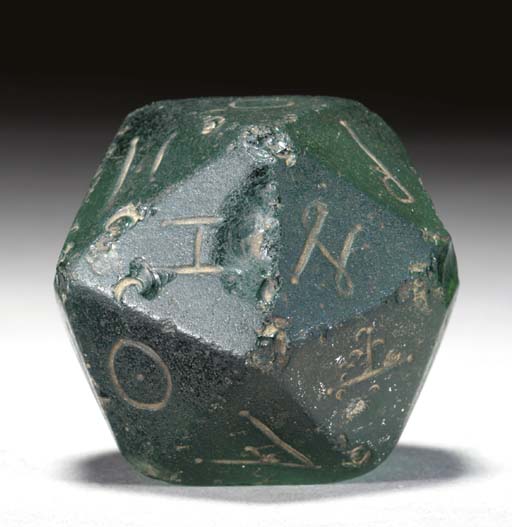
What’s the big deal with this? Why on Earth would you pay that much for a twenty-sider that was made of mere glass?
Because it was made in the Second Century AD and used by gamers in Ancient Rome.
What’s cool is that according to the Christie’s auction info, modern scholars have not been able to determine just what game the Romans used such dice for.
(via the Dead Parrots Society)
Lynn Sislo, always a fountain of interesting stuff, has a couple items especially worth notice: first, her thoughts on photographing sunsets, enhanced by one taken by her own hand.
Secondly, she mentions a natural sweetener called “Stevia”, which is an herb-based “sweetener”, although the FDA has not cleared Stevia for use in the United States specifically as a sweetener. Instead, the government requires that Stevia be labeled in products as a “dietary supplement”. Lynn is, shall we say, a tad irritated that the government has not cleared a product that would be wondrous for diabetics and others concerned with sugar intake. Now, I’d never heard of Stevia before yesterday, but I did turn up some more information on it.
1. Here is one doctor’s very short answer to “Is Stevia safe?”, which includes a link to a PDF of a European study that did not conclude favorably (although it did not conclude specifically negatively, either).
2. Here is an article by a University of Illinois nutrition educator which partially explains how Stevia’s current regulatory status works. (It’s not all the FDA’s fault — part of it specifically deals with the laws governing food ingredients versus nutritional supplements.)
3. The Center for Science in the Public Interest (the folks behind all those exposes of the fat content of Italian food, movie theater popcorn, et cetera in the 1990s) has taken a position against Stevia. (Although the CSPI is not without its own detractors.)
4. The FDA is not alone. Neither Canada nor the United Kingdom has approved the use of Stevia as a sweetener, and the World Health Organization “could not quantify an Acceptable Daily Intake (ADI) because of inadequate data on the composition and safety of stevioside”.
Maybe Stevia is perfectly safe, but it seems to me that skepticism might still be warranted.
There’s a discussion thread over on Oliver Willis right now about the reduction of comfortable places to sit in the large chain bookstores (Borders and Barnes&Noble). Personally, I don’t much care because I’ve never been much of a bookstore-sitting type of person. If I want to sit, I’ll go to the library.
And besides, I learn this morning, via Sarah Jane Elliott, that those chains are reducing something else, and this is a lot more pernicious than moving the armchairs out: they are squeezing word-counts (unless you’re lucky enough to be a mega-selling author).
That’s lovely. As if the road for writers wasn’t difficult enough already.
….now you can hate him in print!
Congratulations to Wil Wheaton! Maybe this whole “Hey, I could write a book!” thing actually works out sometimes.
(BTW, I’ve looked through some of Wheaton’s photo galleries, and I gotta wonder how a guy who spent years on a TV show that made him wear a shirt with a rainbow stretched horizontally across his gut ended up with a woman that lovely. I have a theory, but this is a PG-13 blog.)