The Power of the List

Via Mental Multivitamin, I find one of the list-quiz things that I like so much, but that I haven’t done in a while.

Instructions: Review the following list of books. Boldface the books you’ve read, italicize those you might read, cross out the ones you won’t, put an asterisk * beside the ones on your bookshelves, and place [brackets] around the ones you’ve never even heard of.

* The Da Vinci Code (Dan Brown)
The Catcher in the Rye (J.D. Salinger)
The Hitchhiker’s Guide to the Galaxy (Douglas Adams)
The Great Gatsby (F. Scott Fitzgerald)
* To Kill a Mockingbird (Harper Lee)
[The Time Traveler’s Wife (Audrey Niffenegger)]
* His Dark Materials (Philip Pullman) (I’ve only read the first volume.)
* Harry Potter and the Half-Blood Prince (J. K. Rowling)
The Life of Pi (Yann Martel)
Animal Farm: A Fairy Story (George Orwell)
Catch 22 (Joseph Heller)
* The Hobbit (J.R.R. Tolkien)
[The Curious Incident of the Dog in the Night-time (Mark Haddon)]
Lord of the Flies (William Golding)
* Pride and Prejudice (Jane Austen)
1984 (George Orwell)
* Harry Potter and the Prisoner of Azkaban (J. K. Rowling)
One Hundred Years of Solitude (Gabriel Garcia Marquez)
Memoirs of a Geisha (Arthur Golden)
[The Kite Runner (Khaled Hosseini)]
[The Lovely Bones (Alice Sebold)]
Slaughterhouse Five (Kurt Vonnegut)
The Secret History (Donna Tartt)
Wuthering Heights (Emily Bronte)
* The Lion, the Witch and the Wardrobe (C.S. Lewis)
Middlesex (Jeffrey Eugenides)
[Cloud Atlas (David Mitchell)]
Jane Eyre (Charlotte Bronte)
[Atonement (Ian McEwan)]
[The Shadow of the Wind (Carlos Ruiz Zafon)]
* The Old Man and the Sea (Ernest Hemingway)
The Handmaid’s Tale (Margaret Atwood)
The Bell Jar (Sylvia Plath)
* Dune (Frank Herbert)
Sula (Toni Morrison)
Cold Mountain (Charles Frazier)
The Alchemist (Paulo Coehlo)
[White Teeth (Zadie Smith)]
The House of Mirth (Edith Wharton)

When I strike the books above, indicating that I won’t read them, I’m meaning this in the “probably not” sense, not the “I hear that’s a crappy book and I want nothing to do with it” sense. Basically, I’m just assuming that with my current interests being what they are, I don’t see myself making those books priorities any time soon. All of this may change, however, in the next five years. Maybe I’ll revisit this list in 2011, if I’m still blogging.

(And I’m not going to apologize for my intention to read The Da Vinci Code. I love goofy-assed conspiracy theories, especially those involving Jesus and whatnot. Sue me.)

Share This Post

I’ll get you next time, Nevins!

Jess Nevins recently informed me that if I bought his book, The Encyclopedia of Fantastic Victoriana, he would reimburse me the cost of the book if I didn’t like it.

Well, he probably chuckled to himself the whole time, thinking, “Yeah, like that’s gonna happen, because I wrote a good book and it’s right up his alley! Heh!”

And damned if it didn’t work: I’ve had the book less than a day and I’m wondering why I haven’t had it for years. So, round one to you, Mr. Nevins. But wait until my book comes out!

(Note to self: resume writing book.)

(BTW, I only just started using Amazon again, so how long have they been putting up these “Hey, you already bought this item!” messages? I find that kind of irritating. I know what I own, dammit!)

Share This Post

Two steps forward, one step Bach

(Apologies to the audience for the horrible pun in this post’s title. The parties responsible have been sacked.)

Lynn Sislo reports something of a shocker for the classical music world: a number of works that have for centuries been attributed to Johann Sebastian Bach may actually have been composed by Anna Magdalena Bach, Johann Sebastian’s second wife.

My reaction is that, to a certain extent, I don’t care.

Even if it can be conclusively established that the Suites for Unaccompanied Cello were not composed by Johann Sebastian Bach, it still in no way diminishes the works themselves: they are still miraculous. The music has stood the test of time, and I don’t think that a change in attributed composership would impact the music at all.

But as for the historical record, at this point the idea that we’ve been crediting the wrong Bach for three hundred years certainly constitutes an extraordinary claim, and in the immortal words of Carl Sagan, “Extraordinary claims demand extraordinary evidence.” I’m going to need to see a lot more evidence before I’ll accept this idea.

To cite, as the article does, a mere stylistic difference in the Cello Suites from the rest of J.S. Bach’s oeuvre establishes nothing, really, in itself, aside from a possible grounds for speculation. What’s needed here is an autograph manuscript of the works in Bach’s hand; or, failing that (since such a thing would not have existed if Anna Magdalena Bach had written the works), some kind of documentary evidence, in the form of a letter or a journal entry, in Bach’s hand firmly establishing Anna Magdalena’s compositions.

Likewise, I don’t think that forensic analysis of the handwriting yields anything more than possible grounds for speculation. I can imagine any number of circumstances in Bach’s life that would have explained the presence of Anna Magdalena before she became his wife. I just don’t see any extraordinary evidence here, as yet.

But, just for a moment, suppose there was some extraordinary evidence that firmly established Anna Magdalena Bach as the composer of some of those great works.

Firstly, we’re talking about J.S. Bach here. If we strike, say, one quarter of his most famous works from his oeuvre, the man was so prolific that we’d still be talking about one of the towering geniuses in all of classical music. Unless the “extraordinary evidence” took the form of a diary confession by Johann Sebastian — “I have poison’d her, and all her divers works shall be mine forever! Haaa ha ha ha ha!”, or something similarly nefarious-sounding — I don’t think it would diminish Bach that much. It might establish Johann Sebastian and Anna Magdalena as one of the great musical marriages, right up there with Robert and Clara Schumann. And it also might illustrate something about the role of women in classical music.

The fact is that the story of classical music is almost entirely a story of white men. Yes, there were important figures in classical music who were not white or male, but they were very infrequent. Obviously this is because women in classical music were usually steered toward performing roles as opposed to composition, and in music history, composition is where it’s at. I’ve never been sure exactly about the fairness of that aspect of it, but there it is.

A question that often arises in classical music discussions is, “If Mozart came along today, would be recognize him?” And that’s an interesting question, but it seems to me that since women were so frequently steered away from musical composition for whatever reasons, effectively fifty percent of the population was ruled out of composing. How many Mozarts have we missed, by the fact that women were pushed to the sidelines or onto the stages, as opposed to the composers’ desks?

When I was in college, the woman who conducted our orchestra and taught music history was something of a feminist. I never found her terribly annoying about it; it was more that the role of women in classical music was a particular area of scholarly interest for her, as opposed to the focus of her being. One of our orchestra concerts was comprised of works by woman composers, and it was a pretty good concert — all works worthy of being heard. And when I took music history from her, there were a couple of lectures on the topic, but nothing really rabid.

Some of my fellow students didn’t see her this way, of course; it was a fairly conservative campus, and a lot of times, merely broaching the topic of women’s roles in history drew a heavenward rolling of the eyes. When the prof handed out a list of suggested topics for papers, there were a handful of topics involving women in music; one of my classmates went through the list and circled all of these, marking them as “femme topics”, whatever the hell that meant. And one guy who took the course a year previously warned those of us at the start of the semester thusly: “If a woman didn’t compose it, we didn’t study it.” Well, unless the prof completely recasted her syllabus in the summertime, I don’t see that as likely, especially since the textbook — Grout and Palisca’s History of Western Music, hardly a tome of feminist scholarship — was the same for both years.

Hell, I don’t know what point I’m trying to make here, except to note that as of now I find it highly unlikely that this conjecture about Anna Magdalena Bach is ever likely to rise beyond conjecture; but also to note that if it did rise to a level higher than conjecture, it wouldn’t be terribly damaging to music.

Share This Post

Miyazaki-san

Steven Den Beste has an article summing up his opinions on the films of Hayao Miyazaki. It’s a good read. I’m a giant fan of Miyazaki’s work myself, and SDB’s post is interesting, even though I don’t agree with him in all the particulars. In particular, I don’t find Miyazaki’s films terribly “preachy” at all — but maybe I’m more simpatico with the general messages involved, so I tend to not find them heavy-handed in the first place. (Not that I’m immune to movie messages I agree with; as much as I love the Director’s Cut of The Abyss, for example, that film drives its message home with all the subtlety of an Adam Sandler comedy.)

A couple of random points, only partially in response to SDB’s article:

1. I love Castle in the Sky, but I have to grant SDB’s point that the characters aren’t the deepest that Miyazaki has created. Maybe with some stories, I’m more interested in the tale than I am in the characters? I’m not really sure here, but I know that I’ve greatly enjoyed, and counted more than a few among my absolute favorites, films whose characters aren’t terribly interesting in themselves.

2. The Daughter just watched half of Totoro just this evening (turning it off at homework time). There just isn’t a single misstep in this entire film. I find it immensely satisfying, and it doesn’t leave me empty at all. I actually like the fact that this film gives just a tiny slice of one family’s life, and doesn’t even go more deeply than it needs to. We aren’t forced to dwell on the mother’s illness, and there’s none of that “They could see Totoro while they were young and believed in magic, but as they aged they forgot” stuff that often turns up in magical stories about young children.

3. SDB doesn’t mention another constant of Miyazaki’s films: the music of composer Joe Hisaishi. I actually came to Miyazaki via the music of Hisaishi; I read a glowing review of the Princess Mononoke score and gave it a listen without seeing the film (longtime readers will know that I do not consider seeing the film to be prerequisite to enjoying a filmscore); the score became one of my all-time favorites more than a year before I had a chance to actually watch the film. The plucked strings and woodblocks of the kodamas sequence is an extraordinary passage of music.

Hisaishi has a very chameleonlike quality as a composer. He loves to use Eastern motifs in a Western musical idiom; these kinds of motifs abound in Totoro, Mononoke, and Spirited Away. For Kiki’s Delivery Service, Hisaishi adopts an almost stereotypical French sound, with accordions and a lilting waltz for a main theme. His Castle in the Sky score is properly big and epic. (I have neither seen Howl’s Moving Castle nor heard its score yet.)

4. To SDB’s list of common Miyazaki themes, I’d add magical realism. All of Miyazaki’s films involve fantastic elements to one degree or another (I did read one article once that argued fairly articulately that Castle in the Sky is even science fiction and not fantasy, but I’d still stick with the latter), but the treatment of magic is always very matter-of-fact. Miyazaki never stops the action for any kind of explanation of his magical events, and with the exception of Chihiro, no one is ever much surprised when magical things happen.

5. One of the things I most love about Miyazaki is the way he tosses tiny details into his films that are never remarked upon, never explained, and never figure into the main story at all. These little details are just there. Sometimes they greatly add to the depth of Miyazaki’s universe, where other times they just add a small amount of “spice”. Examples include Pazu’s birds in Castle in the Sky and the dust-bunnies in Totoro. In this way, Miyazaki reminds me of George Lucas; the Star Wars films are chock full of small details that often mean less than fans seem to think they should. (Since Lucas is a known lover of Japanese cinema, perhaps someone can tell me if this is a facet of Japanese filmmaking in general, as opposed to being a unique quirk of Miyazaki’s.)

6. Clouds. Seriously: I want to live in a world where the cities look like Lucas’s Coruscant but boast Miyazaki’s cloudscapes.

Share This Post

Sentential Links #47

Yup, it’s that time of week again. Here goes:

:: Are we all hardwired to be idol worshippers? (Nope, I don’t worship any idols. Nosiree Bob, not me! But that’s not what she’s talking about, anyway.)

:: Occasionally on my sandy walks I come across some remarkable man-made items. (Provisionally a very nice blog, by a composer who offers listening samples of her work. I haven’t listened to any of them yet, but I will. Via ACD.)

:: I feel myself getting stupider every time I read that line, but the good news is that I have a long way to go before I would be actually stupid enough to say that line myself. (Maybe someday I’ll inflict my own Star Wars fanfic upon the world. Ye Gods, what a disaster that would make — I’d most certainly be banished to some sector of Blogistan frequented by old and dyslexic guys who keep trying to visit Polarwine and LFG.)

:: Trying to posthumously enlist Heinlein (or any dead author for that matter) in some modern political cause strikes me as a dubious enterprise.

:: So, I guess if men want to get it up, happily, they need to not keep us down. (Wow!)

:: I’ve nibbled on A; I’ve squished B; I’ve cavorted with C; but my favourite remains D. (This one might not be safe for work.)

:: How can you tell when the national immigration debate has reached saturation point and seeped too deeply into the public’s consciousness? When your wife starts having dreams about it.

:: Is every Republican in Washington the emotional age of seven? (Oh, for the love of God. This shit cannot be for real.)

:: The SS Great Britain is cleverly designed to bring as much comfort to its passengers and crew members as possible. (This is part of a series of posts. Look at the photos; fascinating stuff!)

:: Set up an account and you’re automatically admitted to the futurismic bowels of the Monkey. (All together, now: “The filthy monkey, it plans!”)

Enough for now. Tune in next week. And tomorrow. And…well, you know.

Share This Post

Traffic jams will be a thing of the past!

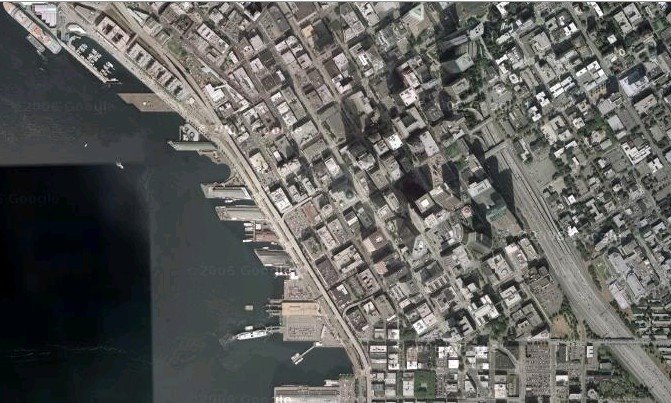
Over at City Comforts, David Sucher has been focusing a lot on a Seattle issue: what to do about the “Alaskan Way Viaduct”. This is an elevated expressway in downtown Seattle that runs right along that city’s waterfront. According to the Wikipedia article linked previously, the Viaduct has become an object of concern because of the threat of earthquakes in the Pacific Northwest, especially following the collapse of the similar double-decker expressway in the Bay Area in 1989’s major earthquake. I did some noodling about with Google Maps, and I was able to capture this bird’s-eye view of the Viaduct:

The Viaduct

Looking at that photo, I was strongly reminded of something. And I hope that my Buffalo readers are reminded of the same thing: our own Interstate 190, which is also an elevated expressway in our downtown that runs right along the waterfront. Apparently a number of Seattlites are of the view that in addition to being unsafe in earthquakes, the Viaduct also cuts off easy access to the city’s waterfront, which is an oft-made complaint about I-190 in Buffalo. Here’s the bird’s-eye view of the 190:

I-190

This is not to suggest, of course, that Seattle and Buffalo are in similar positions, since Seattle actually has an economy and Buffalo would sure like to get one of those someday iffen’ we can get the nice folks in Albany to remember that we exist way out here, but still, it’s heartening to know that the same kinds of issues exist elsewhere.

Share This Post

Sunday Burst of Weirdness Greatness

Hey, wanna watch one of the greatest short films ever made? A nearly perfect blend of music and visuals, with comic timing that probably made Lucille Ball look like someone at Open Mike night at a club in Topeka?

Sure you do.

(Sorry, Google! We had some great times and I’ll always love you, but YouTube’s my girlfriend now.)

Share This Post

A very public service message.

Last night, I got my first significant comments-spam attack, as some outfit left something like twenty comments here with links to…something. (Don’t know what, don’t care what. Didn’t check.) After deleting all of those, I’ve now turned on YACCS’s new moderating system, so no comments here will appear until I manually approve them. If this proves to be a larger pain-in-the-ass than I’m willing to deal with, then I may switch over to Blogger’s commenting system, which has a CAPTCHA word-verification thing. Moderation isn’t my first choice, but I’m willing to suffer with it for a while and see how it goes. Luckily, this blog doesn’t tend to generate long comments threads, but my threads have trended longer recently and I’d hate to see that go by the wayside again just because I can’t free myself up for large segments of the day to moderate things. We’ll see.

If any of you Fine Readers have an opinion on this, feel free to e-mail it (or leave it in comments, since with the moderation turned on I’m pretty much guaranteed to see all comments now).

So now, on with our show. And please feel free to enjoy a fine beverage by the fine folks at Schweppes.

Share This Post