Morons on Parade

This guy is scum:

A school principal has resigned and could face felony firearm charges after he shot and killed two orphaned kittens on school property last month.

Wade Pilloud, who resigned as principal of the K-12 Indus school, 40 miles west of International Falls, said he shot the kittens to spare them from starving to death after their mother was killed in an animal trap.

Yeah, because you can’t afford a five-buck bag of Kitten Chow on a school principal‘s salary.

Asshole.

Share This Post

Tigers and monkeys and boas, oh my!

One of the more devious ways that God, or Karma, or the Fates, or the Universe, or the Football Gods, or our Alien Overlords, have of getting even with us in our adult lives for transgressions of childhood is by bestowing us with children whose favorite movies are movies we just can’t stand. Here at Casa Jaquandor, the movie of choice for The Daughter is The Jungle Book.

Now, I’ve always been mildly tepid about The Jungle Book — I kind of like the animal characters and all the little vignettes, but as a character, Mowgli bores me to tears and I can’t frankly care if Shere Khan eats him or not. But “mildly tepid” feelings about a movie can quickly turn sour when one’s kid watches the same movie too many times. Now, it’s pretty safe to say that I can’t stand The Jungle Book.

So, for some unknown reason, I relented the other day when The Daughter decided that she wanted to check out The Jungle Book II from the library.

God, this movie makes me want to kill something. It makes me want to pave all the jungles in all the world for new Targets and Starbucks outlets. It makes me want to bulldoze the Disney studios, and then salt the earth there so that nothing ever grows there again.

What a horrifically awful movie. It exists for absolutely no reason other than to put out a sequel to a Disney “classic”, and clearly demonstrates that if ET: the Extra-Terrestrial had been made by Disney, we would have long since had a sequel in which ET returns and takes Elliot to his home planet, where Elliot would have to phone home.

In The Jungle Book II, Mowgli isn’t completely satisfied with village life and yearns to go back to the jungle, despite his friends Shanti (a girl) and some little toddler whose name I can’t recall. Eventually Mowgli does go back to the jungle, and he has more adventures with the exact same bunch of animals from the first movie. Baloo the bear, Baghera the panther, the elephant brigade, the goofy monkeys, the treacherous snake, the vultures, and Shere Khan the tiger, who wants a rematch. That’s it. Retread, retread, retread, confrontation with the same villain, retread, retread, culminating with one of those action sequences where pits of lava exist for absolutely no reason. And in all that, we have to hear “Bare Necessities” four or five times.

Also, the color scheme in Jungle Book II is too bright. The original movie was able to convey that the jungle is really no place for a kid to hang out, but here it looks like a Club Med getaway that would be perfectly benign if not for that annoying tiger who keeps walking around saying menacing things in a deep British accent. What a waste of Tony Jay, the wonderful voice actor — do we really need “Come out, come out, wherever you are?” Geez.

Anything good about this movie? Well, there’s a song called “Jungle Rhythm” that’s kind of catchy. But that’s about it.

Share This Post

The Snows of October

(10-14-06: Updated below!)

Stuff like this isn’t unheard of in Buffalo, but in October? WTF is that?! There oughta be a cosmic law against snow events like this when the boys of summer are still on the field. Stupid weather gods. I hate them so much….

I’ll put some photos up on Flickr at some point, but for now, it really was that bad. There’s no New Buffalo-esque spinning this one: Mother Nature put the hurt on Buffalo last night, hard.

And as I made progress toward The Store, it got a hell of a lot less pretty. It got downright ugly, even. At that point in the morning, the roads had not been plowed, so the going consisted of these two fairly well-worn ruts in the snow. Once your car settled into those ruts, that was it. Steering was pretty much out of my hands — except for the fact that the ruts were just slightly wider than the chassis of my car, so I kept sliding from the left rut to the right rut.

Of course, this will get Buffalo in the national spotlight again as that place where it snows constantly from October to May. That’s complete shit, of course, but you can’t fight the Weather Channel’s narrative. Jerks. I hate them so much….

Another funny thing: while at The Store today, I could tell that the enormity of the situation was slowly becoming clear to the people of the area, because the shopping patterns shifted quite a lot from what people were buying early in the day versus later in the afternoon. Late in the day, the focus was on things like batteries, flashlights, candles, ice, milk, bread, and bottled water. Early in the day, though, many of the shoppers who were able to get to The Store at that point were buying cases of beer, multiple bags of chips and Doritos, packages of cookies and boxes of crackers. I was thinking for a while that in addition to dumping large amounts of snow on Buffalo, this storm also gave the region a massive case of The Munchies.

I’ll say thanks right now to all the power crews from other states and regions who are, as of this writing, on their way to Buffalo to help with the repairs and restoration of power. I’ve been through something like this once before, on the weekend when we moved from Syracuse back to Buffalo (this was either the end of March or the beginning of April, 2003; look in the archives), and I can say from experience that those guys have many hours of backbreaking work ahead of them. So, citizens of Buffalo, be understanding if you go to a restaurant over the next few days and find that some power workers are actually getting preferential treatment, because, well, how would you like to leave your family for several days to spend ten to fourteen hours a day in the bucket of an electrical truck, in 40-degree weather?

And for that matter, if you do go to a restaurant while this disaster is going on, tip well unless your service is epic in its badness. Those people are getting their asses kicked.

OK, preaching over.

UPDATE: One thing that’s always hard to convey to PWATUTLIB’s (that’s People Who Are Too Unfortunate To Live In Buffalo) is how sharply local the lake effect snows can be. One location can literally receive over a foot of snow, while another location just five miles away can receive a mere dusting. Now, the snow bands for this particular event were a bit larger than that, so pretty much everybody in the Buffalo Metro region (which spans about thirty miles from north to south, and more if you include Niagara Falls) got socked, but it’s not at all unusual for there to be very heavy snows in one part of the area and nearly nothing in another. And if you’re out and about in certain areas as the lake effect amps up, you can actually see the bands of clouds in the sky, making a heavy and dark line across the sky with bright, and possibly even blue and sunny, sky immediately adjacent.

Such an effect was visible on Thursday as the storm that hit us got going, and I saw it a lot because I was doing some out-of-Store driving as part of work that day. Sadly, I didn’t have my camera, but I made a mental note to try to get a photo of that sharp lake-effect cloud line at some point this winter. Now I don’t have to, because Derek got a couple of perfect shots of the phenomenon. Also check out Red, who has a weather map showing what lake effect looks like on the weather radar.

So what is the lake effect? Well, after summer it takes quite a while for the Great Lakes to cool down, so as the colder climes set in, there is often quite a disparity between the air temperatue and the water temperature. And if a system sets up that brings even colder air down from Canada and brings that frigid air across the relatively warm lake waters, that air picks up an astonishing amount of moisture, which then becomes precipitation as that air moves from over the water to over the land. Early in the fall this results in “lake effect rain”, but when it gets cold enough, you get snow. Lots of snow. Boy howdy.

Now, Buffalo’s not the only place that gets hit with lake effect snow. (In fact, the majority of the time the lake-effect snow bands in Western New York pile the lake effect snow south of Buffalo, because winds from the west are more common than the winds from the southwest. The downside there is that those southwest winds have a lot more water to fly over before they hit land, and when they do, the City of Buffalo is what’s sitting right there. But the parts of Michigan that border Lake Michigan and Lake Huron also get lake-effect snow, as does the Syracuse area and the part of New York that lies just east of Lake Ontario. In fact, those parts of New York almost always get it a lot worse than Buffalo over the course of a winter, because most years Lake Erie — being the shallowest of the Great Lakes — will freeze over, which shuts down lake-effect snow production. Lake Ontario, which is four times as deep as Lake Erie, never freezes over.

Anyway, there’s your science lesson. And you know what? All things considered, I’ll still take our lake-effect snows over everybody else’s wildfires, earthquakes, hurricanes, triple-digit summers, negative-degree winters, tornadoes, cyclones, and scrawny chicken wings. So, for all you people out there laughing at Buffalo and its October snow, I scoff at you! ‘Tis but a scratch! It’s only a flesh wound!

Share This Post

Force, meet Farce

John Scalzi today, in which he vents about Star Wars:

I defy you to find any person who was genuinely entertained by Episodes I, II and III.

Hi! My name is Kelly, and I was genuinely entertained by Episodes I, II, and III. Nice to meet you.

Nothing else here is new — it’s just the standard boilerplate “George Lucas is a pretentious hack” thing that you can read by just about anybody, complete with masturbation metaphors applied to George Lucas, so I won’t go into it further. (My reasons for enjoying Episodes I, II and III can be found in posts linked in the sidebar, if anyone’s that interested.) But I’d note that Battle Beyond the Stars is not anywhere near as entertaining as Star Wars. I didn’t find it so when I saw it in the theater when I was eight, nor did I find it so when I saw it on TV on matinees occasionally in the 80s, nor even when I watched it again five or six years ago. That’s not to say that it isn’t a fun little flick, because it is. But advancing it as some kind of pure ideal of entertainment, or even just as a test cast against Star Wars, is just goofy.

(For some real entertainment, though, find a copy of the soundtrack to Battle Beyond the Stars. The film was scored by a very young James Horner; it was one of his first scores, and there’s not an original musical thought in it. It’s pure homage to Jerry Goldsmith all the way. But there’s a track called “Cowboy and the Jackers” in which Horner writes this ostinato for the trumpet section that pretty much goes throughout the entire track, but he pitches it very high in the trumpet’s range, so on the recording, as the track winds down, you can actually hear the slow agonizing death of those poor trumpet players.)

Share This Post

Der Meistersinger von Alpha Centauri

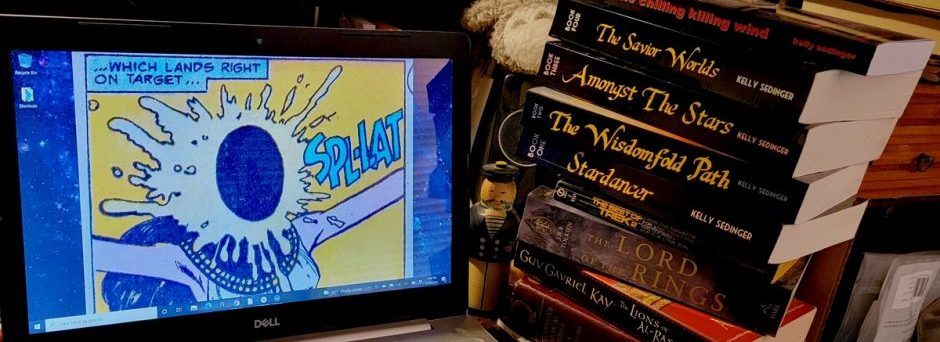
Here’s an update on what I’ve been reading as part of my space opera obsession:

:: Galactic Patrol, by E.E. “Doc” Smith. I bought the entire Lensmen sequence five or six years ago when the Science Fiction Book Club had it in a two-volume set. At the time, I read Triplanetary, but never read farther into the series. Triplanetary is billed as the first book in the sequence, but it really isn’t: it may be set prior to the events of Galactic Patrol, and it might have been initially written prior to GP, but it was only reworked by Smith to take place in his Lensmen saga after the rest of the books were done.

When confronted by a series of books, folks, it’s almost always preferable to read them in the order in which they were written than in the order in which the events take place.

Galactic Patrol pretty much starts without any preamble: Kimball Kinison is “initiated” into the “order” of the Lensmen, fitted with his Lens, and then sent on his first assignment, which involves tracking space pirates who strike from a secret base, and returning to Earth with the information. Having already read Triplanetary and remembering the glacial pace of the opening in which Smith took his sweet time getting things going as he related millions of years of Galactic history, GP is refreshing in the way it gets things going almost immediately.

Smith also has quite an imagination for alien worlds: the planet Trenco, whose equatorial regions receive exactly forty-seven feet and five inches of rain every single night, comes off as a remarkably hellish environment. Plus, Smith’s universe feels nice and big, which is what I want in a space opera. GP tells a fairly tight story, but Smith still makes it clear that he’s only scratching the surface.

:: Requiem for a Ruler of Worlds, by Brian Daley. I remember seeing Daley’s books a lot on the shelves when I’d shop at various WaldenBooks or B. Dalton’s when I was a kid, and I read a few of his media tie-in books and film novelizations, but never his original work, until now. I made a mental note of this title a while back when Will Duquette mentioned it favorably; eventually I tracked it down on eBay (along with its sequels, Jinx on a Terran Inheritance and Fall of the White Ship Avatar. I read Requiem a month or so ago.

I hate to describe books as breezy fun reads, because that makes them sound like less than what they are. Truth is, Requiem for a Ruler of Worlds is as good an entertainment I’ve found in a book in a long while. No, this isn’t deep and insightful fiction, but it is SF adventure backed with lots of nifty ideas, such as Earth having turned away from the stars after they’ve been colonized. The book is a classic “buddy” story, pairing the stiff-laced Hobart Floyt (it can’t be coincidence that the name is so close to “Heywood Floyd”) and the rogueish Alacrity Fitzhugh as they travel across the galaxy to learn why Floyt has been named in the will of the ruler of a distant interstellar Empire. Hijinks, derring-do, and some actual hilarity ensue.

After tracking this book down, but before reading it, I decided to do a bit of research as to what Brian Daley’s been up to. Turns out he died ten years ago. Damn. All that time I’ve been following the SF genre, and I never knew. It’s amazing how we can be so in tune with something and out of touch with it as the same time.

The next two are shorter tales, either novelets or novellas depending on our definition, from the new anthology The Space Opera Renaissance, edited by david Hartwell and Kathryn Kramer (who may be the finest anthologist duo in the F&SF genre, possible excepting Terri Windling and Ellen Datlow). This anthology provides a historical overview of the entire space opera sub-genre, via thirty-two short selections. (The term “short” is something of a misnomer, actually, since this anthology weighs in at over nine hundred pages. Lots of space opera goodness here.) Since the book is arranged chronologically, I’m reading the tales in that order, although I won’t be reading the entire anthology at once. (Reading an anthology straight through is a different practice for me; I’m almost always one to just dip at will into anthologies. But I like the idea of the historical perspective afforded by this book, especially since I’m not making much of an effort to read space opera novels in historical order.)

:: The first story in this book, after a terrific preface on the history of the term “space opera”, is “The Star Stealers” by Edmond Hamilton. I’d never read anything by Hamilton before; indeed, I’m not certain I’ve heard of him before, which is odd since he was married to Leigh Brackett, whose work is essential to anyone wanting to learn about space opera in all its varieties. In the introductory piece to “The Star Stealers”, Hartwell and Kramer note that Hamilton’s work was influential in its day, but while E.E. Smith has achieved some kind of “classic” status, Hamilton’s work is mostly forgotten.

This story has its moments, but it reads more as a historical curiosity than as a good story. I can see why it’s included in this book, but reading it felt like a bit of duty. The idea of the tale is a wild and whacky space opera notion, that a race of aliens whose star has died will instead of trying to move to a different star literally attempt to steal another star, in this case, our own Sol. The rest of the tale depicts the efforts of a plucky band of human heroes to thwart this plot.

I always find that reading very old SF (“The Star Stealers” was published in 1929, right around the time H.P. Lovecraft was writing his Cthulhu tales) requires a lot of forced suspension of disbelief. Here we have the main interstellar spaceport of our Solar System being located on the surface of Neptune; here we have a star going dead and the aliens who call it home living on its surface, erecting cities on its cold stone. I’m usually able to get past things like this, but each successive hit of the “Huh-whuh?” button requires me to work to get back into the story. So does an infodump early on that actually uses the dreaded words of SF hack writing, “As you know….”. And the science isn’t all: there’s a moment of surely unintended sexism on Hamilton’s part, at the end of the story, when we’re informed that following the conclusion of the adventure, the tale’s sole female character decided to do what women do and open a beauty parlor. I couldn’t help laughing out loud at that one.

:: Next came Jack Williamson’s “The Prince of Space”. Williamson is probably the last living link to the Golden Age of SF; he was born in 1908 and as of this writing is still alive, and his most recent novel came out in 2005. Talk about longevity! “The Prince of Space” came out in 1931. The plot here is surprisingly convoluted, beginning with a mystery involving a pirate called “the Prince of Space” who may have murdered everyone aboard a spaceship, and ending in a war between Earth and Mars. There’s also a fairly ham-handed romance in there as well, of the “You cannot love me, so I shall wander off into the wastes and die!” variety.

The difficulties of early 20th century science come into play here as well; we have a Mars with a breathable atmosphere, for one thing. Again, that doesn’t bug me all that much, but it does take a little effort to remind oneself to go with the flow. Williamson’s storytelling is stronger than Hamilton’s, as is the general sense of place he’s able to capture. This is one of those art-deco futures so common to very old science fiction: in the opening scene, a character needs to get a newspaper, so he steps off the moving sidewalk and puts a coin into a vending machine, whereupon a newspaper freshly printed to order is whisked to his location via pneumatic tube. A society of moving sidewalks and pneumatic tubes, forecast for the year 2131.

:: Currently I’m starting Andre Norton’s Star Soldiers (which is a Baen Books repackaging of two separate Norton novels, Star Guard and Star Rangers). After that, I will probably leave off the space opera for a bit, as I have quite a few review books to read for GMR and then there’s some epic fantasy I’ve been leaving neglected for far too long (GRRM’s A Feast for Crows and Steven Erikson’s Malazan Book of the Fallen series, chiefly). And although it’s still four months away, I still have to plan to have my reading decks cleared for the February 6 release (according to Amazon, anyway) of Guy Gavriel Kay’s Ysabel.

:: By the way, I’m not enforcing a rigid definition of “space opera” versus “planetary romance”. Just in case anyone’s wondering. As always, reading suggestions for space operas are welcome!

Share This Post

Harshin’ the 70s Mellow

Upon further review, Shamus grudgingly admits that the 70s weren’t completely bad. But he does revise and extend his original remarks that while the 1970s may not have been a complete waste of ten years, that decade produced bad stuff that is far more bad than any of the bad stuff produced in any other decade:

But I think we can all agree that when things were bad in the 70’s, they were really, really bad. Soul-crushing, mind-destroying, nightmarishly horrible.

As evidence for this proposition, he provides this music video of a disco song called “Apache”. And yes: to describe its badness accurately would leave Roget’s bereft of any more synonyms for “bad”.

But, I can’t help but wonder to what extent our perception of this video’s mastodonic badness is a factor of time. I mean, this thing is twenty years older than, say, “MMM-Bop”, and it’s pretty much historical fact that what’s seen as good and bad changes over time. So, I’m just going to throw this out to the readership: what relic from the 80s or 90s would you think as likely to look that bad when we’re as distant from it as we are now from that video for “Apache”? If you’re blogging in 2026 about how crappy the 1990s were, what will you cite as your evidence?

I’ll start with “Achy Breaky Heart”.

Share This Post

That 70s Blogger

Shamus hates the 70s, and he seems to have pretty good reasons. Politically, the 70s were pure shit — we’re talking about a decade that saw three US Presidents, two of whom were Nixon and Carter. (Now, I like Jimmy Carter, but I like lots of people who would be crappy Presidents.)

I’m not sure I’d dismiss a lot of the cultural stuff of the 70s, though; there was quite a lot of good stuff. This is a tricky point to make. Shamus notes that Star Wars came out in 1977, but George Lucas was very clear at the time (and ever since) that he made a feel-good space opera out of a reaction against the tenor of the 70s. The same can also probably be said of his other great film from that era, American Graffiti. Ditto Grease, a movie whose heart is most certainly not in the 1970s.

Maybe some of the bleaker films of that era aren’t to Shamus’s liking, but I can’t declare a decade a washout if it produced films like Chinatown, Saturday Night Fever, The French Connection, The Exorcist, and (by their reputation, since I haven’t seen them in their entirety) the first two Godfather movies. Also, the 1970s saw the arrival of Steven Spielberg, with the greats Jaws and Close Encounters of the Third Kind.

Here’s a site on the film history of the 70s. A lot of great, although mostly admittedly bleak and cynical, films came out in that decade.

I’m likewise unwilling to cast out all of the television of the 70s. Sure, lots of it was crap, but lots of TV is always crap. There were also Barney Miller, MASH, The Bob Newhart Show, The Muppet Show, and some other stuff that tends to be highly regarded. Saturday Night Live started, although it’s worth asking just how funny it was.

Music? Well, all that big-haired heavy metal from the 80s had its roots in the 70s, right? Jerry Goldsmith was at the height of his powers at the beginning of the decade, and at the end of it, John Williams was reaching the height of his. Disco was mind-numbingly awful, for the most part. (I have a weakness for the Donna Summer song “Last Dance”.)

I don’t really remember the 70s all that well from a personal standpoint, so this post isn’t meant so much as a defense of the entire decade as a defense of some things from that decade that I like, and not much “defense” at that, since again, lots of this is a matter of taste. I certainly don’t deny that the fashions of the era were mostly ugly (excepting that certain articles of workwear were popular at the time!), and that the cars were awful (just try watching the high speed chases of the James Bond movies of the period). We saw a Chevy from the 1970s in a parking lot recently, which by happenstance was parked next to a lovingly restored car from the 1950s. Talk about your “Beauty and the Beast” moments.

So what’s my point? I don’t know, really. Just that the 70s didn’t completely suck, I guess.

(And I’m glad that on the “hippie” scale, I fall on the smiling, happy side!)

Share This Post

A very public service message.

As a guy who’s been doing lots of work on the job with various hand and power tools over the last three years, I know that tools can often be used in ways for which they aren’t originally designed. But sometimes, using a tool for a certain task might not be a good idea, such as using a sharp chisel to open a paint can. (Really, folks, you can get a paint can opener at Home Depot for something like $1.29! Don’t use your chisels or screwdrivers!)

Anyhow, this also applies to medications: yes, it may seem to work initially, but it turns out that you’re really not supposed to use hemorrhoid cream on your face. I know that people like to think outside the box on stuff like this, but really, putting hemorrhoid cream on your face? Really, folks, if you’ve gotta put cream on your face, use either this or this. Don’t use this! Ewwwwww!

Share This Post

What do they shoot on Studio 61, anyway?

Some notes on the new episode of Studio 60 on the Sunset Strip, airing tonight in the US but last night in Toronto — thanks, Canadians!

[SPOILERS]

So OK, this episode is a mixed bag. Shortly after the halfway mark, the episode launches into what might be the most interesting story about the making of a comedy TV show that Studio 60 has yet uncorked — basically, after the live telecast, someone realizes that ninety seconds of comedic material for the show was plagiarized. After that moment, the episode is first-rate. How they deal with the aftermath of plagiarism, how Matt deals with the staff writers, the technical stuff with the show’s live East Coast telecast being over but the West Coast tape delay having not aired yet — it’s all great stuff. I’ve made the West Wing comparison before, and not favorably, but here it works: this is like when TWW would have a big political crisis and everyone would just work. So yeah, the second half of this episode is good.

Before that, however, it’s boring tripe.

I’m sorry, but the whole subplot with Matt the writer and Harriet the Christian comedian has got to end, and it’s got to end soon. It’s just painful to watch unfold. I don’t know if it’s the lack of chemistry between Matthew Perry and that actress or what, but as a couple they’re uninspiring, as a fighting couple they’re uninteresting, and as a former couple who can’t decide if they’re in love or completely over one another they’re exasperating. There’s a whole bit about a baseball bat that Harriet’s giving to Matt, but the bat turns out to be a come-on from the baseball player, who turns out to be possibly dating Harriet, who…oh, screw it.

Aaron Sorkin milks this storyline for half the episode, to the point where it seems that the only reason for it is for him to be able to inject as much “Inside Baseball” talk into his dialogue as possible. But Matt and Harriet are so unconvincing as a couple that I want to scream, “Get to the TV stuff!”

This episode’s Standout Sorkinism: When Harriet is complaining loudly about how Matt has been sleeping with a woman in her own workplace, with that woman in the room, the woman says: “You know I’m sitting right here, right?”

Share This Post