“That was the day I stopped believing in the wild ardor of things.”

I knew nothing about Far From Heaven when I checked it out from the library other than it boasted a highly-regarded score by Elmer Bernstein which was nominated for the Academy Award the year it came out. (That score was favored to win by most film music aficionados, but it didn’t. It was also the last nomination, and last score, of Bernstein’s career; he died less than a year later.) I knew that the movie was highly regarded, but I knew nothing more than that. So I decided to see what it was all about.

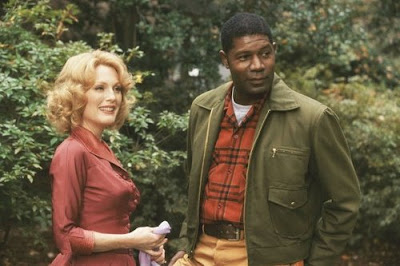
The film takes the form of a 1950s melodrama, but with a much more modern sensibility attached to it. Julianne Moore plays Cathy Whitaker, a housewife in Hartford, CT, where she maintains a perfect home and an equally perfect social life for her husband and their two children. She fancies herself quite the modern woman, sensitive to liberal concerns while also living the staid and conservative life of the fifties housewife who meets her husband at the door after work with drink in hand and who is constantly thinking of what the other ladies think of her and her family life.

One night she has to go downtown and bail her husband out of jail, for some kind of embarrassing thing that’s happened; like any good 50s housewife, she doesn’t inquire too deeply into the incident, trusting her husband’s word that it’s all a misunderstanding that will come to nothing. But a little later, we follow him on a night when he’s working late. He leaves his office and ends up going to a secret bar, one of those down-an-alley and through three doors kinds of bars; if we’re wondering what kind of bar needs to be secret in 1950s America, we quickly learn soon enough: a gay bar. Frank Whitaker is gay.

Soon enough she discovers this, and they embark on a series of psychological treatments designed to “cure” him of his homosexuality (remember, this is the 1950s); and meanwhile, Mrs. Whitaker begins to form a close friendship with the family’s gardener, Raymond Deagan, who is a tall, strapping, handsome black man (played by Dennis Haysbert). So the movie gives us not one character but two who become involved in impossible (for their time) romances. Sadly, while Mr. Whitaker’s homosexuality is allowed to remain secret, Mrs. Whitaker’s friendship for the gardener becomes common knowledge. And there’s no real escape for them, either; when the gardener takes Mrs. Whitaker to a local “black restaurant”, her reception there is about as friendly as his would be at a local “white” restaurant. Later, he bitterly comments that their relationship is the only thing and whites and blacks apparently have between them in total agreement.

Yes, this is a sad movie; there’s no way to sugarcoat that, and in many ways the film ends with no real note of resolution at all. But it’s a pretty noble movie, well-written and beautifully acted; there are moments where emotion is conveyed simply by the non-speaking actors in the way they look at one another. The film’s look is also excellent; designed to look like a fifties melodrama, the film’s color schemes are bold and bright, and even the opening credits are done in that style, with the titles displayed in very large letters that take up the entire screen and which fade into one another while the music swells. The film is awash in color, with many shots that linger; the gay bar, with its muted green lighting that makes it seem just a little otherworldly, for instance, or in the way Raymond Deagan’s clothes tend to match the color scheme of the Whitaker household, suggesting that he belongs where he really doesn’t. And that Elmer Bernstein score is truly beautiful, elegiac and tender.

Far From Heaven is an outstanding film.

Share This Post

Lurkers, lurk no more!!!

Steph alerts me that this is, roughly, National Delurking Week, when lurkers are supposed to go ahead and leave a comment. So, here it is! I know I’ve got a few lurkers, anyway, so go ahead and drop a comment, even if it’s just a “Hi from Chattanooga” or something like that. Or say something, or ask something, or whatever. The floor is yours! Let me know you’re out there, Lurkers!

(And I’d point out that I appreciate lurkers as much as “identified” readers. Those who come back time and again, even if not to say anything, are still reading my stuff, which is why I write it. So thanks for being here!)

Share This Post

The Balance in the Blood (part five)

Continuing a serialized novelette.

Parts One, Two, Three, and Four published previously.

If Death is the absence of Life, Gunther Schliemann wrote, and if Life is the absence of Death, then Vampirism is the absence of both.

Willem was so absorbed in the book that he missed the noontime meal completely. It was as if Uncle Gunther was speaking from beyond the grave – the turns of phrase and attitudes were unmistakable. But it was also as if there were another Uncle Gunther, some sort of doppelganger who moved in a world of graves and blood. He had spent years studying vampires, traveling from Amsterdam to Istanbul to Athens to Lisbon and back again following the trails of vampire folklore wherever they led. Gunther had not been content to merely study the legends themselves; he had been looking for the truths behind the tales. He had been seeking a real vampire. Uncle Gunther had been convinced that they existed. And how had he come to such a belief? At the University of Hamburg he had met Wolf Muething.

After completing their degrees the two friends had worked together, searching for vampires. Gunther wrote of many places where they had found that mysterious creatures had once existed, creatures which might have been vampires – but the trails were always cold, and a real vampire was never found. There was something terribly elusive about them, as if like the dimmest stars they vanished when looked upon directly. They searched towns in Poland and villages in the Carpathians. They journeyed to Transylvania and found no more evidence of real vampires than they had in any other place. Everything they learned, every lead they followed, every tale they traced was written in Gunther’s book: stories of the begetting of vampires, speculations on the nature of the secret vampiric society they believed to exist, hypotheses on the nature of vampirism itself – but no accounts of actual encounters. Those eluded them, and continued to elude them for years even as they lived off the money that Wolf Muething borrowed, cajoled and outright stole from his rich family.

It ended in part when Wolf Muething’s father died, and Wolf returned home to help his brother run the family. Gunther, though, continued the search on his own, earning money for his travels in exchange for medical treatments. He collected vast amounts of folklore relating to vampires, and as he studied them he began to discover parallels in all the accounts that led him to his own theories as to how they came to be. In one chilling passage he devised a simple experiment. It seems, he wrote, that the folklore leads to one conclusion: that vampirism begins by mixing the blood of a vampire with that of a person freshly dead. Would that I had the means to test this hypothesis.

Two years after Wolf Muething left the chase, Gunther found his most promising lead in a village near Salzburg. Here his prose became excited, even urgent: It must be nearing the end. How thrilling to at last approach the terminus of this great and awful road! And with those words, the book ended.

Willem turned the page and found only two blank flyleaves. He sat back, astounded, letting the book fall to his lap. There was nothing at all of the trip to Salzburg; had Gunther found what he had been looking for? Had he found the vampire? There were no answers. The questions filled Willem’s head as he headed out to dinner.

***

“You’re a faster reader than I,” Doktor Muething said as Willem entered the laboratory. “It took me two days to read that book. I often wonder who Gunther had print it. What must that person have thought?”

“He probably thought it was a novel,” Willem said as he came over to the table.

The Doktor raised his eyebrows. “Good Heavens, was that a joke?”

Willem only shrugged. “Another attempt?” he asked, pointing at the corpse.

“No,” the Doktor said as he used a scalpel to cut through chest tissue. “This man was fairly healthy when he was gassed. There are no shortages of opportunities to refresh my knowledge of anatomy here. Or yours, for that matter. Come closer, he’s dead and won’t bite. Rub some of that cream under your nose. It will help the smell.”

Willem took a dab of cream from a jar and rubbed it under his nose. The stuff smelled horrible and was very strong, but it did mask the scent of the corpse. He stepped closer and watched as the Doktor opened the man’s chest cavity.

“’Prick us, do we not bleed? Poison us, do we not die?’ What’s the last part – oh yes, ‘Wrong us, shall we not avenge?’” He chuckled. “If the Bard had only known what was to come. You look like you have a question for me, young Schliemann.”

He is always ahead of me, Willem thought. He asked his question. “How do you do it?”

“Do what?”

“How do you reconcile the oath that a Doktor takes with the fact that here we mete out death in huge quantities, and that we profit by it?”

“Science is not an adequate answer to that, is it?” The Doktor shook his head slowly. “The heart has reasons that are unknown to the mind,” he said as he turned back to the autopsy subject. “In this man’s case, we probably did the right thing for the wrong reasons. His lungs are a cesspool of cancer.”

Willem couldn’t help but notice that Doktor Muething had not answered the question and he could see that it would be useless to bring it up again, so he decided to ask something else that was bothering him. “Doktor, do you really believe the things in that book?”

“My, you do like to change the subject! That’s good. It shows an inquisitive mind.” Doktor Muething picked up the scalpel and began cutting more tissue. “Science is about considering the possibilities. Gunther was a scientist, purely and truly. Before he became a physician, that is. He had no choice in that, you know. The reason the book ends in Salzburg is that Gunther was there when he received a letter from home. That was March of 1931. Do you understand?”

Willem nodded. That was when his father had died, and he had gone to live with Uncle Gunther.

The Doktor began cutting the blood vessels around the dead man’s heart. “Gunther received an urgent letter the day after he arrived at Salzburg, and he knew that he had to return home at once. He wrote to me explaining what had happened, and that he could no longer carry out our work. It broke his heart, at first, to have been so close to unraveling the mystery, but the heart can be strong in ways no one can expect. In time he came to accept his new life. And, I might add, his new family – such as it was.”

Willem stepped forward and looked down into the man’s chest cavity as the Doktor extracted the heart.

“So,” the Doktor went on, “we forgot all about vampires – or rather, your uncle did. He put that part of his life behind him. Whenever I asked him about it after that, he would only recite that passage from the Bible – the one about giving up childish things.”

Willem nodded. That had been one of Uncle Gunther’s favorite passages.

“I, on the other hand, saw nothing childish about our former quest, so I continued on as best I could. I taught at the University and studied the human body. I was able to conduct certain experiments, plumbing the limits and nature of death. Physicians study every way in their power to stave off death, but none ever actually study death itself. It is a fascinating subject. I have learned much since these camps were built. Of course, I doubt that the Allies will take a very kindly view when they arrive.”

“Do you really think they will?”

“I am counting the days,” Doktor Muething said in a voice that made Willem shudder. And then the Doktor continued. “Gunther and I corresponded through the years. He wrote a great deal about his wonderfully gifted nephew who was bound to be a fine physician in his own right. He wrote about things he learned from the old and the weak, and he wrote about all the wonderful little villages where he went to heal the sick. Those letters were far less dark than the ones he had written to me before. All of them, that is, except one he sent to me about two years ago about a village called Ganenpunkt. Do you know this village?”

Willem remembered it all too well, and he paled at its mention. It had happened two years before, when Gunther had heard of a disease that was ravishing the tiny village of Ganenpunkt. Gunther had taken Willem up there to help. Upon their arrival they had found six other physicians from around the region grappling with the disease. Every living thing in the village, it seemed, was wasting away and there was nothing anyone could do to stop it. Willem remembered the gaunt and lethargic livestock in the fields, and the sick people in the homes. He had never seen a town so afflicted, and just remembering all those pale and sunken faces brought the feelings of dread back as if two years had never passed.

But then Willem remembered something else. One of the other physicians there had voiced dismay at Uncle Gunther for bringing a child – Willem – into the midst of such disease, but upon looking at the very first patient he examined Gunther had whispered to Willem: “This is no contagion.” It had not struck Willem at the time, but now….

“God in Heaven,” Willem said.

Doktor Muething nodded. “Gunther wrote me a letter all about that mysterious affliction.”

“He sent me home at once,” Willem said, “but he stayed behind to try and give treatment. He told me that he feared for my safety if I stayed. When he came back he told me that the illness had been dealt with, but he wouldn’t say anything more than that.” Willem shuddered when he recalled the expression that had been on Uncle Gunther’s face for days after that.

“There were vampires there – two of them, actually. While the other physicians worked with ineffectual medicines, Gunther went to the graveyards. It did not take him long to find them. They had been townsfolk who had died just a few weeks before, both having wasted away quickly and died, the same disease that was now afflicting the town. Gunther did what had to be done.”

“A stake through the heart?”

The Doktor shook his head as he examined the man’s liver. “There are a number of ways to do it; staking is merely one of them. It is also not entirely reliable, as some less-than-successful vampire hunters throughout history have discovered.” He chuckled. “You see, staking the heart – the theory goes – destroys the balance between life and death that exists in a vampire. And when that balance is tipped, death always wins.”

Willem pulled up a stool and sat down. “Why is staking dangerous?”

“Because it takes time for that battle – between life and death – to end. During that time, the vampire can still strike. That’s assuming, of course, that the intrepid hunter hits the heart on his first try. Woe to the hunter who misses the mark. Did you know that some vampires sleep with their eyes open?”

“Then how did Gunther do it?”

“The best way: he doused them in kerosene and set them on fire. Fire cleanses and consumes; and it is much faster than staking. Fire completely destroys the life-death balance.” Doktor Muething set the liver aside and probed at the man’s kidneys. “Incidentally, the life-death balance is also why vampires are warded by Crucifixes. Christ is, after all, the ultimate symbol of Life and Death. He transcends both, and nothing so earthly as ‘balance’ applies to Him.” He cleared his throat before continuing. “The vampires had been a minister and his maid. So many vampires were priests or clerics in life, which seems strange: how odd that holy people so often succumb to the unholiest of fates. After Gunther destroyed them he looked through the papers the minister had left behind. Approximately a month before there had been two visitors to the parish, a man and a woman from Spain. They arrived before sunrise, claiming to be refugees of some sort – hardly uncommon in those days, but still I wonder if that poor minister ever regretted not asking just what they were refugees from.” He smiled wryly, and then continued. “The visitors left three nights later, heading for Seville. It was then that the minister and his maid fell ill. They became vampires, and they proceeded to do as vampires do: they fed from their surroundings. Gunther was able to surmise all this from the minister’s journal. It was the breakthrough he had always sought, but circumstances being what they were”—he looked at Willem—“he wrote to me. Thus, two years ago at Gunther’s behest I went to Spain.” Doktor Muething slit the dead man’s stomach and looked inside. “We never feed these people before we gas them. Doesn’t that seem overly cruel?”

Willem leaned forward, completely ignoring the presence of the vivisected body. Only the Doktor’s narrative mattered. “You found them, didn’t you?”

“I did indeed, although it took a long time and a great deal of work, the telling of which I will spare you. The problem with vampire hunting is the drudgery of looking through cemeteries. I searched every damnable burial yard in Seville and found nothing. I despaired of finding these two until, purely by chance, I learned of a wealthy family whose scions were all buried on the family grounds. This was my answer, it had to be – and sure enough, I found them there. I broke into the tomb in broad daylight – a necessity with them, you realize – and after a moment to admire them as they slept with their eyes open, I destroyed them by staking.” He shrugged. “I didn’t miss, fortunately. But before I killed them I was able to collect some of their blood, one pint each.”

Willem’s eyes went wide. “Uncle Gunther wrote that vampires are made by mixing living blood with vampire blood.”

“Go on.”

“And you’re testing it by….by injecting these people with vampire blood. That’s what’s in those vials!”

Doktor Muething nodded as he pushed himself away from the surgical table. “I think I am done here for tonight,” he said. “I am tired.”

“When will our next attempt be?”

Our next attempt?” The Doktor smiled. “Tomorrow morning. Five o’clock.” He turned on the water to the sink and began scrubbing his hands.

Willem headed for the door.

“Young Schliemann?”

Willem stopped and looked again at the Doktor.

“What is right is many times concealed behind a veil of tears and blood,” Doktor Muething said. “Perhaps one day you will understand.”

Willem said good night to Doktor Muething and then left. As he walked across the street he heard the distant rumble of far-off thunder. It was the strangest thunder he had ever heard: the booms perfectly timed and identical. Only when he was almost asleep did he realize that the thunder was actually the rolling sound of exploding bombs.

Share This Post

Fixing the Prequels: Attack of the Clones (part three)

part one
part two

Wow, it’s been a while, hasn’t it? The hectic nature of the holiday season put this, and a couple of other ongoing blog projects, on hold, but now we’re into January and it’s time to get back to business.

Before I do, though, a reader wrote in regarding the Fixing the Prequels project:

Hello. Out of curiosity: The prequels ranked high on your Favorite Movies list, yet you’ve expended quite a bit of effort in making extensive changes. What gives?

I only ask this because The Phantom Menace and Revenge of the Sith are two of my favorite films, and if I were to rewrite them, it would feel like I’m waving a white flag to the bashers.

That’s a reasonable question. If I love the Prequel Trilogy (the PT) so much, why am I going to so much effort to examine their flaws? Well, it’s never been my contention that the Prequels are perfect. Far from it, actually; the PT is, as a rule, more problematic than the OT. I can’t really argue otherwise. But what I can argue – what I do argue – is that the PT’s flaws aren’t nearly as pronounced as most people think them to be, and that in fact the PT manages to rise above the flaws and tell a very compelling story. There is a lot in the PT that is not bad; in fact, there’s a lot in the PT that is downright good, and there’s a fair helping of stuff in the PT that is frankly great. This whole exercise is as much about addressing the real flaws as it’s about pointing out the numerous – and oft-ignored – strengths of the PT, and putting the flaws in a better context than “OMG, Jar Jar sucks and therefore everything George Lucas touches sucks and by extension the original films must have sucked as well except for the little bit of good stuff in them which is only there because Gary Kurtz was there to keep George from infecting everything with the LucasSuck Virus anyway.”

Look: there will always be people who can’t get beyond Jar Jar, or Anakin saying “Yippee!” or ever having been a kid in the first place (I suppose they’d rather that Darth Vader had popped into existence, fully adult and evil), but my feeling is that if you can see that Jar Jar really does undergo some character evolution, and that Anakin’s fall isn’t that unrealistic at all, then maybe you’ll see a lot of the better stuff in the PT that so often goes unnoticed.

Yes, there are many places in the PT where George Lucas makes some mistakes. Most of these are in the writing, but even so, it’s always seemed to me that the writing problems amount to fixing dialogue and explaining stuff and tying other things together. His story in the PT, the plot itself, seems to me pretty robust, which is another case I try to make.

On a more “meta” level, I’m reminded of something Leonard Bernstein once wrote – two things Leonard Bernstein wrote, actually. Both can be found in his wonderful book The Joy of Music. In one, Bernstein writes a dialogue between himself and a Broadway producer who can’t understand why Bernstein’s newest show (I’m guessing “On the Town”?) didn’t have a single hit in it. From this they go to discussing Gershwin, with Bernstein ripping apart the Rhapsody in Blue as being basically a series of jazz tunes dressed up in standard European orchestrations and tied together with cadenza-like passages and not a whole lot of real development of musical ideas. Bernstein’s interlocutor is stunned, saying, “But you love the Rhapsody! You’ve recorded it a bunch of times! How can you riddle something you love full of holes?” Lenny’s response is to note that what’s bad, structurally, about the Rhapsody in Blue doesn’t change the fact of the wonderful, wonderful tunes within it. What’s good in the Rhapsody is so good that it outweighs what’s wrong with it. (Earlier in the book, he makes a similar case regarding Beethoven, whose music has real, demonstrable flaws that don’t subtract from Beethoven’s stature as one of the towering figures of all human art.)

(This is paraphrased, obviously; Bernstein’s book can be read here, with the essay in which Gershwin comes up starting on page 52.)

Well, whether what’s good about the Prequel Trilogy is good enough to outweigh what isn’t good is open to debate. I think it is. The Pod Race, the battle with Darth Maul, the machinations of Senator Palpatine, and the meeting of Anakin and Padme are enough to make me forgive Jar Jar stepping in a pile of shit. And so on. This whole exercise is largely quixotic, but I am hoping that people who encounter it may look at the PT in maybe a little bit of new light.

Thanks to David for the question! And with that, let’s get back to Attack of the Clones.

We’ve just left our Jedi friends in Senator Amidala’s apartment as they make security preparations. We cut to a secret meeting between an assassin named Zam and a bounty hunter in armor that’s very familiar to Star Wars fans. Noting that they really need to get this job done, Jango Fett gives Zam a pair of presumably poisonous centipedes, which she then loads into a droid and sends on its way.

After that, in the script there’s a brief scene that didn’t make it into the movie. Back in the Jedi Temple, Yoda and Mace Windu have a brief discussion:

INTERIOR: JEDI TEMPLE, CORRIDOR – NIGHT

MACE WINDU and YODA walk down the long hallway, silhouetted by a lit room at the end.

MACE WINDU: Why couldn’t we see this attack on the Senator?

YODA: Masking the future, is this disturbance in the Force.

MACE WINDU: The prophecy is coming true, the Dark Side is growing.

YODA: And only those who have turned to the Dark Side can sense the possibilities of the future.

MACE WINDU: It’s been ten years, and the Sith still have yet to show themselves.

YODA: …Out there, they are. A certainty that is.

There is a long silence as they walk away. Only footsteps are heard.

I like this exchange, but its placement here seems odd, so I would not reinstate this scene here. Instead I’d convey this information later on, someplace else. More on that later.

Now we cut back to the Senator’s apartment, where she is sleeping while Obi Wan and Anakin maintain their watch. I’ve always enjoyed this part of the film, and I think the discussion of Anakin’s dreams of his mother would be better served if we’ve already seen one of those dreams, as I did in the last installment. They discuss the security arrangements, and they talk about Anakin’s dreams, which are deeply troubling him. This is the first spot, really, where the Jedi start to let Anakin down, isn’t it? Anakin’s suffering very vivid visions of his mother in terrible danger, and Obi Wan’s answer is basically “Well, just wait it out.” Throughout the PT, the Jedi have the incredibly bad habit of taking the wrong things seriously, turning left when they should be turning right, and paying rapt attention to what the right hand is doing at the expense of paying any heed at all to the left.

Obi Wan’s distrust of “politicians” is also interesting, in light of his later insistence (at the end of RotS) that his allegiances are to democracy and the Republic. The Jedi don’t seem to be terribly thoughtful agents of governance, which is another factor in their extremely quick downfall when it happens. Obi Wan cites Padme’s status as a politician as a reason why Anakin should not be attracted to her, which is fairly odd; one would think that Padme, at least, would have earned his respect during the Naboo affair. Thus, a bit of change is called for in the dialogue:

ANAKIN and OBI-WAN continue their conversation, moving out onto the apartment’s balcony.

OBI-WAN: You look tired.

ANAKIN: I don’t sleep well anymore.

OBI-WAN: Because of your mother?

ANAKIN: I don’t know why I keep dreaming about her now. I haven’t seen her since I was little.

OBI-WAN: Dreams pass in time.

ANAKIN: I’d rather dream of Padmé. Just being around her again is… intoxicating.

OBI-WAN: Be mindful of your thoughts, Anakin, they betray you. You’ve made a commitment to the Jedi Order… a commitment not easily broken… and don’t forget she’s a politician. They’re not to be trusted.

ANAKIN: How can you say that Padme is not to be trusted? After what happened ten years ago…you knew her then!

OBI WAN: I know. But that was ten years ago, and she’s spent the time since she was Queen in the Senate, which is something completely different. That kind of power can change a person.

ANAKIN: And you think she’s changed? Become power-hungry?

OBI WAN: It is something to fear with anyone in the Senate.

Something like that, I think.

You really have to wonder sometimes about the Jedi and love. The whole concept seems so alien to a lot of them, as though love is driven out of them at an early age in some way. This is never discussed at all in the PT, and I have no idea if the subject comes up in any “Extended Universe” books or materials, but once again I note the parallels (which George Lucas may not realize or have intended) between the Jedi and the Knights Templar, that famed band of monastic knights during the Crusades who were, among other things, sworn to celibacy. Anyhow, nobody other than Obi Wan has the slightest idea that Anakin harbors strong feelings of attraction toward Padme, and Obi Wan has no idea how to deal with those feelings at all. (He doesn’t do a whole lot better later on, when it’s Luke agonizing over whether to help Han and Leia. His, and Yoda’s, advice then remains the same: forsake them and follow the Jedi way. Maybe Luke Skywalker’s greatest triumph isn’t his making possible the redemption of Darth Vader; maybe it’s to demonstrate that love and being a Jedi aren’t mutually exclusive things?)

Back to AotC, though. I’ve always liked the way Lucas set up the entire “second assassination attempt” bit, with the probe droid cutting the window open, and Padme sleeping, and R2-D2 sweeping his eye around the room and not seeing anything while the two centipedes hide in the shadows. This whole sequence is really well done. (Odd, you know, since Lucas is such a hack director. I’m rolling my eyes, here.)

So the Jedi sense something amiss and burst in, where Anakin bisects the centipedes with his lightsaber (some very nice precision work with the blade there, too; an inch the other way and he slices Padme’s head open!), and Obi Wan leaps out the window to grab onto the probe droid. Next Anakin goes upstairs, grabs a speeder, and gives chase.

(Some hilarious bloopers from this sequence can be seen as an Easter Egg on the DVD. Hayden Christensen did a lot of wiping out when running across the sets; in one, he’s running out of Padme’s bedroom when he wipes out, leaving Natalie Portman and the other extras there laughing. There’s also a funny bit of Christensen getting too enthusiastic about “piloting” the speeder, pulling the control arm off the dashboard, and a terrific one of Ewan McGregor “piloting” the speeder and then shifting into a bit of “funky rhythm”. Anyway….)

Now, really, the entire Coruscant sky chase is, in my opinion, one terrific action sequence. Only a few problems exist here, for me. As usual, much of it is dialogue related. In the first place, this is where it becomes clear that Obi Wan addresses Anakin with some variant of “My young apprentice” or “My young Padawan” way too often, making a lot of the lines cumbersome. I’d eliminate a lot of that. And then there’s this exchange, which comes right after Anakin pilots his speeder so that a free-falling Obi Wan can land safely inside:

OBI-WAN: What took you so long?

ANAKIN: Oh, you know, Master, I couldn’t find a speeder I really liked, with an open cockpit… and with the right speed capabilities… and then you know I had to get a really gonzo color…

[This last bit about the color isn’t heard in the movie.]

They zoom upward in hot pursuit of ZAM as she fires out the open window at them with her laser pistol.

OBI-WAN: If you’d spend as much time working on your saber skills as you do on your wit, young Padawan, you would rival Master Yoda as a swordsman.

ANAKIN: I thought I already did.

OBI-WAN: Only in your mind, my very young apprentice. Careful!! Hey, easy!!

OK. If we’re going to have Anakin say something smart-assed, can’t we have him say something actually smart-assed? “I just wanted a speeder with the right speed capabilities”? Ugh, what a bad line. What would I do? Well, maybe something like:

OBI WAN: What took you so long?

ANAKIN: Well, Master, I decided to take into account everything you’ve ever said about my “impulse control” and not jump out the eight-hundredth floor window.

OBI WAN: The Living Force guided me to do that.

ANAKIN: And, thanks to me and this speeder, you’re still living. Which way did the assassin go?

OBI WAN: That way.

He points in a direction that is particularly heavy with sky traffic.

ANAKIN: Oh, good! I haven’t done this in a long time.

He steers the speeder straight into oncoming traffic, causing much consternation and uproar among the other pilots and generally wreaking havoc. Soon he is gaining on ZAM. Meanwhile, Obi Wan is hanging on for dear life.

OBI WAN: And there’s a reason you were punished severely the last time you did this!

ANAKIN: That was for fun, Master. This is Jedi business. Don’t worry, the Living Force is guiding me now.

I think that Lucas was going for banter between Obi Wan and Anakin, but a lot of the time it comes off as Obi Wan being the stick-in-the-mud teacher type. Now, that’s actually called for some of the time, but I think the tone trends too heavily in that direction.

Anyway, I’ve always liked the Coruscant skyline chase a lot, and there’s really not a whole lot I’d change, except perhaps for the exchange when it seems that Zam has given the Jedi the slip:

OBI-WAN: Well, you lost him.

ANAKIN: I’m deeply sorry, Master.

ANAKIN looks around front and back. He spots something. He seems to start counting to himself as he watches something below approach.

OBI-WAN: Well, this is some kind of shortcut. He went completely the other way!

ANAKIN: …Excuse me for a moment.

ANAKIN jumps out of the speeder. OBI-WAN looks down and sees Zam’s speeder about five stories below them cruising past.

OBI-WAN: I hate it when he does that.

ANAKIN miraculously lands on top of the Bounty Hunter’s speeder. The speeder wobbles under the impact. ZAM looks up and realizes what has happened.

That little exchange doesn’t quite work, because Obi Wan is reduced to being a terrible grump here. I’d replace it thusly:

Anakin brings the speeder to a sudden halt, hovering in midair in the midst of a bunch of buildings.

OBI WAN: We’re stopping? Did you lose him?

ANAKIN: Well–

OBI WAN: Did he go the other way?

ANAKIN: I don’t know yet.

OBI WAN: Well, why are we hovering here, then?

ANAKIN: I’m about to follow your example, Master.

OBI WAN: What?

Anakin grins at Obi Wan and then jumps out of the speeder, plummeting downward through the cityscape to end up landing directly on top of Zam’s speeder.

OBI WAN: I hate it when he does that.

Obi Wan takes the controls and continues the pursuit. Meanwhile, Anakin is pulling himself onto the top of Zam’s speeder.

The rest of the chase I’d leave as-is, all the way to the bar. One little moment I like is Anakin losing his lightsaber and Obi Wan snatching it out of the air, and the way that Obi Wan gives Anakin the mini-lecture about taking care of his lightsaber. (This, alert readers may recall, actually mirrors a scene from the original script of TPM, which I would have restored to that movie.) There’s the nice line of Obi Wan’s, “Why do I get the feeling you’re going to be the death of me?” After that line, there’s another exchange in which Anakin protests that Obi Wan is like a father to him; I’d actually cut that exchange, leaving Obi Wan’s line as it is. One problem I’ve noticed about George Lucas’s dialog writing is that it’s not so much that he writes bad dialog, but that he tends to overwrite his dialog, so perfectly good lines that would stand out as good lines get obscured because he adds more than he needs to.

(One common objection that always bugs me is the whole “People don’t talk like this” objection. Ummm…so what? Nobody talks in iambic pentameter, either, but that doesn’t render Shakespeare useless. And no, I’m not comparing Lucas to Shakespeare. I’m just saying that the actor’s job is to make it sound like that’s the way his or her character would talk. Nobody talks the way the people talk in The Lord of the Rings, either, but nobody complains there, because the illusion is better created of a world where people do talk like that. I’ve never had the fundamental objection to George Lucas’s dialog that many have, though. Even if a lot of it could withstand some fine-tuning.)

OK, now Obi Wan and Anakin are in the bar, looking for an assassin who is a changeling. I love the exchange that comes now:

ANAKIN: I think he’s a she… and I think she’s a changeling.

OBI-WAN: In that case be extra careful… (nods to the room) Go and find her.

OBI-WAN goes away.

ANAKIN: Where are you going, Master?

OBI-WAN: For a drink.

There’s something mischievous in Obi Wan’s eye as he goes off for his drink; it’s almost like he is sending Anakin to do the dirty work, but instead, he knows that the assassin will likely try to take him out first, since he’d just be standing there, nursing a drink. And that’s exactly what happens.

(Oh, the drug pusher that Obi Wan convinces Forcefully to “go home and rethink his life”? That’s one of my favorite bits in any one of the Star Wars movies. At the midnight screening on opening night, that bit got a huge laugh. Of course, it also had its detractors; I remember reading somewhere online someone whining that this was George Lucas taking a shot at cigarette smokers. Jeebus. The lengths to which some people will go to take offense at a Star Wars movie amaze me sometimes.)

So, while Obi Wan’s having his drink, Anakin is walking through the crowd, looking for the assassin who is in turn stalking Obi Wan. The way Lucas shot this sequence is terrific, especially the Anakin-POV shots of the bar crowd looking at the young Jedi approaching them and moving out of his way. It’s all right out of a Western, isn’t it? What’s really nice here is the way we get a real, solid glimpse into life in the Star Wars universe for people who aren’t involved in any kind of war, star war or otherwise. Plus, the whole sequence is full of little visual touches for the fans: one of the big-screen teevees in the bar is showing a pod race; the signage out front has a scrolling marquee of alien faces, one of whom is the triangular-headed guy from the cantina in ANH. And speaking of that cantina, there’s nice synchronicity in Obi Wan whipping out his lightsaber and chopping off the right arm of a blaster-wielding assailant in a bar, here in AOTC, which is something he’ll do again twenty-plus years later with his partner’s son at his side.

Great moment: the swagger in Anakin as he says to the bar patrons, “Jedi business. Go back to your drinks.” I do wish there’d been a bit of crowd reaction here; one area that the PT always seems to ignore is the public opinion regarding the Jedi. Are they beloved? Are they a shadowy group no one knows much about? How seriously are they taken? They can’t be held in too high a regard, since Palpatine manages to get the entire Galaxy behind the Jedi purge in RotS.

Now Obi Wan and Anakin drag the assassin into the alleyway for a bit of interrogation. There’s not much to be said about this scene, except that wow, Jango Fett sure managed to stake himself out on the perfect ledge overlooking this action, didn’t he? I don’t know, this doesn’t bother me much, but it could have been made a bit better perhaps by having a couple of shots throughout the chase of Jango following their progress, and maybe him coming to light upon the ledge as Obi Wan and Anakin come outside. As for the dialogue in this scene itself, I’d only make a small change. The assassin starts to confess after Anakin basically says “Tell us. Tell us now!” It seems a bit quick for her to confess, so I’d make a small change here:

ANAKIN: Who hired you? Tell us.

Zam only looks at him. Suddenly Anakin’s eye’s flash with anger and he snaps his wrist forward, grabbing firm hold on Zam’s neck in a strangle-hold.

ANAKIN: Tell us now!

OBI WAN: Anakin….

ZAM: It was a bounty hunter named agghhhhh….

A hissing sound heralds the arrival of a toxic dart in Zam’s neck. Zam dies without saying another word. Obi Wan carefully pulls the dart from Zam’s neck.

OBI WAN: Toxic dart, but how–

They hear the firing of thrusters and look up to see an armored man flying away from a ledge above them via a rocket-pack.

ANAKIN: We’re no closer to knowing who’s after Padme.

He gets up angrily and starts to walk up the alley, but Obi Wan stares at the dart.

OBI WAN: We know more than we did….

One final point here, before I wrap up this installment. One frequently-lauded aspect of the OT was the way everything looked lived-in and used; it wasn’t a sterile SFnal environment but instead looked like a real place where people lived and worked and got dirt under their fingernails and all that kind of stuff. The PT, however, made things look a lot shinier and nicer; at least, so went the complaint. I’m not convinced that’s totally true, but the environments in the PT do tend to shine more than their OT counterparts, at least for the most part. Tatooine is still a grungy place, of course. But Coruscant always seems so clean, right?

Except for this alleyway outside the bar where not many people go. Here, there’s a lot of garbage piled in the corners and the edges of the building; this suggests to me that the ultra-clean environment of Coruscant is something of a misnomer. Things are cleaner than they’re going to be in years to come, but they’re starting to slide a bit. I like that.

And on that note, we’ll wrap it up for this time. Next time we follow Inspector Obi Wan Kenobi as he goes off to do some detecting work, while Anakin plays bodyguard to the Senator. Excelsior!

Share This Post

Sentential Links #153

AND we’re back with Sentential Links, after a couple of weeks off. Let’s get to linkin’, shall we?

:: I will predict generally that 2009 will bring Buffalo and WNY more of the same. We will continue to be nostalgic for the good old days – whether they be the 1950s, 1970s, or 1890s – and we will ever forget to discuss and act on ideas that would bring about a better future for this region. We will continue to bitch & moan about the symptoms of a shrinking, economically weak region and forget completely to address the underlying disease. (Wow…I remember Optimistic Alan, back in Aught Five…them’s were the days!)

:: He smiled and shook his head. I got into the passing lane and hit the gas. Both of us knowing, there’s no time to lose. (This is my favorite kind of blog post.)

:: It wouldn’t be a New Year if I didn’t have some drama where my baby is concerned. I’m referring to my Tercel, naturally.

:: And that’s what I learned before I knew I had learned it from watching the Three Stooges. (Hmmmm. Aside from the pie fights, I’ve never much been a fan of the Stooges.)

:: This whole commute thing is wearing me out. But such is life when you live out in the middle of no where.

:: Better that I would have lost on the mental battleground, because then I would have either a new friend gained by an apology or the seed of vengeance planted in my heart and all the fire that grew from it. Instead I’ve got a dull feeling at the bottom of my stomach. (Ragnell misses her trolls. I rarely get trolls; I had one a few weeks ago who told me my posts are “jejune” before (s)he signed off anonymously. I then deleted the comment. That’s about it, in the last year. I need to work harder.)

:: In the same vein, I have also finally figured out what’s so very RIGHT with the Electoral College. People say, correctly, that it’s undemocratic. EXACTLY! It wasn’t designed to be democratic, it was meant to be definitive. (Interesting take. I still hate the Electoral College.)

:: I was surprised to discover that she lived for less than a month. She never crawled, never played, never even smiled. It also struck me at that moment how these little ones who live only a short time continue to be an important part of the lives of their families. (And yet, that’s how it is, isn’t it?)

All for this week. Back next week!

Share This Post

Twenty years

I’ve just realized that 2009 represents the twentieth anniversary of my graduation from high school, and my entrance into college. It was in 1989 that I formed dual obsessions with Richard Bach and Sergei Rachmaninov; it was in 1989 that I went on my first date (I must have not been a very good time, since my two or three subsequent attempts for a follow-up were met with the all-purpose excuse, “Uh, I’m busy that night”); it was in 1989 that I got my first paying job (in the library at St. Bonaventure University). But none of that is what interests me at this moment. I was thinking the other day about Christmas presents I got as a kid, up to the end of high school, and I remembered the big gift from my senior year, Christmas 1988: my first CD player.

It was a boom-box affair, made by Sharp Electronics. It had a dual tape deck, too, and that got a lot of mileage over the next few years as my main musical medium at that time was still the cassette. I did have quite a bit of classical and film music on vinyl, but I would almost always use my parents’ big stereo system to tape the records so I wouldn’t have to play them very often. Even though I fell in love with the compact disc, it would take a number of years for the CD to take over the prime place in my music collection, much less become the only thing in my music collection. (A process which has now reached an end in itself, but more on that later.)

I’ve never been much of an audiophile, although there are some things I do admit. I’ve owned the scores to the Star Wars movies on all of the major formats, and never have the cassettes, CDs, or MP3’s sounded as good as the vinyl records I played to death as a kid. And when I say I played those records to death, I mean, I played them to death. By the time I finally stopped playing them, the characteristic pops and scratches anyone who’s ever been around vinyl for long will remember were so engrained in my brain, in certain places, that to this very day if I listen to those scores on flawless MP3, my mind still fills in the worn-vinyl pops. I also admit that Super Audio CDs do sound better than the standard article, but they’re not so great an improvement that I feel it necessary to invest in them. For the life of me, I think in most cases MP3’s sound just fine, if it’s a good bitrate (at least 192 kbps). The greatest moment of audiophilic revelation in my life came the first time I put a CD in the new CD player and heard a work of music I knew very well…but without any tape hiss.

Anyone who remembers cassettes will remember tape hiss. You’d stick a cassette in the deck, hit play, and the room would fill with this white-noise hissing sound that never, ever went away. Over time you learned to filter it out of your perception of the music, although occasionally you’d get a recording that was made on a cheap cassette and the hiss would be significantly worse. I learned, as did lots of the other music-heads in my age-group, that one could tell how bad the tape hiss would be simply by looking at the tape itself. If the tape was dark brown, dark gray, or even black, you knew you had a quality cassette and the hiss would therefore be less bad. If, on the other hand, the tape was light brown, the color of coffee once you’ve added a lot of creamer, or worse, if the tape actually matched your khaki pants, you knew that the hiss was going to be bad. And lo, it was. But that was how it went, back then: if you wanted your music portable, you had to learn to live with a constant Sssssssssss in the background.

Until the CD came along, and hiss went away.

When my parents bought the CD player for me – it was a preordained gift that I knew was coming, although they did surprise me by getting the fancier, higher quality system than the one I thought they were getting – they also bought the first two discs, since obviously it would have been lame to have a new CD player with nothing to play on it. They had let me pick the discs, and I still own them. Here they are:

In fact, as I write this, I am listening to that very recording of Eine Alpensinfonie. If you’re unfamiliar with this work, it starts off very quietly, with a slow, mysterious figure that descends down the minor scale in the lower strings and winds. I remember putting that disc in the player, pressing play, seeing the disc through the little window start whirling around, and I remember thinking, “When does the music start?” My brain was still expecting to hear tape-hiss preceding the actual music! Instead, I heard nothing at all, until the orchestra started in those opening bars. I couldn’t believe how the thing sounded…and then, a few minutes in when the entire orchestra blazes forth with the motif for Sunrise Over The Mountain (the piece is a musical telling of a day’s climb up, and back down, a single Alp), I thought the paint was going to come off our walls. (Or might have, if we’d had paint back then. We had really ugly faux-wood paneling that my parents would have ripped out a few years later.) The disc still sounds fine. I guess I’ve stored it well over the years.

So, that’s where it began for me, my love affair with the compact disc. There were some odd things about CDs in those early days, weren’t there? Take that Alpensinfonie disc, for instance. That work is roughly fifty minutes long and is comprised of twenty-two distinct sections, even though all are played without break. Every CD I’ve ever seen of the Alpensinfonie, and I own three myself, has separate tracks for each section of the work, except this, my first one. Here, the entire work is in a single track. One CD, one fifty-minute long track.

I also recall CD packaging back in those early days, when they came in these long packages. Some were cardboard, others clamshell plastic, but the CD would be in the jewel box at the bottom, and the booklet would be at the top, outside the jewel box. So you’d have to cut open the plastic package, hoping not to damage the booklet in the process. Also, some music stores were routinely dark places with lots of floodlights illuminating the merchandise from track fixtures above the racks. This was OK when you were thumbing through vinyl record sleeves, but when you’d pull a CD in the plastic clamshell thing out to look at it, and the disc itself would be visible because the booklet wasn’t in the jewel box already, if you got the angle wrong, you’d blind yourself with the reflection of the floodlight off the surface of the disc itself. And I remember how multi-disc sets for some reason always stuck a square of yellow foam in the cases, between the discs. That was ridiculous, and I think I recall reading somewhere that it turned out that those squares of yellow foam weren’t good for the surfaces of the discs themselves, so I threw the foam out of all my opera recordings.

The music department at my college had an already-impressive collection of CDs when I got there, but you weren’t allowed to take them back to the dorm room, because they were afraid that students would just take them home and tape the music off the discs. Well, I’d say that’s not much of an issue now, is it?

Twenty years later, I don’t buy nearly as many CDs as I used to. I’ve reached a certain saturation point, in terms of music; I already own more music than I have reasonable time to listen to. Plus, the CD is still, in general, too expensive, a fact that record companies still seem to refuse to acknowledge. Just last week I was in a Barnes&Noble, looking through the classical music section, and there was, for example, the umpteenth-reissue of Charles Munch conducting the Boston Symphony in Berlioz’s Symphonie fantastique, and it was the full eighteen bucks. That’s ridiculous. The budget Naxos label seems to have gone up a few bucks in the last few years, too; when I first discovered Naxos their typical CD was eight bucks, and now it’s ten. Still not bad, but eight’s less than ten. (It doesn’t help that at some point, Borders and B&N both stopped the once-helpful, but possibly not retail-wise, practice of keeping all of the Naxos discs separate from the other labels.) This isn’t unlike the longtime problem I’ve had with publishers of graphic novels: how much spontaneous exploration of their offerings can those companies expect of people when a single graphic novel is almost always more than twenty bucks?

I’ve also reached the point where CD storage is a big issue. My collection doesn’t take up the most room in the world, but The Wife and I have lately reached the conclusion that our apartment is filled with too much stuff, leaving not enough space. To that end, I intend to gradually replace every CD jewel box in my collection (to a point) with these sleeves. Doing so should allow me to get rid of at least two pieces of cruddy furniture that I use to store the bloody things now.

Do I download music? I do, although not a whole lot yet. I know this will change in the future as downloading becomes more and more prevalent. I’m not wild about my music collection owing its existence to the vagaries of a hard drive’s functionality – there’s no way my current hard drives will still be going strong in twenty years, unlike Maestro Karajan’s old disc of Eine Alpensinfonie – but that’s just the way it’s going to be, so I’ll have to do lots of backing up, I suppose.

But anyway, it’s been a good two decades with the shiny silver discs. They’ve brought me immense pleasure over the years, and I see no reason to let them stop. Viva la CD!

Share This Post

Sunday Burst of Weirdness

Weird…weird…very weird….

:: I saw this linked on a lot of highly-trafficked blogs, so my linking it probably won’t make much difference at all, but here’s the theme from Shaft, played by…the Ukulele Orchestra of Great Britain.

(Thanks to the movie In the Line of Fire, the Clint Eastwood thriller, I’ll never misspell “ukulele” again. Believe it or not, the spelling of “ukulele” actually plays into a significant plot-point in that movie.)

:: Bacon zombie. (via)

:: OK, I’ve committed the act of fanfic in the past, but not in a long time, and…well, here’s some Star Trek fanfic. I clicked on a single story and read about five paragraphs in; in that space one character sat on a whoopee cushion and the author used it’s as a possessive. Then I was done.

That’s about all for this week.

Share This Post

Unidentified Earth #53

OK! After my most recent round of hints, I think we’ve finally pegged UIs 49 and 50. Number 49 is the FAA Credit Union on Aviation Boulevard in Los Angeles, near LAX. A credit union, you ask? As an Unidentified Earth location? What gives? Well, this building also serves as the exterior for the Miami-Dade Crime Lab on CSI: Miami. When you watch that show and David Caruso is standing outside this cool-looking building with the curving exterior, putting on his sunglasses, he’s actually standing in California, outside a credit union.

Installment 50 is the Lego statue of the Loch Ness Monster (visible here) at Disney World.

Oddly, there are no correct guesses as of yet for UI 52, which surprises me; I thought that one would go quickly. I wasn’t really trying to make it hard. Studying the nature of the image should reveal the nature of the thing pictured there, if that helps…think shape.

And finally, time for what is probably another easy one, I hope. I’ll try to mix the hard ones with the easy ones better in the future.

Where are we? Rot-13 your guesses, please!

Share This Post

Ringin’ it in with a Quiz

I’m feeling the need to post something, and before we venture out for a fun-filled day of Gift Card Redemption, here’s a little years-end wrap-up quiz I found at Incurable Insomniac (who still owes me an interview, by the way!):

Best Party: Errr…didn’t go to any parties.
Worst Party: Ditto. No good parties, but no bad parties, either. Maybe some kind of Buffalo blog get-together might be in the offing in 2008, but I dunno…they only seem to have Twitter get-togethers these days, and I don’t do Twitter. (Seriously, if all you spare for me is time to read 140 characters, then sorry; I can’t even say hello in 140 characters. I’m like an Ent: I don’t say anything unless it’s worth taking a long time to say.) There’s usually a get-together of sorts to watch the State of the Union address, but that’s just not my speed.

Best Dinner: Probably the fish fry dinners we had every Friday during Lent; we’d get takeout and then sit on home and watch one disc of Lord of the Rings. It worked out perfectly, as the Extended Editions are spread across six discs.
Worst Dinner: I don’t recall any bad dinners this year. Even at my worst, when time was short and I was trying to get through a jam-packed night and could only find time to wolf down a PB&J, it was OK.

Best News: There’s a new President coming to town.
Worst News: Rejection slips. All you editors who keep refusing to buy my stuff are going to look pretty stupid, some day. You’ll see! (First I’ll learn to write better stories, though. That might help the cause.)

Best Reaction: The Jig of Ultimate Joy I did in my living room when Plaxico Burress caught the go-ahead, and game-winning, touchdown in the Super Bowl, which was repeated a few minutes later when the Giants took the ball over on downs, icing the game.
Worst Reaction: Probably a series of coarse words, uttered in a back room at work.

Best Creative Endeavor: The short stories I managed to write. Only a handful, but I like them. (And the screenplay that will never see the light of day; I enjoyed working in the format again.)
Worst Creative Endeavor: The list-as-long-as-my-arm of unfinished projects.

Best Blog Entry: Can’t pick just one. Here’s the master list.
Worst Blog Entry: Ummmm…you know what? You pick it.

Best Casual Get-Together: Didn’t do much of those, either. I must have been freakishly antisocial in 2008, even by my standards.
Worst Casual Get-Together: See above….

Best Physical Feat: Reducing my weight, waist size, and so on.
Worst Physical Feat: Stubbing three toes at once. Ugh, that hurt.

Best Neighbors: Oddly, we actually lost neighbors this year. Two moved out. I hope it wasn’t us.
Worst Neighbors: CANADA!!! (Just kidding. I love Canada. We don’t have neighbor problems, actually.)

Best Web Feat: Blogging.
Worst Web Feat: Blogging.

Best Moment of Pride: Didn’t have one.
Worst Moment of Embarrassment: Nothing that’s getting written about here.

Best Moment of National Pride: Obama won.
Worst Moment of National Embarrassment: John McCain’s elevation of Sarah Palin, a person so unserious as to make Dan Quayle look like Henry Kissinger by comparison, to the national stage.

Best Laugh: The night the invented champagne….
Worst Cry: See “Worst Moment of Embarrassment”, above.

Best Picture: Any of the ones on Flickr that don’t have me in them, I guess.
Worst Picture: Any of the ones on Flickr that do have me in them, I guess.

That’s it.

Share This Post