
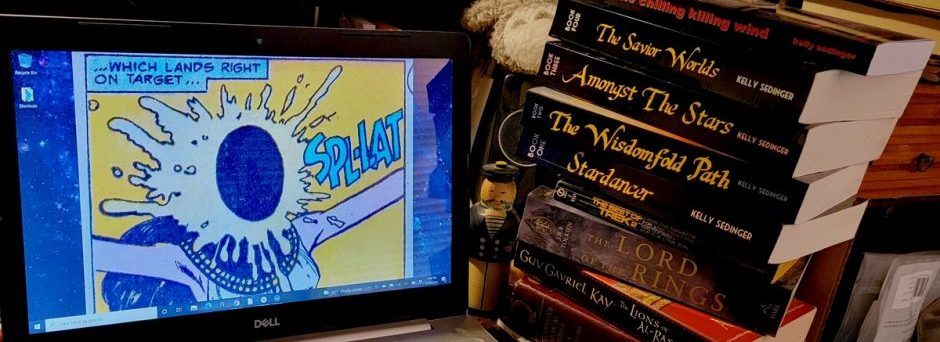
So, how hot is it where you are? And how do you cope? Are you a fan of heat, or is heat something you endure because you like most other aspects of where you live?
Blasters and spaceships, oh my!
I don’t know what it is, but for some reason, in the warmer months my reading tastes gravitate strongly toward science fiction (and the occasional horror book). I associate fantasy with the cooler months. Why this is, I’ve never really figured out; I’ve read many a fantasy novel set in warm locales, so it’s not as if the cooling weather puts me in mind of the snowy journeys through the Misty Mountains in The Lord of the Rings. This isn’t to say that I won’t read any fantasy at all during the warm periods, but…well, summer is when I want lots of exploding spaceships.
So, here’s the skinny on three space opera books I’ve read of late!
:: The first was, technically, a re-read of The Warrior’s Apprentice by Lois McMaster Bujold. This is the first novel in the ongoing saga of Miles Vorkosigan, one of the most famous characters in contemporary SF. I read this book before, several years ago, and I enjoyed it, but for one reason or another I never continued with the Vorkosigan series. No real reason why, really; I just never got around to it until I’d reached a point where I figured that if I was going to continue with the series, I should just start over.
The Warrior’s Apprentice starts with Miles Vorkosigan undergoing the final physical trial he needs to complete before he can enter the military service of Barrayar, his homeworld. Barrayar places supreme importance on its military, but getting in will be difficult for Miles, because he is physically disabled. He is barely five feet tall, and his bones are extremely brittle and prone to breaking. Sure enough, he breaks both his legs in the first minutes of the trial, and Miles is forced to take on the life of a mercenary.
He actually isn’t really forced into that life, per se, so much as he just kind of steps into one situation after another that causes a mercenary crew to just naturally gravitate toward him. It’s a fascinating thing that Bujold does here: she depicts a character with enormous personal magnetism who uses it to his advantage without ever really seeming totally aware of it.
The Miles Vorkosigan tales aren’t “sensawunda” space operas; they’re as character-driven as just about any story can be. I look forward to reading more of them.
:: Starpilot’s Grave, by Debra Doyle and James MacDonald, is the second book in their “Mageworlds” series. The adventures of Beka Rosselin-Metadi continue, along with her various friends from the first book, The Price of the Stars. The earlier book established a galaxy that is post-war, a war against a group of villains hailing from ‘the Mageworlds’. Here, Doyle and MacDonald set up the resumption of those hostilities, and by the end of the book, war has broken out again, with our heroine, Beka Rosselin-Metadi, assuming a leadership rule. Not a whole lot that happens in this book is a surprise, as it is clearly setting up the third act in the trilogy. It’s all somewhat Star Wars-like, in general feel, and it’s a fun read that isn’t terribly demanding. My main complaint, as with Price of the Stars, is that there is still little explanation as to who the Mages actually are or why they are to be feared. I hope this is explained more in the final volume.
:: Finally, John Scalzi’s The Last Colony was the third and final book in his Old Man’s War trilogy, until he went and added a fourth book, making it not a trilogy anymore. Oh well. As with the first two books, this is a fast-paced and involving read that suggests a whole bunch of nifty Sfnal questions without slowing the pace enough to delve into answers. We rejoin our heroes from the first novel, John Perry and his wife Jane Sagan, who have adopted a girl named Zoe from the second book. They are asked by the Colonial government to head up a secret colony whose location is to be kept secret…because, it turns out, an alliance of aliens is systematically destroying colonies they deem to be “unauthorized”. Lots of hilarity ensues: resistance against the aliens, coupled with the fact that they can no longer rely on their own government to be honest with them or give them aid.
Some of my key questions about this whole universe, dating back to Old Man’s War, are finally explained, which is nice, and Scalzi gets a pot boiling quite nicely, creating a definite sense of tension as he depicts on the one hand an alien force that seems well nigh unstoppable and on the other depicts a group of colonists struggling to find an answer to a problem that is seemingly unsolvable. My main issue with the book lies with the nature of the final solution itself; in all honesty, it kind of seems to come out of left field and only barely manages to avoid feeling like an outright deus ex machina. But it’s my understanding that some of this background is explained in a fourth book in the series, which focuses on the Perrys’ daughter, Zoe.
More space opera to come!
Share This Post
Ask Me Anything! August 2011 edition
It’s that time again — Ask Me Anything! This used to be a February-only thing, but seeing as how it seems silly to only do it once a year, we now do it twice a year. Or something like that. Anyhow, all queries are welcome — serious queries, unserious queries, queries about any topic at all.
Leave queries in comments herein, or e-mail them, or get ’em to me via Facebook, Twitter, Tumblr, or Google+. I’m everywhere, I am. It’s like all the people who are normally around you are me! (I got that from an old SNL sketch in which Phil Hartman plays a drill sergeant.)
Anyway, the floor is yours, folks: Ask Me Anything!
UPDATE: There is no limit on the number of questions allowed. If you have eleven things you want to ask, go ahead and ask all eleven!
Share This Post
Sentential Links #254
Linkage (concentrating this week on blogs I haven’t perused in a while):
:: Planking squirrels. What will they think of next?
:: Philadelphia is the worst place for genealogy I have ever seen.
:: Gee, I wonder why tech blogs are still, even in 2011, regarded as cesspools?
:: What we know of the Ninth’s Finale suggests that Bruckner was planning no simple, triumphal answers to such questions. Faith would have won out in the end, but not without an enormous struggle, bordering on madness. At the end of his life, Bruckner was seen reciting the Lord’s Prayer at the top of his voice, repeating each line for emphasis. He is also said to have suggested that if he did not live to finish the Ninth then God would have only Himself to blame. (I sometimes think I don’t listen to enough Bruckner…and then I listen to some Bruckner. Imagine a meal of French toast made with extremely thick slices of pumpernickel bread, with no syrup. That’s Bruckner.)
More next week!