Answers the First: Jerry Goldsmith!

OK, it’s time to start answering the queries from the most recent iteration of Ask Me Anything! (Speaking of which, I’m not closing out for queries yet, so feel free to ask, at the afore-linked post.) I’m going to start with a query that was actually not posed in connection with Ask Me Anything!, because I’m tricksy that way, folks. But the question came up a couple weeks ago on Twitter, and I promised to answer it as a blog post because that would be a better place to go into things in a bit more depth. As the question came when it did, I’m counting it as an Ask Me Anything! submission. The question was:

I don’t currently have any Jerry Goldsmith in my music collection. What should I get?

Ahhh, Jerry Goldsmith. He was one of the giants of film music, producing a huge body of work: I’m guessing well over 300 scores over a career that lasted more than 40 years. Some of his scores are outright classics of the genre, and a great many more are fine works that provide hours of good listening. And yes, in my opinion, he did write a few duds…as would anyone as prolific as he was. But if you haven’t heard any Goldsmith in detail, where should one start? Here is a short list of possible ‘gateway’ Goldsmith scores.

Star Trek: The Motion Picture

I lead off with this one because this is how I discovered Jerry Goldsmith. It was one of the very first film music records I bought, and I listened the hell out of it, eventually wearing it out and doing a lot of mental comparison of it to John Williams’s two Star Wars scores at the time. (Yes, ST:TMP came out before The Empire Strikes Back, but I didn’t get the record until a year later, after I’d already bought TESB.)

The Trek score starts off bold and brassy, in a way that suggested Star Wars, but it was a quicker theme, more militaristic in nature, and then there’s a pretty amazing cue that accompanies the Klingon investigation of this strange cloud that ends up destroying them. The score is very different from Star Wars, and it was my first foray into science fiction that was more about a ‘sense of wonder at the unknown’ than the swashbuckling adventure that was more the thing with Star Wars. Goldsmith’s work here is full of wonderful tone-painting as he takes us musically into the heart of the V’Ger cloud.

And frankly, only Goldsmith’s music is what saves the first Enterprise fly-by from being a self-indulgent mess.


Total Recall

For me, this might be the last truly great score of Goldsmith’s career. It stands at the opposite end of the spectrum from his ST:TMP score, being for a more adventurously bold SF movie than the one from eleven years prior. And it’s a muscular pulse-pounder of a score that nevertheless includes some real moments of Sfnal wonder.


The Wind and the Lion

Goldsmith was more than an SF or action composer; he also scored quite a few films like this period adventure piece featuring Sean Connery and Candice Bergen. (As well as Brian Keith as Teddy Roosevelt, and a young, pre-Dallas Steve Kanaly as an Army officer.) This score became one of my favorites the very first time I heard it, with its gorgeous, sumptuous melodies that were evocative of Rimsky-Korsakov’s Scheherazade and its stunning action writing. This is Jerry Goldsmtih at his very, very best. I’m not sure, but I might well consider this to be his masterpiece.


The Omen

And then there is the score for which Goldsmith won his only Oscar. (This is something that eternally vexes his fans, and one does wish that Goldsmith had received more such honor in his life, but in general, he tended to fall victim to the fact that there were only so many Oscars to go around.) If you want to hear some really deliciously creepy Biblical horror music, complete with a main title called “Ave Satani”, this score is your huckleberry. It’s amazing. (And if you like this, I’d also recommend the other two scores in the Omen trilogy. For the most part, the Goldsmith scores are the best things in this trilogy, and a quick scan of his filmography reveals that Goldsmith may have scored more crappy movies than any other composer, ever.)


Chinatown

When I say that I might consider The Wind and the Lion to be Goldsmith’s masterpiece, I am mainly given pause by his score to Chinatown. This score is one of the legends of film music. Goldsmith wasn’t the first choice to write the film’s music, and was brought in under a severe deadline crunch after the original score was deemed lackluster. (This happens far more often in film music than you might suspect.) The result was that Goldsmith had just ten days to rescore the film. So what he did was to write a noir score, essentially in a theme-and-variations approach (which turned out to be his usual calling card), for a very small ensemble, including some modern sounds like a prepared piano.

What came from his pen was a chamber work that only scores about 25 of the movie’s more than 120 minutes, but with astonishing clarity and purpose, starting right from the mournful main theme. I can’t get over the level of genius and skill behind Goldsmith’s Chinatown score, and it’s probably only my general taste for big and lush orchestral music that compels me to give the nod to The Wind and the Lion.


The Secret of NIMH

I once castigated a film music writer for stating that the music Goldsmith wrote for the late-90s Disney flick Mulan constituted the ‘best score for an animated film, ever’, and I stand by that. Just off the top of my head I can name a dozen animated films with more memorable music than Mulan, and setting that argument aside, I put The Secret of NIMH forward as Exhibit A in my argument that Mulan not only isn’t the ‘finest score ever for an animated film’, it’s not even the finest score written by Jerry Goldsmith for an animated film.

The Secret of NIMH is Goldsmith at his impressionistic best. His compositional influences don’t tend to be as obvious as John Williams’s, but you can definitely sometimes hear Maurice Ravel inside Goldsmith, trying to get out, and NIMH is one of the scores where you can hear it the most. This is just amazing music.


Legend

Here’s an odd case. Legend had a wonderful score by Jerry Goldsmith, until the film was altered severely for release in the United States, all the way to replacing Goldsmith’s music with an electronic score by Tangerine Dream. I don’t recall that I’ve ever seen the movie, so I can’t speak to the quality of that decision, but I do know that the Goldsmith score is mostly wonderful.

Goldsmith fans tend to regard this is a towering masterwork of his, but I have a hard time going quite that far, even as chock full of more of the Ravelian impressionism and tone-painting that typifies The Secret of NIMH. My problem is with the use of synthesizers. Goldsmith has always been willing to employ electronics in his scores, and most of the time, he gets it just right, often managing to incorporate the electronics into the orchestral tapestry in such a way that it just seems to belong there. In Legend, however, the synths tend to stand out like a sore thumb, and there are times when the sounds produced are downright unpleasant to the point of being distracting. The good parts of the Legend score are so good, though!


Powder

In all honesty, I didn’t like this movie, and also in all honesty, Goldsmith’s output after Total Recall tends to leave me awfully cold. Powder is one of the rare post-1990 scores of his that connects with me. I don’t have anything terribly analytical to say about it, except to note that it’s a very moving and sad score.


Now, there are other Goldsmith scores that might serve as exploratory scores: Stagecoach, perhaps. Lots of people love Rudy (although not me — Rudy is ground zero of Goldsmith’s post-1990 tendency to just take a single melody and drive it into the ground to the point that I’m sick of it). There’s good stuff in The 13th Warrior, although I do think that score is awfully repetitive as well. After TMP, Goldsmith would return to Star Trek to do the scores for V: The Final Frontier, First Contact, Insurrection, and Nemesis. Of these, the first two are worth exploring (TFF is actually very good, while First Contact boasts one of Goldsmith’s very finest melodies in the stately theme that signifies the maturing of the human species that results from the first contact with an alien species), while the others are…well, not. (Especially avoid Nemesis, which I consider to be Goldsmith’s worst score.) Some film music fans used to kvetch, back when I regularly interacted with such, that it was just damned bad that Goldsmith didn’t get a crack at the Lord of the Rings films, but frankly, if First Knight was indicative of what an epic fantasy Goldsmith score would have been like…I’m fine with that. I’ve never liked that score. But despite my complaining above, Mulan is really a solid work. It’s just not as good as NIMH, which is genius.

So there you have it. I’m omitting a ton of scores, but how could I do otherwise? The man wrote so much, and a lot of it is great, great music!

More answers to come!
Share This Post

Sentential Links!

It’s time for LINKS! Huzzah!!!

:: And so the Greeks destroyed Ilion and took back Helen
They squashed those Trojans like a ripened melon!
(Sean celebrates completing The Aeneid as only he can. Hoo boy….)

:: Oh no, no, no…one does not wait 37 years for marriage to receive the Holy Kitchenaid mixer from her besties for her wedding shower to HIDE that gorgeous piece of equipment! (Don’t do this, men. Just…don’t do this.)

:: And then Reed is always yelling at him and ordering him around like a helper monkey. Jesus, Reed; first you disfigure him, then you browbeat him, and then you turn him into your servant and take his name away? Give it a rest, you yob. Poor guy can’t even masturbate anymore, fer chrissakes. Can you imagine the stress he’s under? (I’ve never liked The Fantastic Four, and I never read more than an occasional issue of it when I was actively into comics, mainly because Reed Richards is an insufferable tool. The one issue that I remember focused on She-Hulk, in a humorous story that had a paparazzi-type managing to get naked photos of her.)

:: Possibly all those years of bad-taste fat-Elvis jokes and ridiculous impersonators have blotted out the cultural memories of who he really was, and why he once excited us. Maybe it’s something more ineffable. Whatever the reason, though, Marilyn’s image (if not her actual work or personality) resonates with younger folks whereas Elvis’ does not. (Well, Elvis Presley’s reputation ain’t going anywhere so long as Sheila O’Malley is around! Read on….)

:: Elvis arrived in Germany on October 1, 1958. Except for a couple of shows in Canada, Elvis had never been out of the United States. He was greeted at the dock by throngs of screaming fans – if anything more insane than the fans in the United States. He signed autographs. You can see how happy he is in the photos and footage, that here he is in a foreign land, with girls who don’t even speak his language, and they all know who he is.

:: I can’t tell you how many hours I’ve spent on these two volumes, but it’s a lot. One of the best purchases I’ve ever made. I’ve surely gotten more than $70 worth of enjoyment out of them. (Wow, that is a heck of a find!)

:: ‘Blade Runner’ avoids that paradox for too much of its running length, which is why I would like to see someone else take a crack at it. It’s a drama about slavery where nobody ever suggests that slavery is a bad thing, which is a bit too bloodless for a movie with such an angry contradiction right at its very core. The only time we see even a hint of it is when Roy Batty rescues Deckard at the end, an act that gives the lie to the entire notion that androids are incapable of empathy and forces Deckard to confront the truth: He’s a mass murderer, and he never even thought about it. And given that he gets maybe two lines of dialogue after that, I’d call the film at least a little bit flawed. A sequel that really got into the idea, one that confronted the notions that androids could learn how to be human beings…and that human beings can all too easily forget…could be even better than its predecessor.

More next week!

Share This Post

Sunday Burst of Weird and Awesome

Oddities and Awesome abound!

:: Ten Incredible Sea Forts. I love these…the first one looks like it could be a setting in a dystopic, future-Earth-where-global-warming-has-flooded-everyplace story; the second looks like something out of a James Bond movie. The rest are cool, too.

:: Really nifty stormtrooper costumes. My favorite here, given the Dumas I’ve been reading of late, is the Three Musketeers version.

:: Snell pinpoints the true location of the Batcave. It’s…not where I expected. (I have to be honest, though, I mentally rebel against the idea of Gotham being anywhere on the Atlantic coast. In my head, as Metropolis is a stand-in for NYC, Gotham is a stand-in for Chicago. It just is, and forevermore will be. But really, fictional cities suck and mess everything up…said the guy who has set a bunch of his short stories, unpublished as they may be, in the fictional city of New Mowbray, MI, which is located on the eastern shores of Lake Michigan…and which is not unlike another Great Lakes city, farther to the east, at the end of Lake Erie….)

More next week!

Share This Post

Ask Me Anything!

UPDATE: Link fixed!

Hey, folks, one last reminder that I’m still soliciting questions, queries, and interrogatives for the August 2012 edition of Ask Me Anything!. Just drop in in comments on this post, or on Twitter, or on Facebook, or in e-mail. Heck, you can try Morse code, but I wouldn’t vouch for its reliability these days. I’ve got some good queries already, so go ahead and throw in some more!

Share This Post

Film Quote Friday

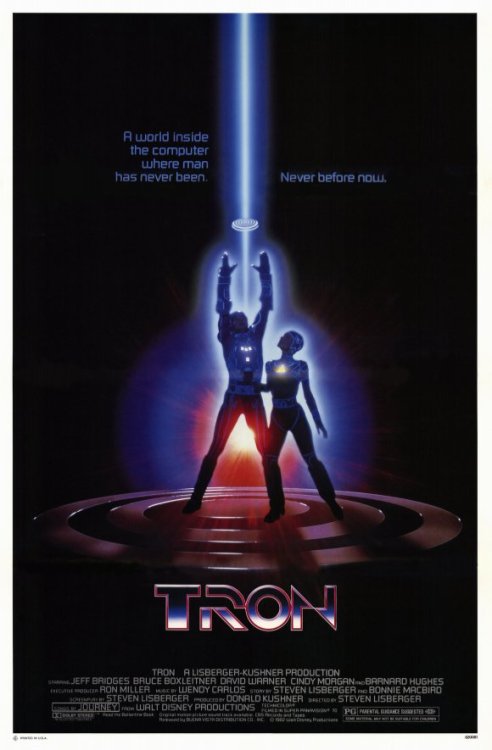
The first time I realized that there was something of a ‘geek subculture’ was when the movie TRON came out. The big ‘tentpole’ movies of geekdom — Star Wars, Superman, The Empire Strikes Back, Raiders of the Lost Ark, ET — everybody saw those. Not so much with TRON, which was pretty much ignored that year, except by me; I saw it and assumed that everyone else did, too. But when I mentioned it to classmates, not one of them had bothered. They had all assumed it was just a piece of, well, geek fluff.

TRON isn’t a perfect movie, but it’s a fun one, and it’s deeply imaginative in its depiction of ‘the world inside the computer’, where programs take on the personalities of their ‘Users’. For all the ballyhooed use of computer graphics in its effects, the film’s production design is surprisingly old-school, using photographic effects of the time, but there is still a lot of amazing eye-candy in the movie. (And the lightcycle sequence is, for my money, one of the iconic action sequences of the period.)

Early in the film, a program from an accounting firm is being escorted into the Game Grid, which is where programs are gathered and forced to engage in forms of cyber-gladiator games. Here we meet Crom, a program who won’t be around much, because he’s doughy and nerdy and….

Crom: Look. This… is all a mistake. I’m just a compound interest program. I work at a savings and loan! I can’t play these video games!

Guard: Sure you can, pal. Look like a natural athlete if I ever saw one.

Crom: Who, me? Are you kidding? No, I run out to check on T-bill rates, I get outta breath. Hey, look, you guys are gonna make my user, Mr. Henderson, very angry. He’s a full-branch manager.

Guard: Great. Another religious nut.

It interests me that belief in the Users is portrayed amongst the bad guys as a strange religion, but that’s the way it had to have started, right? The Master Control Program didn’t always exist. I wouldn’t mind knowing the story of its rise to power…but that’ll be a thought for another day. Anyway, I’m glad that over the years, TRON has been embraced more than it was back in 1982. But I’m also glad that I was on board at the beginning.

Greetings, Programs!

Share This Post

A Random Wednesday Conversation Starter

Antique stores: “ZOMG, look at all the wonderful treasures of yesteryear!” or “ZOMG, look at all the old crap!”?

Extra credit: For those in either camp, what’s the best thing you’ve ever acquired at an antique store? Regular readers will know that I’m in Camp One, but I know a lot of folks who are in Camp Two.

Share This Post

An apple a day keeps the Republicans away?

President Obama keeps a bowl of apples on the table in the Oval Office.

P012712PS-0766

Here’s a big selection of photos of the action in the Oval Office, as witnessed by the apple bowl. I assume they change the apples regularly — if those are the same apples after more than three years, well…ewwww!

(I almost titled this post “Obama Had A Heap Of Apples”. If you understand that reference, you’re my kind of people.)

Share This Post

An awful waste of space

As much as I love Carl Sagan, I have to admit that I never warmed to his one and only novel, a science-fiction first contact story he called Contact. I tried reading it a couple of times, and each time I only got about a hundred pages in before I stopped. I just don’t think that Sagan was really cut out for novel writing, no matter how great his gifts may have been for science writing. But in 1997, a movie adaptation of the book arrived in theaters, starring Jodie Foster and Matthew McConnaughey and directed by Robert Zemeckis. The movie was six months too late for Sagan to have seen it, alas.

I’ve had a somewhat uneasy relationship with Contact ever since it came out. On balance I like it a lot…but I don’t love it, and in truth, I never really have. I’ve never been entirely successful in putting my finger on what it is about Contact that vexes me, but after recently watching the film again on NetFlix, I think I have it: the movie is too unfocused. When the film is concentrated on telling its story and attending to that central story, it is a fine, fine piece of work. But too often I get the impression that Robert Zemeckis got distracted, often by something shiny, and there are way too many times in the movie that the story gets lost so we can follow something shiny.

Contact tells the story of Ellie Arroway, an astronomer whom we meet as a young child, operating her HAM radio under the guidance of her father. They have a wall map of the United States, on which she marks her radio contacts with push pins; after talking to someone in Pensacola, Dad comments that it’s her farthest contact yet. Ellie asks if a radio could talk to the Moon, or to Mars…or to her mother, who is apparently dead. Dad responds, “I don’t think they’ll ever make a radio that can reach that far.”

Grown-up Ellie (Jodie Foster) turns out to be an astronomer, as noted, who is using her research time at the Arecibo Radio Telescope to look for, as she says, “little green men”: she is dedicating her career and scientific energies to SETI (Search for Extra-Terrestrial Intelligence). This leads to her meeting a former priest (Palmer Joss, played by Matthew McConnaughey), who despite being religious and spiritual where she is not, attracts her on a number of levels, and it also leads to run-ins with an older male scientist named David Drumlin (Tom Skeritt) who is snide and condescending to Ellie as he regards her chosen field of specialty as an utter waste of time. After a number of obstacles to her career – mostly owing to funding difficulties, as convincing people to part with money for something like SETI tends to be difficult – Ellie finally has a breakthrough when, while working at the Very Large Array in New Mexico, her radio telescopes detect an unmistakable alien signal. The rest of the film follows the implications of such a discovery.

Or, rather, the rest of the film should do that, and when it does, it’s incredibly effective and thought-provoking and loaded with the grand “sensawunda” of all the best science fiction. The problem with the movie is that it too often wanders into less interesting stuff, or its steps away from subtlety to drive its points home with a jackhammer, or it does things that forcibly eject me from the world of the film.

Taking the less interesting stuff first: Ellie Arroway is too often portrayed in the film as the feminine voice of reason in a crowd of over-bearing, pompous, or downright dim men. Science and engineering are male-dominated fields, and it’s a well-established fact that women in those fields tend to have a tougher going just to overcome gender biases. The problem with Contact‘s approach isn’t so much that it points this out, but that it’s about other things, and thus it can’t really delve too intelligently into those topics which really do deserve higher scrutiny. Thus we have Ellie being treated like an outsider on her own project, or Drumlin stepping up to claim ownership over a project he’s derided consistently up until the moment it proved fruitful. Ellie is constantly on the defensive in the movie, and I think it hurts the narrative because the film can’t just gear up and take us where it wants to go. Instead we have to keep talking about God.

And God is where subtlety just isn’t something that interests Robert Zemeckis. Contact is full of discussions of religion versus science, but the feeling is never that anything is really being debated; what happens is that opposite sides’ viewpoints are stated, and restated, and stated again. Ellie goes to a reception in Washington, where her first order of business upon approaching Palmer Joss is to immediately launch into a discussion on religion, without any preamble or preliminary; more than that, though, the script treats all such conversations – and many that aren’t on the topic of religion at all – as though Ellie has a sizable axe to grind, while everyone else (just about all of whom are male) is calm and collected in their disagreement. Coupling that with the several instances in the film where Ellie is betrayed by men – Drumlin’s taking of the credit, Joss’s posing of a question at the hearings when he knows that the answer is going to doom Ellie’s chances of being the one selected to go in ‘the machine’ – and the film seems to depict Ellie as someone who doesn’t so much achieve a lot but whom is given things, table-scrap like, by the men in her life. It’s an odd kind of feeling.

It also bothers me that the film ends right when it gets most interesting, and it feels to me like it takes the easy way out. To me, the most interesting thing is, What would human society be like once we know that we are not alone in this Universe? We may know next to nothing about who is out there, but surely knowing once and for all, without speculation, that there is someone or something living out there would be a staggering revelation for the human species. Unfortunately, the film doesn’t do much with this notion – in fact, it backs away from it. We get lots of intrigue involving the contents of the message that is received from space, and then the construction of the transport “machine”, and so on. And this is all very compelling and entertaining…but at the end, the film gives us the old “Did it really happen?” gambit, reducing a momentous scientific discovery to something that will appeal to some people and not to others. Not unlike, say, the belief in God.

(Again, I don’t know to what degree the film’s story tracks that of the novel.)

I always find that the film deflates in its last fifteen minutes or so, after Ellie returns from her journey only to learn that, so far as anyone here knows, she never went anywhere. This leads to a Congressional hearing (which really drives home the film’s theme of “one woman versus a whole bunch of mean men”), at the end of which one Representative says, “Are we supposed to take your story…on faith?” And yes, he really pauses and puts big emphasis on those last two words, just in case we missed the irony of a scientist committed to objective observation being forced to admit the necessity of faith. Again, subtle, this is not. The movie does try to have it both ways by showing two government folks discussion the fact that the machine’s video recorder recorded eighteen hours of static (had nothing happened at all, there would have been about two seconds’ worth). But this is to be kept secret, apparently. They might as well seal all this information in a crate and store it in the warehouse next to the Ark of the Covenant.

And the movie ends, on this state of affairs. What happens now, though? Does some kind of new religion start to accrete around Ellie and her scientific beliefs? Does Ellie somehow become an evangelist for a new blossoming of a scientific worldview? Does her experience have any effect on the human tension between science and religion? We never get any suggestions or speculations. All we get is the rolling of the credits. Contact tells a good story, but it stops just as its important story is just beginning.

Finally, I just have to note that all the cameos in the movie annoy the crap out of me. This was when Robert Zemeckis had just discovered that he could put people into lots of interesting situations, digitally; remember, he’d had Forrest Gump consorting with Presidents Kennedy, Johnson, and Nixon. So here we get loads of real-life CNN personalities, and even President Bill Clinton, with the film taking quotes from actual Clinton newscasts and editing them so that it sounds like he’s discussing the events of the movie. It’s incredibly distracting. Instead of being drawn further into the story, I find myself trying to think of what event Clinton was actually discussing in the speeches that were repurposed for this movie. Things like having Rob Lowe play a Christian conservative leader named “Richard Rank” are incredibly distracting, because of course it makes me think of Ralph Reed. Shoehorning in mention of the mass suicide of the Heaven’s Gate cult, which had happened just months before the movie came out, is another example. Zemeckis seems to want his movie to seem ‘real’ and relevant, but all this stuff has the exact opposite effect on me: it forces me to keep the story at arm’s length.

Ultimately, I want to love Contact, because of my love and admiration for Carl Sagan, for the subject matter of the story, and for the view of the Universe as a place of wonder and of science as humanity’s greatest achievement. And there really is a lot to love about Contact. But the movie spends so much time getting in its own way that I inevitably end up just admiring it a lot.

Share This Post

Random Thoughts on ‘Manbabies’

I was going to post about this last week, after local blogger (and, in general, a voice I respect) Christopher M. Smith did a podcast in which he crankily outlined all the ways he thinks US society is unserious and immature, but I ended up not posting it, because it just struck me as a waste of time. But now he’s visited the topic for a second straight week, so here are some random thoughts.

1. Any statement of the form I no longer engage in [INSERT ACTIVITY HERE] because I’m [INSERT AGE HERE] is inherently dumb. Sorry, but I don’t take anything of the sort seriously. I can probably think of a very small few statements of this type that are well taken, but I wouldn’t even try to universalize them to a general rule, to invoke Immanuel Kant. People who say “I don’t see superhero movies because I’m 38” are little different from people who say, “Edna shouldn’t have long hair at her age.” I’ve been told that if you’re over the age of five, you shouldn’t eat peanut butter-and-jelly sandwiches or wear overalls. Well, I’ll keep my own counsel on that.

2. Equally obnoxious is I no longer engage in [INSERT ACTIVITY HERE] because it’s a waste of time. Again, this is pure obnoxious snobbery. You may decide that some things are more important than other things, and adjust your time use accordingly. That you’ve decided that a given activity is a waste of your time does not imply that it’s a waste of everyone‘s time.

3. Smith argues, or at least attempts to argue, that various leisure activities are commanding too much attention from Americans to allow them to focus on the more important things. He doesn’t really argue this, though, because he provides zero evidence to back this statement up. Where’s the data that show this?

4. At the same time, he states that well, OK, it’s fine to have hobbies as long as you don’t let them ‘define you’. No clarification on what it means for a hobby to ‘define you’ is given. He does speak derisively of people who cosplay at the San Diego Comic-Con, again leaning on the ‘you shouldn’t do that when you’re a certain age’ line of thought, but how are we to know who is allowing their hobby to define them and who is not? I have a friend who is really into sports-related hobbies, mainly autograph collecting and fantasy sports leagues. He attends a lot of sports events, has Bills season tickets, and so on. He is also deeply involved in the activities of his church. Does sports define this man? I think not. Are there people who are too deeply into their particular hobbies? Of course. Are there too many in society? Ahhh…that’s a question that requires a lot more evidence to support it than Smith provides.

In fact, he undermines his own point when he cites people he knows who have hobbies of the type he’s deriding, but proceeds to indicate that those people are fine, because he knows then and knows that they aren’t the ones taking things too far. But who are, then? A bunch of people he’s never ever met? Is he able to read minds now?

5. “We don’t do big things anymore.” I’m sorry, what was that? I was too busy reading up on the achievements of our Olympic athletes and looking at the latest data beamed back from the Curiosity rover that we just landed on another planet.

That’s overly snarky, I know. There really is a case to be made that our society isn’t getting enough done to confront our serious problems. But is there a strong case to be made that our entertainment is proving to be a massive distraction thereof? I’m not convinced, because Smith’s argument simply doesn’t have enough connective tissue to convince me. Instead, it basically sounds like, “Too many people like stuff that I don’t like, and they like it too much.” Meh.

6. Smith and his interlocutors slam Hollywood’s filmmaking culture for making too much crap these days, and there’s some real hay to be made here. But extending our movies — and not all of our movies, but just the biggest profile movies — to an argument about all of culture doesn’t seem to really hold up. First off, he quotes Francis Ford Coppola as saying that he couldn’t get The Godfather made in today’s Hollywood culture. And that may well be: I completely agree that movies are too homogeneous right now, too focused on a narrow subset of subject material, and too focused on resuscitating existing properties as opposed to taking risks. But he keeps singling out the entire superhero genre, without even bothering to consider the idea that maybe a good movie can be made of superhero material. One wonders if he similarly dismisses fantasy and science fiction.

Two sub-points here, though. First of all, maybe Coppola couldn’t make The Godfather today. But somebody could, and I know that somebody could because somebody did. His name is David Chase, and he made it as The Sopranos. He just did it for teevee.

Could a movie about inner-city crime in Baltimore get made today? Maybe, maybe not. But an extremely well-regarded teevee show called The Wire got made. How about a movie about a successful teacher-turned-drug dealer? Maybe not, but there’s a teevee show called Breaking Bad. How about a gritty and violent fantasy series that at its best overturns the tropes of its genre? Game of Thrones. Or a science-fiction series that depicts the choices faced by a society that finds itself at permanent war? Battlestar Galactica.

Objecting “But we’re talking movies, not teevee!” doesn’t hold up. Neither, really, does a rejoinder that those are mostly cable shows and not network shows. Cultural media don’t exist in a vacuum. You can’t cite a ton of crap movies as evidence of the increasing crapiness of our popular culture whilst ignoring the other things, in other media, that stand as evidence that the quality exists and has simply moved someplace else.

Secondly, it’s been my belief for years that the denizens of any particular era are the worst people to judge the quality of their era’s artistic and cultural endeavors. Quality takes time to rise, sometimes decades, and the history of every art — not just movies, but books, music, poetry, you name it — is replete with examples of things that were loathed in their day but later became cultural touchstones. There’s a wonderful book called A Lexicon of Musical Invective that makes this point very simply by providing excerpt after excerpt of scathing reviews of works of classical music that would go on to become beloved standards of the classical repertoire, by the critics of the time. We remember the hits and forget the misses.

7. Remembering the hits and forgetting the misses also applies, I think, to regarding too highly the eras gone by. Smith seems to believe that there was a golden age of civic involvement in the past. Is this true? Maybe it is, actually. There is evidence to be cited that in some ways, earlier incarnations of American society were more ‘serious’ than they are now. But I’m not sure how true this is. We don’t vote enough, certainly, and in terms of public policy, we tend to stick rigidly in some odd middle, neither particular liberal nor rigidly conservative. But I’m not prepared to grant that we’re stuck in neutral, either. This deserves greater discussion, but again, not from the rhetorical framework that Smith establishes. Our problem is not that we’re seeing too many superhero movies.

Smith cites a relative of his — an uncle, I think — who did a lot of civic stuff, and Smith cites himself as a further example of the way everyone should be. This is sheer nonsense, and it’s basically equivalent to Professor Henry Higgins when he wonders, in song, “Why can’t a woman be more like me.” If your argument for what’s wrong with society literally sounds like “Not enough people live their lives the way that I choose to live my life”, then maybe you might want to think about reframing things a tad.

8. My final point here: at one point, Smith argues that a big problem is our increased connectivity, with stuff like texting on smartphones. He complains that even when we’re standing in line at the post office, we’re so busy checking Facebook and tweeting and texting and stuff and dammit, “Can’t we just wait in line anymore?” And I’m thinking, “What in God’s name is so great about standing in line?!” I mean, seriously: are we really supposed to romanticize the act of standing in a long line at the post office or the bank or the DMV? What are we supposed to do otherwise? Look at the cinderblock walls? Maybe talk to the person in front of us or behind us…but what if they’re not feeling conversational? In having new options for things to do while we wait our turn at the counter, am I really supposed to think that we’ve lost something as a society? Because…I don’t.

9. Finally: if this reads like me trying to defend the honor of superhero movies or ‘comic book culture’, well, it’s not. I don’t read too many comics, I don’t see very superhero movie that comes along, and so on. But as far as ‘comic book culture’ goes, I am reminded that comic books are a much bigger part of the cultural landscape in Japan than they are here. If we’re truly unserious as a culture — and there is an argument to be made thereof — one has to do a bit more heavy lifting than pointing to some movies to demonstrate it.

OK, that’s enough of that. Back to doing what I usually do on this blog: indulging my love of things that I’m sure would be judged as ‘manbaby’ material by my societal betters. ‘Tis a cross to bear, but bear it, I shall!

Share This Post