For those of a musical mind:
An Eb note, a C note, and a G note walk into a bar. The barman says, “Sorry, we don’t serve minors here.”
C sends Eb a dirty look. “I told you to act natural!”


The official site of Kelly Sedinger: Reader, writer, photographer, and dreamer
I know, it’s not Thursday. But hey, whoever said I had to stick to the schedule?
I’ve had an odd relationship with country music my entire life. On balance, it generally isn’t my cup of tea, but when a country song gets under my skin, it really gets under my skin, and this — “Y’all Come Back Saloon”, by the Oak Ridge Boys — is a perfect example. I love this song to death. I don’t know why I’ve been listening to it a bit of late, but I have (and I’ve almost certainly featured it on Something for Thursday at one point or another). It goes back in my memory a long, long way — all the way back to my childhood. I looked it up, and the song’s 40th anniversary is coming up later this year. Wow.
I think I really respond to the country songs that have a hint of sadness to them. The best country songs always seem to deal with sad memories, of loves lost and people looking back over hard lives. That’s what this song sounds like to me…and then there are the wonderful lyrics. I mean, the first verse (heard after the chorus, for an interesting formal change) is pure poetry:
In a voice soft and trembling, she’d sing her song to Cowboy,
As a smoky halo circled ’round her raven hair.
And all the fallen angels and pinball playin’ rounders
Stopped the games that they’d been playin’ for the loser’s evening prayer.
I don’t care how much you claim to hate country music, that is some wonderful writing there. The smoky halo circling her raven hair? That is a perfect image for a song like this, as is the notion of an entire saloon’s clientele falling silent as the raven-haired beauty with her tambourine starts her song. Of course, the song’s melody will lodge in your ear in the best way. What a great song.
This live performance is terrific. Please don’t laugh at the Saturday Night Fever outfits they’re wearing! This is a terrific performance. There are more recent renditions on YouTube as well, if you want to hear how the group has changed over the years.
Easter is coming, so in that vein, a concert overture by the great orchestral master Nikolai Rimsky-Korsakov. His Russian Easter Festival Overture is a work that pays tribute to Easter and the Russian Orthodox liturgies. The composer actually uses a number of liturgical melodies and chants throughout the work, giving the piece a feel of being both older and newer than it actually is. Apparently in Russia Easter is called “the Bright Holiday”, and Rimsky-Korsakov’s overture teems with both a celebration of the Resurrection and a more pagan exultation in the coming of Spring.

Like many a lover of classical music, I suspect, my knowledge of composer Paul Dukas can be summed up in one sentence: “He wrote The Sorceror’s Apprentice.”
Which he did.
The Sorceror’s Apprentice is pretty much the only work by Dukas to enter the standard repertoire, and I couldn’t begin to tell you without Googling what else he might have written. This is partly because apparently Dukas was extremely self-critical, and he actually destroyed a good number of his own works rather than let them be heard. A number of his works have survived, but as of this writing, Dukas remains to me entirely unknown outside of this one tremendously famous piece (which received an assist from Walt Disney when it was included in Fantasia).
Here is The Sorceror’s Apprentice.
A friend posted this on Facebook, and in honor of St. Patrick’s Day, here it is!
—
It was raining hard and a big puddle had formed in front of an Irish pub.
An old man stood beside the puddle holding a stick with a string on the end and jiggled it up and down in the water. A curious gentleman asked what he was doing.
‘Fishing,’ replied the old man.
‘Poor old fool’ thought the gentleman, so he invited the old man to have a drink in the pub.
Feeling he should start some conversation while they were sipping their whisky, the gentleman asked, ‘And how many have you caught?’
‘You’re the eighth.’
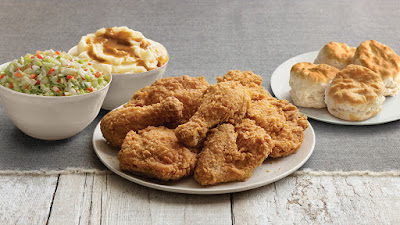
The Wife and I both share a love of fried chicken, because fried chicken is awesome and people who don’t like it are wrong and unhappy. We don’t indulge fried chicken all that often, because it is admittedly not the healthiest stuff in the world, and over the last few years, we’ve indulged even more infrequently, as The Wife has had to adopt a gluten-free diet. Before that, though, this is how we almost exclusively enjoyed fried chicken:

Yeah: the KFC bucket. This is now off the table as an option for us, although once a year or so, when The Wife isn’t gonna be home for dinner, I’ll treat The Daughter and I to a bucket. (Same thing with one of our favorite local pizza joints, because I try not to flaunt Teh Gluten in front of She Who Cannot Eat It But Can Still Smell The Amazing Food).
Anyhow, very few restaurants offer GF fried chicken, so now it’s become an almost-luxury. One such restaurant is the wonderful Waffle Frolic in Ithaca. We make a point of eating there each and every year when we visit for the Apple Harvest Festival. I never heard of waffles with fried chicken until about ten years ago, but since then? One of my favorite things! We found another fried chicken restaurant with GF offerings in Webster, NY, but that’s nowhere near our usual beaten path. That leaves making it myself as the only real option.
Despite our love of fried chicken, I never made it all that often, because it tends to be a bit labor-intensive. (As per this excerpt from one of my favorite cookbooks.) However, I’ve recently decided that I should make it more often, and it needs to be gluten-free. So! Off to the races, Batman!
Obviously, the key is to make sure your seasoning is gluten-free (they almost always are, but it’s best to check the label or make your own seasoning mix) and use gluten-free flour instead of regular wheat flour. That’s it. Other than those cautions, making GF fried chicken is no different from any other fried chicken. I made a batch last weekend, and I was promptly informed that I didn’t make enough. (I made twelve pieces. For a family of three. Not enough. And…they were right.)
In terms of methodology, I did a little research on GF fried chicken, and then I basically mashed up a recipe of Emeril Lagasse’s (from this cookbook) with one of Alton Brown’s (from this episode of Good Eats – excuse the poor video quality. I only fried legs and thighs, because frankly I don’t get America’s obsession with breast meat, and while I could have done wings, the legs and thighs were enough. (And no, I didn’t butcher my own chickens. I know, Alton Brown says you’re supposed to. But when The Store sells these nice big packs of a dozen legs and another pack of a dozen thighs for the same combined price as two whole chickens, which wouldn’t yield enough of what I want anyway, I go with the big packs. My sense of frugality has not yet developed to “butchering my own chickens”.)
As I researched technique and looked at recipes, I realized that the only real difference is the flour, when making fried chicken gluten-free. That’s it. Every other aspect of preparation is the same. You just have to use different flour, and the key tip I found in this regard is that you have to be a little bit careful in which GF flour you use.
Gluten-free flour, for those who have never used it, is made of grains that don’t have gluten. I know, that’s obvious, but there are a lot of variations out there: rice flour, garbanzo bean flour, flours from various nuts, and so on. Some GF flours consist of just one of these, while others are a blend. The thing with GF flours is that because there’s no gluten, they don’t behave in quite the same way that wheat flour does, especially in yeast-leavening situations. Gluten is what gives bread and pizza dough that “stretchy” quality, which is why breads made with GF flour tend to have noticeably different texture. And that’s fine, but to get the textures closer to what’s expected, GF flours often have to be supplemented with xanthan gum.
What does this have to do with fried chicken? Well, some GF flours on the market now come with xanthan gum already added, while others don’t. For fried chicken, you want the stuff that does NOT have xanthan gum in it. Now, I did not verify this myself, but I found that tip on a GF cooking website that really seems to know what it’s talking about, so I took them at their word. So read the label and make sure your GF flour has no xanthan gum. OK? OK!
The rest of the steps were pretty standard, actually. I soaked the chicken in a quart of buttermilk overnight in a one-gallon ziploc bag. Emeril Lagasse says to season the buttermilk with hot sauce and Essence, but I didn’t bother. (Yes, I use Emeril’s trademark Essence spice mix. Sue me. It’s a perfectly good spice mix with flavors I like.) For the cooking oil, I used regular vegetable oil. I know, peanut oil is better for frying, but it’s also really expensive in the quantities needed, and since I do very little deep frying, I never end up keeping the oil I use for further dishes. Besides, smoke point wasn’t a factor, because of the temperature I used.
After about twenty-four hours of buttermilk soaking in the fridge, I drained the chicken, seasoned it liberally with Essence, and dredged it in my GF flour. Then I let the pieces rest on a rack over a cookie sheet while I heated the oil and then fried the pieces in batches, four at a time.
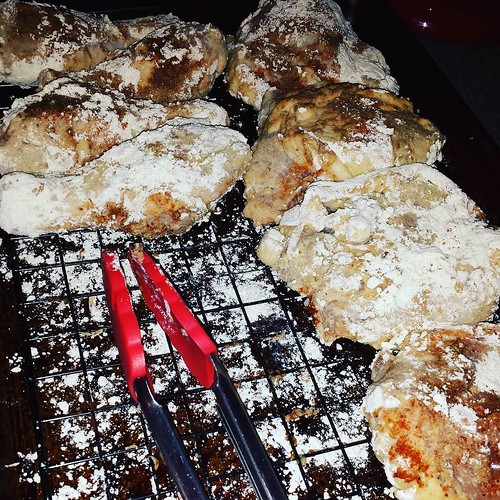
And then, into the oil with the chicken!
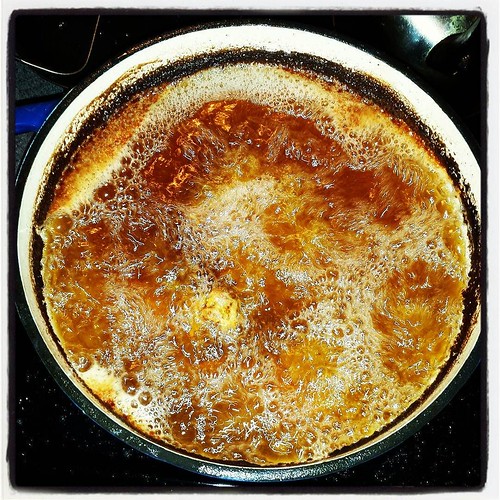
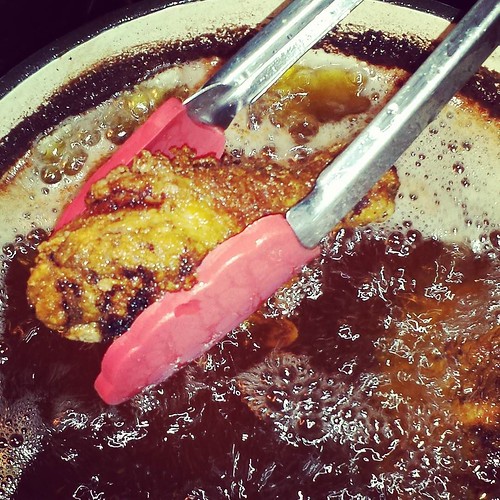
Finally, out came the chicken:
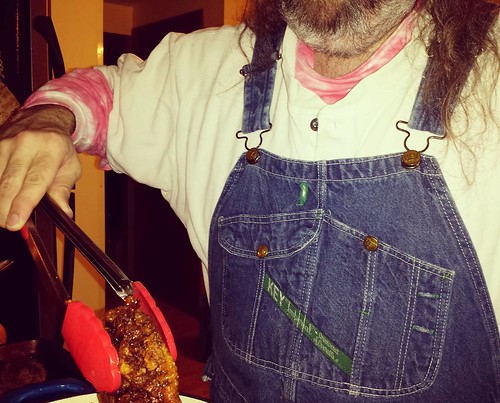
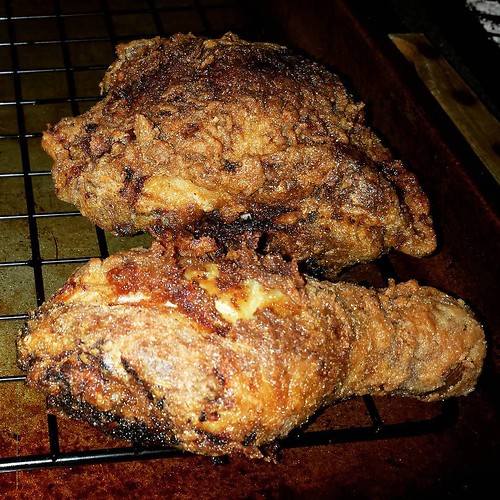
Oh, and that book excerpt I link above? I think she’s wrong when she says that the chicken must be fried at the last minute. If anything, the chicken should be fried first, and then allowed to rest for a while before eating. I had more than enough time to throw together a batch of cornbread and bake it in between the batches. It’s generally my belief that you do not want to eat fried chicken within at least fifteen minutes of removing it from the fryer. The stuff stays warm for a really long time, and cooked meat of any type should always be rested.
How did the chicken come out in the end? Well, the family ate it all up and promptly scolded me for not making enough. I made twelve pieces. That should tell you something. That was some good chicken, folks! And The Wife didn’t get sick from eating it! Yay! Yeah, we really set the culinary bar high here at Casa Jaquandor: food has to both taste good and not make The Wife sick.
A couple other random thoughts:
:: This gadget is awesome:
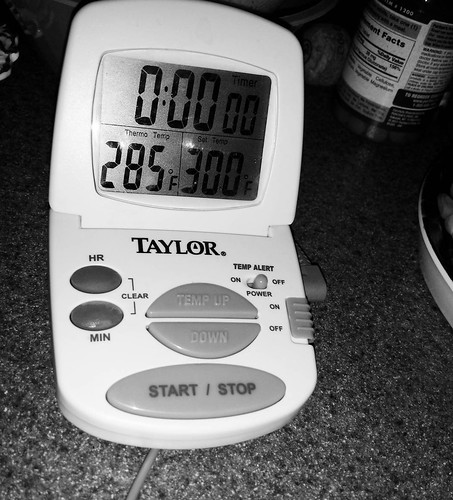
:: I also recommend that every kitchen on Earth have at least one of these:
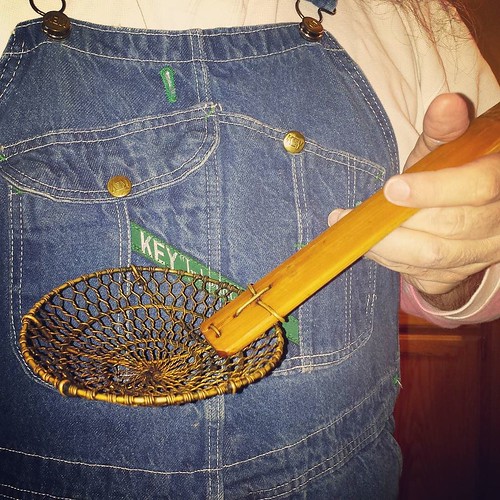
:: This was the first time I ever used my Dutch oven for deep frying. Prior to this, I always used my wok, which works just fine. The wok is a perfectly acceptable pan for deep frying. I prefer the Dutch oven, though. Its straight sides give more room at the pan’s bottom for the chicken pieces to do their thing without touching each other and getting clingy. Also, the Dutch oven is narrower at the top, which means that I could use my splatter-shield gizmo to contain the splattering oil. With the taller pot and the lower oil temp, there wasn’t really much splatter at all, but being able to use the shield was a bonus. (I know, I can get a shield wide enough for the wok.)
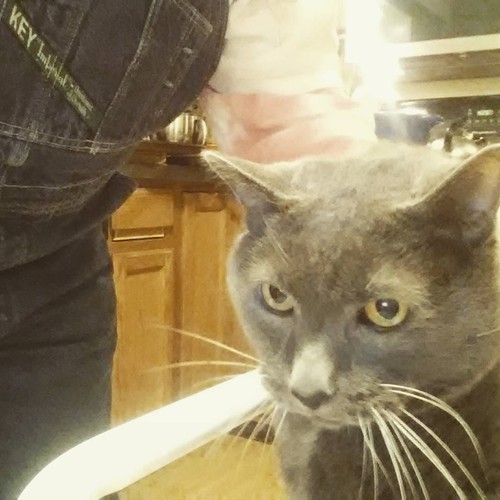
:: Always take time while cooking to pet the cat.
So there you have it: making gluten-free fried chicken. Next time I’ll probably make two dozen pieces. And I’ll be frying for two hours….


