Something for Thursday

So I’m always a little confused by the way a song’s lyrics relate to the rest of it. Some songs have lyrics that are so indelible that it seems almost sacrilege to put any other lyrics to that tune and vice versa (“New York New York”, for example). Other songs have wonderful tunes but awful lyrics that are so bad they almost make the rest of the song laughable in itself (“McArthur Park” is a good example here). And then there’s a third category, where the lyrics aren’t necessarily good, but rather…just weird. It’s easy in songs like that to get wrapped up in trying to figure out just what the heck a song means, and if the melody and rhythm aren’t good, the song just disappears.

Here’s a song whose lyrics make no sense to me at all. I haven’t the faintest idea what this song is trying to say, if anything. And you know what? Maybe it’s not. Maybe it’s just a rhyme that exists for no other reason to fit an incredibly catching melody and compelling dance beat. I dunno…but I know that I love this song.

Here are The Killers with “Human”.

Share This Post

On Fantasy and Film

George RR Martin lists his Top Ten Fantasy movies. Of course I have thoughts!

First off, a stipulation: lists like this are mainly meant to inspire discussion and debate and, being that this is the Internet, rock-throwing and name-calling and aspersion-casting-upon-one’s-children-and-parentage. OK? OK!

Second: Well, Martin actually has a pretty good list here. You’ll have to click through to see his comments on each film (worth doing, also for the honorable mentions), but here’s the Top Ten by itself:

1. The Lord of the Rings (complete)
2. The Princess Bride
3. The Wizard of Oz
4. Ladyhawke
5. Dragonslayer
6. Monty Python and the Holy Grail
7. Dark City
8. Pan’s Labyrinth
9. Beauty and the Beast (1946, dir. Cocteau)
10. Raiders of the Lost Ark

Martin’s “honorable mentions” include some Disney movies (more on that below), Dracula, Frankenstein, Legend, Labyrinth, and Excalibur.

So. Discussion!

As noted, Martin generates a pretty decent list. I’ve seen seven of his ten (Dark City, Pan’s Labyrinth, and the 1946 Beauty and the Beast are the ones I’ve missed). I personally quibble a bit with Raiders: even though it has supernatural elements (as do all the Indiana Jones movies), I see them as primarily adventure films rather than fantasies. But that’s quibbling, and the fact remains that if you’ve never seen fantasy on film, watching all of the movies on Martin’s list is a great start. Also, I do not quibble at all with his Number One pick, which is as good as filmed fantasy gets.

Ladyhawke and Dragonslayer? Hmmmm. I like both, but I’m not sure I’d rank them this highly on my Filmed Fantasy Pantheon. In fairness, though, it’s probably twenty-five years since last time I saw Ladyhawke, and not too much shorter than that since my last viewing of Dragonslayer. I remember the latter being a well-made and exciting fantasy, if a bit dour in tone. I owe both a rewatch, though.

My biggest quibble with Martin’s list is that in his latter commentary he notes that for this list he adopted a “No animation” rule:

Going into this, I decided I had better exclude all animated films. Otherwise the list might well have been dominated by Disney’s classic retellings of time-honored fairy tales: Snow White, Sleeping Beauty, Pinocchio, and The Little Mermaid.

See, the problem here is that animated films are still films and animated fantasy films are still fantasy films. Likewise, there’s no reason to assume that the animated films will dominate the list, or that those animated films that will be doing the dominating are Disney films. A Top Ten list is often going to be exclusionary to the point of absurdity to begin with, but this is particularly bizarre, like making a Top Ten Restaurants of New York City list, but excluding those restaurants that focus on French or Italian cuisine. And in mentioning Disney, Martin makes a telling omission: he omits the masterpieces of Studio Ghibli. Looking at the list above, I would quite willingly trade Ladyhawke and Dragonslayer for Princess Mononoke and Spirited Away.

Then there’s Martin’s dismissal of Willow:

Then there’s Willow. Sorry, no. Yes, I liked Val Kilmer as Mad Martigan, but that’s about it. Willow set filmed fantasy back 20 years.

Look. Taste is taste and if you don’t like a movie, so be it. I don’t think Willow is a classic either, and I wouldn’t put it on my Top Ten Fantasy Movies list either. But yeesh, it ain’t that bad. I genuinely think that Willow has received a bum rap over the years. It’s an OK, fun, swashbuckling Sunday-afternoon-on-a-winters-day movie, and there’s a lot more in it that’s good than Val Kilmer.

And “Willow set back filmed fantasy by 20 years”? That’s a very silly statement to make, and Martin has to know better. Look at all the fantasy movies that came out in the 1990s, within just the first ten years after Willow (which came out in 1988). And just ten years after Willow, The Lord of the Rings was in pre-production. No, Willow did not hurt filmed fantasy. It’s a dumb thing for Martin to have said.

Let’s see, what else? Well, Martin doesn’t mention any of the Harry Potter movies, which seems odd, because they’re giants in the filmed-fantasy world, and they are a highly underrated achievement. They got the same cast together for eight movies over about ten years and told a big story. A little more respect for Potter, please!

And finally, Martin has this to say about Excalibur, which is probably the best version of the King Arthur story filmed yet:

I mentioned Excalibur earlier. There’s much to admire about John Boorman’s film. The visuals are a feast for the eyes, and the movie includes some wonderful performances. But Nigel Terry has to be the least charismatic King Arthur in film history, pouting his way from start to finish, and the film tries to cram in too many different aspects of Arthurian legend, and does justice to none of them. Some studio really needs to step up and film the definitive modern treatment of the Matter of Britain, T.H. White’s The Once and Future King. And not as a cartoon (Disney’s The Sword in the Stone) or a musical (Camelot) either. White’s trilogy deserves to be done as three films, the way Peter Jackson did Lord of the Rings.

OK. If you use the word “cartoon”, that tells me that you don’t really respect animation. Not really. Maybe the Disney film of Sword in the Stone wasn’t particularly good, but to dismiss the effort entirely makes me think there’s a little more to Martin’s stacking-of-the-deck against animation. As for a musical, well–no, Camelot isn’t great. That’s not why the “definitive” version of the Arthurian story hasn’t been filmed, though.

I think it’s because the Matter of Britain’s very nature is stacked against a film or even a tetralogy of films (The Once and Future King is a gathering of four previous books, not three, as Martin should know). The Arthur story isn’t one story but rather a whole bunch of them clustered together under one banner. I don’t know how one film or even several films could make that all work without significant re-casting of the story and removal of some of its key parts. Gillian Bradshaw’s trilogy of Arthurian novels, perhaps, or Mary Stewart’s wonderful trilogy of Merlin novels. Any telling of the Arthurian story is going to leave something behind, because it can’t possibly all be squeezed in there. I doubt very much if we’ll ever see a massive filmed trilogy of the King Arthur story, to be honest. That’s a bummer, but I think that’s the way it is.

So, what would be my Top Ten Fantasy Films list? Well….

1. The Lord of the Rings (complete)
2. Princess Mononoke
3. The Princess Bride
4. Conan the Barbarian
5. The Thief of Baghdad
6. Time Bandits
7. Who Framed Roger Rabbit
8. Harry Potter and the Prisoner of Azkaban
9. Excalibur
10. Monty Python and the Holy Grail

How about yours?

Share This Post

Tone Poem Tuesday

Claude Debussy, like Hector Berlioz years before, won the Prix de Rome in his youth; and like Berlioz, he did not much care for the experience of living in Rome for the years required of winners of the prize. One good thing did come out of his time there: the two-movement symphonic suite Printemps, which is worth hearing as a signpost of what was to come as Debussy matured into his role as one of the leading exponents in music of French Impressionism. The entire work is one of sensation and feeling and impression. There are no melodies that linger in the ear, and the whole time of the piece, it seems to be leaning toward a certain type of song that never arrives. I often find this sense of direction-without-destination in Debussy, and it’s a large part of why I often find it hard to really respond to his music, as lush and wonderful and evocative as it often is.

Here is Printemps by Claude Debussy.

Share This Post

Munchies!!!

I like to try new (or new to me) snack foods and candy on occasion. And by ‘on occasion’, I mean, ‘all the time’. I try not to try new snack foods and candy all the time, but…well, I do my fair share of sampling such wonders.

Examples? Here are three!

:: Lucky Butter Coconut Cookies!

These aren't bad, but I was hoping for more flavor. #cookies #yum

These are nice. Not great, but nice. They have neither a strong coconut nor a strong butter flavor, but enough of each to be detectable. The cookies are thin and crispy, but not so thin as to completely crumble when you bite them. The individual cookies are nicely big–about two inches by one inch rectangular–and the upper side has a nice buttery sheen and a pretty yellow color throughout. They’re quite good with coffee. If you’re looking for a pleasantly mild kind of cookie, these are definitely that. And the package is really cheap: I got one pack for under two bucks.

:: Jimmie Stix!

Dessert tonight: Boyer 'Jimmie Stix'!. I like obscure candy bars, and Boyer's Peanut Butter Smoothie (peanut butter cups with a butterscotch shell instead of chocolate) are one of my favorites. #candy #yum

One major reason I love going to Vidler’s in East Aurora (which is an old-school five-and-dime store) is its selection of obscure candy. If you’re looking to venture beyond the familiar realm of Snickers and Reese’s cups, this is the store for you. Vidler’s is a constant supplier of my favorite candy bar of all time, the Boyer Peanut Butter Smoothie (a peanut butter cup with a butterscotch shell). Here I have another confection by Boyer, the “Jimmie Stick”, or “Stix” in plural. They’re literally what the package says: two pretzel sticks covered in peanut butter and then covered in chocolate.

Interior of the Jimmie Stick (see last pic). This is good! Like a peanut butter Twix but with a pretzel. Will buy again. #candy

I liked this thing a lot. It reminds me of the “Take 5” Bar, without the caramel. The peanut butter and chocolate go well together, obviously, but the pretzel interior gives the whole proceedings a very pleasing crunch, and the pretzel’s saltiness elevates the proceedings. I really liked this and will definitely buy more next time I’m in Vidler’s.

:: And finally, Utz “Sweet Corn” Potato Chips.

These are...odd. Not awful, but I'm not sure I'd buy them again. #yum #potatochips

This summer the fine folks at Utz, who make a lot of fine salty snacks, came out with a line of “Grilling Classics” chips. There are three flavors: Cheeseburger (which are actually really good with a hint of yellow mustard), Grilled Hot Dog (which are really disappointing and taste mostly of char), and now these. If the Cheeseburger chips are the good ones in this line, and the Hot Dog ones are the bad chips in this line, then these are the “Meh”. They’re not horrible. The chips have a definite taste of corn that has been applied somehow, but it’s also an artificial taste of corn, and it literally tastes artificial. Sometimes you can add a non-traditional chip flavor to a chip and result in something that’s kind of tasty (like the Cheeseburger ones), but other times you end up with something akin to cognitive dissonance as your tongue screams to your brain, “This should not taste like this. ERROR. ERROR.” I think we can call that “culinary dissonance”, right?

Anyway, like I said, the flavor of these chips isn’t unpleasant. They’re not bad at all. But I was not able to get used to them. The last two chips in the bowl tasted every bit as wrong to me as the first two, and that’s a problem. I’ll finish the bag, but these won’t be on my list of Munchie Paths To Trod Again.

So, who out there has tried something new in the Munchie world of late?

Share This Post

Symphony Saturday

I keep promising Gustav Mahler, and I keep postponing Gustav Mahler. Alas!

And no, no Mahler this week, either–but in a way, this week’s symphony does help pave the way a but. Instead we’ll revisit Hector Berlioz, because you can never have too much Berlioz. This is one of my handful of “desert island” works: if I were banished from society but I could have recordings of a few classical works to hear for the rest of my days while banished, this would make the cut. It’s Berlioz’s Romeo et Juliette Symphony, which is one of several works he wrote that are really not easily classified. The work bears no formal resemblance to any symphony written around its time, and at times it seems like it might be straight-up opera. And yet it is not: its most intimate moments are purely orchestral, and its heart lies in the central portion where Romeo meets Juliet at the ball, and then the love scene between the two, and then the scherzo depicting Queen Mab as Mercutio describes her. So much depth of feeling and illustrative color in those movements, along with some frankly amazing melody. Berlioz never gets enough credit for his melodic invention. Berlioz’s formal scheme here does anticipate Mahler in a way, for Mahler too was never one to rigidly adhere to the four-movement symphonic model that dominates the form.

This work is on my thoughts anyway of late, because I have been reading Berlioz’s memoirs. I haven’t got to where he writes of this symphony yet, but I look forward to that. Here is Romeo et Juliette.


Next week, I really do hope to get to Mahler. Really.

Share This Post

Something for Thursday

I’ve been reading the memoirs of Hector Berlioz lately, having come to the odd and surprising realization that even though he is my favorite classical composer, I’ve never read his memoirs all the way through! The strength of his opinions is amazing–Berlioz was not a man to ever entertain feelings of ‘meh’.

I’ll have more to say about the Memoirs another time, but for now, here is Berlioz’s Roman Carnival Overture.

Share This Post

One Memory of Each Grandmother

I never knew my grandfathers. Both had passed away long before I arrived on the scene. My grandmothers, though? Both lived into my teens, when–quite sadly–both passed away within about six months of each other. Grammy, my father’s mother, went first in the fall of 1986. Gramma, my mother’s mother, passed later that winter (or maybe it was early spring). Here’s a memory I have from each.

Grammy and the Manhattans

The Manhattan was my grandmother's favorite cocktail, and it is my mother's as well. I don't think it's mine -- my heary belongs to the Mojito and to the Dark&Stormy -- but heavens, is Manhattan good! #whiskey #cocktails #manhattan #bourbon #yum #candyisd


Over the last seven or eight years or so, my tastes in adult beverages have shifted from beer to wine and cocktails. My favorite cocktails tend to be rum-based, with my favorites being the Mojito and the Dark-and-Stormy, but over the last few months I’ve discovered Grammy’s favorite cocktail, the classic Manhattan.

Grammy simply adored Manhattans. I don’t know of a time when I wasn’t aware that there was a drink called a Manhattan and that it was Grammy’s favorite drink. One time, toward the end of her life, she was visiting us for a week or two. By this point she was starting to experience some problems with her mobility, but when my father invited her “down the street” (his longtime euphemism for “going to the bar”) for a Manhattan, well, suddenly she was a bit more spry. My mother later told me that when I was just a toddler and my family was moving from Pittsburgh to Portland, OR, Grammy gave her a bottle of Manhattans to see her through the trip.

So I decided a while back to try making a Manhattan, mainly out of curiosity. I have several books on mixology, so I grabbed a recipe and picked up the ingredients and had a go. The base recipe I use is as follows:

Stir together in a mixing cup with 1 ice cube:

2 parts bourbon
1 part sweet Vermouth
dash of Angostura bitters

Stir for at least twenty revolutions of the bar spoon (yes, I count them), and then pour over ice in a rocks glass. Garnish with at least two Maraschino cherries.

There are recipes out there that call for both sweet and dry Vermouth, but I haven’t tried that mainly because I don’t have room in the fridge for two open bottles of Vermouth. I have also used Red Stag whiskey, which has a black cherry flavor. One thing I don’t do consistently is include the Maraschino cherries, and I have received stern lectures on this from both my mother and my sister. I like the cherries, but too often our jar of them migrates to the rear of the fridge, and who wants to dig through cups of yogurt and jars of pickles and partial cans of tomato paste and who knows what else every time they want a drink? Not me…but for purism’s sake I should probably get with the program.

Besides, the cherries also pertain to Grammy specifically, because she could put the stem in her mouth and tie it in a knot with her tongue. That’s some serious stuff, folks. Everyone’s grandmother should have at least one eye-popping useless skill, right?


Gramma’s Blue Jug

I expect that everyone’s grandmother had a particular item in their home, just some ordinary thing that was just an unremarked and unremarkable part of their daily lives, that stays in our memory. We remember this item not for any specific event that we recall in which it played a part; it’s just that this particular item, whatever it might be, serves as a kind of totem for a particular time and place. If we’re very lucky, we inherit that item. If we’re kind of lucky, we at least see one just like it once in a while at an antique store.

For Gramma, it was a blue ceramic jug.

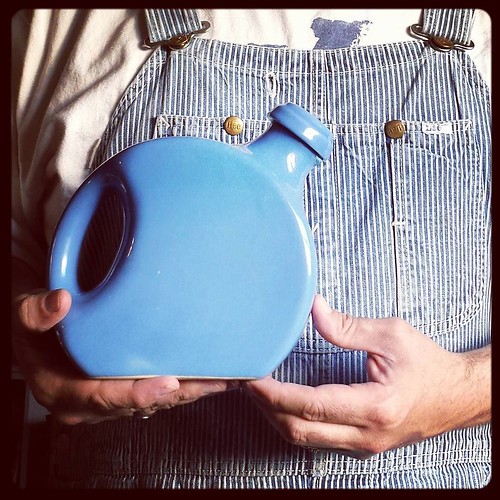
At her house it always contained ice water. She’d fill it from the tap and put it in the fridge, and I don’t remember any ice water in my life ever being so cold and refreshing as that from Gramma’s blue ceramic jug. Now, ceramic is a good material for such things because it takes its sweet time in transferring heat. Cold ceramic stays cold (or hot) for a long time. Water from that jug couldn’t have physically been colder than anything else in that fridge, but for some reason it felt like it was. This jug was blue, and it was circular in profile with the handle a part of the circle as opposed to being its own protrusion. The cork-inlay stopper matched as well.

As far as I know, Gramma had that jug in her fridge up ’til the day she died. I have no idea what happened to the jug after that. Gramma lived with my Uncle Bob, who wasn’t…well, let’s just say that Uncle Bob was not a terribly easy man to like and leave it at that. Inheriting the jug wasn’t a possibility, and that was that.

Some years later, my sister managed to find one in an antique store, and she bought it for my mother, who was ecstatic to have the jug. For her, it didn’t even matter that it wasn’t the very jug from Gramma’s kitchen. The color was the same, the jug was the same, and for her it was every bit as good as having the real thing. I’m not so avid an antiquer as my sister, but I do go to antique stores a few times a year and I’ve always kept an eye out for the same jug. I’ve never yet seen one “in the wild”, but I would have bought one if I’d seen it and the price was right. If it was too much, well–I’d look at it in the case and remember drinking out of Gramma’s and move on.

Flash forward to just last week, when I went to an antique mall near Rochester, NY with my sister. She found one of the jugs, in the right shade of blue. She bought it and gave it to me. It turns out that she’s seen several of them over the years and now she owns two of her own back home, where she lives in Colorado. She was even planning to give one of those to me, but when she saw one right then and there, she figured it would save her some future postage (as well as worry about shipping an antique ceramic jug). How did I not see it, since we were at the same mall? Well, the mall is huge, so when we entered we each went a different direction. Had we reversed course, I might have seen it first and snapped it up.

Anyway, I agree with my mother: having a jug that’s exactly the same is pretty much every bit as good as having Gramma’s original jug. Right now it’s on a shelf in my study. Will I use it as a jug in the fridge, filled with ice water for a hot summer day? I don’t know yet. I sure like looking at it, though.

Adventures in Antiquing 8: Ceramic pitcher. My grandmother had one exactly like this. And now I do too! #antiquing #ceramicpitcher

I could, I suppose, mix up a big batch of Manhattans and keep them in the jug in the fridge. That would be a poetic tribute to two wonderful grandmothers….

Share This Post

On Process

Hey, everyone! Hoping everything is going well. If not, then I hope that your enemies are at least doing less well!

I’ve been thinking a bit about process lately. That’s something that we “aspiring” writers tend to think a lot about, in my experience. We think about word quotas and what time of day we should work or how many hours we should spend. We think about which word processor to use and which computer or which pen and which ink on which paper or in which journal. And for the most part, that’s fine! Most writers I know aren’t operating under the impression that finding the exact right way to work will suddenly unlock the writerly heavens and let the words flow forth in a torrent. They do, however, want to find the process that leads to the most work getting done with the least stress and obstacles.

Again, that’s fine. Most professional, full-time authors that I know of seem to have fairly settled processes by this point. They know the way they work, and they keep doing it because it works. Published, full-time authors always seem mildly bemused by questions of process, but here’s the thing: it helps to get a glimpse of what the life is like. Many of us are still in the early phase that Stephen King describes in On Writing: balancing a cheap typewriter on our knees (or maybe a piece of wood across our knees) as we tuck ourselves into the corners of our laundry rooms. It’s nice to hear that there is a stage when you have a room of your own, with a desk and a door you can close, into which you can disappear for as long as it takes to produce your 2000 words a day.

This is kind of like that scene in Bull Durham, when Crash Davis describes what it was like to be in the Majors:

I think that’s part of why so many of us like hearing about the processes of those who have “made it”, or at least seeing photos of their workspaces.

There’s something else here, though. It’s also about learning tips and sharing ideas. It’s about sharing bits of process.

In my day job, I do a fair amount of carpentry. Not enough that I consider myself a carpenter, but a decent amount. I often work with guys who are actual carpenters, and one thing I’ve noticed about carpenters over the years–every single one I’ve ever known–is that no matter how good they are, no matter how experienced, they are always excited to see something new. They’ll take a long gander at another carpenter’s toolbox, to see how he organizes it. They’ll notice that another carpenter might be doing something just a little bit differently–marking a piece of wood for cutting, perhaps–and they’ll say, “I should watch her do that because her cuts are always really accurate.” It’s about learning new tricks to do with wood or maybe a new joinery technique: “Hey, my dovetails are never as tight as they should be and yours are always perfect. Mind if I watch?”

I think that’s a big part of why writers are so fascinated about process. It’s the nuts-and-bolts of the job, the actual part of doing the work that doesn’t boil down to character questions or literary techniques. (Don’t get me wrong: we’re keenly interested in that stuff, too!)

Talking process is basically the writers’ version of talking shop.

(A note on my own process: for several years now I’ve been getting up at 5:30 am to make coffee and then write for about 45 minutes or so before I leave for work. Lately I’ve noticed diminishing returns from this practice, so I’ve changed it up the last few weeks: while I still get up at that time, I no longer write at that point in the morning. The laptop stays closed. Instead, I read. Dedicated reading time is every bit as important as dedicated writing time. Reading is part of the job, so building it into my schedule is a good thing. Now, I’ll likely change back to writing once we get to November and NaNoWriMo, but for now I intend to keep up with my morning reading. In the small hours, before it’s light out, when the house is silent and the coffee mug is warm? That’s a great time to get some reading done, folks.)

UPDATES!

What I’m working on: With Amongst the Stars out and The Chilling Killing Wind in the hands of a capable beta, I’m back to Orion’s Huntress. I’m currently re-reading the existing material and rewriting a few small bits of it before I return to drafting the rest of the book.

What I’m reading: The Explorers Guild, Vol.1, by John Baird and Kevin Costner. (So far I’m digging this one. It’s a bit of a throwback in terms of writing style, so your mileage may vary. It’s also a gorgeous book with some of the best book design I’ve ever seen. I’ll review it on Goodreads when I’m done but I’m sufficiently jazzed by the book design that I may write a post here just about that.)

Paris: The Secret History, by Andrew Hussey. History book about Paris, but from the viewpoints of the city’s often seedy underbelly. Engaging read thus far.

The Memoirs of Hector Berlioz. I’ve been meaning to read Berlioz’s memoirs for over thirty years. Time to get it done.

The Three Musketeers, Dumas. I love Dumas and I’m re-reading this, with the intent of reading the entire series of books about these iconic heroes.

These last three titles, by the way, are a part of a reading experiment I’m doing wherein I pick a few books that have very short chapters, and then I read a chapter a day from each. In this way it takes a long time to get through a book, I admit, but reading in short bursts is a valuable skill, and in the case of 19th-century novels, it’s a nice way to capture the feeling of serialization that the first readers had.

On Byzantium’s Shores, my Personal Blog:
Box of Dreams, regarding an antique box
On Choosing Happiness, a bit of introspection occasioned by a fully-clothed dip in a stream
Thoughts on Twenty Years of Harry Potter

Have a great week, and I’ll see you around the Galaxy!

Share This Post

Tone Poem Tuesday

What a dramatic work this is! Peter Ilich Tchaikovsky’s symphonic poem Francesca da Rimini is based on a story from Dante’s Inferno, and as such, you can imagine how volatile a piece of music it is. The story being illustrated is a tragic one involving a heroine named Francesca da Rimini, who is condemned to Hell along with her illicit lover, where their torments are many and varied. It’s not hard to understand how Tchaikovsky came to relate strongly to this story, given what a disaster his own love life was. This work is powerful and illustrative, with little of Tchaikovsky’s usual, celebrated lyricism. This is a dark work and a fascinating listen.

Share This Post