A Poetical Excursion: “Love Has Seven Names” by Hadewijch

I read this poem–translated from the original Dutch–in my copy of World Poetry. I had never heard of Hadewijch before, so I did a little digging. It turns out that’s about all one can do. Very little is known about the life of Hadewijch, a mystic and poet who likely lived at some point in the 13th century in Brabant, a duchy in what is now Holland. Hadewijch wrote in Brabantian, a language predating modern-day Dutch, and just about everything we know about her comes from the writings of hers that have survived. She had some influence, although she seems to have utterly disappeared from European consciousness in the 1600s, only to reemerge in the 1800s when some of her works were found in the Royal Library in Brussels.

An excerpt from Hadewijch’s entry on Poetry Chaikhana:

Little can be said for certain about the life of Hadewijch. Unlike many other women mystics of the time, no biography was written about her, so all we know is what scholars have been able to deduce from her writings themselves.

Hadewijch was probably the head of a Beguine community. The Beguines were a sect of devout women in Belgium, Holland, Germany and northern France. Beguines did not take vows, but they gathered together to live in simplicity and service. Many Beguines were mystics and poets of the highest order.

Hadewijch’s poetry has a rich love mysticism. Like her contemporary, St. Francis of Assisi, Hadewijch was clearly inspired by the courtly love poetry of the Troubadours and Minnensingers. The fact that she was familiar with this courtly art form suggests that Hadewijch was probably born to a noble family.

Love Has Seven Names is most certainly a mystical poem, full of lyrical mystery and very clear mysticism, right from the very first line. Seven names for love? Naturally, since seven is a number that is historically beloved of mystics of all kinds.

Love has seven names.
Do you know what they are?
Rope, Light, Fire, Coal
make up its domain.

The others, also good,
more modest but alive:
Dew, Hell, the Living Water.
I name them here (for they
are in the Scriptures),
explaining every sign
for virtue and form.
I tell the truth in signs.
Love appears every day
for one who offers love.
That wisdom is enough.

Love is a ROPE, for it ties
and holds us in its yoke.
It can do all, nothing snaps it.
You who love must know.

The meaning of LIGHT
is known to those who
offer gifts of love,
approved or condemned.

The Scripture tell us
the symbol of COAL:
the one sublime gift
God gives the intimate soul.

Under the name of FIRE, luck,
bad luck, joy or no joy,
consumes. We are seized
by the same heat from both.

When everything is burnt
in its own violence, the DEW,
coming like a breeze, pauses
and brings the good.

LIVING WATER (its sixth name)
flows and ebbs
as my love grows
and disappears from sight.

HELL (I feel its torture)
damns, covering the world.
Nothing escapes. No one has grace
to see a way out.

Take care, you who wish
to deal with names
for love. Behind their sweetness
and wrath, nothing endures.
Nothing but wounds and kisses.

Though love appears far off,
you will move into its depth.

Not exactly the stuff of Hallmark cards, is it? It’s a very old view of love, not entirely positive and not entirely negative, either. Hadewijch seems to view love as a natural force in itself, neither positive nor negative. It’s something that can go either direction. It is a binding rope, and it is light and fire. It is cleansing dew, and it is actually Hell. That’s pretty amazing. Not every love poem is about comparing thee to a summer’s day.

Share This Post

Tone Poem Tuesday

How about some film music today? And some John Williams?

Steven Spielberg’s Catch Me If You Can is one of his more underrated movies, it seems to me; it doesn’t come up in conversation all that much, but I think it’s just terrific. It tells the story of a young man named Frank Abagnale (Leonardo DiCaprio) who discovers that he has a gift for larceny and for making people believe whatever he’s telling them. Frank uses this to escape a home life that he thought was normal but is now realizing is very toxic, and as he makes his way through life cashing fake checks and passing himself off as an airline pilot and a lawyer and a doctor, he inevitably attracts the attention of a particularly focused FBI agent named Carl Hanratty (Tom Hanks). The cat-and-mouse game between Frank and Carl unfolds throughout the movie, and quite brilliantly the movie develops the theme that these two men somehow become dependent on one another. In the end (spoilers, I guess, but the movie’s 18 years old and it’s based on true events, anyway–Frank Abagnale is a very real former thief and con-man who has since made millions as a security consultant), Carl captures Frank and then brings him on board his own team at the FBI.

There’s a wonderful scene in the middle of the movie where, on Christmas night, Frank calls Carl on the phone. Frank is sitting alone in a hotel room somewhere, and Carl is sitting alone at his desk in a deserted FBI office. A somewhat pained conversation takes place; Frank wants to end the chase but he doesn’t want to get caught, either. He thinks he’s calling Carl to taunt him, but Carl is starting to know his man and has a moment of insight:

Carl: I’ll tell you what I am sure of: you’re gonna get caught. One way or another. It’s a mathematical fact. It’s like Vegas: the house always wins.

Frank: …Well, Carl, I’m sorry, but I-I have to go.

Carl You didn’t call just to apologize, did you?

Frank: What do you mean?

Carl: [laughing] You have no one else to call!

That’s a great moment. The relationship between Frank and Carl isn’t so simple as, say, Valjean and Javert. Both Frank and Carl see themselves as Valjean, and both see the other as Javert. It’s quite a brilliant relationship.

John Williams’s score for Catch Me If You Can is something of a departure for the great composer, who at this time was in his Harry Potter and the Star Wars prequel phase. Instead of an orchestral epic, Williams returned to his roots as a studio musician in the 50s and 60s, before he really emerged as a composer in the 70s. The score is full of 60s-sounding jazz, with frequent use of melodic percussion, finger snaps, and prominent work for solo saxophone. He writes two bouncy themes, one somewhat dark and one that’s incredibly fun, highlighting the dual sides of the film’s heist story. But he also leavens all this with some deeply introspective music that draws attention to the loneliness at the heart of each of the two men at the center of the story. The hunter and the hunted are both deeply unhappy, and both realize eventually that all they have is the hunt…until our cop, Carl, the more mature of the two men, realizes that they can work together on a different kind of hunt.

One more thing before the music: Catch Me If You Can has one of the best last scenes I know. Carl and Frank are sitting down, comparing notes over a newly-emerged check fraud case that has landed on Carl’s desk, and as they talk, the camera pulls away, across a bustling FBI field office. Frank gives the movie’s last line, which is fantastic:

FRANK: Now all we gotta do is catch him.

What a great movie.

Back to the music: this performance, which I just found a couple hours ago as I was writing, is a selection of cues from the film, performed by a student orchestra in Poland, almost as a Concerto for Saxophone and Orchestra. It’s an absolutely wonderful performance, and as I write these words, I’m listening to it for the third time today. Here is a suite from John Williams’s score to Catch Me If You Can.

Share This Post

Poetical Excursion: A poem about overalls!

So, something cheerful…I’m going to try to post more of that sort of thing over the next few weeks, I think. The world has darkness a-plenty and I’ll be occasionally writing about that, too. But here’s a poem I found by an author named Tony Johnston. She is a prolific writer of books for children who lives in California. This is from a book called Once in the Country: Poems of a Farm, written in 1996.

My Overalls

The best thing is their color,
old-night or early-dawn.

No, the best thing is their limpness
when I hoist them on.

No, the best thing is their looseness
like the soft skin of a pup

No, the best thing is their buckles
like a suitcase snapping shut.

No, the best thing is their perfume
of cows and hay and dung.

No, the best thing is their many holes
to let in all the sun.

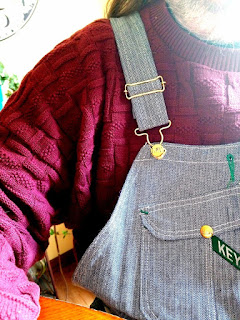
Obviously I don’t own any overalls that are redolent of “cows and hay and dung”, but I do have a couple of old pairs–vintage!–that aren’t quite holey yet, but may get there sooner rather than later.

More poems to come!

Share This Post

The Era of the Virus, one month in

First off: thus far, everyone at Casa Jaquandor is fine.

So, as of this writing, we’re roughly one month or so (however you choose to measure such things) into Covid-19’s grip on American life. This is roughly about when, in March, I started to think that maybe this wasn’t going to simply be one of those diseases that comes and goes but doesn’t amount to a whole lot. But looking at the timeline, by the 5th of March, the World Health Organization hadn’t even classified Covid-19 as a pandemic yet. That wouldn’t happen for another six days. On March 12, Tom Hanks announced that he and his wife, Rita Wilson, had tested positive for the virus while filming a movie in Australia; right around the same time, American sports leagues began canceling events, flirting with the idea of playing in empty venues, and then eventually postponing seasons altogether. From my vantage point, it seems deeply strange that these events aren’t even four weeks behind me yet.

You may or may not remember that my day job is in facilities maintenance at a large grocery store. As the food business is considered “essential,” for obvious reasons, we are not threatened with closure, which means that unless I get sick or things in the world deteriorate to the point where we do have to close (and in that case, we’d probably be looking at some kind of apocalyptic horror kind of thing), I still have a job and am earning money. The Wife also still has her job, as she can work from home (and really, how fortunate are we right now that she ended her long career in restaurant management a year-and-a-half ago!), and The Daughter has her part-time job. We’re OK. In terms of a direct hit to our lifestyle, this crisis isn’t really that big of a blow to us. We’re all pretty introverted, and mostly we stay at home anyway, except for occasional treks out to stores or restaurants. We’ve bought some takeout food, and since I’m at The Store anyway, I do my shopping on my work days, thus making extra trips on the weekends unnecessary. When we are out and about (and when I am working), we’re observing every precaution regarding social distancing and constant handwashing that we can. It seems to me that we are very well positioned to get through this mess.

There are some unfortunate sides of this, obviously. At least one of our favorite restaurants has closed “temporarily,” and we fervently hope that they can reopen once the danger has passed. This is by no means a lock, however, and it would be especially tough for us because The Wife is celiac and finding restaurants that make good gluten-free food is always a challenge. Also, as it’s become clear that this pandemic is not going to be over before May, a number of events in that month–including two that we attend each year–will not be happening. Rochester’s Lilac Festival and Buffalo’s Nickel City Con, both in May, are now officially canceled. The Nickel City Con cancellation is especially hard for me, because that was where I was going to launch The Savior Worlds (The Song of Forgotten Stars, book 4). The next event on which we have our gaze focused is my brother-in-law’s wedding in Idaho, which is scheduled for the first week of June. We’re hoping, but not optimistic. Meantime, we stay home, we cook, we read and watch our teevee shows in streaming. And we still go on walks with the doggos; at least outside is not denied us! Cane and I still do our weekly nature walks at local parks. We’ve seen more people out and about in the parks lately, which is expected, and not only that, but more people are venturing off the main roads and paved areas for the trails in the woods. Maybe more people will find themselves back in nature as they can’t go anyplace else.

And at least this happened when (a) it’s spring after a mild winter, so being outside is an option, and (b) when we’re living in a house! That’s a huge blessing for us. I can’t imagine how this long period of social distancing bordering on (if not being actual) quarantine feels for people in apartments.

If you’re wondering what it was like working in The Store through all this…it’s been surreal. As the threat started to settle in and the panic buying set in, The Store’s sales doubled in a day. It was a Thursday and it was astonishing. The only thing I’ve ever seen that rivaled it was back in 2014 when The Store was closed for four days after that seven feet of lake effect snow buried Buffalo’s Southtowns, and then everybody dug out and The Store reopened. This was truly breathtaking as all the paper products and cleaning supplies and gigantic amounts of the actual food were cleaned out in a matter of hours. I worked an extra day that week to assist with restocking on a Saturday morning, when The Store had already changed its hours from 24-hours-open to opening at 6:00am and closing at 11:00pm just to give everyone a fighting chance to regroup. At 6:10am I pulled an entire pallet of toilet paper onto the sales floor. By the time I got the pallet to the aisle 17 where the TP goes, there was only a third of the pallet left. I just dropped the entire pallet right there and went back for the next one.

TP continues to be an issue, along with paper towels and facial tissue; cleaning supplies are also only starting to filter back onto the shelves. Hand soap and hand sanitizer are also very hard to come by (we have plenty of soap and we don’t use sanitizer at home). Those first days, the pasta and pasta sauce were obliterated, as were the dairy supplies. Fortunately, I had just bought three dozen eggs and half-and-half and what cheese we needed days before, and supplies are slowly coming back as we get to needing more of that kind of thing. Also, this is an area where The Wife’s celiac disease is a kind of weird pseudo-blessing: the regular pasta was completely gone, but the gluten-free pasta, in another part of the store? Untouched. We’ve never come close to running out. In fact, as I’ve been shopping of late, I’ve been buying heavy on certain staple items. (It also helps that as an employee, I can actually go in and do my shopping before The Store even opens. Hey, we have to eat too, and my management has been very understanding of the reality that in this environment, oftentimes employees are finding essential items long gone by the time they get to shop if they wait until the ends of their shifts.)

I’ve noticed that a lot of people have no real appreciated for how supply chains work in large retail. Our stores got hammered, with sales doubling in a time that can be meaningfully expressed in hours, so of course the orders went way up; within days the warehouses were emptied. Then the warehouses passed along huge orders to the suppliers and manufacturers, who don’t maintain huge back inventories because it’s just not cost effective to do so. Demand shot up so high that supply on some items is still likely to not rebound for another week or two. Most of the people I’ve talked to during this crisis have been understanding and not jerks at all, but still, there’s a frightening degree to which the average person is unaware of the gigantic infrastructure that exists to keep them able to get to a grocery store to buy milk and bread.

And that was just the first blast. As the “shelter in place” orders came down, and as the magnitude of what has been unfolding settled in, The Store has changed dramatically. Gone are many of the large displays that filter customers in one direction or another, forcing them to look at some nifty thing we want them to buy; the recommendations for social distancing demand us to open up as much space as we can. Self-serve food bars? We had more than a dozen of these. They are all shut down now. Too risky. Same thing with the bulk foods. The cash register area had to be reconfigured with stanchions and barrier-lines, to force customers into queues, in order to minimize the length of time a customer is standing near a cashier. Just this past week, we installed Plexiglas barriers for added protection. More and more customers are wearing masks and gloves as they shop. And more and more are showing awareness of other peoples’ personal spaces, which is a very welcome development.

That’s where we are right now. I do have some politically-natured thoughts on all this, but I’ll save those for another post. For now, April is upon us. It will likely be worse than March was…but as they sing at the end of Les Miserables:

For the wretched of the earth,
There is a flame that never dies;
Even the darkest nights will end and the sun will rise!
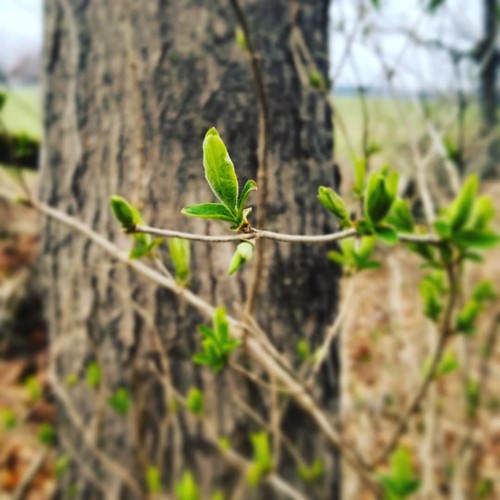
Come on, Spring! You can do it! #KnoxFarm #eastaurora #wny #spring #nature #hiking #trees

Share This Post

Poetical Excursion: Edna St. Vincent Millay and Beethoven

I won’t post a poem each day of this National Poetry Month, but I’ll try to do so as often as I can! Here’s one I found in a collection of music poetry I have, which fits right in with my year-long focus on Ludwig van Beethoven. This sonnet, by Edna St. Vincent Millay, is titled On Hearing a Symphony of Beethoven. Note that Millay does not specify which of the nine symphonies she has just heard! It could as easily be the light and good nature of the 1st, or the power of the 3rd, or the majesty of the 5th, the dance-like awe of the 7th, or the storm-turned-to-joy of the 9th.

Sweet sounds, oh, beautiful music, do not cease!
Reject me not into the world again.
With you alone is excellence and peace,
Mankind made plausible, his purpose plain,
Enchanted in your air benign and shrewd,
With limbs asprawl and empty faces pale,
The spiteful and the stingy and the rude
Sleep like scullions in the fairy tale.
This moment is the best the world can give:
The tranquil blossom on the tortured stem.
Reject me not, sweet sounds! oh, let me live,
Till Doom espy my towers and scatter them,
A city spellbound under the aging sun,
Music my rampart, and my only one.

The lines that hit me hardest here are the ninth and tenth:

This moment is the best the world can give:
The tranquil blossom on the tortured stem.

Unlike a painting or a sculpture or even a poem, a symphony (or any piece of music) can only exist in time. You can’t linger on a particular melodic moment that especially strikes your ear, the way you might stop in an art gallery to spend more time gazing upon a particular painting on the wall. Music is only meaningful in time, and thus music only exists as a momentary thing. Beethoven’s Fifth Symphony does not exist in the same sense that Michelangelo’s David exists. Every performance is a singular event, ephemeral and blossom-like.

And since we’re here, let’s just go ahead and have a Beethoven symphony. We could hardly do better to honor Edna St. Vincent Millay. Here is the Symphony No. 2 in D Major, with Daniel Barenboim conducting the West-Eastern Divan Orchestra at the BBC Proms in 2012.

Share This Post

Something for Thursday (Thank you, Adam Schlesinger)

Singer and songwriter Adam Schlesinger has died of complications from Covid-19. He was an amazingly prolific singer and songwriter who worked on his own material with his own bands, as well as songwriting for movies and teevee. I’ve heard a lot of his work…and I haven’t heard a whole lot more. My primary exposure to him came via the amazing, wonderful show Crazy Ex-Girlfriend, a show I adored with each and every episode. Here are some of the songs on which he worked.

Share This Post

April is here, and so am I

Greetings, programs! Last time I checked in I was gearing up to do a burst of edits for The Savior Worlds, as part of my effort to get it release-worthy for launch in May.

Well.

As I’m sure you’re all well aware, a month later…the world happened.

The plan was to release at Buffalo’s Nickel City Con in May, but now, because of Covid-19, Nickel City Con isn’t happening this year. And that’s not the only hiccup in the works. My wonderful cover artist got her work done and we were just starting to talk about when we could meet up to make the transfer of the art, when the world locked down.

A friend and editor at The Geekiverse, who provided one of my big sets of edits for the book, was going to meet with me to discuss plans for a whole relaunch of The Song of Forgotten Stars along with the release of Savior Worlds, but that hasn’t happened yet, either.

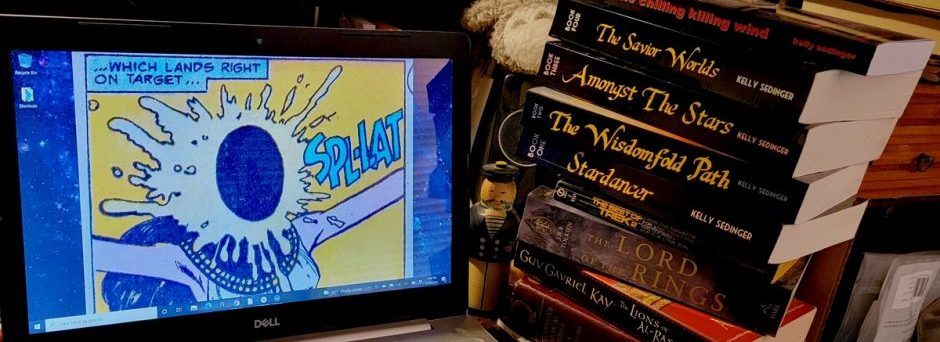
So, when will any of this stuff happen? I have no idea. When it does, I want it to be right. I’ll be revising the existing editions of StardancerThe Wisdomfold Path, and Amongst the Stars; among other things, I will be adding character lists to each book and synopses of the previous volumes in each book after Stardancer. I’ll also be tweaking the book covers, fixing font and color issues to make them “pop” more.

And let’s not forget, The Savior Worlds needs to come out, taking the story into a new era! So exciting! And so very, very frustrating to have a world-wide pandemic basically force me to slam on the brakes.

But, slam them I must. Everything will be fine, eventually, and if I take an optimistic view, I’ve been given the gift of more time to get everything done right. That’s big.

So what am I doing in the meantime? Well, my plan was to get the Forgotten Stars books revised and Savior Worlds launched, and then move on to finally drafting Seaflame! Book II (actual title TBD). Instead, I’ve moved that drafting process onto the front burner. I did a round of edits on Seaflame! Book I last fall and winter, so that story is fresh on my mind and I’m looking forward to completing that adventure.

And that’s where things lie right now, writing-wise. (As for personal observations from our Coronavirus-ridden world, I’ll save those for Byzantium’s Shores at some point. For now, we’re fine here. We are, it turns out, deeply cut out for social distancing.)

Until later, see you ’round the Galaxy!

Share This Post

Poetical Excursions, National Poetry Month 2020: Thomas Nashe

National Poetry Month is upon us.

At last–at long, long, long last–it is finally April. This March was…something, wasn’t it? In fact, there’s a joke going around online; I’ve seen a number of variations on the theme and I’ve no idea who made this joke first, but it roughly goes like this:

Wow, I just realized that I’ve been alive in seven decades!

-the 70s
-the 80s
-the 90s
-the 2000s
-the 10s
-the 20s
March

Yeah, that about sums it up. And this April is likely to be, for many of us, even worse than March was. But here’s hoping April sees some kind of turning-of-the-corner.

For me, the current crisis has yielded more time than I even usually have for digging into my internal world of music and prose and verse, and I don’t believe I have heard anything about National Poetry Month being called off just because it feels like the world is spinning off its axis. So, in addition to other things, I plan to spend time in April digging into poetry. If the current pandemic has you feeling powerless, remember: you can still enjoy poetry and explore it. There are, after all, several thousand years’ worth of the stuff to dig through.

Let’s start, though, on a somber note, for obvious reasons. This year’s celebration isn’t going to be all joy and cheer; sometimes it will be huddling around a guttering candle as the wind roars without, and sometimes it will be waiting in the dark corner as a pounding comes at the door. But it will also be occasional cheer, or, failing that, at least a shaking of the fist at the booming thunderclaps (a worthy image, that, in this year of Ludwig van Beethoven’s 250th anniversary).

Let’s start with Thomas Nashe.

Nashe was a contemporary of William Shakespeare’s, and reliable biographical information on him seems about as abundant. We have his dates as 1567-1601, but we know nothing at all about his death or where he was buried. Much of what is known about him is by inference. He did, though, live in London during outbreaks of the plague, which led him to write this poem. A Litany in Time of Plague is just that: a lengthy rumination on the inevitability and the finality of death, and the way it reduces everyone and everything, in the end, to the purest equality that exists.

Adieu, farewell, earth’s bliss;
This world uncertain is;
Fond are life’s lustful joys;
Death proves them all but toys;
None from his darts can fly;
I am sick, I must die.
   Lord, have mercy on us!

Rich men, trust not in wealth,
Gold cannot buy you health;
Physic himself must fade.
All things to end are made,
The plague full swift goes by;
I am sick, I must die.
   Lord, have mercy on us!

Beauty is but a flower
Which wrinkles will devour;
Brightness falls from the air;
Queens have died young and fair;
Dust hath closed Helen’s eye.
I am sick, I must die.
   Lord, have mercy on us!

Strength stoops unto the grave,
Worms feed on Hector’s brave;
Swords may not fight with fate,
Earth still holds ope her gate.
“Come, come!” the bells do cry.
I am sick, I must die.
   Lord, have mercy on us.

Wit with his wantonness
Tasteth death’s bitterness;
Hell’s executioner
Hath no ears for to hear
What vain art can reply.
I am sick, I must die.
   Lord, have mercy on us.

Haste, therefore, each degree,
To welcome destiny;
Heaven is our heritage,
Earth but a player’s stage;
Mount we unto the sky.
I am sick, I must die.
   Lord, have mercy on us.

Share This Post