Tone Poem Tuesday

I got nothin’, folks. Today was complete shit. Here, as is my practice in such situations, is Franz von Suppe.

Our conductor here (leading the Vienna Philharmonic in their 1990 (!) New Year’s Day Concert) is Zubin Mehta, who just celebrated his 86th birthday the other day. Mehta, by the way, was a Kennedy Center Honoree in 2006, along with Smokey Robinson, Steven Spielberg, Andrew Lloyd Webber, and Dolly Parton. What a night that was!

https://www.youtube.com/watch?v=TmGJalvsUJs

(If you’re wondering, an emergency hot water heater replacement, news that a guy I knew in high school died (I didn’t know him very well, but well enough to know that he was a nice guy), and, yes, the Supreme Court thing.)


Share This Post

National Poetry Month, conclusion: How to build your poetry collection

So you want to read some poetry!

As we have wound up National Poetry Month 2022, as a final summation I earlier reposted an older post about why it’s important for writers specifically to read poetry (besides the simple fact that poetry is art and it should be enjoyed on that basis alone). Now, I offer up some thoughts on how to start building your poetry section of your personal library. (There is an earlier post in the archives along these same lines, but I looked at it and decided it warranted rewriting.)

Like any subject, it can be daunting to approach buying poetry books if you’ve no idea what’s good and what’s not. My belief is that it’s best to start with a small collection of general poetry volumes, and then branch out into more specific areas as your poetic tastes start to make themselves known. You don’t want to fill your library with single-author collections at first; there’s time for that later on.

The really good thing about exploring poetry, though, is that since poetry has been around since we started chiseling words into rock and painting pictures on cavern walls, so too have books of poetry–so this is where your used bookstores and your library’s used book fundraiser sales can be huge. For not a whole lot of money you can stock a pretty nice little starter library of poetry! For an area of literature that is supposedly so intimidating, poetry is actually very easy to find.

Here’s a small tour of some of my poetry library. This is not exhaustive, but these books are representative of my approach.

Two copies of a very fine collection you might want to start with! It’s two different editions, separated by over fifty years, so while there is a great deal of overlap, there is sufficient difference between the two to warrant both being in my library. The later edition (right) obviously has more recent poetry, but to make room, some older work has been dropped from the earlier edition (left). The old edition was a library discard that I’ve owned for forever. There’s nothing the least bit wrong with it, so in my library it lives, and I turn to it often.

(Now, by “English” verse they’re referring to specifically English poets, not all poets who wrote in English, so there’s a companion Oxford Book of American Poetry. Which I also own!)

Sticking with collections, there is this favorite of mine:

Poetry isn’t just an English-language thing, or a Western world thing, so having a collection or two of verse going beyond the confines of English is a good idea. If you’re multi-lingual, great! You can get collections in whatever languages you have sufficient fluency to read. For me, I have to rely on translation. (This particular volume was expensive, and I bought it new, but in terms of return on investment, it’s long-since earned its keep. I do have another, older volume of world poetry that I acquired at a library sale.)

Once you start to home in on specific poets, collections of their work will become valuable. I don’t go nuts with these, but I can’t lay off a pretty Tennyson collection. I own several. The first here was a gift from The Daughter, and a lovely volume it is!

That cover is stunning, by the way; hi-res image here.

Another Tennyson collection:

One caveat about older poetry volumes like this, which turn up at library book sales: these were often used as school books a hundred years ago, so they will often have signatures inside, along with underlining and marginalia from students of many decades ago. If you’re building your own poetry reference library, this shouldn’t be a deal-breaker. (If you’re approaching this as a book collector, then have care. Nothing wrong with being a book collector! That’s just not my approach. My library is a working library.)

And then there are themed collections! Often worth owning not only for their focus, but for the commentary of the anthologists.

I should make honorable mention of this, the poetry book I’ve owned the longest. I bought this at my college bookstore in my freshman year. It’s still in good shape.

For reference volumes of American poetry, you can’t do better than the Library of America. You can join the LoA as a subscription service (they’ll mail you a book from their extensive catalog every six weeks or so, and you get to pick the ones you want), or you can search out the individual volumes on their own. Not a cheap way to go, unless they turn up at the library or a used bookstore, but these are very high-quality volumes. (LoA volumes do not provide any commentary on the works they contain, so bear that in mind.)

As you search for poetry books, you’ll come across volumes that you want not just because they contain wonderful poetry, but because they are interesting and lovely objects in themselves. This copy of the Rubáiyát of Omar Khayyám is one that I found in an antique mall one time. (Some antique malls will have booksellers amongst their vendors. Some do not. Your mileage will vary!)

Isn’t that gorgeous? Poetry really lends itself to beautiful book-making.

Here are two unique items in miniature. I should have included a 3×5 index card for scale, but the Browning book is about 3×4 inches and is less than 1/4in thick.

From the book on the left:

(Hi-res here)

Finally, you might want to have some nonfiction books about poetry in your library. Sometimes you need some background, whether it’s “What are the formal expectations in a sonnet?” or “What were the prime events in Byron’s life and how does his work fit into the poetical canon?” Books like these are good for that. (The one on the left is somewhat intimidating the first time you see it. You don’t have to read it cover-to-cover! I haven’t. I keep meaning to, but…yeah.)

As noted, this is hardly exhaustive. I could write about some collections that Garrison Keillor edited in his long years of hosting short poetry items on National Public Radio, or themed collections like my collection of Holocaust poetry or the one collecting poems about music. Or collections I own by classic poets or modern ones (poetry is very much a going concern, especially on the Internet!). I could write a lengthy post just summing up my Shakespeare collection. I haven’t had great luck with collections with titles like Poems to Inspire Americans or Happy Poems for Rainy Days (not real titles, but reflective of real titles), which in my experience tend to contain schmaltzy poetry of the type that most often resides inside Hallmark cards, but again–your mileage may vary! It’s your library. Curate it to your needs and your tastes!

And now, on to May.

Share This Post

National Poetry Month: Why Writers Should Read Poetry, part I

Reposting now that National Poetry Month is over, as a reminder to make poetry a part of your regular literary life, writers!

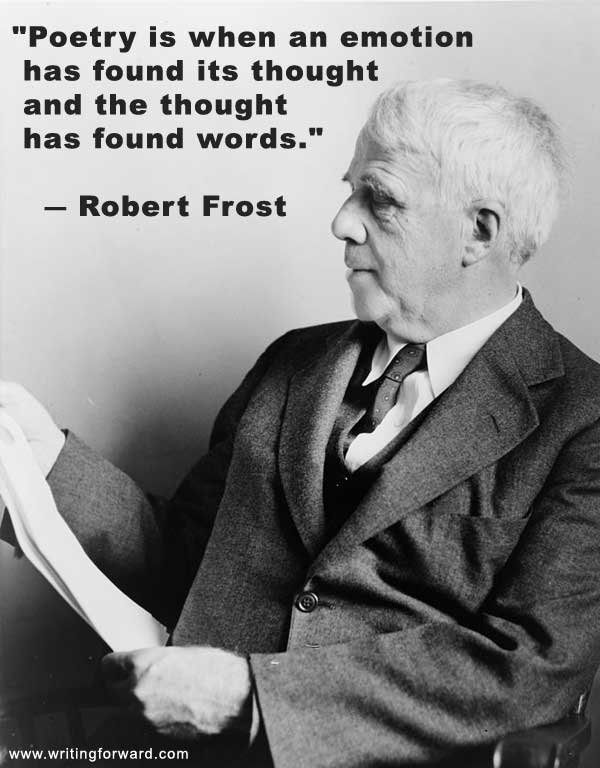
Robert Frost
Image via writingforward.com

The Death of the Ball Turret Gunner

From my mother’s sleep I fell into the State,
And I hunched in its belly till my wet fur froze.
Six miles from earth, loosed from its dream of life,
I woke to black flak and the nightmare fighters.
When I died they washed me out of the turret with a hose.

–Randall Jarrell (1914-1965)

When the Lion at his pleasure comes
To the watering place to drink, ah see!
See the lesser beasts of Al-Rassan
Scatter, like blown leaves in autumn,
Like air-borne seedlings in the spring,
Like grey clouds that part to let the first star
Of the god shine down upon the earth.

–Guy Gavriel Kay, from The Lions of Al-Rassan

April is National Poetry Month, so I’ll be doing some posting about poetry over the next few weeks, starting with this. Should writers read poetry? Should they write it? While I would never presume to tell writers what they should or should not write, I tend to think that the answers to both questions are Yes.

I have occasionally committed acts of poetry myself, but not very often, and as I don’t generally find the results particularly encouraging, I don’t intend to share them except as very brief excerpts in my fiction. I do, however, read a decent amount of poetry, and I firmly believe that all writers should do so.

It all comes down to what Stephen King called “the writer’s toolbox,” and his dictum that to be a good writer one must read a lot and write a lot. Reading a lot extends a writer’s grasp, and reading poetry extends it in ways that reading a lot of fiction does not. If writing is likened to carpentry–extending Mr. King’s metaphor a bit–than reading poetry is like learning entirely new methods and techniques. A new way to stain a piece of wood, say, or perhaps a new method of joinery.

While poetry can certainly be read for its technical aspects, I find myself concentrating much less these days on things like rhyme or meter than I did when I was reading poetry in school. What I’m after now is the language itself. I read poetry to see, in new ways, just what language can really do.

Consider metaphor. Here’s a poem called “Up-Hill”, by Christina Rosetti:

Does the road wind up-hill all the way?
Yes, to the very end.
Will the day’s journey take the whole long day?
From morn to night, my friend.

But is there for the night a resting-place?
A roof for when the slow dark hours begin.
May not the darkness hide it from my face?
You cannot miss that inn.

Shall I meet other wayfarers at night?
Those who have gone before.
Then must I knock, or call when just in sight?
They will not keep you standing at that door.

Shall I find comfort, travel-sore and weak?
Of labour you shall find the sum.
Will there be beds for me and all who seek?
Yea, beds for all who come.

I suppose the metaphor here is pretty obvious: the road that is being walked here is life itself, and the inn at the end that cannot be missed and has beds for all who come is death. That’s not especially hard to see. But the craft of the metaphor is what’s interesting here, and in my experience, metaphor is best explored via an industrious reading of the poets.

Then there is description. Writers often worry about description: what’s too much, what’s too little, which details are best to utilize in painting a word-picture, which details are best left aside. As much as I love the work of JRR Tolkien, Alexandre Dumas, and Victor Hugo, the fact is that writers these days are not given as much space to craft their descriptions as in decades or centuries past, so we have to be careful.

This is where reading poetry can help us. Take this short verse by Tran Nhan-tong, a Vietnamese emperor and poet who lived from 1258 to 1308:

The willows trail such glory that the birds are struck dumb.
Evening clouds balance above the eave-shaded hall.
A friend comes, not for conversation,
But to lean on the balustrade and watch the turquoise sky.

(translated by Nguyen Ngoc Bich, in the collection World Poetry)

So few details! In fact, there are almost no details given here, just statements of fact. But can anyone read this and not create a mental picture of a summer evening, looking out at the willows beneath a turquoise sky dotted with clouds? If they can, I don’t know how.

And then there is rhyme and meter and alliteration and all the other various things that our high school English teachers tried teaching us. Those are all wonderful tools that you can use in your storytelling. For all our focus on things like plot, character, and world building, ultimately the spell that our stories cast is deeply dependent on how we use our language. That’s where so much of the real magic lies, and this is best learned by reading poetry with an eye to what the language is doing.

Next up: Where to start?

Share This Post

First Spring adventure

Last Sunday, Cane (the Dee-oh-gee) and I went out for a Sunday walk in the park for the first time since December. Why no outings since then? Well, we got back from Oahu just in time for the weather to shift into a much colder and snowier pattern; where the WNY winter until the end of December had been very mild, it pivoted hard in January to being snowy enough and cold enough for Buffalo to take this year’s title as Snowiest City In America. Oof. Plus, there’s the fact that Cane isn’t a spring chicken anymore. He’s 9-and-a-half as I write this, and while he’s still got tons of spunk and energy, he’s not as springy as he once was, so I have to be a bit careful about our adventures. I can’t just throw his leash on him and go for a four-hour hike someplace.

But still…he was thrilled to get out!

[Insert Morgan Freeman delivering monologue about hope]

Someone peed here.

Posing him for the camera remains a challenge.

We went to Knox Farm State Park, a favorite haunt of ours in East Aurora. Even though we’re over a month into spring, in this part of the country we’re only just now starting to see the first hints of spring’s awakening. We’re getting there, though. Today is May 1. It can only get greener from here. (I’ll spare you my usual rant about Spring being WNY’s worst season.)

And if you’re wondering why Carla rarely gets featured in these walks, it’s mainly because she really doesn’t like riding in the car, for reasons we’ve never been able to figure. That sucks! She loves being in new places and being outside, but she is so miserable in the car that we always feel terrible about that part of things.

She is enjoying the greening of our yard, though. Witness:

Elmer Fudd can have “Wabbit Season” and “Duck Season”. Carla is all about “Mud Season”!

As I’m writing this it’s a sunny Sunday morning, but there’s rain in the forecast in the next couple of hours. Sigh….


Share This Post