President Carter

I’m sure we all know by now that former President Jimmy Carter is accepting hospice care, rather than continuing to seek treatment for various health issues. Carter is 98 years old; he was elected President over 46 years ago, and he left office over 42 years ago. Carter’s presidency did not go smoothly, but his post-Presidency has been amazing to behold as he has tirelessly championed democracy and other humanitarian causes for decades since leaving office. I expect the historical verdict on Jimmy Carter will likely remain some variant of “Not a great President, but a great man nonetheless.”

Jimmy Carter is the first political figure of whom I was genuinely aware, although admittedly with a very immature understanding of anything at all. I remember hearing about him from my kindergarten teacher and thinking “A peanut farmer wants to be President! Cool!” I had no idea what a “President” was; I vaguely recall asking one of my parents that very question, and getting a response that “He’s the boss for the whole country.” I pictured someone like my school’s principal, going all over the country telling people what to do.

President Carter also angered me as a young sci-fi geek when he chose the evening of ABC’s broadcast of the premiere episode of Battlestar Galactica for the signing of the Camp David Accords. I mean, when you’re a kid sitting down to watch a highly-hyped teevee show with explodey-spaceshippy goodness, nothing throws you into a state of infuriation quite like the screen going dark and suddenly the words “ABC NEWS SPECIAL REPORT” coming on. I’ve made my peace with this more recently, though. (“Harumph,” though, says my inner 7-year-old.)

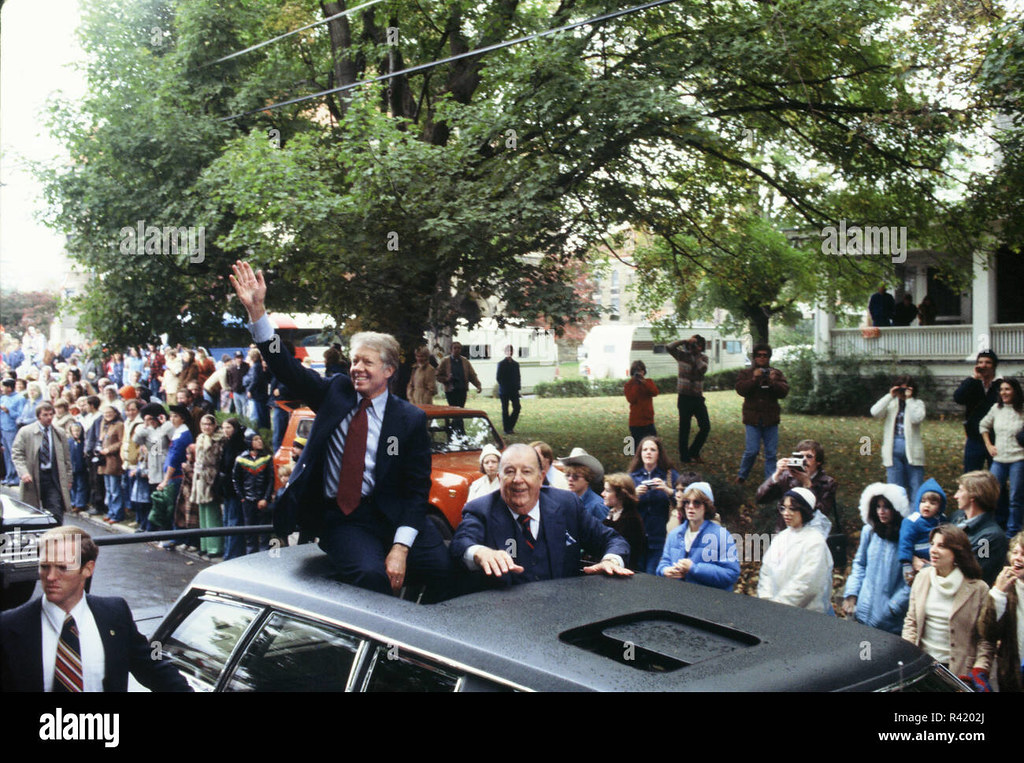
All was forgiven, though, just a couple of weeks later. At this time we were living for a year in Elkins, WV, and the town’s annual festival, the Mountain State Forest Festival, was coming right up, in early October. That year we learned that President Carter himself was coming to Elkins to walk in the parade. We were in the stands along the main street that day, and finally, after what felt like hours (it might have actually been hours), the parade began, and suddenly, there he was: the President of the United States himself, walking in the street and waving, beaming that famous smile of his. Then he climbed into his limousine and I thought “That’s it?” But up he popped from the sun roof, waving some more. Not long after he was gone. I actually found the President’s briefing book from that day–apparently he gave a campaign speech that morning for one of WV’s senators, before driving in the parade–and by late afternoon, he was back at Camp David. I also found these two photos from that day:

Looking at this, I can’t believe how close those spectators were allowed to get to the President!
Not sure if the guy in the tan overcoat is a Secret Service guy or not; he kind of looks like Hamilton Jordan, President Carter’s White House Chief of Staff.

To this day, President Carter remains the only US President I have ever actually seen. The closest I’ve come since? A campaign rally in Erie for Michael Dukakis in 1988, and a couple of times when Presidents Bush the Younger and Obama flew into Buffalo, and I saw Air Force One from the parking lot of The Store.

Anyway, best wishes to President Carter as he begins this journey with as much grace as he seems to have pursued all of his previous journeys.


Share This Post

On “Phneh” and manufactured outrage

So, America’s right-wing has been complaining about an AI chat-bot gizmo the last day or two. Why? Because someone got the idea to hit the AI chat-bot gizmo with a hypothetical situation: there’s a ticking time bomb and when it goes off it will kill millions! But it can be defused by simply calling it a racial slur.

And the AI chat-bot gizmo said, “No.”

Cue the colossal weirdos. Here’s a good and satisfyingly pithy summation of this lunacy.

So much of what passes for “outrage” nowadays is purely manufactured outrage. It’s people not being actually outraged by something outrageous, but rather choosing to be outraged at something they have interpreted through tortured logic into something outrageous.

I have an actual example of this that I remember from my college years.

I was a Philosophy major, and we often delved into some very esoteric topics; and like any group of people studying the esoterica of a given field, we occasionally invented jokes that were probably the extreme version of “You had to be there.” One such bit of philosophy humor came in my Senior year, when I took “Contemporary Analytic Philosophy.” This class was devoted to the Philosophy of Language, as shaped by figures like Bertrand Russell in the early 20th century. Without getting too deep in the weeds here, one issue we discussed was the relationship between words and meaning: do words have inherent meaning, or do they only mean what we decide they mean? Putting this as a thought experiment: Just after the Big Bang, when the universe was just a week old, did the word cat still mean the four-legged beast we all know?

Yeah, I get it. Esoteric stuff. Boring, even, if you’re not a kinda-sorta wannabe 21-year-old intellectual.

But a friend and I decided that there should be a word that has no meaning. None. And not in the sense that “it can mean what you want it to mean!”, like a linguistic wild-card: the word has no meaning. Any time you utter this word, you have expressed no meaning at all. It’s like a linguistic version of the empty set.

The word we coined? Phneh.

We thought this was the funniest thing. We actually spread this around our circle, as only college kids can do. We discussed how even the linguistic representation of Phneh was unable to truly capture the meaninglessness of Phneh, which we illustrated through a notion ripped from Zen: “The finger pointing at Phneh is not Phneh itself.”

Look, you had to be there, OK?

It was all fun and games of the pseudo-intellectual sort until I took a marker, scrawled Phneh on a piece of paper, and stuck it on the bulletin board in the student lounge of the music building.

People would see it and say, “What is that?” And I’d explain the concept. Most people got it and if they didn’t see the goofball 4th-year Philosophy student humor of it, they at least went “Oh, OK” and wandered off, ignoring it.

One guy, however, did not.

This guy got really bothered by Phneh.

Like, really bothered by it.

It just annoyed the shit out of him that I would dare put a piece of paper with a meaningless word up on the bulletin board. So he started tearing it down.

I, of course, seeing an opportunity to take jabs at an easily-annoyed person’s tender spot, kept right on putting our meaningless word back up on the bulletin board, and he kept tearing it down. I figured he’d get bored with the whole thing–by this point the joke had likely well exceeded its sell-by–but not only did he not get bored with his fight against a meaningless word that had literally just been made up a month or two before by a couple of philosophy dweebs, he actually ratcheted it up. He started posting hand-written warnings of his own about the improper use of the bulletin board; then one day he showed up in the lounge with his girlfriend’s laptop (this was 1993, when laptops weren’t anywhere near ubiquitous, so to show up someplace and use one visibly was mostly showing off at that point) to type up a Very Official Memorandum in which he cited some actual shit from some college rulebook someplace about the use of bulletin boards and the required permission needed to post anything at all.

At this point some other folks were starting to think he was making an ass of himself; one person asked, “So unless we have official permission, I can’t post something about a party my housemates and I are hosting next Friday?” or “Do I hafta take down my ‘available for tutoring’ notice?” And he’d offer mealy-mouthed justifications as to why those were OK but Phneh was not. It was plainly obvious that his weird crusade, now being carried out under some kind of quasi-official (at least in his own head) banner, was directed at one thing and one thing only.

Eventually, though, someone asked him the money question. It might have even been me that asked, but I don’t recall, honestly. But someone did ask him: “If it’s a meaningless word, why are you so bothered by it?”

His response: “If it’s meaningless then I can interpret it as being offensive, which means it is offensive.”

That is, as near as I can recall, his verbatim response. And in all honesty, this response just stopped me in my tracks. I’ve never been a good verbal debater; I’m not often quick with a response, especially when the logic I’ve just been offered is so obviously bad that it takes me a bit of time just to wrap my head around the notion that someone has offered up their argument at all, much less processing all the ways it’s bad. All I could manage, when I recovered my wits enough, was to ask, “So…when you encounter something and you don’t know what it means, you first assume it’s ‘offensive’ until you learn otherwise?” He had a mealy-mouthed reply to this that I did not commit to memory.

Later on I related all of this to my former classmate with whom I had coined Phneh in the first place; in the meantime he had left that college to go to another that offered a drama program. When I told him this story, he laughed so hard I thought he was going to fall on the floor. He found the whole thing hysterical, and when he stopped laughing he said, “Why would you voluntarily offend yourself?”

That was really the heart of it, wasn’t it? The guy was offended, obviously. But equally obviously, he wasn’t offended by anything I had said or done, because there was literally no offense to be found there. He had manufactured his offended state, all by himself. All I gave him was the impetus to get offended, but I gave him nothing to be offended about.

So yeah, that was my first experience with manufactured outrage. This guy in college got himself worked into a holy lather that he manufactured out of whole cloth, over a completely meaningless thing that I and a friend had in turn manufactured out of equally whole cloth. The whole episode was one of the weirdest damned things I remember from my college years. I am shaking my head in disbelief as I write this about it. That incident has, as the kids say these days, lived rent-free in my head since 1993.

But that really is what manufactured outrage is, isn’t it? It’s exactly like what all those right-wingers got all upset about last week when a computer program couldn’t be tricked into saying the N-word. It’s amazing how much gets decided, policy-wise, on the basis of manufactured outrage. And not just policy: in his book On Writing, at one point Stephen King discusses all the angry mail he got when an evil character in one of his novels killed a dog. And he’s thinking, “The guy is evil and he does evil things, it’s kind of the whole point of that novel, and also, the guy isn’t real and the dog isn’t real!” (Bad example for me, maybe; for obvious reasons I am now much more sensitive to the fate of fictional dogs.)

So how did the whole Phneh crusade turn out? Well, I guess he won, because ultimately I got bored and moved on to other things and there’s only so much amusement to be gained from poking someone in their sensitive spot, even if the spot is only sensitive because they got up that morning and decided they were sensitive about it. But a few days after the last conversation about all this, the Music Building’s secretary expressed exasperation to me: “I shouldn’t have to field complaints from people about a nonsense word!” As if it was all my fault. (Well…maybe…but anyway) I responded, “Is it people, or is it one person? And you yourself just said it’s a nonsense word, so why are you taking the complaints seriously?” She didn’t have a good answer to that, either. But that’s when I decided to start hanging out someplace else for a while, having decided that maybe I shouldn’t wear out my welcome through use of a word that literally had no meaning.

It’s always worth asking ourselves, though, when we feel our outrage meter rising, “Is this a real thing that I should be getting outraged about?” Because the answer might well be, “No.”

Share This Post

First They Came: Holocaust Remembrance Day

(via)

Today is Holocaust Remembrance Day. And while our memories should be of all the lives snuffed out, and the loss to humanity when someone decided that these six million here, these millions of others there could be done without, I can’t help remembering this chilling photo. These are just coworkers enjoying each other’s company–only, these are SS personnel working at Auschwitz. Coworkers taking time to laugh and blow off steam with each other…when their job is industrialized murder.

We would do well, in our own time, to remember that monsters aren’t always monstrous. They eat and they laugh and they smile and they have fun. That’s what makes monsters truly scary: not how monstrous they are, but how like us they are.

First they came for the Communists
And I did not speak out
Because I was not a Communist
Then they came for the Socialists
And I did not speak out
Because I was not a Socialist
Then they came for the trade unionists
And I did not speak out
Because I was not a trade unionist
Then they came for the Jews
And I did not speak out
Because I was not a Jew
Then they came for me
And there was no one left
To speak out for me

–Pastor Martin Niemoller

Share This Post

MLK

This is our hope. This is the hope and conviction that all men of goodwill live by. It is… the conviction that all reality hinges on moral foundations and that the whole cosmic universe has spiritual control. It is, therefore, fitting and proper that we assemble here, just two years after the Supreme Court’s momentous decision on desegregation, and praise God for His power and the greatness of His purpose, and pray that we gain the vision and the will to be His co-workers in this struggle.

Let us not despair. Let us not lose faith in man and certainly not in God. We must believe that a prejudiced mind can be changed and that man, by the grace of God, can be lifted from the valley of hate to the high mountain of love.

Via Roger Green.


Share This Post

The Indecision of Mr. Goodell

I’ve had this ESPN article loaded in a tab for almost a week now, without reading it. I figured a bit of distance would make the article less likely to make me angry.

It didn’t work.

As I write this, the Buffalo Bills are gearing up for a playoff game in a few hours. The Miami Dolphins are in town, but it’s not even so much the opponent as the feel that maybe this is the year the Bills finally make that long-dreamt-of Super Bowl run–the one that ends in the Lombardi Trophy being brought, at long last, to The 716.

The Bills’ season has been a tough one with a lot of peaks and valleys–and one deep, deep dive that ended up being national news that put the NFL in a very uncomfortable spotlight. Before the 1st quarter was even over in the Bills’ game against the Bengals a couple of weeks ago, safety Damar Hamlin made a tackle and then collapsed of cardiac arrest. What unfolded was one of the scariest sequences ever seen on an NFL field, a scene that involved Bills trainers and medical personnel applying CPR to Hamlin, Bills and Bengals players openly weeping, Hamlin being whisked away by ambulance, and then almost a full hour of chaos and indecision as to the status of the game itself.

Historically, the NFL’s approach to catastrophic injuries has always been: Get the player attended to, get them off the field and to proper medical care, and then the remaining players get a few minutes to warm back up and get the game back on. It’s been the approach for every injury, including such awful ones as Mike Utley (who never walked again) and Kevin Everett (whose injury was later learned to be life-threatening). At one point somehow the word got to the players: “Start warming up, play will resume in a few minutes.” Some players did start warming up. Others did not, or could not. The game’s announcers reported that they had received word that the game would resume, but later NFL officials would deny this to the hilt. This strains credulity something fierce, as it’s hard to imagine announcers just making up something like that.

Yes, previous practice has been to eventually resume the game. However, the Hamlin injury was something else entirely. This wasn’t “stabilize the injured player”; there was no Utley-esque “thumbs-up” gesture forthcoming. This was CPR being administered to a player right on the field. This was literally “We do not know if this player is going to survive the next five minutes. We do not know if this player will leave the stadium alive.

As catastrophic as injuries like the Utley and Everett injuries were, what happened to Damar Hamlin was orders of magnitude worse.

And for the NFL to not have a policy in place for this is, to me, unconscionable.

I’ve had several discussions with other fans about this, some of whom agree with me, others of whom think that this was really an unforeseeable event, a circumstance nobody could see coming. The NFL couldn’t possibly have a plan in place for what to do in the event a player dies on the field.

And no matter how much I hear that sentiment, however earnestly expressed, my opinion remains: Yes, they could; yes, they should; and that they apparently didn’t is dereliction of duty.

The violence of the NFL game is well known. Hell, the violence of the NFL game is one of its selling points. There’s a reason the NFL surrounds itself with the trappings of military service and whatnot (which is partly why Colin Kaepernick’s silent, visual protests were so effective). There’s a reason the NFL drapes itself with war-like terminology. Offensive and defensive linemen are “in the trenches”. The quarterback is the “field general”. Teams are said to be going into battle.

Every hard hit gets replayed again and again, all the more if the field microphones happen to pick up the sound of the collisions. Many times you can hear the stadium crowds going “Oooooh!” after particularly violent hits. Football can be a beautiful game to watch, but let’s be honest: its popularity is in large part because football scratches the same itch that the citizens of Rome used to scratch by going to the Coliseum to watch lightly-armed gladiators square off against angry, starving lions. Football is a game whose dangers were quietly swept under the rug for many years, until enough former players were showing symptoms of brain damage that it couldn’t be ignored anymore.

Every fan I’ve known has said, at one point or another, “Sooner or later, someone’s going to get killed playing this game.” That’s not just random thinking by idle fans, either; former referee Ed Hochuli has indicated such fears in the past as well. Yes, what happened to Damar Hamlin is unprecedented, in that we’ve never seen a player stricken on the field to the point they literally required life-saving measures right then and there. But that’s not the same thing  as unforeseeable.

The narrative that took shape in the hours and days after the Hamlin injury was that there was indecision and a lack of clarity from the NFL offices for almost an hour, and that the decision to finally suspend the game was not a clear decision made for obvious reasons by the league’s highest officials (according to the NFL rules, it’s the Commissioner’s call and no one else’s), but rather a forcing of the NFL’s hand by the players and coaches who were understandably rattled by what they had seen happen to one of their own, up close and personal. Those players and coaches had a traumatic experience of their own, and the narrative quickly formed that it was those players and coaches, plus officials from the Players’ Union, who forced the NFL into finally shutting the game down.

The ESPN article confirms this narrative. The NFL really was in a state of indecision. Troy Vincent, one of the highest officials in the League, really did screw this up, and he really did try throwing other people under the bus when the League’s hour of clueless indecision became clear.

I refuse to excuse the NFL on this. The language could be so very simple:

In the event that a player suffers an emergency during a game that requires life-saving care up to and including CPR, the game shall be suspended, regardless of how much time of game play has taken place.

What happened to Damar Hamlin that night was awful and scary…but given the nature of the game, the last thing is was was inconceivable. Every NFL observer I know has conceived of an instance of a player losing his life on the field.

The National Football League generates money in the billions. The owners are the richest group of people anywhere. And the NFL runs events year-round that are huge logistical challenges. Crowd control, food concessions, safety and security–all of these are things the NFL does every single day. And when you’re planning for events of the magnitude of an NFL game–think of all the moving parts in making an NFL game happen, and how much planning has to be done for them, and how much policy has to be made to streamline it all–you also have to have plans in place for emergency events that take place during these events.

For this one circumstance to render the NFL clueless as to what to do, even for an hour, strains the imagination, and it would have been so even thirty years ago, before the NFL spent much of the last decade pushing hard on “safety” requirements like concussion protocols, limits on practice time and physical exertion therein, and so on. It should have been clear almost as soon as the ambulance was on the field that the game was done. The players should never have been in the position of wondering or warming back up, and the coaches and refs should never have been playing phone tag in the middle of the field with the NFL offices in New York City.

Obviously a big factor here is money. That game was the NFL’s wet dream: a late-season night game, nationally televised, featuring two of the best teams in the entire NFL with the home QB being a rising star and the visiting QB being virtually a superstar, with playoff position on the line. It was the single biggest Monday Night Football game in years, and before one quarter was up, it was in jeopardy. I’m sure that the NFL was suddenly terrified of losing the ratings money.

And then there was a week of indecision as to what to do with the game itself, now that they had suspended it and sent everybody home. Here, too, there needs to be an actual policy. Not a wish-list, not a “Hey, maybe we can do this!”, but an actual policy of what happens in the event a game is suspended.

NFL seasons are only 17 games long, with games happening once a week. The NFL isn’t like baseball where you can say “OK, Royals-Twins got rained out on May 12, so we’ll squeeze that one in when they meet again in July.” NFL games rarely get postponed, and almost never when they are in progress; usually it takes a natural disaster or major weather event to intercede. Games are more often relocated (this happened to the Bills earlier this very season, when a snowstorm forced a home game to be moved to Detroit) than outright canceled.

But here, too, major events sometimes have to be canceled. And the NFL had no idea what to do in that case.

I don’t pretend to know what the policy should be, though my personal opinion would be simply this: In the event of a catastrophic event requiring the suspension of an NFL game in progress, the game shall be entered into the standings as a tie. Who knows, maybe do like MLB does and posit an official length-of-game whereupon the score would simply stand as final. Maybe the NFL’s rule could be this:

In the event of a catastrophic event requiring suspension of a game in progress, the game’s score shall be counted as FINAL if less than 22:30 remains in the second half. If the game is suspended prior to that, the game shall be entered as a TIE in the standings, though all game stats shall still count toward the players.

That’s just a suggestion, but there really should be a simple policy governing these situations. Otherwise, you end up with the NFL taking days to think through various scenarios because this game happened to be important for playoff-seeding purposes. The decision to not make up the game would have come within hours of the game’s suspension if it had been some late-season tilt between two teams vying for high draft position–Texans-Colts, perhaps. The approach should be the same no matter what game it is, and I find objections along the lines of “Oh come on, the NFL has never been in this position before!” deeply unconvincing, because these are billionaires running billion-dollar businesses. If we’re going to accept the existence of billionaires (now there’s a subject for another time) and treat them as the elite of our society–which we absolutely do, let’s be honest–then we should also tailor our expectations of them upward.

My overwhelming impression on the night of Damar Hamlin’s injury was that the NFL was exposing itself as a flat-footed, indecisive mess, and not one thing I’ve learned since has altered that impression. Even now I can feel the NFL heaving a big sigh of relief: Hamlin is recovering well, though his football future is cloudy. The playoffs are here (Jeebus, Chargers, did y’all have a big turkey dinner at halftime or something?!), the Bills play the Dolphins today, the Bengals are still there and ready to make a run of their own, and so on.  There might still be some controversy, particularly from Chiefs fans who are pouty that they don’t get to host the AFC Championship Game if it ends up being Chiefs-Bills, but the feeling now from the NFL that I’m seeing is “Wow, we dodged a bullet there!”

I don’t think the NFL should be let off the hook, is all I’m saying. Expect better from your billionaire masters, folks.

And oh yeah, Go Bills.

Share This Post
All right, who left all these tabs open? Somebody’s gotta clean this shit up!

Yeah, it was me. I left the tabs open. Time to clean house!

::  Is Byron Brown the worst mayor in America?

This piece, in a local site for investigative journalism, came out in the wake of the recent blizzard during which 40 people died and also during which Mayor Brown was pretty much a nonfactor, if not directly MIA.

Problem is, if Brown is the worst mayor in America, whose fault is that?

As Jim Wright often says: If you want a better nation, start by being a better citizen.

::  Cook For Iran: Making Khoresht-e Bademjoon When I’m Homesick

Sarah Gailey is running a feature in which people wrote in with personal stories connected to the recipes to which they return again and again, and this was the first installment. If this is how the series starts, it’s going to be something special to watch unfold.

::  Hubble observes a star being devoured by a black hole.

::  Pizza boxes suck.

A pizza box has one job—keeping a pie warm and crispy during its trip from the shop to your house—and it can’t really do it. The fancier the pizza, the worse the results: A slab of overbaked Domino’s will probably be at least semi-close to whatever its version of perfect is by the time it reaches your door, but a pizza with fresh mozzarella cooked at upwards of 900 degrees? Forget it. Sliding a $40 pie into a pizza box is the packaging equivalent of parking a Lamborghini in a wooden shed before a hurricane.

Having spent four years in the 90s putting pizzas in boxes, I can attest that indeed, the pizza box isn’t the best thing in the world. However, a big problem is in the pizza itself; unless you’re the person who never eats more than a single slice, the texture of the pizza is already changing from the time it comes out of the oven. If the texture you encounter in the first slice within minutes of emerging from the hot box is your Platonic ideal, you’d best stop eating after that first slice, because with the second slice, things are cooling and congealing and the crust is absorbing moisture again. The best the box can do is vent steam through those little vent slots, but if you got delivery and the box got shoved into that thermal bag? Fuhgeddaboudit!

I’m not sure what the solution is here, but maybe a part of it lies in Americans getting beyond crispy being the texture they desire in so many foods. (Oh, and the best way to reheat leftover pizza is not in the microwave or the oven. It’s in a pan on the stove. That way you can, yes, crisp up the crust again, and slap a lid on it during the last minute of reheating it to get things good and melty again.)

::  A Brazilian art collector claims that a Van Gogh painting on display in Detroit belongs to him.

The art world is wild, innit? This is a fascinating story and I’ll be interested to see how it plays out:

A painting by Vincent van Gogh on display at the Detroit Institute of Art was stolen, a new lawsuit claims.

The lawsuit was filed on Tuesday by Brokerarte Capital Partners and its sole proprietor, Gustavo Soter, a Brazilian art collector. It claims the DIA borrowed the painting from an unnamed party that is not its legal owner.

The painting in question is an 1888 oil called Une Liseuse De Romans, or The Novel Reader, which shows a young, dark-haired woman reading a yellow book. It is on show as part of the Van Gogh in America exhibition, which features 74 works by the Dutch post-impressionist, borrowed from 50 sources.

According to the lawsuit, Soter purchased the painting in 2017 for $3.7m, whereupon “a third-party immediately took possession of the painting”.

The suit says Soter “never transferred title to or any interest in the painting to this third party. Since the third party took possession of the painting in May 2017, plaintiff has not known the painting’s location.”

Hat tip to Nerdishly, who actually saw the painting in question before this story broke.

::  Should I divorce my husband after the insane stunt he pulled at our wedding?

The stunt? This:

My only hard-and-fast rule was that he would not rub cake in my face at the reception.

Being a reasonable man who knows me well, he didn’t. Instead, he grabbed me by the back of the head and shoved my head down into it. It was planned since the cake was DESTROYED, and he had a bunch of cupcakes as backup.

The advice columnist advises:

I think what he did was a red flag about not respecting you and your wishes—to say nothing of the physical aggression—but even if it wasn’t, the fact that you really didn’t like it is enough. Make a mental note about which of your loved ones don’t seem to value your happiness, and continue with your divorce.

And maybe this is surprising coming from a fan of the pie-in-the-face, but I couldn’t agree more. What this guy did was shitty and disrespectful, and it was aggressively so, right in front of everyone. There is nothing lovable about violating someone’s wishes in so brazen and humiliating a way.

(If anyone’s wondering, no, The Wife and I did not do that cake-smashing bullshit at our wedding. I honestly think it’s stupid and tacky and I’ve hated it at every wedding I’ve seen it happen at.)

OK, that’s all my open tabs! Yay! Time to open more tabs!


Share This Post

“Inedibility”

I posted a version of this on Facebook earlier and then deleted it when it annoyed someone over there, but it’s stuck in my head, so here it is.

Food is a major topic in my reading and teevee watching. We watch a lot of cooking shows, and I read a lot of books about food, going beyond cookbooks. Reading about food is often a great backdoor way to learn about other cultures, about history, about people, and more. Everybody eats, right?

But I do have one big pet-peeve that annoys me every time I see it in food writing or in food commentary. That peeve is use of the word inedible to mean “I don’t like this food.”

The most recent example of this, which I saw online earlier, is a chef/restaurateur named David Chang, who is apparently the guy behind the Momofuku chain of restaurants. I’ve heard of Momofuku, and I’ve likely seen Chef Chang at some point on teevee–he has to have shown up on the Food Network or as a guest judge on MasterChef, I would assume. Aside from that, I know nothing about the man, but I saw a link on Facebook to an article where he apparently voiced his negative opinion of the rotisserie chickens at Costco.

Now, I do not have a specific dog in that fight. As admitted, I know nothing about Chef Chang, and I have never tasted a Costco chicken. (As of this writing the Buffalo area still doesn’t even have a Costco, and while one is coming, it will be in the terrible stretch of Niagara Falls Blvd. in Amherst to which we never go.) I have no idea if the chickens are great or not. That’s not the point.

What bugged me is that apparently Chef Chang couldn’t just talk about them being not to his liking, or why he thinks their preparation is lacking, or what errors he thinks Costco makes with the seasoning. Apparently he had to refer to the chickens as inedible.

I have to be honest here: I find that use of inedible really lazy and annoying. There is nothing about those chickens that is “inedible”, unless Chef Chang has some allergy. Whenever a “foodie” uses the word inedible in this way, what I hear is, “My personal palate is so advanced that I cannot bring myself to even swallow this food, and if you can, there is something wrong with you.”

This use of inedible reminds me of an old schtick from the early seasons of Hell’s Kitchen. We still watch this show, even as it’s become really repetitive to the point of being paint-by-numbers. Each season begins with the contestants all being tasked with cooking their “signature dish” for Gordon Ramsay to taste, and he goes through the batch judging each dish and assigning points to the two teams. He’ll say something like “That filet is very well-done, good seasoning, nice job”, or, on the flip side, “The fish is well-cooked, but the puree is bland, too bad.”

Back when the show started, though, Ramsay would have, shall we say, much more dramatic reaction if he didn’t like the dish: He’d take a bite, chew it, then he’d fake gagging, grab a trash can, and do a dramatic rendition of someone vomiting. It was always pretty obvious that he wasn’t actually sickened by the food, and this act has vanished from the show.

That, to me, is the equivalent what calling food inedible just because you don’t like it.

Pizza Hut Pan Pizza is inedible to The Wife, because she’s celiac and it would make her sick. Hemlock is inedible to me and chocolate is inedible to Carla, because those things are poisonous to humans and dogs, respectively. But as much as I hate the stuff, broccoli is not inedible to me.

So, foodies of the world, stop referring to food you dislike as inedible. There are lots of words you can use instead. Yes, maybe this annoys me more than it should, but that’s what a pet-peeve is, right?

Share This Post

A Tale of Two Buildings, and other thoughts on The Christmas Blizzard

I make no secret that my day job is doing Facilities Maintenance at a large local grocery store. At my particular location, there are two buildings. The older building, built in 1977, originally housed The Store until 1996, when the second building went up to contain the new, expanded Store. The older building now houses a few smaller businesses, but my company still owns and maintains both buildings.

The new building, with The Store, is powered from the utility company via lines that connect from streetside poles to the main transformers. The old building was powered by a buried utility line that ran from a streetside pole, into the ground, and under the parking lot until it met that building’s main transformers. In the last few years, I’ve seen both of these power systems fail, each time on the utility side. What happens is that the power goes out in the building, and then the electricians we contract are called on an emergency basis to assess the situation and determine if repair is their responsibility or if it is on the utility side, in which case the power company has to come out.

When the power went because of a pole-transformer malfunction to the new building, it took probably about an hour for our electricians to arrive and determine where the issue was; then it took another hour for the power company to arrive with a crew and a truck with a boom-lift on it; then another hour or maybe two for the repair, after which our electricians were able to re-energize The Store. The outage began early in the day, and we were back up and running before noon.

In the case of the old building, the outage similarly began early in the day–actually, this one was overnight. It wasn’t a complete outage, which made diagnosis difficult; it was hard for our electricians to determine if the problem was actually on the building side or on the utility side, and they had to wait for the utility folks to arrive. It was also hard for the utility folks to make the determination where the problem was, since the main utility line was underground, running beneath half the parking lot and a driveway. Eventually, however, it turned out that the buried power line was the problem and the utility supply line needed replaced. So there were two options here: bury a new line, which would mean digging up a whole lot of ground and pavement, laying the line, replacing the ground and repaving, or, installing a new pole and running a new utility line from the street overhead.

Because of time and expense, they went with option B: a new pole and an above-ground, in-the-air supply line.

This installation still took over a day, with the workers working overnight to install the new pole, run the new line, make the connections, and get everything energized.

Why am I bringing this up?

Because my region has just come through one of the nastiest winter storms anyone can recall, and as I write this, there are still several thousand people without power in the City of Buffalo. Many of these outages were caused by downed power lines, when poles collapsed after withstanding many hours of winds exceeding 60mph. I saw a lot of people on social media screaming about how antiquated our electrical infrastructure is, and why can’t they just bury all the lines and be done with it!

That’s a problem with our public discourse in the face of disasters, isn’t it? People just throwing out suggestions–Bury all the power lines!–as if they’re the least bit realistic or reasonable. No one in these conversations seemed to consider for one second the magnitude of an infrastructure project that would be for an entire city (particularly one that is not wealthy–but more on that below), or if it would even be possible or advisable.

I did a bit of googling and reading, and it turns out that buried power lines are preferable in many instances, but as with all things, there are tradeoffs. Burying lines means, by definition, doing a lot of unsightly digging and then covering up, and lines have to go under existing streets and roads and lots. That is a lot of very expensive and time-consuming work…and durability is an issue as well. While you don’t have to worry about buried lines breaking because their poles broke, you do have to worry about them breaking because of corrosion (even in thick insulation), and when they do fail–as I saw directly just last summer–the options for repair or limited and intrusive.

Another facet of this discussion was the constant refrain that, the power should have been back ON already, dammit! And I get this frustration. While I absolutely salute the electricians and line-workers who have to go out and actually do this work, which is dangerous and often happens in unpleasant conditions, I myself have been irritated during power loss events at the lack of concrete information that our power companies provide. I get it.

But.

From the moment those utility workers mentioned above determined that they had to replace the buried cable to the moment the work was done and power restored to those four businesses, it was fully twenty-four hours, if not more. That’s to restore power to a single building in the case of a failed underground power line.

My point is this: while yes, the power companies should share more information, most people have very little real notion of what is involved with these repairs and how long they take in the best conditions.

Moving on, though…this storm has exposed an awful lot of failure from the conceptual level as to how to deal with a storm like this, how a city in the 21st century should be equipped to deal with a storm like this, and what the priorities should be in the wake of a storm like this.

It’s true that this was a “generational” event. Nothing like this storm has been seen here since either 1985 or 1977, so when we talk about preparation, no one is seriously suggesting hundreds of plow trucks standing at the ready. But the simple fact is that in the community of Buffalo, there simply is not enough community infrastructure to provide vital support at the hyper-local level in the event of a serious weather emergency that significantly delays the city’s and the county’s major efforts. It is simply not acceptable–or it shouldn’t be–in 21st century America for entire families to go hungry during the five or six days they are without power and unable to procure food in their food-desert neighborhoods where no stores even exist to be open in the first place.

It is simply not acceptable, or it shouldn’t be acceptable, that a city like Buffalo, whose national reputation is “Holy shit, the snow!”, should be so resolutely bad at removing the stuff, with no tried-and-true plan of attack. The city had barely finished cleaning up from the last snowstorm, which was just six weeks ago.

It is simply not acceptable, or it shouldn’t be acceptable, for a city that faces this sort of storm (if not with this intensity) to find itself short on equipment every time it happens, all the while continuing to increase its Police budget every year.

It is simply not acceptable for the city’s Mayor to go mostly silent during the event but come out with his strongest language when it’s almost over and when there’s been a small amount of sporadic looting by desperate and hungry citizens in the poorest neighborhoods. And it is entirely unacceptable for the general party line from the entire local governmental apparatus to be, at this point, “Look, we told you the storm was coming, you should have had two weeks of food on hand.” In a city where many live below the poverty line on a paycheck-to-paycheck existence.

I find myself wondering a lot of things: Why were disaster declarations so slow in coming? Why was the National Guard mobilized and dispatched to Buffalo so late in the game, and in such small numbers? Why are Military Police being used to ticket drivers instead of distributing food and medicine, and attending to snowed-in citizens who may have desperate needs at this point? Why are local towns using SWAT vehicles that they have no business owning in the first place for snow removal, which they are not designed to do?

Some people believe that climate change will mean more of these kinds of events in the future. I don’t know if that’s the case, but we have these kinds of events now, and the response has not been encouraging…nor is the fact that the people at the helm have been there for years. If we’re going to be a city in a place where once in a while weather can bring just about everything to a standstill, that’s not in itself a bad thing…but we have to be able to do more, much more, than just tell people “Guess you shoulda bought more food, then.” I find myself thinking a lot today about John Scalzi’s old Being Poor essay, which he wrote in the wake of Hurricane Katrina and the appalling chorus of scolds saying things like, “You knew the hurricane was coming, so why didn’t you just leave?”


Share This Post

Seventy-seven

Oof.

I don’t measure our snow, because…meh, I don’t need numbers. You reach a point where they’re not helpful…but here’s a sobering bit of numerical reflection. I just Googled Orchard Park’s average annual snowfall, and apparently it’s 114 inches, according to one site.

So, in the space of about 36 hours, we have received two-thirds of what we average for the entire year, in terms of snow.

Oof, indeed.

Luckily, we’re in good shape! I took the storm seriously as the forecasts started coming in. I loaded up on food and coffee and, yes, booze. We have power* and a comfortable house. We’re supposed to get another few inches overnight tonight as the weakening snow bands shift south again, and then this whole thing will be over sometime tomorrow. We’re forecast above freezing for the next bunch of days. Everything will be fine…eventually.

And that, combined with this from our County Executive, makes me think about something else:

There are problems in many streets and major roadways around here because people who insisted on attempting to drive someplace inevitably got stuck. Obviously this screws up all manner of important operations: plows, trucks moving the snow (when there’s this much, you really can’t just plow it to the side, it has to be trucked and dumped someplace), and the emergency vehicles that have to respond to calls. It’s not just people in regular cars; in advance of the storm, Governor Hochul closed major local expressways to commercial traffic, so now we have truckers getting stuck on major local boulevards as they attempt circumventing closed thruways. All of that can be partially chalked up to capitalism in some degree; we just can’t let business shut down for a day or two, can we?

But looking at County Executive Poloncarz’s tweet, I note his wording: “Please hunker down for a bit longer.”

This storm started in earnest around 8pm on Thursday night. It’s now Saturday morning as I write this, so we’ve been hunkered down for…not even two days yet.

So, my question is: Why do we as a society get cabin fever this quickly now? Is it “car culture” baked into our brains in 2022, where we get antsy to go out after just a few hours at home? Have we allowed our lives to become fast-paced to so great a degree that the very idea of spending a few days in our homes is somehow alien to us? I am by no means immune to this. I keep thinking, Wow, I really gotta suit up and get our cars dug out! I gotta get out there! And then I remind myself, Why? There’s no place that we have to be. We’re not even allowed to drive right now anyway. We have everything we need, right here, and we can go days without running into a NEED that has to be addressed. We’re good. Just take turns shoveling for a few minutes at a time, and meanwhile, just sit and be warm. Why own a personal library, if not in part for days like this!

So yeah, we really do need to do better as a society at living–really, actually living–in our own homes. We need to make our homes into less of a “base of operations” for our lives and more into actual homes. A home should not be a place where we find ourselves not wanting to be after just a short while. At least, that’s not what it seems to me a home should be.

* Oh, I didn’t mention that we lost power for about five hours yesterday morning! That sucked. Apparently a transformer at our local substation blew. Luckily, the NYSEG folks were almost dead accurate in their estimated restoration time: they forecasted power to come back on about 1pm, and it did, at 12:53pm. Nice. Our backup sump pump kept up just fine (though some work is needed in that department; more on that another time). It was fine, really…but a power outage on top of being in the middle of an epic snowstorm was more use of my brain-cycles than I really wanted to expend yesterday. When I finally crashed last night, around 10pm after my bedtime reading of about a page and a half, I crashed hard. Anyway, life marches on!

Share This Post

They don’t make coliseums like they used to….

If the attitudes in Ancient Rome had anticipated attitudes on 21st century America, I suppose they would have razed the Coliseum after just a few decades because the rich and powerful–Brutus and Cassius, say–could have made more money on a newer venue farther out from the city core. But no, the Romans built a sports venue that would last them for centuries and whose stone guts would still be standing over 1500 years following the fall of their Empire.

Meanwhile, in the US we have absurd situations like the Atlanta Braves and Falcons, both of whom are playing in spiffy new stadiums built in the last couple of years, replacing aging venues built…in the 1990s. At least Chicago still has Wrigley and Boston still has Fenway…but here at home, in my neck of the woods, the Buffalo Bills are gearing up to start construction on their new stadium. (And this is literally my neck of the woods: we live less than two miles from Highmark Stadium, current home of the Bills, and the new facility is set to be built across the street from the current stadium, basically taking the stadium and the parking lots and flip-flopping them.)

Renderings for the New Bills Stadium (which I’m sure will sell naming rights to some local company so it’ll end up being a boring corporate-sounding name) were released the other day, all over news media and social media in the 716:

My reaction? Meh, whatever.

Look, it’s fine. It’s nice. Stadiums (stadia?) nowadays all tend to have this futuristic-shiny thing going on (exceptions exist–I do like the way Indianapolis’s Lucas Oil Stadium ended up), and architectural diagrams always make new buildings look shinier than they do in real life; that outside rendering up top looks less like a building and more like a Ralph McQuarrie concept-art painting for a 21st century remake of Close Encounters of the Third Kind. The field rendering? It’s fine. It’s a stadium. Inside, they all kind of look the same, because there’s really not a whole lot new you can do with a football field and 60-70,000 seats around it. It’s interesting that according to the scoreboard the Bills are beating the Jets 24-3, and according to the Gigantic Teevee Screen, the Bills are playing a home game in their white uniforms. Other than that, my basic reaction is “Yup, that’s a stadium.”

Do the Bills need a new stadium? Not exactly, in the sense that the current one is still perfectly capable of hosting games (they’re having one tomorrow night!), it’s not crumbling, et cetera. But in the sense of “Can the NFL, the Bills’ owners, and some others make a shit-ton more money than they already are if they rebuild?”, then the answer is, “HOLY SHIT YES, AND THEY CANNA BUILD IT FAST ENOUGH!!!” Which just happens to be what the answer always is, here in our era of Late-Stage Capitalism.

The worst part is the price tag that will be assessed not on the team’s owners, who are worth over 5 billion dollars, but on the public. This new stadium is supposed to cost well over 1 billion dollars, and it’s yet another example of the rich not being asked to pay entirely for the thing they want. So in a state and community with out-dated schools and infrastructure and loads of impoverished citizens, we’re spending over a billion dollars on a building that will help people who are already rich beyond comprehension get even richer.

I could rant about this, but at my vantage point of 51 years, I’ve given up on this sort of thing. If there is a point at which Americans become so sick of being fleeced by the rich that they start setting up the guillotines in the city squares, I’ve no idea what that point is. It’s tough shit, ’cause that’s just who we are as a country. We’ve equated “freedom” with “thank you sir, may I have another”, when it comes to the rich being showered with advantages they hardly need.

A while back the big debate around here wasn’t whether to build a new stadium, but where. Many people wanted it in downtown Buffalo, or as close to downtown as possible. The most frequently-mentioned site was a spot just off I-190, the main highway that accesses downtown Buffalo, where a bunch of mostly-abandoned buildings once used for public housing now stand. The arguments were that the stadium in that spot would benefit from downtown’s hotel availability and transit systems. Now, hotels I can maybe see, as there are a lot of new hotels in the downtown Buffalo area. (So much new hotel space that I often wonder why we have so much of it, given our city’s old, dilapidated, and entirely-too-small convention center that is in desperate need of replacing but probably won’t be for at least a decade now.) Transit, I’m not at all sure about. Yes, there are more bus lines in the city than all the way out to the suburbs, but that’s all there is, unless Buffalo’s Metro Rail system was somehow extended to the new stadium. (Our Metro Rail, built in the late 1980s, is literally a straight line. It was intended to be the start of a good regional light rail system, but nothing has ever been done to add to the original line.)

Building way out in Orchard Park isn’t awesome, but it makes sense on some other grounds. First, the site is shovel-ready; no demolition of existing property is needed at all. The new stadium is literally going onto the parking lot of the old one. There are lots of hotels kinda-nearby, but the area surrounding the stadium itself is not exactly a hotbed of lodging activity; just about any hotel is probably ten to fifteen minutes away. Public transit isn’t fantastic out here, either, with just a few stops that are meant more for commuters than for consistent access to and from the city. And sadly, neither of those is likely to change as long as the population of The 716 remains in its current neighborhood. Increased transit and lodging density aren’t going to happen unless this region starts growing its population in a major way again. (Which might happen longterm! Especially as climate change really starts digging it its heels. But it won’t happen fast enough to benefit the stadium.)

So, the new stadium will still be a place almost entirely accessible by car or bus or RV or whatever. It will still be a big building on a bigger piece of land with another big piece of land next door to house all the vehicles and such. In Buffalo, tailgating is a major part of the Bills’ fan experience; a downtown stadium would almost certainly have made tailgating mostly a thing of the past, at least as we know it now. Tailgating will survive now, so…yay. (This is the fanbase that drunkenly jumps through folding tables, so I won’t say that I was much swayed by nostalgic appeals to tailgating.)

The other big debate about the stadium was whether or not it should have a dome. As you can see by the renderings, the current design is not domed, which you might think a surprise given how the weather around here can be. Now, as always, it’s worth the eternal Buffalo-rejoinder about our weather: “On average it really isn’t that bad in winter here, you just hear about the few times it does get really bad, and anyway, it’s spring that’s massively unpleasant here, winter’s fine.” And yes, all of that is true. And while more teams play in enclosed stadiums now than ever before, there are still hold-outs that play in the open air in northern climes: the Packers, Steelers, Browns, Giants-Jets, and Patriots all play in open-air stadiums. It’ll be fine here, especially if, as built, it’s got a bit more cover than Highmark Stadium, which somehow manages to surround you with concrete and make you feel more exposed to the elements.

And with the “What, no dome?!” reactions come the real pie-in-the-sky dreamers, the ones who say (and yes, they really do say this), “But if it’s not a dome, then Buffalo can’t host a Super Bowl!”

Oy.

Look, folks. Buffalo could build the single-greatest domed stadium in the history of such venues. They could build it right downtown, and give it a Metro Rail spur with a station right there in the building. They could build it within walking distance of all those nice new downtown hotels…and Buffalo would still be unable to host a Super Bowl.

Like it or not, Buffalo for all its charms and all the work it’s doing to try to reverse its sixty-years of bad economic and demographic fortune is simply too small to host an event as big as a Super Bowl. One person actually said to me on Twitter, “How is Buffalo too small? Stadiums can only set 70000 people. It’s not like the stadium doubles its capacity for the game.” It’s almost like it comes as news to these folks that the Super Bowl brings quite a few times as many people to the host cities as can attend the game. I found an article indicating that when Atlanta hosted Super Bowl LIII in February 2019, more than half a million people flooded the city.

Buffalo, at this time, simply does not have the hotel stock or transportation infrastructure for a week-long influx of that many people. The most recent illustrative example is Jacksonville, FL, which hosted Super Bowl XXXIX in 2005. Jacksonville is often cited as the worst host city of the last couple decades; most famously, that city’s lack of hotel stock at the time was addressed by docking cruise ships in the city’s harbor to act as temporary hotels. And Jacksonville is a city that’s three times the size of Buffalo, in terms of population. (I think it’s obvious that docking cruise ships in Buffalo’s harbor in February is simply not gonna happen.)

So, summing up, my reaction to all this stadium talk is basically, “Sure, OK, looks fine, I’m sure it’ll be a lovely place to see a game if you can afford it, we shouldn’t have to pay for it but we will, and can we please knock off the Super Bowl-hosting talk? Anyway, Go Bills.”

Go Bills, indeed.


Share This Post