“The Force will be with you. Always.” (a repost)

Today marks the 47th anniversary of the release of George Lucas’s “little space movie”, which wasn’t even 20th Century Fox’s projected “Big Movie” of that year. Little did the world know what was about to happen…and certainly a five-year-old kid in LaCrosse, Wisconsin had no idea how his world was about to be shaped forever. I wrote this post in 2017 for the 40th anniversary of Star Wars, and I wouldn’t change anything. I’ll probably write something completely new for the 50th, though…my God, we’re almost at fifty years of Star Wars….


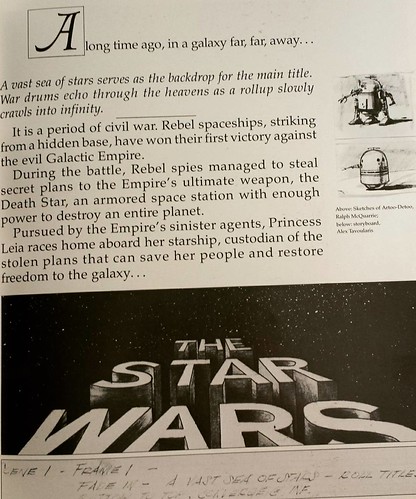
D19 of #IGWritersMay: Novel aesthetics. I make no secret that at its heart, THE SONG OF FORGOTTEN STARS is really my love letter to STAR WARS. (This is a page from the book THE ART OF STAR WARS.) #amwriting #starwars #sciencefiction #spaceopera #Forgotten


I didn’t see Star Wars on opening day. In truth I don’t even remember exactly when I saw it, but it was later in the summer of 1977. We had just moved from Wisconsin to Oregon, and in that time I was not even aware of this enormous movie phenomenon whose popularity was sweeping the nation.

I finally saw it, though, with my sister, who is six years older than me.

I didn’t like it.

It was very loud. It opened with big words flying through space and then there was loud spaceships and talking robots (one of whom only talked in beeps and whistles). There was a girl in white and a bad guy in black whose breath sounded weird. There was a desert planet with weird dwarf-creatures and a kid named Luke who lived with his aunt and uncle. (The uncle could be pretty gruff if Luke was goofing off, to which I could relate.) There were more loud spaceships and one really really big spaceship shaped like a giant ball. There was a guy dressed in black and white who helped the farm kid, and this guy had a giant ape-man friend. There were swords made of light and even more spaceships and a big battle in space.

All of that, and I didn’t understand a lick of it.

In my defense, I was all of five years old at the time.

Until Star Wars, my movie experience was pretty much limited to stuff like Bugs Bunny Superstar and Disney live-actions like The Shaggy DA (which contained a hoot of a pie fight). Then there was this movie with loud spaceships and robots and a farm kid and a bad guy in black and…well, I had no idea what to make of this movie.

Luckily for me I had my sister, who is six years older than me.

She went all-in for Star Wars. She ate it, drank it, breathed it. She talked about it a lot, and gradually her enthusiasm began to win me over. She explained the story to me because I hadn’t understood it all that well, and I decided that I wanted a part of her enthusiasm for my own. So I went with her to see the movie a second time.

I have never ever ever recovered.

I’ve been thinking a lot about Star Wars as it nears and achieves 40 years, and I find myself relating to it most as a storyteller myself. As a writer I tend most to look at Star Wars through the prism of story. Many stories have had a deep effect on me, on the stories I want to tell, and the way I go about telling them, but none moreso than Star Wars, even as the Star Wars story itself has changed over the course of its four decades. Most of the core ideas are still there, though, as Star Wars is now no longer in the hands of its creator, George Lucas. Star Wars is still a tale of heroic adventure unfolding in the sky. It is still a tale not just of the wars but more well-focused on the people fighting that war. It is a tale of improbably redeemable villains, of the way our paths mirror those of our parents, and of finding love in the face of desperation. It is a tale of family.

I can’t help thinking in most, if not all, of these terms every time I write a story, no matter which genre it’s in. Star Wars made me want to be a storyteller (what is playing with action figures, if not storytelling?). It also taught me that stories can focus at times on more mystical matters, and it taught me that story is an excellent way of addressing the challenges people face in their hearts. Most importantly, though, Star Wars taught me about heroes and quests and the wise elders who try to guide the heroes on their way.

Other stories have come since Star Wars arrived, and many have come to places almost as near to my heart. It’s not only stories, either; it’s all of creative art, really:

Lloyd Alexander’s Prydain Chronicles
The Lord of the Rings
Casablanca
On Her Majesty’s Secret Service
My Fair Lady
Cosmos
Much Ado About Nothing
The House with a Clock in its Walls
The Lions of Al-Rassan
Mary Stewart’s Arthurian trilogy (plus The Wicked Day)
Berlioz’s Symphonie fantastique
Rachmaninov’s Symphony No. 2 in E minor
Invisible Touch by Genesis
Once and Again
Princess Mononoke

These are all things — and there are more — that are at the center of my creative life, but none has ever quite dislodged Star Wars as my Prime Mover. Star Wars is, and continues to be, my Platonic Ideal of what story is.

Even so, I haven’t always kept as close an eye on Star Wars as a massive universe as many. I’ve read only a small handful of all the many novels and comics written over the years, and I haven’t played any of the video games. For me, my appreciation focuses pretty exclusively on the movies themselves, and not just the wonderful Original Trilogy but also the admittedly uneven — but still, in my eyes, uniquely compelling — Prequel Trilogy and even to a smaller extent the recent “Rebirth” movies, The Force Awakens and Rogue One. Those form the core.

Star Wars is as strong now as it ever was, and it is very likely even stronger. It has more fans than ever, and it is now in the hands of a corporate power whose pockets are deep enough to maintain it at a very high level for decades to come. More fans are created every day, it seems, and yet…I do have to admit to feeling a certain level of possibly grumpy oldsterism. Sure, you kids can love Star Wars and in fact I hope that you will, and that your love for Star Wars will lead you to other things. But I came in on the ground level. My memories may be hazy, but I do remember a time before Star Wars.

I believe that every story one writes — or rather, every story that I write — should be, in one way or another, a love letter, either to someone or something. The Song of Forgotten Stars has many influences, but it is ultimately my love letter to Star Wars. If not for Star Wars, there’s no way I would be writing this story. It’s not just about the internals of Star Wars, though: it’s about the way Star Wars impacted me and shaped my life and helped reflected certain relationships in my life. Put it this way: There’s a reason why the two main characters in my Forgotten Stars books are two Princesses, one of whom is six years older than the other. It’s a dynamic that makes sense to me on a lot of different levels.

I also know, from reading a lot about the making of Star Wars over the years and about the life of George Lucas in particular, that the way by which a creative work comes into existence is often a messy one. Lucas’s manner of creation is eerily similar to my own, or maybe vice versa. Lucas is someone who starts out by following ideas in any direction they might go, and only gradually whittles things down and discards this notion or that idea until a streamlined story starts to emerge. I work the same way, at least in part. My rough drafts are often very messy and they always contain entire ideas that I remove entirely, for one reason or another. Lucas has done so much mixing and matching of ideas over the decades (remember that for him, Star Wars is 47 or 48 years old, depending on where he dates The Beginning) that he at times seems to be misremembering his own history. I know how he feels. There are times when an idea seems so organic that it’s hard to claim it for my own. Even if it is.

So thank you for forty years, Star Wars! And may the Force be with you, forevermore.


Share This Post

“I have come to conquer you!” A repost in honor of the great Roger Corman

Filmmaker Roger Corman died the other day. It was always easy to poke fun at Corman’s films, but he strove to make them as good as he could, and on his own terms. Corman’s studio was not only prolific but also a starting point for many filmmakers who later went on to great careers of their own.

Below is the text of a post I wrote a number of years ago, praising my favorite Corman film, the 1980 obviously-STAR WARS-inspired “Magnificent Seven In Space” flick, Battle Beyond the Stars. I stand by every word of this. Is the movie good? Yes, because while its objective qualities may be debatable, what cannot be debated is that it’s a freaking delight.


Battle Beyond the Stars is a movie that seems to confound expectations. If you watch it expecting a good movie, you’ll be disappointed. But on the other hand, if you watch it expecting a bad movie, you may be disappointed in the other direction.


Battle came out in 1980, one of a string of flicks to come out in the years after something happened in 1977 to suddenly make the entertainment industry think that there was a market out there for science fiction, especially in the form of explodey-spaceshippy-goodness. Battle was produced by Roger Corman, the king of the low-budget movie who nevertheless also served as a talent scout for later Hollywood geniuses, the most notable being a special effects artist who designed the spaceships for this movie and who later went on to bigger things. His name? James Cameron.


I saw Battle when I was in fourth grade. It was part of a double feature at the local movie house, the first film being a flick called Starcrash. I’ve never seen Starcrash since [UPDATE: After writing this post, I did in fact watch Starcrash again, the results of which you can read about here. Is Starcrash bad? Oh Gods, yes. Have I seen it once or twice even since then, because it’s lovably bad? Oh Gods, yes! –Ed.], although I do have a downloaded copy on one of my hard drives. Starcrash is legendary for being a bad movie, although I recall liking it when I saw it. Battle was the main event of the feature, though, and I was really looking forward to it, mainly because the nine-year-old me had thought that this trailer just looked awesome:


That trailer had run on a bunch of movies leading up to the release of Battle so I was really stoked when it came out. And when I saw it? Well, I was nine. I loved it. It had aliens and spaceships and lasers and things exploding and a cute girl. I got the soundtrack album, featuring music by a composer named James Horner, and I played that album a lot over the years, wearing it out and grooving to what I thought was the best explodey-spaceshippy movie music I’d heard outside of a Star Wars film. (Of course, my sample size was very small, I didn’t know film music enough to hear Horner’s huge debt to Jerry Goldsmith in the score, and I didn’t know enough about orchestration or performance to recognize a score that was recorded on a shoestring budget and which featured some really bad orchestrations, such as the track “Cowboy and the Jackers” which does things to the trumpet section that may be in violation of several international treaties.)


I saw Battle once more when it showed up on network teevee a few years later, and still liked it, and then I didn’t see it again for many years. I may have caught it in a cable broadcast sometime in the 1990s, but I’m not sure. I didn’t see it again in its entirety until just last week. How does it hold up? Well, movies like this don’t really “hold up” – that’s the wrong way to look at them. I had no illusions that it was some unheralded gem of SF moviemaking, but I was pleasantly surprised that it’s not that bad, either.


So, what about Battle Beyond the Stars, anyway? What’s it about? It’s very simple: The Magnificent Seven in space. That’s it. Literally.


We open with a giant enemy ship traveling through space (at a very slow pace, even though it has six enormous thrusters that are constantly firing).


The ship is ruled by our villain, Sador of the Malmori. Who are the Malmori? Are they a race of aliens? An empire? A family? We’re never told. Anyway, his ship approaches a planet called Akyyr (that’s how I’m spelling it, anyway), which, seeing that it is inhabited by peaceloving folk who only own one spaceship (which is a weather station), decides that he’s going to conquer it. So he hovers his enormous ship over them, projects his enormous face over their heads, and says, “I have come to conquer you.” (This he does after destroying the weather ship, just because he’s evil. The weather ship had been occupied by two guys who display the Akyyrian attitude by greeting an enormous and malevolent-looking spaceship by grinning, saying “Look! Visitors!”, and then contacting it by asking, “Could you identify yourself, please?”)


Anyway, Sador gives the Akyyrians seven days (“risings of your red giant”) before he’ll come back and finish conquering them. Why the delay? Who knows, but it gives the Akyyrians time to send one of their local young men, a boy named Shad (played by Richard Thomas as John-Boy Walton in space), off in the other ship they own, the secret one once piloted by the old blind guy who used to be an adventurer, to round up some help in the form of mercenaries.


The ship Shad flies is probably the single most famous thing from Battle Beyond the Stars. The ship is simply named “Nell”, and sure enough, it’s run by a computer by that name who speaks with the voice of a cranky lady. What’s most memorable about the ship, though, isn’t her personality; it’s her shape:


This ship is one of the more famed B-movie spaceships in movie history. You know you’re talking to a knowledgeable geek when the mention of the movie Battle Beyond the Stars draws the rejoinder, “Oh yeah, the movie with the ship that’s shaped like a pair of breasts!” The ship is more than that, though – it looks like a feline body with female breasts and then a couple of wings where the ship’s guns are, which sweep up and out, spread out to look like…well, it’s a very feminine ship. (And it was designed by a young filmmaker who was cutting his chops with Corman’s production crew, the afore-mentioned James Cameron.)


Anyway, Shad goes off in search of mercenaries he can hire to fight off Sador. On the way he meets a taciturn fellow named Gelt (Robert Vaughn), who only wants a meal and a place to hide from the apparent galaxy’s worth of folks who are after him:


He meets a ship commanded by a group of aliens who have third eyes on their foreheads and who use telepathy to do stuff:


He meets a “Warrior Valkyrie” named “St. Exmin”, played by Sybil Danning:


Given that her screentime involves her looking like this, it’s almost a crime that Danning doesn’t get more of it. She does, however, have one of the goofiest lines in movie history, and boy, does she deliver the hell out of it:


The other girl there is Nanelia (Darlanne Fluegel), who is every bit as naïve about people as Shad is, which makes her a perfect fit for him. She, too, gets far too little screentime, because she’s really cute. I remember her being one of the first females onscreen to impress me with her cuteness. I mean, look how cute she is in that clip, when she giggles at the prospect of learning how to “tingle, tangle, prangle” her new love interest from this warrior in the goofy headdress! Yeah, Nanelia is really, really cute:


Most memorable, probably, is the Space Cowboy Shad recruits who goes by the name “Space Cowboy”, played by George Peppard:


Cowboy is an arms runner who ends up leading the Akyyrian planet defense with the weapons he’d been running to a planet that Sador has just wiped out. Cowboy is extremely cool, although it’s hard not to expect him to grin and say, “I love it when a plan comes together!” But he does have one of the niftiest gadgets I’ve ever seen in a skiffy movie: he has a gizmo on his belt that dispenses Scotch and ice. (Why a Space Cowboy is drinking Scotch and not bourbon is never explained.)


And there are some aliens who are basically actors in rubber suits. You know how it is. Anyway, a big battle ensues (the Battle beyond the stars!), in which quite a few of the recruited mercenaries die heroically before Shad and Nanelia finally figure out how to do Sador in. I know, I just spoiled the movie, but what of it? Who would watch a movie like this and even consider the possibility of a bummer ending?


The clip above aside, there’s some witty stuff in the course of the flick, and one nicely done moment after Gelt (Robert Vaughn) dies, involving Shad’s bargain with him (a meal and a place to hide). There are also some exceedingly goofy moments, and like all B-movies, some of the stuff that happens isn’t explained very well at all (such as a scene in which the telepathic-collective aliens make their own stealth attack on Sador that involves sacrificing one of their own and a transplant of arms, believe it or not).


Of course, we have to have a romance between Shad and Nanelia, and it’s your typical awkward stuff (“Do they have kissing on your planet?”), but at the end, when victory has been won and all that are left are our hero and heroine returning to Akyyr, instead of ending with some neat dialog and some delightful snogging, we get Shad quoting at length from the “Varda”, the sacred text that the denizens of Akyyr are constantly quoting throughout the film. Weird stuff – the kid should be finally taking his big step into manhood, and instead he wants to recite from the holy book of a pacifist planet that sounds like The Art of War.


Battle Beyond the Stars is not a good movie. Nor is it a bad one. If you’re attuned to it and willing to go where it wants to go, it’s a fun little flick, if you’re into movies where the villain who is trying to conquer the planet Akyyr gets to shout in triumph at the end, shortly before his unimagined demise, “Akyyr is mine!”, followed by leading his entire bridge crew in sinister bad-guy-who’s-just-won-the-lottery laughter.


In other words, it’s the kind of movie that can only appeal to your inner nine-year-old. And that’s not a bad thing to be, is it?

Share This Post

Something for Thursday

There was news this week on the TRON front: Jeff Bridges is returning to the franchise for the third film that is apparently getting made soon. I’m a longtime TRON fan, all the way back to the original film in 1982, and I enjoyed the eventual follow-up, TRON LEGACY, which doesn’t seem to have been received terribly well, but who cares about those people, anyway.

The 1982 film featured a “futuristic” (for 1982) score, dominated by synthesizers, by  composer Wendy Carlos. Carlos is a noted pioneer of electronic and synth music, and her work for TRON at this point in time sounds both groundbreaking in its approach to scoring a mainstream film with electronic music, and dated because of the state of the electronic gear at the time. But never mind the dated qualities; Carlos did an amazing job at suggesting the otherworldly nature of the World Inside the Computer, but she also composed music of genuine wonder and excitement.

I’ve just read that most of Carlos’s recorded music is unavailable for listening, in any format. This seems to me something of a cultural crime.

Share This Post

“Dick, sometimes I understand why they hate you.” Nixon, 30 years gone

A few days after Richard Nixon died (on this date, 1994), I was out riding around with my father as he did some errands. We stopped at the post office in the town where we lived, and Dad noticed that the flag was at half-staff. He asked why, and I said something like, “Well, a former President died–“

At that my father sputtered and said, “The flag’s down for NixonThat piece of shit?!”

Dad hated Richard Nixon. Hated him. Mom did too. Dad hated Nixon so much that he was angry at Gerald Ford for the rest of his politically-aware life (“Nixon should have gone to jail,” he would often say), and in his office at St. Bonaventure he had on the wall a poster (or maybe it was something he trimmed from a magazine or newspaper) that was a fairly unflattering picture of Nixon, captioned with “Everything he is today, he owes to a free press.”

When I went to college in Iowa, I met people who thought Nixon was just A-OK in their book. He did the same kind of shady shit they all do, you see! Nixon just got caught! That was my first real encounter with the deep cynicism of the American right.

Nixon was President when I was born, and he was gone from the scene before I even turned three, so I was never aware of Nixon as a political figure in any real capacity. I remember seeing him in interviews and wondering how that guy, with his gravely voice and complete lack of any real charisma, not only got elected but then reelected in one of the biggest victories ever. But Nixon was never a reality for me. Nixon was an abstract thing, to be honest.

Nixon was the first President of my lifetime, and he was also the third to die in my lifetime; Truman and Johnson were the first two. His passing in 1994 was a surprisingly big story, as I recall.

My main feeling on Nixon is shaped by, of all things, a film: Nixon, by Oliver Stone. I was excited when the film came out, as I already counted JFK among my favorites (I still admire it greatly, as paranoid and insane as its history actually is). I had to see Nixon by myself, as The Girlfriend (now The Wife) was not interested in another three-hour Oliver Stone political potboiler, and my mother scoffed at the concept, too: “I lived through that bastard once, I don’t need to sit through a goddamned movie about him.”

Nixon remains for me something of a classic. Here is a post I wrote back in 2010 after I rewatched it. I wouldn’t change a word of this.
Oliver Stone’s Nixon is an amazing film. I kind of wish Stone was still making movies like this: densely packed films that overwhelm the audiences with information and tell their tales in complex, non-linear ways. Well, maybe Stone still is making movies like this; in truth, I haven’t kept up with his career much over the last ten years.

It’s easy to see Nixon as a companion piece to the earlier JFK, and in many ways, it almost is. But it’s also a very different film, even while using many of the same techniques of the earlier film. Nixon is more meditative, more of a character study, than a film interested in posing a particular hypothesis, as was JFK. (To a certain extent, anyhow – people often refer to “Oliver Stone’s conpiracy theory” regarding the JFK assassination, but when you actually watch the film, no real, concrete hypothesis is ever actually advanced.)

Nixon seems generally focused on the way that the very strengths, or gifts, or skills that allowed Richard Nixon to ascend to the highest political office in the United States were the ones that brought about his downfall. A “tragic hero” will often have a bunch of good qualities, and one not-so-good quality that causes everything to fall apart. Nixon, however? His power came via his paranoia, and deserted him by the same route.

The film opens with a brief educational film about salesmanship (“What you’ve got to remember, Bob, is that you’re selling yourself!”), and then we’re into the story proper. The overall device of the film is Nixon, alone in his study during a series of nights toward the end of his Presidency, reflecting on the events of his past, most often by listening to his infamous tapes of his Oval Office conversations. The film is told in a series of flashbacks, then, and not always in the real order of events, but in the more real way in which we tend to remember things: the memories that surface as they seem relevant to the events of our present-day lives. At times, Nixon is remembering past political events, and at others, he is remembering past personal moments with Pat, the love of his life.

To me, the question of authenticity with regard to a film like this misses the point. I remember watching discussions of the film on news shows when it came out, back in 1995, and the topic always seemed to revolve around the extent to which Stone captured the “real Nixon”. Some folks attacked the film on that basis, others praised it; I remember one commentator – I think it may have been Bryant Gumbel – who said, “I don’t think it’s the Nixon, but rather a Nixon”. That seems pretty astute to me. Those closest to Richard Nixon seemed fairly adamant that Stone did not depict the “real Nixon”, but even those closest to us don’t know our real selves as well as they might think. Is Stone’s Nixon a “real” Nixon? I suspect that he captures some of Nixon’s qualities well, others not so well. I also suspect that Stone emphasizes some of Nixon’s qualities a bit in the interest of making a better movie. I think that Nixon is to Richard Nixon as Henry V is to King Henry the Fifth.

Of special interest to me when I watched Nixon a couple of weeks ago was the way no one ever really spells anything out directly. Nixon himself seems to be talking in code with his assistants much of the time, and at no point does anyone say, “Hey, we should break into the DNC offices at the Watergate and see what we can find out.” At no point does Nixon say, “We need to cover this up!” Everything is happening, or has already happened. This plays into one of Stone’s themes of the film, which is stated outright in the scene of the odd moment (which really happened) when Nixon left the White House in the middle of the night, went to the Lincoln Memorial, and ended up interacting with the protesting kids there. Referring to the war, one girl says: “You can’t stop it, can you? You’re powerless.”

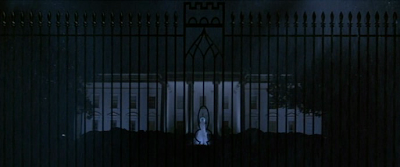
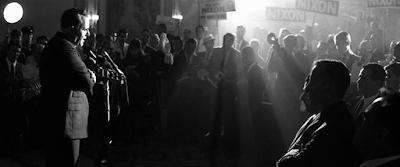
Stone conveys this as well with a lot of fascinating cinematography. As in JFK< he employs a lot of different looks and styles throughout the film, sometimes shooting things “straight”, while other times using black-and-white, or making the film very grainy in spots, or using lots of fades and superimpositions of stock footage to convey the magnitude of the issues Richard Nixon faced or the hugeness of his character. In many “Presidential” films or teevee shows, such as The American President or The West Wing, the White House is shot as a beautiful place where our patriotism and commitment to democracy is literally made physical. No so in Nixon; the White House here is an ominous place, and place of fear and dread in the face of historical forces that cannot be tamed.
Stone often frames scenes from odd angles, and many scenes depict dark shadows contrasting with brilliant light streaming in through windows. An early scene shows Nixon in his personal study, sitting beside a roaring fireplace while the air conditioning is on at full blast.

Nixon seems increasingly shocked, over the course of the film, to learn just how little control even a President gets to have over the forces around him, and by the time he really comes to grips with this, he is on the brink of ending his Presidency. Even late in that particular game, though, he continues to assert that a lack of control was what got them, in the end: “We never got our story out,” he says to Alexander Haig. Nixon relishes the moments, all too few, when he gets to feel as though he is in control, such as when he puts a wealthy donor in his place or chews out Henry Kissinger. But he also reacts with increasing anger when his efforts at control fail, such as when a press conference goes awry or when his own wife tries to criticize him over dinner.
That brings me to the film’s central relationship, that of the marriage of Richard and Pat Nixon. It’s really an amazing relationship, as movie marriages go; it is not depicted as a relationship of blind love that is independent of everything else in Richard Nixon’s life, nor is it depicted as Pat’s Lady Macbeth to Richard’s Macbeth, with Pat being ambitious and desiring of power all her own and only being in the marriage because it’s the best route for a woman to real power in mid-20th century America. Pat Nixon is shown as being literally the only person in Richard’s life who is ever willing to criticize him or tell him when he’s wrong, but she is also there for him through everything, except for one brief period when she considers divorce. Even then, however, Richard brings her back from the brink, and even after all of her disgust during the long unfolding of Watergate, when Richard at last stands alone in the White House on that last night of his Presidency, ruined and emotionally drained and devastated, it’s Pat who comes to him and gives him the only consistent shoulder he’s ever known on which to lean.

Nothing in this movie would work without some great performances by the cast, and there isn’t a single weak link among them. Stone assembles an astonishing supporting cast here; so much so that if this movie had been made in the 1970s, the posters would have included one of those rows of thumbnail photos of the stars along the bottom. James Woods, Bob Hoskins, M. Emmet Walsh, Saul Rubinek, EG Marshall, Madeleine Kahn, Tony Goldwyn, Mary Steenburgen, David Hyde Pierce, Ed Harris, and the like – Nixon might be the single most star-studded film of the 1990s to not feature Kevin Bacon in any role at all. But the two performances that center the film, that absolutely ground it, are Joan Allen as Pat Nixon, and Anthony Hopkins as Richard.

The film made a pretty wise choice as regards the “look” of Richard Nixon. They didn’t go overboard in trying to make Hopkins look like the genuine article; they gave him roughly the same haircut and I assume some prosthetic teeth to make his smile look more Nixonian, but after that, they relied on Hopkins to do it all through the magic of acting. He plays Nixon as a somewhat hunched-over, physically awkward, gravelly-voiced man who never seems to exude much by way of charisma, but rather gets what he wants from others because he simply won’t accept anything else. Nixon is a bundle of nervous energy, and Hopkins plays him as a man who sweats too much, grins at odd moments, and can’t figure out what to do with his own hands.
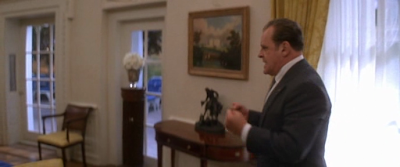
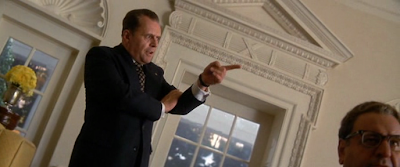
Hopkins’s performance is endlessly fascinating to me, coming as it does in the same period as a number of other performances by him that are all unique: there is nothing of Hannibal Lecter to be found in Hopkins’s Richard Nixon; nor is there to found any of Mr. Ludlow from Legends of the Fall, CS Lewis from Shadowlands, or anyone else. Hopkins’s Nixon is really a singular creation, so much so that the spell is actually broken twice over the course of the film, both involving Oliver Stone’s use of archival footage from the Nixon years. One is of a Nixon mask, being paraded about at a protest rally; the features are distorted, but we can still see that it’s a mask of the real Nixon; the other is at the very end of the movie, when Stone shows us footage of the real Mr. And Mrs. Nixon walking to Marine One for their final departure from the White House.

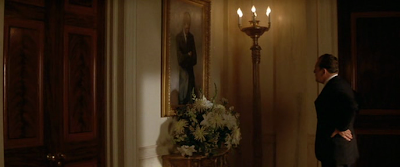
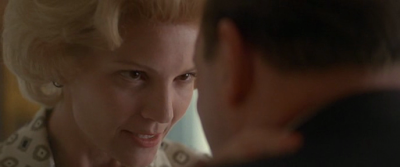
Joan Allen’s Pat Nixon is equally remarkable, because hers is a quieter performance as the only person who gets to talk back to Dick Nixon and not only get away with it but be able to stick around afterwards. She is, by turns, thrilled by him, devoted to him, angered by him, disgusted with him, and in the end, deeply empathetic to him. We can see the pain on her face when she sees him, alone in the White House, talking to the portrait of John F. Kennedy, in one of the film’s finest moments (“When they look at you, they see what they want to be. When they look at me, they see what they are.”) The keenest moment of insight as to Nixon’s character – as the film depicts it – comes when Dick is gearing up for his 1968 run for President, six years after he’s sworn to Pat that he’s done running for office. She is angry that he has been making plans without telling her, but she still feels the old hunger and the pain from the last two losing campaigns has mostly faded, so she is willing to stand with him once again – in fact, she even hungers for it herself, telling him “This time, we’re gonna win. I can feel it.” And Dick takes her in his arms and dances, in the best Nixonian fashion: awkwardly and gracelessly.
John Williams’s score for Nixon is, to my mind, one of his more underrated efforts. He juxtaposes a cheerfully optimistic Americana sound with more downbeat and dark music as Nixon begins to spiral out of control. Stone closes the film with a musical choice that seems odd, at first, but is really amazingly fitting: the Mormon Tabernacle Choir’s a capella rendition of Shenandoah. There isn’t much in the film by way of period popular music, as instead Stone relies on Williams’s sound world to help immerse us in the world of Dick Nixon.

As with JFK, a companion book was released for Nixon, containing the film’s screenplay, a number of archival documents (including transcriptions of the Nixon tapes), and essays by the filmmakers, historians, and figures from the Nixon administration (John Dean and E. Howard Hunt). Here is an excerpt from an essay by Christopher Wilkinson, one of the film’s writers:

The more we got to know Nixon, the more it struck us how odd he was. He was a man who referred to himself in the third person and called his wife “Buddy”. He was physically awkward, socially graceless, and sexually repressed. Other than Bebe Rebozo, he had no real friends. When he needed to relax, he would just sit silently with Rebozo. For hours. Bob Haldeman was with him for nearly twenty years and never shook his hand.

The was a strange man, an extremely strange and mysterious man.

I cannot remember the precise moment when we started to empathize with Nixon. To begin to understand the tragedy of his life. To appreciate the true dimensions of his character.

Nixon came from nothing – the wrong schools, the wrong clothes, the wrong parents – and, by dint of hard work and self-sacrifice, rose to the heights. In many ways he is the American Dream incarnate, the self-made man who tortured himself to be a Somebody. And he never gave up. He came off the canvas again and again, rehabilitating himself, reinventing himself. Admittedly, the notion of Nixon the Indestructible is often trotted out to evoke sympathy for him.

But it’s true.

There are other poignant and peculiar details that reached us, that slowly eroded our contempt. The emotionally distant mother who rarely touched him. The brutish father who directed fits of blind rage at him. The lonely, clumsy boy who was sure that no matter what he did, he would never be good enough.

And the dead brothers. First his beloved little Arthur. Then Harold, outgoing, attractive, a boy Richard idolized. A boy whose lingering death allowed the family to afford Richard’s tuition to law school.

The guilt.

When Nixon fell in love with Pat, he drove her on dates with other boys to prove himself to her. He wore her down with a barrage of flowers and letters. He would do whatever it took to win her and he never let up until she was his.

Classic Nixon.

The only clean campaign he ever ran was 1960. Kennedy (like Harold) was everything Nixon was not – handsome, charming, articulate, witty. Nixon could have used any number of smear tactics against him; the religion, the Mob connections, the women. But he didn’t. He respected Jack Kennedy more than any opponent he had ever faced. So, for the only time in his political life, Nixon played it straight.

And Kennedy stole the election from him.

The fact that he didn’t completely come apart during the crushing pressure of the final days of Watergate is a testament to his bullheaded resolve. To his perverse brand of courage. Everyone was against him. The country wanted his head on a pike and he wouldn’t give it to them. A lesser man might have run screaming and drooling down Pennsylvania Avenue. Or had a stroke. Or committed suicide. But not Nixon. He wouldn’t give them the satisfaction.

As President, he did more to desegregate the schools than any of his predecessors. He created the first and most effective Environmental Protection Agency. He has few (if any) Presidential peers in foreign policy: the spectacular opening of China, achieving detente with the Russians. Accomplishments that Nixon, the quintessential Commie hunter, was uniquely suited for. If a liberal Democratic President had tried it, he would have been crucified.

And Nixon would have brought the nails.

Nixon stretched our idea of what greatness is. He is a huge character who embraces the entire American landscape from its loftiest ambitions to its most malignant schemes. To understand Nixon is to understand what we have been. To understand Nixon’s destiny is to understand what has happened to us. To understand Nixon’s life is to understand the history of our times.

What strikes me now, on reflection, is the way the Nixon political playbook has come to dominate American politics in our day, forty years after Nixon held office, with its dirty tricks and coded appeals to our baser instincts. But Nixon’s actual policy goals now form the farthest boundary to the left that our politics are willing to allow voice. It’s amazing to me that if a Republican candidate came along now, espousing Richard Nixon’s policy goals, that candidate wouldn’t even make it out of the primaries. Things that a Republican President did forty years ago would be labeled as unforgivably liberal — Socialist, even — if a Democrat did them today.

What a great, disturbing film this is. Just like Richard Nixon himself.

Share This Post

Streaming Killed the Cinema Star

This is a topic that just keeps coming up, and up, and up on social media: seeing movies in the theater versus waiting to stream at home. The latest go-round of this topic came up just in the last day or two, via this news report:

A new poll by HarrisX, exclusive to IndieWire, found that 34 percent of U.S. adults prefer to watch movies in theaters, which means a solid two-thirds would rather wait for them to be released on streaming.

“The competition continues between streaming services and the Hollywood engine. While we still see evidence of loyal movie-goers in recent box office numbers, our study shows that 2 in 3 movie watchers prefer to stream movies at home,” Alli Brady, VP at HarrisX, told IndieWire. “Despite this causing some upheaval for the industry, it also means that the demand for content is only increasing – nearly half of consumers say they stream movies weekly, more than 7x as frequently as those who do so in theaters.”

Brady’s pollsters also found that 30 percent of us stream a movie two or more times per week — the same percentage of respondents said they go to movie theaters “a few times a year.”

I have to admit that I have become one of the people who is more likely to wait for a movie to be able to stream at home than see it in a theater, though I’m not totally sure I’d call it a preference. If going to the movies was an experience similar to what I used to enjoy in the late 90s (before we entered the world of parenthood, after which movies became for a time a luxury in which we had to have the worlds of money and available time actually align), then I’d probably still prefer seeing movies at the theater.

Now, certain aspects have actually improved, or at least not got worse. The screens are still fine, and the sound may have actually improved, though the movies have certainly gotten louder, and not just action movies with explosions, either. When we attended a Fathom Events screening of Casablanca last year, I was rather put out by how blaringly loud the volume was, to the point that the movie’s mono audio mix really suffered and finer details of Max Steiner’s score were lost. I’ve noticed this for years; I’ve never forgotten when we went to see Notting Hill way back when and I was thinking throughout, “This is a rom-com! It does not need to be this loud!

And visually, the movies seem to suffer a lot less now…at least presentationally. I remember Roger Ebert’s frequent rants about how many theater owners years ago tried to skimp on costs by outfitting their projectors with bulbs of lower wattage, supposedly saving some electricity cost, which also made the movies themselves look dim and dingy. One theater I used to frequent in Olean did this, I am certain; that particular theater made the movie-going experience so bad, in fact, that eventually I refused to see movies there and if something arrived there that I wanted to see, we would road-trip to Buffalo for it.

But at the same time, screens and sound at home have improved in leaps and bounds. Does my home set-up rival the theater in terms of technical quality? Maybe not…but the difference is hardly so great that the movie itself suffers, either.

Another big factor cited by those who prefer streaming at home is cost, and for me, this is a huge factor indeed. Ticket prices are higher than ever, and so are concessions. I like to snack during a movie, and sure, I could just forego the popcorn–but I’ll get back to that. Time is also a factor, with movies frequently preceded by at least twenty minutes of previews and, deeply annoyingly, commercial advertisements. Apparently the high costs of attending the theaters are not even sufficient to keep them afloat, so they have to inflict ads upon the viewers prior to the movies. Ugh.

The responses when I point these factors out are typical: Just arrive twenty minutes late! Sneak in your snacks or just do without! Well, I honestly don’t much feel like picking my way through the darkened theater during the previews, and I also can’t smuggle in a large popcorn. And if you tell me to just “do without”, well then, you’re running into the last big argument the folks who still love the theaters have: it’s the experience, you see.

Seeing a movie in the theater, with an audience that is also into the story, is the real attraction of the theater. It’s the magic of the lights going down, and the giant screen enveloping you, and feeling the people around you rise and fall with the story in the same way you are. And look, that can be real; I wouldn’t deny that it is. I’ve had some wonderful experiences in theaters because of that communal aspect: a Nickel City con screening of Flash Gordon leaps to mind, or a recent film festival screening of a movie a friend of mine from work made. And I do have to admit that I wish I’d been able to attend a screening of Avengers Endgame in its first week out.

But, it’s generally my experience that those kinds of theatrical experiences, where everyone is into it and we’re all feeling it, are increasingly the exception than the rule. Instead nowadays it’s more common to catch glimpses of the light from someone’s phone, or having to shift to let someone get up to go refill their 64oz cup of Coke or go to the bathroom, or catch the whispers of conversations around. If you live in a place where the audiences still sit in the theater with reverent silence, awesome; I do not. And anyway, as an introvert, I tend to put less premium on the alchemy of the “communal experience” anymore. (And when the “But it’s the experience!” people tell me to go without popcorn or whatever, well…for me that’s part of the experience. That comment reveals an odd belief that I should cheapen my experience so I can be there to somehow enhance their experience, or some such thing.)

Many people do manage to stop arguing at this point, seeing that it’s really a matter of preference…but some really do look down on the very notion that seeing a movie in one’s own home is a perfectly acceptable thing to do. They’re only slightly pacified if you assure them that yes, obviously the theater is the best place to see a movie and it’s only because of these few factors that you just can’t get there as often as you’d like. The idea that the theater is simply not essential to the movie-seeing experience is never given the time of day, and this results in a not-uncommon accusation, one version of which was just leveled at me yesterday on Threads:

“You just don’t really love the movies, then.”

That is, quite simply, bullshit. One hundred percent grade-A bullshit. No aspect of that notion is not bullshit.

Take the simple fact that the majority of the movies I’ve seen on my life have either been seen on teevee, or on a computer screen, or projected onto a small screen in a small setting like a classroom, or even–gasp!–my tablet or–gasper!–my phone. Most of the classic films that I love, I have never had the opportunity to see theatrically, and if I did have a chance to see them theatrically, it was a one-time affair. I think it’s a conservative estimate to say that if I struck from my memory every film I have not seen theatrically, my roster of films seen would be reduced by at least seventy-five percent.

I’ve noticed similar arguments come up in regard to music: what is better, live music or recordings? And the arguments usually go the same way, ultimately referring to some undefined “electricity” or some other mystical element that takes place in a live setting. And sure, maybe. But then I think about books, and these arguments vanish, really. Once in a while someone will say that “audiobooks aren’t really reading”, and just about all of Bookish Social Media will rise up to laugh that person out of the room. Now, I don’t personally use audiobooks for my own reasons (basically: I can’t focus on them and I lose track of the story), but I certainly grant that audiobooks are reading. So are Kindles, e-book apps on your phone, and Braille. Nobody except a churlish weirdo ever maintains that it’s only reading if it’s, say, a first-edition hardcover. In this chair, underneath that light.

“You’re just not a movie person,” said the gatekeeping weirdo to me last night…and what am I supposed to do with that? Delete all the words I’ve poured into this space and elsewhere about Star WarsCasablanca, Princess Mononoke, My Fair Lady, and On Her Majesty’s Secret Service? Shall I forever recuse myself from conversations about Fred Astaire versus Gene Kelly? Am I unallowed forevermore to wax poetic about Harrison Ford in Witness and Jodie Foster in The Silence of the Lambs

I’m not a “movie person”, because I no longer see theaters as essential parts of the entire movie-viewing experience. Sure, OK. You can think that if you want to, and you can look down on my thoughts on film on that basis if you want to. That’s a you problem, not a me problem. I’ll just ignore you and keep seeing movies, once in a while at the theater but more often right here at home, with my own drinks and my own snacks and possibly a dog snoring next to me on this very couch.

Share This Post

Something for Thursday

‘On one rainy night in Tokyo, three strangers experience solitude from three unique perspectives.’

That’s the description of this short film, Tokyo Solitude, which YouTube’s algorithm offered up for me the other day. I found this utterly captivating; the imagery is amazing, with one breathtaking composition after another. It’s especially fascinating because my overwhelming impression of Tokyo at night is that it is ablaze with light and packed with people, but this film suggests otherwise: darkness and solitude exist there, and neither is necessarily a bad thing.

Take ten minutes and enter another world (set your resolution as high as it will go, turn up the volume or listen through headphones for the immersive soundtrack, and put it in fullscreen):

Share This Post

On Character: SCHINDLER’S LIST

I love a great bit of character writing, and this is terrific.

By way of set-up: at this point we’re probably, oh, two hours into the movie. Oskar Schindler started the film by using Jewish investors’ money to buy a factory and he staffed it with Jews after the crackdowns resulted in Jews being forced to give up property and ownership and move into ghettos. Throughout the film, as the crackdowns become more and more severe, Schindler deftly spreads money around to many Nazi officials–including, most prominently, labor camp commandant Amon Goeth (Ralph Fiennes)–to keep his factory running with more or less the same group of Jewish workers he’s been using all along. This makes Schindler an enormous amount of money.

But eventually, as Germany’s fortunes in the war are going south, the Germans decide it’s time to step things up. They shut down the labor camps and send everyone off to Auschwitz, a process that will probably take, as Goeth indicates, a month, maybe two, to get all the logistics right. (One of the fascinating things about Schindler’s List is that it depicts the developing Holocaust through the prism of it was all just work that needed done, which is probably one big reason it ended up being so easy a pill to swallow for the German citizenry…but I digress.) Schindler, horrified at the prospect of his workers going off to their deaths, decides to make one last big gambit: he’s going to launch a new factory near his hometown, and he wants his own workers to be sent to him to staff it.

But he has to convince Amon Goeth, who is a spectacularly evil and small-minded man, to make it happen.

That’s when this short scene takes place:

Now, the scene as filmed is fascinating: we’re looking at these two men, talking on the balcony, but we’re watching them through windows and doors. The key dialog is this:

GOETH: You’re probably scamming me somehow…if I’m making a hundred, you’ve got to be making three. Hmmm? And if you admit to making three, then it’s four, actually. But how?

SCHINDLER: I’ve just told you.

GOETH: You did, but you didn’t. [grumbles] Yeah, all right, don’t tell me. I’ll go along with it. It’s just irritating that I can’t work it out.

By this point, Schindler’s bona fides as a war profiteer who makes money hand over fist is so well established that he’s become something of a mythical figure to the very Nazis whom he’s spent years bribing. So when he lands on the idea that he’s going to have to spend an enormous amount of money on an operation that obviously will bring him little profit if any, he barely has to expend any effort at all to convince the Amon Goeths of his world, because he knows they will assume the exact opposite and that Schindler has put together another scheme that will line his pockets all the more. That he’s intentionally going to spend himself broke to keep this small group of Jews safe never enters their minds.

That’s just amazing writing: Goeth’s frustration that he can’t put the scam together because he knows there’s no profit in what Schindler is proposing, but because it’s Schindler, there has to be profit in it. It’s a great scene, and it unfolds in just about a minute of screentime.

Share This Post

Something for Thursday: Happy Birthday, John Williams!

John Williams turns 92 today…and he’s still working.

In his honor, let’s listen to some of his work!

Williams won a Grammy just the other night for this: “Helena’s Theme” from Indiana Jones and the Dial of Destiny. It’s a typically gorgeous theme that manages to evoke Marion’s Theme from all the way back in Raiders of the Lost Ark without echoing it or quoting it.

Here’s something that vexed film music fans for years: the unavailability of the End Credits music that actually was heard in the film of Indiana Jones and the Temple of Doom. The suite that appeared on the album was nice enough, but the film version is longer, quoting several of the movie’s themes as the last scene in the Indian village plays out. And when we finally go to credits and the Raiders March fires up, it actually fades out in the repeat (at the 3:32 mark) so that we can here a brief quote of Short Round’s Theme. Williams’s ability to put seemingly disparate themes together into an actually cohesive whole is always amazing.

Going back even farther, here’s one of Williams’s earliest contributions to film music: his score to the law-school drama The Paper Chase. Yes, it sounds a bit dated, but you can absolutely hear the fingerprints of the Williams-to-come in this cue, the End Credits suite from that movie:

It’s the lot of most film composers to have to turn in really good work for movies that…aren’t. Hook is, for me, one of the few misfires in Steven Spielberg’s output; it fell in that weird late 80s-early 90s era when Spielberg hadn’t really transitioned into the finer drama work that was to come, but you could tell that his heart wasn’t entirely in the magic-and-fantasy flicks he was still doing. But along comes Williams with this amazing score, and this almost perfect tone-poem-in-miniature:

When Williams’s score to 2002’s Star Wars Episode II: Attack of the Clones arrived, a lot of people were a bit befuddled by that score’s mix of darkness and lyrical love music. One person quipped on some message board or someplace, “It sounds like Nixon on a date.” That was pretty funny, but it seemed to highlight the fact that Williams’s score to Oliver Stone’s Nixon has never been particularly beloved. And that interests me, because I have always found it one of his most fascinating scores. He brings just the right blend of paranoid darkness and throwback Americana to Stone’s film (which I consider a masterpiece). Nixon has some of Williams’s most powerful and most overlooked music.

I do have to make an admission: I’m not always a big fan of Williams when he is scoring comedies or really light movies. For whatever reason, I always feel better when there’s a tinge of darkness in Williams’s music. (I can live quite happily without hearing Home Alone again, to be honest.) But in this wonderful march for Spielberg’s early big-budget misfire 1941, you can tell that John Williams has his tongue firmly planted in his cheek. This is absolutely delightful.

I’ve never seen Seven Years in Tibet. I couldn’t even tell you right now what it’s about without Googling it, other than…a guy is in Tibet for seven years. But I love this theme:

Finally–and I’m only ending this here because let’s be honest, I could go on a lot longer about John Williams and how much he’s meant to me and to my creative life throughout my years, but I actually have to eat dinner tonight–here’s a suite of another of what seems to me an underrated score, which is all the more surprising to me because every time I listen to it, I’m dazzled anew by how new this sounds, even for a throwback score. It’s Catch Me If You Can.

Thank you for the music, Maestro Williams! 

Share This Post

Two Musicals

Last week I watched not one but two musical movies. These two movies are about as different from one another as you can imagine; in fact, about the only thing they have in common is that they are musical movies. One is a “traditional” style of musical in which the characters do the “break into song and dance” thing, a la the old classic musicals of the MGM and Warners era, while the other is a kind of mashup of a rockumentary and romance film about a performing duo, so the music is a part of the movie in terms of performance.

I adored both movies. They were La La Land and Eurovision Song Contest: The Story of Fire Saga.

I’ll start with Eurovision. It opens in an Iceland household, sometime a few decades ago, when Lars, the son of a local fisherman (played by Pierce Brosnan in a craggy, growling performance that will remind no one of James Bond) forms his lifelong dream: to perform in the Eurovision Song Contest for Iceland, with his best friend, local girl Sigrit, as his duet partner. The film shifts to these two in adulthood as they are still pursuing this dream, even while they perform nonsense songs for the local bar crowd. Events ensue that lead them to that very Eurovision stage, with some of those events being much more improbable than others. If you’ve seen any version of the “Young musicians from the backwater try to make it big” story, you can see virtually every plot turn in his movie coming from a mile away…but there are surprises, as the way the movie gets the plot to unfold is, at times, surprising in the most delightful way. For instance–and I will say no more about it than this–the famous Icelandic Huldufolk, the “hidden people” who live in a magical parallel world and are said to occasionally visit our world to delve briefly into the affairs of humans, may or may not end up playing a role in a particularly sticky point in the story.

It doesn’t really matter if this movie’s twists and turns are obvious. You know Lars and Sigrit are going to make it to Eurovision, and you know that they are going to get closer and closer–maybe closer than they should. You know that they’ll suffer a major setback right when it seems they are on the cusp of victory, and you know that they’ll have to break up but then meet again when events somehow conspire to get them back on the Eurovision stage. This is one of those movies where you’re not seeing what happens next, but rather how the next thing happens.

And you’re also watching for the music. At least, I hope you are. This movie is chock-a-block with some of the most delightfully, zanily weird music I’ve ever heard in a movie. Imagine Icelandic pop songs given the prog rock treatment, with stage productions that are as over the top as you might imagine–and that’s just what you’d imagine in a movie with this plot description. But it’s also a Will Ferrell movie, and even if you don’t like Will Ferrell (I love him, personally), you can never accuse him of not giving himself entirely to the task at hand. And the task here is to play an almost endlessly optimistic dreamer of an aspiring Icelandic rock star whose dreams and vision might exceed his talent. Maybe.

Eurovision Song Contest: The Story of Fire Saga is a gorgeous film to watch and hear, and the acting is really top-notch, given how pretty much everyone is required to be over-the-top throughout. Did I mention Brosnan’s growling, snarling Icelandic fisherman? I did? Well, I’m mentioning him again. And Rachel McAdams as Sigrit is a perfect foil for Ferrell’s Lars; both are weirdly naive, but they’re weirdly naive in different ways, resulting in a couple that’s two adorkably clueless people trying to navigate a world they don’t really understand but desperately want to inhabit.

Oh, and Sigrit spends much of the movie rocking a cute pair of overalls. I report, folks.

Some critics think this movie was overlong, with too much music or whatnot. For me, it was perfect. I loved it.

Next:

Then there’s La La Land, which I though came out much more recently than it did. I honestly thought it came out either during COVID or just shortly before, but it actually arrived in 2016. Netflix kept suggesting La La Land to me, but I kept resisting, until the suggestion was accompanied by the warning: “Leaving Soon”. So, one night last week when I was home alone, I decided to finally watch it.

A few days after that, when I was not home alone, I asked The Wife if she wanted to watch a movie, and I cued up La La Land again.

I absolutely loved this movie. Loved loved loved this movie.

La La Land is a full-on musical in the grand old fashion. It even starts with a “vintage”-style animation for the studio logo, and when the film’s title finally appears onscreen, also in the “grand old style”, it takes up the entire screen, with a copyright notice in small print down at the bottom. The movie opens with a Big Ensemble Number, which unfolds during an LA traffic jam. Then we meet our protagonists: Mia (Emma Stone), who is on her way to work but isn’t focused on driving as much as her phone call, and Seb (Ryan Gosling), who is also on his way to work but is stuck behind Mia. He lays on the horn, she gives him the one-finger salute. That would be the end of it, if this weren’t an old-school Hollywood musical being made in 2016. Of course Mia and Seb are going to meet again. Of course they are going to make bad impressions on each other, which will culminate in a song-and-dance number about the fact that they have made bad impressions on each other. And of course that very song and dance number will be when their impressions of each other start to shift the other way.

Mia is an aspiring actress who works at the coffee shop on the Warners lot, so she gets to serve the Big Stars who come in for coffee before she goes off to an audition, still in her coffee shop uniform of a white blouse and black pants. (Of course she’s going to plow into a customer and end up with coffee all over her white blouse and of course she’s not going to have time to change so of course she’ll audition with the coffee stained shirt, not get the part, and end up walking down the hallway from the talent office back to the elevator, passing a dozen other white-shirted baristas hoping to land the same role.

Meanwhile, Seb is a chronically behind-on-his-bills jazz pianist, so of course his apartment is a spartan mess and of course his car is the one good thing he owns. Of course his current job is being the piano player in a local lounge, and of course he chafes against playing the set list as written (it’s December, so it’s Christmas tunes). Of course he veers off course in the middle of a Christmas carol and instead goes on an improvisational tear, which leads to his firing. Of course his next gig is playing synth for an 80s cover band. (A scene where Mia is at the same party he’s playing, recognizes him, and tweaks him by requesting that the band play “I Ran” is one of the movie’s biggest laughs.)

La La Land‘s first hour isn’t surprising at all, but that’s not the point. These two characters are sympathetic and likeable, even if they don’t like each other just yet, and the musical numbers are really catchy and well-shot and excellently choreographed. Neither Gosling nor Stone is really endowed with a singer’s voice, but both do very well with what they’ve got, and the dancing is the real star here, anyway. As they segue from not liking one another to wooing one another, often in the backdrop of great music and great movies, the courtship culminates in a magical number set at the Griffith Observatory. This number is when I committed to loving this movie. (This movie makes me want to go to Los Angeles, which is saying something. I’ve nothing against LA, particularly, but it’s never been a place I want to visit, either.)

Stone and Gosling have considerable chemistry together, and it’s never hard to believe either of them, either separately as an aspiring actress and an aspiring jazz club owner, or together as a couple trying to enable each others’ passions and dreams while recognizing along the way that each is at times backing away from those dreams and settling for a life of unsatisfying comfort over a life of never backing down. Their relationship develops in a logical way and takes them to places that make sense.

It’s no surprise that their relationship is tested more and more as both Mia and Seb get closer to their dreams, in ways that seem to be costing them in terms of themselves and each other. The film’s ultimate resolution of their love story is bittersweetly satisfying, culminating in a long montage-like dance number that is so clearly modeled on the “Broadway Melody” ballet from Singin’ in the Rain that I was almost expecting a young hoofer to enter from stage right, singing “Gotta dance!” This is absolutely a homage and not a theft, though; ultimately La La Land is a modern love letter to the great musicals of Hollywood’s studio era. And this, I suppose, is a love letter to La La Land. What a wonderful movie.

Share This Post

“Let’s get the shit kicked out of us by love!” (A slightly-edited repost)

This is a slightly-modified repost of something I first wrote years ago, back in the Byzantium’s Shores days. It’s fresh on my mind because The Wife and I rewatched Love Actually last night, and it’s the first time I’ve seen it in seven or either years, after a period during which I watched it every year. I don’t know why it fell out of rotation; I certainly didn’t stop loving the movie, even though hating on it seems to have become a fashionable viewpoint in recent years, judging by the think-pieces that circulate social media about how bad Love Actually is. I did feel a small amount of trepidation as I sat down to watch it last night: what if it has been visited by the Suck Fairy? What if I ended up hating it now?

Like many of the stories in Love Actually (but not all, which I think is part of the movie’s genius), this one ends happily. I still love the film. Sure, a few aspects of it haven’t aged well, which I think happens to any creative work over time. (In this case, all the fat jokes directed at Martine McCutcheon’s character fall to the ground with a dull, wet thud.) But as a somewhat fantastical depiction of the weirdness and messiness of human relations where love is concerned, I still think Love Actually is simply terrific. The movie still leaves me in something of a daze as I exit the world it has created and try to re-enter the real one.

It’s also interesting to me how timeless Love Actually manages to be; the only dated aspects are the cell-phones in use, particularly in one of the storylines where a cell phone’s constant ringing at terrible times plays an important and sad role. Also, though I’ve never been to London (yet! It’s on my list!), I am familiar enough with it via photography and film to see that just 20 years ago, when Love Actually was being made, London looked very different! In some long shots you can see that the famous “Gherkin” building, the one that looks like a giant pickle stuck on end in the middle of London’s skyline, was still in construction at the time.

As for ongoing reactions to Love Actually, many remain the same, and I don’t bother reading many of the thinkpieces anymore. I have noted that some people still miss various points along the way: they think that Andrew Lincoln’s character, in the “silent placard” scene, is somehow hitting on Keira Knightley, or they somehow get offended by the supreme silliness of the guy who deduces that while in England he’s just a gangly weirdo, in America he’ll be an exotic sexual being.

I still love this movie and I find it perfectly suited to all the emotions that swirl around at Christmastime.

So. Love Actually. This is one of my favorite movies, so I’m going to wax poetic about it for a while (with spoilers, by the way). Some people watch A Christmas Story and It’s a Wonderful Life at Christmastime; for me it’s My Fair Lady (which I haven’t watched yet this season) and Love Actually (which I have). The other day Mrs. M-Mv (link dead) posted her own appreciation of the movie:

I know that many folks dislike this film — too long, too sentimental, too… something. Everyone has a suggestion for a storyline that needs to go or a character that could be deleted. Even Roger Ebert: “I once had ballpoints printed up with the message, No good movie is too long. No bad movie is short enough. ‘Love Actually’ is too long. But don’t let that stop you.” [Emphasis added.]

I, on the other hand, think the pace, the narrative, and the characters are practically perfect in every way. Moreover, I think the film wears well: I’ve seen it at least six times since it was first released — more, if you count all of the partial viewings — and it’s funny, sweet, and effective each time.

That’s true, isn’t it? I have yet to read a critique of this film that fails to mention the “fact” that it is just too long of a movie. Heck, even the movie’s director, Richard Curtis, seems to feel that it’s too long; in his filmed introductions to the deleted scenes on the DVD, he says something along the lines of “Well, the original cut was three-and-a-half hours long, so if you think the two-and-a-quarter-hour version is too long, it could have been worse.” But I heard that and thought, paraphrasing the movie’s Prime Minister of the United Kingdom, “Who do I have to screw around here to get to see the original cut?” I’ve never found Love Actually too long; in fact, it’s one of the rare films that leaves me wishing I could spend more time with these characters, in their world.

I want to know if Harry and Karen repair the damage to their marriage that Harry caused with his near-miss of an affair.

I want to know if Sarah ever gets another chance with Karl, or if she ever manages to find love in a way that still allows her to care for her brother.

I want to know how the PM’s relationship with a staffer turns out.

I want to know if Mark ever finds love after his impossible crush on Juliet plays out.

I want to know how Sam and Joanna fare as kid loves, and how Daniel and Carol make out as a potential couple.

I want to know if Colin ever matures beyond his need for impressive sex with American girls.

And I’d love to see a biopic of aged, battered old rocker Billy Mack, who late in the movie admits that his life, though lonely, has been a wonderful life.

Few movies seem as full of real people, to me, as Love Actually. That’s a testament, really, not just to the writing, but the entire production, because the movie by its nature has to rely on its actors and editors to make the whole thing really come to life. Since each story in the movie is basically told in miniature, each cast member is put in the position of having to knock each scene out of the park. Luckily for the movie, they accomplish this.

So no, I don’t think Love Actually is too long; not even close. And I think that beneath its exterior, which makes it look like the schmaltziest, mushiest romantic comedy ever made, the film is surprisingly insightful about how some relationships work when they’re based on love.

The film’s masterstroke is this: not everybody gets a happy ending. And, thinking about it, you realize that the movie is aware of an even deeper truth: that nobody gets an ending at all, save one, and that’s the big ending, the one that really ends everything.

When we first meet Daniel (Liam Neeson) and Sam (Thomas Sangster), they are at the funeral for Sam’s mother (and Daniel’s wife). [Daniel is actually Sam’s step-father, which raises other questions about Sam’s life: has he already lost one parent, or were his parents divorced with his mother then marrying Daniel? We never learn, and for the purposes of the story in Love Actually, it really doesn’t much matter.] Daniel is devastated, as is Sam, but it soon turns out that Sam’s got another problem of his own: he’s in love, probably for the first time in his life, with an American girl in his school who doesn’t know he exists. When Daniel finally gets this out of Sam, shortly after the funeral, it’s in a scene where the two are sitting on a bench, and Daniel finally appeals for Sam to tell him what the problem is, even if he can’t help the boy. We’re as surprised as Daniel is when Sam bluntly states, “Well, the truth is, I’m in love.” Daniel and Sam spend much of the rest of the film, when they’re onscreen, working out the details of how Sam can win Joanna’s heart. It’s a beginning that only comes out of a horrible moment of ending.

Harry (Alan Rickman) and Karen (Emma Thompson) are middle-aged married folks. Harry is the boss of what appears to be a non-profit or something like that; Karen is the housewife who basically keeps everything at home going, doing the cooking and cleaning and making the lobster costume for their daughter who has just been cast as First Lobster in the school’s Nativity play. (“There was more than one lobster present at the birth of Jesus?”) Their marriage seems staid and dull, but not unfeeling; even so, Harry finds himself responding to the advances of his new administrative assistant, a comely young woman named Mia. They never have a physical affair, but Harry indulges the attraction to the point of buying Mia a gold necklace for Christmas, which Karen finds out about. When the film reaches its last scene, Harry and Karen greet each other somewhat warmly but cautiously, and nothing really is said of what is going on with them: are they divorcing? Was Harry away on business, or were they separated? Are they working on it, or is it ending? We don’t know.

And then there’s Mark, who serves as his best friend’s best man in a wedding at the beginning of the movie. His problem is that he is himself desperately in love with Juliet, the bride who is marrying his best friend. This is hard for him to cope with, so his way of compensating is to treat Juliet very coldly, to the point where she thinks he hates her – until she visits him one day, hoping to find some good footage in the videotapes he’d made of the wedding, and realizes that all he taped that day was her. Late in the movie this plays out in a fairly charming scene that could give pause, as Mark admits to Juliet his love for her. Was this the right thing to do? It’s tempting, I suppose, to say that he should never tell the wife of his best friend that he loves her, but I don’t see it that way (at least, not in this specific context). Mark knows that he owes Juliet an explanation, and he knows that he has to find a way to be around her and not act like an arse, and he further knows that there’s no danger that he’s going to be coming between his friend and his friend’s wife by doing so, because he knows them. Mark knows that Juliet is not going to love her husband one bit less, so he knows that what he’s doing is not a potential act of abetting adultery. His is an act of reconciliation, and as he walks away, he says to himself: “Enough. Enough now.” He’s put himself in a position to move on, and it’s a totally right thing for him to do, even though if someone else were to try the same type of thing, it might well be disastrous for all concerned.

The most notable unhappy ending, though, belongs to Sarah (Laura Linney), who works for Harry and has been in love with their office’s graphic designer, Karl, for “two years, seven months, three days, one hour and thirty minutes” (half an hour less than the time she’s actually worked in that office). Harry finally sits her down and tells her to do something about her crush on Karl, since it’s Christmas and apparently everybody in the office knows already. Sarah’s eyes light up briefly with the sense of possibility. The problem, though, comes in the person of Sarah’s brother, who is institutionalized with some unspecified mental illness. Sarah is the only one to take care of him, and she does, out of an intense sense of duty (their parents are apparently long deceased). Her brother calls her on her cell phone constantly, usually to talk about problems that she really can’t help him with, but she takes each call anyway – including two that come the very night she is finally trying to seize her chance with Karl. It’s an awful moment that she faces: the two are in bed, beginning foreplay, when the phone rings; Karl says, “Can you help him right now?”, and when she shakes her head, he says, “Then maybe you don’t answer it.” But she can’t bring herself to do this, and she answers, telling her brother that she’s not busy at all. The moment passes, and as far as this film goes, Sarah and Karl never get together.

Sometimes in our lives, our various loves come into conflict. The love people have for one another can’t be exercised because of the love they have for their children; or, as with poor Sarah, her love and desire for Karl – her desire for a life of her own, even – is pushed back because of her love and duty to her brother. One friend of mine hated the movie, mainly for this particular plot point, but I found it entirely realistic. I’ve known people who have made these kinds of choices in their lives.

Of course, I wouldn’t be so enchanted with Love Actually if the movie wasn’t so wickedly funny. There isn’t a scene with Billy Mack (Bill Nighy), the aging rocker, that doesn’t leave me grinning at the very least. There’s the wonderful moment when the Prime Minister has to literally go door-to-door looking for someone, at one point being exhorted by a trio of little girls who have no idea who he is to sing Christmas carols (the look on Hugh Grant’s face when the PM discovers that his own bodyguard has an amazing singing voice is priceless). There is one hilarious moment after another.

Lastly, Love Actually is a beautiful film. So much of the movie seems to actually sparkle, and the music is, for a typical selection of romantic-comedy music, mostly wonderful stuff, including two gorgeous love themes by composer Craig Armstrong.

As a conclusion, here’s the opening scene to Love Actually, with a brief monologue by Hugh Grant as the PM. Love actually is all around.

I don’t know of a scene that better sets the tone for what’s to come in a movie than this one — so much so that I almost want to turn off the computer and watch the movie again right now.

Share This Post