
I know I said the other day that I’ve always had difficulty with the music of Claude Debussy, but that doesn’t apply to everything he wrote. There’s a piano miniature of his that I have always loved, called “The Girl with the Flaxen Hair”. Here it is, played by a cello quintet, because hey, why not.
Tuesday Tones
Continuing our exploration of classical music that is inspired by water, in one context or another, we have a monumental masterpiece by Claude Debussy.
I’ve never had the easiest relationship with Debussy’s music. His approach to music from a place of tonal color-painting, with less emphasis on melody and on form, has generally kept him at arm’s length for me. I’ve generally found it difficult to engage with Debussy’s tendency to create musical mood through orchestral effect and color alone.
But…as I’ve engaged more and more with the visual arts in the last bunch of years, and engaged more and more with the abstract in the visual arts–even in photography!–I’ve found myself drawn more and more to the abstract impressionism in Debussy’s music. (Debussy famously disliked the label “impressionist” being applied to his music, but it seems to have stuck.) So we have this piece: La Mer, a three-movement tone painting in which Debussy paints in sounds and tones and chords his feelings regarding the sea.
Share This Post
Tuesday Tones

Continuing our series exploring classical music about or inspired by water, in one way or another, we have one of the most evocative tone poems of all time: The Fountains of Rome by Ottorino Respighi. Respighi lived 1879-1936, and his gift for using the orchestra for illustrative effect is nearly unparalleled. His music sings with pictorial clarity that recalls Berlioz, Rimsky-Korsakov, and echoes Richard Strauss, albeit with an Italian flavor. His scores are shot through with brilliant light.
Fountains is perhaps a bit more introspective than Respighi’s other famous showpiece, The Pines of Rome, but it contains its own moments of showpiece brilliance. One device that Respighi uses frequently, to great effect, is his off-setting of the beat; he also makes great use of a “shimmering” sound in the strings. More than any other composer, Respighi’s music always seems to have a visible “sheen” to it.
Here is more on the work specifically (credit):
Fountains is also in four movements, each representing one of Rome’s fountains at a different time of day. The opening movement depicts the Valle Giulia at dawn. Now enveloped in the suburbs north of Rome, the Valle Giulia was, during Respighi’s lifetime, a pastoral landscape. The orchestra gradually awakens, murmuring strings joined by plaintive oboes and English horn as cattle pass through the mists in the distance.
In the second movement, the majestic Triton Fountain on the Piazza Barberini springs to life in the morning light. The fountain was created by the sculptor Gian Lorenzo Bernini, and his work – and Respighi’s as well – was inspired by the story of the end of the flood from the first book of Ovid’s Metamorphoses: “The ruler of the seas sets his trident aside, smoothes the billows, and summons the sea-blue Triton who towers up over the depths… and commands him to blow into his sounding shell and by his signal recall the waters and the rivers.”
The third movement represents what is undoubtedly the grandest of Rome’s fountains, the Trevi Fountain, at midday. Respighi’s majestic writing for brass over swirling strings and cresting waves of percussion captures the fountain’s sheer scale, with its central depiction of Neptune in his shell chariot, emerging from beneath the sea and standing under a Roman triumphal arch.
The finale depicts the modest fountain in front of the Villa Medici, which sits atop a hill overlooking St. Peter’s, at dusk. Respighi’s orchestra provides the rich atmosphere of graceful birdsong, gentle evening breezes, and twinkling stars through a combination of sumptuous writing for strings and woodwinds and his use of percussion instruments such as the celesta and the orchestra bells. The work ends as gently as it began.
Here is The Fountains of Rome by Ottorino Resphigi.
Share This Post
Something for Thursday (Thanksgiving edition)
Watching the Macy’s Thanksgiving Day Parade this morning is one of our very rare forays into commercial television each year. We have become such infrequent viewers of commercial television that it’s always something of a shock to us to have to endure all the advertising. We’re always like, “We just watched four minutes of teevee! Now we have to sit through another six minutes of commercials?!”
I have to admit that I have mixed feelings about the common practice of using old songs on commercials. On the one hand, it does at times feel a bit…dirty. But on the other hand, there are a lot of songs I actually end up hearing because they get used in a commercial here or there. (Well, maybe not a lot, since we rarely watch commercials, but the number isn’t non-zero either.) This is one such song: a duet of Bob Dylan and Johnny Cash, called “Girl From the North Country”. If I’ve heard this before, I don’t remember it…but I heard it a bunch this morning on an ad that was repeated quite a bit during the Macy’s Parade. (What was it advertising? I’ve no idea!)
Share This Post
“Vultures, vultures everywhere!”
Eighty-three years of Casablanca.
This morning I got in the car, turned on the radio, and as I was preparing to switch it over to my phone’s output so I could listen to a podcast, the announcer on WNED indicated that they were about to play a suite of Max Steiner’s wonderful music for Casablanca, because the film opened eighty-three years ago today.
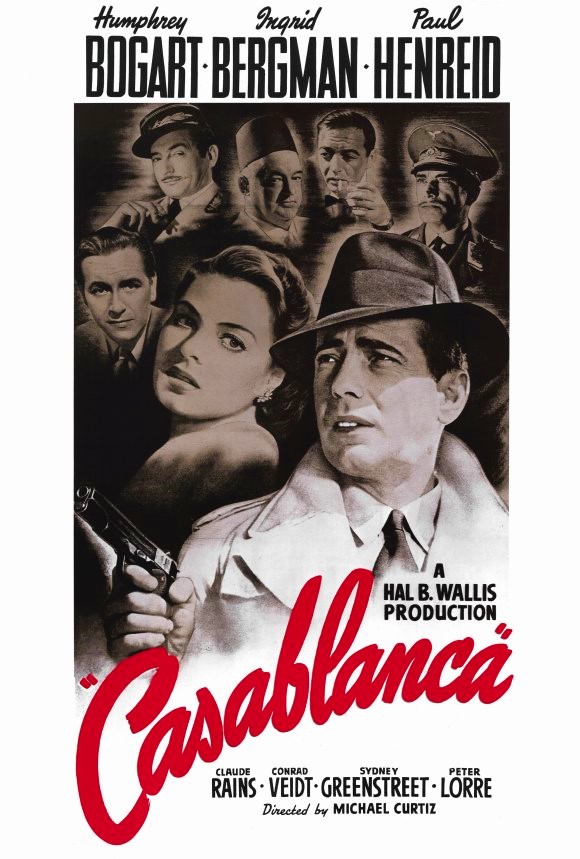
That movie has been a part of my world my entire life. I didn’t watch it myself until sometime during, or immediately after, my freshman year of college, but I was always aware of it, and my parents always spoke very highly of it. I remember when I watched it the first time I thought, “Yeah, that’s pretty damned good, I don’t know if it’s quite as good as everyone makes it out to be, but that’s a damned good movie.”
A while later I watched it again, though…and I discovered something that Roger Ebert would later write about: the fact that Casablanca is, somehow, always better the second time. There’s just something about it that makes it a “pretty good” watch the first time and makes it utterly engrossing the second time around…and each and every time thereafter.
Eighty-three years.
When I was a kid, Casablanca was my benchmark for “an old movie”. Since it was only 29 years old when I was born, I guess I kind of set “twenty-nine years old” as my thought for what constituted an “old movie”. So, using that metric, here in the Year of Our Lord 2025, new “old movies” include Independence Day, Scream, Jerry Maguire, and the first Mission: Impossible movie.
Anyway, here’s the Max Steiner suite I listened to this morning on my ride to work. This is music to put you in the mood to be a big inconvenience to Nazis…which honestly, is saddeningly needed right now, innit?
Share This Post
Tuesday Tones
Here’s something I didn’t know until today when I was driving home: English composer Frederick Delius lived for a time in Florida in the 1880s, during which he managed a local orange grove while he studied with a noted organist in Jacksonville. From this stay arose one of Delius’s most popular works, The Florida Suite. We’re only concerning ourselves with one movement from the suite, because our focus in this series right now is music inspired by water.
The orange grove Delius managed was on the St. Johns River, which is the longest river in Florida, running over 300 miles from headwaters south of Orlando to its mouth near Jacksonville. The river runs parallel to the seacoast, and it’s actually a fascinating river to track on Google Earth, as it winds back and forth and into and out of large lakes along its path.
Since the St. Johns doesn’t have much elevation drop at all, its flow is generally slow and sometimes even ebbs with the shifting of the tides. Thus Delius’s work, which paints a tone picture of life along a slowly moving waterway. There is little drama here, just the slow life spent along a slow river.
Share This Post
Tuesday Tones
A month or two ago when I was doing a series of music posts using music inspired by the moon, one post featured a work by Italian composer Ludovico Einaudi. As I seem to do whenever I find a new piece (new to me, anyway) by Einaudi, I always end up saying something like “I need to explore Einaudi’s music more!” And then I don’t, really, until the next time I’m looking for inspiration.
Which brings us to the current series, which is “Music inspired by water”.
Yes, I need to listen to the album this comes from, which is apparently highly regarded; it’s called In A Time Lapse. Yes, I need to listen to more Einaudi.
I haven’t found anything specific about this track, just its title, but it’s called “Waterways”, so that counts. Right? And it’s hypnotically beautiful. Kind of like a waterway.
Share This Post
Something for Thursday
We all have those movies, don’t we? They’re the movies where we’ll be going about our day, doing stuff that we’ve planned out and intended to get done…but then we’ll see that one of those movies is on teevee or something, and that’s that, screw the To Do List, we’re watching that movie again!
One of those movies for me is The Hunt for Red October, that wonderful submarine thriller based on the Tom Clancy novel. (I never read that particular Clancy book. I read a couple other ones and honestly, I wasn’t super-impressed beyond an appreciation for his plotting. My drug-of-choice for late-80s-early-90s spy fiction was Robert Ludlum.) Hunt came out in spring 1990, and I remember a bunch of friends and I in college going to see it. The movie rocked my world even then, and it has never declined in my estimation. It really is a masterpiece, as far as I’m concerned; it sets up every single plot twist in advance but doesn’t do so in such an obvious way that you can see the foreshadowing as it happens. It’s incredibly well-acted and superbly paced, and for an action adventure thriller, it has some absolutely crackling dialog. I just love it.
The music is also great, by the wonderful Basil Poledouris. Its main melodic material is distinctly Russian, and he makes extensive use of choir throughout, along with some techno material in the tense parts of the film. Here is a suite culled together from the soundtrack.
Share This Post
Tuesday Tones

Miranda (Lumix FZ1000ii)
f/7.1, 1/1000sec, ISO 250
Continuing our self-guided tour of classical music inspired by water, we have perhaps one of the two greatest works ever directly inspired by a river (well, maybe three, depending on how strongly we consider Wagner’s Der Ring des Nibelungen to have been inspired by the Rhine). The other work will surely show up in this series, but for now, we’ll stick with Bedrich Smetana’s Vltava, known to English-speaking audiences as The Moldau.
The work opens with a quiet shimmering that evokes the flow of Vltava, the longest river in the Czech Republic. Written as part of a cycle of tone poems evoking Smetana’s homeland, called Ma Vlast (“My Fatherland”), Vltava is the most well-known of the group and is often performed on its own. Its main melody is one of the great tunes in all classical music, an earworm for the ages, but Smetana’s orchestration is marvelous throughout as he casts the work with sonic effects that evoke the flowing waters and the country through which it flows. Smetana himself wrote of the work:
“Two springs pour forth in the shade of the Bohemian Forest, one warm and gushing, the other cold and peaceful. The forest brook, hastening on, becomes the river Moldau. Through thick woods it flows, as the gay sounds of the hunt and the notes of the hunter’s horn are heard ever nearer. It flows through grass-grown pastures and lowlands where a wedding feast is celebrated with song and dance. At night, wood and water nymphs revel in its sparkling waves. Reflected on its surface are fortresses and castles — witnesses of bygone days of knightly splendor and the vanished glory of fighting times. At the St. John Rapids, the stream races ahead, winding through the cataracts, hewing out a path with its foaming waves through the rocky chasm into the broad riverbed — finally, flowing on in majestic peace toward Prague and welcomed by the time-honored castle Vyšehrad. Then it vanishes far beyond the poet’s gaze.”
Here is Vltava by Bedrich Smetana (in a particularly wonderful live performance).
Share This Post
Tuesday Tones

Taken at Canalside, Buffalo, NY
Miranda (Lumix FZ1000ii)
f/5.0, 1/4000sec, ISO 500
This theme ought to yield some good things! That’s right: after completing an exploration of music inspired by the moon, we’re going to explore music inspired by water, in all its forms. And we’re going to start with a work premiered over 300 years ago, the usefully-titled Water Music by George Frideric Handel.
And maybe this isn’t the best place to start, because the work wasn’t actually inspired by water. Handel wrote it for the water…or rather, the boats upon it. Let me explain…no, is too much. Let me sum up.
In 1717, King George I decided to take a barge up the Thames in London, using the tide to propel the barge upstream before coming about for the return trip. The King wanted music, though, so he commissioned Handel to write some; this was performed on another barge that accompanied the Royal Barge on its journey. Some fifty musicians played Handel’s music on that other barge, and apparently many Londoners took to the water in boats and barges of their own to hear the music and pay homage to the King. This must have been quite a spectacle, and honestly, were I given the keys to Doc Brown’s DeLorean and told I could go back in time to witness one concert, the initial performance of Handel’s Water Music might well be the choice.
And the concert was very much a success: the King liked the piece so much he had it performed again on the return trip back down the Thames.
I’m not the best listener when it comes to Baroque music, but Handel and Bach are always exceptions. The Water Music is one of the most pleasant works I know: in its short movements over three suites, Handel deftly creates music of opulent delight and meditation in simple pleasure. As you listen to it, you may notice familiar themes throughout; the Water Music has provided a great deal of familiar music used for other things beyond some King’s barge journey. One movement was the theme music to The Frugal Gourmet, for instance.
Here is a wonderful original-instruments performance of Handel’s Water Music.