

OK, I think I’ve got the template looking the way I want it. The “tile” background fits the “Byzantium” inspiration for the site, and I’ve added a small rose as a divider between posts (which I think looks better than a hard return, anyway). The new images appear courtesy of the Absolute Web Graphics Archive, a free-graphics site that I was fortunate enough to discover last night.
Untitled Post

Earlier this week I saw the film Road To Perdition, and the next day I read the graphic novel on which the film is based. SPOILERS follow.
The film and the graphic novel are both fascinating works of gangland fiction, and they are actually much more different than one might expect. In fact, the storylines of each are only roughly similar — sharing a few scenes, but in general diverging greatly — and the themes of each are very different. Anyone coming to either the film or the book with expectations based on the other will be quite surprised. Pleasantly so, I think.
The film, as Roger Ebert notes in his review, is steeped in the feel of Greek tragedy. The subtext of the film is centered wholly on the dynamic between fathers and sons, with Paul Newman as the patriarch of the crime family and Tom Hanks as his most trusted enforcer, whom he loves as a son. The problems arise from Newman’s actual son, a weaselly and cowardly man who manipulates events to come out in his favor, setting the Hanks character — Michael Sullivan — up to be murdered. The plot fails, but Mr. Rooney (Paul Newman) has no choice but to stand by his real son and foresake the adoptive one, even though emotionally the adoptive one is a far truer son than the real one. Watching the film, I was reminded somewhat incongruously of the part of the Arthurian legend when King Arthur’s illegitimate son, Mordred, comes along and sets in motion the collapse of Camelot.
The dynamic between the father figure of Paul Newman and his two sons is likewise reflected in Tom Hanks and his two sons, one of whom he seems to love more than the other — until the one he seems to love more is murdered. There are scenes in the film that show Sullivan (Hanks) and his surviving son, Michael Jr., trying to connect with one another, including one particularly moving scene where the child actually asks if his father loved the brother more. Sullivan denies it, but he is forced to make an admission about his surviving son and his hopes for his future that is heartbreaking in its simplicity and seeming impossibility. He does not want Michael to grow up to be like him, but we get the feeling that it is already coming to pass. As Ebert notes, this sense of fate being played out is palpable throughout the film, whose theme seems to be that cycles exist in families that are immutable, unbreakable. As we watch the film’s events transpire, we hope that Michael Jr. will not be forced to become like Michael Sr. — that he will not have to kill — but we almost know that he will, and we wait for it to happen. Thus, it feels almost like divine intervention when, in the end, he does not. The film ends on an unexpectedly hopeful note, because the cycle has been broken and now Michael Jr. may grow up along a different path.
Much of this father-son subtext is absent in the graphic novel, however; the theme of the novel seems to be atonement. There is a great deal more religious imagery in the novel, with Michael Sr. finding a Catholic church and confessing his sins after each time that he kills. “God made Irishmen pale,” Michael Jr. says, narrating his tale, “but not as pale as those priests who came out after Papa had unburdened his soul to them.” The book is much more concerned with the possibility of men like Michael Sr., even while wreaking such terrible violence, still being absolved of their sins and going to Heaven than is the film, in which everyone seems totally accepting of the inevitability of Hell. Likewise, the concern of Michael Sr. that his son never have to kill is not much present in the novel, because about halfway through the novel Michael Jr. does kill. So the focus becomes not on breaking the familial cycle of fate, but on gaining atonement and absolution. The novel’s final denouement reveals Michael Jr.’s fate as an adult, whereas the film ends with Michael Jr. still as a child facing an uncertain future.
There are other, more mechanical differences between the film and the novel. The novel’s story is more of a historical, “true crime” type of story, drawn from actual events; thus the “Rooney” crime family from an un-named city in the film is actually based on the novel’s historically accurate Looney Gang, from the Tri-Cities (the Quad Cities, before Bettendorf was added). The action in the film is much more centralized on the enmity between Sullivan and Connor Rooney, whereas in the novel Sullivan is going after the entire Looney clan — including the father, who was actually the one who betrayed him. More historical events are used in the book, including Eliot Ness’s raid on a New Mexico hideout of Al Capone’s, and the burning of an illegal riverboat casino. And the biggest difference between the book and the graphic novel is that the film’s photographer hitman, played by Jude Law, does not exist in the book. Thus the book avoids what I found to be the film’s biggest flaw: the fact that, when everything else has been resolved, the film’s last fifteen minutes or so boil down to waiting for Jude Law to reappear. The book does not totally avoid the deus ex machina, but it doesn’t crank as noticeably as in the film.
Both the film and the graphic novel are impressive visually; the film’s atmosphere of cold dampness was so pervasive that I don’t recall ever being quite so glad to exit a theater into sunshine, and the novel’s illustrations — by Richard Piers Rayner — are superb black-and-white images that look like woodcuts, and have a not-insignificant similarity to the style of illustration used by Goseki Kojima in the brilliant Lone Wolf and Cub manga on which the entire story was partly based in the first place. (The novel’s epigram is a quote by Kazuo Koike, the writer of Lone Wolf and Cub.)
“The book is better than the movie” is often proferred as an immutable truth, but it’s not always so. In the case of Road To Perdition, both are interesting and complementary of each other.
Share This Post
Untitled Post
Baritone William Warfield died earlier this week. He was most noted for his portrayal of Joe in Showboat and Porgy in Porgy and Bess. I didn’t know much about him until I heard this obituary on NPR. Isn’t it amazing how many remarkable people pass through this world, and we never know a thing about them until they are gone?
Share This Post
Untitled Post
UPDATE to yesterday’s IMAGE:
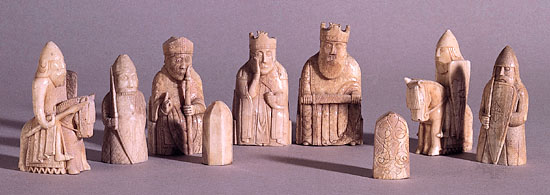
The image that I selected of the Isle of Lewis chessmen appears to be a tad temperamental — it’s not always loading as it should. To see that image, try clicking this link. Otherwise, here are a few extra images of Lewis chessmen, including a very nice image of one of the Kings in the sets.


Share This Post
Untitled Post
IMAGE OF THE WEEK
(EDIT: Image removed due to broken link. For substitute images, see the post directly above this one.)
Several of the Isle of Lewis Chessmen.
In 1831 a group of small figurines, ninety-three in all and mostly carved from walrus tusks, was unearthed on the Isle of Lewis in the Outer Hebrides islands (off the northwestern coast of Scotland). The figurines were later identified as chesspieces. The chessmen are believed to have originated in Norway. They are the oldest chessmen in existence. Replica sets are widely available; I am fortunate enough to own one. (Due to the presence in my home of a three-year-old child and also three cats, this prized possession of mine is still in its box.)
I’ve always found something fascinatingly primal about the design of the Lewis Chessmen. Even though they don’t date back nearly that far, it is easy to imagine them being moved around a board in a Celtic chieftain’s meadhall — in the pages of Beowulf, perhaps, or maybe the halls of Bran the Blessed in The Mabinogion.
Share This Post
Untitled Post
The Schoyen Collection is one of the largest collections of ancient and medieval manuscripts in the world, and has a nifty web page devoted to it. There is something wonderful about the thought that the books of today might survive two or three thousand years hence, and be the objects of a collector’s passion. So much of the human heritage is transitory, being plowed under to make room for the new, that the handful of items that survive are truly priceless.
Share This Post
Untitled Post
POETICAL EXCURSION #7
“The Solitary Reaper”, by William Wordsworth (1770-1850).
Behold her, single in the field,
Yon solitary Highland Lass!
Reaping and singing by herself;
Stop here, or gently pass!
Alone she cuts and binds the grain,
And sings a melancholy strain;
O listen! for the Vale profound
Is overflowing with the sound.
No Nightingale did ever chaunt
More welcome notes to weary bands
Of travellers in some shady haunt,
Among Arabian sands:
A voice so thrilling ne’er was heard
In spring-time from the Cuckoo-bird,
Breaking the silence of the seas
Among the farthest Hebrides.
Will no one tell me what she sings?–
Perhaps the plaintive numbers flow
For old, unhappy, far-off things,
And battles long ago:
Or is it some more humble lay,
Familiar matter of to-day?
Some natural sorrow, loss, or pain,
That has been, and may be again?
Whate’er the theme, the Maiden sang
As if her song could have no ending;
I saw her singing at her work,
And o’er the sickle bending;–
I listened, motionless and still;
And, as I mounted up the hill,
The music in my heart I bore,
Long after it was heard no more.
:: I like this poem a great deal, mostly for its sense of sadness for a question that shall perhaps never be answered. The speaker is traveling, and he encounters a Highland woman working in her field. She is singing, and though he does not know the song its melody moves him greatly. He exhorts his fellow travelers to tell him what the song is, and what she is singing about, but none answer, and thus he must go away never knowing what the woman is singing about although he will forever remember that tune which has captivated him so.
The poem is full of rich imagery. The Highlands themselves suggest a rugged place, where working the fields is as much the province of women as men because the land is so difficult. There is also a sense of loneliness, because the woman is alone; Wordsworth tells us that in the very title. Is she a widow? Is her husband off to war or market? We never learn, and the question is only implied and never asked, because the speaker is more concerned with the woman’s song than with the woman herself. He tells us that the tune is melancholy, and his speculations as to its subject are all sad ones, and yet the melody is more welcome to him that any birdsong. The speaker seems to be starved of beauty, and he wants to stay and hear the song and pray that it never ends, but he cannot — he can only move on and carry the song with him in his heart.
This seems an apt poem to read as August wanes and September arrives, with its autumnal imagery and its tone of wistful remembrance. We reap in the fall, and things like a lovely song can help us to get through the long, cold winter.
Share This Post
Untitled Post
Courtesy of The New York Times, an article on one writer’s struggles with procrastination by novelist Ann Patchett. (NYT registration is required, but it’s free — for now, of course, and with the shady clause that “Our privacy policy is subject to change at any time”.)
Something shared by the vast majority of writers, I suspect, is a gift for procrastination. I am no different from any other; despite the fact that I love writing and nearly always have at least a pleasant time writing and, many times, a wonderful time doing so, I often find other ways to spend my time. One general term, used as a generic noun for any activity whose stated purpose is one thing but whose actual purpose is to delay the time when one must sit down and string words together, is “cat-vacuuming” — probably because many writers own cats, and anyone with cats can attest that there is pretty much always a need to run the vacuum cleaner when cats are about. Personally, I hate vacuuming, so I find other ways to postpone writing: I’ll wash the dishes, perhaps; or I will catch on e-mails; I might play a “quick game of Hearts” (Minesweeper has long since lost its hold on my attention); and sometimes I will even post to Byzantium’s Shores. (Yes, that’s what I’m doing right now. As of this writing I have a folder on my desk, containing a rough draft of Chapter 14 of the novel-in-progress covered with underlines, margin notes and directions all in red, sitting next to the computer. And the folder is closed. Fancy that.)
This is probably why every writing book I have ever read includes the advice, “Write every day and do not fail to write every day”. The Latin expression of this idea is particularly elegant: Nulla dies sine linea, or “Never a day without lines”. This is excellent practical advice, as writing — for many writers — is a matter of momentum, and if the momentum is lost the work can seriously suffer. But as Isaac Asimov once wrote, “That moment you just lost by not writing isn’t only gone, but it’s the best moment that you’ll ever have, because all future moments will come when you’re that much closer to dying.” (That’s not an exact quote, but it’s pretty close — it comes from an essay that I can’t just now locate but have read several dozen times.) Of course, this comes from a man whose personal solution to this problem was to write so much that he is one of the most prolific writers in memory.
This advice is also given, quite strongly, by Stephen King in his wonderful On Writing, where he prescribes a steady diet of daily writing for anyone who wishes to be a writer. He speaks of people like Thomas Harris, who writes a book every seven years or so, wondering what these people do when they’re not writing their books. For King, it’s almost a moral imperative: “If God gives you something you can do, why in God’s name wouldn’t you do it?” I have to agree, although I certainly can’t match King’s schedule — not even close, to be honest. Then why am I so blasted good at finding reasons to not write? There is certainly no reason why the dishes can’t wait until the chapter is done and not before. I suspect that it’s actually a habit that became ingrained when I was just starting writing, a holdover of the American-Puritan ideal that holds that things like writing are nice things to do, but only when the milking and the wood-chopping and the water-pumping are done. (If even then; those Puritans weren’t much on fun — and a lot of times, we Americans aren’t much on fun either. So much of our “funtime” is observed in a grudging, obligatory fashion.)
There is a particularly dangerous form of cat-vacuuming, though, that is rarely cited by writers (at least in my experience), but can lead to more consumed time away from the desk than any other. It is reading. I have found that it is perilously easy to read rather than write, since many times I can call it “research” or “preparation” or “keeping up with the genre” or any number of other justifications. Writers are a reading lot; I’ve only encountered one writer who claimed to dislike reading, and that is because that particular writer is dyslexic (Nicholas Negroponte, in his book Being Digital). Writers have to be well-read, not merely to keep up with the genre and to know what territory has been mapped out before and to research the pesky details that are to come into play in the next project, but also because writers are by definition persons whose lives depend on the written word. As King so excellently puts it, “If you don’t have time to read, then you don’t have the time (or the tools) to write.” And, in the very next paragraph: “Reading is the creative center of a writer’s life.” We read because we have to, but it’s all to easy to walk away from the desk and pick up a book because it’s part-and-parcel of the whole “writer” gig. I’ve heard of Master’s or Doctoral candidates falling prey to this kind of thing: “I can start the dissertation after I read just one more book on my subject, or track down just two or three more articles….”
Well, I’ve probably said enough on that for now….after all, I have Chapter 14 crying for help, and it’s time to throw it a rope. After all, I’m the writer. As Patchett says in her essay, “Sometimes if there’s a book you really want to read, you have to write it yourself.”
Share This Post
Untitled Post
Before my wife and I were married, we underwent the obligatory meetings with the Pastor who would perform our ceremony to discuss our wishes for the wedding, as well as other issues. When it came to the issue of music, we worked with the church’s music director, a fine organist and musician who had a wealth of suggestions to make as to what to use for the Processional, the hymns, the Postlude, and so on. The only rule we were asked to observe, with respect to music, was that we could only select music that was religiously themed — i.e., no pop tunes. We were only too happy to observe this stipulation; it never occurred to us to use some popular song for our wedding. However, this is not the case for everyone; at a wedding we attended two years later, “My Heart Will Go On” was given a central position smack dab in the middle of the ceremony.
Well, it’s not just weddings that are being popularized these days. According to this NPR story, in the United Kingdom popular music is turning up more and more at funerals. Wow. There is even a Top Ten of songs used most often at funerals. I won’t reprint the Top Ten here — it can be read at the link above — but I will say that it’s an interesting list. (And that “My Heart Will Go On” is on it.)
Share This Post
Untitled Post
As usual, there are few things more conducive to starting conversations and debate than making a list of “The {number} Best {things}”. (Or “Worst”, as the case may be.) That said, ESPN has named the Top Twenty Sports Films of All Time. I haven’t seen all of these, but the ones that I have are quite deserving of their accolades here. I would, though, include Tin Cup, but maybe that’s because I’m not a golfer. I have yet to find an avid golfer who actually likes that movie. And personally, I would omit Eight Men Out in favor of Major League. And since I’m including Major League, I’d ditch The Bad News Bears in favor of The Karate Kid. You can’t help but love a movie that added “Wax on, wax off” to the national lexicon.