Your Daily Dose of Christmas

 I saw this amusing post online this morning:

And I saw that just as I was starting to think, “Hmmm, I wonder what I should post for my Christmas music of the day?” I love how every once in a while, the Interwebs anticipate my needs.

Here is some Johnny Cash for your wintry morning. (Well, very late autumn, I suppose is technically correct…and as I look outside at this moment there’s not much “winter” in evidence yet. We’re having one of those years where winter seems to be a slow developing thing, as opposed to other years where at some point in October or early November winter shows up to shout “HEY! I’M HERE!!!” as it wallops us with snow. Right now it’s just eternally damp and muddy. What were we talking about? Oh yeah, Johnny Cash. Sorry about that; I’m writing this as the coffee is only just starting to kick in.)

There was always something special about Johnny Cash’s voice that I could never put my finger on. It really shouldn’t work, that gravelly baritone that doesn’t always home in on the exact pitch the way a singer should. Sliding into a pitch instead of hitting it dead on is a standard device of country singing (Reba McIntyre and Garth Brooks are canonical examples of this technique), but what Cash does is…more than that. Sometimes he sounds like he’s perfectly content to waver in the vicinity of the actual pitch without actually getting there. If you heard a young music student singing like that, you’d question their ability. When you hear Johnny Cash doing it, you know that you’re listening to a master who is doing exactly as he wishes with his voice.

Most of all, though, that guy knew how to home in on the emotional content of a song and use his instrument to make it work. He never stresses the wrong word or puts the em-PHAS-is on the wrong syl-LAB-le, and he somehow makes it sound like every song he sings was written for him and him alone, no matter if he actually did write it or if it’s an old standard like “White Christmas” that has been sung by everyone, some of whom are icons with every bit as much stature as Mr. Cash.

Share This Post

Liberatopia: Now with hungry bears!

 Years ago I was driving someplace and an odd segment came on the NPR show This American Life, which was about a libertarian guy who was spearheading what seemed to me a pretty Quixotic notion: rallying a whole bunch of like-minded libertarians to move to a single state, massing enough numerical strength to force through the engines of democracy a large-scale implementation of libertarian policies. Eventually they would be able to show the world entire how wonderful and glorious things are when there is minimal government, minimal idea of public life, and a strong focus on individual freedom.

I remember this very keenly: so strongly did it hit me that I blogged about way back in 2003 (!), when this blog was barely a year old. Here’s some of what I wrote back then:

The story focuses on one particular Libertarian, an earnest and intelligent young fellow who is steeped in Libertarian theory, and yet he strikes me as so steeped in theory that he doesn’t seem to have a handle on some of the more mundane concerns of life. He completely downplays the inevitable local resistance that his movement is certain to face whenever his twenty-thousand brethren arrive in Vermont or Delaware or Wyoming. His faith in the marketplace strikes me as scary — private companies will pick up the cigarette butts and maintain all the roads, for instance. We’re told that since zoning laws won’t exist in Liberatopia, McDonald’s will be able to build next door to your house if they so desire. But it’s all good, because you’ll be allowed to paint your house any color you want. Well, OK…but I fail to see how being allowed to treat my aluminum siding as a Jackson Pollack canvas really compensates for having what goes on behind fast-food restaurants doing so beside my back yard. (I worked in restaurants for years, and I know damn well what goes on outside the back door when the employees are bored. Especially since Liberatopia will have no drug laws.)

Then there is the surreal moment when the guy discusses, as an example of what he doesn’t like about public parks. He breezily says, “We’ll privatize this common area”. He scoffs at all the regulations typical of a town park — no skateboarding, for instance (this one I can somewhat agree with; there should be more places for skateboard and rollerblade use in this world). But he also scoffs at “No alcohol and no glass containers”, which he thinks is Draconian — but any parent who has ever encountered broken glass around the swings at the playground won’t quite share the same view, I suspect. “Parks” equal “theft”, he tells us: governmental funding of parks equals theft. When the interviewer points out that no private company is simply going to want to operate a free public park, he concedes, “Yeah, it’ll be gated”, and then states broadly that there will be no purely public spaces in Liberatopia. I’m glad the interviewer didn’t ask what happens to the library. I probably would have broken down in tears at this guy’s answer to that one.

This Libertarian travels around Vermont, one of the candidate states for Liberatopia, talking to the locals and trying to get them to sign the pledge promising to move once enough folks are signed up. One guy seems to be hearing these ideas for the very first time, and yet signs on the dotted line almost immediately — we get to hear the scratching of his pen — leaving me to wonder if he’s really thought things through. I wonder what happens when some of these people move and discover just how much they really, truly, deep-down love little things like parks for the kids and libraries and not having to worry about some company putting a set of dumpsters on the other side of their driveway. I don’t know, but something about this whole endeavor makes me envision Bart, after one of Homer’s schemes has predictably turned out poorly, saying: “Bet you wish you’d researched this plan a little, eh, Dad?”

After that, I kind of lost track of (and interest in) the Liberatopia Project, because…well, at that time I could claim that I didn’t have a lot of experience with libertarians, but now, I have had a lot more experience with them, and suffice it to say that while my reaction to libertarianism back then was a bemused “OK there, champ”, my reaction now tends to be “Oh lord, get this nut away from me, and somebody open a window once they’re gone.”

Well, earlier today I saw this article, which is an interview with the author of a book about what eventually happened with the whole “The Libertarians Are Going To New Hampshire!” movement. Last time I looked in on these goons, they were imagining taking over an entire state; they seem to have eventually scaled down their idea to taking over a town, and they actually managed to pull this off in the unfortunate burgh of Grafton, NH.

Maybe I should give a spoiler warning, but come on: anyone with a pulse knows that this whole notion was bound to be a shitshow, and a shitshow it was:

By pretty much any measure you can look at to gauge a town’s success, Grafton got worse. Recycling rates went down. Neighbor complaints went up. The town’s legal costs went up because they were constantly defending themselves from lawsuits from Free Towners. The number of sex offenders living in the town went up. The number of recorded crimes went up. The town had never had a murder in living memory, and it had its first two, a double homicide, over a roommate dispute.

So there were all sorts of negative consequences that started to crop up. And meanwhile, the town that would ordinarily want to address these things, say with a robust police force, instead found that it was hamstrung. So the town only had one full-time police officer, a single police chief, and he had to stand up at town meeting and tell people that he couldn’t put his cruiser on the road for a period of weeks because he didn’t have money to repair it and make it a safe vehicle.

Basically, Grafton became a Wild West, frontier-type town.

Sean Illing

When did the bears show up?

Matthew Hongoltz-Hetling

It turns out that if you have a bunch of people living in the woods in nontraditional living situations, each of which is managing food in their own way and their waste streams in their own way, then you’re essentially teaching the bears in the region that every human habitation is like a puzzle that has to be solved in order to unlock its caloric payload. And so the bears in the area started to take notice of the fact that there were calories available in houses.

Yikes. Read the whole thing, but as a writer, I have to note that wonderful sentence: “You’re essentially teaching the bears in the region that every human habitation is like a puzzle that has to be solved in order to unlock its caloric payload.” That’s some good stuff, right there!

Share This Post

Your Daily Dose of Christmas

 My most beloved of composers, Hector Berlioz, was born 217 years ago today. While he is often noted (and mocked) for his use of bombast, he was actually very tasteful and strategic in his use of big sounds: Berlioz loved contrast, and he could (and did) write music of surprising delicacy and intimacy. A lot of that can be heard in his oratorio L’Enfance du Christ, which tells the story of Joseph, Mary, and Jesus’s flight into Egypt after the Nativity. While Berlioz’s music was often met with hostility from the composer’s native Parisian audiences, L’Enfance du Christ was embraced from the start and for many years was one of the few works by Berlioz to receive regular performances at all, before the great reassessment of his genius took place in the middle of the 20th century, ninety-plus years too late for Berlioz himself to have enjoyed it.

The Shepherd’s Chorus from this work is a common excerpt heard this time of year, but Berlioz is so much more engrossing when one listens to the entire piece, so here it is.

Share This Post

Beethoven at 250: The Ruins of Athens

 One reason that film music often struggles to get mainstream acceptance as music worthy of interest on its own is the fact that film music is always dependent on the film for its inspiration and genesis. Film composers don’t tend to have a great deal of freedom in their work, and they have to compose their scores to accommodate the timing and rhythm of the film given them to score. Obviously some of these composers are masters in their own right and create great works even with these constraints, but the constraints are still there.

Music as an aid to storytelling is best seen, prior to the movies and even after them, in the world of opera, but there is a smaller arena where the great composers of the 19th century often found themselves dealing with at least some of the same constraints that film composers would later confront. I’m talking about incidental music for plays.

Some incidental music has gone on to be quite famous indeed, seen as masterpieces on their own. Felix Mendelssohn’s work for A Miidsummer Night’s Dream is one of the enduring classics, and one of its melodies has even become a traditional recessional in modern weddings. Hector Berlioz also wrote incidental music, as did Mozart, Schubert, Schumann, Bizet, and Grieg.

And so did Ludwig van Beethoven.

What’s interesting about a lot of incidental music is that, Mendelssohn’s work for Shakespeare excepted, the music has outlived the plays in nearly every case. Schubert’s music for Rosamunde is well known (and in that case, mainly for the overture alone), but the play is almost completely forgotten. Likewise with Beethoven’s fine music for a play called The Ruins of Athens. This play was written by August von Kotzebue for performance at a new theater in Pest, and if it’s been performed anywhere in the last hundred years, I’d be shocked. But because one of music’s greatest of all masters wrote incidental music for it, the play isn’t completely forgotten.

Beethoven’s suite of incidental music is one of his more pleasing works, even if even this group of pieces is rarely heard except for the Turkish March movement. The suite is not purely instrumental, featuring movements for voices and orchestra. It’s all suitably dramatic but also very much Beethovenian. For all his anticipation of Romanticism, Beethoven was even at his most ostentatious always grounded in classical proportion and form. This suite, with its drama and genial melodies, doesn’t so much seem to anticipate Wagner as look back at (and, in so doing, extend the reach of) Mozart, and it does so with the geniality of the Beethoven who wrote the Pastoral Symphony.

I’ve long maintained that one need not necessarily have seen a film to appreciate its score on a separate listen, and when people question me on this point, all I need do is point to music like Grieg’s Peer Gynt Suite or Beethoven’s The Ruins of Athens and ask, “Do you really need to see a forgotten play to appreciate this music?”

Share This Post

Your Daily Dose of Christmas

 Forty years ago tomorrow, I got up to get ready for school. My mother had Good Morning America or Today or one of those on in the living room, which is when I learned of what happened forty years ago today. John Lennon, shot dead in New York City.

It would be many years before I would finally warm up to the Beatles’ music and the enormity of the act of cultural assault that Mark David Chapman committed that day.

Here is John Lennon.

Share This Post

Your Daily Dose of Christmas

 One area of classical music I always tell myself I would like to explore, and yet never quite do, is the operas of Nikolai Rimsky Korsakov. NRK was a brilliant orchestrator, a musical colorist who also had a fine gift of melody. His music teems with the sense of exotic color and adventure and emotion; his Scheherazade is one of the enduring works of orchestral magic.

I have read that NRK’s operas constitute a treasure trove of storytelling and music, all based on the legends and fairy tales of Russia. The operas are not often staged, however, mainly because Russian is not one of the more popular languages for singers to learn, which is likely a pity. But we do have orchestral suites derived from NRK’s operas, like this one, from an opera called…Christmas Eve. A light romp, this is not; the story involves a plot by the Devil to steal the moon, and it proceeds from there in what I am sure is delightfully operatic fashion.

This is an orchestral suite derived from the score to Christmas Eve, and if it doesn’t make use of any traditional musical trappings of this season — no jingle bells here! — it nevertheless creates that wonderful sense of NRK’s grand orchestrations and music that is full of rhythmic excitement and emotion.

Share This Post

Beethoven and the Outdoors

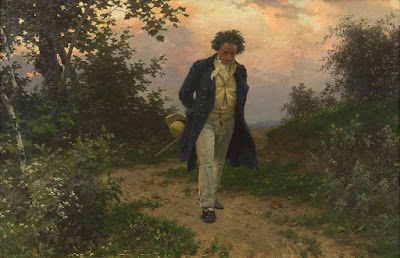
“Beethoven’s Walk in Nature”, Julius Schmid

 One thing that I have in common with Ludwig van Beethoven is that we both find creative rejuvenation in regular walks in the woods near our homes. I don’t know of any canine companionship that Beethoven might have enjoyed, but I have a dog with me at almost all times when I am walking through the forests of Chestnut Ridge Park, or Knox Farm, of Hunters Creek, or Sprague Brook, or Letchworth. Beethoven would escape almost daily to the woods around Vienna.

Even in Beethoven’s time, pollution was a problem in the city, and Beethoven likely felt it necessary to his physical health to get out of the city on a regular basis. I wonder how he applied those walks along forest trails to his musical life! Did he hum to himself, trying out musical ideas as he strolled? Did he take manuscript paper, quill, and ink with him so he could jot down ideas as they came? Or did he simply take a more meditative approach, using the walks to calm his often troubled soul so that when he returned to his chambers and his piano and his ink and paper, his mind was in a place to actually create?

It doesn’t precisely matter how Beethoven’s love of nature moved him to create; all that matters is that it did. His music abounds with examples of this inspiration, but the most famous and obvious is in his Symphony No. 6, the “Pastoral”, in which Beethoven uses five movements (not four!) to more suggest the emotions of walking in nature than musically depict it. This makes the Pastoral Symphony one of the earliest examples of “program music”, even if Beethoven’s desires were more impressionistic in nature. Nevertheless, in those five movements, Beethoven deftly creates a series of emotional moments–“melodic moments of feeling,” as Wagner would later say–that do suggest a natural setting.

The movements suggest the feelings of refreshment and delight upon arriving in the countryside, and then a scene by the side of a rushing brook. The third movement is a folk dance, followed by a storm and then by the feelings of rain-washed newness that follow a good summer storm. The entire symphony is lyrical and beautiful and at times even charming–note the folk dance in the third movement, which has a lively tune played off the beat by the oboe and a bassoon accompaniment that sounds like the bassoonist can only play three notes–and there’s real drama when the storm arrives, before peace settles again. The storm has been frightening, but also rejuvenating.

Here is Beethoven’s Symphony No. 6 in F Major, the Pastoral. Few works with more lyrical delight exist.

Share This Post