Wow….

 A fascinating astronomy image today! Behold:

NASA explains:

A spectacular set of rings around a black hole has been captured using NASA’s Chandra X-ray Observatory and Neil Gehrels Swift Observatory. The X-ray images of the giant rings have revealed new information about dust located in our Galaxy, using a similar principle to the X-rays performed in doctor’s offices and airports. 

The black hole is part of a binary system called V404 Cygni, located about 7,800 light-years away from Earth. The black hole is actively pulling material away from a companion star — with about half the mass of the Sun — into a disk around the invisible object. This material glows in X-rays, so astronomers refer to these systems as “X-ray binaries. 

 … 

In a new composite image, X-rays from Chandra (light blue) have been combined with optical data from the Pan-STARRS telescope on Hawaii that show the stars in the field of view.

Amazing!

Share This Post

Tone Poem Tuesday

 A very short work today! Less than three minutes, courtesy Soviet composer Dimitri Shostakovich.

In 1943 Shostakovich entered a contest to write a new national anthem for the Soviet Union. Apparently he did not win, but he was able to repurpose his material for that project seventeen years later, for use at a war memorial dedication in the city of Novorossiysk. According to what I have found on this piece, the work Shostakovich presented for the war memorial has been played continuously there ever since. Wow.

The piece is only a few minutes long, starting off quietly before building and building to a fairly thundering climax that isn’t hard to imagine being central to a patriotic tableau of some sort. I’d never heard it before today, but if you has asked me to imagine what a Russian/Soviet “Land of Hope and Glory” tune would sound like, this is what I would have thought of: a slow, stately melody of obvious nationalism that nevertheless broods.

Here is Shostakovich’s Novorossiysk Chimes (Flame of Eternal Glory).


Share This Post

A morning of adventure! Or…this.

 What passes for an exciting weekend morning ’round these parts.

Actually, they may have been on to something. Our morning errands are complete, as I write this it’s mid-afternoon, it’s hot enough outside to not be conducive to sitting on the deck, so I may as well go take a nap.

Zzzzzzz, indeed.

Share This Post

Something for Thursday

 Last week, Dusty Hill died. He was the bass player for ZZ Top.

ZZ Top is one of those bands that has been a part of the soundtrack of my life pretty much ever since early-adolescence, when I first became aware of rock music. They’re one of those acts that seems like they’ve been around forever, partly owing to their look: famous for their long beards, they cultivated an air of being old when they were still quite young. But there’s also a timeless quality to their music, which plays equally at ease on a classic rock station and an 80s throwback station, and more.

ZZ Top was always known most for its look: black suits and very long beards. They never updated that look at all. ZZ Top was not one of those “chameleon” kinds of acts that shifted with the times; their musical style and their look was always the same. They knew what they wanted to do, who they wanted to be, and the kind of music they wanted to make. And they made a lot of very fine music, too! Maybe they’re not quite at the level of, say, a Bob Seger or Tom Petty and the Heartbreakers, but ZZ Top is every bit as essential to knowing the last forty years or so of popular music in America. (ZZ Top’s own history began in 1969, so they’ve been a thing for more than fifty years.)

By never much changing while maintaining a high standard of excellence, ZZ Top managed to seem like they’d been around forever and always will. They always had that air of “grizzled old veterans of rock”, even if they were only in their mid-30s when I first encountered them, with their big hit, “Legs”.

My favorite ZZ Top song is one of their less-known ones, a power ballad from the Afterburner album. “Rough Boy” is really quite a lovely song, with lyrics suggesting a boy trying to impress a girl even though he’s, well, ‘rough’. Those lyrics go well with Billy Gibbons’s raspy tenor, and the verses alternate with some frankly beautiful guitar playing.

Here are three videos: first the song itself as recorded (and later remastered) for the original album, and then a live version in which the band is joined by guitar legend Jeff Beck. And finally there’s an example of one of my favorite new genres, the “reaction” video, in which a listener with an open mind listens to “Rough Boy” for the very first time ever. (The reaction video is great, but her experience is slightly marred by the fact that she’s also watching the song’s official video for MTV, which is, I must admit, one of the weirder videos out there, and it’s a video whose content has almost nothing to do with the song itself. But her enthusiasm is real; I love these reaction videos!)

And Dusty Hill: Thanks for the music. It will live long!

Share This Post

Happy Birthday…

 …to the person whose influence on my life includes, among many other things, a love of these various musical numbers.

And so many more!

(The person in question is my mother, who turns 80 today!)

Share This Post

Sure, we got a billion bucks lyin’ around someplace

 Looks like the shoe is finally dropping in Buffalo and WNY, regarding the future of the region’s NFL franchise: the team’s owners, Terry and Kim Pegula, are floating the idea of a new stadium to replace the team’s existing venue, which would be publicly funded to the tune of over $1,000,000,000.

Hold on, let me count the zeroes to make sure I have that right…thousand, million, billion. Yup, that’s right.

Newer reports have the team citing possible other locations for the franchise if the stadium doesn’t happen. Locations like Austin, Texas.

My position on this is simple: I am against any public funding for stadiums at all. None. Not one penny.

A sports team is an investment on the part of billionaires that in almost every case ends up making many more billions for those owners. If someone who is worth a billion dollars wants something that costs a billion dollars, well, let them put up their own money for it. The notion that the public should put up the money so the owner can reap further billions is ludicrous.

And don’t come at me with “Stadiums spur development!” and “Stadiums create jobs!” We all know this is complete nonsense. Study after study after study has confirmed it. I live less than a mile from the local stadium, and believe me when I tell you, the area around the stadium is not a hotbed of massive economic development. There’s about half a dozen bars, a convenience store that was a 7-11 once, a Tim Hortons, and one of those really seedy motels where people who, ahem, are required to register their whereabouts and living arrangements with the local constabulary (and whose presence might be communicated to local parents) go to live.

I consider spending a billion dollars on a single project that will literally benefit a small number of people and enhance the profits for literally one family, and I think of things like…local schools. Parks. Water and electrical infrastructure. Libraries. Museums and arts projects. Streetlights. (This last one sounds prosaic, but I think of it every time I drive through another city that has streetlights on its main expressways. Buffalo does not.)

On a larger point, I am sick of living in an economy which is largely organized around the precept that the natural and preferred course of money is ever, ever relentlessly upward. The idea of giving money to people at the bottom of the economic spectrum is seen as socialist nonsense, but the idea of public money being spent in gigantic amounts so that a single married couple can pocket more millions in profits before eventually selling their investment for a gargantuan return is never even questioned.

When sports stadium talk comes up, I think of Atlanta, Georgia. In the early 1990s, an aging facility–Atlanta Fulton County Stadium–served both the NFL’s Atlanta Falcons and MLB’s Atlanta Braves. The state of Georgia funded the building of the Georgia Dome for the Falcons, which opened in 1992, and the Braves got their new park, Turner Field, four years later when the stadium build for the 1996 Summer Olympics was converted to ballpark status.

In the last few years, both of those venues, built not just in my lifetime but in my adulthood, have been replaced, and for all the usual reasons cited, each and every one of which could be reduced to one very simple reason: the teams’ owners could make more money if they had new venues.

And now here come the Pegulas, the owners of the Bills. When they bought the team they tabled new stadium talk for several years, even though everyone around here knew the subject would come up, if not by them then by the NFL itself (which is an organization that is made to further the football-related investment goals of the owners). As the team is finally good again after many years of not being good, it’s clear that the Pegulas basically wanted to wait until the local mood was favorable toward the Bills again. It’s no accident that the year after the team went 13-3 and nearly made the Super Bowl that the owners are shaking the money tree for a new stadium.

Where will it be built? Current discussion is a new stadium pretty much across the street from the current one, so at least we seem to have abandoned the notion of building it in downtown Buffalo. But still: local money? Over a billion dollars of it?

This local citizen says no. And if the Bills move to Austin (or Toronto, or San Antonio, or Portland, or anywhere else), this local citizen says, “Thanks for the memories, good luck.” I saw the point being made all over social media the last couple days that the Bills “bring Upstate NY together” and that the Bills shape the local mood, and that losing the Bills would be an irrevocable blow to the local psyche. This seems deeply unhealthy to me. Plenty of successful and fine cities exist in this country with no major sports teams. It is my firm belief that we can have a very nice and vibrant city, with all of the things that nice and vibrant cities have, without major-league sports teams. I like sports and I get excited by the prospect of Josh Allen leading the Bills to a championship too, and I’d like to see the hockey team stop being awful and win a Stanley Cup…but I’d hate to lose the Philharmonic, the Albright-Knox, Shea’s, or our waterfront much, more more. I’d hate to see local schools get worse and for jobs and people to keep migrating away.

Regional identity, self-image, self-worth, and major economic policy should not be based on the existence and/or the performance of local sports teams.

If the Pegulas want it, let them build it. And if they can’t afford it, well–Terry Pegula once boasted that if he needed more money he’d just drill another well.

Start drilling, Terry. Better start now.

Share This Post
Tone Poem Tuesday

 The operas of Giachino Rossini are staples of the operatic stage, and the overtures from those operas are staples of the concert world. But even within Rossini’s well-known work, some works are more well-known than others. William Tell and The Barber of Seville are some of the best-known works of all time, including their overtures, which have enjoyed (or endured!) second lives in popular culture outside of the context in which Rossini originally wrote them. Less well-known, but still a staple of the repertoire, is Rossini’s take on the Cinderella folk tale, La Cenerentola.

La Cenerentola was Rossini’s follow-up after the huge success of The Barber of Seville, and its success was more uneven than the earlier opera’s. La Cenerentola did not open particularly well, but it grew quickly in popularlity through the 19th century. However, the style of singing its music required did fall out of favor, and thus La Cenerentola fell into relative obscurity. The opera was revived in the mid-20th century and has enjoyed stable popularity and performance ever since.

The overture is pure Rossini, starting with an air of subdued mystery before giving way to the kind of infectious energy and earworming, propulsive melody that is his hallmark. I’m always interested in how many of Rossini’s overtures don’t start with any kind of Bang!, instead starting pensively and building up their energy.

Here is the overture to La Cenerentola by Giachino Rossini.

Share This Post

Something for Thursday (Friday edition)

UPDATE: The video for the performance I chose, for some reason, won’t embed here, so click through to hear the music.

 A day late, but not my usual excuse this time! I wasn’t too busy…in fact, I was all set to post, but I couldn’t pick out a piece of music for this.

You see, yesterday Sheila O’Malley posted about the work of painter Edward Hopper, the artist behind Nighthawks and other famous paintings that suggest urban loneliness and solitude. In Sheila’s words:

I love the loneliness in Edward Hopper’s work. The insomnia. The urban midnights. The voyeurism. The emptiness. If you’re heartbroken, Hopper is your kindred spirit. I find his paintings very sad, sadness you can wallow in. Many (most?) people do what they can to avoid loneliness. I have never been able to pull it off. All the lonely people, where do they all come from?

Living in a major metropolitan area, you are constantly up against other people’s lives. People have private moments in public. You can peek into people’s windows as you walk by. You give each other privacy as best you can. People can weep on the subway, and nobody freaks out. Everyone clams up, goes into their own private head-space, and the weeping person may as well be in her own room for all the attention she gets. Believe me: having been that weeping person, there’s a comfort in anonymity. There is nothing quite like the freedom to be left alone.

At the same time, there is the sense of being privy to other people’s secrets. There are just so many damn windows. How do other people live? How are they managing?

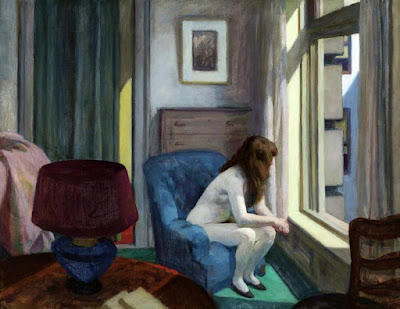
Here are a few of Hopper’s paintings, including, of course, his most famous painting, Nighthawks.

A lot has been said and written about Nighthawks, and those four people in that cafe…but what catches my eye is the storefront across the street. There’s no merchandise on display in the window. Nothing at all. If the couple from Phillie’s wants to window shop, there’s nothing there to look at. Just a cash register, and a printed bill in the window that we can’t read from this distance, so we don’t know if simply says “closed”, or “closed forever”, or “seized by the IRS”, or…anything at all. And above the storefront…equally vacant windows into offices or apartments.

So, back to the music. I read Sheila’s post and wanted a piece of music that conveys the sense of loneliness that Hopper creates in many of his paintings, and that’s where I struggled. I could have picked a song, maybe the title track, from Frank Sinatra Sings For Only The Lonely, but I just wrote about that album recently and wanted something else. Slow ballads, maybe…or songs about urban life, like Glenn Frey’s 80s potboiler “You Belong To The City”…but nothing really fit, and I’m not sure this piece fits either, but I’m going with it.

Enter Claude Debussy.

Debussy, like Bach and Chopin, wrote a series of short pieces for keyboard that he called Preludes. Where Bach and Chopin used their Preludes to explore each key in the chromatic scale, Debussy did not. This Prelude was written in D minor and is titled “Footsteps in the Snow”. Its character is cold and austere, with one particular motif recurring throughout in almost chant-like fashion. About halfway through we get a genuine break into lyricism, but the mood shift is short before the lyrical melody carries us right back to the work’s core motif, a sad and insistent motif indeed.

Does “Footsteps in the Snow” suggest the same kind of loneliness that Edward Hopper suggests in his paintings? Well…I suppose that’s for the listener and the viewer of the art to decide, isn’t it? Debussy is definitely conveying some kind of cold, quiet, hushed solitude.

Maybe it’s odd to be thinking of quiet urban solitude in the bright summery suburban days of my life right now, but the cold is always coming….

Share This Post