From the Books: THE LEFT HAND OF DARKNESS

I’m currently reading Ursula K. Le Guin’s classic sci-fi novel The Left Hand of Darkness, and while I rarely quote books while I’m reading them, this one passage hit me between the eyes. The story involves a planet that’s divided into two countries, and our two protagonists–one a planetary native, one an off-world visitor–are on the run in one of the two countries (“Orgoreyn”) and are trying to cross great distance to return to the other.

This exchange takes place, with the first line spoken by the off-world visitor who is a stranger to these countries:

“You hate Orgoreyn, don’t you?”

“…Hate Orgoreyn? No, how should I? How does one hate a country, or love one?…I know people, I know towns, farms, hills and rivers and rocks, I know how the sun at sunset in autumn falls on the side of a certain plowland in the hills; but what is the sense of giving a boundary to all that, of giving it a name and ceasing to love where the name ceases to apply? What is love of one’s country; is it hate of one’s uncountry? Then it’s not a good thing. Is it simply self-love? That’s a good thing, but one mustn’t make a virtue of it, or a profession…Insofar as I love life, I love the hills of the Domain of Estre, but that sort of love does not have a boundary-line of hate. And beyond that, I am ignorant, I hope.”

Lots of good food for thought in this book. But then, it’s Le Guin, so this is not a surprise.

UPDATE!!! So I just finished the novel, and it turns out there’s an Introduction to the book. Oddly, in my Library Of America edition of Le Guin’s works in which Left Hand is anthologized, that introduction does not appear at the beginning of Left Hand but rather as an appendix to the book as a whole, which is a rather odd thing, I must say. But anyway, in that introduction appears this bit of wisdom:

The artist deals with what cannot be said in words.

The artist whose medium is fiction does this in words. The novelist says in words what cannot be said in words.

I love that sentiment.

Share This Post

From the Books: SEAMANSHIP, by Adam Nicolson

Subtitled A Voyage Along the Wild Coasts of the British Isles, Adam Nicolson’s book Seamanship relates the story of how Nicolson, in a moment that might be consdiered a mid-life crisis, decided to acquire a yacht and sail from Cornwall to the west coast of Ireland, then back to Scotland and through the Hebrides and ultimately to the Faeroes. The yacht is acquired, a skipper (named George) is hired, and off they go.

It is, as you might expect, a voyage fraught with difficulties. Nicolson’s status as a novice sailor is exposed almost immediately as he struggles with seasickness before they’re barely out of port, and more struggles come along the way, such as a disastrous attempt by Nicolson to take their inflatable raft and go ashore at one point. Along the way the personal relationship between Nicolson and George suffers, with the two men unable to bridge the gap between novice sailor on a trip that’s basically a whim and the experience seaman who is grappling with the awkwardness of being both Captain and employee to the same man.

Along the way they make many stops at the stunning locations along those particular seacoasts (the book could really have used a photo section), and Nicolson’s descriptive passages are all evocative and well-written. They meet people along the way–a French sailor here, a cloister of excommunicate monks there–but the encounters are over almost too quickly, and the book always seems to be skirting around the level of depth and thoughtfulness that I found myself expecting. I really kind of expected more from this book, which manages to fall on the wrong side of the oft-cited rule of showpeople everywhere: “Always leave ’em wanting more.” If you do that, sometimes it really is the case that you didn’t give ’em enough.

But like I said, there are a lot of really fine passages in Nicolson’s book, most of which come as he grapples with the enormity and the indifferent nature of the sea itself. This passage comes from when he has managed to capsize their raft and is struggling just to get back to the surface:

Down deeper this time into the roll of the surf, suddenly alarmed at the idea of the dinghy itself, its protruding outboard, coming slamming on to my head as I was down there, and the feeling of enclosure, of wanting to shout, but the water of course clogging me into silence, a wet muddled claustrophobia like the worst of a bad dream, a fear like a nightsheet twisted around your head, into your mouth and nostrils and neck, a gag on your life, a garrotting by water.

This was the idea of the sea in its killing horror, the death element, the antithesis of life. This moment, seen face to face, was the reason that people have always, from the very beginning, loathed the sea. The Odyssey, which is not only the first but the greatest sea poem ever written, as old as the tumuli in which chieftains lie buried on the hills of southern England, and old then the great hillforts that straddle the skyline beside them, is suffused not with love of the sea but fear of it. Odysseus–the first great middle-aged hero in literature; his poem the story of the Middle-aged Man and the Sea–longs to go home, to the sweetness of land and the stillness of a house. But the loathing of Poseidon, the sea god, encloses him in one near fatal sea-trap after another. That is one of the Odyssey‘s central meanings: the sea itself is the element of death.

A few pages later:

The condition of the sea is murderous. Homer calls it “wine-dark” not because that is its color, even in the Aegean, but because that is its nature. It is thick with the intoxication of darkness. It is loved, sentimentally, by the ignorant and by romantics because death is the moment for which Romanticism longs, and because, as Homer knew, as my own panicked crisis now told me, no moment is more vivid than one embraced by death.

That is why death as sea is such a casual affair. Death has no need to approach. It doesn’t need to gird itself up here. It doesn’t come rolling like a swell, proceeding grandly towards you with its bosom before it and its intentions clear. Death is already there, a few feet away, resting beneath the table, its head on its paws and a smile in its eyes, happy to accept the scraps that fall.

Perhaps it’s a spoiler to note that nobody actually dies at sea in Seamanship, but Nicolson seems to feel death’s nearness at each point anyway. That’s probably wise. The sea can, after all, take us and never give a single tiny hint as to where we’ve gone.


Share This Post

EA Poe, Nature Writer

I woke up early yesterday morning–quite early, in fact, well before sunrise and well well well before I had any intention of getting out of bed–so I reached for my Kindle and looked for something to read. I landed on a short essay by Edgar Allan Poe, about a stream near Philadelphia. Called “Morning on the Wissahiccon”, I found it a fascinating little piece, parts of it appealing to me on a number of levels.

Poe:

Indeed, in America generally, the traveller who would behold the finest landscapes, must seek them not by the railroad, nor by the steamboat, nor by the stage-coach, nor in his private carriage, nor yet even on horseback — but on foot. He must walk, he must leap ravines, he must risk his neck among precipices, or he must leave unseen the truest, the richest, and most unspeakable glories of the land.

Now in the greater portion of Europe no such necessity exists. In England it exists not at all. The merest dandy of a tourist may there visit every nook worth visiting without detriment to his silk stockings; so thoroughly known are all points of interest, and so well-arranged are the means of attaining them. This consideration has never been allowed its due weight, in comparisons of the natural scenery of the Old and New Worlds. The entire loveliness of the former is collated with only the most noted, and with by no means the most eminent items in the general loveliness of the latter.

I looked up the Wissahiccon, which is now more commonly spelled “Wissahickon”. It is a stream that rises north of Philadelphia and flows into the Schuylkill River (and then to the Delaware, Delaware Bay, and finally the Atlantic Ocean). I am unfamiliar with the Wissahiccon personally, though looking it up on the map I see that I have almost certainly ridden by it more than a few times, first many years ago when we were frequently traveling from home in NY to the Philly area to visit relatives, and more recently when we drove past its mouth at the Schuylkill as we drove through Philly to New Jersey for vacation.

Looking through some photos the last day, the Wissahiccon looks like exactly the kind of stream I love most: rocky, with occasional waterfalls and vestiges of very old industry now abandoned and returned to nature. As urban as this entire region is, the Wissahiccon has largely been allowed to remain parkland; I’m sure for people in the North Philly region and those suburbs, the Wissahiccon forms a lovely place for respite.

Poe, again:

A singular exemplification of my remarks upon this head may be found in the Wissahiccon, a brook, (for more it can scarcely be called,) which empties itself into the Schuylkill, about six miles westward of Philadelphia. Now the Wissahiccon is of so remarkable a loveliness that, were it flowing in England, it would be the theme of every bard, and the common topic of every tongue, if, indeed, its banks were not parcelled off in lots, at an exorbitant price, as building-sites for the villas of the opulent. Yet it is only within a very few years that any one has more than heard of the Wissahiccon, while the broader and more navigable water into which it flows, has been long celebrated as one of the finest specimens of American river scenery. The Schuylkill, whose beauties have been much exaggerated, and whose banks, at least in the neighbourhood of Philadelphia, are marshy like those of the Delaware, is not at all comparable, as an object of picturesque interest, with the more humble and less notorious rivulet of which we speak.

Poe’s entire essay can be found here. I’ve always loved Poe as a writer, but even having read much of his poetry and his prose fiction, I’ve read very little of his essaying. Fascinating man, Edgar Allan Poe.

(Image credits: 1, 2, 3)

Share This Post

From the Books: “Measure Twice, Cut Once”

I saw a news item the other day that carpenter Norm Abram is retiring from his decades-long job on the teevee show This Old House, which he has been on for over 40 years. I haven’t watched a lot of This Old House, but I have caught it now and then, and it’s always an enjoyable show from which I learn things when I do catch it.

Abram is also an author, and one of his books is a favorite of mine: Measure Twice, Cut Once: Lessons from a Master Carpenter. This small, short book is just what the subtitle says: a series of practical lessons from a person who has been practicing their particular trade for many years. Abram doesn’t go in for a lot of preachy “what it all means” motivational stuff in this book (with a couple of exceptions); he just writes clearly and succinctly about tools and their use and how to approach jobs. This is not an “intro to carpentry” book, but rather the kind of thing you might want to read if you know your way around a toolbox but don’t feel like you know your way around a toolbox, know what I mean?

Toolboxes

Working with my father, I didn’t have a toolbox of my own at first. He had plenty of tools, and I borrowed what I needed. Leather toolbelts hadn’t yet come into fashion; when they did, I was an early convert. My dad never wore a toolbelt. He wore bibbed overalls with loops and pockets for various hand tools sewn on them. He wore them over his work clothes all year, even, to my astonishment, in the worst heat of summer. I wore a cloth nail apron and carried the tools I needed at the moment until I graduated to my own toolbox and leather toolbelt.

There are several kinds of toolboxes, each with advantages and disadvantages. Some carpenters carry triangular wood boxes with pole handles but no covers. These days, I often see carpenters lugging around five-gallon drywall compound buckets with drop-in dividers with slots for tools. They’re not very elegant, but every tool is visible and easily reached. There is almost no stacking, which leads to pawing through layers to uncover the desired tool.

My dad carried a metal carpenter’s box with square corners. Its hinged cover swung open to reveal a shallow removable tray sitting over a larger storage compartment. His toolbox was long enough that a 28-inch level could be stored on the underside of the vocer. A level is delicate and doesn’t benefit from being stacked with other tools inside the box. The level fit over two blocks of wood that were secured to the cover with screws; it was then held firmly in place with homemade metal clips. The tray had limited space for smaller items, such as nail sets, a chalk line, pencils and other marking tools, a plumb bob, and drill bits, which we put in an old metal bandage container.

Measure Twice, Cut Once, but Don’t Measure At All If You Can Avoid It

Never measure unless you have no choice. Instead, base your marking and cutting on the actual situation. For example, I would never measure an exterior wall for a piece of siding, then go off and measure a length, cut it, and bring it back to install. It doesn’t matter how long the siding needs to be: I hold up a length where I intend to install it and mark it in place for cutting. It’s the actual length that’s important, not the numerical symbols on my tape measure.

Tape measures vary. The longer they’re used, the more they stretch. The hook at the end gets gummer up or bent enough to cause slight variations in readings. I don’t assume that my own tape is perfect. If I’m working along, I know that all the measurements are taken from my own tape and therefore profide uniform variations from a true standard. But if I’m working with other carpenters and each of us uses his own tape, with a unique variation from true, the consequences take on real importance. I’ve often seen carpenters argue at a lumber pile about whether a piece was cut to the right length, only to find out that their tapes were not equal.

The Right Way

I saw a funny movie recently about a carpenter and his three sons. The father, who had just died, spoke some of his best lines form his coffin. For instance: “There’s only two ways to do things. There’s the right way and there’s my way. And they’re the same way!” The line reminded me of my somewhat autocratic grandfather. He was a supervisor in a woolen mill, but he knew carpentry and performed it well. In his generation, the family was large and close, but my grandfather was boss and no one dared disagree with him. My dad, on the other hand, never said or implied that his way was the right way. But since he hadn’t come from a tradition of open discussion, he and I didn’t talk about carpentry as much, looking back, as I wish we had.

In my generation, technology has changed many hand tools and introduced the power tools that have largely superseded some of them. Yet many aspects of carpentry are very much as they were in my father’s day or in my grandfather’s. Even if the tool has evolved, the method is the same. There are many situations in which nothing works as well as a hammer and a chisel. I can’t imagine technology reaching the point where there would be no need for the deceptively simple technique of scribing.

What has declined from my dad’s generation to mine is the prevailing standard of skill in carpentry. My father could do many things by hand that I’ve never practiced enough to do, such as ripping a long board by hand in an admirably straight line. Recently I helped renovate an old house in Salem, Massachusetts. A number of handsome frame houses in Salem’s historic district have overlapping clapboards on their sides and backs; the facades, however, are made of very long boards butted square against each other to make a flat surface. An overlapping clapboard can be less than perfectly straight, but there can’t be much divergence when the boards are butted. In Salem, many facades reveal an excellent fit everywhere in long boards sawn and planed two centuries ago–by hand.

Carpentry was once a classic trade in the sense that techniques were treated as secrets to be revealed only to the chosen few, handed down from one generation to the next. Much of my time during the past two decades has been spent demystifying the skills of carpentry and woodworking so that any interested person can acquire the tools, learn the techniques, and practice them to a desired level of skill. Hence this book. It will discuss the contents of the ideal toolbox of today, not the tools that sufficed for my father’s superior carpentry. But as I describe hand tools and offer tips on techniques I’ve adopted, I never forget that much of what I know and practice was handed down to me from my dad and others of his and earlier generations. I hope these lessons will give you the confidence to use more tools, to augment your toolbox and workshop, and to share your experience and wisdom with others.

I find that I tend to respond most positively to people who view knowledge as something to be shared widely and often. Carl Sagan, Norm Abram, Anthony Bourdain…these kinds of people are the guiding lights of my world.

Share This Post

From the Books: Mike Royko

A repost, because somehow the subject of Mike Royko came up on Twitter. For many years he was my father’s favorite columnist. I remember him handing me the Opinion section more than a few times, saying, “Royko’s got a good one today.” Sometimes I got to return the favor.

For quite a few years, one of my favorite things in the newspaper was the syndicated column by Mike Royko. I loved his writing, and his style has come to mean “Chicago” to me in a very real way. Royko was also a favorite of my father’s, and one year for either Christmas or his birthday I gave my father a collection of Royko’s columns. I spotted another collection – or maybe it’s the same one – on the shelf at the library the other day (One More Time: The Best of Mike Royko), and I’ve been dipping into it with great pleasure. It’s a voice I’d forgotten about.

Royko’s writing, more than anyone else’s, evokes a newspaper for me. Often when reading him I can almost see him there, at a desk in a corner of some big newsroom in a big building in downtown Chicago, his typewriter keys clicking away while he smokes. I actually don’t know if Royko was a smoker, but his columns evoke an era when smoking wasn’t quite the demon it is now. His writing is the writing of a guy who haunted local taverns, and reading him makes me think of the smell of newsprint.

Royko was also perceptive and, in some cases, prescient, as when he wrote of Rupert Murdoch in 1984: “No self-respecting fish would want to be wrapped in a Murdoch paper.” I really wish he was still around right now; in this world of FOX News, a voice like Royko’s would be invaluable. He’d only be 79 today, if a brain aneurysm hadn’t struck him down in 1997. I’d love to know what Mike Royko would make of the state of journalism today, and the fact that one of the most important political commentators of our day – two of them, actually – are hosts of shows on a comedy network.

Royko could write gorgeous, lyrical prose, though, and this column of his — from November 22, 1979, on the occasion of the sudden passing of his first wife – is a prime example. I love how delicately he chooses his visual descriptors, which details to include and which ones to omit. I love the lack of proper nouns, and that he didn’t write this in the first person. The short sentences and short paragraphs are a Royko trademark, but they add up to a larger, and deeply beautiful, portrait in words of a beloved person gone too soon. A more loving tribute would be hard to think of.

The two of them first started spending weekends at the small, quiet Wisconsin lake almost twenty-five years ago. Some of her relatives let them use a tiny cottage in a wooded hollow a mile or so from the water.

He worked odd hours, so sometimes they wouldn’t get there until after midnight on a Friday. But if the mosquitoes weren’t out, they’d go to the empty beach for a moonlight swim, then sit with their backs against a tree and drink wine and talk about their future.

They were young and had little money, and they came from working-class families. So to them the cottage was a luxury, although it wasn’t any bigger than the boat garages on Lake Geneva, where the rich people played.

The cottage had a screened porch where they sat at night, him playing a guitar and her singing folk songs in a sweet, clear voice. An old man who lived alone in a cottage beyond the next clump of woods would applaud and call out requests.

One summer the young man bought an old motorboat for a couple of hundred dollars. The motor didnt’ start easily. Some weekends it didn’t start at all, and she’d sit and laugh and row while he pulled the rope and swore.

But sometimes it started, and they’d ride slowly along the shoreline, looking at the houses and wondering what it would be like to have a place that was actually on the water. He’d just shake his head because even on a lake without social status, houses on the water cost a lot more than he’d ever be able to afford.

The years passed, they had kids, and after a while they didn’t go to the little cottage in the hollow as often. Something was always coming up. He worked on weekends, or they had someplace else to go. Finally the relatives sold the cottage.

Then he got lucky in his work. He made more money than he had ever dreamed they’d have. They remembered how good those weekends had been and they went looking at lakes in Wisconsin to see if they could afford something on the water.

They looked at one lake, then another. Then another. Cottages they could afford, they didn’t like. Those they liked were overpriced. Or the lake had too many taverns and not enough solitude.

So they went back to the little lake. They hadn’t been there for years. They were surprised to find that it was still quiet. That it still had no taverns and one grocery store.

And they saw a For Sale sign in front of a cedar house on the water. They parked and walked around. It was surrounded by big old trees. The land sloped gently down to the shore. On the other side of the road was nothing but woods. Beyond the woods were farms.

On the lake side, the house was all glass sliding doors. It had a large balcony. From the outside it was perfect.

A real estate salesman let them in. The interior was stunning – like something out of a homes magazine.

They knew it had to be out of their reach. But when the salesman told them the price, it was close enough to what they could afford that they had the checkbook out before they saw the second fireplace upstairs.

They hadn’t known that summers could be that good. In the mornings, he’d go fishing before it was light. She’d sleep until the birds woke her. Then he’d make breakfast and they’d eat omelets on the wooden deck in the shade of the trees.

They got to know the chipmunks, the squirrels, and a woodpecker who took over their biggest tree. They got to know the grocer, an old German butcher who smoked his own bacon, the little farmer who sold them vine-ripened tomatoes and sweet corn.

They were a little selfish about it. They seldom invited friends for weekends. But they didn’t feel guilty. It was their own, quiet place.

The best part of their day was dusk. They had a west view and she loved sunsets. Whatever they were doing, they’d always stop to sit on the pier or deck and silently watch the sun go down, changing the color of the lake from blue to purple to silver and black. One evening he made up a small poem:


The sun rolls down
like a golden tear
Another day,
Another day
gone.
She told him it was sad, but that she liked it.

What she didn’t like was October, even with the beautiful colors and the evenings in front of the fireplace. She was a summer person. The cold wind wasn’t her friend.

And she saw November as her enemy. Sometime in November would be the day they would take up the pier, store the boat, bring in the deck chairs, take down the hammock, pour antifreeze in the plumbing, turn down the heat, lock everything tight, and drive back to the city.

She’d always sigh as they pulled onto the road. He’d try to cheer her up by stopping at a German restaurant that had good food and a corny band, and he’d tell her how quickly the winter would pass, and how soon they’d be here again.

And the snow would finally melt. Spring would come, and one day, when they knew the ice on the lake was gone, they would be back. She’d throw open all the doors and windows and let the fresh air in. Then she’d go out and greet the chipmunks and woodpeckers. And she’d plant more flowers. Every summer, there were more and more flowers. And every summer seemed better than the last. The sunsets seemed to become even more spectacular. And more precious.

This past weekend, he closed the place down for the winter. He went alone.

He worked quickly, trying not to let himself think that this particular chair had been her favorite chair, that the hammock had been her Christmas gift to him, that the lovely house on the lake had been his gift to her.

He didn’t work quickly enough. He was still there at sunset. It was a great burst of orange, the kind of sunset she loved best.

He tried, but he couldn’t watch it alone. Not through tears. So he turned his back on it, went inside, drew the draperies, locked the door, and drove away without looking back.

It was the last time he would ever see that lovely place. Next spring there will be a For Sale sign in front and an impersonal real estate man will show people through.

Maybe a couple who love to quietly watch sunsets together will like it. He hopes so.

Yeah, I miss Mike Royko.

Share This Post

January Reading (From the Books)

I’m going to try, in 2022, to write a monthly recap of the books (and other things) I read each month. I had a good reading month and am well on my way to meeting my annual goal of 52 books! I track this on Goodreads, and I feel no qualms in including graphic novels in my reading; a good graphic novel is its own challenge and reward because the art demands attention as much as the words. I will also admit that I’m trying to get ahead of my Goodreads challenge a bit because I have some long “doorstop” kinds of books that I’d like to read this year, and those can really get time-consuming. (We’re talking Brandon Sanderson-sized epic fantasies and space operas later this year.)

So here’s what I read in January (or, a few items I started in December but only finished in January):

::  The God Equation: The Quest for a Theory of Everything, Michio Kaku. I’ve become a big fan of Kaku’s science writing over the last few years. As a science fiction writer (even one who tends to play at the George Lucas end of the pool, rather than the Arthur C. Clarke end), I feel it important to read some science every year, and Kaku’s work always keeps the “sensawunda” flowing. He writes big-scale, wide-eyed books about the Really Big Questions, and this one is no exception. If you want the kind of optimistic science writing that gives you the kind of feeling you might have had as a kid when you emerged wide-eyed from the planetarium show, Michio Kaku is your writer. (I confess that at times in his books I really can’t quite understand the more esoteric details of the things he writes about.)

::  Salt, Fat, Acid, Heat: Mastering the Elements of Good Cooking, by Samin Nosrat. This is the best kind of cookbook. Only about half of it is an actual collection of recipes; the rest is like a textbook in Cooking 101, in which Nosrat writes extensively about the how and why these four facets of cooking work the way they do to make food taste good. Reading this gave me much greater appreciation and insight into how to salt my food, why and when to add acid, what I can do with fat to enhance flavor, and the ways heat, applied in different ways, impacts flavor.

The book is richly illustrated, and it has fold-out charts that show how various ethnic cuisines around the world approach each individual element of cooking. Nosrat writes wonderfully, with a strong personal element in which she brings her personal experiences from working in the food world to bear. If you cook, you should check this book out.

::  For Small Creatures Such As We: Rituals for Finding Meaning in Our Unlikely World, by Sasha Sagan. Sagan is the daughter of Carl Sagan, who is one of my all-time heroes for many reasons: his scientific curiosity, his unyielding skepticism which was also bonded tightly to his unending ability to find wonder in what really is. Maybe some people were disappointed to learn that the surface of Mars is not segmented by great canals whisking water around the planet, but is instead rocky and thus far barren of liquid water and life; not Carl Sagan, who found the fact of the Martian surface even more wondrous than the dreamed-up version from the Edgar Rice Burroughs novels he read as a kid.

One common objection to atheism, especially the rigorously empirical version of atheism as endorsed by Carl Sagan, is the idea that absent any kind of spiritual force, our lives are directionless and meaningless. This is false for any number of reasons, but Sasha Sagan answers that objection in this book, and more than that, she endorses the embracing of rituals in our lives, even the ones that have religious origins, as a way of giving our lives meaning, direction, and purpose. Sasha Sagan is every bit as skeptical as her parents (her mother is Carl Sagan’s former wife, scientist and writer Ann Druyan) were as far as religion and spirituality go, but she writes refreshingly that skepticism need not mean a life devoid of ritual and the comfort that ritual provides.

Ms. Sagan writes with a lyricism that at times echoes Carl Sagan so strongly that it does feel, occasionally, like he is writing from “the beyond”. Of course, he isn’t…but his influence lives on, which is one of the points Ms. Sagan makes here.

A few quotes:

We all deserve holidays, celebrations, and traditions. We all need to mark time. We all need community. We all need to bid hello and goodbye to our loved ones. I do not believe that my lack of faith makes me immune to the desire to be part of the rhythm of life on this planet.

An old tradition is not intrinsically better than a new one. Especially when it is such a joy to make new ones up—ones that reflect exactly what you believe, ones that make sense of your life as you experience it, ones that bring the world a little closer to the way you wish it could be.

Gifts were exchanged, but the biggest gift was the idea that celebrations could be invented, that we could choose to honor what was most meaningful to us, that and the knowledge that spring was finally here.

On the scale of our human history, rituals like putting up Christmas trees, lighting menorahs, reading Hafiz, and baking rice dumplings are new. We humans have celebrated the earthly repercussions of our orbit longer than we’ve celebrated virtually anything. Before Christmas and Hanukkah, before monotheism or any other kind of theism, our ancestors were staring up at the stars, trying to gather clues about the changing of the seasons, the passing of time, and what the darkness might bring. The idea of marking the longest, coldest night with the knowledge that the warmth and light is not too far off, that is ancient. And no matter where we’re from, what religion we are, or to what ethnic group we belong, we can be sure that our ancestors, all of our ancestors, contemplated Earth’s place in the universe with awe. For them, it was sacred. And it still can be for us. Even more so because science has brought us a deeper understanding of the mystery and beauty of nature than our ancestors could have ever dreamed.

Sasha Sagan is not a scientist by trade, but she shows how you don’t have to be a scientist by trade to allow science and the rational approach to life govern you and guide you toward meaning that isn’t based on superstition or religion.

::  Eve’s Hollywood, by Eve Babitz. I read this on the strength of Sheila O’Malley’s paean to Babitz on the occasion of her passing last year. I really had no idea what I was getting into with this book, but after reading this by Sheila:

Let’s hear it for the outlaws of this world, particularly women outlaws. Let’s hear it for the swashbuckling romantics, the adventuresses dancing outside the perimeter of the picket fence, unprotected but free. Eve Babitz was their patron saint.

had to read something by Babitz.

I started this book, actually, on the plane to Hawaii, the last leg of that journey, which stared from LAX, so I think it fitting that I started Babitz’s memoir about growing up in LA while I was however-so-briefly in LA. My first hint that I was in for something very different was the dedication. There isn’t just one. Or two. Or three. Babitz dedicates her book to a cast of hundreds, in a dedication section that spans pages. Here is just one of her dedications:

And to the word, brouhaha.

Wow.

I wouldn’t dream of trying to sum up what Babitz writes about here. All of it is personal remembrance of a woman whose parents were friends with Igor Stravinsky, among others. (That’s the part that kept catching my eye. My entire life, Stravinsky is a genius composer who helped classical music kick Romanticism to the curb and embrace Modernism, the composer whose ballet The Rite of Spring cause a riot when it was premiered, but for Eve Babitz, he was a guy whom Dad knew and who showed up at parties.) Babitz’s Los Angeles isn’t a glitzy Beverly Hills experience, but it’s not the gritty place of Jake Gittes, either. It’s an interesting combination of the two, along with other incarnations of the same place. I’ve certainly never had the sense of LA that this book gives me. As the introduction (by Holly Brubach) states:

With a father who was a baroque musicologist and violinist under contract to Twentieth Century-Fox, a mother who was an artist, and a godfather who was Igor Stravinsky, Babitz grew up surrounded by a circle of illustrious family friends that included Edward James, Joseph Szigeti, Eugene Berman, Marilyn Horne, Kenneth Rexroth, and Kenneth Patchett, with poetry readings in the living room and premieres of works by Arnold Schoenberg under the palms.

A few quotes:

Studio musicians and musicians in general, men who have grown up practicing minute things their whole lives, are special. The general rules accepted by the players are that violin players are all lovers of women to an extravagant extent, oboe players are crazy and French horn players are sexy. Everyone else is square as square can be as far as I’m concerned, and if you go to an L.A. Philharmonic rehearsal you’ll see a bunch of accountants sitting around in plaid shirts and you’ll realize that musicians are the most innocent benders to Art there are. Imagine binding yourself into the confines of an orchestra, under the stick of a conductor, having to play what someone has written 200 years ago!

Stravinsky himself was Stravinsky. He was tiny and happy and brilliant and drank. He used to slip glasses of scotch to me underneath the coffee table when my mother wasn’t looking when I was 13. At my 16th birthday party, I wore white (very low necked white, of course) and he slipped rose petals down my top when my mother wasn’t looking.

Of course, gym teachers being what they are, they couldn’t just let us alone, they had to tell us what to do so they used to have “dance contests” with processes of elimination and envy and all that other stuff they have. The idea was to applaud who you thought was best—judgment by your peers, it’s called—and the ones who got the loudest applause won. Only the gym teachers decided which applause was loudest and it was never for the Pachuco couple no matter how obvious it was. Because how could kids who weren’t white and who’d been sent to Le Conte because they’d been expelled from other schools win? So the runner-up always won.

We were hot, the sea was one long wave to be ridden in, our skins were dark, and time even stopped now and then and let things shimmer since time, too, is affected by beauty and will stop sometimes for a moment. We didn’t know, as kids in other schools seemed to, what we were supposed to be, but we knew that somehow we were being taught something about life and that it couldn’t get much better. And when the sun began to set and we’d gather our things and walk silently back to the cars, we only wondered how the waves would be tomorrow in baked, half-conscious curiosity.

I remember reading something George Carlin wrote once, in which he talked about how much he loved and adored the New York City of his home; he closed by saying something like, “So why do I live in Los Angeles, then? Because the sun sets across the street from my house!” That’s the kind of sense I get of LA from Eve Babitz, only she’s kicking over rocks to see what’s underneath, and honestly, what’s underneath those rocks is utterly fascinating. I loved this book and I savored reading it.

::  The 13 Clocks, by James Thurber. I’m an old fan of Thurber’s, though I confess I’ve not read him in a very long time. I found this hardcover…someplace. I don’t honestly recall where: maybe a used bookstore in Ithaca, maybe one of the library book sales, I’m not sure. The story is a fantasy fable about a Princess whose father is an evil wicked Duke who promises her hand to the Prince who can complete the impossible quest set by the Duke. The book abounds with Thurber’s wordplay, so much so that it reads like a prose poem or actual formal verse, complete with rhyme schemes, set in type to look like verse. It’s frankly a delightful read, and it might be a good gateway for younger readers to Thurber’s kind of urbane wit that bites a little bit harder than you realize. I loved it.

If you can find a copy with the illustrations, please do so. The text is available in the Library of America’s Thurber volume, but without the illustrations, alas. (Thurber was also an artist who famously illustrated his own works, but apparently by the time he wrote this his eyesight had deteriorated too far for him to be able to do it himself.) Here’s an example of the illustration (by Marc Simont) in The 13 Clocks:

::  The Starship and the Canoe, by Kenneth Brower. Billed on the cover as “In the spirit of Zen and the Art of Motorcycle Maintenance, this is an exploration of the lives of two men, astrophysicist Freeman Dyson and his son, George. The elder Dyson is transfixed by the idea of the Orion Project, a proposal from the 70s for an interplanetary (or even interstellar) spacecraft that would use nuclear bomb detonations for propulsion. Basically the ship would have a very large shielding plate on its back end, and every once in a while a nuclear bomb would be chucked behind the ship to explode, giving the ship a kick forward. There’s something about that idea that sounds a bit absurd, but it would actually work and was seriously studied (Carl Sagan himself noted its potential in Cosmos) before international treaties banned the detonation of nuclear bombs in space.

Orion is the “Starship” of the title; the “Canoe” is a project of George Dyson’s. The Younger Dyson lives in the Pacific Northwest, as something of a quasi-hermit who builds a treehouse and uses paddle-boats (canoes, kayaks) to get around the hundreds of islands and island communities off the coasts of Alaska and British Columbia. As Brower gets to know him, Dyson the Younger is building a large sea-canoe that will accommodate six adults; Brower follows Dyson on various journeys up and down that coast as he meets people and acquires raw materials for his project.

The Dysons were somewhat estranged for many years, while Brower traces their lives in parallel, highlighting the ways their respective journeys mirror each other even while seeming wildly divergent. I found myself enjoying the chapters focusing on George more, mainly because of Brower’s nature writing, but Brower also does a good job of highlighting the ways these two men are very much alike.

There is very much a kind of 1970s “Search for oneself” vibe here, the kind of thing that makes me think of John Denver songs (not disparagingly, either, I love John Denver), but nevertheless, I was surprised at how much I liked this one.

Not a day passed without whales. The sound of their blowing was always around us, like the respiration of gods. We were trespassing, but with indulgence, I felt. We were like small boys who have sneaked into Neptune’s room and hear him breathing in his sleep.

::  The Sea of Trolls, by Nancy Farmer. I read this aloud to The Daughter years ago, and I remember enjoying it greatly. In fact, it might be the last book I ever read aloud to her, before she declared that she wanted to read herself at night–a wish I granted, though it made me sad to do so!–and we never finished reading the trilogy of which this is Book One. I found all three books on the Used Books section at Savers a while back (I always find something of value in the Used Books at Savers!), so I snapped up all three, and I’m reading the entire trilogy this year. It’s a Young Adult fantasy about a boy named Jack in Dark Ages Britain, who is learning from the local mystic when the Vikings come raiding. Jack and his little sister Lucy are abducted by the Vikings and proceed to have adventures and quests.

The Sea of Trolls is an exciting book, full of violence and magic and ghastly creatures and evil Queens and trolls and magic wells and enemies who become allies and allies who become enemies. It’s a complex tale full of memorable characters, and Farmer doesn’t sugarcoat things while also maintaining a sense of youthful fun. It reads like a more violent, slightly-more-adult Lloyd Alexander novel. I’m looking forward to the next two books.

::  Sergei Rachmaninov: An Essential Guide to His Life and Works, by Julian Haylock. I read this as part of my perparation for this coming April, during which I plan to do a bit of a “deep dive” into the music of Rachmaninov. This book is a short (under 100 pages) bio of the composer, well written but obviously not terribly deep. It’s a good starting point for exploring Rachmaninov’s life and world. (The book carries a label reading “Classic FM Lifelines”, so I assume there’s a whole series of these for various classical composers, to fill the need for bios longer than a single chapter in, say, The Lives of the Great Composers but shorter than long-form biographies.)

::  Firefly graphic novels: Watch How I Soar and The Unification War, vols 1 and 2. I love and adore the Firefly universe, and I’ve long had the sense that if further teevee or film tales from that universe are not forthcoming (and at this point, short of a straight reboot, the moment has probably passed), comics were the ideal medium for further storytelling in The ‘Verse. And lo, that’s exactly what’s happened! After some fits-and-starts, there has been a steady stream of Firefly comics tales over the last couple of years, which I’ve started exploring.

Watch How I Soar is a story, or rather a collection of vignettes, involving our beloved pilot Hoban Washburn (or “Wash”), as his life flashes before his eyes in the moments before…what happens to him toward the end of the movie Serenity takes place. This one might not be rewarding for anyone who isn’t already a fan of this universe.

The Unification War is the kind of tale Firefly did best: a story in which our heroes, who are just trying to keep on flying in the present, find their past deeds still coming back to haunt them. The story alternates between the present day and flashbacks to the “Unification War”, the big conflict that took place a decade or so before our “present day” in which the overbearing Alliance secured victory over the freedom-loving “Browncoats”. (I admit that as much as I love Firefly and its universe and characters, sometimes the whole thing feels like Star Trek for libertarians.)

Part of the delight of The Unification War is in the way the story keeps getting more and more complicated as things progress. Writer Greg Pak splits the crew up, sending each person into various perils that spin more and more out of control, until…well, there’s my problem. I thought that The Unification War was a two-part story. Turns out…it’s three. And I don’t have the third volume yet.

Sigh.

::  Alice in Sunderland by Bryan Talbot. I can barely describe this book. It’s billed on the cover as “An Entertainment”, and it certainly is that: a lone reveler wanders into a seemingly abandoned theater, whereupon he is present with a one-man show that incorporates a literary history of Alice in Wonderland, a biography of Lewis Carroll, a travelogue of Sunderland (a city in the UK), a meditation on stories and storytelling, and an exploration of history and meaning and the intersection of art and life. Alice in Sunderland is a staggering work where you never have any idea what’s around the next page turn: a tale about the ghosts that haunt old theaters? a tour of a tavern that’s a couple hundred years old? the life tale of an industrial robber-baron whose fingerprints are still on the landscape of this old city? a comics creator’s ruminations on the famous illustrations of John Tenniel? Who knows!

Talbot writes an immersive and dizzying work here, and the art–comprising traditional comics art, photographic collage, and other styles–is first-rate. I hold Alice in Sunderland as a masterpiece of the graphic novel form and a stunning example of the very best possibilities of the format.

Here is one spread from the book:

(Go here to embiggen.)

That’s all for January for me. What have you been reading?


Share This Post

From the Books: “This Will All Be Over Soon” by Cecily Strong

Cover art, THIS WILL ALL BE OVER SOON, by Cecily Strong

Cecily Strong is one of my favorite performers on what is a very strong present cast on Saturday Night Live. In fact, this particular season she is getting featured a lot more than usual, possibly because Kate McKinnon has been on a leave from the show while she makes a movie. Strong is brilliantly versatile and funny, most notably for the shrill bombast she evinces when she is impersonating FOX News “personality” Jeanine Pirro. Strong also did a recent bit during an installment of SNL’s “Weekend Update” where, while dressed as a clown, she discussed the fact that she had an abortion in her early 20s. Strong is the kind of performer who is willing to leave however much of herself on the stage she needs to, and it’s often amazing to behold.

Like most of us, Cecily Strong had a very bad year in 2020. Unlike most of us, she wrote a book to document and process what happened to her and her family that year. For her it wasn’t just a year lost to COVID and the turmoil and uncertainty COVID brought; for Strong, 2020 was a year of profound loss and deep grief. Strong’s 2020 started with the death of her beloved cousin Owen from brain cancer. This was followed by the onset of the pandemic that for a time seemed to put the whole world on hiatus. It was during this time that Strong wrote this book.

Actress, comedian, and author Cecily Strong.

This Will All Be Over Soon is structured as a diary, chronicling Strong’s experiences and thoughts and feelings as the year unfolds, starting with her beloved cousin’s death and progressing into the pandemic. As such, she has to grieve not just his passing but others, and the loss of her home and her certainty. Strong meditates throughout the book about her relationships, her upbringing, and her previous struggles–if you want more insight into the abortion she recently discussed on SNL, it’s here–as she, like many of us, was forced to grapple with the uncertainty of life on an almost daily basis for an entire year…and more.

Cecily Strong is, it turns out, a gifted writer in addition to her skills as a performer. This book was on my To Read list as soon as I found out she was writing a book, and it stayed there even when I learned that it was not a comedy book but a memoir of grief and struggle. As such, I am even gladder to have read it. It’s not just a journal of a personal grief, but a primary document of a time that already feels somewhat distant. There’s a definite sense of Did it all really happen? Was it like that? Was all that fear real?

It was, and we need books like this to remember.

From This Will All Be Over Soon by Cecily Strong:

Maybe I can offer up one answer to my dad’s question: why Owen?

Owen fell madly in love after being diagnosed. He released two of my favorite songs with his band. One amazingly right before his last week in the hospital. He helped arrange the strings on that song, without even being able to play any of the strings. He went to basketball games. He covered scars with hats and became the fun guy who collected hats. He came to SNL. He danced. he smiled. He laughed. He read. He ate ice cream. He told my uncle he’d had the best year of his life.

The entire world will be affected in some way by coronavirus. We don’t know how. We don’t know if we will be sick or someone we love will be sick. Could the unthinkable happen and could we actually lose someone? And why can’t we control this fucking thing? I watch Cuomo speak to try to understand the science. We try to wrap out minds around the language of COVID-19 and Ebola drugs and malaria drugs and what it does to your body, and we can only watch, helpless.

I hear and feel the fear and pain and grief and sadness in people and how it manifests in lashing out and hoarding and turning on one another, and it’s dangerous and it’s sad and every day I have started to feel it more and more: the world needs Owen Strong.

This sound hyperbolic and, quite frankly, impossible, I realize. I don’t mind the hyperbole, since I still see him as a bit of a superhero figure. But I guess what I really mean is this: I was afraid to talk too much or share too much of this loss for many reasons. It would mean acknowledging something as real when I wasn’t ready to, I wasn’t sure it was my loss to share, and I was afraid of never being a good enough writer to properly honor him, just to list off a few.

Now I’m ready. Leda is ready. I want to write about him. I want to talk about him. I want you to know him. I want you to feel a little better after knowing a bit of his story. Maybe, just maybe, somebody will feel less afraid about the uncertainty that lies ahead. Maybe we can find moments during a very scary and difficult time to feel lucky.

Because who knows: as Owen proved, the worst year of your life could turn out to be the best year of your life.

Maybe that’s why, Dad.

And yes, there’s a reason why I’m posting about this book, this day. Grief isn’t a thing that ends, after all.

Sixteen years gone, today….

Share This Post

From the Books: Why We Swim

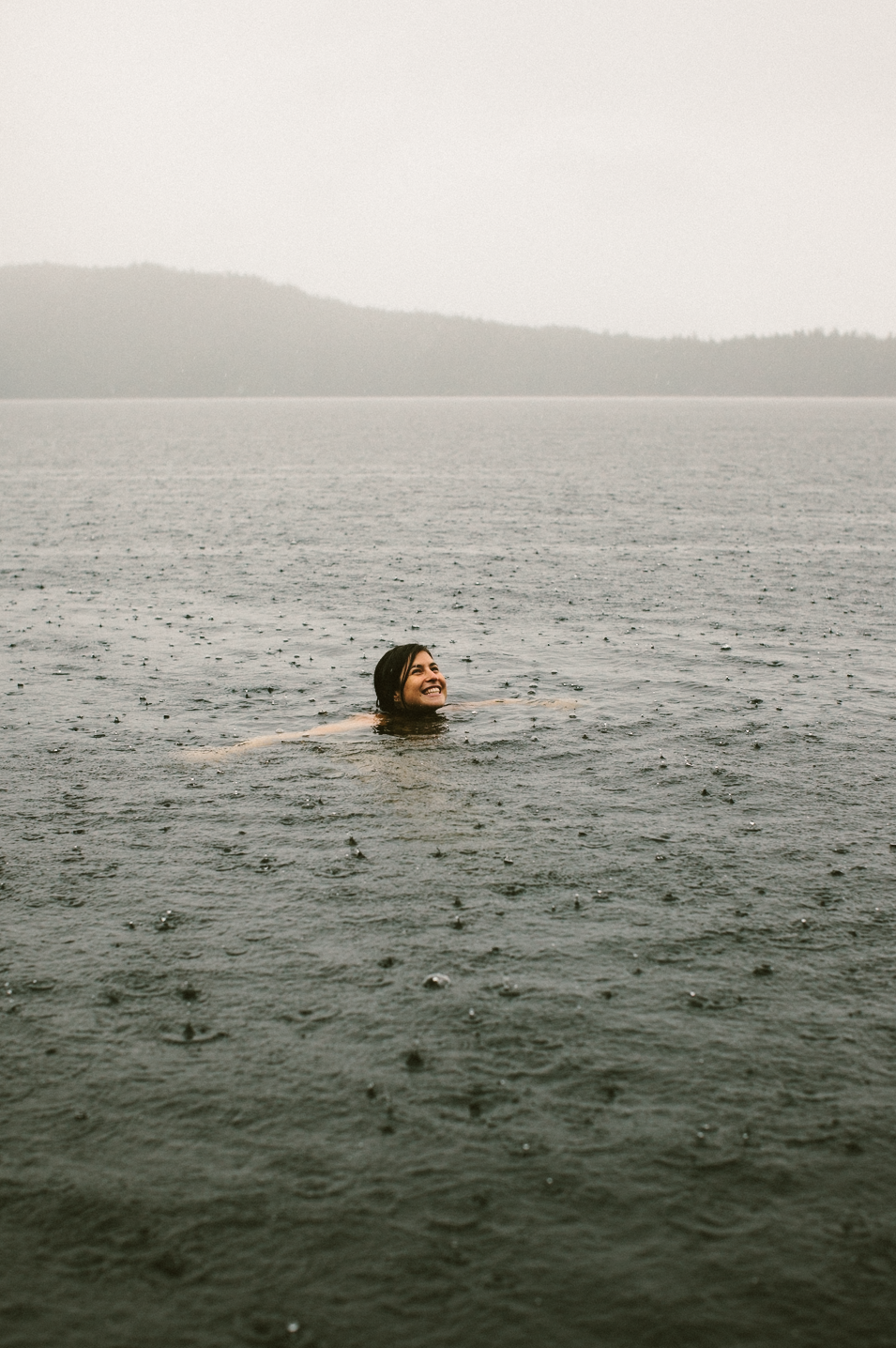
Swimming in the rain.
Swimming in the rain. Via benchandcompass.tumblr.com

Sometimes people cite the lack of browsing as a reason why it sucks that the independent bookstore has fallen on hard times in these, the Days of Amazon and other online retailers. And that’s true: one of the great joys for me, as a bookish person, is wandering through the shelves of this bookstore or that, seeing what random things I may find that I didn’t even know I wanted (while likely carrying around a stack of things I already knew I wanted). Well, indie bookstores seem to be rebounding of late, but there’s another place where you can get your Serendipitous Finds Whilst Lazily Browsing game on, and those places are libraries.

A couple weekends ago I had occasion to be in the Hamburg, NY public library. It’s a lovely place, recently renovated and a member branch of the Buffalo and Erie County Public Library, so my library card works there, too! I wasn’t planning to leave that day with six books under my arm, but that’s what happened. Among them was Why Se Swim by Bonnie Tsui.

Tsui is an Asian-American journalist who has written on issues of interest to that community, including a book called American Chinatown that was a bestseller and won an award for Asian-American journalism. (I have not read it, but on the strength of Why We Swim, I may.) Why We Swim is her second book, and it is quite simply exactly what its title suggests: a look at why human beings, evolutionarily descended from sea creatures but no longer of the sea, are so strongly compelled to the water. Swimming is one of the most common things we do as humans, despite the fact that this obsession with the water so often brings us to harm. We keep coming back. Why?

There are a number of basic reasons, Tsui argues, and she boils them down the sections of her book. We firstly swim for survival, and she opens here with an examination of an Icelandic fisherman who survived alone the capsizing of the fishing boat on which he worked. He swam three miles through icy seas after his mates either froze or drowned, and he lived to tell his tale and become a folk hero for the people of Iceland.

Next Tsui discusses how swimming heals us and how swimming regularly contributes to our overall fitness. She writes about the effects of regular swimming in cold water and how some competitive endurance swimmers turned to their activity after suffering illnesses or injuries.

We also swim for community, and Tsui describes impromptu swim clubs that formed after the fall of Baghdad in the Iraq war. She also discusses the sad history that racism played in the destruction and dismantling of public swimming pools in American cities, during the decades of white flight from urban centers for the suburbs. It’s another example of the fact that no matter how hard we try in America, we can never get far from our deplorable history of racism and the racist motivations behind some of our oldest public policy choices.

These are all practical reasons for swimming, but Tsui saves the most profound reasons for the latter portions of Why We Swim. Water is almost a psychological need for humans. She reports that hospital patients report better sensations of well-being when the decor of their rooms includes water imagery, and she notes that Henry David Thoreau included a great deal of swimming in his treks to Walden Pond and the woods where he went to live deliberately. The water calls to us and guides us, even if we are no longer a part of it; we recognize that some part of us comes from there.

In this passage, Tsui relates a bit of personal history in how swimming played a part in forging connections with her family-to-be. The book is full of beautiful passages like this.

Once upon a time, I fell in love with a family and a lake. In the ritual of swimming, the connection of one body to another, of one person to another, there is flow of a different sort to be found.

The first summer we were together, Matt took me to visit his grandparents at their cottage on the northern shores of Lake George, five hours north of New York City. Ted and Shirley met on a swimming raft on that lake, in 1939, and got married after the war. Their safe harbor was the tiny hamlet of Silver Bay and the grand old YMCA resort that had been there since 1899. Matt and I were young ourselves on that visit, just out of college, and would not be married for another eight years. But that liquid-mercury lake–framed by evergreens in the picture-postcard view from the screen-in back porch–would be a touchstone from the first.

Everyone in the family had a particular way of crossing the lake. Grandpa Ted had a special affection for tooling around in fishing boats. He owned three in his life: The Ultimate Folly III, and III, each larger and more elaborate than the last. No one could remember him having ever actually caught a fish.

Uncle Chris, all six feet five of him, folded himself into a kayak before paddling across. Matt’s mom, Robin, loved to float around in a rubber dinghy–she wasn’t a frequent lake crosser, but she was a spirited shore dabbler. Her husband, Jan, a marine surveyor, traversed the waters on a windsurfer and, later, on a stand-up paddleboard. Uncle George, a National Outdoor Leadership School instructor and all-around outdoorsman, like to sail; Matt’s little brother, Jesse, had just earned a license to pilot the thirteen-foot Boston Whaler.

One morning over breakfast and his daily crossword puzzle, Grandpa Ted casually mentioned that he and his friends used to swim the mile from Silver Bay across the lake to Diver’s Rock, for generations the spot where children have made a heart-stopping jump into the water. “That was the thing to do back then, like swimming the English Channel,” he said, his eyes sliding over to me before returning to the crossword, each completed square lettered in unwavering ink. “If you said you’d swum across the lake that day, that was something.”

My ears perked up. I smiled back at him. This was something I knew how to do, and he knew it. I loved the idea of joining the generations of lake crossers before me, in a way that was me. He was handing me a personal invitation.

That afternoon, we pushed off from Silver Bay, Matt swimming and me beside him, paddling Grandma Shirley’s old blue kayak, so he wouldn’t get run over by speedboats.

We made our way past the sailboats and motorboats bobbing in the harbor; past the raft at Bay Beach, where Ted and Shirley first set eyes on each other; past the tiny island of Scotch Bonnet, where Matt’s parents were married; past a man in a boat who yelled at us through a megaphone, “Swimming in the lake is hazardous to your health,” what with all the boats and Jet Skis racing about. Forty-five minutes later, we arrived at Diver’s Rock, the stone-faced cliff where each member of Matt’s family has made the jump. It was a veritable water tour of his family history at Lake George.

After we performed the solemn ceremony of jumping off the ledge, it was my turn to swim back across the lake. I tried not to think of the speedboats and trusted my man in the blue kayak to keep me safe. When I beached myself on the shores of Silver Bay, I felt initiated. I thought I finally understood something about what the place meant to Marr and to the company of lake crossers before us.

Eight years later, we continued our Lake George swim, the day after our wedding, with forty of our closest friends in the flotilla. Both sets of our maternal grandparents were there to witness it, and I suppose you could say that I swam from one family into another. We returned, year after year. Even after we moved across the country to San Francisco, we kept going back–sometimes in fall or winter, mostly in summer. There have been variations on the swim. One New Year’s Day, our bare feet stinging in the snow, Matt and I held the first and only meeting of the Silver Bay Polar Bear Swim Club (total members: two).

In the years since, Grandpa has gone. Jesse, too. When we go back now, it’s the fireflies and the stars that get me every time. Much of modern life is filtered out through the dense trees and mountains on the winding approach to the lake. Those winking lights, bobbing along the ground and filling up the night sky with their impossible density, send a signal. It’s a reminder to slow up and be awake to the real connections we have while we have them.

Pablo Neruda wrote Twenty Love Poems and a Song of Despair, published when he was just nineteen; he uses aquatic imagery to depict the intoxicating gorgeousness of being in love, the loss of control when we’re immersed in it. The ninth poem in the collection, “Drunk with Pines,” is my favorite, for its vivid conjuring of a pair of swimmers caught together in the outer waves; two passionate, parallel bodies, one yielding to the other, “like a fish infinitely fastened to my soul.”

What are these if not stories of love?

Why We Swim is a wonderful book that made me think, most of all, of the fact that I really do miss swimming. I could claim that there’s not much opportunity for swimming around these parts, but come on: I live in a city that’s near one of the Great Lakes. That notion doesn’t pass the smell test, does it? I don’t remember a time when I wasn’t aware of at least some way of how to swim, when I was uncomfortable in the water. I remember public pools like the one in Hillsboro, OR, where one summer I had diving lessons; I remember pools at the colleges where my father taught. I remember sandy-bottomed ocean beaches and rocky-bottomed lakes, lakes full of seaweed and other lakes where the water was warmer than the morning air, even in August. Lakes, two oceans, and rivers whose names I don’t remember. Small streams that don’t even have names. All of it, water.

I was good at swimming in grade school, sufficiently so that my school’s swim team coach would occasionally say to me, “Hey, goin’ out for swim team this year?” I always laughed and said no. I assume he was kidding around with me.

Thing is, that’s one decision I’d like back…because now, I’m not so sure he was joking. And what a thing that would have been….


Share This Post

From the Books: SO MANY WAYS TO LOSE

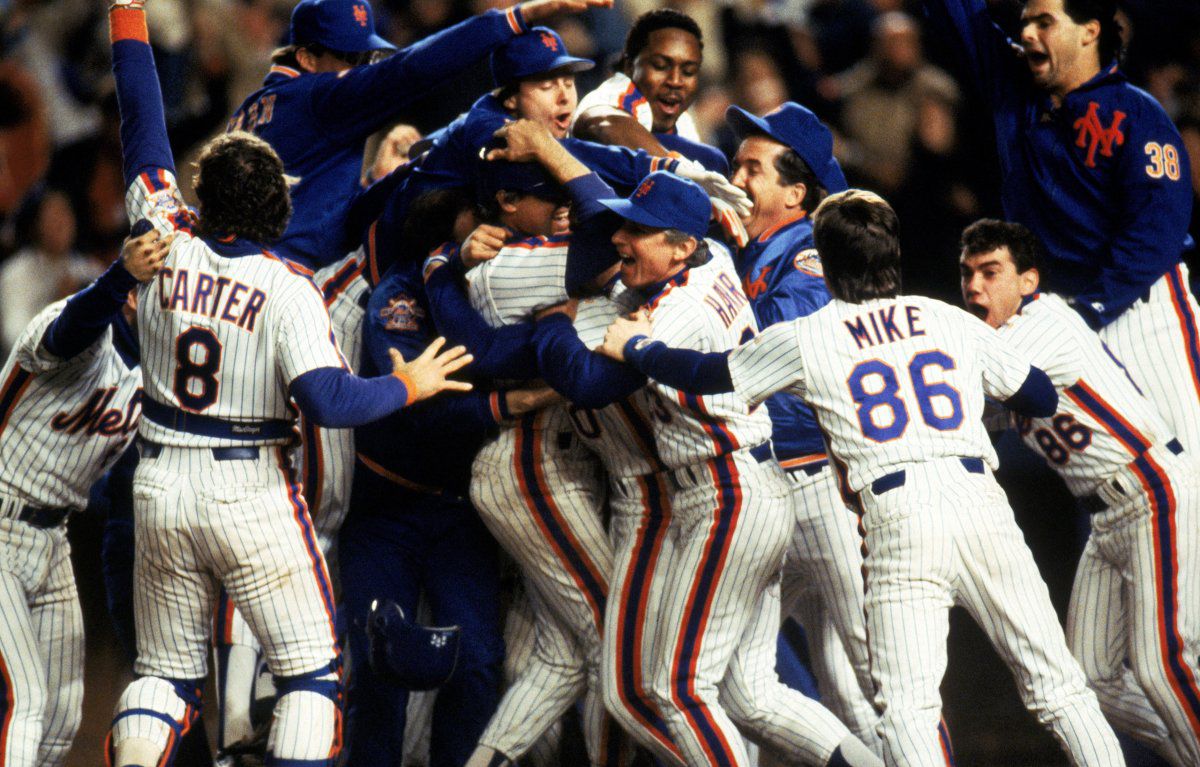
NY Mets win 1986 World Series
Image: NY Daily News

It’s been my experience that any baseball fan will hate at least one of New York City’s two teams, either the Yankees or the Mets. I’ve never really hated either, which makes me an outlier, I suppose. I just like New York City too much to hate on its teams (though that can’t be the only factor, as I adore Boston the city and yet I’d like to see all of its teams fired into the sun*). Back when there were only four divisions in Major League Baseball, the Mets were in the same division as my team, the Pirates, and for a couple years there, the Mets were a thorn in the side of the Pirates as they strove to win three division titles in 1990, 1991, and 1992. Since then they’re all in different divisions, though, so the Mets don’t figure too much. And the Pirates are usually terrible, so what’s to root against? Fifth place?

One of my best friends is a Mets fan, which might seem a bit odd living in Buffalo, where all baseball fandoms basically boil down to a whole lot of Yankee fans, some Red Sox fans, and then a fan or two of everybody else. My friend came by his Mets fandom honestly: he grew up in the days of 1980s cable television, when every local provider had a couple of indie stations from NYC (WOR and…another one), and on one of those stations resided the Mets. Since they were what my friend saw most often, that’s what he came to love, and to this day he roots as hard for the Mets as he ever has, though I’ve noted over the years a certain jaded amusement at the Mets fortunes (which are more often misfortunes) and a general feeling of “Hey, what did you expect” when the Mets flirt with something wonderful only to end up losing.

I’ve seen this same attitude from other Mets fans I’ve known: a certain even-keeled acceptance of their likely fate, which oddly allows them to have more fun in the face of their team losing than other fandoms out there. In all honesty, it’s my sense that a lot of sports fans could learn from Mets fans. They get as deliriously happy when their Mets win, obviously, but they avoid the soul-crushing despair and rage that comes of losing. (Mostly. I mean, it’s still sports, and when you lose the NLCS four games to two because your pitcher walks in the winning run in the bottom of the ninth in Game Six, well, no amount of baseball zen is going to keep you from wanting to take a chef’s knife to every teddy bear you can find.)

The Mets are that odd duck of a sports franchise: they haven’t won a ton (two World Series titles, and five total National League pennants), but still, they’ve won enough in their nearly 60 years of existence to make them rank just a bit above the “lovable losers” thing that the Cubs once managed to hold down for over a century. Mets fans aren’t long-time sufferers the way, say, Bills fans are. Because they’ve won, and because Mets fans seem to choose not to suffer in the first place.

When we traveled to New York City for Thanksgiving in 2015, I thought I’d grab my friend a Mets souvenir when we went into this big NYC gift store in Times Square. Place was huge, loaded with every NYC-related gewgaw and tchotchke you could want, including stuff for the Yankees, the Rangers, and the Knicks. And there wasn’t a single Mets-related item to be found anywhere in that store. Which was really weird, because the Mets are still a NYC team, they have some lore, and they had just won the NL pennant that year. Just six weeks before our visit, the Mets had hosted World Series games in New York City, and this gift shop didn’t have anything. Not a single pennant, shot glass, poster, snow-globe with Citi Field in it, nothing.

In America’s biggest and most important city, one of two resident Major League Baseball teams is a beloved institution of American sports history, and the other is a niche interest, like indie comic books. Weird.

Anyway, a new book came out earlier this year called So Many Ways to Lose: The Amazin’ True Story of the New York Mets, the Best Worst Team In Sports, by Devin Gordon. That’s a great title that sets up the tone of the book to follow: Gordon’s walk through Mets history is (mostly) warm and humorous. It’s Mets history not as a scholar would relate it, or a sportswriter striving for “objectivity”; this is the history of the Mets that you would hear from a Mets fan, and that’s what makes the book special.

Gordon, like my friend, adopted the Mets as his favorite team from an early age, and he’s been with them since their rise to late-80s powerhouse and beyond. Gordon is also an experienced writer, and not just about sports, so he knows his way around telling stories with flare and a good viewpoint. Gordon writes like what he is: an erudite fan who can spend a couple of pages breaking down just why Willie Mays’s “Catch” is as great a baseball play (for many, it’s the greatest baseball play) as it is, while at the same time using chapter titles like “Fuck the Yankees”.

Buffalo’s own sportswriting market is awash in talented writers and journalists who undermine their own work by beating everyone over the head with their heated insistences on their own “objectivism”, so it’s frankly a relief to find a book like this where fandom is admitted and embraced and allowed to shine.

I honestly had a great deal of trouble selecting a passage to quote from So Many Ways To Lose, because it’s packed with great passages. I thought about his lengthy breakdown of the Willie Mays catch, which he uses to prelude what he considers an even greater outfield catch (by Endy Chavez). I considered some of the passages in which Gordon speculates on why discussion of Darryl Strawberry and Doc Gooden tended to focus on drug use when the topic of other players’ drug use never seems to come up much (you don’t really need to think too long to figure that one out), and there’s a passage about the design and construction of Shea Stadium that is helpful because it’s frankly always helpful to remind ourselves what an asshole Robert Moses was.

Instead, I’ll go with this, from early in the book, when Gordon is making the case why the Mets are “the best worst team in sports”, even though they have done something at least twice that a lot of other perennially losing teams have not, i.e., actually win.

Now, there may be some fans of trash teams out there who have read this far and who think I’ve been too cavalier in dismissing their body of work. They’re wrong, but I suppose they deserve a fair hearing, so let’s go through the top contenders, if only to condemn them to yet another defeat.

The Detroit Lions might be the worst team in sports, which is to say: they’re not even good at being bad. They’ve never won a Super Bowl, never been to a Super Bowl. They’ve played (lost) in a conference title game once, and that was before we all had cell phones. I don’t have to consult the Internet to know that the Lions have never had a memorable postseason moment, because if they had, I’d remember it. It’s been nothing but decades of cold, slushy, uninterrupted losing. Even their uniforms, bluish-gray and grayish-blue, are colorless. Playing for the Lions is such a demoralizing experience that the two most gifted players in team history, running back Barry Sanders and wide receiver Calvin Johnson, both retired in their primes rather than spend another season with Detroit. They didn’t just quit the Lions, they quit football. They ghosted. After Johnson walked away in 2016, at age 30, the Lions’ front office demanded that he return a $3.2 million roster bonus, which is sort of petty for a team owned by the Ford family. It also means the Lions now have a frosty relationship with at least 50 percent of their franchise icons.

The Cleveland Browns have a better claim to the “best worst” throne, because unlike the Lions, they are easy to like, and unlike the Lions, their postseason defeats are so infamously excruciating that they have names like The Fumble and The Drive. The Browns have only made the playoffs once this century, despite starting 29 different quarterbacks over the course of 20 years. For three years in the 1990s, the Browns ceased to exist because their greedy, heartless owner, Art Modell, may he rest in peace, hated it so much in Cleveland that he tried to move the team to BaltimoreNest he fired his head coach, Bill Belichick. Now that’s some first-rate ineptitude. The problem with the Browns’ case may be Cleveland itself. It’s too grim. The 21st century hasn’t been good to the city, and every unlikely defeat, every clumsy failure is cut with rust and resignation. You can laugh at the Mets all you want. If you take pleasure in the Browns’ misfortune, you’re a dick.

Same goes for all of Minnesota’s crappy teams, the Vikings in particular, who have been waiting decades for the chance to lose another Super Bowl. In 2020, the Minneapolis-based sportswriter Steve Marsh compared the NBA Timerwolves’ Mets-ian flair for comic incompetence to a night of experimental dining–“Maitre d’, surprise us!”–but even he admits that in a city famous for its losers (the Vikes, Walter Mondale), the Wolves can’t get no respect. Their losing, while admirable, is just too small-time. Ditto for the Cincinnati Bengals, another small-batch loser, whose principal resume for “best worst” champion is the Icky Shuffle.* In order for the Bengals to be the Mets, Cincinnati would have to be New York. This is yet another case of small-market franchises getting overshadowed and disrespected, to which I can only say boo-hoo. To win at this level of losing, you need a big canvas.

Gordon goes on a bit, discussing why several other prominent never-winners in American sports can’t beat out the Mets for “best worst team ever” status, but curiously, he doesn’t mention a few other franchises known for their relentless losing. Surely the fact that the Chicago Cubs won a single World Series a few years ago doesn’t blot out their entire century of losing from our collective memory, does it? Or how about the Arizona Cardinals, a team that until its single Super Bowl appearance (which they lost in heartbreaking fashion despite a superhuman effort by their Hall of Fame quarterback and one of the greatest receivers ever in that very game) had to admit that its greatest moment in franchise history was a fictional moment that happened in the movie Jerry Maguire? And how about the Buffalo Bills, whose four consecutive Super Bowl losses from 1990 to 1993 still boggle the mind of sports fans to this day?

The Mets have done a lot of losing, sure–but they’ve done some winning, too. I’m not ready to grant the Mets the title of “best worst team” just yet, but Gordon does make a compelling case for his team, and that’s what it’s all about, anyway. And really, one of the great subgenres in sports writing is when gifted writers take on bad teams.

In the last year, I’ve read two great baseball books. First was Roger Angell’s iconic The Boys of Summer. Now I have So Many Ways to Lose.

I wonder if it’s time to start watching baseball again.

Endy Chavez makes amazing catch
Image: Metsmerizedonline.com

*This is a metaphor.

Share This Post