Holy SHIT.

Sorry I couldn’t come up with a more eloquent title for this post, but…well, sometimes you gotta go with the words that hit you. Therefore: Let there be dancing in the streets!

Yup, I won a copy of Doug Adams’s The Music of The Lord of the Rings, which makes me so utterly happy that…well, later there may be opening of beer and dancing once I am alone and no one can see.

The entry rules were simple: in addition to providing contact info, entrants had to identify their favorite bit of music from the films and describe why. Here’s what I wrote:

My favorite bit of music from the LOTR scores? That’s a nearly impossible requirement for me to fill, as I adore just about every single note in the trilogy, from start to end. But for the purposes of this contest, I’ll name the music that plays as Gandalf leads the Fellowship into the ruin of the subterranean Dwarvish city of Dwarrowdelf, in Moria. There’s just something so majestic and regal about the music in this scene: most of the Moria music is dark and forbidding, but in this one passage, Howard Shore conveys some of the optimism that the Dwarves must have felt as they started digging into Moria. The music builds and builds, and it feels like it’s about to open up into a huge melody — but that melody never comes, which is fitting since Moria never reached the heights that the Dwarves had hoped. Instead, the music turns dark again as Gimli finds Balin’s tomb. This moment in the score always makes
my spine chill a bit. (The film actually blunts the impact a bit by having Sam say “Now that’s an eye-opener and no mistake”. It’s a scene that needed no dialogue.)

Here’s the music I’m referring to. It’s the first 1:15 of this clip, and I shiver in awe every time I hear this passage. It’s so regal and sad and evocative of Tolkien’s world that is full to overflow with old things that are lost and nearly forgotten:

That music is Middle Earth.

Share This Post

“The pointy end goes in the other man.”

Screenwriting great William Goldman has opined in the past that the hardest films to get right are comedies and adventure films. An adventure film that gets things right is one of the finest things in life, I’ve always believed. One such film — which I hold to be terribly underrated, and a potential classic of the adventure genre — is the 1998 swashbuckler The Mask of Zorro. This has been a favorite of The Wife and mine ever since she and I saw it in the theater during its initial run, and we watched it with The Daughter just a week ago. We hadn’t seen it in some years — I had it on VHS, but I don’t have it on DVD — and I had forgotten just what a rock solid entertainment it is.

What struck me right at the outset about The Mask of Zorro is that it doesn’t do either of the “expected” things for a big-budget flick that pretty much reintroduced a very old character to young audiences who likely had no idea who Zorro was. The film didn’t just follow the adventures of an already-existent Zorro, but neither did it dwell on a long and boring origin story. Origin stories are really tough to pull off; to often, the film spends half its time on the origin and then has to compress the rest of the tale into the second half. Sometimes this works — Superman and Spiderman both pulled it off, mainly by making the origin stuff so good — but a lot of times it doesn’t.

The Mask of Zorro escapes the horns of this dilemma by skirting between them: we open in medias res, with Zorro in full strength, pulling off a daring exploit and escaping. But he is an older Zorro, played by Anthony Hopkins (in what is a typically outstanding Anthony Hopkins performance), and he is ready to retire as Zorro, thinking that he has won and is ready to settle into his private life as Don Diego de la Vega. However, his arch-enemy, Don Rafael, has learned who he is and goes to arrest him. In the ensuing melee, de la Vega’s wife is killed, and we get hints of an old love triangle between these three, even though it is never explained outright. De la Vega is taken prisoner, but Don Rafael decides to levy an even harsher punishment: he takes de la Vega’s infant daughter Elena to raise as his own.

Twenty years later, de la Vega escapes from prison and is about to murder Don Rafael when he discovers that his daughter, now a grown woman, is back in California. His desire for revenge is stymied, until he comes across a much younger man, a drunken thief named Alejandro Murietta (Antonio Banderas), who has his own scores to settle and whom de la Vega can enlist to his aid and train as the new Zorro. Lots of derring-do ensues: Don Rafael’s plot to become ruler of California; de la Vega’s training of Alejandro; Elena’s attraction to the masked outlaw she meets in passing and her growing suspicion that her past is muddier than she has known before; a soldier from the American army who is very nearly psychotic; and ultimately, de la Vega’s twenty-year quest for revenge against the man who took everything from him.

What makes The Mask of Zorro so great, from a story standpoint, is the fact that there isn’t a single unmotivated character in the film. Everybody has something that they’re trying to achieve, something they’re working toward; therefore, everyone in the film has a reason for the things they do. I never once get the feeling of plot machinery cranking away in this movie; every character wants something, and even in the cases of the villains, they want things beyond the typical “villain” things like power and money. It’s always good when there is personal history between hero and villain, and yet, too many adventure films fail to take this easy step toward making their characters more three-dimensional.

The other big reasons why The Mask of Zorro works so well are the usual suspects: the performances are uniformly excellent, the pacing and editing are outstanding, James Horner’s score is a blast, and Martin Campbell’s direction is top-notch. The film is also notable for its lack of computer-aided action sequences; those who place value in old-school stuff like stuntmen and choreography will find much to love in The Mask of Zorro.

It’s one of the best action films of the 1990s, and much better than the more famous (and more popular) The Mummy.

Share This Post

Lovin’ the Lantern

I just saw this article about the Green Lantern movie that is currently in production. It’s sounding like a pretty nifty production:

See, here’s the the thing – I can’t tell you how Green Lantern will be as a movie, but after visiting the New Orleans set of the film I can tell you that director Martin Campbell and company are working to make the biggest, most epic, most sweeping, most cosmic superhero film yet. Forget Hal Jordan versus muggers in an alley, Green Lantern is really about Hal Jordan battling to save not himself, not his girlfriend, not even just his city but the entire planet Earth. Green Lantern is a huge movie, with set pieces that will be unlike anything you’ve ever seen before. I can’t spoil where the final battle takes place, but it’s an INSANE location – it certainly isn’t your standard issue end-of-the-movie warehouse, bridge or warehouse-like supervillain lair.

And it’s not just Hal Jordan. Green Lantern will feature the entire Green Lantern Corps; while visiting I saw life-sized cardboard cut outs of Tomar-Re and Kilowogg, the alien GLs who help train Hal Jordan. I saw mock ups of Oa, the planet at the center of the galaxy where the Guardians of the Universe oversee the galactic police force that is the Corps. And I saw much, much more – stuff that will make not just GL fans but hardcore space fantasy nerds salivate with excitment. I’m talking massive planetary and space vistas, incredible alien life forms and crazy space ship designs.

Yeah, this better not suck. I’d hate for something to sound so completely made for me and turn out to be a turd in the punchbowl. I am pleased to learn that Martin Campbell is directing; he is very good at directing action sequences that are highly kinetic and yet easily followed by the viewer. I’m looking forward to this.

(If you click through the article, make sure to click all the way through to the large versions of the two pieces of concept art they have posted. The Lantern cemetery is a beautiful, haunting space-opera type of image.)

Share This Post

Help me, Readers!

An old friend of mine e-mailed me thusly:

Hey, I was wondering if you would know which older movie featured a battle scene wherein the protagonist and antagonist morphed into various creatures…but since it was well before morph technology, the screen showed neon-like outlines of the animals (in electric blue and neon red, as I recall). Was it Clash of the Titans ’81? A Conan movie? Something else entirely? I saw that little bit of the movie as a kid, and it has stuck in my memory ever since. Do you have any idea what I’m writing about?

And I can kinda picture a scene in my head like what he’s talking about, but nothing specific enough that adds up to a memory. I know I have a number of readers who ought to be right up on their late 70s/early 80s F&SF flicks, so can anyone shed some light on what Mark’s movie might have been?

Share This Post

“He’s the darkness, reaching out for the darkness.”

Oliver Stone’s Nixon is an amazing film. I kind of wish Stone was still making movies like this: densely packed films that overwhelm the audiences with information and tell their tales in complex, non-linear ways. Well, maybe Stone still is making movies like this; in truth, I haven’t kept up with his career much over the last ten years.

It’s easy to see Nixon as a companion piece to the earlier JFK, and in many ways, it almost is. But it’s also a very different film, even while using many of the same techniques of the earlier film. Nixon is more meditative, more of a character study, than a film interested in posing a particular hypothesis, as was JFK. (To a certain extent, anyhow – people often refer to “Oliver Stone’s conpiracy theory” regarding the JFK assassination, but when you actually watch the film, no real, concrete hypothesis is ever actually advanced.)

Nixon seems generally focused on the way that the very strengths, or gifts, or skills that allowed Richard Nixon to ascend to the highest political office in the United States were the ones that brought about his downfall. A “tragic hero” will often have a bunch of good qualities, and one not-so-good quality that causes everything to fall apart. Nixon, however? His power came via his paranoia, and deserted him by the same route.

The film opens with a brief educational film about salesmanship (“What you’ve got to remember, Bob, is that you’re selling yourself!”), and then we’re into the story proper. The overall device of the film is Nixon, alone in his study during a series of nights toward the end of his Presidency, reflecting on the events of his past, most often by listening to his infamous tapes of his Oval Office conversations. The film is told in a series of flashbacks, then, and not always in the real order of events, but in the more real way in which we tend to remember things: the memories that surface as they seem relevant to the events of our present-day lives. At times, Nixon is remembering past political events, and at others, he is remembering past personal moments with Pat, the love of his life.

To me, the question of authenticity with regard to a film like this misses the point. I remember watching discussions of the film on news shows when it came out, back in 1995, and the topic always seemed to revolve around the extent to which Stone captured the “real Nixon”. Some folks attacked the film on that basis, others praised it; I remember one commentator – I think it may have been Bryant Gumbel – who said, “I don’t think it’s the Nixon, but rather a Nixon”. That seems pretty astute to me. Those closest to Richard Nixon seemed fairly adamant that Stone did not depict the “real Nixon”, but even those closest to us don’t know our real selves as well as they might think. Is Stone’s Nixon a “real” Nixon? I suspect that he captures some of Nixon’s qualities well, others not so well. I also suspect that Stone emphasizes some of Nixon’s qualities a bit in the interest of making a better movie. I think that Nixon is to Richard Nixon as Henry V is to King Henry the Fifth.

Of special interest to me when I watched Nixon a couple of weeks ago was the way no one ever really spells anything out directly. Nixon himself seems to be talking in code with his assistants much of the time, and at no point does anyone say, “Hey, we should break into the DNC offices at the Watergate and see what we can find out.” At no point does Nixon say, “We need to cover this up!” Everything is happening, or has already happened. This plays into one of Stone’s themes of the film, which is stated outright in the scene of the odd moment (which really happened) when Nixon left the White House in the middle of the night, went to the Lincoln Memorial, and ended up interacting with the protesting kids there. Referring to the war, one girl says: “You can’t stop it, can you? You’re powerless.”

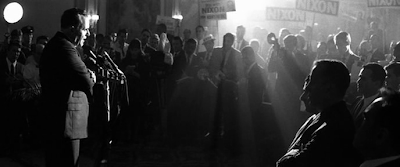
Stone conveys this as well with a lot of fascinating cinematography. As in JFK< he employs a lot of different looks and styles throughout the film, sometimes shooting things "straight", while other times using black-and-white, or making the film very grainy in spots, or using lots of fades and superimpositions of stock footage to convey the magnitude of the issues Richard Nixon faced or the hugeness of his character. In many "Presidential" films or teevee shows, such as The American President or The West Wing, the White House is shot as a beautiful place where our patriotism and commitment to democracy is literally made physical. No so in Nixon; the White House here is an ominous place, and place of fear and dread in the face of historical forces that cannot be tamed.
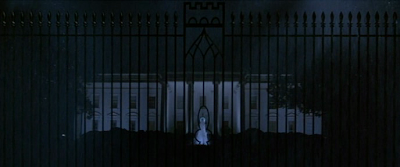
Stone often frames scenes from odd angles, and many scenes depict dark shadows contrasting with brilliant light streaming in through windows. An early scene shows Nixon in his personal study, sitting beside a roaring fireplace while the air conditioning is on at full blast.

Nixon seems increasingly shocked, over the course of the film, to learn just how little control even a President gets to have over the forces around him, and by the time he really comes to grips with this, he is on the brink of ending his Presidency. Even late in that particular game, though, he continues to assert that a lack of control was what got them, in the end: “We never got our story out,” he says to Alexander Haig. Nixon relishes the moments, all too few, when he gets to feel as though he is in control, such as when he puts a wealthy donor in his place or chews out Henry Kissinger. But he also reacts with increasing anger when his efforts at control fail, such as when a press conference goes awry or when his own wife tries to criticize him over dinner.
That brings me to the film’s central relationship, that of the marriage of Richard and Pat Nixon. It’s really an amazing relationship, as movie marriages go; it is not depicted as a relationship of blind love that is independent of everything else in Richard Nixon’s life, nor is it depicted as Pat’s Lady Macbeth to Richard’s Macbeth, with Pat being ambitious and desiring of power all her own and only being in the marriage because it’s the best route for a woman to real power in mid-20th century America. Pat Nixon is shown as being literally the only person in Richard’s life who is ever willing to criticize him or tell him when he’s wrong, but she is also there for him through everything, except for one brief period when she considers divorce. Even then, however, Richard brings her back from the brink, and even after all of her disgust during the long unfolding of Watergate, when Richard at last stands alone in the White House on that last night of his Presidency, ruined and emotionally drained and devastated, it’s Pat who comes to him and gives him the only consistent shoulder he’s ever known on which to lean.

Nothing in this movie would work without some great performances by the cast, and there isn’t a single weak link among them. Stone assembles an astonishing supporting cast here; so much so that if this movie had been made in the 1970s, the posters would have included one of those rows of thumbnail photos of the stars along the bottom. James Woods, Bob Hoskins, M. Emmet Walsh, Saul Rubinek, EG Marshall, Madeleine Kahn, Tony Goldwyn, Mary Steenburgen, David Hyde Pierce, Ed Harris, and the like – Nixon might be the single most star-studded film of the 1990s to not feature Kevin Bacon in any role at all. But the two performances that center the film, that absolutely ground it, are Joan Allen as Pat Nixon, and Anthony Hopkins as Richard.

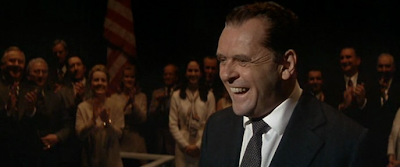
The film made a pretty wise choice as regards the “look” of Richard Nixon. They didn’t go overboard in trying to make Hopkins look like the genuine article; they gave him roughly the same haircut and I assume some prosthetic teeth to make his smile look more Nixonian, but after that, they relied on Hopkins to do it all through the magic of acting. He plays Nixon as a somewhat hunched-over, physically awkward, gravelly-voiced man who never seems to exude much by way of charisma, but rather gets what he wants from others because he simply won’t accept anything else. Nixon is a bundle of nervous energy, and Hopkins plays him as a man who sweats too much, grins at odd moments, and can’t figure out what to do with his own hands.
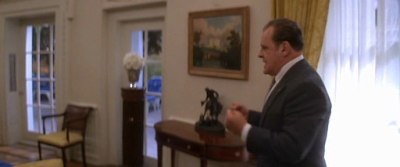
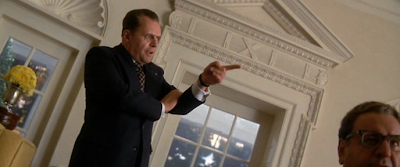
Hopkins’s performance is endlessly fascinating to me, coming as it does in the same period as a number of other performances by him that are all unique: there is nothing of Hannibal Lecter to be found in Hopkins’s Richard Nixon; nor is there to found any of Mr. Ludlow from Legends of the Fall, CS Lewis from Shadowlands, or anyone else. Hopkins’s Nixon is really a singular creation, so much so that the spell is actually broken twice over the course of the film, both involving Oliver Stone’s use of archival footage from the Nixon years. One is of a Nixon mask, being paraded about at a protest rally; the features are distorted, but we can still see that it’s a mask of the real Nixon; the other is at the very end of the movie, when Stone shows us footage of the real Mr. And Mrs. Nixon walking to Marine One for their final departure from the White House.

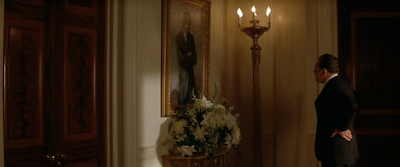
Joan Allen’s Pat Nixon is equally remarkable, because hers is a quieter performance as the only person who gets to talk back to Dick Nixon and not only get away with it but be able to stick around afterwards. She is, by turns, thrilled by him, devoted to him, angered by him, disgusted with him, and in the end, deeply empathetic to him. We can see the pain on her face when she sees him, alone in the White House, talking to the portrait of John F. Kennedy, in one of the film’s finest moments (“When they look at you, they see what they want to be. When they look at me, they see what they are.”) The keenest moment of insight as to Nixon’s character – as the film depicts it – comes when Dick is gearing up for his 1968 run for President, six years after he’s sworn to Pat that he’s done running for office. She is angry that he has been making plans without telling her, but she still feels the old hunger and the pain from the last two losing campaigns has mostly faded, so she is willing to stand with him once again – in fact, she even hungers for it herself, telling him “This time, we’re gonna win. I can feel it.” And Dick takes her in his arms and dances, in the best Nixonian fashion: awkwardly and gracelessly.

John Williams’s score for Nixon is, to my mind, one of his more underrated efforts. He juxtaposes a cheerfully optimistic Americana sound with more downbeat and dark music as Nixon begins to spiral out of control. Stone closes the film with a musical choice that seems odd, at first, but is really amazingly fitting: the Mormon Tabernacle Choir’s a capella rendition of Shenandoah. There isn’t much in the film by way of period popular music, as instead Stone relies on Williams’s sound world to help immerse us in the world of Dick Nixon.

As with JFK, a companion book was released for Nixon, containing the film’s screenplay, a number of archival documents (including transcriptions of the Nixon tapes), and essays by the filmmakers, historians, and figures from the Nixon administration (John Dean and E. Howard Hunt). Here is an excerpt from an essay by Christopher Wilkinson, one of the film’s writers:

The more we got to know Nixon, the more it struck us how odd he was. He was a man who referred to himself in the third person and called his wife “Buddy”. He was physically awkward, socially graceless, and sexually repressed. Other than Bebe Rebozo, he had no real friends. When he needed to relax, he would just sit silently with Rebozo. For hours. Bob Haldeman was with him for nearly twenty years and never shook his hand.

The was a strange man, an extremely strange and mysterious man.

I cannot remember the precise moment when we started to empathize with Nixon. To begin to understand the tragedy of his life. To appreciate the true dimensions of his character.

Nixon came from nothing – the wrong schools, the wrong clothes, the wrong parents – and, by dint of hard work and self-sacrifice, rose to the heights. In many ways he is the American Dream incarnate, the self-made man who tortured himself to be a Somebody. And he never gave up. He came off the canvas again and again, rehabilitating himself, reinventing himself. Admittedly, the notion of Nixon the Indestructible is often trotted out to evoke sympathy for him.

But it’s true.

There are other poignant and peculiar details that reached us, that slowly eroded our contempt. The emotionally distant mother who rarely touched him. The brutish father who directed fits of blind rage at him. The lonely, clumsy boy who was sure that no matter what he did, he would never be good enough.

And the dead brothers. First his beloved little Arthur. Then Harold, outgoing, attractive, a boy Richard idolized. A boy whose lingering death allowed the family to afford Richard’s tuition to law school.

The guilt.

When Nixon fell in love with Pat, he drove her on dates with other boys to prove himself to her. He wore her down with a barrage of flowers and letters. He would do whatever it took to win her and he never let up until she was his.

Classic Nixon.

The only clean campaign he ever ran was 1960. Kennedy (like Harold) was everything Nixon was not – handsome, charming, articulate, witty. Nixon could have used any number of smear tactics against him; the religion, the Mob connections, the women. But he didn’t. He respected Jack Kennedy more than any opponent he had ever faced. So, for the only time in his political life, Nixon played it straight.

And Kennedy stole the election from him.

The fact that he didn’t completely come apart during the crushing pressure of the final days of Watergate is a testament to his bullheaded resolve. To his perverse brand of courage. Everyone was against him. The country wanted his head on a pike and he wouldn’t give it to them. A lesser man might have run screaming and drooling down Pennsylvania Avenue. Or had a stroke. Or committed suicide. But not Nixon. He wouldn’t give them the satisfaction.

As President, he did more to desegregate the schools than any of his predecessors. He created the first and most effective Environmental Protection Agency. He has few (if any) Presidential peers in foreign policy: the spectacular opening of China, achieving detente with the Russians. Accomplishments that Nixon, the quintessential Commie hunter, was uniquely suited for. If a liberal Democratic President had tried it, he would have been crucified.

And Nixon would have brought the nails.

Nixon stretched our idea of what greatness is. He is a huge character who embraces the entire American landscape from its loftiest ambitions to its most malignant schemes. To understand Nixon is to understand what we have been. To understand Nixon’s destiny is to understand what has happened to us. To understand Nixon’s life is to understand the history of our times.

What strikes me now, on reflection, is the way the Nixon political playbook has come to dominate American politics in our day, forty years after Nixon held office, with its dirty tricks and coded appeals to our baser instincts. But Nixon’s actual policy goals now form the farthest boundary to the left that our politics are willing to allow voice. It’s amazing to me that if a Republican candidate came along now, espousing Richard Nixon’s policy goals, that candidate wouldn’t even make it out of the primaries. Things that a Republican President did forty years ago would be labeled as unforgivably liberal — Socialist, even — if a Democrat did them today.

What a great, disturbing film this is. Just like Richard Nixon himself.

Share This Post

It’s all a bunch of gorram felgercarb!

Today at work, we were talking movies and whatnot as we often do, and we happened on the topic of teevee edits of movies — specifically, the editing of swear words. My friend and I share a favorite one, from The Breakfast Club. During Brian’s (Anthony Michael Hall) confession, Claire (Molly Ringwald) says something that she intends to be comforting but is really condescending and rude. And when she tries to defend herself, she says, “Brian, you just don’t understand the kind of people I’m friends with, the kind of pressure I’m under!” And Brian responds, “What? I don’t understand pressure? Well, f*** you! F*** YOU!“. But, in the version of the film which is often aired on TBS, this is changed to: “Well, flip you! FLIP YOU!”

So now, we like to invoke the phrase “Flip you!” at opportune moments.

In the course of today’s conversation, I related an experience I had a while back. I’ve always had a soft spot for the movie Smokey and the Bandit, the Burt Reynolds flick. I watched it with my parents years ago for the first time, and since then I’ve only ever seen it on teevee. So, as far as I’m concerned, Sheriff Buford T. Justice throughout the film keeps calling people “You scum-bum!”

But…it turns out that’s not what he says. A while back, we checked the movie out of the library on DVD for a family movie night. It was as fun a flick as ever, but I noticed that Sheriff Justice was not calling everyone a “scum-bum”. He was calling everyone a “sumbitch”.

I suppose that’s the authentic, canonical version and all…but years of watching this movie the other way has made “scum-bum” canonical for me.

“Now where are you, you scum-bum!”

Share This Post

“We’re always fascinated when we find leg irons with no legs in ’em.”

Be it resolved: The Fugitive is a perfect movie.

This may seem a strong claim, and maybe it is. But I’m not talking about “perfect” in the normal sense of “perfect”, to indicate that The Fugitive has no flaws at all. No, I’m talking “perfect” in, if you will, the “baseball” sense of the word. In baseball, a pitcher has thrown a “perfect game” if he doesn’t allow a single opposing hitter to reach base. It’s even more impressive than a no-hitter: it’s no walks, no errors, no passed balls on third strikes, no batters hit-by-pitch, no nothing. No baserunners. At all.

And yet, you can watch any of the small number of perfect games in baseball history and, if you know baseball well, you can pick out imperfections. Maybe the outfielders are shied toward left a little too much at one point, so when a guy hits it deep to right, the right fielder has to sprint a long way to run down the ball. Or maybe the shortstop boots a grounder and only just baaaaarely manages to get the ball back up and across the field to the first basemen’s glove a tenth of a second before the runner’s foot lands on the bag. Or maybe the pitcher himself goes to a 3-0 count on a hitter before retiring him on a lazy pop-up or an easy grounder.

The game has flaws…and yet not one of those flaws matters, in the end. Not one of them has any effect on the end result. The game is perfect.

The Fugitive is like that. It has flaws. It has imperfections. But none of them matters. In the end, the movie is perfect.

Watching it again a few weeks ago, for the first time in a number of years, I was amazed at how well the suspense in the film still works. I know what happens, I know how it ends. And yet, I witnessed the whitening anew of my knuckles when Dr. Richard Kimble is scrambling about the innards of a dam, or finding escape into the crowd on St. Patrick’s Day in downtown Chicago harder than one might think, or closing in on his wife’s murderers even as the police close in on him. The Fugitive never fails to draw me in. Never, ever.

I’m sure the story is familiar: Dr. Richard Kimble (Harrison Ford), a noted Chicago surgeon, comes home one night from work, after having been called in to perform a delicate emergency surgery, to find his wife, Helen, brutally murdered (shot and bludgeoned). Worse, the assailant is still there, and in grappling with him, Kimble notices the man’s distinctive feature: he is one-armed and wears a prosthesis. The one-armed man gets away, and Kimble is left to explain all this to the police, who don’t buy any of it and quickly end up booking Kimble for Helen’s murder. Kimble’s insistence on his innocence and his fingering of a “one-armed man” as the murderer fall on deaf ears, all the way to his conviction and sentence of death. Ouch.

So Kimble is sent on a bus from court in Chicago to the state penitentiary, somewhere in the south of the state. On the way there, however, something goes awry, and the bus ends up on its side across a pair of railroad tracks. The guards and prisoners start scrambling to get out, Kimble last of all…and the light of an approaching train appears. Ouch, again.

After the massive train wreck (one of the most impressive bits of mayhem ever filmed, in my opinion), Kimble finds himself free. And he runs, following the path of a river. Soon, however, Kimble’s trail is picked up by US Marshall Samuel Gerard (Tommy Lee Jones), who is confident, competent, perceptive, and deeply intelligent. Thus begins one of the best cat-and-mouse games in movie history, and what’s so great about it is that it’s a double game of cat-and-mouse: Kimble is fleeing Gerard even as he is pursuing Helen’s murderer.

The film has lots of fine set pieces, including the train wreck, the chase through the bowels of the dam, and so on. As good as the set pieces are, though, it’s all the stuff in between that really makes the movie work as brilliantly as it does.

:: The film really leaves a lot of good stuff to the viewer. Gerard is professional to the hilt, and yet he’s put together a really good team where everyone knows one another well and respects one another. We see all this just in the way they talk to each other and they way they conduct themselves around one another; there’s never that type of bit that a less well-written film would throw in (“Geez, Sam, the way this guy keeps getting away from us really reminds me of that guy we were chasing in San Francisco that time, huh?”).

Likewise, even better, we see, without ever once having it stated, that Gerard is gradually figuring out the case behind Richard Kimble’s arrest and conviction. There is never a moment where someone says, “Hey, Gerard, you’re not startin’ to doubt this guy’s guilt, are you?” But we see this happening, slowly and gradually, as the trail Gerard follows leads him into the case and into contact with the same clues that Kimble himself is finding. He’s slowly putting the pieces together himself, even as he has already told Kimble that he’s not interested in the crime. Only near the very end of the movie, when Gerard has to shout out to Kimble, “I know you’re innocent!”, is it ever stated outright.

:: I can’t think of any moment in the film where anyone does anything that is outright stupid for the simple reason that the plot needs that someone to do that thing to keep the plot moving along.

:: Richard Kimble takes so many amazing risks in this film, risks that he thinks through as best he can and only takes when he decides that the risk is the only way of moving forward. I’m not just talking about his sneaking into a hospital early on, in order to stitch up his wounds and get clothes and put together the next part of his escape in an environment he is familiar with; and I’m not just talking about his leap from the brink of the dam, which is the only choice he has (aside from accepting recapture). For my money, the most amazing risk in the film is when he finally learns the identity of the one-armed man. Kimble tracks the man down and discovers evidence in the man’s house that ties him to other people in Kimble’s world – doctors from his former hospital, pharmaceutical executives he met at a banquet the night his wife was murdered. Kimble has found…something, but he doesn’t know what. He’s found a piece of the puzzle. He knows it’s a big piece, but he knows that he can’t put the puzzle together. So he does something amazing.

He calls Gerard from the one-armed man’s home, allowing the call to go on long enough for the trace to be completed. He knows that Gerard will come, even though he’ll be long gone by the time Gerard arrives. So what is he doing? He’s making the only move he can: he is gambling that Gerard will find the pieces and, with his own investigative abilities that Kimble himself doesn’t have, help put the puzzle together for him. And he challenges Gerard to do what he’d already said he didn’t: he challenges Gerard to care about the case.

Kimble has no way of knowing if this will work. He has no way of knowing if Gerard will start digging into the life of Sykes, the one-armed man, and uncover the man’s unsavory dealings. He has no way of knowing what Sykes’s unsavory dealings even are. Kimble knows that he can’t flush out the bad guys himself, so he hopes that Gerard will do it for him.

Amazing stuff.

:: The cinematography of The Fugitive is fascinating. Transitions and the passage of time are often signified in the movie by sweeping, aerial shots of downtown Chicago. Many of these shots have the camera looking straight down on the city streets as the buildings float by the lens, some of the taller ones coming up so high that it’s almost as if the camera may well brush their roofs or radio antennae. I’m not sure that these shots are symbolic in any way – maybe they’re symbolic of Richard Kimble’s attempts to perceive key details from a very far vantage point that is constantly moving – but they are certainly very stylish.

:: I love how the one time the film breaks away from Kimble’s chase to give us a moment of his character is when he is standing around in the Cook County Hospital ER, in his stolen janitor’s uniform, as a bunch of injured kids are brought in. He doesn’t even consider doing anything other than what he does here: grab a kid’s X-rays, make a diagnosis that the ER people have missed, and take the kid to the ER after faking a signature on the orders. (There’s even a funny medical in-joke here, referring to the legendarily awful handwriting of most doctors.) It’s not really a moment of great risk, in terms of capture, but it is a moment of risk in that it limits Kimble’s movements in the future. But he can’t think in those terms; he has to help that kid at that moment.

So what are the apparent flaws in the film? Well, a couple jump to mind. One would think that if a renegade escaped convict could elude capture and still manage to nail down the identity, location, and motive of the “real killer”, all on his own, then surely the Chicago Police Department could have turned up some evidence that maybe, just maybe, their prime suspect was, in fact, innocent. Kimble’s investigations are all pretty straightforward: he remembers damaging the killer’s prosthetic arm in the struggle, so he reasons that the killer would have to go in to have his arm adjusted. So he checks those records and finds a group of one-armed men who did just that shortly after the date of the murder. Then he follows up on each one, learning that one is dead, another is already incarcerated, and that another is…a fellow with ties to medical people. You’d think the police, or Kimble’s own lawyer’s investigators, could have come up with some of this.

Also, Kimble seems to have enough money to stay on the lam for a while, doesn’t he? Sure, he steals a wallet and borrows money from a friend (who later turns out not to be a friend after all), but he rents two different rooms, buys clothes and food, purchases stuff to make fake IDs with, and so on.

But those are really small flaws overall, in one of the most effective thrillers ever made.

Share This Post

Didn’t I write this post?

I was just looking through a file in which I keep “in progress” posts on movies, and I found my partial thoughts on Hayao Miyazaki’s Howl’s Moving Castle, which I watched with The Daughter, oh, quite a while ago. A year ago, actually. I thought that I had certainly finished that post and published it here, but it’s not turning up in my searches, so maybe I didn’t. Anyway, here’s what I had, to begin with:

Back in 2005, when Howl’s Moving Castle came out, I remember that while there were some highly positive reviews of the film, the general reaction seemed to mostly be that the film was, by some margin, the least successful work to date by Hayao Miyazaki. The reaction seemed to range from “Worth watching, but his least good film” to “Miyazaki’s only dud”. It took me several years to finally get around to watching the movie, and I must admit that I’m not sure why so many people were down on it, except by virtue of comparison to the films in Miyazaki’s oeuvre before it.

My guess is that Miyazaki’s previous work had been so good as to simply make a subsequent film that wasn’t as good look even worse than it is by comparison, and that I was able to avoid looking at Howl’s through Spirited Away-colored glasses by virtue of having waited so long to finally watch the movie. (I’d forgotten I owned it on DVD, believe it or not.) Miyazaki’s two previous movies, Princess Mononoke and Spirited Away, are truly great films that manage to rise above being “classics of genre” and become actual “classics”. So a more pedestrian effort like Howl’s is standing in a much larger shadow. But I would say that the films need to be judged for what they are, and not what the other films around them imply they should be; and that a continuum exists that must be acknowledged. Surely there is a greater range of possibilities for a Miyazaki film than “Classic” on one end, and “Dud” on the other. I mean, not every James Bond film is Casino Royale or On Her Majesty’s Secret Service, but that doesn’t mean that every film not at that end of the pool is therefore Live and Let Die.

So, as for Howl’s specifically, I found it highly enjoyable, if occasionally maddening in its Miyazakian way of not explaining stuff.

I’d like to flesh this out a bit, but I’ve only watched the film once and I don’t remember a lot of the specifics. I recall some highly typical Miyazaki visual flair; what often makes his films so astounding is his ability to not just think up lots of weird stuff but to also come up with ways to depict that weird stuff in a world that looks familiar to us and yet still not have all of his weird stuff look ridiculously out-of-place. The “Moving Castle” itself is a piece of work, an enormous, ramshackle steam-powered vehicle that putt-putts around the countryside and maybe even from one world to another. It’s an amazing piece of design.

I don’t recall a whole lot of the story, although I do remember that I found it by turns captivating and a little frustrating, because Miyazaki didn’t really explain nearly as much as I would have liked. Miyazaki has always been of the “let the viewer figure some stuff out” camp of filmmakers, but in Howl’s, I found myself thinking — for the first time ever in a Miyazaki film — along the lines of, “Geez, a little more exposition might not be the worst idea here.”

Characters? I liked and sympathized with them all, especially the Prince who is losing his soul as war engulfs his land. The most memorable character, though, is the inanimate scarecrow who has only one facial expression and who can’t make any gestures at all, and yet somehow, through Miyazaki’s genius, is able to seem like a totally autonomous actor in the story.

So yes, I liked Howl’s Moving Castle, quite a bit. Is it Miyazaki’s least successful film, story-wise? Maybe. But if it doesn’t quite clear the bar, it at least gets up there, which a lot of films never do.

Share This Post

Alas, poor Yori! I knew her, Horatio….

Via Cultural Compulsive Disorder, I see this poster for TRON Legacy. It’s a Hungarian poster, actually. Apparently the marketing strategy in Hungary for this movie is a bit different from the one in this country so far:

But I also found this one out there somewhere, so maybe the marketing will now focus on the wimminfolk of TRON as opposed to the teaser posters to date, which have been all-lightcycles, all the time.

I’m looking forward to this movie, even with my trepidation that it may end up feeling more Matrix than TRON. That would be disappointing, given that I’m a big fan of the latter and not a very big fan at all of the former.

Share This Post

Obtaining the Unobtainable

The Wife and I watched Avatar the other day. My reaction to the film is still pretty much what it was: I liked it as a well-made, beautiful-to-look-at SF adventure flick. Nothing earth-shattering from the story standpoint, but just an extremely well-crafted popcorn movie. And you know what? There’s absolutely nothing wrong with that, and in truth, I’m even kind of OK with the film’s Best Picture nomination, since William Goldman has long noted that adventure films and comedies are the hardest movies to get right, and yet, those are the kinds of films that get snubbed left and right at Oscar-time.

I do want to note one thing, though. I remember lots of reviews either lightly making fun of James Cameron, or ripping him outright, for his naming the elusive mineral the mining company in the movie is looking for unobtainium. Well, a few weeks ago I was reading David Brin’s Startide Rising (which I ended up bouncing off and stopping in the middle, despite the book’s somewhat classic status), and I found this passage on page 93:

None of the other moons in the Kthsemenee had the one attribute this one possessed: a core of almost one percent unobtainium. [Emphasis added]

Well, lookee there. Cameron just used a term that David Brin used in a highly-regarded novel years before. What a yutz!

Share This Post