“That was the day I stopped believing in the wild ardor of things.”

I knew nothing about Far From Heaven when I checked it out from the library other than it boasted a highly-regarded score by Elmer Bernstein which was nominated for the Academy Award the year it came out. (That score was favored to win by most film music aficionados, but it didn’t. It was also the last nomination, and last score, of Bernstein’s career; he died less than a year later.) I knew that the movie was highly regarded, but I knew nothing more than that. So I decided to see what it was all about.

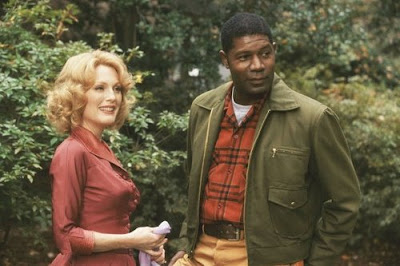
The film takes the form of a 1950s melodrama, but with a much more modern sensibility attached to it. Julianne Moore plays Cathy Whitaker, a housewife in Hartford, CT, where she maintains a perfect home and an equally perfect social life for her husband and their two children. She fancies herself quite the modern woman, sensitive to liberal concerns while also living the staid and conservative life of the fifties housewife who meets her husband at the door after work with drink in hand and who is constantly thinking of what the other ladies think of her and her family life.

One night she has to go downtown and bail her husband out of jail, for some kind of embarrassing thing that’s happened; like any good 50s housewife, she doesn’t inquire too deeply into the incident, trusting her husband’s word that it’s all a misunderstanding that will come to nothing. But a little later, we follow him on a night when he’s working late. He leaves his office and ends up going to a secret bar, one of those down-an-alley and through three doors kinds of bars; if we’re wondering what kind of bar needs to be secret in 1950s America, we quickly learn soon enough: a gay bar. Frank Whitaker is gay.

Soon enough she discovers this, and they embark on a series of psychological treatments designed to “cure” him of his homosexuality (remember, this is the 1950s); and meanwhile, Mrs. Whitaker begins to form a close friendship with the family’s gardener, Raymond Deagan, who is a tall, strapping, handsome black man (played by Dennis Haysbert). So the movie gives us not one character but two who become involved in impossible (for their time) romances. Sadly, while Mr. Whitaker’s homosexuality is allowed to remain secret, Mrs. Whitaker’s friendship for the gardener becomes common knowledge. And there’s no real escape for them, either; when the gardener takes Mrs. Whitaker to a local “black restaurant”, her reception there is about as friendly as his would be at a local “white” restaurant. Later, he bitterly comments that their relationship is the only thing and whites and blacks apparently have between them in total agreement.

Yes, this is a sad movie; there’s no way to sugarcoat that, and in many ways the film ends with no real note of resolution at all. But it’s a pretty noble movie, well-written and beautifully acted; there are moments where emotion is conveyed simply by the non-speaking actors in the way they look at one another. The film’s look is also excellent; designed to look like a fifties melodrama, the film’s color schemes are bold and bright, and even the opening credits are done in that style, with the titles displayed in very large letters that take up the entire screen and which fade into one another while the music swells. The film is awash in color, with many shots that linger; the gay bar, with its muted green lighting that makes it seem just a little otherworldly, for instance, or in the way Raymond Deagan’s clothes tend to match the color scheme of the Whitaker household, suggesting that he belongs where he really doesn’t. And that Elmer Bernstein score is truly beautiful, elegiac and tender.

Far From Heaven is an outstanding film.

Share This Post

“Let’s get the shit kicked out of us by love!”

So. Love Actually. This is one of my favorite movies, so I’m going to wax poetic about it for a while (with spoilers, by the way). Some people watch A Christmas Story and It’s a Wonderful Life at Christmastime; for me it’s My Fair Lady (which I haven’t watched yet this season) and Love Actually (which I have). The other day Mrs. M-Mv posted her own appreciation of the movie:

I know that many folks dislike this film — too long, too sentimental, too… something. Everyone has a suggestion for a storyline that needs to go or a character that could be deleted. Even Roger Ebert: “I once had ballpoints printed up with the message, No good movie is too long. No bad movie is short enough. ‘Love Actually’ is too long. But don’t let that stop you.” [Emphasis added.]

I, on the other hand, think the pace, the narrative, and the characters are practically perfect in every way. Moreover, I think the film wears well: I’ve seen it at least six times since it was first released — more, if you count all of the partial viewings — and it’s funny, sweet, and effective each time.

That’s true, isn’t it? I have yet to read a critique of this film that fails to mention the “fact” that it is just too long of a movie. Heck, even the movie’s director, Richard Curtis, seems to feel that it’s too long; in his filmed introductions to the deleted scenes on the DVD, he says something along the lines of “Well, the original cut was three-and-a-half hours long, so if you think the two-and-a-quarter-hour version is too long, it could have been worse.” But I heard that and thought, paraphrasing the movie’s Prime Minister of the United Kingdom, “Who do I have to screw around here to get to see the original cut?” I’ve never found Love Actually too long; in fact, it’s one of the rare films that leaves me wishing I could spend more time with these characters, in their world.

I want to know if Harry and Karen repair the damage to their marriage that Harry caused with his near-miss of an affair.

I want to know if Sarah ever gets another chance with Karl, or if she ever manages to find love in a way that still allows her to care for her brother.

I want to know how the PM’s relationship with a staffer turns out.

I want to know if Mark ever finds love after his impossible crush on Juliet plays out.

I want to know how Sam and Joanna fare as kid loves, and how Daniel and Carol make out as a potential couple.

I want to know if Colin ever matures beyond his need for impressive sex with American girls.

And I’d love to see a biopic of aged, battered old rocker Billy Mack, who late in the movie admits that his life, though lonely, has been a wonderful life.

Few movies seem as full of real people, to me, as Love Actually. That’s a testament, really, not just to the writing, but the entire production, because the movie by its nature has to rely on its actors and editors to make the whole thing really come to life. Since each story in the movie is basically told in miniature, each cast member is put in the position of having to knock each scene out of the park. Luckily for the movie, they accomplish this.

So no, I don’t think Love Actually is too long; not even close. And I think that beneath its exterior, which makes it look like the schmaltziest, mushiest romantic comedy ever made, the film is surprisingly insightful about how some relationships work when they’re based on love.

The film’s masterstroke is this: not everybody gets a happy ending. And, thinking about it, you realize that the movie is aware of an even deeper truth: that nobody gets an ending at all, save one, and that’s the big ending, the one that really ends everything.

When we first meet Daniel (Liam Neeson) and Sam (Thomas Sangster), they are at the funeral for Sam’s mother (and Daniel’s wife). [Daniel is actually Sam’s step-father, which raises other questions about Sam’s life: has he already lost one parent, or were his parents divorced with his mother then marrying Daniel? We never learn, and for the purposes of the story in Love Actually, it really doesn’t much matter.] Daniel is devastated, as is Sam, but it soon turns out that Sam’s got another problem of his own: he’s in love, probably for the first time in his life, with an American girl in his school who doesn’t know he exists. When Daniel finally gets this out of Sam, shortly after the funeral, it’s in a scene where the two are sitting on a bench, and Daniel finally appeals for Sam to tell him what the problem is, even if he can’t help the boy. We’re as surprised as Daniel is when Sam bluntly states, “Well, the truth is, I’m in love.” Daniel and Sam spend much of the rest of the film, when they’re onscreen, working out the details of how Sam can win Joanna’s heart. It’s a beginning that only comes out of a horrible moment of ending.

Harry (Alan Rickman) and Karen (Emma Thompson) are middle-aged married folks. Harry is the boss of what appears to be a non-profit or something like that; Karen is the housewife who basically keeps everything at home going, doing the cooking and cleaning and making the lobster costume for their daughter who has just been cast as First Lobster in the school’s Nativity play. (“There was more than one lobster present at the birth of Jesus?”) Their marriage seems staid and dull, but not unfeeling; even so, Harry finds himself responding to the advances of his new administrative assistant, a comely young woman named Mia. They never have a physical affair, but Harry indulges the attraction to the point of buying Mia a gold necklace for Christmas, which Karen finds out about. When the film reaches its last scene, Harry and Karen greet each other somewhat warmly but cautiously, and nothing really is said of what is going on with them: are they divorcing? Was Harry away on business, or were they separated? Are they working on it, or is it ending? We don’t know.

And then there’s Mark, who serves as his best friend’s best man in a wedding at the beginning of the movie. His problem is that he is himself desperately in love with Juliet, the bride who is marrying his best friend. This is hard for him to cope with, so his way of compensating is to treat Juliet very coldly, to the point where she thinks he hates her – until she visits him one day, hoping to find some good footage in the videotapes he’d made of the wedding, and realizes that all he taped that day was her. Late in the movie this plays out in a fairly charming scene that could give pause, as Mark admits to Juliet his love for her. Was this the right thing to do? It’s tempting, I suppose, to say that he should never tell the wife of his best friend that he loves her, but I don’t see it that way. Mark knows that he owes Juliet an explanation, and he knows that he has to find a way to be around her and not act like an arse, and he further knows that there’s no danger that he’s going to be coming between his friend and his friend’s wife by doing so, because he knows them. Mark knows that Juliet is not going to love her husband one bit less, so he knows that what he’s doing is not a potential act of abetting adultery. His is an act of reconciliation, and as he walks away, he says to himself: “Enough. Enough now.” He’s put himself in a position to move on, and it’s a totally right thing for him to do, even though if someone else were to try the same type of thing, it might well be disastrous for all concerned.

The most notable unhappy ending, though, belongs to Sarah (Laura Linney), who works for Harry and has been in love with their office’s graphic designer, Karl, for “two years, seven months, three days, one hour and thirty minutes” (half an hour less than the time she’s actually worked in that office). Harry finally sits her down and tells her to do something about her crush on Karl, since it’s Christmas and apparently everybody in the office knows already. Sarah’s eyes light up briefly with the sense of possibility. The problem, though, comes in the person of Sarah’s brother, who is institutionalized with some unspecified mental illness. Sarah is the only one to take care of him, and she does, out of an intense sense of duty (their parents are apparently long deceased). Her brother calls her on her cell phone constantly, usually to talk about problems that she really can’t help him with, but she takes each call anyway – including two that come the very night she is finally trying to seize her chance with Karl. It’s an awful moment that she faces: the two are in bed, beginning foreplay, when the phone rings; Karl says, “Can you help him right now?”, and when she shakes her head, he says, “Then maybe you don’t answer it.” But she can’t bring herself to do this, and she answers, telling her brother that she’s not busy at all. The moment passes, and as far as this film goes, Sarah and Karl never get together.

Sometimes in our lives, our various loves come into conflict. The love people have for one another can’t be exercised because of the love they have for their children; or, as with poor Sarah, her love and desire for Karl – her desire for a life of her own, even – is pushed back because of her love and duty to her brother. One friend of mine hated the movie, mainly for this particular plot point, but I found it entirely realistic. I’ve known people who have made these kinds of choices in their lives.

Of course, I wouldn’t be so enchanted with Love Actually if the movie wasn’t so wickedly funny. There isn’t a scene with Billy Mack (Bill Nighy), the aging rocker, that doesn’t leave me grinning at the very least. There’s the wonderful moment when the Prime Minister has to literally go door-to-door looking for someone, at one point being exhorted by a trio of little girls who have no idea who he is to sing Christmas carols (the look on Hugh Grant’s face when the PM discovers that his own bodyguard has an amazing singing voice is priceless). There is one hilarious moment after another.

Lastly, Love Actually is a beautiful film. So much of the movie seems to actually sparkle, and the music is, for a typical selection of romantic-comedy music, mostly wonderful stuff, including two gorgeous love themes by composer Craig Armstrong.

As a conclusion, here’s the opening scene to Love Actually, with a brief monologue by Hugh Grant as the PM. Love actually is all around.

I don’t know of a scene that better sets the tone for what’s to come in a movie than this one — so much so that I almost want to turn off the computer and watch the movie again right now.

Share This Post

People who quote movies should be boiled in oil.

UPDATED with some correct guesses!

I’ve just seen a movie quote quiz-thing over at Erin’s blog. The idea is simple: you pick 15 movies or so, give a quote from each one (IMDb is good for this), and challenge your readers to identify the movies. As the quotes get identified, I’ll strike through them. I can’t pass this up, now can I? Why, no! So here we go (and just to make it slightly harder, there are no quotes from any Star Wars movie here):

1. We grew up in peacetime!

2. You’re as crazy as your mama! Goes to show it’s in the genes. (JFK, guessed by SamuraiFrog)

3. The only thing that worried me was the actual killing. How does one do that? Hmmm? How does one kill a man? It’s one thing to dream about it; very different when, when you, when you have to do it with your own hands. (Amadeus, guessed by Charlie.

4. Sherif, is there not one thing in your life that is worth losing everything for? (The Wind and the Lion, guessed by SamuraiFrog)

5. I have been known on occasion to howl at the moon.

6. That’s enough, Baron. Turn it off. No one’s impressed with your cheesy light show, okay?

7. If you ever get tired of going steady with somebody that ain’t around, I’m up for grabs. (American Graffiti, guessed by Aaron)

8. We had a nice couple of minutes together. She threatened me, I patronized her. Didn’t have anything to eat, but I thought there was a connection. (The American President, guessed by Charlie)

9. I can’t fight it anymore. I ran away from you once. I can’t do it again. Oh, I don’t know what’s right any longer. You have to think for both of us. For all of us. (Casablanca, guessed by Aaron)

10. “People”? I ain’t “people.” I am a – “a shimmering, glowing star in the cinema firmament.” (Singin’ in the Rain, guessed by Will Duquette)

11. When you first entered the restaurant, I thought you were handsome… and then, of course, you spoke. (As Good As It Gets, guessed by Aaron)

12. I’m not gonna spend the rest of my life working my ass off and getting nowhere just because I followed rules that I had nothing to do with setting up, OK?

13. We didn’t choose this place! We didn’t choose these people! They were invited! (Close Encounters of the Third Kind, guessed by SamuraiFrog)

14. Never take it seriously, you never get hurt. Never get hurt, you can always have fun. And if you ever get lonely, you just go to the record store and visit all your friends.

15. Boy, it sure would be nice if we had some grenades, don’t you think? (Serenity, guessed by Aaron)

There they are. What movies are they from?

Share This Post

Really Sorta!

I’m not sure if I’ve encountered a more ungainly movie title than Definitely, Maybe. I suppose Love Actually is a contender. And like that film, somewhere in the screenplay to Definitely, Maybe those very words are spoken, giving the strange title a bit of context that kinda-sorta makes sense. Really. Sorta. (Hey, there’s a title: Really Sorta!)

Unsurprisingly then, Definitely, Maybe comes from some of the same filmmakers responsible for Love Actually, and it’s the same genre of movie: it’s a mushy romantic comedy with a plot that’s as old as the hills freshened up a bit through the use of some nifty narrative trickery. It doesn’t rise to the level of Love Actually (which is one of my favorite movies ever), but it’s got quite a bit of quirky charm going for it.

So, what’s Definitely, Maybe about? Well, it tells the tale of the proverbial lonely guy who can’t figure out who he’s supposed to be with. However, it doesn’t start out being about that, using some misdirection to make us think it’s about something else. A man named Will, working in an ad agency in New York, receives his final divorce papers, which puts him in the mood to finally tell his daughter Maya (who is one of the cuter movie kids I’ve seen recently, by the way) the story of how he met her mother (the woman he is about to divorce). However, he decides that in the course of telling her the story, he will change the names of the women involved, and that she therefore has to try and pick out which one is actually her mother.

So it’s set up as kind of a “love mystery”, in a way. Will, it turns out, has in his life had three “great loves”, and each is a “contender” for turning out to be Maya’s mother. There’s “Emily”, Will’s college sweetheart; there’s “Summer”, the journalism grad student Will meets in the course of working for Bill Clinton’s 1992 campaign; and there’s “April”, the copy-girl in Bill Clinton’s New York office. These women come and go into and out of Will’s life for various reasons, and at times he’s truly in love with each one (or that’s how he tells the tale), so we’re kept as in the dark as Maya as to who her mother will turn out to be.

(Yes, this framing device is not dissimilar to the CBS sitcom How I Met Your Mother. An idea’s an idea, folks.)

As the movie progresses deeper into Will’s travails of love, it slowly dawns on Maya that obviously her mother can’t be the one true love of her father’s life, since he’s divorcing her. Who can it really be, then? Well, by the time Maya’s realizing this herself, we’re realizing already just who Will really belongs with in the first place. The answer’s pretty conventional by romantic comedy standards, especially when Will buys a certain meaningful gift for one of his three lady loves. Still, the movie does a pretty good job of at least making it seem as if Will’s future with this particular lady is hopeless, pretty much right up until the very last scene.

A lot of the film’s humor stems from poking fun at how things have changed in so short a time since the early 1990s. At one point, Will is handed one of those gigantic first-generation cell phones, the ones that could only be carried around if one was wearing Batman’s belt; at another, the Bill Clinton campaign staff is sitting around watching the news, and Bryant Gumble interviews the owner of the Texas Rangers, George W. Bush, and someone scoffs, “This guy better plan on spending the rest of his life in baseball.” Or later on, when someone’s job security depends on getting some information off the Internet immediately…and in the middle of New York City, they have to wait for the posh hotel’s dial-up connection to kick in.

Acting-wise, the movie’s not any great shakes, but everybody gets the job done. Rachel Weisz (“Summer”) is probably the biggest name among the leads, but my favorite of the women was Isla Fisher as “April”. (It’s the long red hair, obviously.) Ryan Reynolds’s first impression as Will is pretty bland, but he grew on me in the course of the movie. Everybody’s good looking, but not so good looking that it’s distracting. Kevin Kline has a cameo as a pompous-ass college professor that’s worth watching for. If the performances aren’t great, they’re not distracting, either. The music is a combination of nicely selected pop songs and earnest “romantic comedy” music (heavy on the piano).

Like I said, this is nothing more than a well-made mushy romantic comedy. If that’s not your genre, then for the love of God, stay away from this movie. But I enjoyed it.

Share This Post

Between two and three days of my life I’ll never get back

I’ve seen this “Alphabet Movie” meme-thing on a lot of blogs, in which you basically pick one movie for each letter of the alphabet. Here are the rules for this game (as quoted from SamuraiFrog, from when he did the game):

1. Pick one film to represent each letter of the alphabet.

2. The letter “A” and the word “The” do not count as the beginning of a film’s title, unless the film is simply titled A or The, and I don’t know of any films with those titles.

3. Return of the Jedi belongs under “R,” not “S” as in Star Wars Episode IV: Return of the Jedi. This rule applies to all films in the original Star Wars trilogy; all that followed start with “S.” Similarly, Raiders of the Lost Ark belongs under “R,” not “I” as in Indiana Jones and the Raiders of the Lost Ark. Conversely, all films in the LOTR series belong under “L” and all films in the Chronicles of Narnia series belong under “C,” as that’s what those filmmakers called their films from the start. In other words, movies are stuck with the titles their owners gave them at the time of their theatrical release. Use your better judgement to apply the above rule to any series/films not mentioned.

4. Films that start with a number are filed under the first letter of their number’s word. 12 Monkeys would be filed under “T.”

5. Link back to Blog Cabins in your post so that I can eventually type “alphabet meme” into Google and come up #1, then make a post where I declare that I am the King of Google.

6. If you’re selected, you have to then select 5 more people.

Since I myself wasn’t tagged, I’m ignoring rules 5 and 6. Also, I decided to do this differently after I saw the twist that “Superwife” put on it: she listed one bad movie for each letter of the alphabet! And hey, it’s always fun to rip on movies I don’t like, so here we go.

But again, I’m doing bad movies. (By the way, Badmovies.org was a nice resource for browsing through lists of titles of movies I’d forgotten I’d seen, as a way of jogging the memory. Resurrecting bad memories, that is. Gee, thanks, guys!

A is for Armageddon. It’s a ridiculous film. As SF, it is complete dreck; for this little scientific accuracy in a movie, you might just as well watch a space fantasy like Star Wars and have done with it. But, as I’ve noted before, Armageddon is the lava lamp of movies: I can’t stop watching the thing whenever I find it on the teevee. Hurg. Bad movie. That I watch every time I come across it. (Earlier this football season I actually ended up watching Armageddon instead of a Bills game, and I suspect those who have paid any attention to the Bills this season won’t hold that decision against me.)

B is for Beaches. Treacly garbage that I hated. I saw it in college when they had a screening on campus; everybody told me I’d cry because it was such a tearjerker, but instead, I sat there glowering at the screen because the movie had these two women basically treating each other like crap for two hours. Ugh. (And I could live my whole life without ever hearing “Wind Beneath My Wings” again.)

C is for The Cat from Outer Space. This was one of those live-action Disney movies in the 1970s, the ones that always either starred Dean Jones or Ken Berry. This one had Ken Berry, and I saw it when I was in kindergarten or first grade, and it was complete crap. No need to hash out why; just look at that title.

D is for Dead Poets Society. I’ve said my piece on this movie here. Didn’t like it.

E is for Earthbound. This too came out when I was a kid. An alien family crashlands their ship on Earth and evades the government while taking refuge with a geezer (played by Burl Ives) and his grandson or nephew or something like that. I remember liking it as a kid, but it was probably crap.

F is for Ferris Bueller’s Day Off. The one part of the movie I like is the destruction of the Corvette. Other than that, I find this movie really dull and not terribly funny. This could be due to my generic dislike for Matthew Broderick.

G is for Gymkata. OK, I haven’t seen the entire thing. But I have seen the last half hour, which astonished me in its sheer awfulness. Near as I could tell, some dude with Mad Gymnastics Skillz managed to beat off an entire town’s worth of attackers by using his Mad Gymnastics Skillz, at one point even finding a pommel horse in the middle of the town square. Ummm…sure.

H is for Highlander. I’ve never understood the cult fascination this movie holds for some people. The premise is goofy, and not in the “fun goofy” kind of way either; the acting is dreadful (except for Clancy Brown), with not even Sean Connery avoiding lines like “Are the stars pinpricks in the curtain of night?”; a bunch of guys fighting over a prize that’s never revealed until they whole thing is over so we don’t even know why we should care. Despite the presence of Connery and Clancy Brown, I still manage to dislike this movie.

I is for Independence Day. It’s fun to watch, but there’s just not a single plot point in this movie that makes any sense at all. Most famously there’s Jeff Goldblum disabling the entire alien computer system with a virus he threw together on his 1995 Apple Powerbook, but this movie also has Area 51 having been a secret for fifty years but also being spotted by Will Smith when he flies over it in his fighter jet whilst in combat; it has a Senior Aide to the President of the United States who keeps her cell phone number listed in the local Washington DC phone book “for emergencies” (huh?!); it has the President being a fighter pilot whose Mad Fighter Piloting Skillz are still good enough that he can outfly aliens in space fighters; et cetera.

J is for Jaws IV: The Revenge. Jaws II isn’t that bad a movie, really. III is downright bad. But IV is legendary for its awfulness, including the end where the shark stands on end while a boat runs it through. Ouch.

K is for The Karate Kid Part III. The first Karate Kid movie is fantastic. Seriously, it’s a very, very good movie. The second one isn’t bad either, although it is obviously nowhere near the same league as the original. But the third? Oy. It’s just a disaster. More wisdom from Mr. Miyagi, more troubles for Daniel-san, and another fight at the end where it turns out that Daniel-san’s karate is better than the other guy’s. Why did they make this movie? I have no clue. (And while Ralph Macchio could pull off the sixteen year old kid in the first movie fine, and the seventeen year old kid a little less fine in the second one, here he looks like a thirty-year-old playing a seventeen year old.)

L is for The Lost World: Jurassic Park. What a terrible sequel this is; I can’t believe Steven Spielberg went from Schindler’s List to this. It’s full of one implausible sequence after another, it kills off Richard Schiff, it has a thirteen girl fending off velociraptors by using her Mad Gymnastics Skillz, and so on. The last half hour is better because of the “T-rex on the loose in San Diego” stuff, but this movie is bad.

M is for Mission to Mars. This is one of the worst SF movies I’ve ever seen. It’s boring, it tries to have it both ways with 2001-like hard SF combined with some “Face on Mars” mystical nonsense, and its score (by Ennio Morricone) is downright unpleasant.

N is for Nell. It’s just physically impossible to take this movie seriously. I’m sorry. It’s a neat idea for a story, but as filmed, I always wondered how many takes it took certain scenes to be filmed due to actors breaking out in laughter at the stuff the script had them saying. (I wrote this post a while back and have been sitting on it; since then I learn that it’s one of Belladonna’s favorites. Oh, forgive me! I really wanted to like this one; it’s got a killer cast, for one thing, and it has some great ideas behind it. But about the fourth or fifth time somebody said “Taaayyyinnn innn daa weennnnnddd”, or whatever it was Nell said over and over and over again, I just mentally checked out of the movie.)

O is for Ordinary People. I had to watch this in school, my sophomore year. Other classes were reading Mark Twain, while we were reading Judith Guest and watching this movie, which had the effect, ironically enough, of making me want to do myself in. Luckily, I got better. It took three consecutive viewings of Star Wars the weekend after we finished this one to get it out of my system. (By the way, I know I’ve griped over this before, but one of the great educational travesties of my youth is that my English teacher that year made us read Ordinary People while the other English classes were reading Mark Twain. Heckuva job there, Mrs. Whatever-Your-Name-Was.)

P is for Predator II. I enjoyed the first Predator movie; it was an effective “monster on the loose” kind of movie, good for watching with a couple of friends and some beers on a night in college. Not so the second movie, which was little more than an excuse to use the same monster again. Bad.

Q is for Quest for Camelot. Someday an indisputably good movie will be made from the Arthurian legends. (Excalibur is pretty close, but its pacing is too sluggish and its use of Wagner and Orff in the soundtrack too distracting.) Until then, we’ll have to live with all of the bad movies about Arthur and Camelot that have been made, and there have been a ton of ’em. Here’s one, an animated piece of crud. Not recommended.

R is for Rambo: First Blood Part II. Or any of the Rambo movies, for that matter. (Maybe not First Blood, which I haven’t seen and I’ve heard the best things about.) Rambo was embarrassing macho crap for the macho-men of the 1980s. Jerry Goldsmith wrote some good music for these flicks, but other than that, they’re crap.

S is for Scream. What terrible dreck this movie is. There’s nothing plausible about it, and it’s a terribly confused movie, too: what is it? Spoof? Horror flick whose main notion is that other horror flicks should be taken seriously? It’s just a stupid, stupid movie, filled with dumb characters who behave in ways no ordinary person would behave. And it had two sequels. Yuck.

T is for Thank God It’s Friday. It’s a shame this movie isn’t better known, because it truly deserves the reputation that seems to have accrued around Saturday Night Fever instead. Whereas that film is a dark and cynical film about the lives of young adults who hang out in a disco, TGiF actually is the campy, goofy movie about the lovelorn adults who hang out in a disco. It does have a saving grace in a nice performance by Donna Summer, who sings my beloved “Last Dance” toward the end of the flick. Other than that, though, it’s a bad movie.

U is for The Usual Suspects. Who is Keyser Soze? Who gives a crap? Instead of a gripping movie about the criminals trying to execute a heist bigger than any of them, we get a lame mystery that I found interesting for all of thirty seconds, because that’s how long it took me to figure out who Keyser Soze was. I genuinely can’t understand why so many people think this movie is a classic.

V is for A View to a Kill. I feel a bit unfair here, because I genuinely can’t claim to dislike this movie, even if I grant that Roger Moore was too old by this time to be convincing and that Tonya Roberts was less than good in a part that was also written less than well. But Christopher Walken as a Bond villain? He was terrific! I can’t bring myself to hate this movie. But there’s quite a lot wrong with it, I’ll grant you that.

W is for Waterworld. I actually think this movie wasn’t as bad as its reputation at the time made it out to be, but it’s not that good, either. For one thing, it’s pretty dull most of the way, and you’d think a set that cost something like $100000000 to build would look a bit better than a giant rusting hulk. And while I’m glad there was an SF film that gave a bit of thought to certain survival issues in an environment such as the movie depicts, did the opening scene really have to feature Kevin Costner urinating? Talk about setting an unfortunate tone.

X is for Xanadu. Just because I can’t even think of any bad movies that start with X other than Xanadu. Luckily, Xanadu is truly awful.

Y is for Yes Giorgio. It’s a romantic comedy starring Luciano Pavarotti as a tenor with confidence issues, and the female psychologist who has to help him regain his mojo so he’ll sing at some big concert, or something. It’s wildly bad.

Z is for Zen Monkeys in Love. OK, that’s not a movie that exists, so far as I know. But I drew a complete blank on movies starting with ‘Z’ that I hated, and not even some extensive Googling turned up anything (though Zardoz looks pretty bad, though I’ve not seen it). So, if anyone can jog my memory as to a ‘Z’ movie I’m missing, let me know. I’m sure there are some, out there somewhere. (We watched Zathura a couple of weeks back because The Kid picked it out at the library, but it doesn’t come close to being bad enough to merit inclusion on this list. It’s more of a “Meh” movie.)

Why, oh why, did I watch all these? WHY???!!!

Share This Post

Quanta

THE SCENE: A passenger compartment on the Orient Express. Five men enter the compartment, one at a time. Three are elderly but still with a certain twinkle in their eyes, while two are younger, in their fifties. All are impeccably dressed, in dark suits with perfect silk ties; their wristwatches are very expensive indeed. They take their seats in the compartment and wait for someone to speak. Finally one does.

JAMES BOND ONE: Well, as the first, I suppose I should call this meeting of Former James Bonds to order?

JAMES BOND THREE: That sounds fine, but shouldn’t we all authenticate ourselves?

JAMES BOND ONE: Quite right. Have any of you got a match?

JAMES BOND THREE: The snow this year is better at Innsbruck.

JAMES BOND FIVE: In London, April is a Spring month.

JAMES BOND TWO: I didn’t have any code phrases on my mission. But I do have this.

He holds up his left hand; on it is a wedding ring, which none of the other Bonds have.

BONDS ONE, THREE, FOUR and FIVE: Oh. Yeah. OK, you’re in.

BOND ONE: (eyeing Bond Four) What about you?

BOND FOUR: I’ve got this cool key ring that Q made for me. Just don’t whistle “Rule Britannia”, OK?

BOND ONE: (to the others) Good enough?

BONDS TWO, THREE and FIVE: Sure. Fine.

BOND ONE: All right, then. We’re all here, so I suppose we can get started—what?!

The compartment door slides open, and a guy dressed in full pirate regalia steps in. He’s got the big hat, the beard, the cutlass, the eye patch, everything.

PIRATE: I’m in the wrong compartment, aren’t I?

BOND FIVE: I’m not sure why you might think that.

BOND TWO: We’re former James Bonds.

PIRATE: Oh! I misread my ticket, I’m in compartment 696, not 969. I’m looking for the meeting of former Dread Pirate Robertses. Sorry, gentlemen.

Dread Pirate Roberts exits, and the train lurches into motion.

BOND ONE: So, how are we all enjoying retirement?

BOND THREE: Meh. Not all it’s cracked up to be.

BOND TWO: I retired too early.

BOND ONE: Yeah, that wasn’t a smart move on your part. You would have got a lot better at it with practice.

BOND TWO: Some people don’t think I was that bad to begin with!

BOND ONE: Sure, but I had to come back for one more after you left.

BOND THREE: And then it was my turn.

BOND TWO: I saw the film briefings on your missions. You certainly faced some strange people out there. That guy with the metal teeth….

BOND THREE: Yeah, it was questionable there for a while. Lots of people think I smirked too much. Pissed me off. I had to act like a dwarf was something to be scared of! I was in space! Were any of you guys in space?

BOND ONE: I almost went to space.

BOND FOUR: Yeah, way to go there. Even I know you don’t carry that air unit onto the capsule with you.

BOND ONE: It didn’t come with an instruction book, you know.

BOND FOUR: Uh huh.

BOND ONE: Say, weren’t you a Prince of Mongo before you joined the James Bonds?

BOND FOUR: Say, didn’t you get your head chopped off by a swordsman?

BOND ONE: That was a guy who looks like me. If my head had been chopped off, would I be here?

Bond Two is chuckling. Bond One turns to glare at him.

BOND ONE: What are you laughing at? You totally disappeared after your one mission!

BOND TWO: There was a TV show once, but that was–

BOND FIVE: Could we get back onto the subject, please?

BOND THREE: (whispering to Bond Four) He doesn’t want to talk about his all-singing routine.

BOND FOUR: Heh.

BOND ONE: All right, let’s get on with it. I assume we’ve all seen the latest film briefing on the second mission of Bond Six? Code-named “Quantum of Solace“?

BOND THREE: Wait, shouldn’t we order drinks first?

Almost as if on cue, the compartment door opens and a waiter sticks his head in.

WAITER: May I bring you gentlemen some drinks?

BONDS ONE, TWO, THREE, and FOUR: Vodka martini, shaken–

BOND FIVE: Whoa! Since we’re here to discuss Number Six, we should order what he orders, yes?

BOND ONE: Oh, Lord.

BOND FOUR: Yes! Three measures of Gordon’s Gin, one measure of vodka, one half measure of Kina Lillet. Shake it until it’s ice cold and serve with a twisted peel of lemon.

BOND THREE: I thought it was two measures of Gordon’s?

BOND FOUR: No, three.

BOND TWO: Do they even make Kina Lillet anymore?

WAITER: I’ll see if we have it, sir.

BOND THREE: But the Gordon’s – was it two or three measures?

BOND ONE: Just bring us some damn martinis, would you?

WAITER: Yes, sir.

(The waiter exits.)

BOND ONE: That’s the problem with Bond Six. He takes too long to order a drink.

BOND FIVE: That’s true. He reminds me of this woman I saw in another filmed document, one which traced the relationship of a man and a woman through eleven years of friendship before they got married. They stop at a restaurant and the woman goes to order apple pie but she’ll only have the ice cream if the pie is heated, or the whipped cream if it’s real and not out of a can but then the pie shouldn’t be heated, or if–

He notices that the other Bonds are staring at him.

BOND TWO: What are you talking about?

BOND FIVE: I have no idea.

BOND TWO: That doesn’t sound like any MI6 mission film I’ve ever seen.

BOND FIVE: It wasn’t. It was for fun. I saw it with some other people at one of those places where you pay to see films.

The Bonds all exchange quizzical looks, nobody having any idea what to say to this.

BOND FIVE: People like to see these films for fun.

BOND THREE: (to Bond One) Why’d they hire him, again?

BOND FIVE: Can we get back to Quantum of Solace, please?

BOND ONE: Please.

BOND TWO: I saw it last night. Who is filming these missions now, anyway? Did the MI6 budget for filming Double-O missions get cut or something? Whenever our man was called on to perform dome derring-do, it was impossible to see what he was doing.

BOND FOUR: Oh, I agree. That car chase at the beginning of the mission was terrible! Doesn’t MI6 assign a camera crew to get establishing shots anymore? I couldn’t tell how many cars were following him or what was going on there, until it was over. I suppose Bond Six is a good driver, but you couldn’t tell, really. It might have been luck.

BOND FIVE: I kept wondering why he didn’t just, I don’t know, launch his missiles at the attackers or use the water jets out of the tail lights or something.

BOND ONE: I don’t think he had that kind of car.

BOND FIVE: Well, that’s just crazy. I had an invisible car!

BOND FOUR: I heard Q-branch got its budget severely axed after that fiasco. Nobody took that seriously.

BOND FIVE: Hey, it worked.

BOND THREE: Sure it did.

BOND FIVE: I never saw you guys escape a crumbling glacier on a parasail!

BOND ONE: Come on now. We all know that MI6 had to rescue you, and to save face, they used their special effects division to make it look like you did that yourself.

BOND FIVE: Well I never!

BOND THREE: Judging by the fact that Bond Six doesn’t get any nifty toys for his missions, I assume that Q-branch was redirected after Bond Five to spend its time designing really neat computer displays for MI6? Have you ever seen cooler stuff?

BOND TWO: Well, I’ve got a phone that–

The compartment slides open again, and a woman with long, brown hair enters, stops, and looks at her ticket.

WOMAN: Oh, sorry. Wrong compartment. (stares at Bond Four) Mr. Steele?

BOND FIVE: No, sorry.

WOMAN: OK.

She exits.

BOND TWO: And the boat chase was the same thing, wasn’t it? Can anybody tell me how Bond Six managed to get that second boat to flip up into the air?

BOND ONE: He did something with a grappling hook, didn’t he?

BOND TWO: Sure, but what?

BOND THREE: Does it matter?

BOND FOUR: Probably not. But really, this guy’s got it hard, doesn’t he? At least the rest of us never actually fell in love on our missions.

Nobody says anything for a minute, and Bond Four glances around, wondering at the awkward silence, until he looks at Bond Two.

BOND FOUR: Oh yeah. Sorry.

BOND TWO: We had all the time in the world….

BOND ONE: We know. But I killed him for you, if that helps.

BOND THREE: Actually, I did.

BOND ONE: You did not! That wasn’t him!

BOND THREE: Sure it was! We just couldn’t refer to him by name, that’s all. But I dropped him down a smokestack.

BOND FOUR: I can’t believe you did that. I had to beg my father for enough money to buy a delicatessen in stainless steel, and he was gonna give you one just for not killing him.

BOND THREE: What the hell am I going to do with a delicatessen in stainless steel? I don’t even eat cold cuts.

BOND ONE: OK, enough of that. Anyway, we’re sorry about Tracy, Bond Two.

BOND TWO: Thanks. (blows his nose very loudly)

BOND ONE: But that’s a good point. Bond Six is awfully emotional, isn’t he? Is that really a good thing?

BOND FIVE: I think it is. Face it, we were all pretty glib. Well, except you, Bond Four. You were closer to him than the rest of us.

BOND THREE: I wasn’t glib all the time. Especially when I was in Greece. Did you see me kill that assassin?

BOND ONE: Yes. That was a good moment for you. We were all very proud.

BOND TWO: It impresses me how intense Bond Six is. He is so focused, isn’t he? And those eyes of his. He’s almost a hypnotist, isn’t he.

BOND FOUR: He is. And you can see him thinking when he’s fighting or chasing, can’t you? You can see him planning, considering his next move, taking in his surroundings and figuring out how to best gain the advantage. He’s really very impressive.

BOND FIVE: He has some wit, too. Actual wit, and not stupid double-entendres. I’m so glad that MI6 has dropped that particular requirement on the Bonds.

BOND THREE: Yeah, those kind of lost their cachet when you were going on about Christmas coming once a year, huh.

BOND FIVE: I’m still annoyed by that. Like any of you guys would have been caught dead with a woman named Christmas.

BOND THREE: No, I just had to get it on with a woman named Octopussy.

BOND ONE: Pussy Galore. Plenty O’Toole.

BOND FOUR: Wow, I’m glad I dodged those bullets.

BOND TWO: Me too. But at least I seduced three mental patients in one night! Did any of you do that?

BOND THREE: Yup, you sure cornered us in the “Scoring with Girls Who Are Phobic About Chickens” department.

BOND FOUR: Heh! I made it with one of the world’s great cellists.

BOND FIVE: Who broke up with you after you refused to pay for the repair of the bullet hole that you put in her cello.

BOND FOUR: Hey, maybe MI6 paid more when you came aboard, but there was no way I could have paid to restore a Stradivarius cello on what I was making back then.

BOND FIVE: You know, Bond Six looks really good without a shirt on. Seriously, he’s got an amazing physique. Those deltoids of his, and he’s got what the Americans call “a six pack”. Amazing. None of us was ever that – (notices all the other Bonds staring at him) – what?

BOND THREE: We’re men here, aren’t we?

BOND FIVE: I’m just pointing out the obvious here. It’s not like I’m–

BOND ONE: This from the Bond who spends his free time watching “romantic movies” with the commoners.

BOND FIVE: I don’t know why I talk to you fellows.

The compartment door slides open again, this time admitting an old guy who looks a lot like Richard Harris. The old man peers at his ticket and scowls.

RICHARD HARRIS: Oh, I am sorry. They make these damned tickets so hard to read…peers at Bond One…King Arthur?

BOND ONE: No, but I get that a lot.

RICHARD HARRIS: So do I.

Richard Harris exits.

BOND TWO: I thought he was dead.

BOND THREE: We’re complaining about realism, now?

BOND FIVE: But about Bond Six again. I think this guy may be Bond for a good, long time. He’s really good at it.

BOND THREE: But how does he not make love to the girl at the end? How can that be?

BOND ONE: I had to make love to Tiffany Case at the end of my last one. And that was after your wife had died.

BOND TWO: That’s OK, because you weren’t married to her. Oh, my poor Tracy.

BOND THREE: Oh, I’ve been putting flowers on her grave, just so you know. Solidarity and all that.

BOND TWO: But he was still getting over that Vesper woman. It makes sense that he wouldn’t fall for that Bolivian girl.

BOND ONE: Yeah, that’s OK with me. At least he scored with that Mrs. Fields.

BOND TWO: Mrs. Fields? The cookie lady?

BOND ONE: No, but the roster at the end of the mission film named her as “Strawberry Fields”. Was that a joke?

BOND FOUR: Of course it was – oh yeah, you’re the Bond who doesn’t like the Beatles.

BOND ONE: Absolutely not! I’m a Stones man, all the way. (singing) “I can’t get no’–“

BOND TWO: Please stop.

BOND ONE: What’s wrong with my singing?

BOND TWO: (singing) “Underneath the mango tree, my honey and me–“

BOND ONE: That wasn’t my fault. I didn’t write that song.

BOND THREE: Thank God for that.

BOND ONE: Oh, like you’re one to talk. (singing)“Love is required, whenever he’s hired! He comes just before the kill!”

BOND THREE: So, have you struck like Thunderball lately?

BOND ONE: That’s the only way to strike, baby.

BOND FOUR: (to Bond Five) Do you know what they’re on about?

BOND FIVE: I promise you, I have no idea.

Now Bonds One and Three are trying to out-do each other, singing at the same time:

BOND ONE: (singing) Goldfinger! He’s the man, the man with the Midas touch!

BOND THREE: (singing) Nobody does it better! Makes me feel sad for the rest!

BOND FIVE: (breaking in, louder than these two) Max Power! He’s the man, whose name you’d love to touch! But you mustn’t touch….

Silence falls, and Bond Five sits back, satisfied.

BOND FIVE: Good.

BONDS ONE, TWO, THREE and FOUR: Huh?

BOND FIVE: Once I lent my voice to another bit of…well, you don’t want to hear about that. Back to Bond Six: how come he isn’t getting a new Felix Leiter every time he goes out in the field? Anybody wonder about that?

BOND ONE: Damn, that got confusing. Every time I went out, a new Felix. One time I got a strong, handsome Felix. The next time I got Felix the accountant. And then they tried handsome Felix again.

BOND THREE: I only had one Felix. He was okay.

BOND TWO: No Felixes here.

BOND FIVE: Or here.

BOND FOUR: I had two. First one was like a bottle of Paul Masson.

BONDS ONE, TWO, THREE and FIVE: Ewwwwww!

BOND FOUR: Yeah, not very interesting at all. But then, next time, I got your Felix, Bond Three.

BOND THREE: And look what happened to the guy! Jeez, that was never supposed to happen to Felix!

BOND FOUR: I felt terrible about it.

BOND THREE: I hope so.

BOND ONE: It’s interesting how Bond Six’s Felix is working on his own thing, isn’t it? My Felix was always there to do whatever I told him to do. The new Felix actually gives Bond Six some lip. I wonder how he is in a scrape.

BOND FIVE: It’s too bad he had to work with such a ponce this time, isn’t it? That other CIA guy Felix was with? What a git.

BOND FOUR: Hey, he reminded me of another CIA guy I saw recently, in a historical documentation of a 1980s CIA clandestine operation in Afghanistan. Felix’s CIA buddy looked just like the guy in that other film.

BOND FIVE: Yeah, now that you mention it. The same porn-star mustache.

BOND ONE: Show of hands, though – who ever thought Bolivia would be a major location of a James Bond mission?

BOND TWO: Not me, that’s for sure. Is it really all desert down there?

BOND THREE: I guess so.

BOND FOUR: So, did those people get water when Bond Six got the bad guys?

BOND FIVE: I don’t think the mission film said whether they did or not.

BOND ONE: These new mission films certainly leave behind lots of loose ends, don’t they.

BOND THREE: They really do.

BOND TWO: If the bad guy drank the motor oil, why was he shot? And who shot him?

BOND FOUR: Obviously, Quantum is the new SPECTRE.

BOND ONE: You guys never had to deal with SPECTRE.

BOND TWO: I did!

BOND ONE: Oh yeah.

The compartment slides open again. It’s another beautiful woman.

WOMAN: Oh, sorry. (peers at Bond Four) Rhett?

BOND FOUR: (waving her off) SHHHHH!

WOMAN: Sorry.

She exits.

BONDS ONE, TWO, THREE, and FIVE: Rhett?

BOND FOUR: How the hell do I know?

BOND ONE: You know what? It amazes me that for these briefing films, MI6 spends money to have singers do songs for them. Especially when the song is such shite.

BOND TWO: Yes. Total shite.

BOND THREE: Shite indeed.

BOND FOUR: I liked it.

BOND ONE: Really?

BOND FOUR: No. ‘Twas shite.

BOND FIVE: It sounded good at first, but then it never went anywhere. Shite. But the animations were cool. I’m glad we’re beyond the silhouettes of naked girls flying about empty air or whatever.

BOND FOUR: I’d sure love to see some of the base footage of those old title sequences, though. It had to involve naked girls and trampolines.

BOND THREE: Ahh, trampolines. I’m so glad I got to do the mission with the circus in it.

BOND ONE: Yeah, that was quite the breakthrough there, Clownie.

BOND THREE: Well at least I defused the ticking nuclear bomb myself. I didn’t just stand there waiting for one of Felix’s buddies to do it.

BOND ONE: That bomb was very complex!

BOND THREE: He reached in and flipped a switch!

BOND ONE: That switch was hard to find, and I was still winded after killing the fat guy with the bowler hat.

BOND THREE: I was always able to turn the strong henchmen to my side.

BOND FIVE: Bond Six hasn’t had to deal with henchmen yet, has he? My last one had a face studded with diamonds.

BOND FOUR: My girl killed my last henchman.

BOND THREE: You know, I thought she was a pretty underrated girl. She was plucky.

BOND FOUR: Thanks. You really got screwed on the girl on your last one, didn’t you?

BOND THREE: Seriously, if she screamed my name one more freaking time, I was gonna toss her from that bridge myself.

BOND TWO: Interesting that the new guy hasn’t had to contend with a ticking bomb yet.

BOND FOUR: In all fairness, there’s a new guy on the scene in America who seems to have the market cornered on ticking bombs.

BOND FIVE: You mean that guy on TV who has our initials?

BOND FOUR: Yeah. “Chloe, hack the database! We’re running out of time!”

The Bonds laugh.

BOND ONE: So, are we all in agreement that Bond Six is doing a fine job? And that MI6 just needs to devote more energy to making the derring-do easier to follow?

BONDS TWO, THREE, FOUR and FIVE: We are.

BOND ONE: Good. So, let’s talk about something really important, then. Which of our girls was the hottest, eh?

The other Bonds begin talking heatedly at once, when the compartment door opens again, this time admitting an American man with brown hair and a little scar on his chin.

MAN: What’s this?

BOND TWO: We’re Bonds.

BOND THREE: James Bonds.

MAN: Oh, sorry. I’m looking for Jack Ryans. (peers at Bond One) Dad?

BOND ONE: No.

MAN: Sorry.

The man exits.

BOND TWO: I wish I’d get mistaken for someone….

BOND ONE: Maybe someday, Bond Two. Maybe someday.

BOND THREE: Speaking of someday, where are our drinks?

BOND TWO: Maybe we should order some food, too.

BOND ONE: Oh here we go….

And the train chugs away into the night.

Slightly edited to correct a joke.

Share This Post

If you want to sing out, sing out!

So I watched some movies, as you might expect, while I was not blogging. I’ll discuss them in no particular order over a series of posts. First up, Harold and Maude.

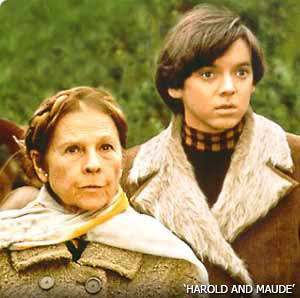
I knew absolutely nothing about Harold and Maude until I picked up the DVD from the library. All I knew was that it had been cited on the recent AFI list of great romantic comedies; on that basis I checked it out, since I do love a good romantic comedy. Imagine my surprise, then, when I looked at the DVD cover and discovered that the couple in the film involves a young man in his late teens (Harold) and a woman who is about to turn eighty (Maude). What’s more, Maude is played by Ruth Gordon, an actress whom I’ve always seen as, well, the crusty old lady, which is basically what she is here. I wasn’t sure I’d like the film at all, but I decided to watch it anyway.

Which is a good thing. What a movie.

Upon further reflection, I realized that my impression of Gordon is rather unfair. The only other movies I’d seen her in before this were the two Clint Eastwood comedies Every Which Way But Loose and Any Which Way You Can, in which Gordon plays Eastwood’s incredibly crusty and foul-mouthed mother. That’s not what Maude is, at all. So my initial expectation of the film was confounded, and rather delightfully so.

Maude is quite a character. She first meets Harold at a funeral, which she attends because she likes attending funerals, and not because she has any connection at all to the person in the coffin. This is also why Harold is there: he has a bizarre fascination with death and suicide that give the film many of its fine moments of black humor, such as the opening shots in which Harold fakes hanging himself in his family’s living room, to have his mother merely walk in and react to this as if nothing out of the ordinary has happened at all.

Over the course of the movie, Harold and Maude form a very unlikely friendship based on mutual notions of what it means to live a life worth the effort. There’s one wonderful moment when they are sitting at the edge of a hillside that is covered with daisies. Harold comments that the daisies all look the same, and Maude objects, saying that a daisy is a beautiful thing, and that it’s tragic that so many people are really “like this” (holding up a daisy) but allow themselves to be “treated as if they’re that” (gesturing to the field of nearly-identical flowers).

Maude’s conversations with Harold are mostly about rediscovering zest for life, and over the course of the film, it’s clear that these conversations have their desired effect as Harold slowly begins to come out of the death-worshiping shell he’s built for himself, even as he stages several outrageous fake suicides for the benefit of the nice girls that his mother keeps trying to fix him up with. Maude seems so completely random in her approach to life, but as the film reaches its conclusion, we discover that she’s not random at all, and everything she’s been doing has been leading up to her final act that somehow surprised me even though it’s pretty strongly telegraphed early on.

One small thing that I greatly appreciated about Harold and Maude is in the way the key fact about Maude’s past – that she is a Holocaust survivor – is conveyed by the simple device of having Harold getting a brief glimpse of the numbers tattooed on the inside of her wrist. What’s so great about this is that this happens, Harold has an expression of recognition on his face that lasts a couple of seconds, and then that’s it: the moment is over and never mentioned again. I have the feeling that if Harold and Maude were made today, Harold’s glimpse of her concentration camp tattoo would eventually lead to a Big Major Scene wherein he gets her to open up about the horrors she saw there, and she’d have the obligatory Big Oscar Clip in which the actress playing Maude would chew the scenery in grand fashion. Not so here: Harold gets a brief glimpse of insight into his new friend’s character, and so do we, but it’s not the only insight we get and the film neither highlights it nor downplays it. How often does this kind of thing happen, after all? How often do we find ourselves learning something new about someone we’ve thought to know so well that the new thing, prosaic as it may be, comes as a complete surprise? And yet, as we get to know these two people, so many of the things they do don’t come as any surprise at all. When Harold gives Maude a trinket he’s had engraved with the words “Harold loves Maude”, she throws it into the nearby water, and then says, “So I always know where it is.” This is the kind of movie that has characters who do things that would strike anyone else as being nonsensical but, given the people they are, make perfect sense when we think about it.

One other aspect of Harold and Maude that warrants mention are the songs, written and performed by Cat Stevens. His voice, an earnest tenor that occupies the same kind of area as Jim Croce, is ideally suited to the kind of story told here – or, more specifically, to the characters whose story we are following. I wasn’t terribly familiar with Cat Stevens before I saw this movie. The most important song in the film, “If You Want to Sing Out, Sing Out” is, in particular, a very special song.

I loved Harold and Maude.

Share This Post

Love and Death, or, What Movies Are For!

Back a few months ago Entertainment Weekly had themselves a big old list-fest, in which they compiled a bunch of lists of pop-culture stuff. At the time I commented on their teevee shows, and the movies and books lists. They did a whole bunch of these, but there are two lists I wanted to comment on at the time, and hey, I can still comment on them.

First up, they did a list of Romantic Gestures of the Last 25 Years. Here’s that list, with some comment:

The spectral Patrick Swayze lifts a coin across the room for Demi Moore in Ghost (1990).

I haven’t seen this movie in a long, long time, but I really liked it back in the day. I wonder how it’s aged? I think that the movie got taken a little more seriously than it should have; I found it a perfectly nice piece of supernatural melodrama. This was a good moment in the movie.

:: Robert Redford washes Meryl Streep’s hair in Out of Africa (1985).

I haven’t seen this movie, even though I have a copy floating around here somewhere.

:: John Cusack blasts Peter Gabriel outside Ione Skye’s window in 1989’s Say Anything…

This image has become pretty iconic, hasn’t it? My adoration of this movie is long established, but it’s still, for me, one of the most romantic love stories ever made. I love how chivalrous Lloyd Dobler is, how it’s not just something he does because it’s the way the script is written but because the script knows that this is hard-wired into his very being. For me, though, the most romantic part of the film comes when Diane Court comes back to Lloyd after the breakup and tells him that she needs him. He asks if she really needs him or just someone, and before she can answer, he just says “It doesn’t matter” and takes her back anyway.

:: Heath Ledger finds and keeps the shirts Jake Gyllenhaal had saved from their first trip to Brokeback Mountain (2005).

I haven’t seen the movie, but the short story is all kinds of brilliant – however many years of searing emotional life captured in less than thirty pages.

:: The beauty (Molly Ringwald) gives the rebel (Judd Nelson) her earring in The Breakfast Club (1985).

Yeah, sure. But I’ve always had mixed feelings about the way Andrew (Emilio Estevez) comes to his attraction to Ally Sheedy. I’d have preferred it if somehow they could have had him attracted to her “goth” side, as opposed to the makeover that, however cute, isn’t her. Does anybody think that she’s going to maintain that look on Monday morning when she’s back at school?

:: Leonardo DiCaprio draws Kate Winslet in the nude in Titanic (1997).

Oh, heavens, yes. I know we’re all supposed to hate this movie now, but this is just one beautifully executed moment. DiCaprio is so good in this scene (the whole movie, really): he starts out easily enough, since he’s drawn lots of nudes; but then he becomes terribly nervous when it’s the girl he loves nude before him. And then he shifts again, once he manages to focus his attention on the task at hand: capturing her in pencil strokes. Plus, the scene has the movie’s musical highlight: the solo piano version of “My Heart Will Go On”, played without a lot of lame embellishment by James Horner himself.

(By the way, when Lovejoy comes into the stateroom to see if Rose is there and behaving herself, why didn’t Jack just hide in a closet while Rose sat in a chair pretending to read a book or something? That might have been more productive than leading Lovejoy on a chase through the ship. And when they decide that they have to tell everyone about the iceberg, why did Jack have to go along? I know, so he could be there for Lovejoy to plant the diamond in his pocket, but that’s the point in the movie where I can always feel the Heavy Hand of Plot pushing us along.)

:: Ewan McGregor breaks into ”Your Song” while wooing Nicole Kidman in 2001’s Moulin Rouge (2001).

:: Larenz Tate offers an impromptu beat poem to Nia Long in Love Jones (1997).

:: Amélie (Audrey Tautou) setting up a wild goose chase for her beloved Nino (Mathieu Kassovitz) all through Paris in Amélie (2001).

Haven’t seen these.

:: Glen Hansard buys Marketa Irglova a piano before he leaves to find his other true love in London in Once (2007).

I hadn’t seen this before I saw the movie, but now I have, and I must say: this is a wonderful moment, but the really incandescent moment in this movie is much earlier, when they’ve just met and play an impromptu duet in a music store.

:: Julie Delpy sings a song (”Waltz”) she wrote about him to Ethan Hawke right Before Sunset (2004).

A good moment. I should watch these movies again soon. I wonder if they’ll ever revisit these characters again?

:: Zhang Ziyi leaps into the clouds for her true love at the end of Crouching Tiger, Hidden Dragon (2000).

I really need to see this all the way through.

:: Richard Gere climbs up the fire escape to Julia Roberts’ window in Pretty Woman (1990).

Hmmmm. It’s a pretty corny end to a pretty corny movie. A fun movie, sure, but one of the best romantic moments of the last twenty-five years of movies? I dunno.

:: After her beloved Pedro (Marco Leonardi) dies making love to her in Like Water for Chocolate, Tita (Lumi Cavazos) eats matches, literally igniting her inner flame and burning her whole ranch to the ground.

Yes. Another movie I should watch again.

:: Ellen Page as Juno (2007) leaves orange Tic-Tacs in Michael Cera’s mailbox to make up with him.

You know what? The names of these characters are so perfect for the characters themselves. “Juno” is a perfect name for a girl who’s something of an outsider but who’s content to be that; and “Bleeker” is a perfect last name for the gangly kid who somehow blunders into losing his virginity with a girl named Juno.

:: Joey Lauren Adams buys Ben Affleck a painting in a diner in Chasing Amy (1997).

Note to self: watch Kevin Smith’s movies.

:: Steve Carell, i.e., The 40-Year-Old Virgin (2005), sells his toys on eBay to build his life with Katherine Keener.

I was surprised how sympathetic this movie was to its characters. It didn’t go the cheap and easy route of making us laugh at the Steve Carell character; nor did it require him to completely change his life to be with the woman he falls for. He makes some changes, but he doesn’t alter everything. (Plus, the Bollywood-style ending cracks me up more than anything else in the movie.)

:: The Beast gives his library to Belle in Beauty and the Beast (1991).

I’d go earlier, actually: when he manages to set aside anger to say “You’re welcome” when she thanks him for saving her life. But then, I tend to find romance in the very small moments when the seed of love is planted, rather than in the big gestures that show it in full flower.

:: Billy Crystal hunts down Meg Ryan on New Year’s Eve in When Harry Met Sally (1989).

Well, duh. I’ve always wondered, by the way, if the original script had the bit about “I love the little crinkle you get above your nose when you’re looking at me like I’m nuts”. If so, did they have to look at actresses on the basis of whether or not they had that little crinkle above their nose? Or did Billy Crystal notice that while filming and throw that in there?

:: Daniel-Day Lewis unbuttons Michelle Pfeiffer’s glove in The Age of Innocence (1993).

I don’t really remember this moment, since it’s well over ten years since I saw this movie.

:: Adam Sandler and Billy Idol serenade Drew Barrymore on a plane in The Wedding Singer (1998).

Didn’t see this. I’ve heard good things about it, so maybe I should. I never liked Adam Sandler until Spanglish, in which I liked him very much (even though I didn’t like the movie itself).

:: Ralph Fiennes carries Kristen Scott Thomas out of the cave in The English Patient (1996).

I think I owe this movie a reappraisal since I read the book and found it amazing.

:: Colin Firth buys Renée Zellweger a new diary at the end of Bridget Jones’s Diary (2001).

:: Campbell Scott gives Kyra Sedgwick a garage door opener in Singles (1992).

:: As his fascist punk pals look on, Daniel Day-Lewis secretly licks the ear of his Pakistani lover (Gordan Warnecke) in 1985’s My Beautiful Laundrette.

I haven’t seen these. But hey, here are some moments I find pretty iconically [that’s not so much an actual word -Ed.] romantic from the last twenty-five years:

:: Ashitaka carries a wounded San out of Iron Town in Princess Mononoke.

:: James Bond holds a terrified Vesper in the shower in Casino Royale.

:: Jude sings “I’ve Just Seen a Face” in the bowling alley in Across the Universe.

:: John Book (Harrison Ford) teaches Rachel Lapp to dance to “Wonderful World” in Witness. The last shot of this scene, after Eli takes Rachel away, has Book dropping his sweat-covered brow to his shirt sleeve in a gesture of physical heat and embarrased realization that he’s done something he probably shouldn’t have. This remains Harrison Ford’s finest achievement as an actor.

:: President Andrew Shepard tries to send Sydney Ellen Wade a bouquet of flowers in The American President.

:: Will Turner literally gives his heart to Elizabeth in Pirates of the Caribbean: At World’s End. (I liked At World’s End a great deal, and never found it a “mess”.)

:: Thinking death is soon to come, Samwise Gamgee remembers Rosie Cotton and the flowers in her hair in The Lord of the Rings: The Return of the King.

:: Young Anakin Skywalker asks the girl who’s just walked into his master’s shop if she’s an angel.

OK, those are the romantic scenes. Now let’s tackle EW‘s list of Great Death Scenes:

:: Steve Buscemi + a woodchipper + the pure white snow of 1996’s Fargo = arguably the most hilarious ooky death on film.

Well, sure! Nobody looks at woodchippers the same way since this movie came out. But was anybody else surprised that it apparently takes a good deal of effort to get a body through a woodchipper? I heard that this movie had a “putting a guy through a woodchipper” scene before I saw it, and I kind of figured it would be over in seconds; guy goes in, bloody goo flies out the other side.

:: The T-1000 pulls a Wicked Witch of the West (via a vat of molten metal) at the end of Terminator 2: Judgment Day (1991).

Yup, that’s a good villain demise, right there.

:: Bill Murray throws a toaster in the tub, steps in front of a moving truck, and swan dives off a bell tower in Groundhog Day (1993).

Gods, if only they’d cast someone other than Andie MacDowell in this movie! I’ve always found something very off-putting about her.

:: The heroines of 1991’s Thelma and Louise drive over the edge of the Grand Canyon.

Roger Ebert made the case that the way this scene is edited hurts the film by fading to credits too quickly. I tend to agree.

:: Mel Gibson, sans intestines, bellows ”Freeeeedommmmmm!” in Braveheart (1995).

Well, that happens a minute or so before he dies, really. His actual death has him seeing his beloved Murron wandering through the crowd, holding his gaze, while the axe descends toward his neck.

Al Pacino’s Scarface (1983) introduces seemingly half of Miami to his ”leetle friend” before getting a bullet in the back of the brain.

I haven’t seen this and have little intention to do so, since mob stories aren’t my cup of tea, and I’ve heard this movie described either as brilliant or a giant turd with nothing in between.

:: Samuel L. Jackson is speechifying to the rest of the cast of 1999’s Deep Blue Sea about survival when a super-shark leaps out of the water and — CHOMP! — no more Samuel L. Jackson.

This is the only good thing about this movie. The rest of it’s a forgettable exercise in gore. OK if you like gore, I suppose. I’m not opposed to gore, but that’s this movie’s entire purpose. It’s like going to an ice cream parlor and being told, “We’re out of ice cream so here’s a bowl of hot fudge.” Ewwwww.

:: Bruce Davison gently coaxes his AIDS-stricken lover to ”let go” in Longtime Companion (1990).

Haven’t seen this.

:: Chris Sarandon uses The Machine to suck 50 years of Cary Elwes’ life away in 1987’s The Princess Bride.

OK, that’s a decent scene. But we’re talking death scenes here, not mostly death scenes. So I disqualify it on that basis. We’re looking for all dead, not mostly dead.

:: Gollum follows the Ring of Power right into the scorching depths of Mount Doom in The Lord of the Rings: The Return of the King (2003).

Watch the movie again, EW! Gollum doesn’t follow the Ring, he precedes it. I’ve always been of two minds on this scene, anyway, as Peter Jackson filmed it. I don’t mind Frodo coming back at Gollum for one final attempt to get the Ring, but what makes it so amazing in the book is that what happens is that Gollum is so ecstatic about regaining The Precious that he completely loses perspective and doesn’t realize he’s gone right over the edge. I’d have preferred the movie to retain that aspect of things by maybe having Gollum holding the Ring, grinning, preparing to slip it on his finger – and only then realizing that he’s about to land in the pool of lava.

:: Warring exes Michael Douglas and Kathleen Turner fall to their doom on a chandelier in 1989’s The War of the Roses.

OK, I guess.

:: A human sacrifice watches his own heart get ripped from his chest in Indiana Jones and the Temple of Doom (1984).

OK, again, it’s not a “death scene” if the guy isn’t dead after the thing happens that we’re talking about. It’s the lowering into the lava that does him in. Mola Ram’s death scene is a nice villain death, but there’s a subtlety there that’s often missed: if you listen to the sound in the film closely, every time someone is awakened from the Black Sleep of Kali by fire there’s a very specific “burning hiss” sound. This sound is heard when Mola Ram tries to grab onto the glowing Sankara Stone just before it drops to the river, implying that at that moment Mola Ram awakens from his own Black Sleep, realizes what he’s been doing…and then plummets to the hungry crocodiles. But anyway….

:: Darth Vader, after defying the Emperor and saving Luke Skywalker’s life, decides he wants to see his son’s face with his own eyes at the climactic end of Return of the Jedi (1983).

Oh, absolutely. And John Williams does something typically brilliant by having a single harp plucking out the Imperial March as Vader expires.

:: Scar (Jeremy Irons) tosses Mufasa (James Earl Jones) into a wildebeest stampede in his quest to become The Lion King (1994).

I’m not as big a fan of this movie as some, but this is one amazing moment. There’s always someone evil in Disney movies, but this is really evil.

:: Jennifer Jason Leigh is quite literally pulled apart by two semi-trucks at the end of 1986’s The Hitcher.

Haven’t seen this. Doesn’t sound like my thing, either.

:: With his dying breath in L.A. Confidential (1997), Kevin Spacey speaks two words to his killer — ”Rolo Tomasi.”

I liked this movie a lot. I don’t recall the exact details of Spacey’s demise, but good movie.

:: Will Ferrell crosses Dr. Evil, gets very badly burned, shot, and then shot again — all off camera — in Austin Powers: International Man of Mystery (1997).

Heh.

:: Jack telling Rose not to say her goodbyes before freezing to death in Titanic (1997).

Wow, are there a lot of well-done deaths in this movie! I always liked how we don’t see Jack die; we see him talking, and next time we see him, he’s gone. Plus, the other deaths on the ship: the old couple cuddling in bed for the last time, the last bedtime story for the children, Captain Smith alone on the bridge. Why do we all have to hate this movie, again?

:: First, Emil (Paul McCrane), is doused with a horrifically disfiguring batch of toxic waste. Then he’s literally liquidated by his boss’s car in 1997’s RoboCop. Bad day.

Yup, that was a great moment.

:: Lucy Liu losing her head to Uma Thurman’s blade in Kill Bill Vol. One (2003).
:: The Bride killing Bill at the end of Kill Bill Vol. Two (2004).

I haven’t seen Kill Bill yet.

:: Martin Sheen going splat! after getting tossed off a roof in The Departed (2006).

Again, a movie I’m not likely to see.

:: Cedric Diggory dying by Voldemort’s wand in Harry Potter and the Goblet of Fire (2005).

Well, I don’t know about this one. Half-Blood Prince is likely to outdo this particular death, I think.

:: Dan Hedaya stubbornly refuses to die in Blood Simple (1984).

:: An underwear clad Paige (Paris Hilton) is chased through a factory warehouse and eventually killed by a wooden spear thrown through her forehead in 2005’s House of Wax.

I haven’t seen either of these.

So what would I add?

:: The Apollo 1 fire at the beginning of Apollo 13. All you really see is one astronaut’s hand, desperately pounding at the hatch that can’t open.

:: Michael Ironside gets his arms pulled off in Total Recall. This is one of my favorite “gross-out” bad guy deaths ever in a movie.

:: They don’t count because they’re only “near death” scenes, but two amazing acts of self-sacrifice in The Abyss: Lindsey (Mary Elizabeth Mastrantonio) allows herself to drown so Briggman can swim her back to the Deep Core, and later on, Briggman goes on a one-way journey to defuse the nuke dropped to the bottom of the deepest trench on Earth. I love The Abyss.

:: Aragorn declares the honor of the Dead restored in The Lord of the Rings: The Return of the King, and the thousands of dead warriors finally pass to the death that has been denied them for a thousand years.

:: Dr. Whatsisname, the guy whose research on the arm left behind by the original Terminator would lead to Skynet, sacrifices his own life to save John and Sarah Connor.

:: Harry (Bruce Willis) in Armageddon detonates a nuclear bomb manually to destroy the asteroid threatening Earth; not to be outdone, an entire space shuttle full of astronauts do exactly the same thing in Deep Impact, one of them noting “Hey, look at the bright side. We’ll all have junior high schools named after us.” (One of my greatest weaknesses as a human being is that even though I know Armageddon is total crap, I can’t not watch the thing when it’s on. A few weeks ago it came on one of the local sports-free channels at the same time as a Bills game in which the Bills were playing badly. I kept clicking back to Armageddon, but hey, bad SF is always better than bad football.)

So, what love and death scenes to you all like?

Share This Post

Scoring Her Majesty’s Secret Service

No James Bong Blog-a-Thon would be complete without a post somewhere about the music of Bond, would it? Why, no! That’s why I’m here, folks. I fill a need.

Any discussion of the music of James Bond must begin, and probably end, with John Barry. Barry is an English composer who has had a very long and storied career. Apart from his work on the Bond films, Barry has also written notable scores to films like The Lion in Winter, Born Free, Out of Africa, Body Heat, and Dances With Wolves, for which he won an Oscar. Barry is still kicking and still active as a composer, although he doesn’t much write for films anymore, and he hasn’t scored a Bond film since 1987’s The Living Daylights.

Starting with Dr. No, the series had a distinctive musical voice, grounded in the string-and-percussion heavy sound of the 1960s, with a lot of “stinger” notes from the brass punctuating things. Dr. No‘s opening sequence kicks us right into the musical sound-world of James Bond: after the gunbarrel sequence (which is actually “scored” in that film with some odd electronica), the famous James Bond Theme kicks in for the first time ever.

Now, the James Bond Theme has been a subject of controversy for many years. It is always credited in the films as having been written by a man named Monty Norman, but this has been a point of contention for a long time, and it was even the topic of a court case in Great Britain some years ago. I don’t know what was decided in that case, but my general notion is that Norman gets credit for the theme, but Barry’s been arranging it as he sees fit ever since. (Or, at least, that’s what he did on his tenure as the Bond composer-in-residence.)

Dr. No‘s score is dominated by Jamaican rhythms, and to modern ears the score at times seems to be making gestures in pretty silly fashion. The James Bond Theme, for example, plays in its full arrangement early in the film not when Bond is doing serious spy work but when he’s finishing up his game of baccarat and is on his way back to his apartment. Likewise, the score is occasionally dominated by a song called “Under the Mango Tree”, which is…well, there’s no way to sugarcoat it. It’s a silly song. I’ve always found Dr. No‘s score to be much like the rest of the film: I can see where it’s pointing the way the rest of the series will go, but it’s not terribly satisfying on its own.

Barry would return for From Russia With Love, a score that’s more confident of itself. Notable here is that the film’s song is only heard in its vocal arrangement (crooned nicely, if not spectacularly, by Matt Munro) during the end credits, while Barry writes an impressive up-tempo arrangement of it for the opening credits, featuring a series of staccato brass chords as an opening figure that’s highly distinctive. (David Arnold would use those same staccato chords many years later in a few of his own Bond scores, one of many ways he’s paid homage to Barry.) The scoring for the Orient Express sequence is some wonderfully suspenseful “travel montage” music indeed, and the score’s a lot more confident, excepting one “danger” cue that is tracked from the Dr. No score.

With Goldfinger, Barry started to hit his stride. This score is like the song: big, brassy, and without a trace of subtlety to be heard within it. This is many enthusiasts’ favorite Barry Bond score (although not mine), particularly thrilling are the cues underscoring the flight of Pussy Galore’s Flying…whatever they were called. Flying Circus? Flying Uruk-Hai? I don’t remember…but it’s great stuff. And of course, the theme song, belted out by Shirley Bassey, is the model for all Bond songs, even if it’s not my favorite.

Thunderball would bring an even bigger and brassier score, well befitting a film whose main goal was to be just plain bigger than the iconic Goldfinger. Barry’s score for Thunderball is, to my ears, even better then Goldfinger, even if it’s slightly schizophrenic at times. Barry wrote a song for the film called “Mr. Kiss Kiss Bang Bang” and, as was his wont, incorporated that song’s tune into his score all over the place, only to have the producers ask him to write a new song that used the film’s title in its lyrics…hence we hear Tom Jones belting out about a man who “strikes…like thunderball”. (What does that mean? Nobody knows!) Interestingly, if you listen to the song’s original recording, you can almost hear Tom Jones losing consciousness after that last note which he had to hold for something like a day and a half. Thunderball also features the second instance of Barry’s secondary Bond Theme, which he titled “007” (previously used in From Russia With Love in a proto-form).

Next up was You Only Live Twice, in which Barry wrote in faux-Japanese style. This was in no way authentic Japanese music, but what a British composer would write if asked to write something sounding Japanese. It’s an extremely lyrical score, much more melodic and fluid than Thunderball. The song is sung by Nancy Sinatra, and even though it boasts a beautiful melody, it’s not the most memorable of Bond songs.

This brings us to what is, for me, the best Bond score of them all, befitting the best Bond film of them all, On Her Majesty’s Secret Service. This score is brilliant from start to finish: it boasts amazing melodies, some of Barry’s best action writing, a pounding main theme (for the instrumental opening credits music), and a gorgeous cue for the helicopter flight through the Alps. Barry gives the film’s song, “We Have All the Time In the World”, a number of different arrangements, one of which is proud and almost arrogant, another of which is terribly sad and lonely, and yet another which is just ravishing. I love this score deeply; it’s one of my favorite film scores ever. “We Have All the Time In the World” is only heard in its vocal arrangement during neither opening nor closing credits, but rather about a third of the way through the film, as scoring for a love montage between Bond and Tracy.

Barry would close out the Connery era with Diamonds are Forever, in which he goes back to some of the Goldfinger sound, all the way to using the same singer for the song, Shirley Bassey. It’s not that great a score, frankly, but it has a lot of nice moments and a nice sound of “glitter” to it, befitting the diamonds of the plot. That’s actually a strength of Barry’s throughout: he’s able to always suggest various things about each individual film, be it the “gold” of Goldfinger, the undersea adventure of Thunderball, the love story of OHMSS, the diamond glitter of Diamonds are Forever.

Roger Moore’s arrival as Bond would also see Barry’s first temporary departure from the series. Live and Let Die was scored not by Barry but by George Martin, a producer for the Beatles. As much as I dislike LaLD (it’s my least favorite Bond film by a long margin), I have to give Martin his due: this is a nicely written score, not totally divorced from the John Barry sound but also bringing some new approaches to the table. Roger Moore plays Bond with more overt swagger, and the score reflects that view of the Bond character pretty well. The title song is performed by Paul McCartney and Wings, and it’s an odd song, although it’s had a longer life on oldies stations and the like. The song is hindered by a very odd middle section that is in a completely different style than the beginning and end.

John Barry would return for The Man with the Golden Gun, which is, like the rest of the movie, mainly OK. It’s not one of the better scores by any stretch, but it’s got some strengths, mostly in the film’s last act. Barry gets to revisit his pseudo-Asian writing, and some of it’s pretty nice. The film’s song is sung by Lulu. I actually have a bit of a soft spot for the song, even if it’s really silly and way too frenetic.

Next up was The Spy Who Loved Me, which boasts a terrific title song (Carly Simon’s “Nobody Does It Better”, which if not for “Goldfinger” would probably be the series’s best known song) and a frankly awful score by Marvin Hamlisch. I hate this score, and it’s my second-least favorite in the series. Its sound is dominated by outlandish 70s funk stuff, sounding downright disco at times. The score does nothing to help the film establish a sense of suspense, and the underwater music just stands out as awful when considered alongside Barry’s underwater music for Thunderball.

Luckily, Barry would return for Moonraker, in which he gives us a score that’s one of the slowest I’ve ever heard. Seriously, in terms of tempo, this score is one slow cue after another. It’s not a bad score, at all, and it’s got some really nice moments, but wow, is it slow. It’s like listening to a symphony where every movement is marked “Andante”. (Not “adagio”; that would be too slow.) Barry also reuses his “007” secondary theme for Bond, not heard since Diamonds are Forever (it’s heard during the Brazil boat chase). This film would also kick off a new habit of Barry’s, that he would use in each of his remaining Bond scores, using the James Bond Theme in the film as an action cue for the respective film’s silliest chase scene (although that point is debatable in A View to a Kill).

Barry would leave again for For Your Eyes Only, so scoring duties would be taken over by Bill Conti. He takes the “Disco Bond” approach again, but this time it works a lot better; first of all, he wisely limits the “Disco” sound to the action cues, using a more traditional sound for the “normal” scenes; second, the action cues work very, very well. This score has some addictively listenable stuff inside it. The main weak point comes at the very end, though; after some wonderfully atmospheric writing for Bond’s ascent of St. Cyril’s, the score mainly becomes plodding suspense stuff after that. But to that point it’s all very good, with some orchestral and techno effects used to create the kind of unique atmosphere that Barry did in his glory years in the 60s. Sheena Easton’s song is a nice 80s ballad, and interestingly, this is the only time that the singer of the song actually appeared in the opening credits sequence.

Barry came back again for 1983’s Octopussy, which would be the first of his final three Bond scores. It’s a good score, although not really one of his best. Barry’s onetime skill at giving each of his Bond scores a distinctive sound of its own, evocative of the film’s character or location, isn’t terribly on display here, aside from a bit of Indian percussion here and there. Still, the action cues are well-crafted, and there’s some very nice tension-filled scoring for the knife-wielding twins as they chase down 009. Rita Coolidge’s song isn’t bad, if you’re into the kind of song you hear on radio stations that tout themselves as presenting “the best soft rock of the 70s and 80s”. The song makes for some nice love music during the score, but as a Bond song, it’s not terribly exciting.

A View to a Kill would be Roger Moore’s final appearance as Bond, and Barry gave him one of his better scores. The action music is raucous and fun, with nice use of electric guitar, and the love music makes impressive use of a title song (by Duran Duran) that wouldn’t at first hearing seem to lend itself to that sort of thing.

Barry would wrap up his James Bond tenure for good with The Living Daylights, the first of Timothy Dalton’s two Bond films, and in my view, he would end his tenure with one of his best scores of the series. It’s a richly melodic score, using not just the title song (by a ha, whom Barry apparently found difficult to work with) as a basis for action cues, but also two songs by The Pretenders: “Where Has Everybody Gone?” and “If There Was a Man”, the latter of which forms the basis of the film’s love music. Highly notable is the wonderfully atmospheric music that accompanies Bond and Kara’s trek across Afghanistan. TLD is a highlight of the series.

For Licence to Kill, the producers turned to Michael Kamen, who was making a name for himself in the late 80s scoring action films like the Lethal Weapon series. (His biggest successes, such as his score to Robin Hood: Prince of Thieves, were still in the future.) Kamen’s score to Licence is something of a mixed bag. On balance I like its different approach and sound, befitting a film that dared to venture afield from the typical Bond formulae. It’s less melodic, but it’s got its own sound, which I appreciate. The film’s two songs, the title number sung by Gladys Knight and “If You Asked Me To”, are decent if not terribly notable songs.

After a six year absence, Bond would return to the screen with Pierce Brosnan in the role for Goldeneye, a terrific film that only really suffers in a major way in one area of production: its score. The producers went with Eric Serra, who turned in what is, to my ears, the single worst score ever written for a Bond film. It’s full of techno sounds that are awfully distracting, it boasts no notable melodies at all, and it only really works as a score at the very end of the film, during the final fight between Bond and Trevelyan. I don’t like this score at all. Bleecchh. (I’m not a big fan of Tina Turner’s song, either.)

For Tomorrow Never Dies, the Bond producers brought in one of the brighter film music voices to emerge during the 1990s, David Arnold. Arnold’s work seems to pretty sharply divide film music fans; in my experience he’s one of those “love him or hate him” types of composers. I like his work, especially his Bond work. His sound is often evocative of Barry, without aping him too closely. Arnold does tend to use a techno approach quite heavily, especially in his action cues. This can bother some listeners, but I generally find it enjoyable for the most part. TND has two songs: a title number by Sheryl Crow that’s just OK, and a really good song by kd lang that is used on the end credits and actually forms the melodic basis of much of Arnold’s score, which seems to suggest that this song was originally to be the main one before Crow was brought on board.

The World is Not Enough features a song by Garbage that I actually like a lot. TWINE is such an odd film; it’s got some really great stuff going for it but it also has this awful tendency to shoot itself in the foot. Arnold’s score satisfies the film’s needs nicely, though. (There’s actually a second song on the album that wasn’t used in the film; I wonder if it tested poorly in some way.)

Die Another Day has Arnold doing much the same thing as in the previous two films. If there’s a criticism to be made of Arnold’s Bond scores, it’s precisely that: there often isn’t a whole lot that sets them apart, soundwise. The title song by Madonna has been largely derided because it’s a very techno-oriented song. I don’t hate it, but it’s very far from being one of my favorites. In truth, I’ve listened to DAD very few times since I bought the CD when the film came out.

Finally, David Arnold was retained for Casino Royale, despite that film’s status as a reboot for the franchise. He took a terrific approach here, often hinting at the James Bond Theme without actually quoting it directly until the very end of the film. Chris Cornell provides a really good song, “You Know My Name”, which he then for some unimaginably stupid reason refused to allow to be presented on the film’s soundtrack album. Why? Who knows? There can’t be a smart reason for that. Arnold’s score is much more emotional in nature, befitting one of the most emotional Bond films.

And that brings us to Quantum of Solace. Stay tuned….

Share This Post

Just shoot, dummy!!!

Ooooh! I’m always finding out about cool Blog-a-thons after they’ve happened, so I’m never able to participate, but this time I can. This will be the first post of two in honor of Lazy Eye Theatre’s James Bond Blog-a-thon!

This first one will be a quickie, but here’s a neat video: every opening “gunbarrel” sequence from every Bond film. How fun to watch this iconic visual make its evolution through the series!


Some observations:

:: The early ones are all really slow, aren’t they? I mean, Bond just walks along as slowly as possible. (Of course, it’s not even Sean Connery until Thunderball; that’s a stuntman or something like that.)

:: Watching all of these, I always wonder about the bad guy with the gun: why doesn’t he just shoot, if he’s always got Bond dead-to-rights for something like six or seven seconds before Bond whips around and shoots him?! Especially in those first couple of gunbarrel sequences, when Bond’s movement into the shooting position is so drawn out that he’s practically shouting “I’m gonna shoot you now, Mr. Assassin Who Thinks He’s Got the Drop On Me!”

:: Connery always drops down a bit, but stays on his feet; George Lazenby actually drops to his right knee for the kill shot. Roger Moore’s shooting stance is to put his feet close together and use his left hand to steady his right arm (his shooting arm). Timothy Dalton returns to a Connery-like stance, whipping his left arm behind him and dropping down a bit. Pierce Brosnan shoots one-handed as well, but doesn’t drop down his stance at all. His is probably the quickest delivery of the shot.

:: Moore’s the first one to not wear a hat.

:: From The Spy Who Loved Me on, Moore is always wearing a tux when he shoots Mr. Gunbarrel.

:: With Thunderball, the sequence started ending with the “shifting white dot” dissolving into a part of the opening scene, and then irising outward to let us into the entire shot. This would remain the practice until For Your Eyes Only, when after the white dot shows us a piece of the opening scene, we just cut all the way right to it without the irising-outward effect.

:: Never Say Never Again was not an “official” Bond film, so no gunbarrel sequence. They did try to do something that suggests the graphical style of Bond films, though. I rather liked it, actually.

:: For most of the films until the Brosnan era, the shifting-white-dot moves down to the lower right corner, dissolves to a bit of the opening scene, and then either irises out from there or moves back to the center of the screen before irising out. The Brosnan films would move the shifting-dot all over the place, each time. For The World Is Not Enough, it actually dissolves to Bond’s face, the first time that Bond is the first thing we see as we emerge from the gunbarrel sequence.

:: Brosnan’s gunbarrel isn’t static-looking either; the gunbarrel itself reflects the shifting light as it tracks Bond’s movement.

:: Die Another Day added a digital bullet ripping right at the viewer. I’ve never been able to decide if I liked this or if it bothered me.

:: Casino Royale‘s teaser sequence actually ends with the introduction of the gunbarrel sequence, which was one of the niftier things about that movie. I always thought it would have been cool if they could have worked in a reverse-gunbarrel sequence of some sort into the film’s ending, just after Bond finally gets to utter the words “The name’s Bond. James Bond.” Our old friend, the shifting dot, would appear in reverse, irising down to just Bond’s face before fading to white and then allowing the credits to roll.

But what fun to see them all, back to back; the Bond gunbarrel is one of the most iconic things in movies. I rank it right up there with the MGM lion and the 20th Century Fox fanfare, to be honest.

Share This Post