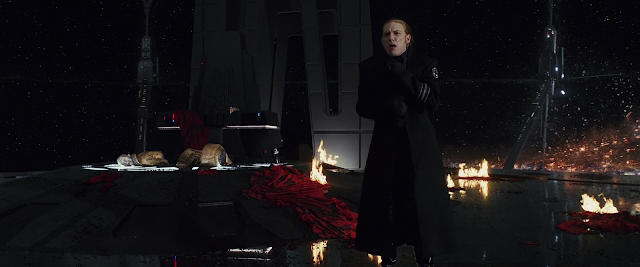
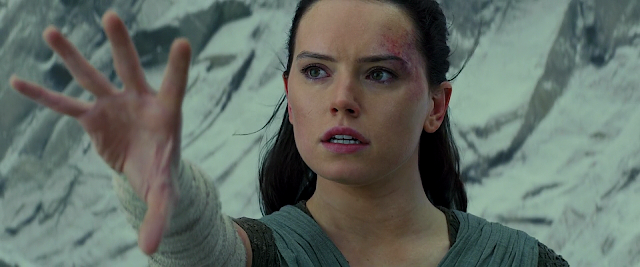
“What Happened Was….” (Thoughts on the Film)

 I suppose I am lucky that I never had to negotiate the world of dating as a single adult, out there in “the wild”. My dating life was mercifully short, and it took place in the context of the sheltered existence of college. It was also by the greatest good luck that the last person I dated in college ended up being the last person I dated at all, because we’re still together now.

What Happened Was is a movie that not about dating, but it’s about one specific date, and that’s it. Ninety minutes that track the entirety of a single date between two people who work in the same New York City law firm. He ((Michael, played by Tom Noonan, the film’s writer and director) is a paralegal  and she (Jackie, played by Karen Sillas) is an executive assistant. The movie was made in 1994, so he can make a crack about “That’s what they’re calling secretaries now.” He’s a very tall, gangly man, bald except for around the edges. She wears her red hair tied back, but loosely. The entire date takes place in her apartment (one set, which fits since the film is an adaptation of a stage play). She has made dinner. They eat, they drink, and gradually they bare their souls to one another, with results that disappoint each, in each other and in themselves.

I wouldn’t have even known this movie exists if not for Sheila O’Malley, who wrote glowingly of it last week (and previously in her paid column which I hope returns one day). Apparently the film was released in 1994 to some acclaim, and then it managed to disappear into the memory hole pretty completely. It had a VHS release but never a DVD, and the version that was haltingly available on streaming services wasn’t in great shape. But a restoration has taken place and now that version is in release and is getting wider streaming access. I watched the film on YouTube, as a rental, but I’m not sure which version I saw, the restoration or the earlier, cruddier print. (I did try to watch the restored one on Fandango, but for some reason Fandango’s credit card interface wasn’t working at all, prompting me to correct my information even though it was correct each and every time. YouTube, being a Google company, uses Google Pay, which makes that sort of thing much easier.)

Here is Sheila on What Happened Was:

In her 2016 book The Lonely City: Adventures in the Art of Being Alone, an essential entry in the sparse study of loneliness, Olivia Laing writes, “What does it feel like to be lonely? It feels like being hungry: like being hungry when everyone around you is readying for a feast. It feels shameful and alarming, and over time these feelings radiate outwards, making the lonely person increasingly isolated, increasingly estranged.” When I read Laing’s book, I thought of 1994’s What Happened Was…, written and directed by Tom Noonan, one of the great films about loneliness, in particular loneliness of the urban variety. The film unnerved me so much when I saw it in its initial release—25 years ago—that it was a long time before I re-visited it. Images from it haunted me for years. Marketed as a meet-cute gone awry, What Happened Was… is, instead, an unblinking look at the havoc loneliness can wreak on humans. It’s only 91 minutes, but every minute is excruciating.

The description–a movie unfolding in real time with just two people on a date–made me think of another classic film of the same general description, which came out right around the same time, Before Sunrise. But where that film is about the fire of youthful lust between two people who are walking around Vienna, What Happened Was is about older people who have been adults long enough to feel some disappointment that their adult lives have not tracked their younger dreams, but they haven’t given up the dreams yet, either. It’s harder for them to open up, and when they do, the results are much, much, much messier. This movie plays out almost like a psychological thriller, but the thrills are purely internal. Don’t read anything into the brief moment where she brandishes a knife at him. She laughs, saying “I’m kidding!” She does this a lot: saying something to provoke him or push him off kilter, and then laughing and assuring him (and us) that she’s joking. It never really quite defuses the tension, though. He does it too, and it doesn’t work for him, either.

We first see her sleeping, naked, face down, on a mattress with no pillows and only a sheet wrapped around her waist. Her phone–the kind of cordless handset once found in every home in America, though this one’s pink–lies on the bed next to her and she is clutching a ceramic cat. Why? We don’t know. Minutes later she’ll drop the cat and break it while in her last frantic moments of getting ready for the date. She picks up the pieces and drops them in the fish tank. Nothing is ever explained of the ceramic cat. This isn’t the kind of movie where characters linger over personal belongings: “Oh, that. My grandmother bought that for me at a flea market when she was traveling through Dubuque. She always loved the Mississippi River….” Nope; none of that. Oddly this makes the apartment seem like a real place for me. All of our personal spaces have things in them that only make sense to us.

Her apartment is oddly large, for someone living alone. I wonder what it costs. She has a sitting area with enough space for four or five people, but a separate dining area just for two. She has a dressing area cordoned off by drapes, and a mannequin that is draped with scarves. The mannequin shows up throughout the film, coming and going from the background shots, almost like a third person, silently watching the night’s events unfold. Others seem to watch, too: she has a poster of Martin Luther King and the famous “cat’s eyes” poster from the musical Cats. These posters, along with the mannequin, create almost a constant presence of other eyes, watching Karen and Michael throughout their evening (the only other piece of wall art in Jackie’s apartment is a print of album cover art from the band Asia)…and the film also establishes that Karen’s apartment has a view into other apartments across the streets. She needs to live in a place with a view, she tells Michael several times. No one seems to be looking from their own views into her apartment, though.

I notice that the layout of the apartment is such that the Cats and the MLK posters don’t have a direct line of sight into the kitchen, though. They can’t see into there, and that’s where the Asia cover-art print hangs. It’s almost as if Jackie has constructed her life as to leave her kitchen as private as she can. 

(A beautiful time-lapse shot during the credits shows one of the other buildings, viewed from Jackie’s apartment, as the day fades and the various apartment lights come on.)

We next see her returning home from work; she has bought wine and a cake for the night. A fluorescent light in the hallway outside her front door is constantly flickering, and she finds it annoying enough to smack it a few times, with no result. When Michael arrives he comments on it, and she gives him the usual excuse: the landlord won’t fix it. But before he arrives, she is already sipping from the wine, and a few minutes earlier, when her alarm clock went off, we see an unfinished glass of wine next to it. Jackie drinks a lot, apparently. This is never really commented on, but it’s always there, and Sillas has to trace Jackie’s mannerisms throughout the evening as the alcohol takes its grip on her.

We see her getting dressed for her date, in the not-quite-private dressing area. She tries on a few items, rejects them; she touches her own face in a gesture that will be reprised later by Michael, and she has an expression throughout all of this that is very hard to read. Is she afraid? Nervous? Is she questioning herself? I don’t know. We’re not given any internal (or external) monologue. All we can do is watch…but as she is clearly struggling with something, the mannequin is looking away.

I seem to be focusing a lot on the visual nature of this film, don’t I? But that’s because…well, a movie is a visual thing, and a movie doesn’t have to be some gigantic blockbuster filled with million-dollar digital effects to be a visual masterpiece. What Happened Was relies on visuals to create its story every bit as much as it does its dialogue and acting. All of this creates mood, all the way down to the lighting. Jackie is very particular about the lighting. She has different kinds of lights all over the apartment. Normal lamps and lamps with cloth draped over for color. Cannister track lights over the bar separating the kitchen from the rest of the place. Candles. A chandelier over the dining table. The light in the aquarium. And, eventually, a light-up Mother Goose. Jackie is forever turning this light off and that one on, dimming this and brightening that. And then there’s the light out there in the hallway, the one that flickers so garishly you think it might cause seizures.

Michael arrives, and the first minutes of the date are incredibly awkward. He is carrying his briefcase and the requisite bottle of wine that you bring to someone’s house; when he offers it he stands there for a few seconds, clearly trying to will himself into action, and then he says, “Oh, I brought this wine!” as if he’d forgotten about it…which he very clearly had not. His collar is open and he’s wearing a sweater vest; his necktie is hanging from his jacket pocket. Throughout the first half of the movie, there is usually something between Jackie and Michael: a dining table, a coffee table, the kitchen bar. When they finally reach a point where there’s nothing between them, first on the couch and then later in a part of the apartment we don’t even know is there at first, it feels…neither quite right nor quite wrong.

And there’s the movie’s master stroke, right there, in addition to the brilliant visual construction of the film itself: We never really have a sense of how this date is going. Is this two awkward people being awkward at first and gradually feeling at ease with each other? Or is the awkwardness permanent and these people are a disaster who should never ever date again? We never know. Not even after the film has ended. That’s what makes it linger.

As Jackie and Michael talk through the first half of their date, some things–themes–emerge, and their dialogue is intriguingly constructed. Each says things that they repeat a few times, like how Jackie likes to live with a view. It’s almost like they feel the need to return to conversational safe space as they feel themselves starting to drift toward a confessional space. Michael seems to get there first, opening up about how he is gathering information for a book he’s writing about the law firm; this catches Jackie’s ear, because her own dialogue conveys a strong sense that even at the firm she feels like she’s on the outside looking in, a little.

At first Michael definitely comes off as being the stranger of these two people. One of his early confessions is that he hears his own name mentioned subliminally in a Beatles song. Jackie is briefly taken aback by this, but she recovers by claiming that “Oh yeah, something like that happened to me once!”, but she gives no details. Her own awkwardness is less overt: she has invited this guy over to dinner at her place, so she’s cooking for him–but she does all her cooking on the weekend and freezes everything to be microwaved through the week, so her big dinner for him is a microwaved scallop dish that she literally serves to him from the Tupperware container she nuked it in. He grins through this, in a way that seems a little mocking–but then he says weird shit like “I hate the word ‘seafood’,” so it’s hard to tell just where he’s landing on all this. Meanwhile, she keeps drinking and filling his glass. She almost forgets that she has rolls on the table, and she doesn’t serve the salad until after they’ve been eating for ten minutes.

Michael’s book-writing sounds like real social crusader stuff: he wants to get the truth out there, let the people know what’s going on! But it’s all vague and he says things about publishing that seem…wrong, made-up. He pulls out a little notebook at one point to jot something down, but he doesn’t tell Jackie what he’s written, and we never do find out. There are a lot of such moments in What Happened Was: tiny moments that might be meaningful or might not be, and all we can do is watch it all play out and decide for ourselves, later on.

Jackie, it turns out, also writes. She writes stories, and she has even published a few–but that turns out to have been a vanity publisher. Michael seems to know this, but he’s got enough kindness not to squash her on that basis, and eventually he gets her to read one of her stories to him. She tells him that it’s a kid’s story, but it very much…is…not. She reads it to him in another room, separated by a curtain. She keeps her notebooks in a lockbox (the same kind of notebook, albeit larger, as the one in which he had jotted his secret note earlier). She reads a story that starts off sounding awkward, stilted; I have to note Sillas’s performance here as she starts the reading haltingly, in the manner of someone who is reading their work aloud for the first time (and yes, I know what that feels like). But she gets over that and reads…and reads…and reads. The story is quite a bit longer than we (or Michael) expected, and it’s here that the movie makes its most use of close-ups. The reaction shots on Michael are disorienting, in the dim light of this secret space that’s illuminated by a Mother Goose lamp.

Returning to visual elements, the use of color in What Happened Was is pretty amazing. The palette seems muted early on, but aspects of the set take on a more saturated appearance as we proceed. Even the Asia poster in the kitchen shows this: in the last scene, it has red highlights that aren’t there in the opening scenes. The visuals are more and more stark as the emotions our characters are plumbing become more and more stark.

I don’t want to spoil too much of this, but in the end, the date doesn’t end particularly well. Nor does it end spectacularly badly, either. Jackie may eventually be too drunk to make sense of what’s gone on (though she’s not wrecked, either) and Michael makes a final confessional that feels like a desperate attempt on his part to salvage a night that has not gone the way he may have hoped…but then, he never really seemed to bring much by way of hope into the night to begin with. Michael’s final confessional might be the part of the film I liked least, because…it’s honestly the one thing that happens in this movie, the one thing said by either character, that’s not surprising. I’ll just leave it at that. But as the movie ends, we’re not sure really if the situation between Jackie and Michael is completely doomed, or if it can be repaired (they’re going to see each other Monday morning, right?), or if they’ll exist in some kind of relational limbo for a while. But it’s worth noting one last visual cue: when Michael leaves for the night, as he heads out into that hallway, the formerly flickering garish light is no longer flickering. It’s just garish.

Sillas and Noonan are both incredibly effective in these roles. Noonan even makes use of his own incredibly long fingers for some shots, like when he picks a piece of lettuce off the table (it fell out of his salad bowl when she overfilled it) and puts it in his mouth after a second or two of clearly thinking, “I’m not sure what to do with this.” Sillas tracks quite the emotional journey here as she hurries to get ready for this date, then pours herself into it, then opens herself up, and then has to process her deep disappointment that it hasn’t gone the way she had hoped, though we never really know what she hoped for this night. Meanwhile, Noonan’s Michael seems like a guy who has a lot of initial bluster, then some retreat, then some more bluster, followed by defensive retreat…and when he finally decides to commit to his own feelings in any way, it may be too late. In the end he finally admits that he has no idea what he’s doing, and Jackie has to clarify that for him.

In the two days since I watched What Happened Was, I keep thinking about it and about these two characters. I wonder what happened for both of them. I have my thoughts on that (I think this night ends up a one-off that they never even mention again to anyone), but maybe I’m wrong. Maybe. I keep thinking about it, and I suspect that’s the entire point.

ADDENDUM: In Sheila’s article above, she also mentions that the film’s marketing campaign did it no favors, and after looking into that a little, Holy SHIT, is she right. The trailer really does make it look like an erotic thriller, and the poster makes it look like…I don’t even know what you’d expect from a movie with this poster, but it sure isn’t what the movie ends up delivering.

I wonder if the movie’s 1994 vintage hurt it a bit. This was when the “rise of indie film” in the 90s was just starting to gather steam, and I suspect that the people in charge of marketing this film just simply had no idea at all of how to do that. So, they came up with a terrible campaign that likely gave audiences the complete wrong idea, so any word of mouth was likely not great. That’s a shame.

Share This Post

Something’s afoot, aye!

 Apparently they made a movie about Sherlock Holmes’s younger sister Enola, featuring Mille Bobbie Brown in the title role. The movie drops on Netflix just a few days before my birthday.

If it’s good, this might be one of 2020’s stopped-clock moments (even a stopped clock is right twice a day)!

Share This Post

“Thy dawn, O master of the world, thy dawn….”: ON HER MAJESTY’S SECRET SERVICE AT 50 (a repost)

Fifty years ago today, on December 18, 1969, the sixth James Bond movie opened. Its initial reception was mixed, partly because the Bond mania of the 60s was simmering down, and partly because it was the first time that Sean Connery had not starred as Agent 007, in favor of complete unknown newcomer George Lazenby. While I didn’t see the movie until an ABC telecast sometime in the early 80s, I liked it from that very first viewing and it very quickly shot up my personal rankings until by the time I was fifteen or sixteen I was willing to crown it as my favorite Bond movie of all time. And while certain opinions that we have in our youth shift as we learn and grow, some do not…and for me, this is one of the opinions that stuck. To this day, almost 19 movies later, OHMSS has never been equaled.


I wrote the following essay almost nine years ago and repost it here without a single word changed, except to fix a broken link.


Sometimes I change my mind about movies. Sometimes I don’t. Some movies meant a lot to me, years ago, but have dropped away to the point that I’ve forgotten about them. Other movies, though, have stayed with me forever. One of those is On Her Majesty’s Secret Service, the sixth James Bond film, which I have regarded since I was a teenager as the best Bond film ever made. In fact, I consider it one of my favorite films of all time, in any genre.

My long examination of the film, with lots of screencaps, after the page break.


Released in 1969, OHMSS came out when the Bond-mania of the 1960s was starting to wane. Films like Goldfinger and Thunderball had been enormous hits, but now, Sean Connery had left the role of Bond and a complete unknown named George Lazenby was cast as his replacement. All this is well known, and over the years, Lazenby’s performance in OHMSS has been reliably controversial. To this day, there are Bond fans who loathe his performance, and to this day, there are fans who not only think he did a fine job, but that he really doesn’t stand in Sean Connery’s shadow at all. (I am in the latter camp.)

Narratively speaking, OHMSS is one of the strongest films in the series. Its script, by Richard Maibaum, is outstanding, with lots of wit and fine dialogue that rarely seems as far-fetched as Bond dialogue can sometimes get. The story, though, does present problems for people who are interested in continuity.

The problem comes from the fact that Eon Productions (the producers of the Bond series) did not adapt the Ian Fleming novels to the screen in the order that they were written. The first Bond film is Dr. No; the first novel is Casino Royale. The Bond films of the 1960s, excepting Goldfinger, all feature Bond squaring off against the minions of SPECTRE, culminating in You Only Live Twice when he finally meets Ernst Stavro Blofeld face to face. However, in the novels, it’s in OHMSS that Bond meets Blofeld. The problem then is why Bond and Blofeld don’t recognize each other in the OHMSS film when they come face to face. There are lots of possible fictional explanations for this, and the original idea was to have Bond undergoing plastic surgery to explain his new resemblance to George Lazenby. The producers chose not to do this…and yet, in the next film, Diamonds are Forever, they would use the plastic surgery idea to explain why Blofeld in that film now looks like Charles Gray. (Without, of course, explaining why it is that Bond now no longer looks like George Lazenby but like Sean Connery again.)

In watching OHMSS recently, I came to realize that the Bond films that are the best tend to be the ones that most deviate from the standard Bond “formula”. That certainly holds true with OHMSS. The film starts with Bond, already on assignment in Portugal. But, as M notes in the film’s very first scene, no one with MI6 has any idea where Bond is, and his current assignment is becoming politically problematic: “Number 10 is making ugly noises about Operation Bedlam.” Operation Bedlam, we later learn, is the search for Blofeld, who is presumably on the run following his failed scheme in You Only Live Twice. So already Bond is on thin ice with his superiors; he is failing at an assignment; he’s been on a single assignment for two years.

That last is important, because time is a recurring motif all through the film. Bond’s relationship with time is a constant underlying theme, made explicit in Maurice Binder’s typically-brilliant opening titles sequence. Clocks and hourglasses figure prominently in the title sequence. Now, timers and clocks are a constant trope of spy fiction and thriller films, what with heroes defusing bombs or whatnot as the digital timer ticks off the last few seconds before disaster is to strike. But there is something different about time in OHMSS: even as Bond is up against the same kinds of time constraints that he’s always faced before, we get a real sense that he’s weary of the whole thing and desires a different kind of relationship with time.

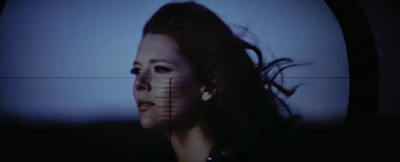
So Bond is in Portugal, driving along, when a woman in a red car passes him on a lonely seaside road. Bond, of course, gives chase, and comes to a beach where the woman parks her car and goes down to the water, where she starts to wade out. Bond spies her through the telescopic sight of his rifle, and it’s thus that we get our first close-up of Contessa Teresa di Vicenzo, better known as Tracy.


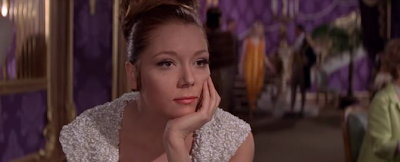
Tracy – played by Diana Rigg – already looks sad and lost in this shot, as Bond watches her wander into the water. He quickly realizes that she intends to let the tide carry her out; he is watching a suicide attempt, so he intercedes, bringing her back in from the water and introducing himself – “Good morning! My name’s Bond. James Bond.” Here we see Lazenby’s face for the first time; up until now, the film has teased us with shots of his head from behind, closeups of his lips as he lights a cigarette, and the like.


Two goons show up here, to take Tracy away. Of course, Bond has no idea who this girl is, or who her two “protectors” are, but the goons apparently intend to kill Bond, so there’s a fight. It’s a pretty kinetic fight, and all of the fights in OHMSS are pretty kinetic – and with good reason, as director Peter Hunt has literally sped them up in the editing room. I’m not sure why he chose to do this – some fans speculate that Lazenby was an awful screen fighter, and the sped-up fights are a ploy to conceal this – but it doesn’t matter. This is another facet of OHMSS that can divide fans. Some are distracted by the quickened fight scenes; others – myself included – simply accept it as a stylistic choice in a film that has a lot of style going for it.

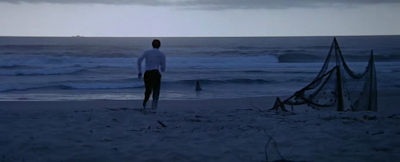
Anyhow, Bond dispatches the goons, but the girl has already fled, jumping back in her car and driving away. Bond is left alone on the beach, holding her shoe, whereupon he breaks the fourth wall to tell us, “This never happened to the other fellow.” Cut to opening title sequence.

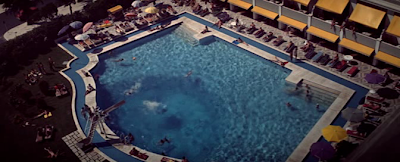
When we return, Bond is still in Portugal, and checks into a hotel, where he notices a red Cougar parked outside that he is informed belongs to a lady. He takes his room, and looks down on the pool, whereupon there’s a wonderful transition shot from day to night as this shot…


…fades into this one, while a slow tune for jazz flute plays in the background.


I love that second shot; the pool seems deserted but the reversed “Casino” logo is disrupted by ripples a couple of times. This isn’t the kind of shot one typically sees in a Bond film.

Over the next twenty minutes or so, the film’s story continues to unfold slowly, and in a way that seemingly has absolutely nothing to do with spy intrigue. Bond goes to the casino to play baccarat (the traditional card game of the Bond films, until Casino Royale replaced it with poker). An elegantly-dressed woman enters the game, places a huge bet, and promptly loses – but she has no money. Bond recognizes her: she is the woman whom he saved on the beach the night before. Detecting her streak of self-destructive behavior, Bond bails her out for twenty thousand francs and then has a brief conversation with her over champagne, where she is quite blunt about how she is to repay her debt to him: she gives him her room number and says, “I hope it’ll be worth it.” She is cool and businesslike; when Bond calls her “Contessa Teresa”, she replies, “Teresa was a saint. I’m known as Tracy.”


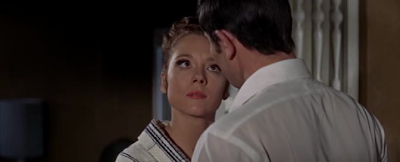
Bond is already intrigued by this woman who is proving somewhat resistant to his charms, by her mysterious background, and by the fact that she has goons following her around. One attacks him when he enters her room; after dispatching the goon, Bond figures that the tryst isn’t happening and goes back to his room, which is where she’s waiting. She pulls his own gun on him, but now he is having none of this: he demands to know who the men following her are, and when she claims ignorance, he slaps her and says, “I can be much more persuasive, Contessa.” Ahhh, the freewheeling sexism of the early Bond films – not a quality of the Bond series that I’ve missed, but it’s worth noting that Tracy proves equal to the moment, lifting her gaze to fiercely meet Bond’s as she says, “Whatever else I may be, I’m not a liar.”


Here, at this moment, is when the film score gives us the first hint that this girl is different, because this is where we first hear the film’s love theme. After some more discussion during which Tracy still resists Bond’s efforts to figure out who she is and why she is acting the way she is (“The only thing you need know about me, Mr. Bond, is that I pay my debts”), Bond and Tracy do, in fact, sleep together, but when he awakes the next morning, he finds that she is gone not just from his room but from the hotel entirely…but not before leaving two chips for ten thousand francs in his bedstand. “Paid in full,” Bond notes – and we never learn just how she came up with that money.

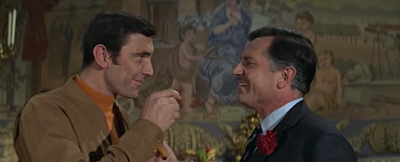
Here, Bond is again greeted by the goons following Tracy, who have him at gunpoint (with his own gun – Bond was a bit careless in not noticing that it was missing). The goons take him on a long drive to a shipping company headquarters, where Bond meets the man behind these guys. Is he a villain? Maybe, at first glance – he is Marc-ange Draco, the head of a crime syndicate called the Union Corse – but more relevant, he is Tracy’s father. It is he who fills in some of the blanks, telling the story of Tracy’s birth and her sad life which has led her to behave self-destructively. Draco’s big idea, though, is that Tracy’s need can be filled by…a man. A man like Bond. This, too, is eerily sexist, and Bond seems to see through this whole notion, refusing Draco’s offer of a dowry of one million pounds in gold.


But here, about a half hour into the movie, is when the film finally steers its course back into the espionage arena, because Bond senses an opportunity here. He knows that Draco, as head of a huge crime syndicate, may well have information on the whereabouts of Ernst Stavro Blofeld; he implies to Draco that while he won’t take Draco’s money, he might consider marrying Tracy if Draco tells him where Blofeld is. Draco, for his part, says “If I did know [where Blofeld is], I would not tell Her Majesty’s secret service. But I might tell my future son-in-law.” Bond gets his first break in the case in years, returns to London to report to M on what he’s learned…and the formula reversals continue.

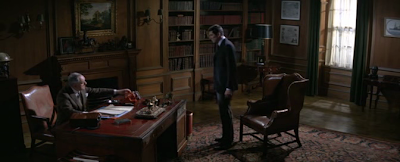
M takes Bond off the case without even hearing his new lead. “You’ve had two years to run him down,” M points out. “The license to kill is useless unless one can set up a target.”

Bond has been chasing Blofeld for two years, and the little bit we’ve seen of that chase has taken its time unfolding – but M has just decided that Bond is out of time, and Bond angrily decides that he’s had enough of the whole thing and decides to resign. He dictates his resignation letter to Moneypenny and goes to clean out his desk (allowing a few brief glimpses of gadgets from Bond-films past), before M calls him back to accept his request. Bond thinks he’s out of a job, but Moneypenny has changed the letter to a request for two weeks’ leave, so Bond heads out again…this time to return to Draco to get his information. Bond has been freed of his time constraint for finding Blofeld, since there really can’t be any doubt that he intends to continue the chase.

(In a charming bit, M expresses his gratitude to Moneypenny for changing Bond’s resignation letter as well, saying “What would I do without you, Miss Moneypenny? Thank you!”)

The film’s relaxed pace continues, as Bond returns to Portugal to meet with Draco at his country estate. Tracy is there as well, and is disgusted to find Bond there; she clearly regards him as just another in a long line of men who have come along who were interested in one thing alone from her. Funny thing is, we know Bond’s history, and this might well not be off the mark – only Tracy is, for the first time, different for Bond. Tracy susses out the crappy deal between Draco and Bond (“No woman would waste this excellent champagne discussing a business deal unless she herself happened to be part of the arrangement”), and basically forces her father to give Bond the information he wants without going through with the whole marriage idea. Draco relents, telling Bond that there may be a connection between Blofeld and a lawyer in Bern, Switzerland; then Tracy gets up from the table and storms away after saying, “And now Mr. Bond need have no further interest in me.”

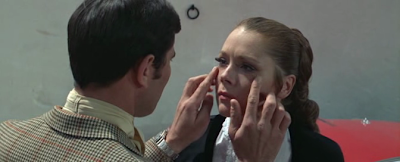
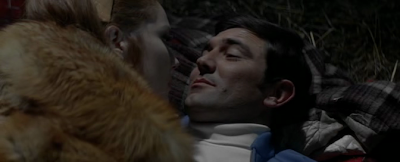
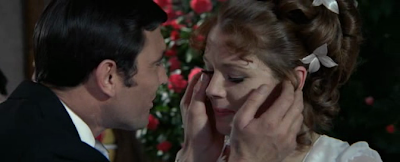
Bond, however, disagrees, and goes after her. Meeting her by her car, he finds that Tracy is in tears. Why? I suppose it’s because she’s sick of this kind of thing. She doesn’t want to be someone’s prize or payment, and she doesn’t want to pay her own debts anymore, either. When Bond catches up to her, though, he does something interesting: he doesn’t crack wise, or make it obvious that his next goal is to make love to her. In the first real gesture of intimacy we have ever really seen from James Bond, he brushes the tears from her cheeks, and then takes Tracy into his arms.


Our slow pacing continues, as what comes next is an honest-to-goodness love montage, complete with love song (“We Have All the Time In the World”, sung by Louis Armstrong), which at first might seem terribly out of place in a James Bond film, but which works here, because the film has taken its time in setting it up. We’re only vaguely aware that Bond is on the job at all; the whole first third of the film is given to him meeting this strange, wounded woman and finding himself under her spell. The title of the song used makes it all clear that Bond has finally found a woman with whom he wishes to relate outside of his job, because as a spy “on Her Majesty’s secret service”, Bond never has all the time in the world. His world is a world of ticking time bombs, of stopping villains before it’s too late, of passing moments of physical pleasure that must be set aside quickly so that he can move on to the next threat. Now, he’s getting his first hint of a world where one doesn’t have to worry about time.

The film never states it outright, and I have no idea if George Lazenby intended it (aside from the one scene, later in the film, where the subject sort of comes up), but his portrayal of Bond really does seem to convey a certain feeling of weariness about the whole business. Lazenby’s Bond is competent, skilled, brave, and witty – but he also seems just a bit tired of it all. It’s in little touches, really – would a Bond who is really invested in things fail to notice that his gun wasn’t where he’d left it? If he’s on assignment, would he really be heading out for a round of golf? It’s not that Bond is “phoning it in”, not at all, but it’s as if the thought is starting to form in the back of his mind that maybe, just maybe, he doesn’t want to be 007 for his entire life.

As the montage ends, though, Bond is back in the world of spying and being up against time. He has to infiltrate the office of a lawyer named Gumbold and search for any connection he can find to Blofeld, while Gumbold is off at lunch. For a simple office break-in, this scene is surprisingly tense, because of the time limit. Gumbold emerges from his office and walks down the hall, curtly informing the desk attendant that “I’ll be back in an hour.” Gumbold’s shoes click on the marble floor of the office building with such precision (we’re in Switzerland, after all) that it sounds like the ticking of a clock. Bond arrives, and goes to work, using the only real gadget in the movie: a safe-cracker that also comes with a built-in photocopier. This is hoisted up to the balcony of Gumbold’s office from the construction site next door – Bond has a man there – and then Bond has to simply wait for the machine to do its job. Meanwhile, John Barry’s suspenseful music churns in the background, first slowly and then picking up steam as the hour ticks past. You can watch the entire scene here; it’s like a thriller-within-a-thriller. I love the bit where Bond settles in, looking bored while he waits for the safe cracker to do its thing; it’s also hilarious the way Bond finds Gumbold’s issue of Playboy, tucked into a newspaper.

Of course, Bond finds something: letters from a “Count de Bleuchamp”, who is apparently seeking to establish himself as reigning Count of the Bleuchamp family. Bond takes this information to M – visiting him at his home – and indicates that “Bleuchamp” is the French form of “Blofeld”. The reversal here is interesting: Bond is briefing M, not the other way around.

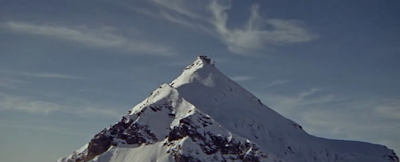
What unfolds next is more in traditional keeping with Bond films, as the intrigue takes over as Bond, posing as an expert in heraldry and genealogy, heads to Switzerland to find out if this “Bleuchamp” is Blofeld or not. Of course, he is, with the whole works: a new scheme involving his posing as a doctor who cures allergies, the young women who are his patients (but who are really unwitting pawns of his, via mind control), and a fortress perched atop a Swiss Alp.


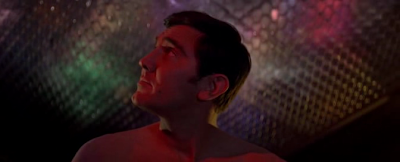
Of course, what commands Bond’s attention almost immediately is Blofeld’s allergy patients:


There’s a funny scene where Bond is trying to seduce one of the girls at the moment the mind-control stuff in her room starts up: swirling red lights, odd music, and Blofeld’s voice coming over the loudspeaker to address this girl who is mortally afraid of…chickens. Bond’s expression of “WTF?!” is perfect as we hear Blofeld’s voice intoning things like “You love chickens. You love their feathers.”


Even so, all of this continues to unfold quite slowly, and the film actually is free of action entirely from the fight in Tracy’s hotel room fifteen minutes into the picture until Bond’s capture by Blofeld over an hour in. OHMSS allows its story to unfold, and the slackening of the pace makes it all the more tense later on when Bond finds himself once again battling the clock. There is a fine scene, after Bond has been found out by Blofeld, where Bond must escape from the gear room of the cable cars that provide the only access to the mountain hideaway; then Bond lurks about as Blofeld’s “allergy patients” – beautiful girls, all of them – are given their final hypnotic briefing on how things will go now. The girls are each given an atomizer, theoretically filled with perfume, but which are actually filled with a toxin that, according to Blofeld, will cause widespread infertility in crops and livestock. The girls will be hypnotically instructed as to when to release the toxin.

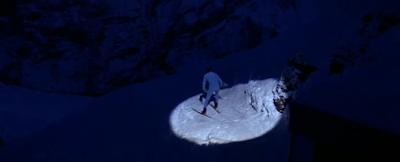
Now, Bond is up against the clock, and makes his escape from Piz Gloria (the mountain hideaway), on skis. It’s surprising to note that, aside from a couple of brief fistfights, this is the first action set piece since the teaser sequence, and it comes well over an hour into what was for years the longest of all the Bond films. (Casino Royale was actually longer.) The ski chase in OHMSS is, for me, still the best ski chase ever filmed for a Bond movie (subsequent skiing scenes would appear in The Spy Who Loved Me, For Your Eyes Only, A View to a Kill, and The World Is Not Enough). It relies fairly heavily on rear projection during the closeups, but the entire sequence is edited together wonderfully, with the main theme from the film making its first reappearance since the title sequence.


What’s great about the ski chase is that Bond has to work for it. So many Bond chases in other films make it look easy for him, but here, Bond is constantly having to re-escape. At one point, he loses one ski; at another, he has to lie in wait for his pursuers to come upon him, which results in a couple of fights atop a thousand-foot-high cliff. Bond makes it down the mountain, to the charming Swiss village in the valley where there’s all manner of Christmas celebration and ice skating and happy people all over the place…and yet, the bad guys are there too, and Bond can’t get away. This is all pretty fascinating: many times in the series, we see Bond evade pursuers by putting a big crowd of people between them and himself. Here, though, it doesn’t work, and we become aware, through a series of quick cuts from the crowd to the pursuers to Bond back to the crowd and back again, that Bond is really, genuinely afraid. It’s not often at all in the 007 movies that we get to see Bond feel fear.


And, in keeping with the film’s reversal of quite a few formulas, Bond doesn’t escape on his own. He is rescued, by an unlikely heroine:


Tracy is there. She’s followed Bond to Switzerland, based on information from her father, and now she’s found him. She gets Bond out of that village, albeit not without being seen by the bad guys, who again give chase. With Tracy driving, Bond is the passenger in a high speed chase that takes us into a demolition derby.


And after that, they drive away, straight into a snowstorm that forces them to take shelter in someone’s barn. This scene is the emotional heart of the film, because Bond and Tracy don’t just do what Bond and any other girl would do when trapped in a barn during a snowstorm. They actually talk first, and they talk about something: their relationship with each other. Bond can’t tell her what really went on up at Piz Gloria, because he’s still an agent; Tracy says that they’ll just have to keep doing things the way they are. “Tracy, an agent shouldn’t be concerned with anyone but himself,” Bond says…and the way George Lazenby delivers the line makes absolutely clear that as true as it may be, Bond is sick of it. “I’ll find something else to do,” he says. This is as startling an admission as you’ll hear from James Bond. Tracy asks if he’s sure, and he is: “I love you, and I know I’ll never find another girl like you.” And thus does James Bond get engaged.


This scene is the scene in the film; if this scene doesn’t work, pretty much the entire film is sunk, because the entire subtext of the film is that James Bond is tired, he’s vulnerable, and he wants to do something else. Lazenby sells this scene so well that it’s almost heartbreaking, and as I’ve said for years, I defy any of Lazenby’s detractors to claim in seriousness that Sean Connery would have done this scene any better. (Frankly, as much as I love Sean Connery, I’m not sure he wouldn’t have done this seen worse. In his Bond films, he never presents a single hint of genuine vulnerability in his portrayal of 007. Which isn’t to say that Connery couldn’t do “vulnerable”, because clearly in his acting career we see that he could, but in playing Bond, he didn’t, and I’m not sure he would have done so here.)

The next morning, Blofeld and lackeys arrive at the barn, only to find that Bond and Tracy have already left, and are skiing away. There’s another ski chase – this one taking place by day instead of night – and again, it’s a close affair that ends when Blofeld uses a flare to set off an avalanche. Thus he captures Tracy, but assumes that Bond is dead (“A grave deep enough to prevent even 007 from escaping!”). Of course, Bond isn’t dead, but he is despondent that he has failed: Blofeld’s plan is alive, and the woman he loves is now his prisoner.


Back in London, Bond paces in M’s office as M is notified by his superiors that the United Nations plans to give Blofeld what he wants: a full pardon for all crimes as head of SPECTRE and full recognition of his title as “Count de Bleuchamp”. M seems oddly accepting of this, while Bond is thinking that if they can get to Piz Gloria before Blofeld’s deadline, they can destroy his center of communications and thus keep him from ever being able to psychologically order his patients all over the world to release his toxin. M refuses to go along with it, assuming that all Bond wants to do is save Tracy: “This department is not concerned with your personal problems.” Bond retorts, “This department owes her a debt. She saved my life.” Bond still fails to persuade M to allow an attack on Piz Gloria, so Bond organizes one anyway…using Draco and his men.

This brings us to the film’s final action setpiece, the aerial attack led by Bond and Draco in helicopters against Blofeld’s headquarters. As the choppers approach, Draco has to convince the Swiss authorities that they are a Red Cross flight. As Blofeld and his men listen in on the radio transmissions, Tracy recognizes her father’s voice, realizes that the game is afoot, and starts using her feminine whiles to appeal to Blofeld, thus keeping him distracted and not realizing that he’s about to be attacked until the guns start shooting.

From here out, it’s pretty standard Bond film set-piece fare: explosions and gunfire, close fights, and so on. Bond slides on his stomach across the ice of a curling board, dispatching lots of bad guys in the process; meanwhile, Tracy has to fend off several goons on her own, further establishing her credentials as Bond’s genuine equal. At no point in the film, really, is Tracy ever a helpless damsel in distress, screaming “James!” as Bond tries to rescue her; instead, a number of times she rescues him. Anyhow, Draco’s men rout Blofeld’s, and plant explosives to destroy Piz Gloria. Bond manages to find Blofeld’s map of where his “angels of death” are all located, and is taking photos of the locations when Blofeld fires on him and then runs away. Bond gives chase, leading to a bobsled chase with Bond trying to catch Blofeld as Piz Gloria explodes behind him.

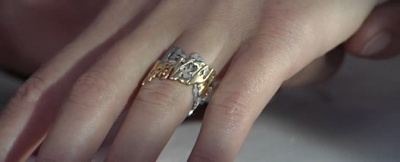
The chase ends with Blofeld being snagged by the neck in a tree; apparently Bond assumes that Blofeld is dead, which is ironic because that is the same mistake that Blofeld (and others) are always making about Bond, and this time it will have disastrous consequences. Meanwhile, Bond goes off to live happily ever after: we see him purchasing Tracy’s wedding ring, and then putting it on her finger and wiping away her tears of happiness in a reprise of his gesture from the bullfight. Bond says his goodbyes to M and Q; he gives Draco back the one million pound dowry (“Her price is above rubies…or even, your million pounds!”, and then, after tossing his hat one last time to a crying Moneypenny, drives off into his new life with his bride.


It’s about here that I usually start to lose it, when watching this movie. There are lots of movies with sad endings, and I count among them many of my favorite movies. This one, as well. But when I stop and think on it a moment, On Her Majesty’s Secret Service is unique among movies with sad endings in that every time I watch the film, I desperately want the ending to not be sad. Just…this…once.

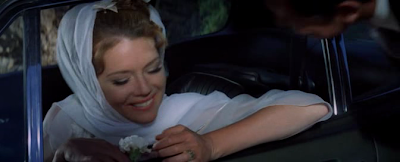
What happens is this: Bond pulls over on the side of a road that’s overlooking the sea, so he can pull some of the flowers off the car. He and Tracy enjoy some playful newlywed banter. Another car comes along…and it’s driven by Blofeld. In the backseat is Irma Bunt, his chief lackey; and in her hands is a machine gun. She sprays Bond’s car with bullets as he speeds past.


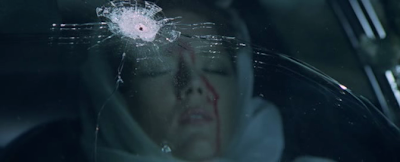
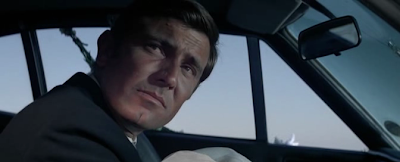
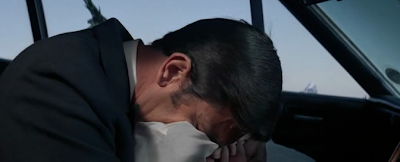
“It’s Blofeld!” Bond shouts, as he jumps back into the car. “It’s Blo–” he starts to say to Tracy, when he looks at her…and sees the single bullet wound in her forehead. Tracy is dead. Her body slumps into his lap as a policeman pulls up alongside on a motorcycle. Bond looks up at the policeman, and with the dazed calm of a person whose brain hasn’t yet caught up to what’s just happened, he says, “It’s all right, really, she’s just having a rest. We’ll be moving on soon…there’s no hurry, you see, we have all the time in the world.” Here Lazenby’s voice cracks as he leans down over her, kisses her forehead, and then buries his head as he begins to sob. John Barry’s instrumental arrangement of “We Have All the Time in the World” plays through these last few seconds. The music is heartbreaking, and reaches its final chord as we fade to the film’s final shot: the bullet hole in the windshield of James Bond’s Aston Martin.


Then, as the credits roll, the “James Bond Theme” smashes in, obliterating the mood from the beautiful melody of “We Have All…”. I’ve heard film music fans over the years argue that this is a mistake on the part of the filmmakers, and that the film should have used “We Have All…” as the end title, but I don’t agree – because it fits perfectly with the themes of the film. Time, Bond’s weariness as a secret agent, all of it is brutally illustrated by the drastic musical switch in moods at the end of OHMSS. As soon as the Bond theme starts, it is as if Bond is being told, “No, you don’t have all the time in the world. That was it. That was all the time you got…and now, like it or not, you’re back in the only world you’ve ever known.” Time is the relentless enemy of us all, and not even James Bond can stand in its way. No one has all the time in the world.

I don’t think it’s anything peculiar to John Barry’s arrangement of the Bond theme in this picture, as opposed to just the connotation of hearing that theme after what’s just happened, but I don’t think you’ll find another instance in the entire Bond series of the James Bond Theme sounding so bitter, so cold. The Bond Theme is a cultural icon, after nearly fifty years of these movies, that musically symbolizes thrills and coolness, but at the end of OHMSS, it’s anything but cool or thrilling. It’s angry, it’s sullen, and it’s unwelcome. We don’t want to hear it…and yet, the film forces it upon us, as it has forced cold, unblinking loneliness upon James Bond, at the moment when he thought himself to be free of it all.

I’ve occasionally wondered what might have been, had George Lazenby stuck around as Bond. I’m genuinely unsure, really. I think his performance in OHMSS is terribly underrated, and that he would have been just fine had he continued in the role. But also, the Bond films were about to undergo a significant transition into campy scripts and gonzo plots. Connery returned for the next one, Diamonds are Forever, in which Blofeld is again the villain – but that film doesn’t make a single mention of the fact that Blofeld killed Bond’s wife, and Bond never even seems angry with Blofeld, just mildly disgusted as he is with any villain. And then Connery would leave, to have the role go to Roger Moore, who would then be saddled with the silliest scripts of all the Bonds (and yet, Moore, too, had his moments when he made Bond cold and ruthless, moments that are often forgotten or overlooked by people who tar the Moore era with the cloth of camp). It’s interesting, though, that Moore’s best Bond film, For Your Eyes Only, opens with Bond visiting Tracy’s grave.

And now that James Bond has been rebooted with Casino Royale and continued with Quantum of Solace, what to make of it all? Will they just go for straight-up remakes of some of the earlier films? Will Daniel Craig’s Bond have to fall in love with a new Tracy, all over again? Who knows…but it doesn’t matter, really. We’ve already got On Her Majesty’s Secret Service. Even if we don’t have all the time in the world.

ADDENDUM, 12/18/2019: Obviously since I’ve written this there have been two more Daniel Craig Bond films, SKYFALL and SPECTRE, both of which I enjoy greatly and both of which have enormous charms. Neither is OHMSS, of course, but those two films do continue the Craig era’s willingness to openly explore the emotional life of James Bond, with SPECTRE containing specific elements that do seem to call back to the 1969 film. I eagerly await the arrival of NO TIME TO DIE in 2020 to see where Daniel Craig’s 007 ends up.

Share This Post

Of Cackling Emperors and other things….

OK, so now that I’m done cranking out the words every day in a final push to complete a novel draft, what should we talk about? Why…how about the teaser trailer to Star Wars Episode IX that dropped a few weeks ago?

If you haven’t seen it, here it is:


As with all teasers, there’s simultaneously a lot to unpack there and…there’s nothing to unpack there. Teaser trailers are designed to tantalize in any of a hundred different ways, and since this thing showed up online during the Star Wars Celebration fan festival, the Interwebs have been all a-tizzy as they try to read the tea leaves.

Well, never one to leave a muddle of wet tea unscrutinized, here are some random thoughts of my own!

1. As the Lucasfilm logo fades in we hear breathing. It’s Rey, and our first glimpse of anything in the trailer is Rey herself, standing alone in the middle of a desert wasteland. This is already reminiscent of the first shot of the trailer for The Force Awakens, in which we saw Finn also standing alone in the middle of a desert wasteland…but where Finn looked visibly afraid and distraught, Rey’s manner is one of calm. She is relaxing into…a moment.

2. Luke Skywalker’s voice: “We’ve passed on all we know,” and Rey pulls out her lightsaber. It’s the Anakin-and-Luke model that she’s been sporting through this trilogy, but…it was broken in two when she and Kylo Ren Force-battled to claim in in The Last Jedi, so now it’s been reforged. The lightsaber is now Anduril to the original Narsil, if I may.

3. Luke, continued: “A thousand generations live in you now.” This establishes that Rey is, after all, the last Jedi. It’s all down to her.

4. Onscreen text: “Every generation has a legend.” This calls back to the “Every saga has a beginning” line in that first trailer way back in 1998 for The Phantom Menace. Interesting choice, given the lengths this creative team went during the TFA build-up to differentiate their movie from the Prequels.

5. A TIE ship zooms across the same landscape, approaching Rey. It’s flying right-to-left, kicking up a cloud of dust. This echoes the pod race from TPM, but reversed (the pod race mostly went left-to-right), and also the attack of the Resistance X-wings from TFA, when they streaked across a lake and kicked up water spray (and also went left-to-right).

6. The TIE ship bears down, Rey runs, we don’t see who’s flying the ship although I guess we’re supposed to assume it’s Kylo Ren, and then…Rey does this big slow-motion backflip toward the ship, with her lightsaber ignited. Hmmmm. This is not the type of action move we’ve ever really seen in a Star Wars movie. We cut away as the music erupts into a powerful rendition of Princess Leia’s theme, which is, for all intents and purposes, the Star Wars music of choice for really big emotional beats.

7. A ship flying through mountains to a city at night on some planet. No idea. Someone online noted a similarity between that ship and the one that Rey envisioned during her Force-dream in TFA, the ship that presumably carried her parents away as young Rey screamed “Come back!” But I don’t know.

8. Kylo Ren in action. I guess we have to see him, but Kylo Ren remains for me one of this trilogy’s least well-executed factors. He’s reforging his mask, he makes a power move in a fight with his goofy lightsaber.

9. Finn and Poe on some desert planet. The same one Rey’s on? Maybe. Finn seems to be holding Rey’s staff, and Poe Dameron is standing behind him on a rock outcropping that looks a bit like one of those from Obi Wan Kenobi’s skulkings-about on the planet Geonosis way back in Attack of the Clones. Hmmmm….

10. The Millennium Falcon, flying through hyperspace as LANDO F***ING CALRISSIAN laughs with glee. I’m not gonna tell you I’m not excited to see Lando in action again, because I am! I do continue to think that this trilogy’s use of the classic characters has not been handled as well as I would like. But anyway, the Falcon exits hyperspace but we don’t get to see where. Hmmmm….

11. Onscreen text: “The Saga comes to an end.” Well, yup, I suppose. I continue to view this story as not the third part of a saga but as a tacked-on thing added on by someone other than the author. Unfair? Maybe. But this trilogy, even with all its merits (and it does have them, even if most of them are in The Last Jedi), just doesn’t feel to me like an organic continuation of what went before.

12. A series of quick cuts: speeder vehicles including ones so small they look like Quidditch brooms, Poe and Finn and C-3PO in some kind of action shot, and then…fingers caressing what looks like one of the medals Luke and Han got for blowing up the Death Star in ANH, and Rey hugging Leia. I’m interested to see how this movie constructs a satisfying narrative for Leia out of pre-existing cut footage from the last two movies, now that Carrie Fisher is gone.

13. A wide shot of our heroes! Rey in the foreground, with Finn, Poe, C-3PO, BB8, some new droid, and Chewbacca all behind her. They have the classic “There it is!” expression that all movie adventurers get when they crest the last rise before whatever it is they’re looking for.

14. Then we cut to the other view: what they’re looking at. It’s an ocean shore, with crashing waves and…way out amongst the rocks…a giant piece of metal wreckage with a particular indentation in it, circular. It’s a crash chunk of a Death Star.

15. Luke: “No one is ever really gone.” Cut to black, and….

16. The unmistakable laughter of Emperor Palpatine.

17. The trailer ends with the title card: STAR WARS, and then the episode’s subtitle: The Rise of Skywalker.

OK. Operating under the assumption that this teaser is designed to create all kinds of misdirection and speculation-fodder for thoughts that will turn out false, we should go down the rabbit hole anyway! But first, here’s a cool moment from the trailer’s first screening at STAR WARS Celebration. The fans are cheering and going nuts…and then the lights come back on and there, on stage, all by himself, is actor Ian McDiarmid, who played Palpatine in the first six films. It’s a great moment, and really, shouldn’t we all admit now that McDiarmid created one of the iconic villains in movies in Palpatine?

Watch:


“ROLL IT AGAIN!” Love it!

All right. So. The trailer.

Again, most of this will almost certainly be false.

First, the title: The Rise of Skywalker. What does that mean?

Well I don’t know, but I do not think it will mean that Rey’s backstory from TLJ, of being a nobody born to worthless parents, will be retconned. A lot of fans seem to think that JJ Abrams is going to be using this movie to walk back all the stuff that many fans recoiled against in the last film, but Abrams was involved in TLJ‘s production. He executive produced it, and Kathleen Kennedy has overseen all of these movies. Rian Johnson was not simply handed a wad of cash and told “Come back to us with a Star Wars movie.”

Plus, the creative team has made no bones about their using this trilogy to put the entire “Skywalker Saga” to bed, so that moving forward after Episode IX, any new Star Wars stories will be non-Skywalker tales. I’m fine with that, to be honest. It’s a big galaxy, after all. Lots of stories to be told.

But the title is The Rise of Skywalker, so if the saga is ending, what can be rising? One fan theory has the Jedi ending entirely with a new brand of Force-users coming in the wake of these events, called “Skywalkers”. Maybe. Or maybe this title simply refers to the Skywalker family’s final coming-down on the light side of the Force, after decades of being good then bad then good then bad again.

The problem there is that in this movie there’s only one Skywalker descendant left, and that’s Kylo Ren. If he’s the one who is supposed to balance the Skywalker clan’s books with regard to the Force, it implies that he gets a redemption arc, which I’m not that interested in seeing, on pure story grounds: We already had a Sith redemption arc with Darth Vader. And these films have been a lot more up front with Kylo Ren’s evil, right down to his murdering his own father, Han Solo. Can Kylo Ren be redeemed? Of course he can. These movies have already established it. But for me, a Kylo Ren redemption arc would feel like one more echo of the Original Trilogy in a trilogy that has too many such echoes already.

Maybe Rey, when all is said and done and all of the remaining Skywalkers have died, takes on the name herself, kind of like how in Titanic Rose took the surname Dawson when she arrived in New York on the Carpathia, in tribute to Jack Dawson who died saving her from the sinking ship. In that way the Skywalkers would end…but they would also rise. Maybe.

Second, what about that Death Star?

I’d hoped that we could have a Star Wars story that does not involve a giant planet-destroying weapon, and yet, here we’ve got a wrecked Death Star. Fan speculation here centers on just which of the two Death Stars we’ve seen destroyed this is: Is it the one from A New Hope, crashed on Yavin IV or another of Yavin’s moons? Or is it the one from Return of the Jedi, crashed on Endor after its destruction? And if that’s Endor we’re looking at, are the Ewoks all dead, having been wiped out in a planetary calamity of a big piece of Death Star falling out of the sky?

Maybe it’s neither.

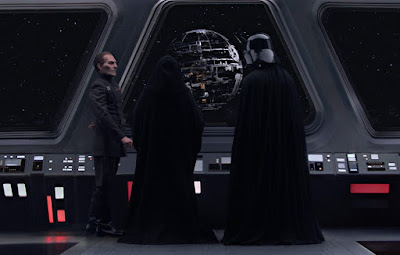
There was a lot of galactic history outside of just the movies. Remember that the Prequels established that the Death Star was at least in the conceptual stage as far back as Attack of the Clones, and that we saw the very beginnings of a Death Star shell under construction at the very end of Revenge of the Sith, whose events took place a full two decades before the Original Trilogy.

That shot has always been slightly problematic, hasn’t it? Is that supposed to be the very Death Star that would later show up in A New Hope? Did it really take twenty years to build it?

Maybe the one in the Episode IX trailer is neither of the two Death Stars from the OT. Maybe it was a prototype. Remember above, when I noted that the rock formation that Poe is standing on looks more than a little like some of those seen on Geonosis, the planet where the Death Star was first designed.

From The Rise of Skywalker

From Attack of the Clones

Again, I’m probably completely wrong in this, but this is what makes it fun!

So, what if our heroes are on Geonosis, where construction first began on the Death Star? According to the new canon established by Disney after their kinda-reboot, the Empire eventually moved Death Star construction away from Geonosis and sterilized the planet, killing all of the Geonosans. But maybe a prototype that was never operational was scuttled, and maybe that wreckage fell onto an already-dead planet, winding up at the edge of a Geonosan ocean.

Remember, from Rogue One we know that Death Star development took many years and ran into huge technical problems that were only surmounted once Galen Erso was brought in by Orson Krennic to figure out how to make the superlaser work. So maybe the crashed Death Star is one that was never close to working…but there’s something important about it.

Maybe…Kyber crystals, which power many weapons in the Star Wars universe, from lightsabers to Death Star superlasers.

Much rumor about Episode IX has at least part of the plot revolving around a secret mission that our heroes are entrusted with by General Leia Organa. Maybe that mission is to find the crashed Death Star and recover its Kyber crystals, for the Rebellion to use against the First Order. Maybe this time it’s the Rebellion that’s trying to build a super weapon, which would actually make sense, given how the Rebellion’s numbers were reduced in TLJ to the carrying capacity of the Millennium Falcon.

So, enough about Death Stars. What about our friend the Emperor? Old Papa Palpatine? Well, I was a bit surprised to head his laughter, along with everybody else. I’m less thrilled about this, since we’ve already had a Palpatine-back-from-the-dead story (in Dark Empire, a comics series that came out in the 90s and became an accepted part of the “Star Wars expanded universe,” as the non-film content before Disney’s Lucasfilm purchase came to be known). Also, a very-much still-active-after-all-these-years Palpatine negates yet another of the happy-ending outcomes of Return of the Jedi, if it turns out that Darth Vader’s self-sacrifice wasn’t to kill Palpatine but to just inconvenience him for a few years.

No, I’m not in love with the idea of Palpatine showing up again. But…here he is, apparently. In some form.

Backing up a bit, we have Supreme Leader Snoke, murdered by Kylo Ren in TLJ. I’ve been pretty open about my frustration regarding Snoke and his personification of what I see as some serious worldbuilding errors in this trilogy. Snoke is completely without backstory of any kind, which has always annoyed me. I’ve always been bothered by the fact that these movies give no explanation for how the triumph at the end of Return of the Jedi ended up being pretty much meaningless and that the galaxy went to shit anyway. We’re given this evil Force user (Snoke never actually claims the mantle of “Sith”), with no hint of where he came from or who he is or anything at all. And then he’s killed and that’s that for Snoke.

Or is it?

First of all, I’ve wondered if Snoke actually was killed in TLJ, because Luke Skywalker clearly establishes that for a Force user of sufficient power, projecting a physical copy of oneself across the universe is a thing. Maybe Snoke was doing that and thus was never in that Throne Room.

But maybe Snoke was just a simulacrum operated by Palpatine, or a mere puppet for Palpatine…or maybe Snoke actually was Palpatine. Maybe Palpatine has been a disembodied Force spirit who moves from one body to the next. Heck, springing off my point just above…maybe Palpatine was Force-projecting a copy of himself into the Throne Room in Return of the Jedi! Maybe Vader wasn’t throwing anybody into the shaft at all!

Well, probably not. But if Palpatine’s around in a way similar to the way that Yoda and Luke and others are, maybe this makes Kylo Ren the proxy stand-in for the entire line of Sith, just as Rey is for the Jedi.

You never know…and all this navel-gazing may end up completely refuted by the next trailer. I guess we’ll see…but we’re a mere eight months away from this movie’s release. Revealed, all shall soon be….

Share This Post

Travels Along the Yellow Brick Road

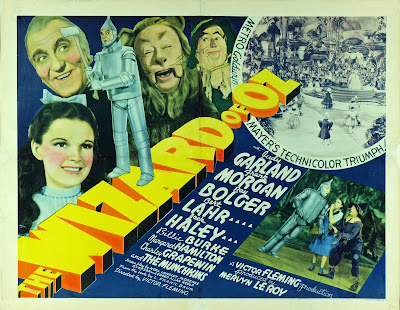
I suppose I am hardly unique among Americans in that The Wizard of Oz has been a part of my life almost as long as I can remember. I grew up during that hazy prehistory when the only way to watch Wizard was to wait an entire year for one of CBS’s annual airings of the movie—usually in springtime, as I recall. When you’re a kid that wait is so long that you’re barely aware of it. Suddenly one day it’s spring again, and one day you’re in front of the teevee to watch The Wizard of Oz.

I don’t remember much about those viewings of the movie when I was very young; just a few images here and there. I remember the early moment when Dorothy falls into the pig pen. I remember the Scarecrow pointing in both directions, and the Tin Man’s oil can, and the crown the Lion wore for his big song number, a crown made from a shattered flower pot. I remember the Wicked Witch melting, and Dorothy’s farewells to her friends. I always cried at those, and I’ve had a terrible time with “forever farewells” in stories ever since. The worst, though? I remember one year—maybe this was when we lived in Oregon, when I would have been a preschooler—that I burst into tears when the words “The End” appeared on the screen.

The Land of Oz, as shown in The Wizard of Oz, was my earliest fantasy world, and certainly the first one that I didn’t want to leave when it was time. More of those would come. I’ve always thought of Lloyd Alexander’s Prydain as my proto-fantasy world, but in truth, two came earlier: Middle Earth, via the animated version of The Hobbit, and the kingdom of Oz.

Nowadays, of course, I find that as a writer I too can be “that man behind the curtain.” In the end, after Dorothy’s adventures with her wonderful friends (who, I am sorry to admit, took me adulthood before I realized their strong resemblance to the farmhands of Dorothy’s Kansas home), the character with whom I identify most may well be the Wizard, that kindly and wise man who is still something of a charlatan.

Of course, experiencing The Wizard of Oz as a fleeting, once-a-year thing is long a thing of the past. First there was VHS and then DVD and then Ted Turner bought the rights so the movie showed up on TBS only a little less often than The Beastmaster. Now, you can pretty much watch The Wizard of Oz whenever you want. I don’t much pine for the “old days”, but there was a certain charm back then of going to school the next day knowing that you and all your friends would be equally basking in the post-Oz afterglow.

Several weeks ago, The Wife, The Kid, and I attended a screening of Wizard as part of its 80th Anniversary Celebration at one of the Fathom Events. (These are special screenings of many artistic presentations—classic films, live operas, and more—shown digitally at certain movie theaters.) Eighty years of The Wizard of Oz astonishes me on many levels. The movie came out in 1939, the year my father was born. I have a solid chance of seeing Wizard hit 100. The theater was packed on the day we attended, which for some reason we found surprising. We’ve been attending Fathom Event films off and on for a couple years now, and we’ve never seen the theater sold out. There were even families with children in costume, little girls in blue gingham dresses and “ruby slippers”.

This was the second time The Wife and I saw Wizard on the big screen, with the last time coming twenty years ago for the film’s 60th jubilee. Like any great film, the experience of seeing it on a big screen in a darkened theater crowded with people who are sharing the same journey is deeply different from watching it on the finest teevee or computer screen. The crowd laughs, hisses, and tears up at all the right moments. I found myself fearing a little that some of the film’s moments that have become so ingrained in popular culture as to become cliché might be met with laughter, but not so. No one sniggered at the Wicked Witch’s cackling threat: “I’ll get you, my pretty—and your little dog, too!”

I was struck at how funny this movie is, too. When Dorothy, running away from home early on in order to save her poor Toto’s life, encounters a man who is clearly a charlatan, he puts on a display of cold-reading that is dead-on, and the scene is intelligent and full of wit. This goes on throughout the movie, with laughs both famous and laughs that are only remembered when one encounters them, like a forgotten acquaintance for whom we once felt a particular fondness.

Wizard’s opening act is so engrossing that the famous moment when Dorothy enters Oz and steps into a Technicolor world, the enchantment is as spellbinding as ever. I do wonder what that moment must have felt like to the movie’s first audiences, back in 1939. Surely those audiences gasped loudly, because today’s audiences still do, even when they know it’s coming.

From that moment on The Wizard of Oz marches on, building its world quickly and confidently. It weaves its magic so completely that we never really stop for a moment to consider what we’re not being told: What’s so amazing about those Ruby Slippers, anyway? Why does the Wicked Witch want them so badly? What will she do when she gets them? And…do we care about any of that? Of course not. It’s fine. And when Dorothy meets the Scarecrow it’s at a fork in the Yellow Brick Road, so how do they know which way to go? Who cares! None of these things are lapses in the storytelling, just things left unexplained because they don’t need explanation. And so it goes.

(I do, though, wonder just where Scarecrow got the gun he’s holding in one scene. Once you realize the Scarecrow is walking around with a pistol, you can’t unsee it.)

I also rediscovered the delight of the music of The Wizard of Oz. Obviously “Over the Rainbow” is the film’s most iconic song (and how stunning that the producers briefly thought to cut it!), but every song in this movie is distinctive and cleverly written. The Munchkins’ “Follow the Yellow Brick Road” segues perfectly into “We’re Off To See the Wizard”, which becomes a recurring anthem as Dorothy progresses through Oz. And the introduction of the Munchkins themselves contains some incredibly witty wordplay, from the representatives of the Lollipop Guild to the Munchkin Coroner:

As Coroner I must aver,
I’ve thoroughly examined her;
And she’s not only merely dead:
She’s most sincerely dead!

A more cheerfully morbid lyric might exist, but as of this writing I’ve no idea what it might be.

The film’s songs and musical styles shift throughout the film, too. The Munchkins have their childlike sound, contrasted with the good cheer of the denizens of Emerald City as they welcome Dorothy and company to the “Merry Old Land of Oz”. Surprisingly, after the Cowardly Lion’s “If I Were King of the Forest,” the movie stops being a musical: there are no more numbers at that. I wonder why that might be the case. Maybe the producers didn’t feel the need for any, or maybe they felt that any songs past that point might slow down the narrative. I don’t know that any other songs might have worked. Maybe a reprise of “Over the Rainbow” as Dorothy sits captive in the Wicked Witch’s tower, which might be when she seems to really start to learn the film’s central message that “There’s no place like home.” I don’t know if that would have worked, but it is interesting that Dorothy’s initial dream of going “Over the Rainbow” is not bookended in song with her learning that she doesn’t really need to go over the rainbow at all.

This screening was also the first time I’ve seen The Wizard of Oz after we saw the Broadway show Wicked, which tells the story of the Wicked Witch, whom we learn is named Elphaba. The movie is, of course, very much its own thing, and I found that at no point was I envisioning the events of Wizard in light of the events of Wicked. The Wizard of Oz is such a classic as to maintain its own storytelling heft, which stands alone, unshared by such follow-ups as The Wiz, or Wicked, or the 1980s movie The Return to Oz.

Ultimately The Wizard of Oz remains what it always was, what it always has been: a grand fantasy, a touching story, a thrilling adventure, a witty and sophisticated tale, a wonderfully tuneful musical, and ultimately a sublimely well-made film that is a constant touchstone for the youth in all of us. And why shouldn’t it be that? It is, after all, dedicated on screen to the “young in heart.”

Share This Post

“Happy beeps, buddy. Happy beeps.” (Thoughts on THE LAST JEDI, conclusion)

part 1
part 2
part 3
part 4
part 5
part 6
part 7
part 8
part 9

So here we are, at long last: the last installment of my longform review of The Last Jedi! Huzzah!! We have now reached the “Random Observations and Thoughts” part of the review, so here’s a bunch of stuff in no particular order or with any particular logical through-line. Here we go:

::  The Last Jedi may well be the most beautiful Star Wars film ever made. This is a series that has always amazed on the visual level, but this movie goes above and beyond. It is full of astonishing visuals that make it amazing to look at, shots that are wonderfully composed. Look at some of these compostions:

Even more than that, though, is the way a lot of the film reflects George Lucas’s own visual style, particularly as was established in the Prequel Trilogy. Throughout the Prequels, Lucas rarely let the camera come to a stop. He was always moving, either panning or zooming in or zooming out. Even during scenes of quiet conversation he would alternate cuts between speakers and the camera would be zooming, creating a kinetic quality even to conversations that should have been static. Rian Johnson does much the same in TLJ, more often than not having the camera moving even during shots that don’t seem to call for it.

Johnson engages other visual call-backs, too. When Kylo Ren is flying his fighter and lining up for the shot to kill Leia, there are quick cuts from him to Leia and back again, reminiscent of the similar cuts between Luke and Vader at the end of The Empire Strikes Back, as the Falcon is fleeing. With some of the most striking visuals in any Star Wars movie, TLJ nevertheless makes it clear that we always are looking at a Star Wars movie.

::  Random quibble: Doesn’t it seem like the First Order always seems to have a Big Gun that blows up whatever they need to blow up at any one time? We had Starkiller Base in the last movie, which could blow up every planet in a star system from quite a long ways away. Then we have the dreadnought at the beginning of this movie, which can obliterate capital ships with a single shot (I assume, anyway–we never get to see it fire). Then, when faced with a nearly impregnable steel door sealing off the Resistance base, out they roll with a “Battering Ram cannon”! All this hyper-specificity of their Big Guns is getting a little odd.

::  Random observation: The humanoid dude on Canto Bight, who reports Finn and Rose to the police for having parked their shuttle on the beach? I love that he had a southern accent. I thought that was cool. “Yup, there’s those shuttle-parkers!” We’ve now heard “Yup” in a Star Wars movie.

::  I really really really love this movie’s opening battle sequence. The whole thing is just really well done, from Poe Dameron’s taunting of Hux all the way to Leia’s slumping in her chair when she sees the price they’ve paid to destroy one Imperial ship. This sets the tone: one moment of triumph and victory, but it means nothing at all. There are a lot of great moments in that battle. I especially like Paige Tico’s desperate attempts to get the bomb launch control, and the close-up on half her face as the explosions that will kill her mount below, and the look on Captain Canady’s face as he realizes he is screwed.

::  Speaking of Captain Canady, I like how this movie depicts the second-tier First Order officers as being experienced and even somewhat competent. Canady’s growl of “Of course they are” when he’s told that the Resistance is attacking with bombers is great, as is that other officer’s when Poe Dameron is verbally poking General Hux: “I think he’s tooling with you, sir.”

::  Of all the characters in this new Disneyfied Star Wars, BB8 is the clear champion at picking up the mantle of his obvious precursor, R2-D2.

::  Speaking of R2, if you didn’t tear up when he played Leia’s original “Help me, Obi Wan Kenobi” speech to Luke, I don’t want to know you.

::  In all the commentary I’ve seen about Luke’s lifestyle on Ahch-To, everybody focuses on the sea-cow things that give blue milk. Fair enough, but nobody mentions that utter bad-assery of his spear-fishing technique.

::  As is often the case with Star Wars movies, storylines that have different characters going to different planets seem to occupy different timeframes. It’s hard for me to square the time that Rey spends with Luke with the short timeframe that the rest of the movie occupies. This same thing happened in The Empire Strikes Back, when Luke’s training on Dagobah seems like it should take a lot longer than Han and Leia’s adventures on the Falcon. A single line from Luke could have fixed this:

LUKE: There are certain planets in the galaxy…planets that are strong with the Force…where time itself seems to slow down. So maybe if I stay here long enough, nine hundred years I will reach, too.

Just a thought.

::  You know what’s never mentioned much at all in Star Wars until this movie?

Reading.

I’m trying to think of an instance where books are mentioned at all in Star Wars, and this is the first time that I can recall. And even here, the idea of reading is paid short shrift, when Yoda gets Luke to admit that he hasn’t actually read the “sacred Jedi texts” with the pithy observation that “Page turners, they are not.”

And yet Rey swipes the books, so when the tree is burned, nothing is destroyed. This is interesting to me. Clearly Rey will need to become a self-taught Jedi, which is interesting in itself. I wonder how that will go.

:: I wish I could credit this correctly, but I saw it online someplace a couple weeks ago and I have no idea where. But the idea is this: Luke’s actions at the end of TLJ constitute the single most Jedi moment in Star Wars history, in terms of what we know of actual Jedi teaching. He takes an utterly pacifist approach and, for a moment, brings the Galaxy’s strongest military to a complete stop. He uses the Force for “knowledge and defense only, never for attack” (Yoda’s onetime words). It’s really something.

::  Plot hole: according to the movie, tracking ships through hyperspace has been “impossible”. And yet…the Empire tracked the Millennium Falcon through hyperspace (via a homing beacon) way back in A New Hope! Oops.

::  Admiral Holdo’s piloting of the frigate at light speed into Snoke’s ship is one of the movie’s more impressive moments (especially with the way the soundtrack drops to pure silence for several seconds). One wonders, though, why at various points in the previous movies nobody solved big problems by doing the same thing. Couldn’t the Rebel Fleet arrive at Endor and, as soon as the shield is down, put one of their big ships on auto-pilot and hyper-crash the Death Star II? Or is it a desperation move on Holdo’s part, a “Well, nobody’s ever tried this before” kind of thing?

::  Speaking of Admiral Holdo, I loved her character and I wish she hadn’t had to die. Alas!

::  I prefer the crystal fox things over the Porgs.

::  So Yoda can do Force stuff in the “physical” world even though he’s part of the Force now? Kinda makes me wonder if he could have been a bit more helpful to Luke in the second duel against Vader. Hmmmm.

::  I continue to be impressed with John Williams’s work on these movies! This score is rather different. There are really only two new themes in evidence, a hopeful and optimistic theme for Rose Tico, and a theme for Luke’s exile. The rest of the score is a revisitation of existing themes, but everything melds together wonderfully. I notice in this trilogy that the old “Rebel Spaceship Fanfare” has become a theme for the Millennium Falcon. Also some re-use of earlier material might seem lazy, but it works. The quote of the “TIE Fighter Attack” music from A New Hope when the Falcon blazes into the crystal cave is utterly thrilling, and I loved hearing Yoda’s theme and the piano version of Leia’s theme. John Williams never fails to deliver with these movies, and as he’s already indicated that Episode IX will be his last, I hope he can go out on an equally high note.

::  Speaking of Episode IX, what to expect? Well…I’m not super optimistic, because JJ Abrams is writing and directing. Sorry, Geek Lords, but while I’m fine with his directing, I remain on the “Unimpressed” side when it comes to his writing. Rian Johnson took the pieces left by Abrams and Kasdan in The Force Awakens and did what I consider to be a pretty damned good job, telling a story that I actually love despite the fact that I dislike a lot of its starting points and premises. What will Abrams do? Who knows. Johnson took some creative risks, but Abrams seems to often play it fairly safe in these sorts of things, so I wouldn’t be surprised if what we end up getting mirrors Return of the Jedi more than The Last Jedi mirrored The Empire Strikes Back.

Further, I do rather expect some disjointed storytelling. This entire trilogy does not convey to me a sense of being any one person’s story; it feels like storytelling-by-committee, and I suspect that will continue. The story of the Skywalkers will likely feel like it is limping to its conclusion while the movie keeps doing the job of setting up the new trilogies and teevee shows to come. Whatever their flaws, George Lucas’s first two trilogies were always focused on the story; sadly, the story now feels like it’s a secondary thing, even as good as TLJ is. And that’s sad.

But what might Abrams actually do? Well, I dunno. He’s got to rebuild the Rebellion from the handful of people on the Falcon. He’s got to deal with the fact that Princess Leia must die between films (I consider recasting a non-starter). He’s got to deal with Rey’s blossoming with the Force. And a lot more. I doubt that anything will happen in Episode IX that will alleviate the awful worldbuilding of the first two movies in this trilogy, so that’s a flaw that ain’t going anywhere.

Will Rey’s parentage turn out to be what Kylo Ren said it was? Maybe.

Will Snoke stay dead? Maybe…but maybe not. If Luke Skywalker could project a physical copy of himself across the galaxy, why couldn’t Snoke?

I hope that however things wind up, in the end we see Rey, Finn, and Chewie (and probably a few of those damned porgs) flying off in the Falcon to have adventures together.

And there had better not be any kind of redemption arc for Kylo Ren. Screw that guy.

And…well, that is finally about it. That wraps up my long-arsed review of The Last Jedi. See you in December of 2019, folks!

Share This Post

Attack of the Screw-ups (Thoughts on THE LAST JEDI, part 9)


part 1
part 2
part 3
part 4
part 5
part 6
part 7
part 8


Ye Gods, there’s a lot of failure in this movie, on all sides. Nearly everybody fails in this movie at least once. I don’t recall a story so completely full of capital-F FAIL in quite some time. Let’s take a photographic tour of all the FAIL in The Last Jedi!!!

Seriously, that is a lot of screwing up, across the board. What gives?

For me, all the failure in TLJ is one of the most interesting things about its story. Over the course of the movie everybody fails at one thing or another.

The First Order attempts multiple times to snuff out what’s left of the Resistance.

The Resistance takes out one of the First Order’s biggest ships, but at way too high a price.

The Resistance attempts to flee to safety, but fails.

Kylo Ren tries to kill Leia, and fails.

Finn tries to flee the fleet so that Rey won’t fall to danger, but he is stopped by Rose.

Finn and Rose fail to deactivate the First Order hyperspace tracker thingie.

Phasma fails to kill Finn and Rose.

The Resistance tries to flee its doomed last ship in cloaked vessels, and fails.

Snoke thinks he sees what Kylo Ren is thinking, but fails to his own doom.

Rey thinks to appeal to Kylo Ren’s good side, and fails.

At the end, the Resistance is trying to call for help…but fails. Meanwhile the First Order is closing in, with more than enough firepower to win the war right then and there…but they fail.

Only in the film’s last act does anyone succeed…maybe. Luke Skywalker manages to command Kylo Ren’s attention, and therefore the rest of the First Order waiting, while what’s left of the Resistance can get away. Meanwhile, Luke’s would-be pupil, Rey, who hasn’t really learned a hell of a lot about the Force in his presence, steps up to rescue the fleeing Resistors.

All this failure strikes a keenly interesting tone for this so-very-different Star Wars tale, combined with the film’s very short timeframe and its deeply intimate feel. TLJ makes the war feel like a war of attrition, with all the compounding failures piling up on one another. By the end, when the Resistance numbers less than twenty people, Rey can’t even see a way forward. But Leia can, and assures her that there actually is one, in point of fact.

This, then, is the difference in the failures. The failures of the First Order, of Snoke, of Kylo Ren, all feel like failures of over-confidence and hubris. The Resistance’s failures, though, are something different. They are fighting the good fight, trying to ensure not victory but survival. This leads to the kinds of stories that get told again and again over fires. As a result, the Resistance’s failures feel like lessons being learned and valuable experience being gained. The Resistance is leveling up, while the First Order is not. Kylo Ren clearly believes that there are no more lessons for him to learn…while Rey knows that she is just getting started.

And in the end, all the failure by our heroes has the best result of all, as Luke has already told us.

Next up: Concluding thoughts and random impressions and speculations.

Share This Post

“Are you the fellow who designed St. Paul’s?” “No, that’s Christopher WREN. I’m….” (Thoughts on THE LAST JEDI, part 8)


part 1
part 2
part 3
part 4
part 5
part 6
part 7

Hey!

Hey guys!

If Kylo gets together with a bunch of his buddies, is that a Ren-fest?

OK, fine. But let’s talk about Kylo Ren anyway.

I keep getting this feeling in these two movies that Kylo Ren should be a really interesting character. Adam Driver gives it his all, and he almost single-handedly elevates the character, but the problem with Kylo Ren that TFA had is the same one that TLJ continues. The basics just aren’t there, and TLJ doesn’t really do much to correct the issue like it did with its heroes. Kylo Ren remains little more than a scenery-chewing villain who wants to be evil for no discernible reason. We still have zero idea of his motivations beyond that he wants to be powerful and kill Jedi and stuff, but we still have no idea why. We have no idea what tempted Ben Solo to the Dark Side. We still have no idea what awful choices he made to get to this point. We still have no idea at all how Snoke got his hooks in him. There are a couple of flashbacks to the final moment of his turning, but they are treated in Rashomon-like fashion, and anyway, the last fall isn’t really all that interesting, when you get to it.

Kylo Ren was pretty much always on his way down, and TLJ tells us nothing new about him at all.

In Star Wars, falling to the Dark Side is always presented as about the most tragic thing that can happen to a person. It’s a complete abdication of great promise, this decision to use one’s innate powers for awful ends. Kylo Ren’s story should be doubly so–he is the son of Han Solo and Leia Organa–but again, we learn nothing of it. And again, as with Snoke, it’s no good to simply say “Well, we didn’t know anything about Darth Vader’s fall either,” because again, what you can do in the opening chapters of a story isn’t the same as what you can do farther on when you know your universe and what can happen within it.

Kylo Ren is deeply angry, but why? He has all this rage for his parents and for Luke, but why? He talks vaguely about needing to destroy the past–“Kill it, if you have to”–but again, why??? What is the point of all this? Is he just tempted by power and nothing else? Maybe he is, but then the films should acknowledge that…and frankly, I don’t look to Star Wars for meditations on the banality of evil.

Reasons are completely absent, and so are his desires. Why is he so invested in working with Rey? He’s only just met her a few days before. Is it because he senses someone as powerful as he is? Maybe, but maybe not–the film supports either reading. Likewise, until the moment he strikes, there is no indication that he intends to kill Snoke and take over. Is this an idea that has just occurred to him? Who knows? The moment is interesting as a second fratricide, actually. Snoke is the second father-figure that Kylo Ren kills in a matter of a few days. And yes, Snoke is a father-figure. How else to describe the wounded look on Kylo Ren’s face after his scolding early in the movie? That’s the look of a son who has just been tongue-lashed by the father he has been itching to please.

But again…why has Kylo Ren forsaken his own father for this guy?

We don’t know.

I don’t ever get the feeling of knowing Kylo Ren. He is pretty much a total mystery. Rey claims to feel “conflict” within him, but there is nothing at all for us to base that on…and she turns out to be completely wrong, anyway. He has killed his real father, he kills his second father, he is prepared to kill his mother. He talks of “killing the past” but he lives with all the various trappings of the Sith and the Empire: he is as big a slave to the past as anyone else.

Ultimately I have no idea what to make of Kylo Ren as a villain. I have no idea where he wants to go or why he wants to go there or why he hates where he’s been. Adam Driver’s terrific performance aside, ultimately this new Star Wars trilogy is really faltering with its villains, and it’s a shame.

Next: TLJ and failure. Are we almost done? Maybe! Maybe not! Tune in and find out!

Share This Post

Snokin’ in the Boys Room (Thoughts on THE LAST JEDI, part 7)


part 1
part 2
part 3
part 4
part 5
part 6

If the main heroes were underdrawn in TFA, the villains were doubly so. The First Order’s origins were completely unexplained, as was its power differential: was it the Empire reborn, or was it some insurgent effort? How did it have the means to build a superweapon over twice as large and powerful as either Death Star, which the Galactic Empire could only manage to build twice? How was the First Order managing to stockpile its armies with troopers kidnapped apparently as kids, and yet managing to do this with no one at the Republic noticing a sudden and massive uptick in child abductions? How much territory did they control? If this mission to get the map to Luke Skywalker is that important, why is a rookie space janitor on the away team? And who was Supreme Leader Snoke and where did he come from?

TFA was almost comically deficient in its worldbuilding with regard to its villains, and to add insult to injury it gave us General Hux, who was an annoying enough character to begin with before he was the central figure in what I have decided is, for now, the Single Worst Scene In Star Wars History: the “Space Hitler” speech. That scene was so bad that it actually eclipses the “Jar Jar meets Padme” scene from The Phantom Menace.

The villains of TFA were awful across the board, including Kylo Ren, whose motivations were as unexplained as Rey’s or Finn’s. They were little more than mustache-twirlers, people who were evil just because they were evil. One could answer “Who cares?” to a lot of my questions about their backgrounds and motivations, and I suppose that’s kind of fair. “We never knew Palpatine’s backstory in the Original Trilogy!” one might say. Or, “We never found out why Vader fell until four or five movies in!” Yeah, OK.

But.

When things happen in a story matters. In the first film or two or three, when you were basically in the first part of your story, you can get away with leaving some things for imagination or for Part Two. You don’t have to explain who Palpatine is and why he became Emperor; all that matters at the outset of your story is that there’s an Empire and he’s the one ruling it.

Now, however, we are eight episodes into this story, and what’s more, we’ve been told that after the happy ending of the first part we’re supposed to accept that none of it ended up meaning anything, that there’s a new Empire in town with a new red-lightsaber-wielding dude in charge, and so on. Well, I submit that if you do that when you get to your last few chapters, you need to put some work into explaining it.

Sadly, while Rian Johnson’s script for TLJ has a lot of things going for it, its treatment of the villains is for the most part not one of them.

Let’s start with my favorite, General Hux.

(NARRATOR VOICE: Hux is not his favorite.)

Hux fares a bit better this time out. There’s no embarrassing Space Hitler speech, and actor Domnhall Gleason does a nice job conveying Hux’s arrogant self-satisfaction: the way he smirks a lot and strides about with his hands behind his back. His job is still mostly to act mean and threaten the Resistance with utter destruction, but he does get a few interesting moments. Just a few, though. Mainly Hux is still the guy whose job it is to yell “Fire!” when the Resistance ships line up in the crosshairs. There is some nice development of the tension between Hux and Kylo Ren, including a moment after Snoke’s death when Hux, noticing Ren on the floor, starts to draw his blaster as if to kill Red and take over.

The opening scene uses Hux’s self-inflation to nice comic effect, actually: he is talking on the radio to Poe Dameron, and he’s going into full Space Hitler mode, when Poe breaks in and says something like “I’m sorry, I was waiting to talk to Hux. Is he there?”

Hux is, though, a pretty generic character. We are told nothing about him at all. He’s not much fun to root against, because let’s be honest–at no point does anybody really think that Hux might win.

Next up? Captain Phasma.

All the TFA pre-release publicity made Phasma sound like a total bad-ass…and then she turns out to be utterly useless, a complete waste. She is so staggeringly worthless in TFA that I was frankly astonished that a novel about her earlier “adventures” was commissioned by Disney. Delilah S. Dawson wrote it, and I’ve heard good things about it, but I doubt I’ll read it because I expect I’d have a terribly hard time squaring Dawson’s well-drawn character with the useless mirrored-shades armor character in the movie. In TLJ Phasma doesn’t show up until late. She acts a little menacing, babbling about how executions should hurt, and then all hell breaks loose and Phasma only sticks around long enough to get her ass kicked by Finn and then call him “Rebel scum” before falling through the collapsing deck into a giant rolling ball of fire. (I hope she’s dead this time.) We do get this one nice exchange, courtesy of Phasma:

PHASMA: You’re always scum.
FINN: Rebel scum.

I like that, but to bring Phasma along just to have that discussion seems a little weak to me.

There’s actually a deleted scene from TLJ where Finn taunts Phasma by pointing out that she deactivated the Starkiller Base shields, so really, that defeat is on her. I can see why they cut it–it’s nice and all, but it’s not needed. Phasma isn’t interesting enough to constantly show up. She’s kind of this trilogy’s Boba Fett…although Fett actually did get something done, back in the day.

Ultimately I find it telling that the only Imperial character who strikes me as being especially competent is the Captain of the Giant Death-Dealing Star Destroyer in the first scenes, and he gets blown up for his troubles.

And now to Snoke.

Snoke, Snoke, Snoke.
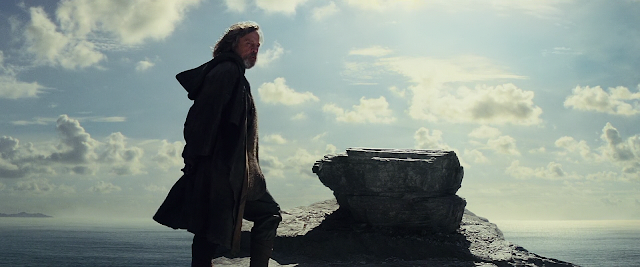
You know, you’d like to be able to hate your villains and hiss when they show up on screen, but Snoke is just…a giant nothing. That’s all he is. There is literally nothing there. We are still told nothing about where he came from, how he rose, what his motivations are, where his powers come from, whether he considers himself a Sith…none of it. Snoke is a complete cypher, a giant fill-in-the-blank, and it bugs the hell out of me.

Some, again, have argued that it doesn’t matter. After all, in the Original Trilogy we knew nothing of Palpatine–in fact, we didn’t even really know that his name was Palpatine. But again, so what? We’re not in the Original Trilogy now. We’re eight episodes in, and the sixth episode ended on a note of triumph that the seventh episode completely negated, without explanation. This is not good storytelling, and to the extent that a great deal of Star Wars relies on its villains, it’s not good worldbuilding either. I’m not saying that we need a complete backstory on Snoke, but something to go on would help. As it is, he’s merely the Star Wars equivalent of one of the lesser James Bond villains. (Quick! What was the bad guy in Die Another Day trying to accomplish? You don’t know, do you?)

Snoke’s rise could play into one of this trilogy’s apparent thematic concerns: that the Force need not be eternally separated into Jedi and Sith. Surely there are Force-users who have naught to do with the orthodoxy of either group, and surely there are some who are enormously powerful and evil. The Prequels hinted at this when they had the Jedi initially refuse to train Anakin even though he was clearly very special. These movies are hinting at Force-use that goes beyond the simple Jedi-Sith spectrum, but they are also somehow deeply hesitant to really explore that angle. Kylo Ren pays a bit of lip service to the idea, but note that despite his whole “Kill the past!” thing, his entire support structure is The Empire 2.0, with stormtroopers and star destroyers and AT-ATs and TIE fighters.

Of course TLJ has Kylo Ren kill Snoke in a shocking twist (I really was surprised), but this would have been even more interesting if we had the slightest idea who Snoke was. As it is he’s just an obstacle for Kylo Ren to overcome on his way to whatever it is that he wants, and that’s a problem too–but more on that another time. Besides, is Snoke really dead? Who knows? If Luke could cast a physical projection of himself across the universe, who’s to say that Snoke couldn’t do the same thing? Maybe, maybe not. For now it remains the case that Snoke, for all his tall height and nifty-looking guards (in red, echoing Palpatine’s–quite the break with the past there) and his incredible-looking throne room, is just paint-by-numbers, and barely that. I expect we’ll get Snoke’s story at some point, but it’ll be in a novel or comic or something–not in the movie where it belongs.

Which brings us to the actual most interesting villain in TLJ: DJ, the hacker-thief played by Benicio Del Toro. For the first time since Lando Calrissian we have a Star Wars character who is genuinely motivated by little more than self-interest. DJ openly points out that his main concern is money, and he displays virtually no moral compass whatsoever. He steals a ship to rescue Finn and Rose, and he agrees to help them in their scheme to deactivate the First Order’s hyperspace-tracker thing, but he also points out that the owner of the ship he’s stolen profited by business dealings with both the First Order and the Resistance.

It’s all business to DJ, so when he finally betrays them for money, it’s not the least bit surprising. He just shrugs and tells them that some days you win and some days you lose, in the most nihilistic claim in a Star Wars movie since Han Solo’s “I’m not in it for you, I’m in it for the money” all the way back in A New Hope. But there’s no last-second redemption for DJ, no last-minute heroics to show that his heart really is in the right place. He takes the money and goes, never to be seen again (at least in this film). The addition of DJ and his neutral morality is a fascinating thing for Star Wars, and it’s interesting to note that of all this film’s villains, we know the most of DJ’s motivations and character.

It will be interesting to see if DJ returns in Episode IX–maybe the Rebellion finds itself with no choice but to roll the dice on him again. Or maybe he just goes away, never to be heard from again, except for when he inevitably turns up in a novel or comic.

This all brings us to the main villain of TLJ, but…more on Kylo Ren next time. Tune in, Star Warriors!

Share This Post

“People will come, Rey!” (Thoughts on THE LAST JEDI, part 6)


part 1
part 2
part 3
part 4
part 5


I was never bothered by Rey’s abilities in TFA, the way some fans were. What bothered me was that there was no acknowledgment that she was aware of her nature, nor was there any hint of what she wanted. In TFA Rey had just one stated motivation: to get back to Jakku so that she could maintain her apparently lifelong vigil for the return of her parents. That was it. Even at the film’s end, when Starkiller Base was destroyed and Han was dead and she had fought off Kylo Ren, we didn’t even know exactly why she went alone to find Luke Skywalker. Most assumed that it was to seek his training in the ways of the Force, but it was also clear that Leia was hoping for Luke’s return so he would help fight the First Order.

So in TLJ, Rian Johnson addresses almost all of that in Rey’s first minutes of screen time. He completely ignores her oft-stated desire to return to Jakku, and instead writes this wonderful exchange:

LUKE: Where are you from?

REY: Nowhere.

LUKE: No one’s from nowhere.

REY: Jakku.

LUKE: All right, that is pretty much nowhere. Why are you here, Rey from nowhere?

REY: The Resistance sent me. The First Order has become unstoppable–-

LUKE: Why are you here?

REY: Something inside me has always been there…but now it’s awake, and I’m afraid. I don’t know what it is, or what to do with it, but I need help.

This is more than we ever got for any kind of motivation for Rey in TFA, and it’s really very welcome here. Johnson wastes no time establishing Rey’s desires, and also the degree to which she is powerful. Luke sees her enormous Force potential, and he admits that it scares him. He resists the idea of teaching Rey, and she seems to be resisting a bit as well. Her real job is to bring Luke back to the fold, so he can reestablish the Jedi Order and help the Resistance. It’s not certain at this point if she sees herself as a Jedi-in-waiting. She never states any desire one way or the other, except that she wants to know what to do with this thing that’s inside her. Rey’s entire story is her search for herself, and only at the end of the story does Rey find her purpose as she seems to be taking on the mantle of the Jedi herself. She will have to find her own way forward.

This fits in with what we learn about Rey. Through the Force, Kylo Ren sees Rey’s lineage. Even though a lot of speculation after TFA had Rey being someone hugely important–she’s Han’s daughter! She’s Luke’s daughter! She’s Ben Kenobi’s daughter!–it turns out, at least for now, that Rey’s parents were shitty junk dealers who sold her into slavery for some booze money and now they’re dead in an unmarked grave. Rey’s heritage is meaningless, irrelevant. The Skywalker Saga won’t give way to the Rey Family Saga.

I wondered, the very first night I saw TLJ, if Rian Johnson was slyly alluding to Lloyd Alxander’s Prydain Chronicles. That series is an epic fantasy about a young farm boy of unknown parentage who dreams of heroism and destiny and all that, even as he is drawn into the historical events of his age. He is certain he is of noble blood–the book’s magic sword even seems to indicate that he is–even though his lofty position is that of “Assistant Pig Keeper”. It turns out that no one knows who he is. His own master, a kindly and powerful wizard, found young Taran as a babe crying in a field, and even as Taran does eventually take the throne as High King he has no more idea of his heritage than he ever did. Likewise with Rey…and both this film and the Prydain books have a sequence in which the respective heroes look into magic mirrors, hoping to see who they really are, only to see themselves.

Rey’s journey in TLJ also mirrors Luke’s in a way, and Anakin’s before that. Each at one point sets aside duties and imperil their friends by rushing into situations they shouldn’t: Anakin’s flight to his mother’s side in Attack of the Clones, which ends with his failure to save her and his rage-filled slaughter of the sandpeople; Luke’s rush to save his friends and confront Darth Vader on Bespin in The Empire Strikes Back. Rey’s plan is to turn Ben Solo away from the Dark Side, just as Luke did Vader. (Quibble: How does she know that story? Is it common knowledge? Should it be?) This turns out to be impossible: Ben is fully committed to the point that he kills his own teacher in a Darth Plaguis moment–and just like that, the sides are drawn. Rey is given a choice here: Ben tempts her, but she turns away and chooses the light all on her own. She has chosen the Jedi path, whether she really knows it or not.

Yoda knows this, when he appears to Luke on Ahch To. That wonderful line of his–“We are what they move beyond. That is the burden of all true masters.”–illustrates that Rey has made her choice and she is now moving beyond what Luke had to offer. As the film ends, Rey has been tempted and she has passed the test. She is frightened of what is to come, and she is daunted by the task, but she has found–just as Luke found–peace and purpose.

It’s interesting to see where Rey stands, two episodes into her story, compared with Anakin and Luke two episodes into theirs. Rey isn’t broken. She isn’t defeated. She has all her limbs. She is determined and has a better grip on things than either of the previous two heroes at these points in their stories. This could make for an interesting starting point next time out…which depends on JJ Abrams, so all bets are off.

Next time: the villains. (Spoiler: I remain unimpressed.)

Share This Post