
I watched this during lunch today and it’s great!
Hey! Need some love music?
I made a playlist of love songs! 50 songs, 3 hours of music!
(Now, I originally conceived this little exercise as a playlist for our wedding reception if The Wife and I were getting married now, or renewing vows, or just having an anniversary party, which is why there’s one song on here that doesn’t match the theme…well, it kind-of does, if you know some of the history and backstory of the song, but really, it’s just a great dance tune which is why it’s there.)
The playlist has some obvious selections as well as some more obscure stuff, though if you’re a long-time reader here you’ve likely heard most of these. Enjoy!
Share This Post
Something for Thursday
Burt Bacharach has died. He was one of those ultra-prolific songwriters (along with frequent partner Hal David) who, for every song you knew he wrote, there’s probably two songs you know well that you did not know he had a hand in.
For me, this was one. I perused a list of Bacharach songs and discovered that this was one of them. I never knew he wrote it.
Here’s “I Say A Little Prayer”.
(UPDATE: I feel like I should write something more about Bacharach and his legacy, but I’m really not the best person to do that. If anyone sees any particularly good tribute pieces on him, let me know and I’ll link them.)
Share This Post
A song for a random Saturday
“Oh my darling….”
There’s a frankly ghastly anti-smoking ad that seems to be showing up on teevee a bit of late; I’ve seen it nearly every day during visits to my parents. I’m not embedding the damned thing here, but if you MUST watch it, here it is. The ad features a kid singing a broken, increasingly guilt-ridden version of “My Darling Clementine” as his mom gets sicker and sicker from smoking.
(No, I am not defending smoking, but this particular ad is some depressing shit.)
So, as a possible antidote, here’s Bobby Darin’s swinging (and oh, so very fatphobic) version.
Share This Post
The Chairman of the Board will see you now.
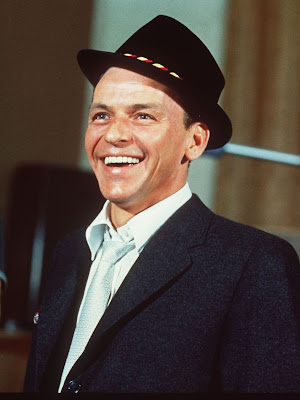

Sheila O’Malley has a typically lovely post about Frank Sinatra, whose birthday is today. I started composing a comment on her site, but then I realized that my thoughts were getting away from me, so I decided to bring it over here. Sinatra has been a part of my universe for as long as I can remember; my parents owned a bunch of his records, which were on constant rotation in my childhood. I remember his distinctive sound, sometimes clear and sometimes with just a hint of rasp (depending on what he wanted to express), his sense of rhythm (he could make a song swing without any assisting percussion at all), his lyricism, and his unfailing sense of how to land the emotional beats of a song. This last gift is rare indeed, and it’s interesting to me that I’m featuring two singers so highly gifted in that regard on the same day (scroll down to today’s Daily Dose of Christmas post). And of course he wasn’t just a singer; Sinatra was also a very fine actor with a lot of range. He was in a lot of movies and he won an Oscar along the way and he still might be underrated as such.
The earliest of his roles that I’ve seen is Anchors Aweigh, in which he plays a Navy sailor who is very young and naive, who has to be instructed by his older buddy Gene Kelly in the ways of the world (meaning, how to flirt without seeming weird about it…in the late-1940s meaning of ‘flirting’). Somehow he pulls this off without getting blown off the screen by Kelly; in fact, the two men have a partnership in that movie that elevates it. Anchors Aweigh isn’t quite one of the immortal musicals–it’s no Singin’ in the Rain–but it’s damned close.
Just eight years later Sinatra put his dramatic skills on display in a dark turn as Private Maggio in From Here to Eternity, a movie that hit me between the eyes when I watched it in high school. I was channel-flipping lazily, and I happened to land on the opening credits; next thing I knew it was two hours later and the movie was over and I hadn’t touched the remote the entire time. Sinatra plays the cocky, arrogant young hothead whose actions end up costing him everything. There are some weird stories–legends, actually–about how Sinatra got the role in the first place, but it doesn’t really matter how he got it. The man ended up winning a Best Supporting Actor Oscar for it, and there’s a reason for that. Last time I watched From Here to Eternity I found it every bit as gripping as I did when I accidentally watched it as a sixteen-year-old.
Sinatra would bounce in and out of musicals a lot, and his dramatic turns always seemed to be in the crime genre. There was a teevee movie in the 70s called Contract on Cherry Street that I remember, and there’s his amazing performance in The Manchurian Candidate. He even turned up in the 1980s in an episode of Magnum PI, a show that often leavened its generally light-hearted tone with detours into espionage thrillers and, in the case of Sinatra’s episode, pure noir.
Maybe it’s easy to discount Frank Sinatra a little because of the genres in which he worked or the popular forms he pursued, but for my money, you can’t tell the story of American art in the 20th century without talking about Frank Sinatra.
Sheila starts her post with this quote (possibly aprocryphal) by Bing Crosby: “Frank is a singer who comes along once in a lifetime, but why did he have to come along in mine?” I can’t read that quote without thinking of High Society, a movie that was also a favorite of both my parents. It’s a musical remake of The Philadelphia Story, with Crosby as C.K. Dexter Haven (the romantic lead who is pining for Grace Kelly), and Sinatra as Mike Connor, the gossip rag reporter sent to cover Kelly’s impending nuptials. (Those roles were originated by Cary Grant and James Stewart, with Katherine Hepburn in the later-Grace Kelly part.) High Society is a fun movie, though this story is really better told in the original, as parts of the script had to be set aside to make room for the musical numbers, and…well, I have to agree with my sister, who once said on a Christmas Eve when one of Crosby’s Christmas movies was on and we’d all taken in a few beers, “Whoever thought to cast Bing Crosby as a romantic lead was out of their mind.”
Well, I don’t know about that, but it’s always struck me as very strange that this movie has Bing Crosby and Frank Sinatra together, and it gives them exactly one number together…and that number had to be added at the last minute when the producers suddenly realized that they had Crosby and Sinatra in the same movie with no shared numbers. Astonishing! Can you imagine such a thing? Almost making an entire movie with two of the 20th century’s greatest American singers in it and only realizing near the end that you’ve given them zero duets? That’s like having Babe Ruth and Mickey Mantle on the same team, but benching one of them at all times. Luckily for High Society, that one number is a hell of a number:
Of course, I can’t write about Sinatra without discussing his singing a little bit. Many years ago I read an interview with one of my personal musical heroes, the great Chicago Symphony orchestra trumpet player Adolph Herseht, in which among many other things he recommended that young trumpet players (among others) listen to great vocalists like Frank Sinatra, on the basis that all music, even for instrumentalists, starts with the human voice, and I remember Herseth citing Sinatra for always telling a story with his singing. That is absolutely true.
I’ll close this with my favorite track from my favorite Sinatra album, Frank Sinatra Sings for Only the Lonely. Just listen to Sinatra’s absolute control in this song! He fades away at the end, fading fading fading (“Answer, echoes, dying dying dying,” Tennyson might write), but his pitch never wavers, which is something that requires enormous technical skill: singing (or playing, if you’re on an instrument) a note correctly, and making it sound full, while also making it piano or pianissimo is a skill that many musicians don’t realize they need until well into their careers. And I’ll have to write sometime about my father’s favorite Sinatra song…but that needs a post of its own.
Share This Post

Your Daily Dose of Christmas!
Today, a suite from an opera by Rimsky-Korsakov! The opera is called Christmas Eve, and its plot involves a scheme by the Devil to steal the moon. Rimsky-Korsakov’s operas have suffered an unusual curse: they are well-loved and highly regarded by those who know them, but because they’re in Russian, a language that most singers don’t learn (and because singing operas in translation is out of fashion), they remain shrouded in obscurity, only known if at all through orchestral suites and excerpts like this.
David Dubal writes, in The Essential Canon of Classical Music:
Some of the best of Rimsky-Korsakov is contained in his fifteen operas, with their supernatural, pan-Slavic, mythological, and pantheistic symbolism. Unfortunately these operas remain unfamiliar to the vast majority of music lovers. They form an encyclopedic source of a lost, legendary, wild, and exotic Russia. According to the writer V.V. Yastrebsev, Rimsky-Korsakov confided, “You would scarcely find anyone in the world who believes less in everything supernatural, fantastic, or lying beyond the boundaries of death than I do. Yet as an artist, I love this sort of thing above all else. And religious ceremony? What could be more intolerable? But with what love have I expressed such ceremonial customs in music! No, I am actually of the opinion that art is essentially the most enchanting, intoxicating lie.”
It does surprise me that Rimsky-Korsakov, with his often beguiling melodies, magnficient orchestrations (few composers have ever wielded the full palate of the modern orchestra like Rimsky-Korsakov), and enchanting subject matter in many of his compositions nevertheless does not command a stronger position in the classical canon. I always enjoy listening to him, whether it’s something less familiar to me or a return to Scheherazade, one of my favorite classical works of all time.
So here’s a bit of Russian Christmas lore, depicted in the music of one of Russia’s great masters.
Share This Post
Your Daily Dose of Christmas!
Hey, it’s morning and I’m getting the Daily Dose out! See, I told you I’d get on track with this.
In 1994, a remake of the 1947 classic movie Miracle on 34th Street came out. If I recall correctly, it did OK and then mostly disappeared. I’m sure it’s streaming someplace and is beloved by a few, but like most remakes it does not seem to have supplanted the original in any way. [ASIDE: Hmmm, it now occurs to me that I quite literally have not seen the original since a day in 2nd or 3rd grade when I walked in on my mother watching it on teevee and decided to stick around.] The remake stars Richard Attenborough as the is-he-or-isn’t-he department-store Santa, and Mara Wilson as the cute-as-a-button kid who makes wishes.
While I haven’t seen that movie, I have heard quite a bit of the movie’s score, written by Bruce Broughton. Broughton is a composer who wrote quite a few really really good filmscores in the 80s and 90s; film music fans tend to view his work on Silverado, Young Sherlock Holmes, The Rescuers Down Under, and Tombstone as particularly fine scores. Broughton’s work is often redolent of the scoring styles of older composers from film music’s so-called “Golden Age”, and it’s just really good stuff, a lot of the time. I’m not sure why Broughton never really “broke through”, but he has enjoyed a long and productive career and he has produced a lot of fine music…which includes his work on the Miracle on 34th Street remake.
Here is a suite of Broughton’s music from that film. Enjoy!
Share This Post
“When the skies of November turn gloomy….”
Tone Poem Tuesday
Film music today! It suddenly occurred to me the other day that I haven’t heard anything by Jan A.P. Kaczmarek in a long time, so I gave a bit of his music another listen. My introduction to him was the gentle lyricism of his score to Finding Neverland, a wonderful movie you don’t hear much about anymore. Kaczmarek won the Best Score Oscar for this score, and he won it the year after The Lord of the Rings: The Return of the King won that honor, so in two years you had polar opposites winning the Oscar: a gigantic epic score of enormous complexity and orchestral grandiosity, and a quiet chamber work of delicate intimacy.
Finding Neverland tells a fantasized version of the story of J.M. Barrie and his creation of Peter Pan. The film abounds with dream-like sequences and flights of imagination, and these passages have a gossamer quality that is well served by Kaczmarek’s orchestral clarity. I love this score and hearing it again after a number of years was a delight. It’s always a pleasure to return to favorite works we’ve not visited in a long time, isn’t it?
I looked for a suite from this score, but the few that I found don’t feature the passages that I love most, so I decided to simply go with this: the entire score album presented at once. Plenty of tone poems are an hour long, so why not?
Here is Jan A.P. Kaczmarek’s score to Finding Neverland. If you can, listen to this someplace where you think there might be some magic lurking in the corners.