

National Poetry Month, day 13: Two poems about cats

Remy (l) and Rosa (r). I think. I find it hard to tell them apart at times.

Except for the time between Julio’s passing and our adoption of the two felines pictured above, I have never in my life not lived in the presence of at least one cat. (Unless we count my months in college.) Cats are an eternal presence in my life, and I don’t expect that to change, even as I have spent the last seven-and-a-half years discovering the unique magic that is dogs.

Many poets have written about cats, and here I offer two. First is a poem written (I think, since he’s credited with the teleplay for the episode) by Star Trek writer Brannon Braga, for a Next Generation episode entitled “Schisms”. At one point in the episode, Data presents a poem that he has written about his cat, Spot.

“An Ode to Spot”, by Lieutenant Commander Data of the starship Enterprise

Felis catus is your taxonomic nomenclature,
An endothermic quadruped, carnivorous by nature.
Your visual, olfactory, and auditory senses
Contribute to your hunting skills and natural defenses.
I find myself intrigued by your subvocal oscillations,
A singular development of cat communications
That obviates your basic hedonistic predilection
For a rhythmic stroking of your fur to demonstrate affection.
A tail is quite essential for your acrobatic talents.
You would not be so agile if you lacked its counterbalance.
And when not being utilized to aid in locomotion,
It often serves to illustrate the state of your emotion.
Oh Spot, the complex levels of behavior you display
Connote a fairly well-developed cognitive array,
And though you are not sentient, Spot, and do not comprehend,
I nonetheless consider you a true and valued friend.

I would not dream of analyzing this as a poem in itself, but I do think it an excellent bit of character writing. By this point in the series (the sixth season), the characters are so well-known that crafting a poem that (a) is not bad and (b) actually sounds like it was written by a specific fictional character is no small task.

Here, by contrast, is probably the greatest of all cat poems. I won’t go into depth here, because Sheila O’Malley just did the other day, and she did so much more skillfully than I could. But here’s the poem, and what a work it is!

“For I Will Consider My Cat Jeofrey”, by Christopher Smart

For I will consider my Cat Jeoffry.
For he is the servant of the Living God duly and daily serving him.
For at the first glance of the glory of God in the East he worships in his way.
For this is done by wreathing his body seven times round with elegant quickness.
For then he leaps up to catch the musk, which is the blessing of God upon his prayer.
For he rolls upon prank to work it in.
For having done duty and received blessing he begins to consider himself.
For this he performs in ten degrees.
For first he looks upon his forepaws to see if they are clean.
For secondly he kicks up behind to clear away there.
For thirdly he works it upon stretch with the forepaws extended.
For fourthly he sharpens his paws by wood.
For fifthly he washes himself.
For sixthly he rolls upon wash.
For seventhly he fleas himself, that he may not be interrupted upon the beat.
For eighthly he rubs himself against a post.
For ninthly he looks up for his instructions.
For tenthly he goes in quest of food.
For having consider’d God and himself he will consider his neighbour.
For if he meets another cat he will kiss her in kindness.
For when he takes his prey he plays with it to give it a chance.
For one mouse in seven escapes by his dallying.
For when his day’s work is done his business more properly begins.
For he keeps the Lord’s watch in the night against the adversary.
For he counteracts the powers of darkness by his electrical skin and glaring eyes.
For he counteracts the Devil, who is death, by brisking about the life.
For in his morning orisons he loves the sun and the sun loves him.
For he is of the tribe of Tiger.
For the Cherub Cat is a term of the Angel Tiger.
For he has the subtlety and hissing of a serpent, which in goodness he suppresses.
For he will not do destruction, if he is well-fed, neither will he spit without provocation.
For he purrs in thankfulness, when God tells him he’s a good Cat.
For he is an instrument for the children to learn benevolence upon.
For every house is incomplete without him and a blessing is lacking in the spirit.
For the Lord commanded Moses concerning the cats at the departure of the Children of Israel from Egypt.
For every family had one cat at least in the bag.
For the English Cats are the best in Europe.
For he is the cleanest in the use of his forepaws of any quadruped.
For the dexterity of his defence is an instance of the love of God to him exceedingly.
For he is the quickest to his mark of any creature.
For he is tenacious of his point.
For he is a mixture of gravity and waggery.
For he knows that God is his Saviour.
For there is nothing sweeter than his peace when at rest.
For there is nothing brisker than his life when in motion.
For he is of the Lord’s poor and so indeed is he called by benevolence perpetually–Poor Jeoffry! poor Jeoffry! the rat has bit thy throat.
For I bless the name of the Lord Jesus that Jeoffry is better.
For the divine spirit comes about his body to sustain it in complete cat.
For his tongue is exceeding pure so that it has in purity what it wants in music.
For he is docile and can learn certain things.
For he can set up with gravity which is patience upon approbation.
For he can fetch and carry, which is patience in employment.
For he can jump over a stick which is patience upon proof positive.
For he can spraggle upon waggle at the word of command.
For he can jump from an eminence into his master’s bosom.
For he can catch the cork and toss it again.
For he is hated by the hypocrite and miser.
For the former is afraid of detection.
For the latter refuses the charge.
For he camels his back to bear the first notion of business.
For he is good to think on, if a man would express himself neatly.
For he made a great figure in Egypt for his signal services.
For he killed the Ichneumon-rat very pernicious by land.
For his ears are so acute that they sting again.
For from this proceeds the passing quickness of his attention.
For by stroking of him I have found out electricity.
For I perceived God’s light about him both wax and fire.
For the Electrical fire is the spiritual substance, which God sends from heaven to sustain the bodies both of man and beast.
For God has blessed him in the variety of his movements.
For, tho he cannot fly, he is an excellent clamberer.
For his motions upon the face of the earth are more than any other quadruped.
For he can tread to all the measures upon the music.
For he can swim for life.
For he can creep.

I love that last: “For he can creep.”
 

Share This Post

National Poetry Month, day 12: In which I experiment with the Spoken Word.

I’ve never liked the way my speaking voice presents on video, which is why my own explorations into video content don’t tend to be…much. However, I figure I should really work on getting over this, for various reasons. It all boils down to the fact that in this day and age, it’s probably best if one doesn’t rely on a single means of content-delivery. Plus, I’d like to be on a podcast someday! Those sound fun!

So, in that mode, here is me, with a brief poetry reading.


Share This Post

National Poetry Month, day 11: Overalls!

For today’s selection I turned to Google, and I simply searched “Overalls poetry”. I figured somebody out there has to be waxing poetic about overalls! And I found more poetry so devoted than I expected, to be honest. Some of it is kids’ poetry, some of it is not…anyway, I especially liked this one, by writer Anne Maren-Hogan.

“Overalls”, by Anne Maren-Hogan

A new suit of overalls has among its beauties
those of a blueprint. –James Agee

In matching Osh-Kosh overalls,
straw hats,
and identical names of James,
father and son
lean on the horse-drawn rake.

Oats in March, corn in May,
beans last,
just in time to start cutting hay.
In his fresh indigo overalls,
the son steps
into planting time.

The father’s overalls, a subtle blue,
weather-worn by wind, sun, sweat,
like his face and arms.

The overalls cover the chest,
a protective shell.
Hips heavy with pockets,
room for pliers and handkerchiefs,
as their hands glide
to rest in front pockets.

Crossed straps lie flat
as a harness on their backs.
Baggy stove pipe
pantlegs allow
fence climbing then kneeling
to taste soil.

Mealtime, overalls bring
the outdoors in, grease smears
from fittings, pig manure,
fresh hay hanging from cuffs.

At day’s end overalls dangle on pegs,
distinct shapes,
after conforming to bodies,
submitting to all the daylight hours.

They drape the bedroom wall,
ready for dawn,
when again the men pour
themselves
into them, rousing them
back to the work
of desperate sky-watching,
sniffing the air, for clues of what’s to come.

I got the poem from The Great Smokies Review. Maren-Hogan, according to her bio there, “a poet-gardener, relishes farm life with her husband in the South Toe Valley beneath Mt. Mitchell. Her childhood on an Iowa farm, which her family still farms, provides material for her poetry, as deep and rich as the black earth from which she comes.”


Share This Post

National Poetry Month, day 10: Walt Whitman and the Learn’d Astronomer

During most of my college years, the Physics department was run by Dr. Don Roiseland, a guy who was frankly beloved on campus. He was a big, tall goofy guy, bald, with facial features that famously (at least to everyone in the student body) looked like Yoda. During the autumn, when the leaves fell, he would never stay on the sidewalks, preferring to scuff his feet in the leaves as he went; he would even castigate students for not doing the same. In his high-pitched yelp of a voice he’d exhort us to scuff leaves along with him. I had only a bit of direct contact with Dr. Roiseland, when he taught a few sessions of the Astronomy class I took as one of my science electives. He loved just winging it when he had an audience in the school’s planetarium, and his love of the universe was well-known around campus.

Sadly, Dr. Roiseland got sick with some kind of cancer and died during my senior year. I attended his memorial service, which was held in the school’s main auditorium; he packed the place, one last time. Various professors stepped up to give tribute, including one who read this poem by Walt Whitman.

“When I Heard the Learn’d Astronomer”, Walt Whitman

When I heard the learn’d astronomer,
When the proofs, the figures, were ranged in columns before me,
When I was shown the charts and diagrams, to add, divide, and measure them,
When I sitting heard the astronomer where he lectured with much applause in the lecture-room,
How soon unaccountable I became tired and sick,
Till rising and gliding out I wander’d off by myself,
In the mystical moist night-air, and from time to time,
Look’d up in perfect silence at the stars.

There’s a problem, though. I sat there that day, listening to those lines, and I thought, “I’m not sure that means what the prof seems to think it means.” Because the poem refers to a person listening to a boring lecture that is reducing the universe to numbers and equations and charts and diagrams, with no wonder that one feels when one simply goes out and looks in silence at the stars. I thought the prof who read that missed the meaning.

Now, I’m not so sure. I think that the prof read that as something of a cautionary warning to those following in Dr. Roiseland’s footsteps, because Dr. Roiseland never did lose sight of how wondrous it is to look in silence at the stars. No matter how brilliantly he could run down the equations and the numbers and the diagrams and the charts, he could also just talk with amazement about how big Betelgeuse is, or hold forth on the beauty of a comet in the night sky.

You don’t have to lose the wonder to be a learn’d astronomer.

Share This Post

National Poetry Month, day 8: A hat tip to Sheila O’Malley

Sheila O’Malley marks the occasion of Billie Holiday’s birth date with a poem by Frank O’Hara, “The Day Lady Died”. Like many of the people Sheila writes about, I know entirely too little about Mr. O’Hara, who was a prominent voice and presence in the New York literary and art worlds until his death at age 40, when he was hit by a jeep on a Long Island beach. I was just thumbing through my copy of The Music Lover’s Poetry Anthology, and there’s Mr. O’Hara, with a poem that would have been very useful a week ago, titled “Rachmaninoff’s Birthday”. Oh well, I’ll just use that one next year when I spend April 2023 honoring the composer’s 150th.

In the meantime, O’Hara wrote this poem on the occasion of Billie Holiday’s death, and what a vivid sense of time and place and mood O’Hara creates, a life bound by time and obligation and places to be and the time it takes to get there and the general discomfort with everything at all, a discomfort that fades–or is replaced–by something new, a remembrance of a single moment of song that he remembers, a moment that he had to squeeze himself into a gin joint to hear just a whisper.

Amazing.

“The Day Lady Died”, by Frank O’Hara

It is 12:20 in New York a Friday
three days after Bastille day, yes
it is 1959 and I go get a shoeshine
because I will get off the 4:19 in Easthampton
at 7:15 and then go straight to dinner
and I don’t know the people who will feed me

I walk up the muggy street beginning to sun
and have a hamburger and a malted and buy
an ugly NEW WORLD WRITING to see what the poets
in Ghana are doing these days
I go on to the bank
and Miss Stillwagon (first name Linda I once heard)
doesn’t even look up my balance for once in her life
and in the GOLDEN GRIFFIN I get a little Verlaine
for Patsy with drawings by Bonnard although I do
think of Hesiod, trans. Richmond Lattimore or
Brendan Behan’s new play or Le Balcon or Les Nègres
of Genet, but I don’t, I stick with Verlaine
after practically going to sleep with quandariness

and for Mike I just stroll into the PARK LANE
Liquor Store and ask for a bottle of Strega and
then I go back where I came from to 6th Avenue
and the tobacconist in the Ziegfeld Theatre and
casually ask for a carton of Gauloises and a carton
of Picayunes, and a NEW YORK POST with her face on it

and I am sweating a lot by now and thinking of
leaning on the john door in the 5 SPOT
while she whispered a song along the keyboard
to Mal Waldron and everyone and I stopped breathing


Share This Post

National Poetry Month, day 7: On Memorizing, Mrs. Havers, and Frost on Punkins

When I was in 7th grade, my English teacher, Mrs. Havers, required us to memorize and recite a poem.

That was bad enough. I’ve never really understood the pedagogical value of this exercise, but my teachers were all deeply conservative in their approaches to teaching that they literally handed out the same tests each and every year (which led to another teacher having to scramble one year when we protested that we hadn’t actually covered what was on the test she handed out).

Even worse was that Mrs. Havers required us all to memorize and recite the same poem. So there we were, spending an entire class session, maybe two, listening to the same damned poem, over and over again, twenty-five times or however many times it took to get through each kid in the class.

We did this twice, that I recall. The second time was “The Night Before Christmas”, but the first was…oh look, I’m not gonna be nice here, OK? I hate this poem. I hated from the first second Mrs. Havers recited it to us, and I hated it through all the time I spent learning it and the time I sat in class listening to it over and over again.

It’s a poem by James Whitcomb Riley, a prolific poet who apparently wrote a great deal of sentimental poetry that was usually cast in some kind of dialect. This poem is no different. It’s got a kind of cornpone charm, I suppose. I know, I’m not being fair to this poem. It’s probably perfectly fine, but the circumstances with which I came to it beat it into my head and I formed a dislike to it that deepened to the point of being instinctive. At least I’ve driven all of it from my mind since fall of 1983…except for the first line. That ain’t goin’ anywhere, and believe me, I’ve tried. Believe me, I’ve tried, and I’ve got the empty bottles to prove it.

Here it is: “When the Frost is On the Punkin”:

OK, wait a minute.

Obviously, I didn’t just copy-and-paste the poem here. I mean, I did do that, but I didn’t do it without reading the damned thing through once, just to see if I remembered anything other than the first line. And I honestly did not…but damned if I didn’t find this poem’s rhythm again. It’s very insistent, the rhythm here. You can’t avoid it.

I also found something else. I started hearing a voice as I read this thing. But it wasn’t my voice, and it wasn’t Mrs. Havers’s. It was…John Denver’s.

I’m serious.

As I read this, prepared to mock anew the bumpkin dialect Mr. Riley used, I found myself remembering a couple of John Denver songs in which he, too, sang in this kind of way: “Thank God I’m a Country Boy” and “Grandma’s Feather Bed”.

Thing is…I love those songs, partly because of their country wisdom, their illustration of a particular kind of life sketched perfectly in few words, and their infectious rhythm.

And I started to wonder if…maybe…this was another instance of my seventh-grade self having been full of crap, and my failure over all the years since then to really interrogate those beliefs.

Maybe.

Just maybe.

Here’s the poem, “When the Frost is On the Punkin”.

When the frost is on the punkin and the fodder’s in the shock,
And you hear the kyouck and gobble of the struttin’ turkey-cock,
And the clackin’ of the guineys, and the cluckin’ of the hens,
And the rooster’s hallylooyer as he tiptoes on the fence;
O, it’s then’s the times a feller is a-feelin’ at his best,
With the risin’ sun to greet him from a night of peaceful rest,
As he leaves the house, bareheaded, and goes out to feed the stock,

When the frost is on the punkin and the fodder’s in the shock.

They’s something kindo’ harty-like about the atmusfere
When the heat of summer’s over and the coolin’ fall is here—
Of course we miss the flowers, and the blossums on the trees,
And the mumble of the hummin’-birds and buzzin’ of the bees;
But the air’s so appetizin’; and the landscape through the haze
Of a crisp and sunny morning of the airly autumn days
Is a pictur’ that no painter has the colorin’ to mock—

When the frost is on the punkin and the fodder’s in the shock.

The husky, rusty russel of the tossels of the corn,
And the raspin’ of the tangled leaves, as golden as the morn;
The stubble in the furries—kindo’ lonesome-like, but still
A-preachin’ sermuns to us of the barns they growed to fill;
The strawstack in the medder, and the reaper in the shed;
The hosses in theyr stalls below—the clover over-head!—
O, it sets my hart a-clickin’ like the tickin’ of a clock,

When the frost is on the punkin and the fodder’s in the shock!

Then your apples all is gethered, and the ones a feller keeps
Is poured around the celler-floor in red and yeller heaps;
And your cider-makin’ ’s over, and your wimmern-folks is through
With their mince and apple-butter, and theyr souse and saussage, too! …
I don’t know how to tell it—but ef sich a thing could be
As the Angels wantin’ boardin’, and they’d call around on me
I’d want to ’commodate ’em—all the whole-indurin’ flock—
When the frost is on the punkin and the fodder’s in the shock!

Sigh.

I may owe Mrs. Havers an apology on this one.

Maybe.

Share This Post

National Poetry Month, Day 6

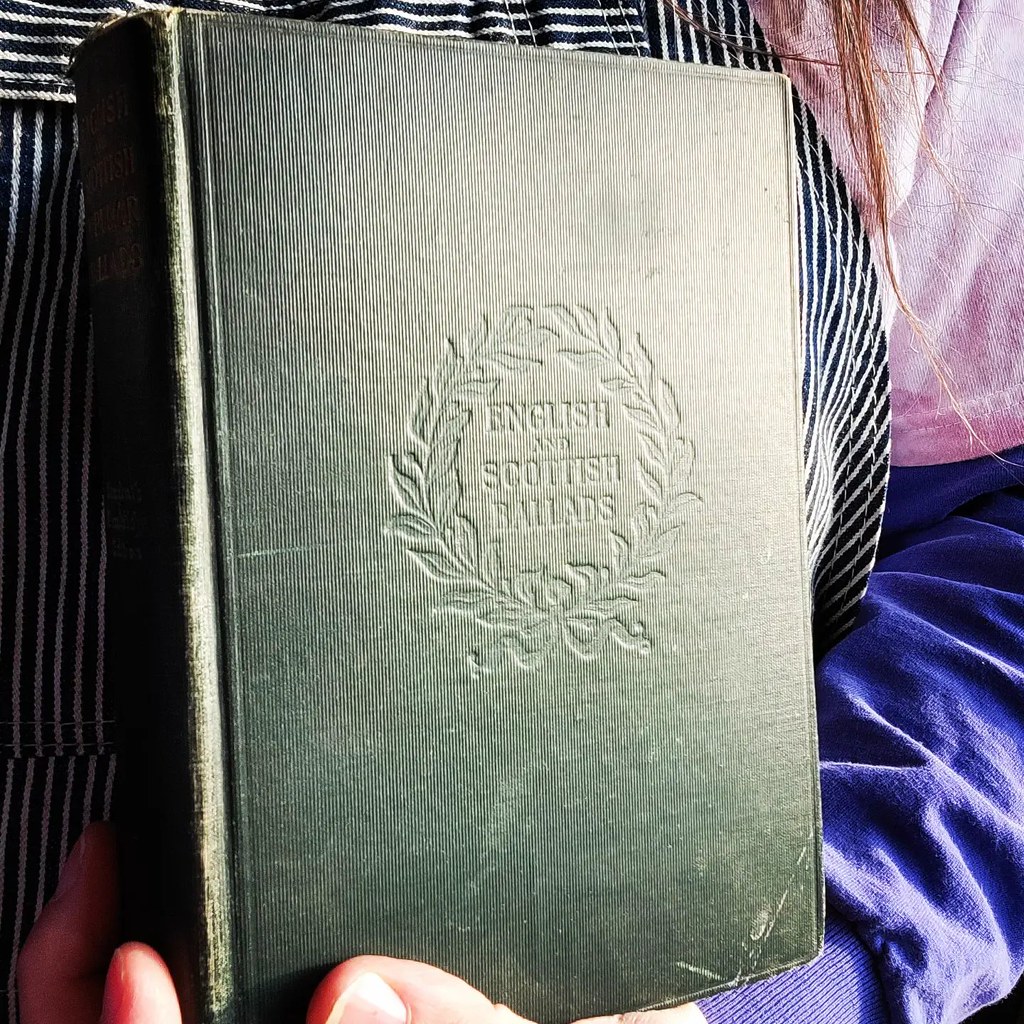
One of the best ways to build a poetry collection is to frequent used-book sales at local libraries. You can almost always find something good at those, and for my money, the real treasure is always the really old stuff, like this:

That’s a volume of English and Scottish ballads, printed in 1904. It’s in a bit of rough shape, but it’s still a joy to own. I’ve picked up a bunch of other old poetry collections in this way. Not only are books like this a pleasure since they just don’t make ’em like this anymore, they’re also nice because–in the case of collections like, say, old editions of The Oxford Book of English Verse–the contents will vary wildly with the contemporary editions, the farther back you go. Very old anthologies of poetry will include poets who are almost (or entirely) forgotten today, and I’m always a big fan of keeping artists of yesteryear from vanishing into total obscurity as much as I can.

Lots of times these old collections were schoolbooks, and the students of the past signed them. I looked this man up, and all I was able to find out was that he graduated high school in Abingdon, PA in 1921. A young man was reading from this book over a hundred years ago…and now it’s on my shelf.

And here’s the man who assembled this collection. This volume appears to be a reissue, and it notes that this editor had already died by this point.

This particular book obviously features ballads, the narrative poems of English and the Scottish tongues, which were a prime medium for storytelling several hundred years ago. As such, a lot of these ballads were kept alive in oral traditions and authorial information, to the extent there ever were any actual “authors”, is long gone. Many of the poems in this book unfold over quite a few pages, but here’s a single short one, with no author given. It’s a grim tale with a sad end…but there’s never any guarantee with these things, is there? I imagine this tale is sadly realistic for its time.

Additional information on this ballad, with one of many alternates, here.

Share This Post

National Poetry Day #5: Two by Rudyard Kipling

She-Hulk has a joke for you!

Original art by John Byrne, tweaked a bit by me.

With apologies to Marvel and John Byrne, I’ve stolen this joke from a postcard that I remember reading about when I was a kid, in, of all places, The Guinness Book of World Records. According to the Guinness folks, this postcard was actually the best-selling postcard of all time:

Yes, I could have just posted this all by itself, but I always like dusting off the She-Hulk pie-in-the-face cartoon, so.

The postcard was created by illustrator Donald McGill, but he didn’t even originate the joke! It goes back farther, as early as 1907. Which means that the joke was around during Kipling’s lifetime!

Rudyard Kipling lived 1865 to 1936, and he was a prolific writer and journalist who wrote short stories, novels, and poetry in addition to his journalism. Kipling’s legacy is complicated, or even controversial, given his reputation as being a chief voice of the high point in British Empire colonialism. There is a certain stuffy feeling to reading Kipling now; even in his lyric descriptions of far-off lands he feels like the kind of poet one reads in an oak-paneled study with a fire in the hearth, a clock ticking on the mantel, and perhaps a smoldering pipe in the hand that’s not holding the book. Kipling really does seem to be the voice of the “stiff upper lip, lads!” era of Proper Britain. In a large way, Kipling seems to occupy a similar space in his writing that Edward Elgar does in his music. (Hence my choice for today’s Tone Poem Tuesday, coming up later!)

All that is a bit simplistic, though, because Kipling is still a fine poet, with a keen command on how to deploy rhythm, meter, and rhyme to the emotions he wants to illustrate in his work. These two poems illustrate this particular well, in the service of two common themes: love, and death.

First, love. The Lovers’ Litany is a catalog of failed loves and a hope of more to come. “Love like ours can never die!” says the narrator, but he says it of four different loves, each one gone into memory. But even though he has been “bankrupt in quadruplicate”, he would endure the same fate a full forty more times if he could.

“The Lovers’ Litany”, Rudyard Kipling
Eyes of grey—a sodden quay,
Driving rain and falling tears,
As the steamer wears to sea
In a parting storm of cheers.
Sing, for Faith and Hope are high—
None so true as you and I—
Sing the Lovers’ Litany:—
Love like ours can never die.”

Eyes of black—a throbbing keel,
Milky foam to left and right;
Whispered converse near the wheel
In the brilliant tropic night.
Cross that rules the Southern Sky
Stars that sweep and wheel and fly
Hear the Lovers’ Litany:—
Love like ours can never die.”

Eyes of brown—a dusty plain
Split and parched with heat of June
Flying hoof and tightened rein;
Hearts that beat the old old tune.
Side by side the horses fly,
Frame we now the old reply
Of the Lovers’ Litany:—
Love like ours can never die.”

Eyes of blue—the Simla Hills
Silvered with the moonlight hoar;
Pleading of the waltz that thrills,
Dies and echoes round Benmore.
Mabel,” “Officers,” “Goodbye,”
Glamour, wine and witchery—
On my soul’s sincerity,
Love like ours can never die.”

Maidens of your charity
Pity my most luckless state.
Four times Cupid’s debtor I—
Bankrupt in quadruplicate.
Yet despite this evil case,
And a maiden showed me grace,
Four-and-forty times would I
Sing the Lovers’ Litany
Love like ours can never die.”

And then, death. Here, in Possibilities, Kipling ruminates on how those who die are mourned all too briefly before their places are taken again amongst the living by someone else, so that the ghosts who gather to cavort when the living have retired must disperse again by sunrise. The thing that catches me in this poem is in the second stanza, when Kipling describes death as “the Great Perhaps”; this is reminiscent of Shakespeare’s “undiscovered country”.

“Possibilities”, Rudyard Kipling

Ay, lay him ‘neath the Simla pine —
A fortnight fully to be missed,
Behold, we lose our fourth at whist,
A chair is vacant where we dine.

His place forgets him; other men
Have bought his ponies, guns, and traps.
His fortune is the Great Perhaps
And that cool rest-house down the glen,

Whence he shall hear, as spirits may,
Our mundane revel on the height,
Shall watch each flashing ‘rickshaw-light
Sweep on to dinner, dance, and play.

Benmore shall woo him to the ball
With lighted rooms and braying band,
And he shall hear and understand
“Dream Faces” better than us all.

For, think you, as the vapours flee
Across Sanjaolie after rain,
His soul may climb the hill again
To each of field of victory.

Unseen, who women held so dear,
The strong man’s yearning to his kind
Shall shake at most the window-blind,
Or dull awhile the card-room’s cheer.

In his own place of power unkown,
His Light o’ Love another’s flame,
His dearest pony galloped lame,
And he an alien and alone.

Yet may he meet with many a friend —
Shrewd shadows, lingering long unseen
Among us when “God save the Queen”
Shows even “extras” have an end.

And, when we leave the heated room,
And, when at four the lights expire,
The crew shall gather round the fire
And mock our laughter in the gloom.

Talk as we talked, and they ere death —
Flirt wanly, dance in ghostly-wise,
With ghosts of tunes for melodies,
And vanish at the morning’s breath.

Two geographical notes: Simla is a city and region in Northern India, where Kipling spent most of his time when was in that country (it is called Shimla today), and Benmore was a mansion with a ballroom that was a hub of social activity in the Simla region.

Share This Post

National Poetry Month, day 4: Christine Turner Curtis

An odd road to this one: my last two years of college, I lived in a rented house with a roommate, and thus I was off the campus meal plan as well. This meant cooking. As a college student with little income (OK, let’s be honest, outside of what my parents were graciously willing to send me despite my frankly not-especially-good habits of showing gratitude for it, no income), “cooking” generally meant things like Kraft Mac-and-Cheese, Ramen noodles, PB&J or bologna sandwiches, and the like. But I did start learning to do more actual cooking during those years, with a big way of learning my way about a kitchen coming from Jeff Smith, the “Frugal Gourmet”, who at the time was still a big name. I bought a number of his cookbooks and I enjoyed watching his shows, which just happened for one year to run in the afternoons in Iowa during a period when I had no classes.

(I know, I know, all about what happened to Smith’s career, and I’m not relitigating any of that in this space. It’s not the point.)

My favorite of Smith’s cookbooks, which in addition to having a lot of great information in the recipes were just good food writing in general, is The Frugal Gourmet Cooks American, in which Smith focused heavily on foods native to America, or reflective of American history. He believed that food and memory–i.e., history in the personal sense as well as the larger, collective sense–were intertwined, and that foods that were enjoyed by our ancestors should still be enjoyed, even if our associations with them weren’t always positive. Hence a story he told about his father one day cooking cornmeal mush in the kitchen, and young Jeff’s confusion at this when his father had told him once that he’d had many mornings as a poor kid when all they’d had to eat was cornmeal mush.

“If all you had to eat was cornmeal mush, and you got sick of it, why are you cooking it now?” Jeff asked.

“Because I have to taste it again,” said Jeff’s father.

But anyway, onto poetry. There’s a section in The Frugal Gourmet Cooks American about New England’s food heritage, going all the way back to the first Pilgrim colonists. (Again, this was written in the 1980s. Smith was a lot more acknowledging of what European colonists had done to the native populations than most, but he was still very much “of his time”.) At the end of a brief introductory essay, Smith closes with this bit of verse:

All the fine old frugal ways
Of the early Pilgrim years
Have the power to wake in me
A deep and sober ecstasy
Close akin to tears.

I’ve always rather liked that little bit. Problem is, Smith doesn’t credit it! I have never been able to figure out where it came from, and I wondered if Jeff Smith wrote it himself.

He did not.

I’ve searched that verse online every once in a while over the years, and never found a source for it…until just the other day.

The author is one Christine Turner Curtis, a writer about whom almost no information exists online, as far as I can find. All I know is that Curtis was born in 1891, she was a New England poet and writer, and her most notable work is apparently a novel called Amarilis. I also found, in a collection of verse written by poets connected to Wellesley College over fifty years, from 1875 to 1925. The book is digitized into Google Books, and as the book was probably out of print more than fifty years before Jeff Smith ever started researching his American cookbook, I’d be interested to know exactly how he came across this terrifically obscure bit of verse.

Anyway, here is the entire poem.

“The Strain”, by Christine Turner Curtis

The Old New England soul of me
Loves all sleek and hearty things;
Wide-roofed barns and stuffed haymows,
Fat white goslings, leaf-brown cows,
Autumns and harvestings,

And the bulging orange cheeks
Of ripe pumpkins in the sun;
Seed-corn hanging by the door,
Melons on the woodshed floor,
Clapp’s Favorites, one by one,

Dropping from the loaded trees,
And the copper Seckel pear,–
Loves the crowded apple bin
And the red fruit rumbling in;
Grandfather’s spindle chair

Standing by the kitchen blaze,
The deep chimney and the clock
And the blackened old firedogs
Under the huge twisted logs,
New butter in a crock

And great foaming jars of milk,
Yellow loaves of citron cake,
Currant jellies, clear and red,
And the brown domes of the bread,
Fresh from the morning bake.

All the fine old frugal ways
Of those gallant Pilgrim years
Have the power to wake in me
That deep sober ecstasy,
Close akin to tears.

A great poem? Enh, maybe not. But maybe not deserving of complete obscurity outside of a brief quote, with the wording changed, and the author uncredited in a nearly forty-year-old cookbook, either.


Share This Post

National Poetry Month, day 3: John Donne

From a collection of love poetry that I own, an offering by John Donne.

“The Good-Morrow”, by John Donne

I wonder, by my troth, what thou and I
Did, till we loved? Were we not weaned till then?
But sucked on country pleasures, childishly?
Or snorted we in the Seven Sleepers’ den?
’Twas so; but this, all pleasures fancies be.
If ever any beauty I did see,
Which I desired, and got, ’twas but a dream of thee.
And now good-morrow to our waking souls,
Which watch not one another out of fear;
For love, all love of other sights controls,
And makes one little room an everywhere.
Let sea-discoverers to new worlds have gone,
Let maps to other, worlds on worlds have shown,
Let us possess one world, each hath one, and is one.
My face in thine eye, thine in mine appears,
And true plain hearts do in the faces rest;
Where can we find two better hemispheres,
Without sharp north, without declining west?
Whatever dies, was not mixed equally;
If our two loves be one, or, thou and I
Love so alike, that none do slacken, none can die.

There’s a lot going on in this poem–I had to look up the reference to the “Seven Sleepers”, which turns out to be a pretty interesting bit of mythology on its own–but what caught my eye, just briefly, is the question Donne asks in the very first two lines and explores over the course of the first stanza. It’s certainly my experience that once love is found, it gets harder and harder to remember what it felt like before it was found, and it’s easy to ask the question Donne is exploring: If our two lives are one now, how were our two lives two before we found each other? Were we really living, or were we just sleeping through life?

But when we do find love, it’s a melding of worlds into one, and our worlds become each other, don’t they? Hence the cartographic references in the third stanza, which are interesting metaphors for a love poem, aren’t they?

Share This Post