The Season

Christmas at Casa Jaquandor

Christmas has come and gone for another year, as it always does. As always, it was full of a lot of beauty and a little stuff that wasn’t so beautiful, but we’ll concentrate on the good, OK? Because I’m sure that none of you were naughty this year.

Santa Jaquandor suspects that you've been naughty.

Or something like that….

The Christmas season for us began, as it does for a lot of folks, on the weekend after Thanksgiving. After an activity-filled Black Friday, we continued with the next day, traveling to my “ancestral” home in Allegany, NY, where my parents live.

The Original Casa Jaquandor

This is the house where I grew up — at least, from June 1981 onward. The house didn’t always look like that; when my parents bought it there were no trees on the lot at all, and the house still had its original siding. In those first few years my parents did a lot of tree-planting. That big pine there, the one that dwarfs the house? My parents bought that at my request one day at some nursery when I decided that I wanted a tree, too. They further humored me by planting it right outside my bedroom window. Now that tree is so enormous that you can’t even see out that bedroom window anymore.

After that, the holiday season settled into a bit of routine, but it was pretty busy. There were a lot of church functions to attend: potluck dinners, Christmas pageant rehearsals for The Daughter, Christmas parties, and so on. Here’s our church’s roof after the first big snowfall of the year:

St: John's: the snow-covered roof

And there was the quarterly Used Book Sale at the library:

The haul

This stack is just what I bought for myself. The total I spent on these, plus books for The Wife and The Daughter? Fourteen bucks. God, I love the library book sale!

There was the sudden realization that I needed to buy new work boots:

Wow, I need new boots!

I spent some time this Holiday season wondering about the aging process. Part of this is natural — I am almost 40, after all — but part of it was brought on by an odd lady at the library who actually asked me if I had kids approaching me thinking that I’m Santa. Huh?

See? I don't look like Santa.

I know that a gray or even white beard is on the way, but I’m not there yet! And I keep my beard fairly short. Portly guy plus beard of any color equals Santa? Huh? Should I therefore suspect that if I were to lose a lot of weight, I could look like Jesus?

Well…what else? There was one day when we were driving home and the sunset was behind us:

The sun sets behind us

And there was the day I had to drive home through Bills-game traffic, including a bus destined for wherever “Test Pattern” is:

Test Pattern

And of course, no matter how busy the Holiday season gets, one must always take time for kitties.

No, it's OK, guys, I don't wanna read, I wanna pet you doofuses instead.

Looming over Julio

Share This Post

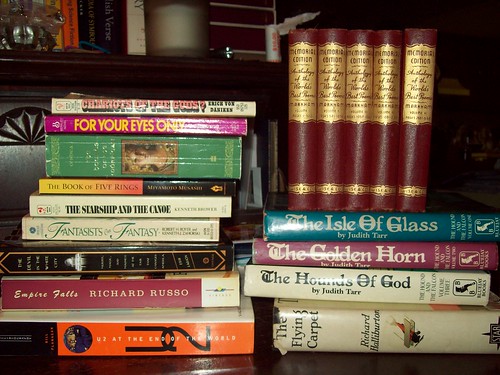
Ye Olde Booke Haule


Ye Olde Booke Haule, originally uploaded by Jaquandor.

The other day was the quarterly Used Book Sale at the local library, which I honored as I usually do by filling a box with books for about $15. I’m telling you, folks, if you like to read, find out when your local library is having a used book sale.

The stuff in the picture is just the stuff I got for myself; I got seven or eight books each for The Wife and The Daughter. Great bargains, all. Here’s a rundown:

:: Chariots of the Gods?, by Erich van Daniken. I’ve always had a soft spot in my heart for gonzo theorists like van Daniken. I read stuff like this as fiction, basically.

:: For Your Eyes Only, Ian Fleming. This is not a novel but a collection of several short stories featuring Agent 007. (Specifically, “From a View to a Kill”, “For Your Eyes Only”, “Quantum of Solace”, “Risico”, and “The Hildebrand Rarity”.) I’ve just decided to start trying to gather all of the Fleming Bond books, but I want them in old, cheap paperbacks. Hence, I grabbed this one right up…and then discovered that I’ve already got one. An earlier edition, even. Oops. (Buying duplicates of stuff you already own is a constant danger of used book sales.)

:: The Hounds of the Morrigan, by Pat O’Shea. I know nothing about this, but I loved the cover art.

:: The Book of Five Rings, by Miyamoto Musashi. I also have a long-standing soft spot for Asian philosophy.

:: The Starship and the Canoe, by Kenneth Brower. I bought this by virtue of its trippy title and the blurb comparing it to Zen and the Art of Motorcycle Maintenance.

:: Fantasists on Fantasy, a collection of essays about fantasy.

:: The Devil in the White City, by Erik Larson. Serial killers at the World’s Fair in Chicago. A friend recommended this to me some years ago, and I forgot about that recommendation until I saw the book.

:: Empire Falls, by Richard Russo. I’ve been intending for some time to read Russo, and the presence of his most decorated book (it won the Pulitzer) at the sale made it easy. I’ve already started reading it.

:: U2 at the End of the World, by Bill Flanagan. I’m not a huge U2 fan, but I like good music writing.

:: An Anthology of the World’s Best Poems. It’s a six volume set, but only five were there. I’m a sucker for old poetry collections; as tastes change and as more poetry gets produces, anthologies shift, and many poets who were beloved decades ago won’t be found anywhere near an anthology today. It’s not that I need two dozen volumes containing the same poems by Whitman, Poe, Shakespeare et al.; it’s that I want to have volumes containing all of the voices that are now mostly forgotten.

:: The Hound and the Falcon Trilogy by Judith Tarr. No idea at all, but grabbing an entire trilogy I haven’t read, in a genre I love, in hardback, for three bucks? Yeah. Sign me up.

:: The Flying Carpet, by Richard Halliburton. I love Halliburton. He was a wonderful writer, one of those adventurers of the first decades of the 20th century — like Frank Buck — who journeyed all over the world just because he wanted to see it. (Here’s an earlier review of mine of one of Halliburton’s other books. Halliburton is one of those authors whom I buy on sight when I see his books at the sale, which is why…ahem…I now own three copies of The Flying Carpet. But I can justify this one by the fact that it has an intact, if a bit worn, dust jacket intact!

Not pictured (because I mistakenly put it with The Daughter’s stuff): How Much For Just the Planet?, by John M. Ford. Ford was a science fiction writer who passed away several years ago. This book is one the higher regarded Star Trek tie-in novels that began coming out in the 1980s. I rarely read tie-in books these days, but this one’s got a pretty high pedigree.

Next sale’s in September!

Share This Post

Monty Haul 9-09

This weekend saw my local library’s quarterly Used Book Sale, and as always, I was there when the doors opened to rush in and grab my fair share of the booky goodness. While this iteration was spectacularly unsuccessful from the standpoint of bolstering my SF collection — I didn’t see a single SF volume at all amidst the offerings, whether it was something I wanted or not, and I can almost always count on at least seeing a few Star Wars or Star Trek novels floating about — I did grab some nice items, as pictured below.
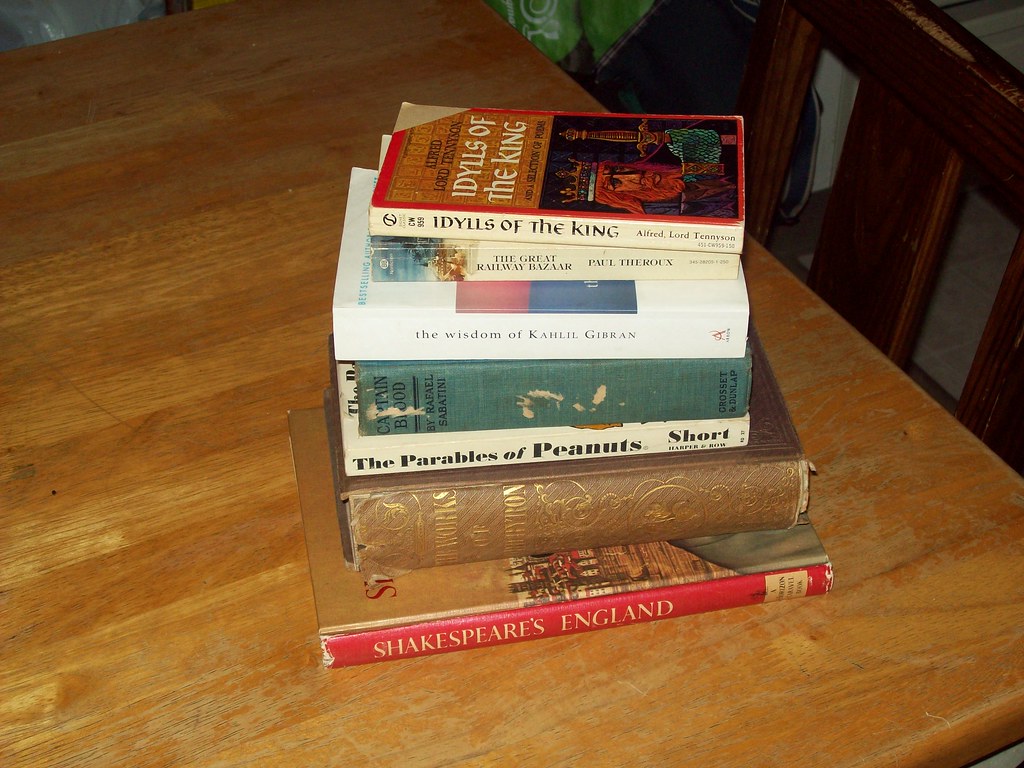
Library Book Sale 9-09: The Haul

Going from the top down: Tennyson is, as longtime readers will know, my favorite poet, and thus, when it comes to the library book sale, I have a weakness for grabbing volumes of his poetry. I was especially glad to see this, however, since it’s been a very long time since I read Idylls of the King and was thrilled to see a copy here. Yes, I already own a copy, but that’s not the point! (And anyway, my other copy is kind of neat in its own regard, printing the text on the right side of the open page only, with the left given to explanatory footnotes. Obviously it’s a “teaching” edition.)

Next down we have a travel book, The Great Railway Bazaar by Paul Theroux. I’ve never read any Theroux, but I’ve heard lots of good things about him, and I have grown to love good travel narrative writing a lot over the last few years, so I was glad to pick this up.

Then, The Wisdom of Kahlil Gibran. I’ve read some Gibran of late, and I’m keenly interested in pursuing his work. I’m not sure what in this volume I already own — probably most of it — but that’s not bothersome to me at all.

Below that is Captain Blood by Rafael Sabatini. I know that Sabatini was quite popular in his day, and, like most such authors, has fallen out of fashion nowadays, but I’ve always been interested to see what he’s like, and of course, I love a good pirate tale, so we’ll see. Who knows when I’ll get to this one, of course, but there it is. The book sale is always a good source for copies of very old books, the bestsellers of yore; it’s not uncommon for me to thumb through a very old book titled “Best Loved Poems” or something like that and realize that I don’t recognize any of the names of the poets contained within. I always find myself hoping that these books find homes.

Next is something called The Parables of Peanuts. It looks like some kind of theology or moral philosophy book, using Peanuts as its inspiration. To be honest, I grabbed this on a whim.

On the bottom is Shakespeare’s England, which I picked up to help in a future project of mine — to learn more about the Bard and his world. (I’ll have more to say about this project in time.)

The most interesting book I found today, though, was that thick one second from the bottom of the stack.

Library Book Sale 9-09: Byron

It is a collection of the works of George Gordon, Lord Byron, and it cost me all of one dollar. I adore very old books, and I gravitate toward them often at the library sales. Some, I admit, I purchase with the intent of listing them on eBay, but in most cases I’ve kept them for my own collection. Not only do old books on the shelves look cool, but there’s a unique tactile sensation, I think, in actually reading a very old book.

This one is in relatively decent condition, with the most wear and tear being present on its spine:

Library Book Sale 9-09: Byron, spine

The binding is in decent shape, though, and the pages are all bright and have lost none of their contrast. But as I started thumbing through the book, I discovered that it’s not just a literary time capsule of sorts, but also a very small window into a couple of lives. Here is what I found immediately upon opening the front cover:

Library Book Sale 9-09: Frontispiece

The book plate on the endpaper indicates the this volume belonged to a James Resetarits, who indicates in his tiny script on the flyleaf that he lived in Buffalo (“Bflo”) in 1975. (I’ve never seen that name before, ever.)

Thumbing through the book, I discovered a common feature of very old books: multiple flyleafs. (The flyleaf is the blank page one finds immediately inside the front cover, opposite the endpaper. Older books have more than one flyleaf.) On the final flyleaf (five of them), I found this inscription:

Library Book Sale 9-09: Inscription

To Dr. James Keech,

In appreciation for
your inspiration and
confidence.

May we each find
our own perfect stream.

Regards

James & Karen Resetarits
1976

So it seems that Mr. Resetarits owned this book for at least a year before he inscribed it and gifted it to Dr. Keech, whomever that may have been. (More on that a little later on, though.)

Books with gift inscriptions show up frequently at library book sales. I don’t know how actual book collectors feel about this, but it never bothers me — I always enjoy the indication that at some point in a book’s life, the book was considered enough to be judged worthy of being a gift for someone special to someone else. I see this a lot in the children’s books I pick up for The Daughter, and I always think there’s something a bit wistful about those — not unlike the sad nostalgia of, say, the second Toy Story movie, where toys are tossed aside by kids when they outgrow them. The same may apply to books.

But with cases like this, another possibility exists: that what I’m finding at the library sale is the detritus of a life that has since ended. Was this a prized volume in Dr. Keech’s home library until his passing? I don’t know. (I don’t even know if Dr. Keech did pass yet.)

Continuing, I found this wonderful frontispiece:

Library Book Sale 9-09: Byron portrait

Again, in books of this era, it’s common to find a small piece of tissue paper bound into the book between the frontispiece and the title page, which is the case here. Turning that tissue paper past, covering the portrait of Lord Byron, I find the first of two title pages:

Library Book Sale 9-09: Byron title page, II

Of all the historical forms of illustration, I think the engraving is my favorite. I wish we’d see more of this these days.

And then, turning the page again, the second title page:

Library Book Sale 9-09: Bryon title page

The age of the book is now apparent, isn’t it? It’s been a very long time since the style was to include a period at the end of each phrase on a title page. Note the use of the “Olde English” font on the phrase “The Suppressed Poems”, and note especially the date at the bottom of the page, indicating the book’s year of printing: 1866.

This volume is 143 years old. And I got it for a dollar.

For amusement, here is a brief taste of the “Sketch of His Life”, as written by a J. W. Lake:

It was reserved for the present age to produce one distinguished example of the Muse having descended upon a bard of a wounded spirit, and lent her lyre to tell afflictions of no ordinary description; afflictions originating probably in that singular combination of feeling with imagination which has been called the poetical temperament, and which has often saddened the days of those on whom it has conferred. If ever a man was entitled to lay claim to that character in all its strength and all its weakness, with its unbounded range of enjoyment, and its exquisite sensibility of pleasure and of pain, that man was Lord Byron. Nor does it require much time, or a deep acquaintance with human nature, to discover why these extraordinary powers should in so many cases have contributed more to the wretchedness than to the happiness of their possessor.

Phew! The “life sketch” goes on thus, in very tiny print, for another thirty-four pages. I imagine that many an owner of this particular volume, back in the 1800s, skipped right past Mr. Lake in favor of Mr. Byron.

The rest of the book is a fairly typical example of an exhaustive collection of an author’s work from the nineteenth century: it is very densely printed, with occasional engravings of art scattered throughout on thick plate-paper. But the story of this book doesn’t end there, for tucked into the back cover, I found this:

Library Book Sale 9-09: Enclosed in Byron II

This is the program for an “Honors Convocation” for Kappa Delta Pi, held in the Upton Hall Auditorium. (Upton Hall turns out to be part of the campus of Buffalo State College.) This convocation was held on April 30, 1976 (right about the time I was in the home stretch of Kindergarten). Tucked inside this program is a typewritten list of what I assume to be Kappa Delta Pi members who were in attendance at that convocation. Each student (listed on the left) is paired with a guest (listed on the right). At the bottom of the second page of this list (it’s four pages, stapled together), I found this:

Library Book Sale 9-09: Enclosed in Byron

So, I can only surmise that Dr. Keech was the guest of Mr. Resetarits at this Honors Convocation, and that this book was presented to Dr. Keech on that occasion. There’s nothing especially remarkable about this — a gift from a student to a valued teacher, I suppose — but the long winding road this book has taken impresses me greatly, as does the fact that owing to the presence of that program in the back cover, never removed even when the book was unshelved and boxed up for its trip to the library, I can trace one of those steps on that path.

I’ve written of this kind of thing before, and this fascination with finding things in old books has manifested itself in my fiction writing as well (“Elizabeth and Andrew”). Here’s another fine example.

Share This Post
Books! Books! Books!


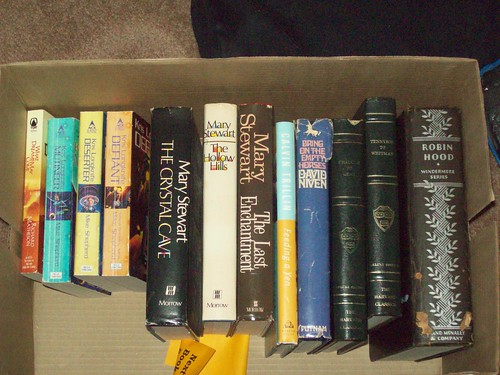
Book sale haul!, originally uploaded by Jaquandor.

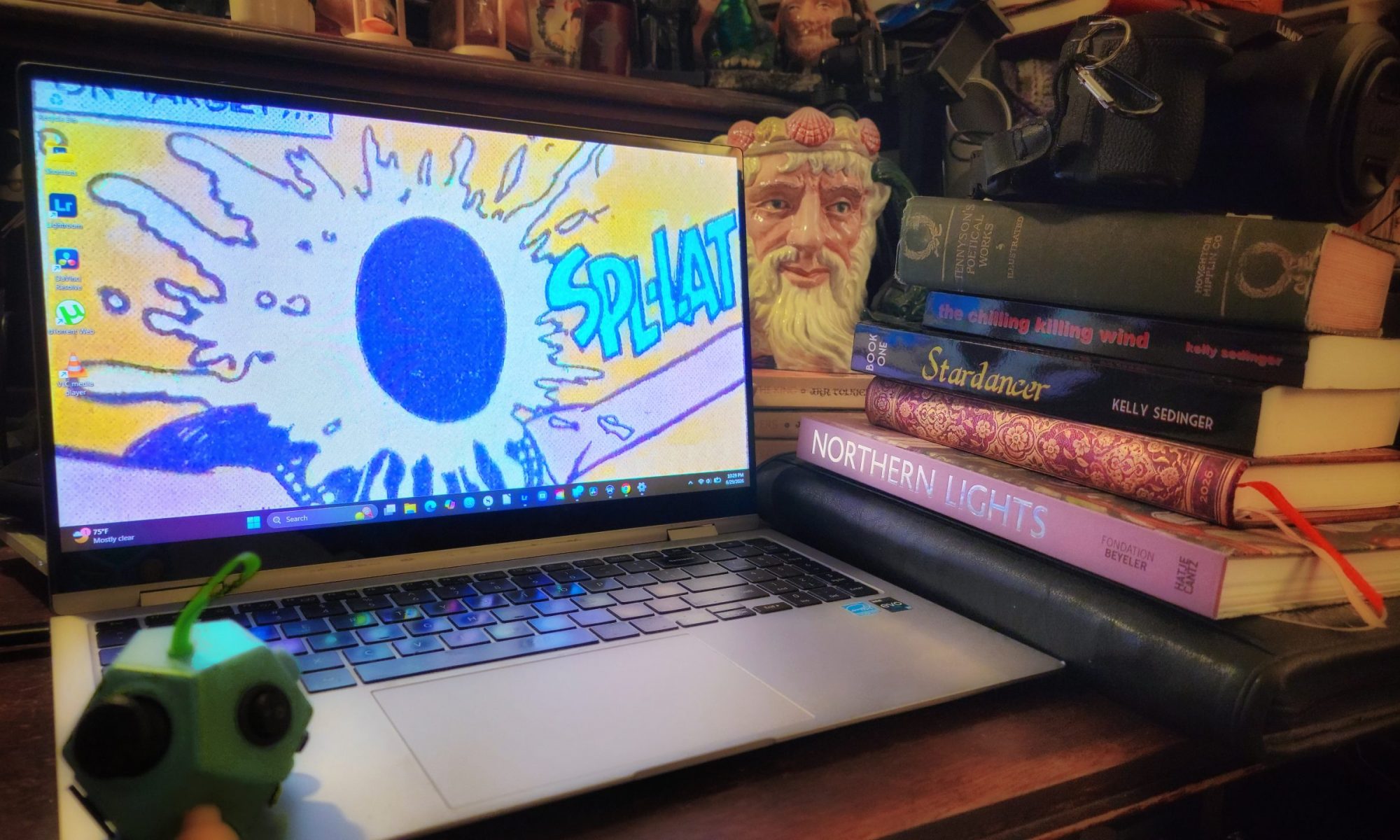
This weekend marks the quarterly Used Book Sale at my local public library, and this photo shows the books I bought for myself. (There were other things for The Wife and The Daughter.) This sale was more productive, owing to the fact that they were able to have the sale in the usual room again; the sale in March was put in a tiny room about one-third the size of the usual room, owing to remodeling that was going on at the time.

From left to right, we have:

:: What Dreams May Come, by Richard Matheson. I never saw the movie, but I like Matheson a lot.

:: Three SF books featuring a heroine named “Kris Longknife”. I’m not sure I’ve ever heard of these before, but they looked fun, so there they are.

:: Mary Stewart’s King Arthur trilogy. (The books are in order.) I was thinking a few weeks ago that I really should re-read these, as I adored them when I first read them way back in 1992 and I’ve never re-read them since. Now I have nicer hardcovers to read. My MMPB’s of these books are OK, but the problem is that with many fantasy books published MMPB format in the late 80s and early 90s, maps tended to be nearly illegible. (I had a MMPB Lord of the Rings where the map was almost completely unreadable.)

(There was a fourth book that Stewart added later on, called The Wicked Day, which tells the story of Camelot’s fall from the viewpoint of Mordred. She wrote a sympathetic Mordred that was so effective that I’ve had trouble with standard, “villainous” Mordreds ever since.)

:: A food book by Calvin Trillin. I’ve heard good things about Trillin and not much read him.

:: Bring On the Empty Horses! by David Niven. I’ve wanted to read this for years, but the Buffalo and Erie County Public Library’s copy is non-circulating, for some reason. This is a Hollywood memoir by one of the wittiest men ever. (The title is from one of the more notable set directions from Michael Curtiz, one of Hollywood’s great directors but also a man who had trouble with English as a second language. When, after a number of nominations, he finally won the Oscar, he started his speech with: “Always a bridesmaid, and never a mother.” My favorite Curtiz fractured-English tale is when he told someone he wanted a poodle on the set, so the prop guy went and got him a poodle; Curtiz exploded and yelled, “Not a dog! A poodle! A poodle of water!”) Anyway.

:: Two poetry collections, because I can’t help myself. Too bad they didn’t have the third volume.

:: An old illustrated version of Robin Hood. I picked it up, hoping it was Howard Pyle, but it wasn’t. Still, it’s a handsome volume and I’ll do more research on it at some point.

All in all, a satisfying take, even if I didn’t see anything that I thought would make a good sale on eBay.

Share This Post

Monty Haul


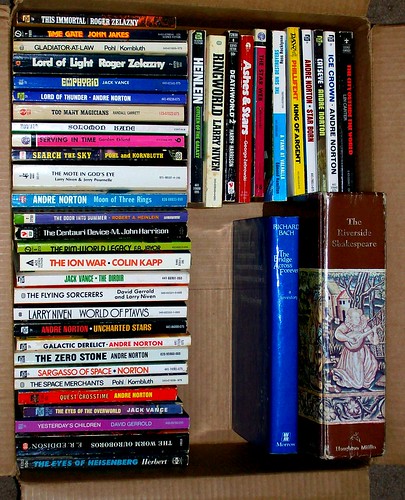
Book Sale, originally uploaded by Jaquandor.

OK, we’ve established in the past that I live for the quarterly used book sale at the Orchard Park library. (See here and here for representative posts.) My methodology is usually to pick out some stuff for The Daughter first, and then look around for stuff for myself and for The Wife. Sometimes the SF pickings are good (here’s the previous best SF haul), sometimes the pickings are better for stocking the shelves with classic literature. But this time? Wow.

It seems that someone donated an entire collection of old SF paperbacks for the sale. I spotted a couple of Andre Norton titles, and then some Larry Niven, and then more and more and more, quite a bit of which I grabbed indiscriminately. As you can see, I came home with the largest haul I’ve ever brought home from the book sale, and that big chunk of SF goodness represents less than a fifth of what was there along that vein.

You’ll also notice, if you click through to the larger version, two non-SF volumes. For some reason I can’t pass up a complete Shakespeare; this edition of the Riverside Shakespeare looked nifty indeed. And I couldn’t pass up a hardcover edition of Richard Bach’s The Bridge Across Forever, a book which meant a great deal to me many years ago but which has slipped away from me more recently. (I have a post in mind to write about this, but I’ve been stalling on it because it involves some pretty personal stuff. I’ll probably work up the guts one of these days and have it turn out to be no big deal, as is usually the case.)

But really, look at all that SF goodness! Zap! Pow!!!

Share This Post

Save the Books!

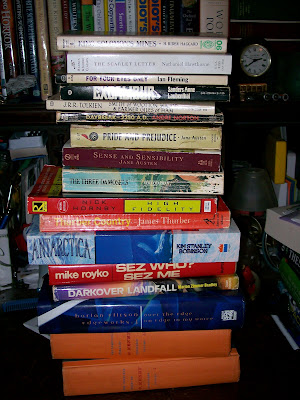
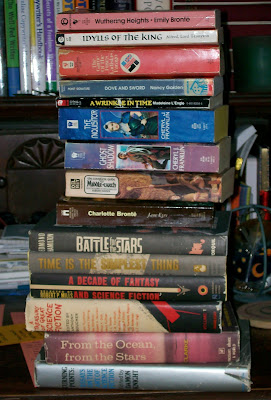
Yesterday was my favorite quarterly event: the Book Sale at my local public library. I adore this sale! And as usual, my haul amounted to under ten bucks. Here is just the stuff I got for myself:

I’m not sure how much, if anything, of today’s haul represents a find that I can hawk on eBay. I was able to sell two of the volumes I picked up at the last book sale for more than twice what I paid for that entire haul, which was nice. We’ll see. Those O. Henry collections may go nicely, as may that TPB edition of Antartica (which turns out to be a British printing). I don’t know if I’ll sell that Tolkien volume; I already have both of those tales in another volume, but that paperback is in outstanding condition, save for the original owner’s signature inside the front cover. We’ll see.

What’s always kind of bittersweet at these kinds of sales is reading the cover copy on the books themselves, with blurbs along the lines of “Another breathtaking classic from one of our very finest authors!” or “Certain to be read for many years to come!” These kinds of notices adorn books that no one much remembers at all today. How many stories have come and gone, almost completely vanishing, their only hopes at revival being on the shelves of a library sale where the paperbacks go at the rate of five for a buck? When I see so many volumes whose contents will almost certainly be gone forever in just a few more decades, I wonder how true it is that the cream rises to the top. Far more likely, it seems to me, that authors who rival the finest still read — the Jane Austens, the Henry Jameses, the Eudora Weltys — have come and gone without ever being realized. No, the cream doesn’t always rise to the top. Sometimes it just gets washed away, right down the sluice drain.

OK, that got a little depressing, didn’t it? Anyway, if you like to read, there’s really no reason to not frequent your local library’s book sale. They need the money, and the books need to be read.

Share This Post

Monty Haul

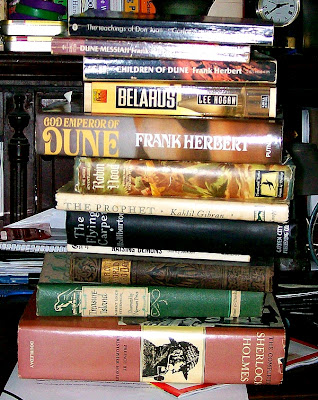
Yesterday was my local library’s quarterly used book sale, an event that always fills my heart with joy and my arms with pain (from lugging out a huge number of books). The pickings this time weren’t as good from the SF standpoint as the sale in March, but that sale was an outlier of sorts as far as SF goes; I’ve been going to this library’s sales for more than three years now and have never seen as much old SF as I did on that day. But I was still able to get the second, third, and fourth books in Frank Herbert’s Dune series (I already own Dune), and some other nifty stuff on the non-SF front. Behold:

And that’s not all I bought: I picked up five and four books respectively for The Daughter and for The Wife, in addition to all that above, and all for $8.75. Amazing.

The best part is that I’ll likely end up profiting on this book sale, because I also snagged a pristine Library of America edition of the essays and lectures of Ralph Waldo Emerson, and when I’ve sold LoA volumes on eBay in the past, they’ve always gone for somewhere around fifteen bucks each. I may also auction that Complete Sherlock Holmes, and since that copy of Halliburton’s The Flying Carpet is nicer than my other two copies of the same book, I’ll keep that one and auction one of the others.

It’s hard to see, but that third book from the bottom is an old translation of Around the World in Eighty Days by Jules Verne — it’s so old that the title is given there as Tour of the World in Eighty Days. There’s no date in the book that I can find, unfortunately, but the thing is clearly quite old, judging by the browning of the paper, the typeface, and the old stylistic thing where book titles were always followed by a period in that era. I’ll have to investigate this further, but I strongly suspect that this book will be of more use to collectors than to anyone as a reading copy of Verne’s novel.

Oh, and that paperback of the Carlos Castaneda book at the top? I found in its pages the original owner’s receipt of purchase. They bought it at the Canisius College bookstore on April 2, 1971. I love finding stuff in old books.

So where am I going to put all this stuff? No idea at all. Duh!

Share This Post

O for a bunch of shelves!

Today was the quarterly Used Book Sale at the local library. I always find some treasures there — and even treasures within the treasures themselves — but today was an even better haul than usual, with far better pickings in the SF department than usual. Behold:

And those are just the books I bought for myself. I also picked up five books each for The Wife and The Daughter. And the grand total spent?

Nine dollars.

Folks, if you like to read and if you like to own books, then you really have no reason to not be frequenting your local library’s used book sales. It’s just that simple.

Share This Post
Reaching across time

For all the dreamy talk about electronic books and how some day when the Technowhizkids figure out how to make a “screen” that has about as close a tactile and visual appeal to actual paper all the traditional bound books will go away and we’ll all be carrying our entire libraries with us wherever we go — and I have to admit that part of me finds that dreamy talk alluring — there are things about physical books, tactile books, real books, books-as-objects, that won’t ever be replicated by ePaper or the iTome or the CyberCodex or whatever it is we’re going to call it.

Here’s one.

Once every quarter, my local public library holds a book sale, with the most recent one being just this past Saturday. This book sale always yields an impressive bounty, on several fronts: I can load up on the kind of thick, breezy epics that The Wife likes to curl up with in bed at the end of a long day. I also snatch up a number of books for The Daughter, almost always finding copies of things she’s going to own someday anyway, like that Richard Scarry book about cars and roads (can’t recall the title right now) and her copy of Charlotte’s Web, which I just got the other day.

And for me? Past book sales have brought hardcover copies of things like Love in the Time of Cholera by Marquez, The Ascent of Man by Bronosky, Cosmos by Carl Sagan, The Discoverers by Boorstin, and more. It’s a great way to fill out the “classic lit” section of my personal library, too: I own a very old copy of Elizabeth Barrett Browning’s complete poems, an equally old copy of the Oxford Book of English Verse, and so on.

It’s always interesting to me to note a certain dichotomy at the library book sale between old copies of books everybody knows and old copies of books that nobody knows. For every copy of Charlotte’s Web and Johnny Tremain (which I’ve actually been wanting to re-read, and there it was last Saturday!), there will be a copy of a bestseller from yesteryear that is just gathering dust. The cover copy of these books will often say something like “The next great work from the author of _____!”, with _____ being yet another unfamiliar title. Here are authors who may have thought that their books would outlive them and carry their names into memory, and yet, here they are being purchased by people who want nothing more than to spend a quarter on a cheap, quick read. Don’t think for one second that I haven’t sadly envisioned, on some library table many years from now, a battered and yellowing copy of some novel bearing my name, being picked up by some person, perused for a moment or two, and then as likely as not being put back down again in favor of some other book with a more appealing cover.

I have to admit that book sales are the main vehicle by which I exhibit any real interest at all in antiques. I enjoy antique stores, mind you, but more as walk-through experiences than anything else, and I rarely feel any desire to buy anything from them. An old chair or dish just doesn’t have the same allure for me that an old book does. It’s easy to sit in a chair. There’s nothing terribly profound about the act of sitting in a chair, and even if the chair is a hundred years old, I don’t feel any kind of historical connection with the previous people who might have sat in it before, any more than I feel any connection with the people who have previously slept in hotel rooms I’ve booked or seats at a venerable old restaurant.

But books? Ah, there’s something else: when I read a very old book, I’m not just in that kind of “readerly communion” with the author, but also with the other people who have read it. The ideas being expressed in those pages, or the tales being told or the pictures being shown, are entering my mind in just about the same way that they did for someone many years before. I don’t think that kind of communion, a communion between readers, will be possible with the CyberCodex.

And then there are the physical reminders of all this that are only possible with very old books.

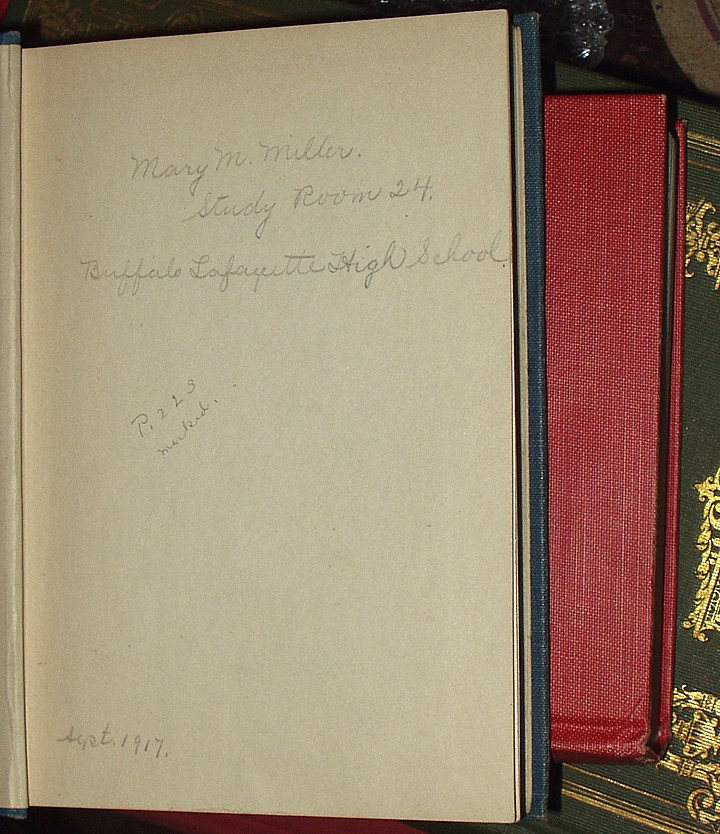
One of the volumes I bought the other day is a hardcover edition of Tennyson’s Idylls of the King. I already own the Idylls, of course, but I couldn’t pass up this lovely little hardcover, and I grabbed it and put it in my stack on sight. Only when I got home did I open it up, and find that the book was an edition specifically intended for school students. The student to whom this copy of Idylls of the King had been issued had dutifully signed the frontispiece:

And she dated it: September 1917. Almost eighty-nine years ago, this book that I grabbed off a stack of other dusty and forgotten volumes was given, presumably new, to a young woman named Mary M. Miller for use in her high school class. (By the way, her school, Buffalo Lafayette, is still there.)

Further flipping through the book, I found scattered marginalia throughout. The marginalia comes in spurts, with lots of it during certain passages and then none at all during others; this makes me wonder if Miss Miller’s class didn’t actually read the entire Idylls but only parts of it. Miss Miller, I also note, had lovely penmanship.

Finding marginalia in books like these is not uncommon, but the combination here of factors — the years between Miss Miller and myself, the Buffalo location, the fact that Tennyson is my favorite poet — made it feel more profound than usual. But the real whammy was still to come: for while finding marginalia is common, finding note cards in the book is decidedly less so.

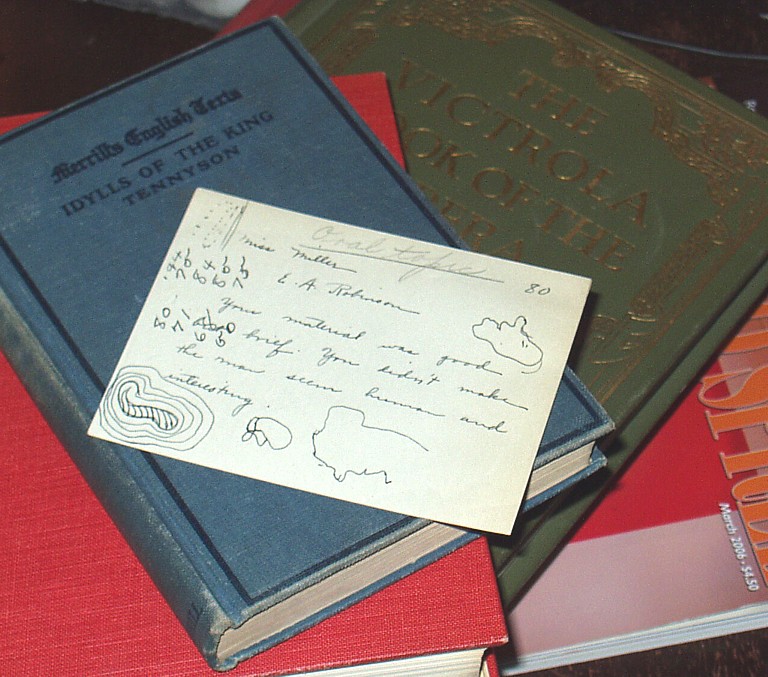
I found this card, tucked somewhere in the middle of the book:

In pencil at the top, it reads: “Oral Topic”. Then, in pen, there is a note in a hand that isn’t Miss Miller’s, and addressing her:

Miss Miller

E.A. Robinson

Your material was good
and brief. You didn’t make
the man seem human and
interesting.

I have no idea what the doodles are, nor do I have any idea what those numbers represent — page numbers, perhaps, or line numbers within the Idylls. I think the note probably comes from Miss Miller’s teacher, but the reference to ‘E.A. Robinson’ is slightly baffling.

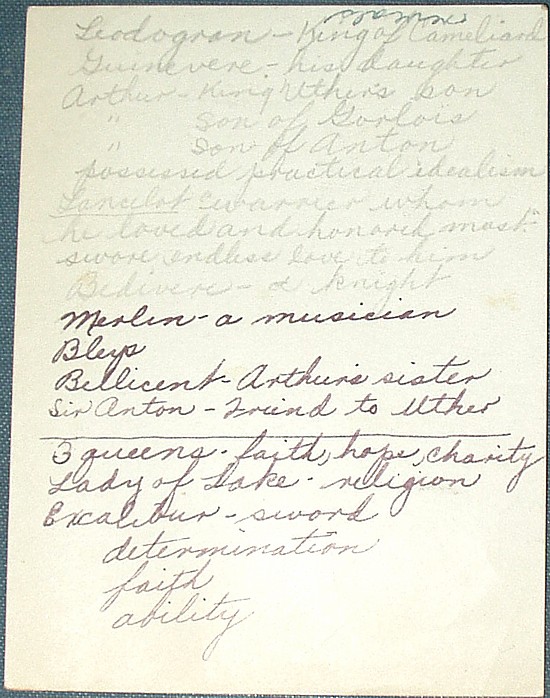
On the reverse of this card, Miss Miller wrote some notes pertaining to the Idylls — maybe study notes, or, thinking a bit more perversely, a cheat sheet! Here’s the reverse of the card:

So on one side of this card, there are notes about the book in which I found it; on the other, a probable note from a teacher about something else. I can only surmise that E.A. Robinson is actually American poet Edwin Arlington Robinson (1869-1935), and that this card was first a note of feedback for Mary M. Miller regarding an assignment on Robinson which she then used, on the reverse, as a place to write some notes she’d taken on Idylls of the King.

So this little book that I picked up at the library book sale has given me a small, fleeting glimpse into the life of a high school student from almost a hundred years ago.

As I noted above, finding margin notes is common, but finding cards like this is not. Cards tend to fall out of books the more they’re handled, and for a card like this to have remained in this book until I found it makes me wonder if anybody has handled this book at all since Miss Miller did. The likely chain of events is that Miss Miller toted this little volume around all her life, for whatever reason — maybe on her shelves, maybe at the bottom of a box of old school memorabilia — until some descendent of hers found it and decided to take it to the book sale.

Yes, someday I’ll be able to take my entire library with me when I travel. Someday I’ll be able to read just about any book ever written. Someday, “out of print” will be a virtually unthinkable concept. But also, someday I won’t be able to share the exact book that someone before me read, and I won’t be able to find some long-forgotten set of notes scrawled in haste on the back of a teacher’s note, lurking somewhere amongst the aging pages. An inevitable trade, of course, and certainly not a trade worth impeding upon the march of technological progress, but still: nothing is ever gained that something else isn’t lost.

(Of course, the real problem with the inevitable CyberCodex would be solved if they could figure a way to make it smell like an old book.)

Share This Post