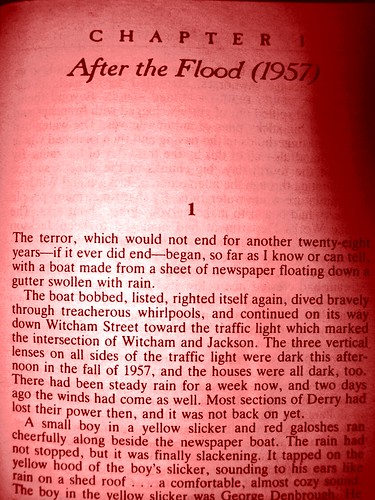
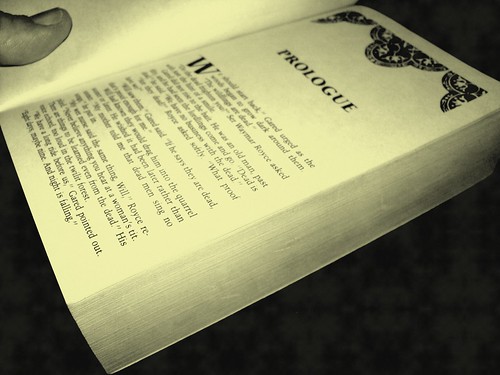
Page One: A Princess of Mars

Page One: A Princess of Mars

Here’s Page One of one of my copies of A Princess of Mars. This copy is part of something called the “Library of Wonder”. I bought it off the Bargain Books table at Barnes&Noble. Even though I already owned a copy (an omnibus I bought, in turn, back when I was a member of the SF Book of the Month Club), I couldn’t resist this one. I read A Princess of Mars a while back, and I was surprised at how well the writing holds up after 100 years; I expected a pulpy work that would be difficult to read for its prolix writing, but Burroughs crafts a nice, spiffy, readable tale that doesn’t have nearly as many anachronisms as one might expect. I haven’t yet read any farther into the series, but I intend to. This volume contains the first three of Edgar Rice Burroughs’s “Barsoom” novels, of which the first, A Princess of Mars, has just been adapted for the big-screen. Somewhat infamously, it turns out.

So, why did John Carter fail? I suspect for lots of reasons, not just one.

I’ve heard that there was a change in Disney management during the film’s production, and William Goldman has pointed out in his books that often an incoming exec’s first act of business is to make sure everything that the previous guy greenlit either gets ungreenlit or at least is just tossed out there without hype. I’m not sure about this; it’s one thing to just put the brakes on developing projects, but quite another to purposely scuttle a movie that’s already been made because the $200 million has already been spent. I’ve also heard that director Andrew Stanton was in charge of the marketing, and he made the decision to assume that audiences are more familiar with the John Carter character than they actually are. I’m not sure who was behind the decision to change the movie’s title to simply John Carter, when John Carter of Mars would have been more evocative, and hell, A Princess of Mars would have been in keeping with the book on which the movie was based in the first place.

For my part? I wonder if this isn’t the kind of movie that wouldn’t have failed had it come out, say, twenty years ago, when movies could be allowed to be in theaters for a couple of months, when they weren’t thrust into 18-screen multiplexes on as many screens as possible so as to guarantee massive opening weekends and then a couple more respectable weekends before the movie disappears from release entirely barely a month after its initial appearance. John Carter opened on a Friday, and I was reading about the movie’s box office failure on the subsequent Tuesday. Four days later. That is insane.

Now, I’m not convinced that word-of-mouth can always change a movie from failure to success – remember, The Shawshank Redemption was a box office failure and word-of-mouth didn’t elevate that movie to classic status that everyone’s seen until it came out on video. But still, in this day and age when there are a bunch of movies coming out all the time, and when most folks in my experience only tend to go to movies once or twice a month at most (and many less than that, as the cost of moviegoing is getting to the point where it might well rival the cost of a nosebleed-section admission to an NHL game soon), they tend to only go see whatever the BIG new release is. And that, sadly, tends to be the sequel to the tentpole franchise, or the adaptation of the current favorite book, or whatever. Not a movie like John Carter, which is in turn marketed with ads that really aren’t clear at all as to what the damn movie is about in the first place.

So anyway: I saw John Carter this past Saturday. For a reputed flop, there were a lot of people in the theater to see it. The place wasn’t packed, but the auditorium was probably almost half-full. That’s not bad, especially considering how packed the cinemas were for The Hunger Games. It’s just not the case that no one wants to see this movie. It’s just the case that, for whatever reason, this movie was set up to fail with unreasonable box office expectations that make the movies a sprinting horserace and an ad campaign that simply didn’t get the job done.

My particular screening didn’t start out so well. I attended a 2D showing, because I refuse to see 3D movies. I just can’t do it. I had a headache years ago after sitting through a couple of fifteen-minute 3D flicks at DisneyWorld. And I’m certainly not paying extra for the privilege of having a headache. So 2D it was. But after the previews ended, a title card appears on the screen, accompanied by voiceover: “Please put on your 3D glasses, now!”

Uh-oh….

And yup, they started the 3D version, with the telltale doubling-up of the image that had me in mind of the Monty Python sketch with the double-vision guy planning an expedition to climb “both peaks” of Mt. Kilimanjaro. I wondered if I’d screwed up or ended up in a 3D showing by mistake, but suddenly there were a bunch of folks behind me saying “Wait, what?” and getting up and heading out to the hallway. A Cinema employee stepped in, saw the 3D movie on the screen, and said, “Uh, I gotta go upstairs.” A minute or two later, the 3D version stopped, another minute or two passed, and the 2D version started. Huzzah! And they gave everyone there a free ticket to another movie, which was nice. So I get a free movie, for not that bad of an inconvenience.

(Oddly, when they restarted the movie, we had to sit through the previews again. Are they physically attached to the print of the movie you see?)

So anyway: about John Carter, the movie. Yeah, I loved it, and it depresses me that lost in all the discussion of the movie’s terrible marketing and undeserved fate (which, unless the movie develops surprising legs and then goes on to a remarkable life on DVD, will rule out sequels) is the fact that John Carter is a kind of movie you don’t see much anymore: a rollicking and entertaining adventure movie with high production values. The acting is good all the way around, especially the leads (Taylor Kitsch as John Carter, and Lynn Collins as Dejah Thoris). The visuals are all well-done, with none of the odd muddiness that I’ve noticed in movies shot for 3D. The film is full of wonderful spectacles and set-pieces, and for the most part, the plot isn’t hard to follow, once it gets going. There is a prologue that really doesn’t have much need to be there, and I did find the final battle scene slightly hard to follow as it ended. Also, there are a few pacing problems in the first act, as we cut away from John Carter for a bit too long to learn about Dejah Thoris and her dilemma; in my view, in these kinds of “Fish out of water” stories, it’s best to stay with the fish as long as possible. Those are fairly minor quibbles, though; once the movie settles into itself, about half an hour in, it’s as absorbing an escapist movie as I’ve seen in a long time. Michael Giacchino turns in a typically professional score, sounding a lot like his score to Star Trek 2009, and just as ear-wormy as the earlier score – I’ve had the main theme stuck in my head ever since.

John Carter, and the books that inspired it, aren’t really space opera, but its sister genre, planetary romance. There’s no space here whatsoever. Carter is teleported to Mars – Barsoom, they call it – and there’s an air of steampunk over the entire movie. It feels ‘retro’, and that retro feel is a large part of the movie’s charm.

No, John Carter is not a great movie. But it’s a very good one, well made, a fine addition to its genre. It deserves to be seen and enjoyed, not dissected in some kind of half-assed postmortem on what Hollywood does wrong these days.

Share This Post

Page One: the Marvel STAR WARS comic

Page One: the Marvel STAR WARS comic

It’s kind of odd to think of it now, but once upon a time, there was no Star Wars. I know, weird, huh? And once upon a time, the only stuff out there with Star Wars on it were the movie itself (which you had to see in theaters), a novelization of the movie with George Lucas’s byline on it (but actually ghost-written by Alan Dean Foster), and the comic book by Marvel. Here’s the first page of it.

The original are was by Howard Chaykin, who would stick around for ten issues before leaving and being replaced by Carmine Infantino for a while. The first six issues were strictly an adaptation of the movie, but based on the original shooting script, so you had the deleted early scenes with Luke Skywalker looking up at the sky during his work and seeing flashes of light — the flashes of laser cannon fire between the blockade runner and the Imperial star destroyer — and his conversation with Biggs, who reveals his intention to leave the Imperial Academy and join the Rebel Alliance. There is also the deleted scene between Han Solo and Jabba the Hutt, which was eventually put back into the movie by George Lucas, but as there was no design for Jabba at that time, Marvel made him into a trim, bipedal alien.

After issue #6, Marvel found itself with a hit comic and no idea what was to come in the Star Wars saga, so they struck out on their own, first with a story tracking Han and Chewie as they return with their money to pay off Jabba. Unfortunately they get attacked by pirates, who steal the money; then they find themselves on a backwater world that’s even more backwater than Tatooine, where they end up in a rehash of The Seven Samurai. Meanwhile Luke is sent out to look for a new planet for the Rebels to put their hidden base on, because the Empire is sure to counterattack at Yavin pretty soon. Luke finds a world that is nothing but ocean, where a whole separate war is going on. Then the heroes end up together on a space station that’s a giant Las Vegas in space. And so on.

The Marvel Star Wars comics were really a lot of fun, especially during the period between A New Hope and The Empire Strikes Back. Without guidelines of what to do (or probably with some vague limitations), the Marvel series was basically a lot of fun space opera adventure. I didn’t get to read these stories until some years later, during the mid-1980s, after Return of the Jedi had come out, and as part of my big comic book collecting phase, I amassed the entire run of Marvel’s Star Wars books. The generally light-hearted, adventurous, swashbuckling tone of those thirty-one or so issues of the book (their Empire Strikes Back adaptation would begin with #39) was partly in keeping with the tone of the first film, the film in which the mythic aspects of Star Wars weren’t quite so prominent as in later films (although they certainly were prominent). The tone of the book would shift after TESB to put the Rebel Alliance and its struggles in sharper focus, and the Empire would become significantly more important.

After Return of the Jedi, the comics lost a lot of their focus. The series kept going until issue #107 (ROTJ had been adapted in its own four-issue limited series, with #83 or 84 being the first post-ROTJ story in the series). At the time, the book was setting up an alien invasion story, but this got wrapped up by necessity entirely too quickly. This was not surprising, really; Star Wars pretty much went completely dormant after ROTJ left theaters, and wouldn’t awaken until 1991 and Timothy Zahn’s novel Heir to the Empire, which would launch the entire “Extended Universe”, which is still going strong to this day.

The Marvel Star Wars comic has been anthologized several times. Oddly, even though I still own all the original issues (albeit in my parents’ garage), I haven’t picked up the anthologies.

Share This Post

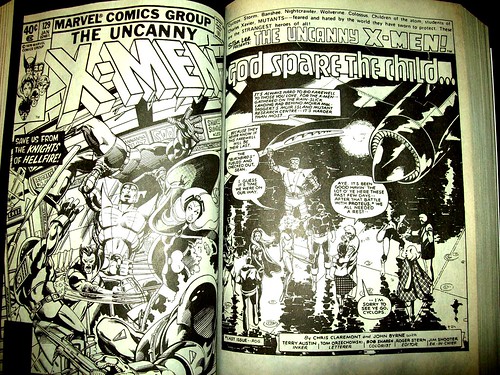
Page One: The Dark Phoenix Saga (Uncanny X-Men)

My main era of comics reading was in the mid to late 1980s, spanning roughly the latter half of seventh grade until the end of my senior year, when I decided to pretty much stop reading comics on the basis that there was no way I was going to be able to afford all my monthly titles whilst in school.

For the most part I was a Marvel fan. There were titles that I didn’t much care for, but I really grooved on The Uncanny X-Men from the first time I read it (issue #183 or thereabouts, my first issue being one in which Peter Rasputin has to tell Kitty Pryde about a girl he’d met on an alien planet). My entrance into the Marvel Universe was pretty much of the “jump in, buy comics, read ’em and put it all together in my head” variety, but back then, you could do that. Sure, the Marvel Universe had tons of continuity going on, but it was still fairly manageable without resorting to lots of reference stuff.

So, a couple of years after I started reading comics a lot, Marvel produced a trade paperback of something called “The Dark Phoenix Saga” from The Uncanny X-Men‘s issues 129 to 137. I knew enough about this storyline to know that it was already considered something of a classic of the genre, and I knew that Jean Grey’s death was an event that was still showing repercussions throughout the Marvel Universe. Now I was going to find out how that death had come to pass.

That original trade paperback of mine is long gone, but I have since reacquired the “Dark Phoenix Saga” as part of one of Marvel’s “Essential” compilations, which nicely and cheaply reprints lots of issues into a nice thick volume (albeit keeping the cost down by printing in black-and-white). I plowed through this entire volume a while back, and a lot of it comprised stories I didn’t know, particularly the ten or fifteen issues leading up to the start of the “Dark Phoenix Saga”, and a couple of issues that showed the aftermath.

The faults in Chris Claremont’s stories tend to stand out quite a bit more in omnibus editions. Now, to be fair, I’m not sure if some of the most annoying style tics of his were actually tics of his or if he was directed by editors to do some of these things, but we’re talking about Wolverine constantly pointing out his unbreakable claws, Cyclops constantly referring to his ruby-quartz visor, and so on and so forth. Or how it sometimes seems as though two or three pages of every twenty-two page issue is given to summing up stuff that happened before. And over time, Claremont’s focuses on character interactions and complex webs of interrelationships tends to start to feel like soap opera; I remember one commentator describing his run on Uncanny X-Men as “Dallas with capes”.

And yeah, that’s all true. But it worked a lot better when you were reading these issues one at a time, once a month. And now, reading the omnibuses, those flaws aren’t really all that distracting, when Claremont is firing on all cylinders…as he is in the “Dark Phoenix Saga”.

This story starts out small. The X-Men are recovering a bit from a pretty tough battle, and there are apparently some conflicts of personality within the team (this is how things seem if you start here and not before). Professor X returns from somewhere (I don’t recall where he was), and almost immediately, they detect two new mutants, one in Chicago and one in New York City. (The X-Men are always scanning for new mutants, so they might intercede and help them learn to deal with their mutancy in a world that is hostile to mutants.)

From such humble beginnings — tired team, investigating two new mutants — this story takes us on an ever-widening story whose scope gets bigger and bigger and bigger until, by the time we get to the final three issues or so of the “Dark Phoenix Saga”, we’ve got full-blown space opera going on, leading to a showdown amongst ruins on the dark side of the Moon. And along the way there is a love story, seeds planted for future tales (this is where we meet Kitty Pryde, after all), and the slow but inexorable rise of Jean Grey’s power until she can no longer control it.

Claremont — along with artist Byrne — presents one of the most cinematic stories I’ve ever read in a comic. In a real way, most of the comics stories of today — and the comics movies — can trace some piece of lineage, in terms of storytelling style, back to the “Dark Phoenix Saga”. This is one of the stories that I would likely cite if someone ever asked me what stories they should read if they want to see superhero comics at their very best.

And now I want to read the bloody thing again!

Share This Post

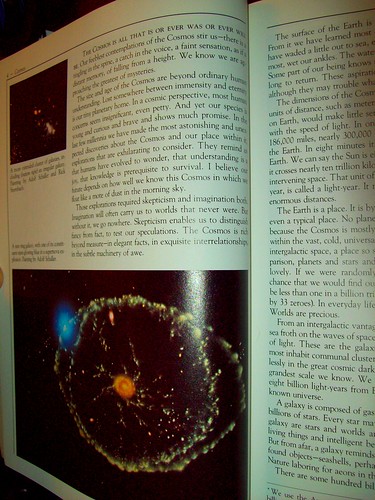
Page One: Cosmos

Page One: Cosmos

I was in fourth grade when Cosmos first aired. My teacher had a poster up about it in the classroom and encouraged us to watch it. I was quite the space geek at the time, and I expected the show to be about space and nothing else, so when it actually aired, I was baffled that it was about the entire history and breadth of science from a truly cosmic perspective. I didn’t understand much of the show, but I faithfully watched each episode. I remember to this day sitting in my living room, watching Carl Sagan standing on the cliffs above the sea, saying in that wonderful baritone of his, “The Cosmos is all that is, or ever was, or ever will be.”

After three or four episodes aired, we were shopping in one of the local malls (this was when we lived in Portland, OR, so I think it was actually the Washington Square mall), when we spotted the show’s companion book. It was something like $19 (hardcovers were expensive back then!), but my parents allowed me an advance of a whole bunch of weeks’ allowance to buy it. So for the rest of the series’s run, I’d watch and try to follow along in the book. This turned out a little more difficult than I’d expected, as the book is not a transcription of the show (and nor is the show a filming of the book). Both contain material not in the other, and in different sequences.

I was, as I said, only nine. I didn’t understand much of the material. A lot of it sailed right over my head. Most of it, actually. But I could sense something big there, and even now, I remember the sense of wonder certain passages of the show and book created in me: the animation detailing the history of human evolution. The ‘Cosmic Calendar’. The depiction of Johannes Kepler. Sagan’s concern over nuclear weapons. The anecdote of the mathematician who asked his nine-year-old son to name the number depicted by a 1 followed by one hundred zeroes, which the kid called a “googol”. (Sagan pointed out that making up names for numbers has a certain charm, especially if you happen to be nine. Which I was.) And all those poetic turns of phrase: “If you wish to make an apple pie from scratch, you must first invent the Universe.” “The Martians will be us.” “Our obligation to survive and flourish is owed not just to ourselves, but to that Cosmos, ancient and vast, from which we spring.”

No, I didn’t understand much of Cosmos. But I sensed it. (And I sure loved the pictures. Cosmos was the first truly beautiful book I ever owned. The mass-market paperback edition of the book, with only a small selection of the art in a section at the middle of the book, strikes me as a publishing error of high magnitude.)

Cosmos receded into the background of my life a bit over the rest of my school years. The show never repeated at a point where I could watch it again, and it wasn’t until college that I decided to re-read the book in its entirety. This time I understood a lot more of it. During ‘May Term’ of my junior year of college — ‘May Term’ was a four-week ‘semester’ that came in May, during which students took a single course — I discovered that this little dump of a video store up on the corner actually had the entire Cosmos series on VHS. I rented them all and, more than ten years after originally watching the show, saw it again. And it deeply thrilled me, again.

I’ve watched Cosmos again one time since college, although I am in the midst of a re-watch again right now. I’m waiting until I’m done to blog anything about it, if even then; Cosmos is now a classic of science documentary film making, and most folks interested in such things have already seen it. I can say that as a production, it stands up beautifully; some of the science is obviously dated, but the show’s overall theme of science as a candle in the dark (as Sagan would later call it in his book The Demon Haunted World) is as important and hopeful as it always was. And you know what? Over the last few years, as the Buffalo Bills have turned in one crappy season after another, I’ve turned to movies when I’ve reached a point where I no longer wanted to watch the Bills. And Cosmos is perfect viewing for turning around that “My football team just got crushed” funk. Who cares that the Bills just lost 39-2! The Cosmos awaits, man!

Carl Sagan’s death continues to strike me as an awful tragedy. I’m not sure anyone is out there right now who can bring such a sense of poetry to writing about science. There’s precious little science writing out there right now that shows that Sagan-esque quality of evocation of “sensawunda”, and some of what’s out there right now is smug in tone when it should soar.

I’ve read a large number of Sagan’s other works — not all of them, but a bunch. I must admit that when I tried his one novel, Contact, I did not much like it, although I greatly admired the film that was eventually made from it. I wish he’d had the opportunity to write more. As a close to this post, here’s another quote of his, not from Cosmos, but from his essay “A Sunday Sermon”, reprinted in the collection Broca’s Brain. I’ve had cause to think of this quote a great deal lately.

My deeply held belief is that if a god of anything like the tradition sort exists, our curiosity and intelligence are provided by such a god. We would be unappreciative of those gifts (as well as unable to take such a course of action) if we suppressed our passion to explore the universe and ourselves. On the other hand, if such a traditional god does not exist, our curiosity and our intelligence are the essential tools for managing our survival. In either case, the enterprise of knowledge is consistent with both science and religion, and is essential for the welfare of the human species.

Thank you, Dr. Sagan.

Share This Post

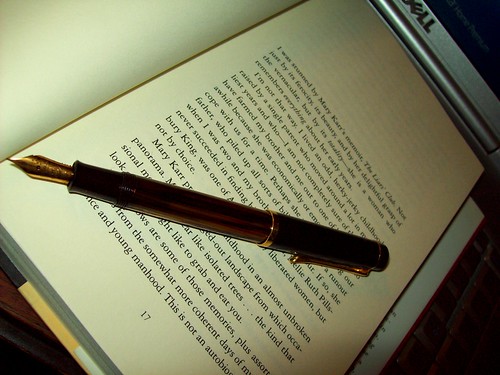
Page One: 'On Writing'


Page One: ‘On Writing’, originally uploaded by Jaquandor.

Steven King’s On Writing: A Memoir of the Craft is the writing book I return to the most often. (In fact, looking at my shelf of books on writing, On Writing is the writing book I pretty much return to at all, anymore.

It’s not a long book, by any means, but King puts so much into it…half the book is biography, in which King is not afraid to make himself look like an ass when merited (his frank discussion of his various addictions, for example), and only half the book is given to discussing actual writing. The book is half-memoir, half-craft, but the ‘craft’ stuff is so neatly folded into the ‘memoir’ that you can’t really have one without the other. And that is certainly King’s point. Stephen King is one of those people for whom to talk about their life without talking about their vocation would basically reduce to a list of times they went to McDonald’s for breakfast or popped into Target because they needed socks.

One of my favorite parts of the book deals with plot and plotting, an area where my own notions tend to line up with King’s.

The situation comes first. The characters — always flat and unfeatured, to begin with — come next. Once these things are fixed in my mind, I begin to narrate. I often have an idea of what the outcome may be, but I have never demanded of a set of characters that they do things my way. On the contrary, I want them to do things their way. In some instances, the outcome is what I visualized. In most, however, it’s something I never expected. For a suspense novelist, this is a great thing. I am, after all, not just the novel’s creator but its first reader. And if I’m not able to guess with any accuracy how the damned thing is going to turn out, even with my inside knowledge of coming events, I can be pretty sure of keeping the reader in a state of page-turning anxiety. And why worry about the ending anyway? Why be such a control freak? Sooner or later every story comes out somewhere.

In the early 1980s, my wife and I went to London on a combined business/pleasure trip. I fell asleep on the plane and had a dream about a popular writer (it may or may not have been me, but it sure to God wasn’t James Caan) who fell into the clutches of a psychotic fan living on a farm somewhere in the back of the beyond. The fan was a woman isolated by her growing paranoia. She kept some livestock in the barn, including her pet pig, Misery. The pig was named after the continuing main character in the writer’s best-selling bodice rippers. My clearest memory of this dream upon waking was something the woman said to the writer, who had a broken leg and was being kept prisoner in the back bedroom. I wrote it on an American Airlines cocktail napkin so I wouldn’t forget it, then put it in my pocket. I lost it somewhere, but can remember most of what I wrote down:

She speaks earnestly but never makes eye contact. A big woman and solid all through; she is an absence of hiatus. (Whatever that means; remember, I’d just woken up.) “I wasn’t trying to be funny in a mean way when I named my pig Misery, no sir. Please don’t think that. No, I named her in the spirit of fan love, which is the purest love there is. You should be flattered.”

Tabby and I stayed at Brown’s Hotel in London, and on our first night there I was unable to sleep. Some of it was what sounded like a trio of little-girl gymnasts in the room directly above ours, some of it was undoubtedly jet lag, but a lot of it was that airline cocktail napkin. Jotted on it was the seed of what I thought could be a really excellent story, one that might turn out funny and satiric as well as scary. I thought it was just too rich not to write.

I got up, went downstairs, and asked the concierge if there was a quiet place where I could work longhand for a bit. He led me to a gorgeous desk on the second-floor stair landing. It had been Rudyard Kipling’s desk, he told me with perhaps justifiable pride. I was a little intimidated by this intelligence, but the spot was quiet and the desk seemed hospitable enough; it featured about an acre of cherrywood working surface, for one thing. Stoked on cup after cup of tea (I drank it by the gallon when I wrote…unless I was drinking beer, that is), I filled sixteen pages of a steno notebook. I like to work longhand, actually; the only problem is that, once I get jazzed, I can’t keep up with the lines forming in my head and I get frazzled.

When I called it quits, I stopped in the lobby to thank the concierge again for letting me use Mr. Kipling’s beautiful desk. “I’m so glad you enjoyed it,” he replied. He was wearing a misty, reminiscent little smile, as if he had known the writer himself. “Kipling died there, actually. Of a stroke. While he was writing.”

I went back upstairs to catch a few hours’ sleep, thinking of how often we are given information we really could have done without.

King goes on to describe the writing of Misery, which in King’s original concept would have ended very differently from the way it eventually came out: Annie would force Paul Sheldon to write the final book in the ‘Misery’ series, just for her, and then…she would kill him and use his own skin as the binding for the only existing copy of the final ‘Misery’ book.

But what happened as King was writing is that the two characters, Paul Sheldon and Annie Wilkes, took on new life in his mind, and the story took a new life as well for all that, eventually coming out in a very different place indeed. This wouldn’t have happened had King created a plot outline and forced the characters to act within its confines.

I tend to approach things the same way. I rarely ‘outline’ my stories, although I have done some outlining for Princesses In SPACE!!! (not the actual title). Not a lot of outlining, to be sure, but just a few notes here and there to help me kinda-sorta keep my way. But even as I’ve been writing, I find the characters saying and doing surprising things, and I find myself learning things about my own universe that I had never planned until the moment that I wrote them — including one idea that just popped unbidden into my head at once, but which I now see could very well drive the stories of a number of future volumes in this series.

Conversely, some time ago I was grinding along for several chapters, the book feeling increasingly lifeless, until about halfway through Chapter 13 I finally could no longer ignore the chorus of my characters screaming at me, “This isn’t what we should be doing! Go back, and we’ll show you what actually happened!” So I scrapped three whole chapters and went back to Chapter 10 — retracing to that missed left turn at Albuquerque, as it were. Now I’m on Chapter 18, and so far, no signs of having taken a wrong turn.

So, it’s always cool to reflect that I’m approaching things in a similar manner to Stephen King…even if I don’t have any of his success. At least the process feels right to me.

(And, like King, I hate adverbs and do whatever I can to not use them!)

Share This Post

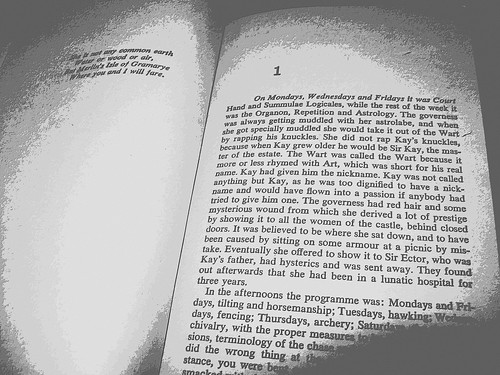
Page One: The Once and Future King

“The fate of this man or that man was less than a drop, although it was a sparkling one, in the great blue motion of the sunlit sea.”

During my college years I formed a deep passion for the legends of King Arthur, and over a couple of years I piled up a small but reasonably impressive library of Arthurian books — novels that retold the legends, novels set in and around the legends, short fiction collections, and a bunch of nonfiction works pertaining to various aspects of Arthuriana and the Celtic legends and mythology that came before. I’m not now the Arthurian that I used to be, but I’ll always have a special place in my heart for the Matter of Britain.

I’m not sure if a ‘definitive’ telling of the Arthur stories has ever been written — certainly no definitive Arthurian film has yet been made — but I think that’s due to the nature of the legends themselves, which are basically a big collection of stories, many of which aren’t really related much at all. The focus is deeply difficult to get right — is the important part the Arthur-Guinevere-Lancelot triangle? Is it the Round Table and the dream that Camelot represents? Is it the Grail, which is often the hardest part of the story to get right (which is why a lot of retellings leave it out entirely)? I’m not sure.

But one big candidate for the title of “Definitive Arthurian Retelling” is TH White’s The Once and Future King, which is just a wonderful, wonderful book. It occurs to me that maybe I’m due for a re-read…and I am planning a whole lot of fantasy reading this winter….

Share This Post

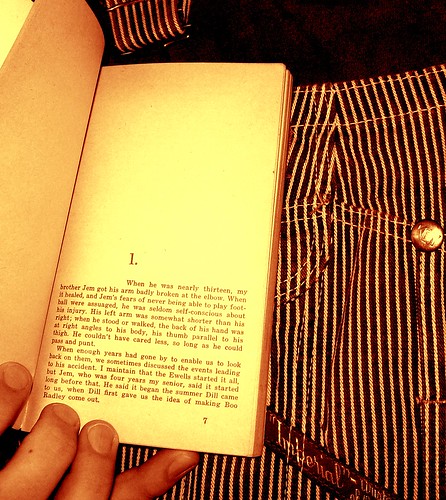
Page One: To Kill a Mockingbird

Page One: To Kill a Mockingbird

I re-read To Kill a Mockingbird not long ago…or at least I thought I did, but when looking through the archives for my blog post about it, I find that is was actually about two-and-a-half years ago. I know, time flies and all, but wow. I really thought it was in the last year!

I chalk that up to just how memorable the book really is. To Kill a Mockingbird is one of those books I feel truly, truly fortunate to have been able to read.

Share This Post

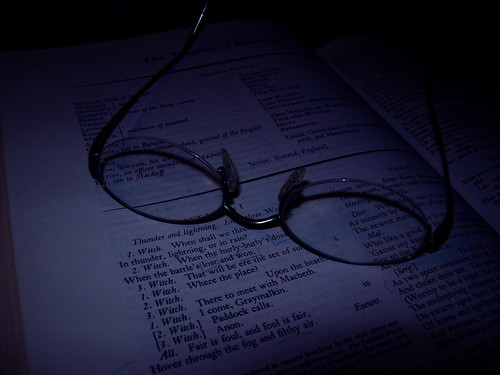
Page One: Macbeth

Page One: Macbeth

I’d love to be able to say that I loved Shakespeare right from the first time I read him, but I can’t. Sorry, but I was a typical ninth-grade kid, and I thought that Shakespeare sucked. Despite my teacher’s desperate attempts to force us to see the beauty in Shakespeare’s poetry and drama, I saw none of it. All I saw was a guy who used twenty words when six would do, a guy who insisted on repeatedly stopping the action so someone could stop and babble at the audience, and a guy whose stage directions consisted of things like “They fight” and “Exeunt”. Yeah, I hated the experience of reading Shakespeare.
In ninth grade, the play was Romeo and Juliet. Hated it. (At the time.) In tenth grade, our Shakespeare of the Year was Julius Caesar, which was, I had to grant, a bit more interesting than Romeo, because it had nifty political stuff and brutal murders and whatnot. And then, in eleventh grade, there was Macbeth. I suppose the third time was the charm, because this time, I thought, Wow, this is pretty awesome.
It wasn’t just the fantastic elements of the story, although yes, that did help. But I think that by this point, I was getting to the point as a reader where I could understand a lot more readily what Shakespeare was doing. I didn’t have to have the teacher explain just what Lady Macbeth was doing when she said “Out, damned spot! Out, I say!” I didn’t have to have it explained to me what Macbeth’s “Tomorrow and tomorrow and tomorrow” speech. I thrilled to the way the witches’ prophecies were fulfilled. I did have to have some stuff explained, but a lot of it was falling into place.
The next year we would read Hamlet and The Tempest. I’ve read more since then. Not all of it, but…someday.

Share This Post