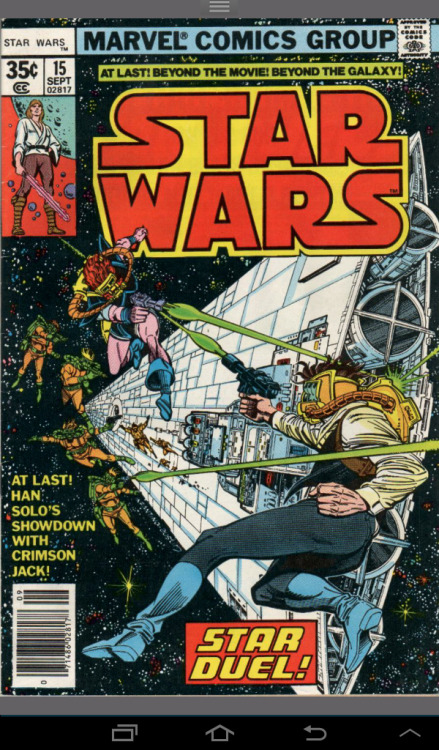
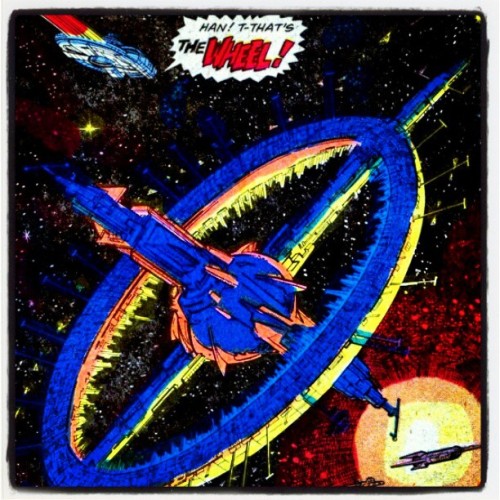
Comics artist Carmine Infantino died the other day. I primarily remember his work on the Marvel Star Wars series, which he drew during a hefty chunk of the period between A New Hope and The Empire Strikes Back, which was actually a really wild-and-wooly time for the Star Wars comics. At that point, nobody had any idea what was to come in terms of the Star Wars mythology and backstory and so on, so Marvel was flying about as blind as could be. The result was a sequence of issues that told some really fun and entertaining space opera adventure stories, and Infantino’s art was a big part of that.
I had a piece chosen already, but yesterday’s passing of pianist Van Cliburn gave me cause to push that one back a week. This particular work is so associated with Cliburn that it’s almost cliche to use it, but there’s a reason cliches become so in the first place.
Back when I was in school and taking piano lessons, my teacher — a wonderful lady named Margaret Hooker — used to rave about Van Cliburn. She thought the world of him, and I never think of him without thinking of her almost at the same time. I was never that good at the piano, choosing instead to focus my energies on my beloved trumpet, which I imagine had to frustrate Mrs. Hooker somewhat, as I could have done better had I worked harder at it. I’d say ‘Story of my life’, but then, that’s the story of everyone‘s life, isn’t it?
Anyway, I hope that Mrs. Hooker is finally getting to meet Mr. Cliburn in whatever musical realm they now inhabit. There’s no question in my mind that if there is such a realm, she’s already tracked him down.
Here’s Van Cliburn playing the Tchaikovsky Piano Concerto #1.
Neil Armstrong was laid to rest last week. He lived near Cincinnati, and fittingly, the moon on the night of his burial was full and, as it happened, blue.
I haven’t said anything about Armstrong’s passing, because so many others have said what I would have said and said it better. I remain firm in my belief that humanity’s future ultimately lies beyond this world, and I hope that Armstrong’s footsteps won’t have been the first of just a few that were never taken again.
When Sally Ride became the first American woman to fly in space, in 1983, I kept thinking, “Why did it take us so long to do what the Russians did twenty years ago?” It’s kind of sad that the Cold War mentality kept me, at eleven years of age, from realizing how inspiring Ride’s efforts were. That, and I honestly could not understand why we’d made space a boy’s club for so long.
I’m saddened to hear of Ride’s passing, too early, from pancreatic cancer. If I could pick one cancer to eradicate with a wave of a magic wand, that would be the one.
Actor Ernest Borgnine has died. I try not to be too sad when folks die at such an age (he was 95); after all, Borgnine led a long life and he led it well, the kind of life where one might honestly say that the rest at the end of it is a well-earned reward. But it still saddens me, a bit.
I honestly don’t recall ever seeing Borgnine in anything in which I didn’t like him, unless he was playing a villain, in which case I disliked him in exactly the right way. His was an utterly unmistakable face, between the roundness of his head, the slight bulging quality of his eyes, and the gap between his two front teeth — but he was also one of those actors who was able to look the same and yet make you think of nothing else other than the character he was playing at any one time. (I consider Steve Carell to be another actor of this type.) Borgnine was able to put just the right look in his eyes to convey exactly what he wanted to convey about any character he played.
I assume that I first saw Borgnine in a guest-starring role on some show in the 1970s or so, maybe The Love Boat (which, yes, he was on — but then, so was everybody). The first thing I really remember him in was an episode of Little House on the Prairie that I’ve mentioned before in this space. It’s a two-parter called “The Lord Is My Shepherd”, and it’s one of the tear-jerkingest things I’ve ever seen. In Part 1, Charles and Caroline have a baby boy, whom Laura resents and (if memory serves) she actually wishes to die. Sadly, as infants sometimes did back then, little Baby Charles actually did die, and Laura became racked with guilt — so much so that, in part 2, she runs away from home to seek God and petition him to take her instead of Baby Charles. Quite logically for a child, Laura recognizes that her best bet of being heard by God is to seek high ground, so she goes atop a craggy mountain (we won’t ask what this mountain is doing there, in the middle of ‘the prairie’), where she meets a wise old man named Jonathan, played by Borgnine.
Here’s the entire episode of part 2:
Now, this episode can really only stand or fall based on what Borgnine does, and he conveys a pitch-perfect combination of warmth, wisdom, and mystery that suggests who or what he must be, well before a final reveal (of sorts) happens at the end. This episode made a mark on me years ago when I saw it as a kid, when Little House was an after-school re-run. Little did I ever suspect that this particular story would one day turn out to have some fairly uncomfortable parallels to events in my own life.
For a totally different side of Ernest Borgnine, there is his malevolent stockade administrator in From Here to Eternity. He’s a mean and sadistic bully, but Borgnine knows to portray a bit of the cowardice that lies at the heart of most bullies. Here he’s forced to stand down, but he knows that he’ll have his chance again, one day.
Thanks for the memories, Mr. Borgnine. About the only good thing about the passing of fine actors is that their memories are enshrined forever on film.
Actress Kathryn Joosten has died, which is a sad thing. She was one of those people who can show up in a teevee show or movie and make me smile immediately, with the thought, “Hey, something nifty is about to be said!” And that’s because she was, in turn, one of those actors/actresses who just seemed to wind up with the best lines. She might only appear in one scene and get two or three lines, but damned if they weren’t often the best lines.
I never realized that, until earlier today, when I went outside toward the end of my work day for a last brief break. I pulled out my phone, and before I even realized I was doing it, brought up “Last Dance” on it. And then I stood there, listening to that great disco song, for all eight minutes of its long version. It was a gorgeously sunny day, and there in the cool shade I listened to a song that I’ve loved since I was seven or eight years old, over the tiny speakers on my phone. The sound wasn’t very good, of course. The phone’s not designed for that. It sounds nice as a portable music player over earphones, but the speakers on the phone don’t produce any bass to speak of. It did not do Ms. Summer justice.
And she still sounded utterly, utterly astounding.
Because of my unusual relationship with pop music, I never owned a recording of Donna Summer’s, aside from “Last Dance”, until only just in the last few years. I rarely listened to rock or pop as a kid, preferring to stick with film music and, later on, classical. In fact, I didn’t really start to engage with pop music until I was already actively engaging with classical music. Interesting that both interests blossomed right around the same time…but just because I wasn’t buying pop and rock records or tapes until I was 14 doesn’t mean that I had zero idea of what was going on, mainly because of my sister, who listened to a lot of pop and rock (in addition to classical herself). The soundtrack of my world back then had that music in it, and I keenly remember hearing a lot of Donna Summer for a few years.
But she’d first come to my attention cinematically, through her acting debut in the disco movie Thank God It’s Friday (which I may well watch again this weekend in her memory). In the movie Ms. Summer plays Nicole Sims, an aspiring disco singer who is trying to get her big break by getting the deejay at the disco in the movie to let her sing. He refuses, and refuses, and refuses; he tries to kick her out of the disco and she keeps getting back in. Of course, there’s no doubt in our minds that she’s going to get her shot, but Summer plays her ably as a kid with some skill and just enough confidence to stick with it but also a bit of fear that once her shot is done, that’s it. Finally, the deejay realizes with horror that he has to kill a few minutes of airtime until the Commodores show up, and he’s got nothing to fill it with…so Nicole takes over and starts singing. What’s she singing? “Last Dance”. And of course, after a rough start, she comes into it, and it becomes a performance that has the entire disco dancing and cheering and so on.
Yeah, it’s predictable as hell. But Donna Summer is so beautiful and vulnerable and cocky and confident and willing to stake her life on this one opportunity that doesn’t so much present itself as make itself available to be stolen, that the moment totally works.
And it helps, of course, that “Last Dance” is such a great, great, great song.
Yes, it is. It really is.
Look, it’s fun to laugh at disco, and for a whole lot of reasons. It was music of excess and rhythm-above-all, music that seemingly existed for no reason other than to trumpet a very casual approach to sex that would seem not just quaint but downright dangerous just a few years later. The music, the clothes, the discos with their glowing lights in the darkness, all of it. But there’s never been anything, not one thing, that no matter how fierce the backlash against it, didn’t produce at least something worthwhile. And that was Donna Summer.
“Last Dance” has been a favorite song of mine ever since I saw that bad-but-fun movie (that a seven-year-old kid probably shouldn’t have been watching, but thank God for liberal parents). It sounds like typical overlong disco, with its throbbing beat. But it has real melody behind it, and its master stroke lies in its slow introduction, where Ms. Summer imbues the lyrics with more than a touch of sadness.
Last dance
Last dance for love
Yes, it’s my last chance
For romance tonight
I need you by me
Beside me, to guide me
To hold me, to scold me
‘Cause when I’m bad
I’m so, so bad….
The way Ms. Summer sings this, it’s not a woman trying to be seductive. It’s a woman feeling desperate. She is being seductive, but she’s also pleading. How many others have there been this night? It doesn’t matter; this is the last one. She needs you, but not because of anything special about you…it’s just the fact that the place is closing and they’re playing the last song of the night. This is it — last call, the last dance.
The beat starts now, and the dance part of the song begins.
So let’s dance the last dance
Let’s dance the last dance
Let’s dance this last dance tonight
The lyrics repeat, now over the thumping disco beat and the synths and the strings and the brass. This all plays out like a dance on the floor, quick and thumping and seductive, but then there’s a very brief B section where Ms. Summer sings this:
I can’t be sure
That you’re the one for me
But all that I ask
Is that you dance with me….
That bit right there, that brief, brief moment, elevates the song to something more than just a “Hey let’s dance and then go screw” kind of song. (And the fact that the short version that you hear on the radio omits that part is a major reason why that short version should never be listened to by anybody.) The song takes on a secondary melody, with a break of several seconds in the singing between the second and third lines. What Ms. Summer is saying here is: “I’m looking for someone, I’m looking for the one…and I don’t know if you’re the one and for right now, I’m not asking you to be.” The dance is all there is…the dance on the floor, and maybe the dance to come, the one in bed.
That tiny B section is so blunt in its desperation, and Ms. Summer sounds so vulnerable as she sings it, that “Last Dance” rises, right there, above its genre and its poor reputation that lingers to this day.
The song includes a second slow section, which repeats the lyrics of the opening. It’s an interesting structural shift, and I wonder if it’s not partially meant to depict that second dance, the one that the singer hopes the last dance is leading to. As the song shifts back yet again to the faster tempo, Ms. Summer delivers one of the most amazing high notes I’ve ever heard from a singer (at about the 6:20 mark in the song). It’s the perfect, glorious, vocal climax of a wonderful song.
Donna Summer’s voice was an absolute miracle, as was the complete and utter command she had of that instrument when she was at the peak of her powers. Here’s how good she was, just three years ago, performing “Last Dance” live:
And here she is performing The Star-spangled Banner before a Red Sox game. I didn’t know this performance existed until just tonight.
Donna Summer was a beautiful, transcendently wonderful singer and artist. I truly, deeply hate that she’s gone from this world, and it’s people like her that make me wish so hard that there’s a next one.
:: Dungeons and Dragons was created almost 40 years ago by Gary Gygax and David Arneson. Both men have passed on, but Arneson’s personal collection of materials comprising his creative work on the game was recently found in, of all places, an abandoned storage locker. Now it’s all going to be auctioned. Wow! I’m glad that the new owner of the locker wasn’t a putz like that guy on Storage Wars who is always searching for ‘collectibles’, and just tosses stuff aside if he has no idea what it is.
:: How in God’s name have I gone this long without learning about Blue Milk Special? This is a webcomic that is retelling the Original Trilogy of Star Wars, as a parody. And it is awesome. I spent some time this morning reading it, getting up to the Millennium Falcon blasting its way out of Mos Eisley. I think that this one is my favorite thus far…but it’s got some competition.
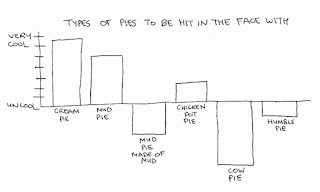
:: Some recent stuff pertaining to that goofball fascination of mine, the pie in the face:
I saw this on Tumblr. I guess I’d agree on the first two, but I’m befuddled that a chicken pot pie has a ‘positive’ rating as a potential pie for someone’s face. I don’t think I’d like that at all. Especially if it’s still fairly fresh from the oven.
A reader e-mailed me this helpful bit of advice:
See? Pot pie is not recommended. (I wouldn’t recommend shaving cream either, because it tastes like, well, shaving cream. And meringue doesn’t stick, at all.) As for the delivery techniques, I have zero experience in this regard myself, but I recall from gym classes in school that throwing things isn’t my wheelhouse, as it were. Best stick with the push, I suppose.
Comics readers from the 1970s (on which I was a young one) may recall a DC Comics superheroine named The Mighty Isis, whose powers and mythology was derived from Ancient Egyptian mythology. (Hmmm…I wonder if her creation was inspired by things like the tour of King Tut’s treasures around the US….) She had a teevee show that was paired with the Shazam! show, along with her short-lived comic. In one of the issues of the comic, one of Isis’s fellow Egyptian gods, Set, shows up to try to force humans to worship him, and he works all manner of mischief, which Isis can’t stop because she’s not as powerful as he is. So she hatches a plan to show Set that he doesn’t really want to rule humans anyway, because they’re not sufficiently reverent of the gods. How does Isis demonstrate this? By letting some kid (from her schoolteacher alter-ego’s class) throw a pie in her face.
It’s a weird story (I posted the whole thing on my Tumblr), but kind of funny and even ‘wholesome’ in that “Hey, I can triumph over my foes without resorting to violence!’ way. And as comic-book pies in the face go, this one’s fairly nicely drawn. (Not that I have a huge sample size of such things to meditate upon…I remembered this one from when I was a kid, and I spotted the issue in an ‘Old Comics for Ten Cents Each’ box at a local comics store, and the cover jogged my memory.)
:: Finally, I note the passing last week of Adam Yauch, one of the founding members of the Beastie Boys. In truth, I wasn’t a fan, but that’s more because I just don’t grok rap in general. Not my cup of tea, although I do grant the artistry involved. The Beastie Boys’ popularity and influence can’t be ignored, but for me, their best thing was their famous video that included a pretty spiffy pie fight.
OK, that’s it. More Weirdness and Awesome next week!
Former NFL linebacker Junior Seau is dead, apparently of a self-inflicted gunshot wound.
I learned this earlier today, when I went online at work just to check my e-mail one last time before coming home. I had a few Facebook updates, a blog comment to approve, and a ‘breaking news’ message from WGR. I figured the WGR thing would be something about the fact that the Bills had a workout with quarterback Vince Young today. Instead, I read that Junior Seau had been found dead.
Seau was a great, great player. He truly was. He came to prominence in the early to mid 1990s, and he played most of his career with the San Diego Chargers, including that teams one and only Super Bowl team in 1994 (which would lose, 49-26, to a juggernaut of a San Francisco 49ers team). I always liked Seau, and his physically athletic (or athletically physical) play. He was one of the good guys, having done a great deal of charity work in San Diego during his career there. I really didn’t want to hate him in 2007, when he came out of retirement to try for the elusive championship ring with the Patriots, but a football fan has his priorities, so for one year, hate Seau I did. Although not really. You couldn’t hate Junior Seau.
Why did he apparently kill himself? I honestly don’t know, although speculation is sure leaning strongly toward side effects of concussions being a factor. Seau wouldn’t be the first formerly concussed player to commit suicide. We do know more and more these days, though, about the effects of concussions — particularly repeated concussions, on the brains of athletes, and the effects those concussions can have many years later, once the athletes have stopped playing.
I’m once again struck by the degree to which physical things affect our mental states, and I continue to wonder just to what degree we really have control over the things we think. Not everything is choice. I’m reminded of recent research that suggests a strong correlation between the decline of violent crime in America over the last few decades and the reduction of lead exposure over the same period. We don’t always have the power to think what we will. And that can be a somewhat grim realization.