
National Poetry Month, day 4: Christine Turner Curtis

An odd road to this one: my last two years of college, I lived in a rented house with a roommate, and thus I was off the campus meal plan as well. This meant cooking. As a college student with little income (OK, let’s be honest, outside of what my parents were graciously willing to send me despite my frankly not-especially-good habits of showing gratitude for it, no income), “cooking” generally meant things like Kraft Mac-and-Cheese, Ramen noodles, PB&J or bologna sandwiches, and the like. But I did start learning to do more actual cooking during those years, with a big way of learning my way about a kitchen coming from Jeff Smith, the “Frugal Gourmet”, who at the time was still a big name. I bought a number of his cookbooks and I enjoyed watching his shows, which just happened for one year to run in the afternoons in Iowa during a period when I had no classes.

(I know, I know, all about what happened to Smith’s career, and I’m not relitigating any of that in this space. It’s not the point.)

My favorite of Smith’s cookbooks, which in addition to having a lot of great information in the recipes were just good food writing in general, is The Frugal Gourmet Cooks American, in which Smith focused heavily on foods native to America, or reflective of American history. He believed that food and memory–i.e., history in the personal sense as well as the larger, collective sense–were intertwined, and that foods that were enjoyed by our ancestors should still be enjoyed, even if our associations with them weren’t always positive. Hence a story he told about his father one day cooking cornmeal mush in the kitchen, and young Jeff’s confusion at this when his father had told him once that he’d had many mornings as a poor kid when all they’d had to eat was cornmeal mush.

“If all you had to eat was cornmeal mush, and you got sick of it, why are you cooking it now?” Jeff asked.

“Because I have to taste it again,” said Jeff’s father.

But anyway, onto poetry. There’s a section in The Frugal Gourmet Cooks American about New England’s food heritage, going all the way back to the first Pilgrim colonists. (Again, this was written in the 1980s. Smith was a lot more acknowledging of what European colonists had done to the native populations than most, but he was still very much “of his time”.) At the end of a brief introductory essay, Smith closes with this bit of verse:

All the fine old frugal ways
Of the early Pilgrim years
Have the power to wake in me
A deep and sober ecstasy
Close akin to tears.

I’ve always rather liked that little bit. Problem is, Smith doesn’t credit it! I have never been able to figure out where it came from, and I wondered if Jeff Smith wrote it himself.

He did not.

I’ve searched that verse online every once in a while over the years, and never found a source for it…until just the other day.

The author is one Christine Turner Curtis, a writer about whom almost no information exists online, as far as I can find. All I know is that Curtis was born in 1891, she was a New England poet and writer, and her most notable work is apparently a novel called Amarilis. I also found, in a collection of verse written by poets connected to Wellesley College over fifty years, from 1875 to 1925. The book is digitized into Google Books, and as the book was probably out of print more than fifty years before Jeff Smith ever started researching his American cookbook, I’d be interested to know exactly how he came across this terrifically obscure bit of verse.

Anyway, here is the entire poem.

“The Strain”, by Christine Turner Curtis

The Old New England soul of me
Loves all sleek and hearty things;
Wide-roofed barns and stuffed haymows,
Fat white goslings, leaf-brown cows,
Autumns and harvestings,

And the bulging orange cheeks
Of ripe pumpkins in the sun;
Seed-corn hanging by the door,
Melons on the woodshed floor,
Clapp’s Favorites, one by one,

Dropping from the loaded trees,
And the copper Seckel pear,–
Loves the crowded apple bin
And the red fruit rumbling in;
Grandfather’s spindle chair

Standing by the kitchen blaze,
The deep chimney and the clock
And the blackened old firedogs
Under the huge twisted logs,
New butter in a crock

And great foaming jars of milk,
Yellow loaves of citron cake,
Currant jellies, clear and red,
And the brown domes of the bread,
Fresh from the morning bake.

All the fine old frugal ways
Of those gallant Pilgrim years
Have the power to wake in me
That deep sober ecstasy,
Close akin to tears.

A great poem? Enh, maybe not. But maybe not deserving of complete obscurity outside of a brief quote, with the wording changed, and the author uncredited in a nearly forty-year-old cookbook, either.

 

Share This Post

National Poetry Month, day 3: John Donne

From a collection of love poetry that I own, an offering by John Donne.

“The Good-Morrow”, by John Donne

I wonder, by my troth, what thou and I
Did, till we loved? Were we not weaned till then?
But sucked on country pleasures, childishly?
Or snorted we in the Seven Sleepers’ den?
’Twas so; but this, all pleasures fancies be.
If ever any beauty I did see,
Which I desired, and got, ’twas but a dream of thee.
And now good-morrow to our waking souls,
Which watch not one another out of fear;
For love, all love of other sights controls,
And makes one little room an everywhere.
Let sea-discoverers to new worlds have gone,
Let maps to other, worlds on worlds have shown,
Let us possess one world, each hath one, and is one.
My face in thine eye, thine in mine appears,
And true plain hearts do in the faces rest;
Where can we find two better hemispheres,
Without sharp north, without declining west?
Whatever dies, was not mixed equally;
If our two loves be one, or, thou and I
Love so alike, that none do slacken, none can die.

There’s a lot going on in this poem–I had to look up the reference to the “Seven Sleepers”, which turns out to be a pretty interesting bit of mythology on its own–but what caught my eye, just briefly, is the question Donne asks in the very first two lines and explores over the course of the first stanza. It’s certainly my experience that once love is found, it gets harder and harder to remember what it felt like before it was found, and it’s easy to ask the question Donne is exploring: If our two lives are one now, how were our two lives two before we found each other? Were we really living, or were we just sleeping through life?

But when we do find love, it’s a melding of worlds into one, and our worlds become each other, don’t they? Hence the cartographic references in the third stanza, which are interesting metaphors for a love poem, aren’t they?

Share This Post

National Poetry Month, day 2: Peter Halstead

A poem about yesterday’s birthday composer:

“Rachmaninoff” by Peter Halstead

On top of fluted spines
Between the massing pools
Of dark chromatic lines

And using blood for fuel
Follow all the signs
And signatures

Read the fine print
On the flapping label
In the search for love

So the incidentals
Of the dim rule
On the page above

Take the clouded hint
Or later on you’ll
Tend to bluff

In the no man’s land
Of the intellectual
Handcuffed to chance

And lost in jewels:
A dream of hell
With inhuman hands.

Source. Peter Halstead is a poet, pianist, and photographer who with his wife Cathy founded the Tippet Rise Art Center in Montana.

I love the hints of musical terminology in this poem, and I assume the “inhuman hands” of the last line belong to Rachmaninoff himself, who had famously enormous hands, which enabled him to span gigantic chords at the keyboard (and which led him to unapologetically write gigantic chords in his own piano music). When he was on his deathbed, Rachmaninoff is reported to have bid farewell to his hands.

Share This Post

National Poetry Month, day 1: Seamus Heaney

I want to post a poem each day this month! Here is the first, a poem about writing poetry, by Seamus Heaney. Note how he compares his own work–writing, with the pen as his tool–with that of his father, who is digging up potatoes in the garden. It’s a metaphor that works in a lot of ways: if one characterizes writing as “digging”, then one sees writing as a way of delving deep into the regions of the mind as digging is a way of delving deep into the regions of the world.

But Heaney also sees a disconnect between the work that he does, the work with which he is accustomed and comfortable and skilled at doing, and the work that his father and his grandfather did with such strength and skill, stopping only to drain an offered bottle of milk. How vivid the details: the smell of the potato plants and their fungi, the sound the peat makes as one digs, the sharpness of the lines left by the men doing the digging. A tone of possible regret creeps in as Heaney notes that he has no spade to take up of his own. He cannot dig in the earth as his forebears did.

But he can dig with the “squat pen”.

“Digging”, by Seamus Heaney

Between my finger and my thumb
The squat pen rests; snug as a gun.
Under my window, a clean rasping sound
When the spade sinks into gravelly ground:
My father, digging. I look down
Till his straining rump among the flowerbeds
Bends low, comes up twenty years away
Stooping in rhythm through potato drills
Where he was digging.
The coarse boot nestled on the lug, the shaft
Against the inside knee was levered firmly.
He rooted out tall tops, buried the bright edge deep
To scatter new potatoes that we picked,
Loving their cool hardness in our hands.
By God, the old man could handle a spade.
Just like his old man.
My grandfather cut more turf in a day
Than any other man on Toner’s bog.
Once I carried him milk in a bottle
Corked sloppily with paper. He straightened up
To drink it, then fell to right away
Nicking and slicing neatly, heaving sods
Over his shoulder, going down and down
For the good turf. Digging.
The cold smell of potato mould, the squelch and slap
Of soggy peat, the curt cuts of an edge
Through living roots awaken in my head.
But I’ve no spade to follow men like them.
Between my finger and my thumb
The squat pen rests.
I’ll dig with it.

Share This Post

Something for Thursday (National Poetry Month Edition)

 Today is April 1, which means that it’s another National Poetry Month! This month, each of my Thursday music posts will involve poetry, either by direct setting or…something else. (What “something else” may be, I’m not really sure. It might just be settings.)

This is a gorgeous setting of a slightly revised version of one of my favorite poems by one of my very favorite poets, Alfred, Lord Tennyson. The poem is “The Lady of Shalott”, and the musician is the great Loreena McKennitt.

John Atkinson Grimshaw - "The Lady of Shalott" - Google Art Project.jpg

This poem has appealed to me ever since I read in high school, either my junior or senior year. Its lyricism and its capture of the sadness of one of the tales that takes place at the periphery of the Arthurian legend (which is ultimately a collection of very sad stories). Tennyson’s work continues to move me greatly; no matter how poetry changes or what has come after, I always find myself responding to his sense of rhyme and meter, as well as his content. Reading Tennyson is like coming home.

“The Lady of Shalott” begins thusly:

On either side the river lie
Long fields of barley and of rye,
That clothe the wold and meet the sky;
And thro’ the field the road runs by
       To many-tower’d Camelot;
The yellow-leaved waterlily
The green-sheathed daffodilly
Tremble in the water chilly
       Round about Shalott.

As it’s lengthy, I won’t quote it here in its entirety. But you can read it here.

And here is Loreena McKennitt’s setting.

Share This Post

Poetical Excursion: “The Ruin”, from the Anglo-Saxon

This poem is fascinating in that it seems to anticipate Shelley and Ozymandias by almost a thousand years. It describes in some depth the ruins of a Roman city, which has fallen into decay and disrepair, and juxtaposing that imagery with the thoughts of life that must have once flourished there. By the time this poem was written in the 8th or 9th century, the ruins being described (it’s not entirely clear which ones specifically are in the poet’s heart, or if they’re even meant to) had probably been abandoned for centuries already. It’s often worth remembering just how much time really passed during the Middle Ages, and how distant a memory the glory of Rome truly was.

The Ruin comes to us from a manuscript called the Book of Exeter, and unfortunately the poem as we have it is incomplete because of fire damage to the book itself. This translation comes from one of my favorite poetry collections. The poem itself is anonymous.

The Ruin

Well-wrought this wall-stone which fate has broken:
The city bursts, the works of giants crumbles.
Roofs are fallen, towers in ruins,
The gate is gone, frost on the mortar,
The shelters in shards, open to showers,
Eaten by age. Earth has in its grasp
Ruler and workman, removed now, perished,
Held fast in the ground while a hundred generations
Went from the land. This wall remained,
Stood under storms, will all around perished.
Bright were the buildings, many bath-houses,
High-gabled homes, and the sound of soldiers,
Many a mead-hall where men enjoyed themselves
Until mighty fate overturned all.
Many men fell in the days of wrath;
Death took all the valor of earth.
Bulwarks became wrecked foundations,
A fortress in fragments. The builders perished.
Defenders gone unver. The courtyard is dreary;
The arch of red stone, the roof with its rafters,
Shed their tiles, and they slip to the earth,
A broken mound. Once many men
Glad and gold-bright, in gleaming array,
Proud and wine-flushed, shone in war-apparel;
Saw the treasure, the silver, the well-set jewels,
RIches, possessions, precious stones,
In the bright fortress of a broad kingdom.
Stone courts stood, the hot stream came
In its broad whelm; a wall enclosed all
Within its bosom. There the baths were,
Hot in the midst. It was a haven.

Translated by Michael O’Brien,
Printed in World Poetry: An Anthology of Verse From Antiquity To Our Time

Share This Post

A Poetical Excursion: “Love Has Seven Names” by Hadewijch

I read this poem–translated from the original Dutch–in my copy of World Poetry. I had never heard of Hadewijch before, so I did a little digging. It turns out that’s about all one can do. Very little is known about the life of Hadewijch, a mystic and poet who likely lived at some point in the 13th century in Brabant, a duchy in what is now Holland. Hadewijch wrote in Brabantian, a language predating modern-day Dutch, and just about everything we know about her comes from the writings of hers that have survived. She had some influence, although she seems to have utterly disappeared from European consciousness in the 1600s, only to reemerge in the 1800s when some of her works were found in the Royal Library in Brussels.

An excerpt from Hadewijch’s entry on Poetry Chaikhana:

Little can be said for certain about the life of Hadewijch. Unlike many other women mystics of the time, no biography was written about her, so all we know is what scholars have been able to deduce from her writings themselves.

Hadewijch was probably the head of a Beguine community. The Beguines were a sect of devout women in Belgium, Holland, Germany and northern France. Beguines did not take vows, but they gathered together to live in simplicity and service. Many Beguines were mystics and poets of the highest order.

Hadewijch’s poetry has a rich love mysticism. Like her contemporary, St. Francis of Assisi, Hadewijch was clearly inspired by the courtly love poetry of the Troubadours and Minnensingers. The fact that she was familiar with this courtly art form suggests that Hadewijch was probably born to a noble family.

Love Has Seven Names is most certainly a mystical poem, full of lyrical mystery and very clear mysticism, right from the very first line. Seven names for love? Naturally, since seven is a number that is historically beloved of mystics of all kinds.

Love has seven names.
Do you know what they are?
Rope, Light, Fire, Coal
make up its domain.

The others, also good,
more modest but alive:
Dew, Hell, the Living Water.
I name them here (for they
are in the Scriptures),
explaining every sign
for virtue and form.
I tell the truth in signs.
Love appears every day
for one who offers love.
That wisdom is enough.

Love is a ROPE, for it ties
and holds us in its yoke.
It can do all, nothing snaps it.
You who love must know.

The meaning of LIGHT
is known to those who
offer gifts of love,
approved or condemned.

The Scripture tell us
the symbol of COAL:
the one sublime gift
God gives the intimate soul.

Under the name of FIRE, luck,
bad luck, joy or no joy,
consumes. We are seized
by the same heat from both.

When everything is burnt
in its own violence, the DEW,
coming like a breeze, pauses
and brings the good.

LIVING WATER (its sixth name)
flows and ebbs
as my love grows
and disappears from sight.

HELL (I feel its torture)
damns, covering the world.
Nothing escapes. No one has grace
to see a way out.

Take care, you who wish
to deal with names
for love. Behind their sweetness
and wrath, nothing endures.
Nothing but wounds and kisses.

Though love appears far off,
you will move into its depth.

Not exactly the stuff of Hallmark cards, is it? It’s a very old view of love, not entirely positive and not entirely negative, either. Hadewijch seems to view love as a natural force in itself, neither positive nor negative. It’s something that can go either direction. It is a binding rope, and it is light and fire. It is cleansing dew, and it is actually Hell. That’s pretty amazing. Not every love poem is about comparing thee to a summer’s day.

Share This Post

Poetical Excursion: A poem about overalls!

So, something cheerful…I’m going to try to post more of that sort of thing over the next few weeks, I think. The world has darkness a-plenty and I’ll be occasionally writing about that, too. But here’s a poem I found by an author named Tony Johnston. She is a prolific writer of books for children who lives in California. This is from a book called Once in the Country: Poems of a Farm, written in 1996.

My Overalls

The best thing is their color,
old-night or early-dawn.

No, the best thing is their limpness
when I hoist them on.

No, the best thing is their looseness
like the soft skin of a pup

No, the best thing is their buckles
like a suitcase snapping shut.

No, the best thing is their perfume
of cows and hay and dung.

No, the best thing is their many holes
to let in all the sun.

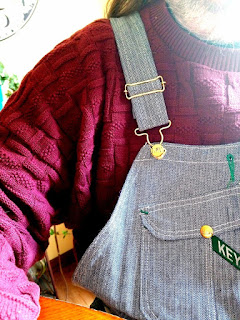
Obviously I don’t own any overalls that are redolent of “cows and hay and dung”, but I do have a couple of old pairs–vintage!–that aren’t quite holey yet, but may get there sooner rather than later.

More poems to come!

Share This Post

Poetical Excursion: Edna St. Vincent Millay and Beethoven

I won’t post a poem each day of this National Poetry Month, but I’ll try to do so as often as I can! Here’s one I found in a collection of music poetry I have, which fits right in with my year-long focus on Ludwig van Beethoven. This sonnet, by Edna St. Vincent Millay, is titled On Hearing a Symphony of Beethoven. Note that Millay does not specify which of the nine symphonies she has just heard! It could as easily be the light and good nature of the 1st, or the power of the 3rd, or the majesty of the 5th, the dance-like awe of the 7th, or the storm-turned-to-joy of the 9th.

Sweet sounds, oh, beautiful music, do not cease!
Reject me not into the world again.
With you alone is excellence and peace,
Mankind made plausible, his purpose plain,
Enchanted in your air benign and shrewd,
With limbs asprawl and empty faces pale,
The spiteful and the stingy and the rude
Sleep like scullions in the fairy tale.
This moment is the best the world can give:
The tranquil blossom on the tortured stem.
Reject me not, sweet sounds! oh, let me live,
Till Doom espy my towers and scatter them,
A city spellbound under the aging sun,
Music my rampart, and my only one.

The lines that hit me hardest here are the ninth and tenth:

This moment is the best the world can give:
The tranquil blossom on the tortured stem.

Unlike a painting or a sculpture or even a poem, a symphony (or any piece of music) can only exist in time. You can’t linger on a particular melodic moment that especially strikes your ear, the way you might stop in an art gallery to spend more time gazing upon a particular painting on the wall. Music is only meaningful in time, and thus music only exists as a momentary thing. Beethoven’s Fifth Symphony does not exist in the same sense that Michelangelo’s David exists. Every performance is a singular event, ephemeral and blossom-like.

And since we’re here, let’s just go ahead and have a Beethoven symphony. We could hardly do better to honor Edna St. Vincent Millay. Here is the Symphony No. 2 in D Major, with Daniel Barenboim conducting the West-Eastern Divan Orchestra at the BBC Proms in 2012.

Share This Post

Poetical Excursions, National Poetry Month 2020: Thomas Nashe

National Poetry Month is upon us.

At last–at long, long, long last–it is finally April. This March was…something, wasn’t it? In fact, there’s a joke going around online; I’ve seen a number of variations on the theme and I’ve no idea who made this joke first, but it roughly goes like this:

Wow, I just realized that I’ve been alive in seven decades!

-the 70s
-the 80s
-the 90s
-the 2000s
-the 10s
-the 20s
March

Yeah, that about sums it up. And this April is likely to be, for many of us, even worse than March was. But here’s hoping April sees some kind of turning-of-the-corner.

For me, the current crisis has yielded more time than I even usually have for digging into my internal world of music and prose and verse, and I don’t believe I have heard anything about National Poetry Month being called off just because it feels like the world is spinning off its axis. So, in addition to other things, I plan to spend time in April digging into poetry. If the current pandemic has you feeling powerless, remember: you can still enjoy poetry and explore it. There are, after all, several thousand years’ worth of the stuff to dig through.

Let’s start, though, on a somber note, for obvious reasons. This year’s celebration isn’t going to be all joy and cheer; sometimes it will be huddling around a guttering candle as the wind roars without, and sometimes it will be waiting in the dark corner as a pounding comes at the door. But it will also be occasional cheer, or, failing that, at least a shaking of the fist at the booming thunderclaps (a worthy image, that, in this year of Ludwig van Beethoven’s 250th anniversary).

Let’s start with Thomas Nashe.

Nashe was a contemporary of William Shakespeare’s, and reliable biographical information on him seems about as abundant. We have his dates as 1567-1601, but we know nothing at all about his death or where he was buried. Much of what is known about him is by inference. He did, though, live in London during outbreaks of the plague, which led him to write this poem. A Litany in Time of Plague is just that: a lengthy rumination on the inevitability and the finality of death, and the way it reduces everyone and everything, in the end, to the purest equality that exists.

Adieu, farewell, earth’s bliss;
This world uncertain is;
Fond are life’s lustful joys;
Death proves them all but toys;
None from his darts can fly;
I am sick, I must die.
   Lord, have mercy on us!

Rich men, trust not in wealth,
Gold cannot buy you health;
Physic himself must fade.
All things to end are made,
The plague full swift goes by;
I am sick, I must die.
   Lord, have mercy on us!

Beauty is but a flower
Which wrinkles will devour;
Brightness falls from the air;
Queens have died young and fair;
Dust hath closed Helen’s eye.
I am sick, I must die.
   Lord, have mercy on us!

Strength stoops unto the grave,
Worms feed on Hector’s brave;
Swords may not fight with fate,
Earth still holds ope her gate.
“Come, come!” the bells do cry.
I am sick, I must die.
   Lord, have mercy on us.

Wit with his wantonness
Tasteth death’s bitterness;
Hell’s executioner
Hath no ears for to hear
What vain art can reply.
I am sick, I must die.
   Lord, have mercy on us.

Haste, therefore, each degree,
To welcome destiny;
Heaven is our heritage,
Earth but a player’s stage;
Mount we unto the sky.
I am sick, I must die.
   Lord, have mercy on us.

Share This Post