
Rachmaninoff at 150: The First Symphony

Rachmaninoff did not have a huge symphonic output, in terms of quantity: just three symphonies, written over the course of his lifetime. But in those three symphonies there are entire universes. Rachmaninoff’s ability to get so much varied musical life into a relatively small symphonic output is rivaled probably only by Berlioz, whose idiosyncratic strangeness informed every bar he ever wrote.

Rachmaninoff’s symphonies (and we’re going to be taking these slightly out of order) are purely orchestral, and none of them boast any programmatic content; none of them are nicknamed in any way. They exist in their own musical world, not unlike Brahms’s symphonies, or Schumann’s, or, hewing more closely to Rachmaninoff’s own world, Borodin’s and Tchaikovsky’s.

The Symphony No. 1 in D minor is, like the First Piano Concerto, a youthful work that shows Rachmaninoff’s influences more strongly than his later works, as his voice was still developing. The overt lyricism of Rachmaninoff’s mature era is less in evidence, and there are places where the work’s youthful awkwardness is clear–I note in particular the way the symphony’s ending does seem to go on longer than it should, as if Rachmaninoff isn’t quite sure when to stick that landing–but on the whole the degree to which this symphony is far less well-known than the two that came after it is disappointing.

There are extra-musical reasons for the First Symphony’s obscurity, relative to the rest of Rachmaninoff’s output. Rachmaninoff himself disowned the work not long after he wrote it, and he refused to acknowledge it, perform it, or revise it. He didn’t destroy it or suppress it, he simply ignored it, and when he left Russia in 1917, he made no effort to secure a copy with the rest of his manuscripts, choosing instead to leave the manuscript score in a desk which he bequeathed to a relative who stayed in Russia. That manuscript score was lost, and the entire symphony was thought lost until the complete orchestral parts were rediscovered in the Leningrad Conservatory’s library. Thus the score was able to be reconstructed, and Rachmaninoff’s First Symphony returned to orchestral performance.

But why did Rachmaninoff react so strongly to one of his first major works? Well, that stems from the symphony’s first performance and a subsequent reaction to the work penned by Cesar Cui (I alluded to this incident last month). In short, the premiere of Rachmaninoff’s symphony may well rank as one of the most disastrous premiere performances of a new work by a major composer in history. By all accounts, the orchestra wasn’t the best, and to make matters worse, the work was under-rehearsed, so the faults in the orchestration (Rachmaninoff at this point hasn’t really developed a keen sense of orchestral balance, so in spots the work has a “muddy” sound) were all the more obvious. Worse was that the conductor, Alexander Glazunov, was…well, Glazunov is remembered as a fine composer now, and no history of conducting mentions him much at all, because he wasn’t very good at it. And what’s worse than a lackluster orchestra playing an under-rehearsed new work under the baton of a mediocre conductor? Well, what if that conductor is drunk at the time of the performance?

Basically, every single thing that could make for a bad orchestral performance happened at the premiere of Rachmaninoff’s First Symphony, and it was apparently so bad that the composer himself, horrified by what he was hearing, actually left the performance before it ended. Disaster, indeed.

But the worst was still to come, when Cesar Cui wrote his review. This particular review stands tall in the history of bad reviews; seriously, this is right up there with Roger Ebert’s famous “I hated this movie. Hated, hated, hated, hated this movie.” Here is the money quote from Cui’s missive:

If there were a conservatory in Hell, and if one of its talented students were to compose a programme symphony based on the story of the Ten Plagues of Egypt, and if he were to compose a symphony like Mr. Rachmaninoff’s, then he would have fulfilled his task brilliantly and would delight the inhabitants of Hell. To us this music leaves an evil impression with its broken rhythms, obscurity and vagueness of form, meaningless repetition of the same short tricks, the nasal sound of the orchestra, the strained crash of the brass, and above all its sickly perverse harmonization and quasi-melodic outlines, the complete absence of simplicity and naturalness, the complete absence of themes.

Ouch.

This review didn’t just his Rachmaninoff hard; it helped send him into a depressive episode, a mental health crisis, that would endure for several years, and from which he needed psychiatric treatment including hypnosis to emerge. Luckily, when he did emerge, he proceeded to set about writing a second piano concerto…but we’ll be discussing that work soon enough.

Meanwhile, the First Symphony does live on, not quite in infamy, but not in the full embrace of the musical world, either. It’s not a bad listen, by any means! Heard in full with a good (and sober!) conductor at the helm, one is amazed to think that this piece’s initial reception was so poor as to almost scuttle a promising career before it started. It’s not as accessible a listen as Rachmaninoff’s later works; it relies more on motifs than pure melodies. (The motif that opens the work and is heard throughout will appeal to fans of composer James Horner, because it’s identical to the motif that Horner fans would later dub his “Danger Motif”.) The emotional tone is cooler than later works, but it’s still a fine Russian symphony in the tradition already explored by the likes of Borodin and Tchaikovsky. It certainly didn’t deserve the poor serving it received from its first performers, nor did it deserve the virulent reception it got from the critics. The world of Russian music at that time was deeply political, and Rachmaninoff in presenting this symphony ran afoul of clashing schools of musical thought, which is never a good position for a young artist to be in.

So the damage was done…and yet from that damage Rachmaninoff would emerge to write his strongest work. It’s easy to romanticize strife and hard times based on whatever good comes after, but I always have a problem with that, as at times it can seem like an almost fetishization of suffering, or at least a post hoc justification for it.

Anyway, Rachmaninoff’s First Symphony endures.

Share This Post

Something for Thursday (Rachmaninoff at 150)

Rachmaninoff wrote his first piano concerto when he was 17 and 18 years old. He dedicated to his teacher and cousin, Alexander Siloti, a composer and pianist who would later play the concerto himself a number of times. The work reflects his youthful exuberance, even if it isn’t quite as openly melodic as the later concertos (he would write four total for piano and orchestra). As a youthful composition, the influences can be heard clearly: the piece begins with a dramatic fanfare-ish introduction that is reminiscent of the Grieg concerto (which happens to be one of the most enduring piano concertos of the entire Romantic era).

Rachmaninoff’s first concerto isn’t imbued with the kind of soaring lyricism that would be the hallmark of his mature work, but there are a lot of moments of wondrous delicacy in this concerto…a spot in the second movement where the bassoon enters with a descending motif, and the second subject of the last movement. Even this early in his career Rachmaninoff was doing amazing things with the contrasts of the second subject in his final movements!

Sixteen years after the concerto’s first publication, Rachmaninoff heavily revised the work in accordance with his experience and knowledge in the intervening years. While the concerto still never achieved levels of popularity equal to his Second or Third concertos–a fact which vexed Rachmaninoff greatly–it is still a charming piece, at times fiery and dramatic, at other times gently lyrical, and at still other times charming and effervescent. Not bad, for a first concerto!

Here is Rachamaninoff’s Piano Concero No. 1, in F-sharp minor.

Share This Post

Tone Poem Tuesday

When Sergei Rachmaninoff was just 20, he wrote his first major orchestral work, a symphonic fantasy called The Rock, or sometimes The Crag. No lesser a musical luminary than Peter Ilyich Tchaikovsky was impressed with the piece–there was a brief relationship between the younger composer and the old–and Tchaikovsky apparently proposed including The Crag on an upcoming program of concerts he was planning. Unfortunately, Tchaikovsky died suddenly that same year, and nothing came of those plans.

I wonder what might have been had Tchaikovsky lived and had Rachmaninoff been able to really lean on Tchaikovsky as a mentor figure. A great theme of Rachmaninoff’s life was his yearning for a lost Russia, and the death of Tchaikovsky was probably the first such loss he experienced, twenty-four years before he would lose Russia itself, when Russia lost Russia itself.

As for The Crag, it really sets the stage for what Rachmaninoff will sound like pretty much all through his career: fatalistic brooding shot through with moments of nearly incandescent lyricism, achieved with sure-handed command of the orchestra. Rachmaninoff appended an epigraph to the score, a couplet from a poem by Lermontov:

The golden cloud slept through the night
Upon the breast of the giant-rock

Rachmaninoff apparently claimed a secondary “program” for the work, based on a Chekhov short story in which a young girl and an old man meet in an inn on a snowy Christmas Eve, and he tells her of his life and his regrets.

It interests me that Rachmaninoff’s dark imagination, coupled with intense lyricism, was in full flower this early in his life, before his musical gifts really caught up with it. Here is The Crag.


Share This Post

Rachmaninoff at 150: A Month of Celebration

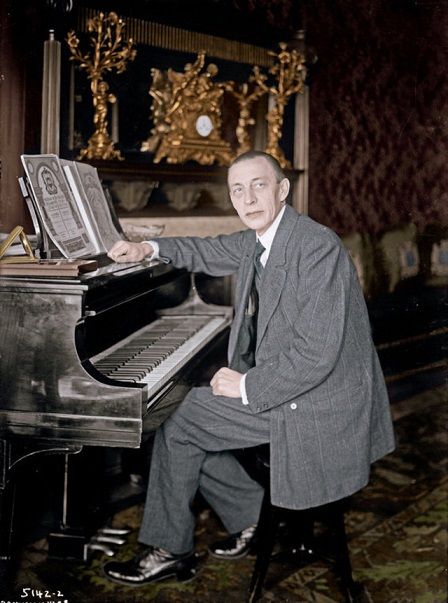
I’ve been looking forward to this month for a while now! I actually started gathering ideas for an essay or two about Rachmaninoff a year ago, but then I looked up his dates and I realized that 2023 is his sesquicentennial. I’m not going to spend this month blogging about Rachmaninoff and nothing else–it’s also National Poetry Month, after all–but there’s going to be a lot of Rachmaninoff this month. And probably more over the rest of the year, because this is a composer who has meant a great deal to me for quite a few years…going back to high school when I started discovering a particular affinity with the Russian Romantics.

I’ll be posting both here and on my Substack about Rachmaninoff this entire month, so make sure you’re following me on both platforms if you’re at all interested in my personal celebration of one of my most personal relationships with a composer.

Of course, we can’t kick off a month of celebration of Rachmaninoff without actually hearing any Rachmaninoff, can we? So we’ll start with what might be his most famous work, and a work with which he had a strained relationship over his life, because of its tremendous popularity: the Prelude in C-sharp minor, for solo piano. Written as part of a sequence of five small pieces for piano called Morceaux de fantaisie, the Prelude took on a life of its own, to a stunning degree. Rachmaninoff sold the rights to it for a pittance, because he was low on money at the time: he was only 19 years old and was barely a name anywhere, much less the recognition that was to come years later as one of the greatest musicians of his day. Because Imperial Russia was not a signatory to the Berne Convention, Rachmaninoff never received royalties on a work that has been recorded literally hundreds of times and performed live countless times.

The work’s popularity was such that Rachmaninoff could almost never get away with not performing the Prelude at any recital or concert he ever gave. This haunting, doom-stricken and yet lyrical work somehow became an early-20th century classical music analog of Lynyrd Skynyrd’s “Free Bird”. Its performance was occasionally even newsworthy!

From Sergei Rachmaninoff: A Lifetime in Music (Bertensson and Leyda):

As usual, London papers said more about one encore than about the whole program of his recital [a 1933 concert Rachmaninoff played in London]. The News Chronicle headline:

THE PRELUDE: RACHMANINOFF MUFFS IT.

In the midst of the applause he struck the famous opening chords of IT. He did not even wait for the applause to die down, but flung it at the audience like a bone to a dog.

And here is news which will be a consolation to thousands of amateur pianists: he played it, and he muffed it. Yes, in the rapid middle section, which is such a trial to the amateur, Rachmaninoff himself played two wrong notes.

And a reporter from the Star cornered Ibbs, Rachmaninoff’s European manager, for the “inside” story of IT:

“It is quite a mistake to assume that Rachmaninoff hates it,” he explained. “He thinks it is a very good bit of work. What troubles him is the fact that he is expected to play it every time he is seen near a piano.

“It worries him also to think that the vast majority of people know him only by it, whereas he has written other things as good or better.

“But he face the inevitable many years ago. At Saturday’s concert he said to me, ‘Don’t worry, I know my duty. I shall play it.'”

Here “it” is: the very Prelude in C-sharp minor that vexed Rachmaninoff and yet endeared him to music lovers for decades. It’s not hard to understand why it is one of the enduring piano works, right up there with Beethoven’s Pathetique Sonata or any of Chopin’s Nocturnes. The Prelude announces itself with three pounding chords that seem made for one another–it’s one of those musical figures that seems less composed so much as discovered by the composer–and then unfolds over the course of four minutes with rhythmic shifts that feel relentless as the pieces ebbs and flows, builds and falls back, drives and sings.

An interesting thing about this recording: it’s a reproduction on a modern player piano, using piano rolls created by Rachmaninoff himself. So it’s not quite the master himself playing…but also, yes, it is.

And here is the composer again, playing the Prelude in the same way: piano rolls for a reproducing piano (link only, as the video owner has disabled embedding). This time, though, the Prelude is in the context of the Morceaux, which casts it into an interesting light. I’ve always been interested in this tension sometimes in classical music when a given work becomes very popular: oftentimes the popular work is only a part of a larger work that is often supplanted by virtue of the incredible popularity of the one piece. Witness the way “Nessun dorma” became one of Luciano Pavarotti’s signature arias, greatly outshining the popularity of Turandot, the Puccini opera from which it comes.

The Prelude in C-sharp minor seems to me a good starting point for Rachmaninoff, though it wasn’t my starting point with him (we’ll get to that). In it you can hear his virtuosity, his lack of concern with the demands he places on the musician, and the somewhat relentless nature of his brooding. These are all qualities to which we will return in his music, again and again…but there are many other qualities to come.

Welcome to Sergei Rachmaninoff’s Sesquicentennial month.


Share This Post