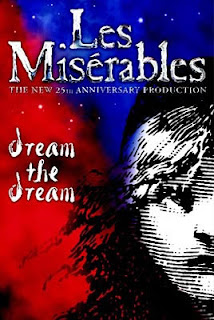

I suspect that a great many of us nurse various dreams, some big and some little, that go unfulfilled for many years. Those dreams are always there, percolating in the background of our minds, sometimes surging to the fore but most times just staying in the background, only surfacing as part of a general reverie of things we wish might be. One of my such dreams has for years been to see Les Miserables onstage.
It’s no longer a dream of mine. Two nights ago, it became something I’ve done. What an odd feeling. Dreams don’t have to be big to feel strange upon their fulfillment.
Les Miserables first hit me back in August of 1987 or 1988, one of those two years – probably the latter – when I attended Bristol Hills Music Camp for two weeks. This was exactly what the name implies: a summer camp for young musicians. There were vocalists and string players there as well, but as a trumpet player I was in the wind ensemble. One guy led the wind ensemble the first week, another guy the second. The first guy, Mr. Sprague, was more into ‘showy’ pieces, while the second, Mr. Rudgers, had a more ‘cerebral’ approach (in coming years Mr. Rudgers would use us as guinea pigs in his own compositions, which I always enjoyed – he wrote some good stuff). It was really a wonderful contrast; both men were fantastic at what they did, and I’m a big fan of variety. Anyway, it was during the first week of one of those two years when Mr. Sprague put on our program an arrangement of tunes from Les Miz.
I don’t recall much of that arrangement at all, except that it was a pretty good arrangement. There was a cool solo for most of the instrument groups, and it ended with – what else – “Do You Hear the People Sing”. I had zero idea what Les Miz was about, none whatsoever, but man, those tunes just sank into my heart and never left. And I suppose I wasn’t the only one: I was friends (platonically, I swear!) with a really nice girl named Aimee, who spent much of camp that year trying to fend off the advances of a sax player who was nursing an enormous crush upon her. One day I walked by and he had kinda-sorta cornered her and was flirting with her by playing “On My Own” on his sax to her. Ahhh, the days of hanging out with people who were more comfortable communicating through a tune than any other way! There are times when, if I could turn back time, I’d go back there, and stay.
Like a lot of musical kids, I was in the habit of buying recordings of pieces we played, as a way of keeping an auditory scrapbook. When you play a work and fall for it, you want to be able to hear it forevermore, even if it’s an arrangement for high-school level band and the best you can do is get an abridged version of the Original Broadway Cast recording. This is not abnormal…one of the most popular such arrangements back then was the one from The Phantom of the Opera, which is why nearly every fellow music student of mine owned that recording, too. For various reasons, though, Phantom wasn’t the show that captured me for life. We never played its band arrangement at camp, and we never played any such arrangements in high school. (I suspect that Mr. Roosa would have chewed his own arm off rather than stoop to the level of playing an arrangement of tunes from what he would have seen as Broadway’s current Flavor-of-the-Month, which was odd considering that when I played under him in the Pit Band for our school’s production of The Music Man, he showed quite an understanding and flare for show music.) So Phantom slid right past me, but Les Miz charged right in.
I listened to that disc a lot – I still own it, actually, although I haven’t played it once in a very long time, since it was supplanted by the astonishing live recording made at the Tenth Anniversary concert productions from the Albert Hall in London. That’s the recording that is billed as the “dream cast”, and so far as I can tell, it is. I’ve listened to that recording tons of times over the years. With Les Miz, I tend to go through phases where I listen to nothing but Les Miz for two weeks or so. And yet, in all that time, I never saw the show live, onstage. The touring production would come to Buffalo every two or three years, but somehow its arrival always coincided with an inability on my part to acquire tickets (lack of money) or something else (presence of a baby, which also took care of the money-for-tickets issue). It’s only been in the last few years that I’ve been in a position to actually be able to afford tickets – and that was right on time for the touring production to wind up shop and for the original show to close on Broadway. I pretty much figured that Les Miz had passed me by.
But then, a year or so ago, we were in Shea’s Buffalo to see Wicked, and I saw then that there was a new, 25th Anniversary Production of Les Miz set to come to Buffalo in 2012. I resolved, then and there, to get tickets, no matter what. The tickets ended up going on sale at a pretty inconvenient time – a couple weeks before Christmas, which kind of screwed up my Christmas budget – but I chose my seats and placed the order. This show was not passing me by again.
It may seem strange, forming so strong an association with a show that I have never seen, but it’s all about the music to me, and there is nary a melody in Les Miz that doesn’t hit me right in the emotional sweet spot. The emotions in this show are so open, so raw, and so perfectly captured by the melodies that express them. This is surely by design, as the tunes come and go and come again, with new lyrics each time, but some expressing similar things each time we hear them. But one of the show’s signature tunes – that of Fantine’s heartbreaking “I Dreamed a Dream” – is heard, and then is never heard again. This is the kind of thing that fascinates me. Of course it has to be this way, because Fantine’s life is doomed, and she will never really have any close connection with anyone in the show other than Jean Valjean; even her daughter, Cosette, grows up knowing virtually nothing at all about her mother.
Les Miz blurs the line throughout between hero and villain, policeman and criminal, lover and hater. Jean Valjean is twice a thief and a parole-breaker and a rebel. Inspector Javert is single-minded nearly to the point of insanity, and his inability to process the fact that he owes his life to both Jean Valjean and his obsession with bringing Valjean to justice leads him to what might be the show’s most dramatic moment, when he flings himself from the bridge into the waters of the Seine (in a pretty astonishing effect in the stage production, I might add).
A lot of time goes by in Les Miz — seventeen years of it, and the story makes clear that we’re only joining in the middle; Valjean’s story began nineteen years earlier than that, with his theft of a loaf of bread, a single, simple act of larceny that will resonate through his life and those of others for so many years to come. We see Cosette grow to a woman, and we see Valjean age to infirmity. Along the way we encounter student rebels and see the tragedy that ensues when they give their revolution and no one comes; we meet the people who profit by picking over the corpses; we see redeeming love and hopeless love and hatred for hatred’s sake. That’s quite an evening.
I noticed for the first time, also, a theme of faith running throughout the show. Valjean is a bitter ex-con at the beginning, going so far as to steal from a priest, but when the priest intercedes on his behalf, Valjean is moved to live a life of faithfulness, going so far as to become a new person (even though it means breaking parole). And all throughout the rest of the show, Valjean’s faith is well-nigh unshakeable, even on the eve of the final battle at the barricade, when he sings the amazing “Bring Him Home”, a prayer for God to allow Marius to survive what is sure to be a failed rebellion. Contrasting Valjean is Fantine, who, in “I Dreamed a Dream”, seems to have given up on faith entirely (“I dreamed that God would be forgiving”), now that she’s been left by a man she loved and cast out of her job. But just as Valjean’s faith was rekindled when someone interceded, so is Fantine’s when Valjean intercedes, even on her deathbed. Thus it is that when it comes time for Valjean to die, it is Fantine who first comes to his side to show him the way to the next world.
It’s also telling that, when Valjean joins the dead at show’s end, the most overtly religious individual in the show – Inspector Javert – isn’t there. Does this mean that he is in Hell? Have the words of his Act One song “Stars” come true?
And if I fall as Lucifer fell,
the flame, the sword!
But Javert does fall as Lucifer fell – at least, I’m sure he would see it that way – so has he been cast to the flame? I suppose that’s so…but I can’t help thinking how poetic it would be if it was Javert who came to Valjean at the end, thus fulfilling his long pursuit simply by bringing Valjean into death.
Having merely listened to the music all these years, I was a bit fuzzy in some of the particulars of the story (especially why exactly Valjean suddenly feels the need to flee Paris at the end of Act One); now, at last, it all makes sense to me. Emotionally, I was pulled in from the very first few bars, and I remained pulled in until most of the way through the first act. Some of the steam did come out of the show a bit, I thought, as various conflicts for the second act were set up and pieces were moved into place. But by the time that first act ended with “One Day More”, I was back in; and through just about all of Act II, I was a complete wreck, all the way to that shattering last scene, when Valjean says his final farewells and is led into the afterlife by Fantine and Eponine. Though I was somewhat anxious before the show that it couldn’t live up to my expectations, I felt almost no disappointment whatsoever by the time the final curtain came down.
Stage productions really have to rely on big gestures and great music to pull me in. There are no cinematic tricks available; you can’t have lingering closeups of characters exchanging subtle glances, and you can’t have super-convincing fight sequences using stunt performers. Scene changes have to be concealed somehow, and light has to be used to distract the audience. Misdirection is employed all over the place; two characters go to stage right and interact for a minute, hopefully keeping the audience looking over there while the scenery is changed on stage left. In the case of Les Miz, it was all very convincingly and nicely done; the sets were designed to convey the idea of what they represented and were left somewhat hazy out at the edges, so that our imaginations might fill in the details. I’ve read that the original production featured a giant turntable on stage that would rotate one entire set out of view; this one is more traditional, with props being brought in and out. Interesting use of the backdrops – which are based on paintings by Victor Hugo himself – are able, at times, to convey illusions of motion, and the costuming is what you expect: bodices and lacey collars and tricorn hats and the like.
As far as the cast for this particular production, everyone was excellent to outstanding. J. Mark McVey’s Valjean was wonderful, and the show clearly doesn’t work without a good Valjean. (No, he’s no Colm Wilkinson, but that’s like a Pirates fan judging every right fielder who comes along by the standard of Roberto Clemente.) While McVey earned the night’s biggest applause with “Bring Him Home”, the best vocals of the night overall came, in my opinion, from Andrew Varela as Javert, although Richard Vida’s Thenardier and Betsy Morgan’s Fantine were both memorable. I’m hard pressed to name a weak link in the cast I saw…and even if I could, I don’t think I’d want to.
No, the stage production lived up to my ‘expectations’, such as they were. What I’m more nervous about is the filmed version that’s to come this December. I remember reading in some comments thread someplace – maybe on AICN – back when The Phantom Menace came out, one person was trying to process disappointment by pointing out, “I’ve made Episode One in my head a thousand times since 1983.” Well, I’ve made the movie of Les Miz in my head a thousand times too, over the years, right down to a recurring visual motif of a bridge over the Seine where a number of key events would all take place. The movie will have none of the limitations of a stage show, so how will it look? Will it exchange dark and evocative peripheries of the image for brightness and boldness and lots of swooping CGI effects? How will “One Day More”, the Act I finale (and a showstopper that I find nearly overwhelming), be put together, given that it features a bunch of characters singing at the same time but who are not all in the same places? I suppose we’ll see. I don’t think it’s too hard to get this kind of thing right…but then, I thought the movie version of The Phantom of the Opera was the bee’s knees, and it’s not too highly regarded.
And so I go on, having at last seen Les Miz. This may have been my final personal “Holy Grail” of live or filmed entertainment. I’ve held it, and I’ve found…illumination. The question now is, if the show comes to Buffalo again, do I see it a second time?
Actually, come to that…it’s not really a question at all, is it?