Unidentified Earth 43

OK, at long last, the 43rd installment of this series. Hooray! First, some bookkeeping:

:: I knew last week’s would be easy, and it was: UI 42 was the Brooklyn Bridge.

:: But still no guesses on UI 40 and UI 41? Come on, folks! Don’t make me tape all of your buns together. And UI 41 is more famous for its proximity to an already famous location than for itself being famous.

OK, that out of the way, time for the new puzzler:

Where are we? Rot-13 your guesses, folks!

Share This Post

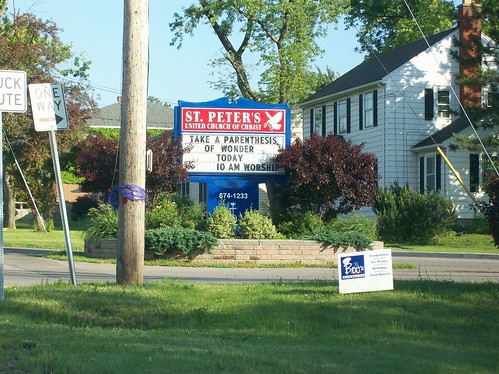
Take a what of the who, now?


Take a what of the who, now?, originally uploaded by Jaquandor.

There’s a church that I drive by every day on the way to and from The Store, and like most churches, it’s got a reader-board out front on which they usually post some kind of short blurb like this, again, as most churches do these days. But this one has completely flummoxed me. I have NO idea what it means. Zero. If someone could explain it to me, I’d be grateful, because right now it reads to me like some kind of Engrish thing.

(It says the same thing on each side, and it’s said this all week, so it’s not like some prankster came along and changed the sign so it makes no sense.)

Share This Post

Something for Thursday

In honor of Cyd Charisse, who just died the other day:

My problem is that I want to live in a world where this is how you woo a woman.

And a bonus Something for Thursday: Gene Kelly and Cyd Charisse again, in the Broadway Melody Ballet from Singin’ in the Rain. I think this number is vastly superior to the ballet from An American in Paris. It’s in two parts; the first little bit here is from the film’s opening credits, but when Gene shows up in the tux by himself, that’s the ballet proper. It’s well-worth the thirteen minutes, folks.

Amazing. Just amazing.

Share This Post

Dustin

UPDATED below.

As long as I’m writing about high school reminiscences, I remembered a few days ago that a sad anniversary came and went this past April. I don’t remember the exact date, and I’m not even entirely sure it was in April and not May, but I’m fairly certain on that score. Anyway, it’s been twenty years since Dustin Jae Fleming died.

That name very likely means nothing at all to those reading this. Dustin would have graduated in the Allegany Central School Class of 1988, one year ahead of me. Instead he was killed in a car crash two months before he would have “entered the real world”. I don’t remember all of the particulars, but he was out with some friends at night, and the car was going a bit too fast on a two-lane road that runs along the Allegany River in Olean, NY. I seem to recall that the car hit one tree, “became airborne” in the horrible parlance of accident reports, and then came to rest against a second tree, upside down. I don’t remember if alcohol was involved, nor do I remember if Dustin was thrown from the car or crushed to death. Maybe I never knew those things at all.

Dustin was the musician of the class of ’88. His big thing was the guitar; he was our school’s “kid with his own rock band”, and from all reports, he was actually a pretty good guitar player. I only heard him play once, in a “concert” that took place in the parking lot behind the school during homecoming week. I remember thinking he was OK, although I found it hard to judge him because he did a string of songs I don’t particularly care for: “Twist and Shout”, “Talk Dirty to Me”. (Of all 80s hair bands, Poison was surely the worst.)

Dustin was extremely popular, virtually beloved by everybody. I genuinely don’t recall anyone else in high school, and possibly college either, who was as beloved as he was. I didn’t know him personally at all, but I will admit that I was rather in awe of his ability to be friends with anyone with a pulse. It was really pretty uncanny: Dustin Fleming was the kid to whom cliques not only didn’t matter, they didn’t even exist in his mind, from what I could see. In the space of sixty seconds walking down the hall, he’d joke with the school quarterback and the science brain in rapid succession, and flirt with three different girls while doing it. I was completely baffled by him. His girlfriend that year was a very beautiful exchange student from somewhere in Scandinavia.

On the last day he was alive, Dustin was present at a meeting I attended. The Social Studies department was making arrangements for the next year’s senior class – my class – to participate in some kind of Civics program that involved weekly treks to the county seat. (I think it was a mock legislature or something of that nature.) Dustin was there was one of that year’s participants. I doubt I’d remember this at all if he hadn’t died that night, but he casually sat on the radiator against the windows, leaning back against a cinderblock pillar. He was wearing a long-sleeve white t-shirt with some band logo on it. (Or maybe it wasn’t a band.) He didn’t say much during that meeting; he just nodded and laughed occasionally.

The next morning, I was getting ready for school myself. We had the living room teevee tuned to the Today Show; at that time the Today Show would break away for about six minutes at the bottom of each hour so local stations could do weather and run down any big local news stories. (Maybe they still do this; I haven’t watched the Today Show in years.) The guy on Channel 2 from Buffalo came on and said that the day would be warm and springlike, that someone in Buffalo had been arrested for something or other, that something else had happened someplace else, and that a fatal accident in the “town of Olean” had claimed a teenager. He gave a few details of the accident, and then the words: “Seventeen-year-old Dustin Fleming was killed.” I remember exclaiming “What?!”, just as my mother came out from her bedroom where she’d had the same station on and asked if I knew a Dustin Fleming.

That whole day was the most surreal day of my entire grade school career, and my grade school career spanned six schools. People everywhere were openly sobbing, or randomly breaking down at odd moments. I remember that they brought in grief counselors – or, I think they did. Basically the entire school shut down for the day; I don’t think a single lesson got taught in a single classroom in any grade. Our principal, who had only been in that position for less than a year after many years teaching biology, looked when I saw him like he was about to throw up. (It frankly wouldn’t surprise me if he did.) At every class I attended, every teacher basically said: Talk about him, or anything you want. If you need to go down to the auditorium (where the counselors were), go ahead. Do what you need to do. I was sitting in my history class reading when I glanced up to see my teacher go out into the hall, and when I shifted forward to see where he’d gone, I saw him tightly embracing a female student, who then turned around. It was Dustin’s younger sister. (I don’t remember her name.) How on Earth she came to school that day, I never understood until the day Little Quinn died and I went into The Store because I had to see the people I knew.

For me, the day after Dustin’s death was a quiet day that I spent more as an observer than as a participant. I hadn’t known him at all, as I noted to the one member of the senior class that I felt comfortable mentioning him to. That was a girl I quite liked at the time (the poor girl I’d inadvertently gotten in trouble a year before in trig class), although for some reason I never worked up the guts to ask her out. I asked her how she was doing, and she replied, “I’m awful.”

“I never knew him,” I replied.

“He was a great guy,” she said.

“He must have been,” I said. And then I walked away.

Dustin’s funeral was a few days after that, during the next week, if I remember rightly. I didn’t go, but at the time I did a lot of bike riding around town, and on more than a few occasions I rode to the St. Bonaventure cemetery to see his grave. It was covered with flowers and notes and prayer beads; the stone – graven with his name, his dates, and a picture of an electric guitar – arrived a month or so later. There was only one time when I was there that someone else came by. I didn’t even hear her coming until she started crying, and then I glanced over. It was his other younger sister. I think she was maybe ten or eleven at the time. I didn’t have the faintest idea what to say, and by that time I’d learned that when one has no idea what to say it’s best to say nothing at all, so that’s what I did. I quietly turned and left so Dustin’s little sister could pay respects in private. (I don’t remember if he had any siblings other than the two younger sisters.)

So why am I thinking about Dustin Jae Fleming now? Probably because of that number: twenty years. He’s been gone three more years than he lived. Twenty years is a weird stretch of time; Dustin’s death isn’t one of those events that feels like it was twenty years ago, and I have to actually work the sum in my head (2008 – 1988 = yup, twenty years) to realize that’s how long it’s been. I remember fewer and fewer names from high school as the time passes from those days to these, but Dustin Fleming’s is a name I’m not likely to forget. And I’m one who didn’t know him. I imagine those who did think of him often and wonder what might have been had he not perished in that car.

Anyway, I just figured that Dustin deserved a blog post.

UPDATE, 17 June 2010:

For those coming here via the link I put on the Facebook page remembering Dustin’s life, welcome. As I noted over there, and as can be seen by the date above, I wrote this back in 2008, before I joined Facebook and started reconnecting with a lot of folks from Allegany. While a lot of old high school friends stay connected after graduation, my own life took a different course, and since graduation in 1989, I’ve had very little contact with folks from ACS. The reconnections, “virtual” as they may be, have been wonderful and I’ve found myself thrilled and amazed to see what has become of so many people whose names I couldn’t remember when I wrote this post, but whose pictures I can now see again on Facebook and elsewhere.

I’ve never been one to engage in “regrets”; my view is that we make mistakes so we can grow and learn, and that every thing I’ve done wrong was an opportunity to get something right somewhere down the line. But dammit, I sure wish I’d have taken time to get to know Dustin.

-KS

Share This Post

Of Passions, forever and fleeting

WARNING: This is long, and quite likely boring.

Passions come and go in this life, don’t they? Things we are just so passionate about when we’re young may remain passions throughout our adulthood; others may fade into memory of something that was important to us once upon a time, while still others can find themselves subject to complete reversal as we realize that the new “Me” hates the very thing that the old “Me” found so amazing.

This is about two passions of my life, both of which I found at the same time, but only one of which has really endured. This narrative stretches back almost twenty years to my last months in high school, a time which is now starting to recede into a kind of haze where even some of the names of those involved require effort to dredge up. How distant some of those emotions now seem, however real and intense they were at the time.

This is the story of when I came to the writings of Richard Bach and the music of Sergei Rachmaninov.

I have always been drawn strongly to Romanticism, from the earliest time that I can recall being drawn to anything much at all. The Romantic in me is drawn to large gestures, bold statements, feelings so strong it seems that the force of my heart might well shift the world on its axis. Love is to be shouted from the rooftops; anger is to be no small irritation but a smoldering rage. Sadness is to be felt keenly and deeply, like the cut of a freshly sharpened knife, and beneath everything, every feeling, even happiness and joy, can be found a long streak of melancholy. That’s the Romantic in me, and he still lives within, sometimes under careful guard but at other times nearly allowed complete control.

In high school, my greatest passion above all was music. I was a good trumpet player, and had I continued down that path, I believe I would have become a very good trumpet player indeed. But for all my love of the trumpet, my greatest dream was to conduct an orchestra. This I dreamed in much the same way other boys dreamed of playing center field for the Yankees. I would watch concerts on PBS or attend the occasional concert of the Buffalo Philharmonic, and my eyes would remain forever riveted on the actions of the conductor. I would buy multiple recordings of the same piece of music and study those recordings to better hear the difference in interpretation each conductor brought to the work. I learned to hear which conductors did the best with which repertoire: Colin Davis conducting Berlioz, Solti conducting Wagner, Szell conducting Brahms, Bernstein conducting Mahler. I bought orchestral scores to study, and my bedroom stereo constantly throbbed with the strains of Mozart, Schumann, Beethoven, and Dvorak.

In music my supreme love was, and has always been, the music of Hector Berlioz, that great French Romantic who wrote one of the greatest of all symphonies, the Symphonie fantastique, after he fell passionately in love with an English actress during a performance of Hamlet. In Berlioz I sensed a kindred spirit: a person who felt everything so, so deeply. Strangely, though, given my predilection for Romanticism, it was not until my senior year when I began to explore the work of the Russian Romantics, composers who imbued their works with enough lyricism and fire to melt and mold the hearts of any listener. The first of these that I explored was Sergei Rachmaninov, via a tape cassette I bought in the budget bin at a record store of his Symphony No. 2 in E minor, played by the London Symphony Orchestra and conducted by Andre Previn. I have long since lost that tape, but I’ve always remembered something from the liner notes: Previn described the reaction to a performance of this work he had conducted with the LSO while on a tour of the then-Soviet Union, after which an old woman, so overcome with emotion at hearing the Symphony, pressed into Previn’s hand her most treasured possession at that moment: a single orange.

Nevertheless, when I first listened to the work, it didn’t move me greatly. It was long and pretty, to be sure, with lots of long melodies that dipped and soared, but it didn’t really move me. That was yet to come.

At the same time, non-musical life continued. There was a project in English class when we were supposed to pick a specific author and report on several of his works. I can’t remember now what author I chose – Arthur C. Clarke, perhaps – but the guy next to me (his name was Joe) did his project on Richard Bach. A few weeks later I was in a bookstore and I happened to see a shelf full of books by this Bach guy: his apparent perennial bestseller Jonathan Livingston Seagull, another mystical-looking volume titled Illusions: The Adventures of a Reluctant Messiah, yet another mystical-looking book called One. Having heard Joe talking a bit in class about Bach, I thumbed through the books a bit. I didn’t know what to make of Jonathan, which looked to be a short parable involving birds. (I’d later find out that that is exactly what that book is.) Illusions looked interesting in a way, but rather quasi-religious, and at that time, I was in a hostile-to-religion phase of my life that would last through much of the next five or six years (and frankly, there’s still a part of me that thinks that way). One looked oddly mystical as well, although I must admit that I was struck by what was written on the back cover. No synopsis, no blurb, just two sentences:

I gave my life to become the person I am right now. Was it worth it?

Now there was some food for thought, I had to admit. I do think that’s true to an extent: at any given moment, the person-we-are is the sum of the choices we’ve made through our years and the lessons we’ve learned from the results of those choices. To a great extent, what typically causes us to go off the rails in our lives is when we fail to learn lessons from our choices.

But back to that afternoon in the bookstore: the last Bach title on that shelf was The Bridge Across Forever: a lovestory. Like One, its back cover copy consisted of a single, brief item:

If you’ve ever felt alone in a world of strangers, missing someone you’ve never met, you’ll find a message from your love in The Bridge Across Forever.

As a Romantic at heart, that single blurb caught me. I bought the book and proceeded to read it pretty quickly. Without getting into too many details, my love life in high school was non-existent; I didn’t go on my first date until about a month before I graduated, and I didn’t have what I could by any reasonable definition a “girlfriend” until I was in college. (I always suspected my general high levels of geekiness and my general low levels of good looks as being prime causes of this, but I digress.) There was something about that bit on the back cover of that book that really captivated me: Missing someone you’ve never met.

As I recall, I read The Bridge Across Forever over the course of a week or so. Bridge tells the story of Richard Bach’s search for love, for a “soulmate”. Over the course of the first part of the book he casually meets women and rejects them for seemingly good reasons, but it soon becomes clear that despite his claims to be searching for true love, he’s purposely keeping love at arm’s length, in favor of some kind of “freedom” where he’s able to maintain open relations with a number of women. Much of this went right over my head when I read the book as a high schooler; I was mainly interested in how Richard found that person and in the book’s ultimate assurance that yes, there is someone out there and that one day, if you’re open to the possibility, you’ll meet the person you’ve been missing all your life. Richard meets that woman, actress Leslie Parrish, and at first he has a great deal of fun and open romance with her, before he realizes that he’s let her become too close. He pulls away, and she writes him a letter that’s worth the price of the book itself; they get back together and nearly break apart again; finally Richard allows himself to “use the words he despises” and says “I love you” to Leslie. The book meanders a bit after that, as he and Leslie build their life together through some hardships (and, frankly, some very strange “New Age” type mysticism, such as when Richard and Leslie share mutual out-of-body experiences and thus learn that their current cat is a reincarnation of Leslie’s former cat). The book closes with a luminous image: Richard and Leslie, after all their struggles, watching as their younger selves meet for the first time:

Dirt-streaked, glorious, she smiled at me, tear-bright radiance. “Richie, they’re going to try for it!” she said. “Wish them love!”

I don’t know if it happened during the time I was reading it, or shortly thereafter, but at some point in that general timeframe I listened again to Rachmaninov’s Second Symphony. This time I really heard it: the epic scope of that twenty-minute long first movement, with Rachmaninov introducing one motif after another that would recur throughout the entire work. The way the piece broods with a constant sense of melancholy but never descends into outright sadness. The opening, with the tone set by the low strings before the woodwinds break through with two high chords that usher in the violins with a soaring motif that offsets what’s going on in the low strings. The way that opening movement begins with a largo that is followed by an allegro that doesn’t feel all that much faster than the largo.

The second movement is a scherzo that I always have a hard time relating to; its mood stands at some contrast to the rest of the work, but it too includes the motifs brought forth in the first movement, and its second subject is as lyrical as anything. But it’s the third and fourth movements that worked their way into the innermost chambers of my heart, once I was attuned to them. I can barely describe those movements, and I don’t even want to try, except to note that this is, to me, what “eroticism” in music sounds like. True eroticism, though: the type of sensual experience that comes from shared emotion, from the ebb and flow of shared passion, with the type of climactic bursting at the end that comes as glorious release of pent-up tension.

I don’t know if having read Bridge made me more predisposed to the Rachmaninov Second, or if I simply came to two works at the same time, at the right time, at a time when I was equally predisposed to both. I suspect the latter; even when listening repeatedly to the Rachmaninov Second, I don’t recall ever making a specific connection between the music and the journey shared by Richard Bach and Leslie Parrish.

My college years saw my fascination with Sergei Rachmaninov and Richard Bach intensify. I listened to as much Rachmaninov orchestral music as I could find (I was always prejudiced toward orchestral music over chamber music, solo piano, and art song), and I soon read everything Richard Bach had written at the time, an activity that was helped along by the fact that his pre-Jonathan books were reissued in paperback right about that same period. Those earlier books – A Gift of Wings, Stranger to the Ground, Nothing by Chance, and Biplane – were all devoted to the main motif of all of Bach’s books: flight. Bach is obsessed with flight, having been a pilot his entire life, and flight is a constant metaphor in his books, where he is always flying to something, flying with someone, or, in the darkest moments, flying from something. Those early books were marked with none of the mysticism that would dominate Bach’s work beginning with Jonathan, but I could sense it brewing beneath the surface. A bit.

Likewise, I explored Rachmaninov. His Third Symphony also became near and dear to me, although never as intimate as the Second. I admired his Symphonic Dances, and I came to love the Piano Concertos and the Rhapsody on a Theme of Paganini deeply (if you think that 18th variation is gorgeous, it becomes even moreso when you hear it in the context of the remainder of the work). His magical choral work Vespers struck me as both gorgeous and haunting, and my favorite tone poem of all time is very likely Rachmaninov’s Isle of the Dead.

I’ve never re-read Bach’s early books, but I’ve always maintained a soft spot for both Jonathan and Bridge. Gradually, though, while Rachmaninov has always remained close to me, Richard Bach has slid away for some reason. I barely remember reading his Running from Safety, and I haven’t read anything he’s written since that. Why is this? Why have I moved on from the one passion I found in early 1989, but not the other one?

Richard Bach, for one thing, is still alive, and thus his tale is not done. And that means that things that happened to him later on could color my perceptions of his work, which happened: I learned a few years ago that the happy ending of The Bridge Across Forever was fleeting, and that Richard and Leslie divorced. In a message that appeared online (here it is), Richard painted a happy face on the ending of his marriage to the person he’d earlier declared in several books his “soulmate”, but it still casts something of a pall over the book now, knowing that it all ended anyway. I’m not sure that it’s fair for me to even feel this way, given my own ambivalence on the concept of “soulmates” to begin with. I’ve never believed that life is a quest for that one and only one person out there somewhere who can make us whole. How can it be that way, when we live in a world where a person can see his or her soulmate snuffed out in an errant turn of the steering wheel, or struck down by cancer?

Perhaps it’s not fair for me to read Bridge this way, but the tone of the book is pretty one-sided in its conviction that the journey, or “flight”, through life of Alone-Richard is over and all that remains is the journey of Richard-With-Leslie. But it’s hard to accept their eventual divorce in light of things like a chapter where Richard and Leslie are training themselves to leave their bodies so that they might cheat death together and exist as loving spirits. And maybe there’s something more basic than that underlying my movement away from Richard Bach: my sense that, as sympathetic as I may be to his brand of mysticism, I just don’t buy into a lot of it. (This may be a particular failing of mine; I tend to be almost envious of everyone else’s mysticism.) Maybe it’s that Richard, for much of Bridge, is really kind of a jerk: he’s a narcissistic prude who is shocked – shocked! when Leslie swears at a bad driver, as well as a guy who refuses to come to his friend’s aid when she really needs him because he has some predetermined principle about women and ownership of other’s lives of some such nonsense. (Although it’s to his credit that he’s willing to write himself as a jerk.) And maybe it’s that I see life, somewhat as Leslie does as she writes in the letter that Richard quotes in the book, as a sonata where Richard sees it as a sequence of flights in an airplane, where the only person who matters is the pilot and where the passengers are interchangeable. It’s telling that in all those books, Richard Bach never mentions his first marriage or the children it produced.

(Bach’s son would later write a book of his own, dealing with his father’s non-presence in his life. I read that book years ago, but I don’t remember a whole lot about it.)

But what’s the real reason that Richard Bach is no longer a constant presence in my life, while Sergei Rachmaninov is? It’s because Sergei Rachmaninov wasn’t a writer, he was a composer, and relationships with music are, I’ve found, much more fluid that relationships with books. Great music remains great music, even as we bring new associations and new experiences to bear. So too do great books, but there’s something about writing that remains fixed in time that doesn’t happen, at least for me, with music. I associate Richard Bach with a person I once was but am no longer, but I don’t do that with Rachmaninov. The Rachmaninov Second doesn’t represent musical rapture to me as it once did; it now represents something deeper and more primal. But it still represents something. Rachmaninov continues to show me new things through music; Richard Bach only shows me what he’s always shown me. That’s not a bad thing, but it shows a limit somehow. Listening to Rachmaninov today continues to feel like visiting an old friend who still looks the same but has something new to say; reading Bach today feels to me like thumbing through old photo albums and seeing faces I remember. But the memories are vague, and in some of the photos, I can no longer put names with the faces. And in a few cases, I recognize the girls I really really really liked back then…and in at least a few cases, I can no longer fathom why.

To me, Richard Bach is a memento. Sergei Rachmaninov, though, is a force.

(That said, I’ll be re-reading Jonathan this week.)

Share This Post

Assistant Pig-Keeper

I have a bit of a problem. At bedtime, The Daughter and I have been reading through The Dark is Rising Sequence by Susan Cooper, and The Prydain Chronicles by Lloyd Alexander. We’ve been alternating through the series, and tonight we finished The Black Cauldron, putting us at the two-books-down point in each series of five. OK.

However, it didn’t occur to me that I might have this particular problem until last night, when we read the last chapters of The Black Cauldron. If you’ve read the book and know the story, you know that a particular character executes a pretty amazing act of self-sacrifice at a critical juncture; it’s one of the most emotional moments of the series, and last night while reading that passage I found myself getting choked up.

I did pretty well at concealing it, and the real difficulty is still three books away, so it’ll be a while, but it’s real and it’s going to happen. The problem is that I can’t get through the last two chapters of The High King, the last book in the Prydain Chronicles, without crying like a little girl. Wow, that’s going to be a hard book to read aloud. Hmmmm. But as I say, that’ll be a while; tonight we’re back into The Dark is Rising, with Book Three, Greenwitch.

In other news, two short stories of mine went out into the world yesterday, where they will do battle against editors who will likely vanquish them with mighty Slips of Rejection +4. But you never know, so wish them luck.

Share This Post

Page 123!

I’ve done this before, but now I’ve been tagged again, so here are the directions:

“To participate, you grab any book, go to page 123, find the fifth sentence, and blog it. Then tag five people.”

Hmmmm. OK, picking a book. Hmmm….OK, got one: Popular Alienation: A Steamshovel Press Reader. So, page 123…fifth sentence…got it.

Inslaw signed a contract with the Justice Department in 1982 to supply the software exclusively to all US Attorney’s offices.

This book comes from the mini-library of conspiracy theory books I assembled ten years or so ago, back when I was interested in such stuff. (I still am, really, but I’m not terribly active about it now.) What’s being discussed here? Why, the ever-fascinating Inslaw case, in which the Federal government may or may not have basically stolen software called PROMIS from a company called Inslaw, and this may or may not have been part of some kind of shadow government conspiracy that may or may not have had reporter Danny Casolaro murdered when he may or may not have come too close to the truth. Which is, of course, out there.

Spooooooky….

OK, now I’m to tag some folks. I don’t recall who I tagged last time (and I’m too lazy to look it up), so if I re-tag someone who has likewise already done this, oh well. Deal with it! So, I tag Drew, Blue Girl, The Indestructible Mr. Jones, Steph Waller, and Tom the Dog.

Share This Post

Sentential Links #143

Weekly roundup commences…NOW!

:: There’s such a thing as professional courtesy. And gratitude. (Ken Levine on Katherine Heigl’s public calling-out of the writers on Grey’s Anatomy this season; check his follow-up post too. I’m a faithful Grey’s watcher, although the show really needs some new blood, which I think might have been in the offing had the writer’s strike not robbed them of half their season; there’s only so much “Derek and Meredith, on-again, off-again” that we can stand, really. But in all the time I’ve watched Grey’s, it’s Heigl’s character that I’ve hated the most. I’ve been chalking that up to the writing, but now, I’m wondering how much of Heigl herself is bleeding through. She’s starting to seem like an ungrateful harridan.)

:: Amost one hundred years later and with just one survivor still living, to say that the Titanic story is irresistible is about as original as remarking that this Cary Grant fellow was really quite attractive. We’ve cycled through books and movies and musicals and miniseries and a hundred years from now they’ll no doubt be adapting the story to whatever format our great-grandchildren have cooked up. (Terrific posts with some nifty insights into the James Cameron film along with two others, and not from the standpoint that the Cameron film is Teh Suck.)

:: My skirt was too short, my heels were too high, I was wearing fishnets for God’s sake, and my lips were far too blacky-red for me to be riding on that particular L line that night. I was headed to a Christmas party in Rogers Park, in an iffy area, and the train had to go through even more iffy areas, and I realized, too late, what a risk I had taken. There was an edgy energy in the car, an on-the-make electric charge, too many people with nowhere to go, nowhere to be – you could sense it, the looking-for-something-to-happen expression on restless dead-eyed faces – it’s an energy which is unmistakable to folks who live in urban environments, but was new to me at the time. (Salty language here, but it’s a really compelling post.)

:: Few words are needed to describe the utter joy of hopping in a kayak on a bright sunny day, and paddling for miles from island to island in this never-ending archipelago of tree-strewn gems.

:: Someone should have told Johnston that sometimes explaining things makes it worse. (Yup, another complaint about For Better or For Worse. This week Lynn Johnston, the strip’s creator, posted online in defense of Liz marrying Anthony, and she gave the stupidest and flimsiest of reasons for it. Ugh!)

:: This is the crisis that has been coming since the 70’s. It is strange that we don’t recognize it.

:: In some form, Doubleday Field deserves Major League baseball. (Wow, no more Hall-of-Fame games? I’m sorry, but that’s just stupid. And for baseball players and owners, who are raking in millions, to halt the game because it’s hard to do? Frankly: screw that. Make the game count in the standings, if you want — or maybe even hold the All-Star Game there, since nobody bothers watching that, anyway. But doing away with it? Feh.)

:: Finally, I can say with no irony, no sense of fabrication, to a little black baby, “Someday, you may be president.” (My only political link this week.)

More next week, as always.

Share This Post

Close to Home

Two news stories of personal interest to me happened over the last couple of days. I won’t provide any links, since you can all Google this stuff if you really need to:

:: The city of Cedar Rapids, Iowa has suffered massive flooding. I looked at the photos, and my jaw dropped. Cedar Rapids is about ninety minutes down the road from where I went to college, and both towns share the Cedar River, with Waverly being a hundred miles or so upstream. We drove through Cedar Rapids many a time between 1989 and 1993. We never spent a whole lot of time in Cedar Rapids itself, but we did stop there a few times for pit stops or shopping; and of course, since Cedar Rapids is Iowa’s second-largest city, I had a number of friends from that area. How many of those old friends still live there, I don’t know, but I hope they’re all well if they’re still there.

That’s downtown Cedar Rapids there, all flooded out. That image astonishes me. That large bridge there, the third one up the river from the bottom, is Interstate 380, which runs northward from Iowa City, through Cedar Rapids, to Waterloo. That was the road we took through the city each time (when we drove that way; sometimes we took Route 20 east out of Waterloo toward Dubuque). Cedar Rapids always struck me as a lovely and pleasant town, and I dearly hope the place can withstand this disaster. All my best to those living there, as well as in all the other flooded locations in Iowa. (I think I may have a regular reader there, if I remember correctly from my referral logs.)

:: Tim Russert is dead. I personally tend to think of him more as Buffalo’s current most famous native son on the national stage than a journalist; I was never a fan of his interviewing style, which seemed more geared toward confronting people with inconsistencies in their record and making them squirm than in actually discussing policy questions. I always felt as if a public figure’s goal was more to “survive” an interview with Russert, and he also struck me as being, well, selectively tough on people. (Matthew Yglesias wrote the definitive article on the Russert approach.) However, as unenthusiastic as I was about Russert’s approach, it still remains that Russert himself was a very likable guy, and it really does sadden me that now we don’t have anybody on the national stage willing to say, “Yeah I’m from Buffalo and Buffalo rules and bite me if you don’t like it.” Anyway.

Share This Post