BUY BUY BUY BUY STUFF STUFF STUFF STUFF

I read with some horror of the poor guy who got trampled to death by the stampeding shoppers at a Wal-Mart, and my feelings really weren’t all that mixed. Wal-Mart continues to anger me with this sort of thing. No, it’s not like somebody’s getting trampled to death every year on Black Friday, but crowd control isn’t that hard, especially when you’re dealing with an event like this where you know exactly when the movement of people is going to happen. Other retailers manage to figure this out: you set up stanchions and steel fence lines, you hire security people to direct the crowds into lines outside the door, and so on. There is absolutely no reason for Wal-Mart’s approach to simply boil down to “Unlock the doors, and then get the hell out of the way!”, no reason that I can see, except for one:

Wal-Mart likes it this way.

You’d better believe they do. What better publicity can there be for Wal-Mart’s unbelievable bargains than the annual news footage, which runs like clockwork on all the news stations every year on Black Friday starting with the very earliest local newscasts and then propagating out to the TODAY Show, of all those lunatic shoppers leaping forward from their three-point stances as they race into the damn store? Wal-Mart loves this publicity, and the news stations love giving it to them – otherwise, they wouldn’t have camera crews on site to capture this footage. Sure, having lines set up and personnel outside the store to help things move along in an orderly fashion might be safer and prevent the trampling death that everybody knew was gonna happen sooner or later, but that’s not fun to watch on teevee, is it?

And of course, that news footage every year helps guarantee that the same crowds will be there every year, probably even larger and they’ll be gathering even earlier, because every year somebody’s going to see that footage and think, “Hey, gotta remember that for next year!” And why does the news media think that a bunch of stampeding weirdos looking to buy stuff is important to show? Who knows why the news media thinks that most of the stuff it shows is news?

I have no problem at all with the 4:00 a.m. shopping stuff, even if I think it’s total lunacy. But I do think that the stores should make it safe. This was not a freak occurrence. Anybody who has half a brain and has seen the news footage of the Wal-Mart Shoppers of Pamplona in years past must know that sooner or later somebody was going to get killed on account of those $300 laptops, and just because it’s been a rarity doesn’t cancel out the fact that this was preventable. That guy did not have to die under the feet of shoppers who didn’t care enough to stop and notice him beneath the soles of their boots. Those people didn’t have to be running at all.

So, yeah: f*** Wal-Mart.

Share This Post

Sunday Burst of Weirdness

Not a whole lot, since I wasn’t doing much websurfing, but:

:: Oh, come on. Here’s a simple test to see if the person you’re dealing with is an idiot: if they use the words “Muslim” or “Socialist” to describe Barack Obama, they’re an idiot.

:: Heckuva job, Bushie. God, these people need to go.

:: In a truly weird item: Matthew Yglesias, whom I believe to have grown up in NYC, is a native New Yorker who actually admits that NYC pizza isn’t the only kind of acceptable pizza in the world. But then, Matt is a pretty sensible fellow and not given to rabid lunacy.

OK, that’s all.

Share This Post

Happy Thanksgiving!

I’m posting this tonight, on Wednesday, before the day actually dawns. I can never decide if I’m an optimistic pessimist, or a pessimistic optimist, but generally when kvetching over whether the glass is half full or half empty, I usually — even if it takes quite a while — arrive at the conclusion that hey, at least I got myself a glass. I’m not sure what that means, but there it is.

I’ll be taking a few days off from posting (not a few months, so don’t panic, you regulars who have returned); there probably won’t be anything new here until Sunday. For now, I leave off with a quote from Randy Pausch’s Last Lecture, which has been occupying my thoughts a great deal since I read his book a month or so ago. It’s the bit about his experiences playing football:

OK, let’s talk about football. My dream was to play in the National Football League. And most of you don’t know that I actually — no. [laughter] No, I did not make it to the National Football League, but I probably got more from that dream and not accomplishing it than I got from any of the ones that I did accomplish. I had a coach, I signed up when I was nine years old. I was the smallest kid in the league, by far.

And I had a coach, Jim Graham, who was six-foot-four, he had played linebacker at Penn State. He was just this hulk of a guy and he was old school. And I mean really old school. Like he thought the forward pass was a trick play. [laughter] And he showed up for practice the first day, and you know, there’s big hulking guy, we were all scared to death of him. And he hadn’t brought any footballs. How are we going to have practice without any footballs?

And one of the other kids said, excuse me coach, but there’s no football. And Coach Graham said, right, how many men are on a football field at a time? Eleven on a team, twenty-two. Coach Graham said, all right, and how many people are touching the football at any given time? One of them. And he said, right, so we’re going to work on what those other twenty-one guys are doing. And that’s a really good story because it’s all about fundamentals. Fundamentals, fundamentals, fundamentals. You’ve got to get the fundamentals down because otherwise the fancy stuff isn’t going to work.

And the other Jim Graham story I have is there was one practice where he just rode me all practice. You’re doing this wrong, you’re doing this wrong, go back and do it again, you owe me, you’re doing push-ups after practice. And when it was all over, one of the other assistant coaches came over and said, yeah, Coach Graham rode you pretty hard, didn’t he? I said, yeah. He said, that’s a good thing. He said, when you’re screwing up and nobody’s saying anything to you anymore, that means they gave up. And that’s a lesson that stuck with me my whole life. Is that when you see yourself doing something badly and nobody’s bothering to tell you anymore, that’s a very bad place to be. Your critics are your ones telling you they still love you and care.

After Coach Graham, I had another coach, Coach Setliff, and he taught me a lot about the power of enthusiasm. He did this one thing where only for one play at a time he would put people in at like the most horrifically wrong position for them. Like all the short guys would become receivers, right? It was just laughable. But we only went in for one play, right? And boy, the other team just never knew what hit ’em. Because when you’re only doing it for one play and you’re just not where you’re supposed to be, and freedom’s just another word for nothing left to lose, boy are you going to clean somebody’s clock for that one play. And that kind of enthusiasm was great.

(Quote taken from here.)

That bit about criticism really meaning that those criticizing you haven’t given up on you hit me when I first heard it, like an answer to a question I’ve been trying to figure out on my own for a long, long time. So, just for that (as well as everything else), this year I’m thankful for this computer science prof I never once met and who is now dead.

Happy Thanksgiving, and thanks, Dr. Pausch.

See you on Sunday.

Share This Post

If you want to sing out, sing out!

So I watched some movies, as you might expect, while I was not blogging. I’ll discuss them in no particular order over a series of posts. First up, Harold and Maude.

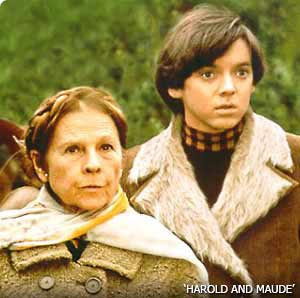
I knew absolutely nothing about Harold and Maude until I picked up the DVD from the library. All I knew was that it had been cited on the recent AFI list of great romantic comedies; on that basis I checked it out, since I do love a good romantic comedy. Imagine my surprise, then, when I looked at the DVD cover and discovered that the couple in the film involves a young man in his late teens (Harold) and a woman who is about to turn eighty (Maude). What’s more, Maude is played by Ruth Gordon, an actress whom I’ve always seen as, well, the crusty old lady, which is basically what she is here. I wasn’t sure I’d like the film at all, but I decided to watch it anyway.

Which is a good thing. What a movie.

Upon further reflection, I realized that my impression of Gordon is rather unfair. The only other movies I’d seen her in before this were the two Clint Eastwood comedies Every Which Way But Loose and Any Which Way You Can, in which Gordon plays Eastwood’s incredibly crusty and foul-mouthed mother. That’s not what Maude is, at all. So my initial expectation of the film was confounded, and rather delightfully so.

Maude is quite a character. She first meets Harold at a funeral, which she attends because she likes attending funerals, and not because she has any connection at all to the person in the coffin. This is also why Harold is there: he has a bizarre fascination with death and suicide that give the film many of its fine moments of black humor, such as the opening shots in which Harold fakes hanging himself in his family’s living room, to have his mother merely walk in and react to this as if nothing out of the ordinary has happened at all.

Over the course of the movie, Harold and Maude form a very unlikely friendship based on mutual notions of what it means to live a life worth the effort. There’s one wonderful moment when they are sitting at the edge of a hillside that is covered with daisies. Harold comments that the daisies all look the same, and Maude objects, saying that a daisy is a beautiful thing, and that it’s tragic that so many people are really “like this” (holding up a daisy) but allow themselves to be “treated as if they’re that” (gesturing to the field of nearly-identical flowers).

Maude’s conversations with Harold are mostly about rediscovering zest for life, and over the course of the film, it’s clear that these conversations have their desired effect as Harold slowly begins to come out of the death-worshiping shell he’s built for himself, even as he stages several outrageous fake suicides for the benefit of the nice girls that his mother keeps trying to fix him up with. Maude seems so completely random in her approach to life, but as the film reaches its conclusion, we discover that she’s not random at all, and everything she’s been doing has been leading up to her final act that somehow surprised me even though it’s pretty strongly telegraphed early on.

One small thing that I greatly appreciated about Harold and Maude is in the way the key fact about Maude’s past – that she is a Holocaust survivor – is conveyed by the simple device of having Harold getting a brief glimpse of the numbers tattooed on the inside of her wrist. What’s so great about this is that this happens, Harold has an expression of recognition on his face that lasts a couple of seconds, and then that’s it: the moment is over and never mentioned again. I have the feeling that if Harold and Maude were made today, Harold’s glimpse of her concentration camp tattoo would eventually lead to a Big Major Scene wherein he gets her to open up about the horrors she saw there, and she’d have the obligatory Big Oscar Clip in which the actress playing Maude would chew the scenery in grand fashion. Not so here: Harold gets a brief glimpse of insight into his new friend’s character, and so do we, but it’s not the only insight we get and the film neither highlights it nor downplays it. How often does this kind of thing happen, after all? How often do we find ourselves learning something new about someone we’ve thought to know so well that the new thing, prosaic as it may be, comes as a complete surprise? And yet, as we get to know these two people, so many of the things they do don’t come as any surprise at all. When Harold gives Maude a trinket he’s had engraved with the words “Harold loves Maude”, she throws it into the nearby water, and then says, “So I always know where it is.” This is the kind of movie that has characters who do things that would strike anyone else as being nonsensical but, given the people they are, make perfect sense when we think about it.

One other aspect of Harold and Maude that warrants mention are the songs, written and performed by Cat Stevens. His voice, an earnest tenor that occupies the same kind of area as Jim Croce, is ideally suited to the kind of story told here – or, more specifically, to the characters whose story we are following. I wasn’t terribly familiar with Cat Stevens before I saw this movie. The most important song in the film, “If You Want to Sing Out, Sing Out” is, in particular, a very special song.

I loved Harold and Maude.

Share This Post

Two Definitions of “D’oh!”

I guess “definitions” isn’t the right word; maybe “examples”. Anyway, two instances of “D’oh!”:

:: So I started getting a bit tired of the current mix CD I’ve been listening to while working out at the Y, so I made myself a new one. And it rocks. Seriously, this one turned out great, and I couldn’t wait to get to my workout today to start listening to it. And there I was, on the exercise bike, before my weight-lifting, happily doing my cardio and listening to the tunes…when I realized that Tracks Four and Ten are both “Twistin’ the Night Away” by Sam Cooke. Great song, but I sure didn’t want it on there twice. D’oh!

:: So I sat down last night to do some writing, but I decided a minor post-dinner snack was called for, so out came the box of Thin Mints, because I love me some Thin Mints. I exercised a nice bit of self-control in only taking four out of the box, which I then set on my desk, next to the laptop, for slow consumption while I wrote. Then I left them there for a few minutes while I consulted a book…and when I returned my attention to the Thin Mints, I discovered that they were melting. Because I’d put them about an inch and a half away from the laptop’s heat discharge vents. D’oh!!

That was all.

Share This Post

The Balance in the Blood (part three)

Continuing a serialization of a horror novelette. Part One and Part Two, published previously.

Willem jumped back with a gasp. He tried to tear his eyes away from the dead Jew’s cold, bloodless stare but he could not. “Doktor?” His voice came out strangled. “Doktor?”

“Magnificent,” the Doktor said. He was now standing beside Willem and looking with wonder at the Jew. “Has the stilled heart starting beating again?” he stepped forward and probed the Jew’s chest with his stethoscope, shielding his eyes with his free hand from the icy gaze of the Jew. “No breath and no heartbeat,” the Doktor said. “No signs at all that this Jew is anything but dead.”

“That’s impossible!” Willem protested. “Look at him!” The dead Jew turned his gaze back to Willem, and Willem took a step backward. He had never before seen a gaze so….commanding, that held him and wouldn’t let go. The dead Jew opened his mouth and a sound came out, a breathless snarl of rage and malevolence. Willem felt himself being beckoned closer, pulled forward by some force. He took a step toward the dead Jew, and another, and another. The dead Jew bared his teeth. Had his canines been that long before? Had they been that sharp, tapering to needle-like points? The dead Jew opened his mouth wide as Willem leaned over him. A vein throbbed in Willem’s neck as he bent down toward the dead Jew’s waiting lips—

STOP!”

Willem was suddenly grabbed from behind and torn away from the dead Jew. He sprawled across the floor and the room seemed to spin around him. He blinked his eyes clear and looked up at Doktor Muething, who now knelt beside him. Willem’s stomach heaved and he rapidly swallowed to keep from vomiting.

“Here,” the Doktor said as he pressed something into Willem’s hand. “Wear it around your neck. It will protect you.” Willem looked down at the object. It was a silver crucifix. “I’m sorry I didn’t think to give it to you before,” the Doktor went on. “I must be getting old, if such important details are escaping me.” Willem put the chain around his neck, and his stomach quieted almost immediately as he did so. Then he stood up and joined Doktor Muething beside the dead Jew. The Doktor wore a matching crucifix.

“Lord have mercy,” Willem said. The Doktor only nodded.

The dead Jew stared at them with wide eyes burning white. Its skin had gone the color of alabaster and those horrible canine teeth gleamed in the harsh light of the surgical lamps. The dead Jew slowly tested the restraints on each of his extremities and growled when it discovered its immobility.

“It worked,” the Doktor whispered. “More things on heaven and earth….

“What have we done, Herr Doktor?”

“We have created.”

Willem tried to fathom just what they had created….and then the dead Jew let loose a smoldering cry of agony. Its body convulsed against the restraints, and its strength was such that they nearly broke. The dead Jew convulsed again and again, shrieking wildly each time. That scream reminded Willem of that of children receiving their first injections – but of course it was far, far worse. He winced and stepped back, but Doktor Muething stepped forward.

“What is happening?” the Doktor said. The dead Jew kept screaming, its convulsions becoming more and more violent. Willem stepped back up to the Doktor’s side and watched, his eyes wide in fascination and horror. Somehow this starved, weak, dead body was pushing the restraining straps to their absolute limits. It was inconceivable that it could be that strong.

“What if it breaks free?” Willem asked.

Doktor Muething glanced at the clock. “I have a way of dealing with that.”

Willem heard trucks rolling by outside and the distant whistle of an arriving train; the camp would now be coming to life for the day – but his attention was riveted to the dead Jew who thrashed violently against its bonds. A musty and pungent odor of rot and decay filled the laboratory. Willem remembered that smell from when he had accompanied Uncle Gunther to a village that had been stricken by influenza. It had been the smell of unburied dead bodies.

Then the dead Jew’s skin sank as though its body was aging forty years in minutes, and still it threw its weight against the bonds and glared at Willem and the Doktor with blazing eyes. His shrieks became even more horrible, and Willem covered his ears; and then the restraints finally buckled and gave way. The dead Jew’s arm was free. A giant lump formed in Willem’s throat as the dead Jew reached up with his free hand and tore the head restraint aside; after freeing its other hand the dead Jew rose to a sitting position and glared at Willem. It ripped its ankles free and leaned forward, as though preparing to spring.

Willem froze, utterly unable to move. The veins in his neck pulsated and a warm wetness trickled down his leg as he realized that Doktor Muething was no longer beside him. The dead Jew approached, baring those awful teeth. All the while its skin sank farther, taking on the mottled appearance of a person three days dead. The dead Jew circled Willem, shrieking again and again, coming no closer than a few feet as the crucifix became hot around Willem’s neck. Willem wanted to run, but the creature’s eyes kept him rooted to that spot as if his legs were no longer his own. The crucifix grew hotter and hotter, and Willem wanted nothing more than to tear it from his neck. The vein in his neck throbbed, his hand moved toward the crucifix that seared his flesh – and then the dead Jew was suddenly bathed in brilliant yellow light. It threw up its hands in front of its eyes and screamed anew, but this time in horror and agony. Willem looked to his left and saw that Doktor Muething had opened the shutters, allowing the light of the rising sun to stream into the laboratory. The dead Jew wailed and writhed upon the floor, and as Willem watched its skin turned gray, its eyes sank into its skull, its lips shriveled and its teeth turned black. Less than a minute later the dead Jew truly was dead; the corpse was a dried, desiccated thing that looked human only in its roughest shape. Quiet settled over the laboratory again, and Doktor Muething’s cuckoo clock signaled seven. Just like that it was all over. From outside could be heard loudspeakers blaring announcements, truck horns and engines, and the regular commotion of morning at Hamerstadt Concentration Camp. Willem looked at Doktor Muething, who was wiping his hands on a towel. He suddenly felt quite weak.

“You knew that would happen?” he asked. His voice felt very small.

“Not entirely.” The Doktor shook his head. “Something went wrong, that much is certain. He clearly suffered an adverse reaction to the drug.”

“An adverse reaction,” Willem echoed, not quite believing the Doktor’s choice of words.

“Quite adverse, wouldn’t you say?” The Doktor smiled. “I am so close, so very close….” His voice trailed off, and he rubbed his forehead before speaking again. “You should go clean yourself, Young Schliemann. Then I will take you to a place where you may find explanation. Be ready in one hour.”

Suddenly aware again of his damp undergarments, Willem nodded and headed outside. He had to stop before crossing the street. A column of prisoners was being marched by, single-file. All were Jews. Willem remembered the defiance, the grim determination that he had seen on Jewish faces when it had all begun, years before. Now there was no determination; there was only waiting, waiting for the end. The last of the prisoners, an emaciated old man, glanced at Willem, and for some reason Willem looked away. They weren’t human, so why should any of this matter? Finally they had all gone by, and Willem crossed the street and returned to his dormitory. He felt a strange sense of calm, so it was completely to his surprise that he vomited when he got to the washroom.

Share This Post

Fixing the Prequels: Attack of the Clones (part two)

part one

Returning to Attack of the Clones, we’ve just left the Chancellor’s office where Palpatine has just prevailed upon Senator Amidala to accept the protection of the Jedi for the time being, after the attempt on her life. We also have already fleshed out the political situation a little more, giving more of a face and feel to the Separatist movement that threatens the Republic.

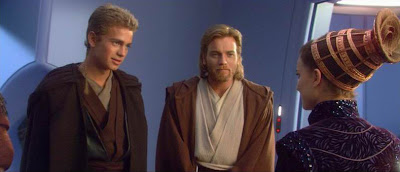
Now, we’re ready to meet our heroes: Obi Wan Kenobi, now a Jedi Master, and his Padawan learner, Anakin Skywalker.

In the film, we cut from the Chancellor’s office to the elevator on Senator Amidala’s building, where Anakin is really nervous. For a few reasons I’ll discuss afterward, though, I would add a bit of material before the elevator scene. Here’s what I would do:

EXT: Tatooine – The Dune Sea.

Riding across the Tatooine landscape on an eopie [those are the cow-like things on Tatooine, seen a few times in the PT] is SHMI SKYWALKER. She looks tense, nervous; something is wrong here. The appearance of the scene is glaring and washed out; this is a look to Tatooine that we haven’t seen before. There is no sound at all, until she crests one dune in particular and then the sand before her gives way, causing her eopie to slide down the deepening slope. Before her, at the bottom of a giant bowl of sand, opens the mouth of s SARLACC. Shmi screams in terror–

INT: Coruscant – Jedi temple – bedroom.

ANAKIN SKYWALKER suddenly awakens, his face covered with sweat and his breathing labored.

ANAKIN: Mother!

He’s just had a nightmare about his mother. He blinks, sips some water from a glass on the table next to his bed, and rises. Ten years older since we’ve las seen him, Anakin is tall, muscular, and confident in his motions. He gets a hold of himself and heads into the other room.

INT: Coruscant – Jedi Temple – living room.

Anakin walks into his sparsely furnished living room and moves to the exact center of the circular chamber, where he makes a Force gesture toward a lockbox that pops open, releasing the four REMOTE DROIDS that had been at rest inside. The remotes stream toward him, automatically assuming the attack; they bear down on Anakin and start firing their electro-shock rays at him. Instantly he drops to the floor and rolls to one side, summoning his lightsaber to his hand as he does so. Activating the blade, he begins to do battle with the remotes, deflecting their shots with his lightsaber and evading them with seeming ease. He smiles a little in self-satisfaction, when suddenly the remotes kick into a higher gear, bringing their attacks even faster now. Anakin keeps up, but the remotes increase speed again, and one manages to get a shot through Anakin’s defenses, zapping him on the shoulder. Anakin suddenly lunges in anger, bissecting the remote with one fast and mighty slash of his weapon. The other remotes zip away from him to hover in one corner of the room. Anakin prepares to charge them, when another lightsaber is activated and intercepts his own. Anakin, surprised by the new presence, turns to find himself face-to-face with his teacher, OBI WAN KENOBI.

ANAKIN: Obi Wan!

OBI WAN: They’re just remotes, Anakin. You don’t have to kill them every time.

ANAKIN: I’m sorry, Master.

OBI WAN: Did you know that you go through more remotes than any other two Jedi combined?

ANAKIN: You said it yourself, Master. They’re just remotes. I needed the practice. There wasn’t much action on Ansion.

OBI WAN: (mildly offended) There was plenty of action!

ANAKIN: For you! I had to stay and fix the ship after your so-called landing.

OBI WAN: And a fine job you did, my young Padawan. That ship’s never flown better.

ANAKIN: The Jedi aren’t mechanics. And did you turn up the intensity settings on my remotes? I didn’t do that!

Obi Wan gives him a sheepish grin and shrugs.

ANAKIN: How long have you been doing that? Why are you here, anyway? Shouldn’t you be practicing your piloting or something? We’re on leave….

OBI WAN: Not anymore. It seems that a certain high-ranking Republic dignitary is in need of Jedi protection, at the request of the Chancellor himself.

Anakin groans….

ANAKIN: Not another protection job, Master! All we ever do is stand around looking mean in the face of a threat that never materializes. Can’t Master Shak-ti take this one?

OBI WAN: No, it’s ours. As I said, we’ve been requested personally by the Chancellor. Meet me on the shuttle pad in thirty minutes. And you might want to touch up your hair.

ANAKIN: (touching his disheveled hair) Why?

OBI WAN: Oh, I just think you may find yourself more enthusiastic about this assignment once you know who we’re protecting. Thirty minutes.

Obi Wan turns and exits, leaving Anakin to puzzle over that last thing he said.

OK. What I’ve done here is, first of all, to try to turn up the banter between Anakin and Obi Wan. It’s important that we establish that their relationship isn’t just that of teacher/student, or father figure/son figure. They’re also friends; remember, many years later, when reminiscing about Anakin with Luke Skywalker in ROTJ, Obi Wan says that “Anakin was a good friend.” So we need to see more of that dynamic between them. (I do think that Lucas did a pretty good job in depicting that aspect of their relationship in the finished products; I just think it could have been highlighted even more.)

Also, I include a brief dream sequence. I always thought it a bit of a problem in AOTC that we don’t actually see any of Anakin’s dreams of Shmi’s danger; all that happens is that we’re told of them (and later we see Anakin in bed having the dream but not actually seeing the dream itself, a moment that’s awkward in another way – but we’ll get to that at a later time). I imagine George Lucas came to the same conclusion, since in RotS he would show us Anakin’s premonitions of Padme’s dolorous fate.

I also establish here that Anakin’s a man of action, and rather impulsive; he’s been on leave for mere hours and he’s hankering for action, and he’s got a bit of a problem in not giving in to anger. (Obviously that little aspect of his character will end up having some disastrous consequences later on.) I also take the opportunity to give a little glimpse into what daily life is like for a Jedi. It’s not all-lightsaber fights, all the time.

OK, now we cut to the elevator scene, which I always liked a lot, and only tweak just a bit, again to bump up the level of banter between Obi Wan and Anakin. Obviously now Anakin knows who they’re going to protect, and he’s a tad nervous about it. I always found it interesting, by the way, that Anakin’s now nervous about meeting Padme again; ten years before, he’d been serenely confident around her, having no problem at all telling her that she’s as beautiful as an angel and carving her a pendant out of wood and stuff like that. Now, he’s nervous. What’s changed? Well, he’s a teenager now. That’s awkward as hell, for all concerned.

(And by the way, before I get back to the script, let me say that I have no objections at all to Anakin Skywalker being an awkward teenager, even if he’s at the end of his teen years. A lot of fans have over the years objected to the Prequels on the basis that it’s just inconceivable that a villain as odious as Darth Vader could have his genesis in teen love, but that’s never bothered me at all. This was set up from the very beginning, really, when in ANH Obi Wan describes Vader to Luke as a person “a young Jedi who was a pupil of mine, before he turned to evil”, and the way Vader himself greets Obi Wan after twenty years by saying that he’s no longer a student but a master. OK? OK.)

Anyhow, the elevator scene:

INT: APARTMENT BUILDING ELEVATOR – TWILIGHT

ANAKIN and OBI-WAN ride in a windowed elevator attached to the outside of the Senate Building. They are on their way to SENATOR AMIDALA’S apartments. ANAKIN nervously rearranges his robes, which are spotlessly clean.

OBI WAN: I’ve never seen your robes that clean before.

Anakin says nothing; he just keeps fidgeting.

OBI WAN: Did you repair the stitching yourself? That’s nice work.

Anakin still says nothing.

OBI WAN: My robes could use some stitch repair as well.

Still nothing.

OBI-WAN: You seem a little on edge.

ANAKIN: Not at all.

OBI-WAN: “Not at all”? I haven’t felt you this tense since we fell into that nest of gundarks.

This grabs Anakin’s attention.

ANAKIN: You fell into that nightmare, Master, and I rescued you, remember?

OBI-WAN: Oh. Yes.

Obi Wan chuckles, knowingly, and Anakin realizes he’s been tricked into acting less fidgety. Anakin laughs as well.

OBI WAN: You’re sweating. Relax. Take a deep breath.

ANAKIN: I haven’t seen her in ten years, Master.

OBI-WAN: She’s not the Queen anymore, Anakin.

ANAKIN: That’s not why I’m nervous.

OBI WAN: Just remember, she’s not a remote, either. I’d hate to have to explain that to the Council.

ANAKIN: I’ll keep that in mind, Master.

Now we’re in the apartment, and here comes Jar Jar Binks!

INT: APARTMENT BUILDING, APARTMENT CORRIDOR – TWILIGHT

The door to the apartment slides open. JAR JAR walks into the corridor, where TWO JEDI are exiting the elevator. He recognizes OBI-WAN and becomes extremely excited, jumping around, shaking his hand.

JAR JAR: Obi! Obi! Obi! Mesa sooo smilen to seein yousa. Wahooooo!

OBI-WAN smiles.

OBI-WAN: It’s good to see you, too, Jar Jar.

JAR JAR notices OBI-WAN’S APPRENTICE.

JAR JAR: …and this, I take it, is your apprentice…Noooooooo! Annie? Noooooooo! Little bitty Annie? (Looks at Anakin) Noooooooo! Yousa so biggen! Yiyiyiyyi! Annie!!

ANAKIN: Hi, Jar Jar.

JAR JAR grabs hold of ANAKIN and envelops him in a big hug.

JAR JAR: Shesa expecting yousa. Annie… Mesa no believen!

They move toward the main living room of the apartment.

ANAKIN: You’re a diplomat now, Jar Jar?

JAR JAR: I am parten of de official Naboo delegation. Boss Nass himself appointed mesa.

ANAKIN: Not like battle, is it?

JAR JAR: Sometimes itsa worse!

INT: SENATE BUILDING, APARTMENT – EVENING

PADMÉ is in a conference with CAPTAIN TYPHO and DORMÉ. JAR JAR enters the room, followed by the TWO JEDI.

JAR JAR: Senator? Desa Jedi have arriven.

PADMÉ and TYPHO rise as OBI-WAN and ANAKIN stop before the SENATOR. OBI-WAN steps forward. ANAKIN stares at PADMÉ. She glances at him.

OBI-WAN: It’s a pleasure to see you again, M’Lady.

PADMÉ walks over to OBI-WAN and takes his hand in hers.

PADMÉ: It has been far too long Master Kenobi. I’m so glad our paths have crossed again… but I must warn you that I think your presence here is unnecessary.

OBI-WAN: I’m sure the Jedi Council has its reasons.

She moves in front of ANAKIN.

PADME: And your Padawan learner…(now she recognizes him) Annie? (stares) My goodness, you’ve grown.

They look at each other for a long moment.

ANAKIN: (trying to be smooth) So have you… grown more beautiful, I mean… and much shorter… for a Senator, I mean.

OBI-WAN looks disapprovingly at his apprentice. PADMÉ laughs and shakes her head.

PADMÉ: Oh Annie, you’ll always be that little boy I knew on Tatooine.

This embarrasses ANAKIN, and he looks down. OBI-WAN and CAPTAIN TYPHO smile. They all move toward the sitting area, Anakin rolling his eyes at himself as they do.

ANAKIN: (under his breath) You’ve grown “shorter”?

They all sit, Anakin and Obi Wan facing Padme and her assistant. Captain Typho remains standing, next to Jar Jar.

OBI-WAN: Our presence will be invisible, M’Lady, I can assure you.

CAPTAIN TYPHO: I’m very grateful you’re here, Master Kenobi. I’m Captain TYPHO, head of Her Majesty’s security service. Queen Jamillia has informed you of your assignment. The situation is more dangerous than the Senator will admit.

PADMÉ: I don’t need more security, I need answers. I want to know who is trying to kill me.

OBI-WAN: (frowning) We’re here to protect you Senator, not to start an investigation. That is a matter for–

ANAKIN: We will find out who’s trying to kill you Padmé, I promise you.

He’s looking earnestly into her eyes; only too late does he realize that Obi Wan is glaring at him. He’s done it again. He bites his lip in frustration and shame. OBI-WAN gives ANAKIN a dirty look.

OBI-WAN: We will not exceed our mandate, Anakin.

ANAKIN: I meant in the interest of protecting her, Master, of course.

OBI-WAN: We will not go through this exercise again, Anakin. And you will pay attention to my lead.

ANAKIN: Why?

OBI-WAN: What??!!

ANAKIN: Why else do you think we were assigned to protect her, if not to find the killer? Protection is a job for local security… not Jedi. It’s overkill, Master. Investigation is implied in our mandate.

OBI-WAN: We will do exactly as the Council has instructed, and you will learn your place, young one.

Now, finally, Anakin shuts up. Several awkward glances are exchanged throughout the room. Finally Padme decides to break the tension.

PADMÉ: Perhaps with merely your presence, the mysteries surrounding this threat will be revealed. Now, if you will excuse me, I will retire.

Everyone gives AMIDALA a slight bow as she and DORMÉ leave the room.

TYPHO: Well, I know I feel a lot better having you here. I’ll have an officer situated on every floor and I’ll be at the control center downstairs.

OBI WAN: What levels are above this one?

TYPHO: A speeder garage only, accessed by this stair….

Typho shows Obi Wan the door on the far wall leading to the roof; meanwhile Anakin turns to Jar Jar.

JAR JAR: Speakin’ out of turn? Mesa know that feeling. Are yousa sad?

ANAKIN: She hardly recognized me, Jar Jar. I’ve thought about her every day since we parted… and she’s forgotten me completely.

JAR JAR: Shesa happy. Happier den mesa seein her in longo time.

OBI-WAN: Anakin, you’re focusing on the negative again. Be mindful of your thoughts. She was pleased to see us.

ANAKIN: Master, I’m sorry for before.

OBI WAN: We will continue our long series of discussions of your impulse control later on, Anakin. For now, let’s check the security around here. Work will help you focus.

ANAKIN: Yes, my master.

For the most part, I’ve always liked this whole scene too. The only main fixes I’d make are to have Jar Jar’s speech be a bit more refined; he’s a diplomat now. I don’t imagine the diplomatic community on Coruscant would take him all that seriously if he were still wandering around jabbering and using words like “Okeyday!”. But I’d retain a little of his unique speech patterns, like “Mesa” and others.

I’d also highlight Anakin’s awkwardness, his awareness of his awkwardness, and his desire to impress Padme anew. Also, that bit I have there at the end, with Obi Wan referring to Anakin’s problems with “impulse control”, will come in handy in the next installment of this series.

So that’s where we’ll break off for now. Next time, the plot thickens as the assassin strikes again. Carry on, Star Warriors!

Share This Post

Unidentified Earth 49

OK, I forgot to do this yesterday. Sorry!

Anyway, there was a partially correct answer given last week, by Steph: it is a promontory on Lake Como in Italy, but we were looking for a bit more specific information than that. We were looking at the Villa del Balbianello, which was a shooting location in Star Wars Episode II: Attack of the Clones and in Casino Royale. So, a hundred Quatloos to the winner.

And now for this week’s puzzler, which is also a shooting location (for what, I wonder?):

Where are we? Rot-13 your guesses, folks!

Share This Post

Sentential Links #149

Click these links, or the stock market will go down. Unless it goes up.

:: There are a certain segment of conservatives who literally cannot believe that anybody would see the world differently than the way they do. They have not just forgotten how to persuade; they have forgotten about the necessity of persuasion.

:: Remember when [Mitch] McConnell opposed an open amendment process when Republicans were in the majority? Remember when McConnell used to believe “up or down vote” were the four most important words in the English language? (I hope that when the filibuster shenanigans begin, the Senate Democrats actually force the Republicans to filibuster, instead of using the mere threat to carry the day. I expect the weapon will lose some potency if the evening news is full of footage of Republicans droning on from the Senate floor.)

:: But this is key: never let a fear of failure prevent you from trying – writing or any other creative endeavor. Why? Because we ALL fail. No matter how successful we are we all have our AfterMASH’s and COP ROCKS and STUDIO 60’s. Writing isn’t about winning awards, it’s the need to express yourself. If you have something to say, say it.

:: What cheerful thing shall we talk about today? How about poison!

:: I’m probably going to lose about a thousand coolness points for admitting this, but there was a time, many years ago, when I actually liked the work of — prepare your gasps of derision now — Thomas Kinkade. (That’s it, he’s off the blogroll!)

:: That makes me LAUGH. Cary Grant comparing himself to Gene Wilder – as though they would ever be cast in the same roles. An ordinary chap!! Beautiful!

:: But then part of my resistance to Pine’s portrayal of Kirk might be how Abrams has apparently chosen to interpret Kirk, i.e., as a troubled and reckless kid looking for a place to belong. That’s not my Kirk. The Kirk of the original series was an explorer at heart; he was driven by duty and the urge to see what was Out There, not a desire to find his “true worth.” (Someone e-mailed me to say that since it’s a reboot, they pretty much can re-interpret anything they like, which might be true, if not for one thing: Leonard Nimoy is in this movie, which to me implies that we’re not actually seeing a Casino Royale-style start-over-at-square-one type of thing, but rather, an attempt to have it both ways. I don’t know. This movie is probably its own Kobyashi Maru test for me: even if it’s Teh Awesome, I probably won’t be able to completely like it.)

:: Novelette: a short story beefed up by an author who couldn’t stretch the idea out long enough to make it a novella or novel.

And there we have it. Tune in again next week!

Share This Post

“If I ever kill you, you’ll be awake, you’ll be facing me, and you’ll be armed.”


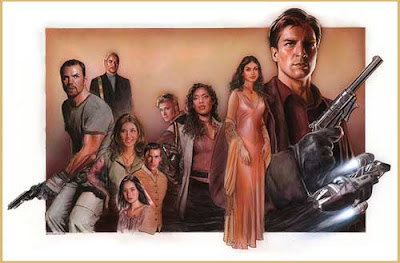
A few months back I finally addressed a monstrously huge hole in my science fiction, space opera loving resume: I watched all of Firefly, every bit of it, including the movie Serenity. I realize I’m very much late to the game on this, but hey, late to the game still means I’m a player. Or something like that.

Firefly, for those who haven’t paid attention, is a show that Joss Whedon created back in 2002, after Buffy the Vampire Slayer ended. It’s an SF show set something like five hundred years in the future where humanity has colonized a distant star system that consists of, well, lots of planets and whole ton of moons that have been terraformed for human colonization. The “Core Worlds” are the rich and powerful planets of the system, and these worlds form the basis of “the Alliance”, which is the somewhat despotic government. The outlying worlds and moons are a mix of independent planets and moons and some dependent on the Alliance. The show takes place several years after the end of a civil war in which the “Independents” fought unsuccessfully against the encroaching Alliance; the spaceship that serves as the main location of the show, Serenity, is a Firefly-class freighter named for the deciding battle in the war, Serenity Valley, in which our lead character, Captain Malcolm Reynolds, fought on the side of the Independents. Got all that? (Yes, it’s weird that the show is titled for the class of ship rather than the title ship itself. By that logic, Star Trek should have been titled Constitution, because the Enterprise is a Constitution-class vessel.)

So, when the show starts, Reynolds (often called “Mal” for short) is commanding his beat up old ship with its small crew as they go from job to job to pay their way, with many of these jobs being of the less-than-legal sort. This can mean smuggling illegal goods from one world to another, or salvaging valuable cargo from spacewrecked ships, or stealing valuable medicines from Alliance hospitals for sale on the challenged outer worlds. This also leads Mal and company into the employ and/or business association with all manner of unsavory characters, some of whom are very dangerous people indeed.

In looking about online for commentary about the show, much has been made about the show’s atmosphere. I’ve often heard Star Wars described (at least A New Hope, not so much the rest of the series) as a Western set in space, but I’ve frankly never seen that as being a fair or accurate label. In the case of Firefly, it’s entirely accurate, not only in the fact that everyone dresses like they’re in a Western, Mal’s preferred weapon is a six-shooter, everyone talks in that Western way (you’ll know what I mean if you see the show), everyone dresses in a Western way (long coats, wide-brimmed hats, lots of facial hair all over the place), the main mode of transportation on many of the poor worlds the show visits is the horse, and many of the settlements on those worlds are exactly the kinds of dusty towns you’d see in any Western. This appears to be a problem for some viewers, but it never really bugged me all that much. I would have liked to have seen a little more variety in the kinds of settings on the show, but I there was some of that, after all (one world has rich people living in floating cities that hover above an ocean), and lodging such complaints about a show that was only around for fourteen episodes and a movie seems a bit churlish. The obvious rejoinder from Whedon and company is, “Yeah, yeah, we’d have got round to that if Fox hadn’t canceled us after jerking us around for half a season.”

OK, as to that last: FOX’s shabby treatment of certain shows and not others is something of infamous legend in teevee fandom circles, but FOX’s record in the case of Firefly is particularly bad. About the only thing they could have done to show less confidence in the show and to guarantee its eventual demise would have been to simply not have greenlighted it in the first place. FOX execs weren’t overly enthusiastic about the show’s two-hour pilot episode (which in itself is astonishing, as that pilot could have been transposed to the movie screen as-is for one hell of a SF movie), so they ordered the pilot shelved and another hastily shot, which is why the show’s second episode, “The Train Job”, was aired first. Then FOX continued to air the episodes in whatever screwy order they felt like airing them in, which in turn screwed the show because, while it wasn’t exactly a serial, Whedon and company were creating quite a bit of continuity with recurring characters and storylines. The wonderful pilot episode wasn’t aired until the show’s fate was already sealed, and the show’s timeslot was a disaster: FOX took a show that was heavy with continuity and in a genre that traditionally has to struggle to gain an audience and put it on Friday nights at 9:00. Now, maybe FOX was thinking back to the earlier days of the network when they had The X-Files in that timeslot and they kept it there since they didn’t have much of anything else to air anyplace, but those days were long gone by the time Firefly came along. (Remember, NBC in the 60s was able to finally drive the final nails into Star Trek‘s coffin by giving it a Friday time slot.) In any case, FOX’s treatment of Firefly makes ABC’s treatment of Once and Again look like the very picture of network support. Again, I think of Jon Lovitz’s bitter quip to David Letterman some years ago when FOX canceled his own critically-loved but ratings-challenged show The Critic: “FOX? They should spell it with a ‘U’.”

But back to the show. One claim I’ve heard is that lots of fans find Malcolm Reynolds compelling because he’s what Han Solo might have been if he hadn’t been “softened” in Return of the Jedi. I don’t see that, actually. First, I never thought Solo was “softened” at all. But what happened is that Reynolds’s character arc is pretty much Han Solo’s character arc in reverse.

When we first meet Han Solo, he’s a pirate and a smuggler, making his living by using his ship to transport the goods belonging to one criminal low-life or another. In fact, when we meet him, he’s just earned himself the anger of one of his “clients” because he’s lost cargo belonging to one of his criminal bosses. But as the Star Wars story progresses, Solo falls in with the Rebellion, hangs with them for a while, and while aching to return to his former life, eventually finds himself converting to their cause and becoming a true believer. The cynical criminal becomes an idealist. Mal Reynolds, however, started out as the idealist hero, fighting a losing fight with the side he believes in. (When an Alliance officer questions him about it, saying “You fought on the wrong side”, Mal replies, “I fought on the losing side. I’m still not convinced it was the wrong side.”) The opening scenes of the pilot show the last moments of the Battle of Serenity Valley, when Mal believes that his side in on the verge of victory, just as soon as his air support arrives – when word comes that his commanders have decided to throw in the towel and those fighting are ordered to lay down arms. Just like that, Mal’s cause is defeated, and he becomes bitter and cynical. Han Solo is the criminal who finds something to believe in and fight for; Mal Reynolds loses the thing he had to believe in and fight for, and thus becomes a criminal.

(Now, when I say that Mal Reynolds is a “criminal”, I’m saying that some of what he does is illegal. He’s not afraid of doing things that are illegal, but he’s not at heart a criminal in the sense that he lives to break the law. Robin Hood and Ernst Stavro Blofeld are both “criminals”, if you take my meaning.)

This all changes a bit in the feature film Serenity that somehow managed to get made after the show’s cancellation; the major theme of the film is everyone around Mal trying to figure out what, if anything, he actually believes. The film gives us an answer, but it’s not an easy answer at all, and Mal’s actions in the film are as consistent with one set of beliefs (that someone must stand up to the Alliance) as with another (that Mal’s days as a fighter-for-something are over, and all he wants now is freedom).

But anyway. Firefly has become as beloved in SF fandom as anything I can remember, and it’s truly a bummer to note that the lackluster box office of the follow-up Serenity movie likely means that we’re unlikely to ever see another Firefly show or movie again. There have been a few comics series taking the story further, and that to me is probably the best format we can expect for continued Firefly goodness (if not actual novels; I’d read original Firefly novels if they existed). So, for the time being, what we’ve got is what we’ve got. That being the case, Firefly as it stands is a surprisingly complete body of work.

In just fourteen episodes, Firefly creates an SF universe that feels plausible and real, populates it with characters we can know and care about, and tells involving stories using all that in the mix. Watching the show’s episodes in the correct order, via the DVD set, I noticed how fully-imagined the show was right from the beginning. Firefly stands in marked contrast to any of the Star Trek series, each of which required a season or two to really settle into a rhythm. The characters’ voices are all established from the first moments, which is something you don’t often see. Thus, there’s nothing in Firefly that reminds people of, say, Mr. Spock in the early episodes of Star Trek emoting all over the place since it hadn’t yet been decided that Vulcans suppress their emotions. This is a show that really learned the lessons of Star Wars in that it made all its technology look like it does something. I particularly appreciated the episode “Out of Gas”, where Serenity is crippled by the failure of an engine part that’s about the size of a can of coffee. That may have struck some as implausibly, but being a maintenance worker myself (but not quite up to the level of a Keylee or a Montgomery Scott), I’ve seen lots of big machines felled by comparatively tiny parts. Remember: the space shuttle Challenger was doomed by a piece of rubber that wasn’t even part of the ship itself, and the Apollo 13 mission was nearly destroyed by a faulty wire.

Also of interest was the show’s approach to establishing its universe. Lots of SF shows, like the Star Treks, insist on showing us one new world after another, and only start to use recurring characters when the show is established. (DS9, by virtue of its stationary setting, broke this habit, much to its credit; I still hold it as the best post-TOS incarnation of Trek.) Firefly, however, gives us recurring characters right off the bat: con-woman Saffron, criminal boss Niska, low-grade but ambitious hood Badger. This is more evidence of how well-designed the show was, and another reason to be annoyed at the show’s ultimate failure.

In terms of casting, Firefly was, as far as I can tell, perfectly cast, at least in its leads. Everybody seems to not be playing their roles so much as inhabiting them, and the chemistry amongst this crew is established very early on. Other touches are equally pleasant: the swearing in Chinese (and the constant hints that China became the dominant culture of Earth before the diaspora), and it only took a few hearings before my ears accepted the word “Goram” as a surrogate for “goddamn”. Fictional expletives are always tricky (“Felgercarb!” being a notable example, from BSG), and using Chinese and one made-up English one is a nifty way to solve that particular problem.

Was Firefly perfect? Of course not, but its general level of quality was astonishing for a show that never had the full backing of its network. What might have been! I can’t believe that we’ve seen the last of this crew or heard the last of their stories. It’s too promising a world, and its existing canon is too high-quality to languish forever. Or so I can hope.

(Image above via.)

Share This Post