
Kushiel

Kushiel’s Dart is the first “fat fantasy” I’ve read in a long time; and I enjoyed it so much, I may find myself shying away from the genre for a while for fear of disappointment in whatever Fat Fantasy book I pick up next. Jacqueline Carey has crafted here a novel that put me in mind of Guy Gavriel Kay; in fact, I thought more than once while reading it that this is what GGK would have written if he’d been a woman. This was a wonderful, wonderful book that only let me down at the very end, when it came time for Carey to set things up for the sequel.

The setting was the first thing about the book to remind me of GGK. We’re in a land that is basically Europe with the names changed, and the history is strongly based on Europe as well. In their “Middle Ages”, the main action takes place in the City of Elua, named for Blessed Elua, an angel born in the aftermath of the crucifixion of Yeshua more than a thousand years before. Blessed Elua and his followers established a land where the guiding priciple is Love as thou wilt. Into the service of Naamah, one of Elua’s followers, comes our heroine, Phedre, whom we meet as a child but who grows up before our eyes over the course of this 900-page novel. She is sold into the service of Naamah, which makes her a courtesan; later, she comes into the direct employ of a charismatic teacher named Anafiel Delaunay, who turns out (as does everybody in this complex book) to be much more than he seems. Phedre learns much about the world while in Delaunay’s service, much that eventually puts her in danger as she finds herself engaged in the court politics of this dangerous land; but Phedre is a good student and sharply intelligent, so she becomes as much a player as an observer over time.

More than that, Phedre is a rarity among courtesans: she has a red mote in her eye, which indicates that she has been marked with Kushiel’s Dart (Kushiel was one of Blessed Elua’s followers), and as such, she is something called an anguissette, a person who experiences physical pain as erotic pleasure, which leads to some fairly difficult passages in the book wherein Phedre describes for us her erotic actions (the book is told in first person, from Phedre’s perspective). Fair warning here, folks: if reading about what is literally sadomasochism isn’t your cup of tea, this book won’t be for you; but likewise, if you don’t mind that material (which is very well written, and not really gratuitous, in my estimation), the rest of the book is worthy of attention.

I don’t want to say a whole lot about the plot of this book, not just because I wouldn’t want to spoil it, but also because it’s a hard book to summarize. It’s very long, being the type of book one loses oneself within. One of the book’s most important characters, Joscelin Verreuil, who serves as bodyguard (and eventually much more than that) to Phedre, isn’t introduced until after page 250. This is an actual epic of a book, with the action ranging over virtually the entire continent of “Europe”. Along the way we meet roving bands of gypsies and their king; we travel north and east into the rugged lands dominated by Viking-like warriors called Skaldi, who are gathering underneath the banner of a new warlord; we travel west, over the straits, to the barbarian island realm where the blue-painted warriors fight for dominion. We meet the Master of the Straits, the being who controls the weather in the straits between Alba and Terre d’Ange (think the English Channel), choosing who gets to make passage and who doesn’t. We meet nobles motivated by love and by hate, soldiers motivated by money and by loyalty, lords motivated by revenge and lust, and noblewomen whose motivations can’t even be summarized in any real way.

Kushiel’s Dart is the start of a series, and I have every intention of continuing on. It takes a really good “Fat Fantasy” to capture my attention these days, but this one did. Carey creates a vivid world here, familiar and fantastic, and she populates it with memorable people who stand out and command sympathies – even the villains. I loved this book.
Share This Post

Hey, WNED

On the off chance anyone from WNED, Buffalo’s classical music station, reads this: this sort of thing does not predispose me to giving money to WNED, something I had actually been considering doing. Now I think I’ll just buy a pizza instead, or maybe get that wireless router I’ve been considering.

John Landis always came on the radio when I was getting off work, and I enjoyed listening to his show. He was knowledgeable and always conveyed a great love of classical music. I can only assume that his termination had something to do with the fact that he’d been there for a long time and thus was probably making more money than some of the less-tenured hosts. If that is the case, I would hope that the WNED brass note that the “Let’s fire the ones who have been around the longest and therefore make the most money” strategy didn’t work out so well for Circuit City.

Anyway, best wishes to Mr. Landis, and hopes that he lands on his feet in these times when so many people are hoping to land on their feet.

Share This Post

From the Books: The Proud Tower

(A series of posts in which I post longer than usual excerpts from books of mine.)

A number of the liberal-leaning blogs I read have been arguing of late that the filibuster in the US Senate needs to be done away with, as it is a fundamentally undemocratic thing whose use has become so frequent and entrenched over the last few years as to render the Senate into a body which de facto requires a supermajority in order to pass anything. (Example.) I tend to agree with this argument; the filibuster’s main virtue seems to be that it’s been that way forever, and that, in itself, is never much of a reason to keep doing anything.

But I’m reminded of a historical episode I read about in a wonderful book by Barbara Tuchman, The Proud Tower, in which she describes a similar problem faced once by a Republican Speaker of the House named Thomas B. Reed, at the end of the nineteenth century.

He [Reed] was determined, on taking up the gavel as Speaker, to put into effect a plan on which he had long deliberated, consulting no one, and on which he risked his entire political future. He knew that the fight would focus upon him the nation’s attention and also that if he failed his Congressional career would be over. The stakes were high: he would either break “the tyranny of the minority” by the which the House was paralyzed into a state of “helpless inanity”, or he would resign.

The system Speaker Reed had decided to challenge was known as the silent – or disappearing – quorum. It was a practice whereby the minority party could prevent any legislation obnoxious to it by refusing a quorum, that is, by demanding a roll call and them remaining silent when their names were called. Since the rules prescribed that a member’s presence was established only by a viva voce reply to the roll, and since it required only a majority of the whole to constituted a quorum, the silent filibuster could effectively stop the House from doing business.

To Reed the issue was survival of representative government. If the Democrats could prevent that legislation which the Republicans by virtue of their electoral victory could rightfully expect to enact, they would in effect be setting aside the verdict of the election. The rights of the minority, he believed, were preserved by freedom to debate and to vote but when the minority was able to frustrate action by the majority, “it becomes a tyranny”. He believed that legislation, not merely deliberation, was the business of Congress. The duty of the Speaker to his party and country was to see that that business was accomplished, not merely to umpire debate.

He reached his decision to attack the silent quorum, and planned his campaign, alone, partly because no one else would have thought there was a chance of success and partly because he was not sure that even his own party would support him. There were indications that they might not. Because of Reed’s known views on the silent filibuster it was clear that quorum-counting would be an issue in the new Congress. REED WILL COUNT THEM, predicted a headline in the Washington Post, and the story beneath it said that even Mr. Cannon, Reed’s closest lieutenant, was, opposed to the attempt. The Democrats were manning their defenses. Ex-Speaker Carlisle let it be known that any legislation enacted by a quorum which had not been established by a “recorded vote” woul dbe taken to court as unconstitutional.

Reed, however, had satisfied himself that he would be upheld if it came to law, and on the attitude of his own party he was prepared to gamble. He shrewdly judged that the Democrats in their rage would provoke the Republicans to rally to his support. When the first of the contested elections appeared on the schedule for January 29 he was ready. As expected, the Democrats raised a cry of no quorum and demanded a roll call. Reed’s moment had come. Without a flicker of expression on the great white moon face, “the largest human face I ever saw”, as a colleague described it, without any quickening of the drawling voice, he announced, “The Chair directs the Clerk to record the names of the following members present and refusing to vote,” and began reading off the names himself. Instantly, according to a reporter, “pandemonium broke loose. The storm was furious…and it is to doubted if ever there was such wild excitement, burning indignation, scathing denunciation and really dangerous conditions as existed in the House” during the next five days. Republicans were wildly applauding, all the Democrats were “yelling and shrieking and pounding on their desks” while the voice of their future Speaker, Crisp of Georgia, boomed, “I appeal! I appeal from the decision of the Chair!” The explosion was “as violent as any ever witnessed in any parliament,” a member recalled later. “Mr. Blanchard, Mr. Bland, Mr. Blount, Mr. Breckinridge of Arkansas, Mr. Breckinridge of Kentucky…”

Up jumped the Kentuckian, “famous for his silver hair and silver tongue.” “I deny the power of the Speaker and denounce it as revolutionary!” he called.

The resonant twang from the Chair continued unregarding, “Mr. Bullock, Mr. Bynum, Mr. Carlisle, Mr. Chipman, Mr. Clement, Mr. Covert, Mr. Crisp, Mr. Cummings” – through hisses and catcalls and cries of “Appeal” irresistably rolling down the alphabet – “Mr. Lawler, Mr. Lee, Mr. McAdoo, Mr. McCreary…”

“I deny your right, Mr. Speaker, to count me as present!” bellowed McCreary.

For the first time the Speaker stopped, held the hall in silence for a pause as an actor hold an audience, then blandly spoke: “The Chair is making a statement of fact that the gentleman is present. Does he deny it?”

It’s a fascinating tale. It doesn’t end there with that one act of Reed’s, of course; few things of this nature ever do. The Republicans would later lose Congress so badly that the Democrats were able to raise a quorum by themselves, and they then restored the silent quorum. This backfired after the next election cycle, however; the Democratic majority was greatly reduced such that now-Minority Leader Reed was able to frustrate Democratic legislative aims by using the silent quorum himself, until the Democrats finally relented and allowed the silent quorum to end forever.

(The Proud Tower is one of my favorite history books, by the way. It is a large-scale picture — a historical snapshot, if you will — of the state of the the world as it was moving inexorably toward World War I.)

Share This Post

The original one-hit wonder

One of my Facebook friends, a guy I went to college with and who was a fellow trumpet player, posted this video of a comedian who was once a cello player and thus has a special reserve of hatred stored up for Pachelbel’s Canon in D, because the poor cellist has to play that infernal ground bass, eight notes in all, over and over and over again:

As my Facebook friend noted, we used to play a brass quintet arrangement of this piece, which was OK if you’re a trumpet, horn or trombone player, but not so much if you’re the poor tubist. As I’ve noted many times, the most thankless tasks in classical music are playing the ground bass in Pachelbel’s Canon and playing the snare drum part in Ravel’s Bolero.

Share This Post

I find his lack of faith disturbing.

Kevin Drum on Liam Neeson:

Neeson is, after all, our greatest living actor. How do I know this? Consider: every single actor directed by George Lucas in the second Star Wars trilogy gave a performance that could only charitably be called embarrassing. The lone exception was Liam Neeson, who, against all odds, managed to overcome Lucas’s leaden dialog and clunky direction and turn in an appealing, understated performance anyway. If that’s not evidence that he’s our greatest living actor, I don’t know what is.

Oh, come now. I know that most folks think that Hayden Christensen and Natalie Portman turn in sub-par performances in the Prequel Trilogy. I don’t share that view, but I know that’s the general consensus. But every single actor other than Neeson as Qui Gon? Ewan McGregor was embarrassing? Ian McDiarmid? Pernilla August? Christopher Lee? Every single actor not named Liam Neeson? I know, we’re all supposed to hate everything about the PT, but come on, now. Sheesh.

Share This Post

Sentential Links #157

Start clicking:

:: I really don’t understand how bipartisanship is ever going to work when one of the parties is insane. Imagine trying to negotiate an agreement on dinner plans with your date, and you suggest Italian and she states her preference would be a meal of tire rims and anthrax. If you can figure out a way to split the difference there and find a meal you will both enjoy, you can probably figure out how bipartisanship is going to work the next few years. (I’ve decided that I just don’t care about the “tone” in Washington. I don’t care one whit about it. Reading through various histories of politics, the “tone in Washington” is always acrimonious and nasty. That’s not a bug, it’s a feature. It’s the way it is, everywhere you have differing political parties fighting for stuff.)

:: Some days it’s just this. And this is what I live for.

:: It’s a freaking lifetime when your midsectional and breastal frontage areas are suddenly exposed to God-knows-who. (Yeah…I’m gonna have to take her word on that one. Kerry’s new to the blogroll, but she’s actually an old friend from my high school days, found via Facebook.)

:: For the moment let me just note that in Spain they have this interesting political system (”democracy”) wherein if your party loses the election, the other party gets to make policy until they lose an election.

:: What does it say about me that I could go with either interpretation? (Me, too. This post features one of the more clever LOLcat photos I’ve seen in a long time.)

:: I make an awesome hot salsa. I use cactus in it. (Wait, what?)

:: Comic book lettering has some grammatical and aesthetic traditions that are quite unique. (This isn’t a blog post, actually, but a fascinating article on an overlooked aspect of comics: lettering. When I was a big comics reader, I got to the point where I could recognize letterers on sight, and in some cases where certain comics had the same letterers for years, I would be thrown off if an occasional issue came along lettered by someone else. The art and Chris Claremont’s writing might not change, but an issue of X-Men without Tom Orzechowski’s lettering? That threw me off!)

All for this week. Tune in next week!

Share This Post

Sunday Burst of Weirdness

I didn’t see a whole lot of weirdness this week, for obvious reasons, but some stuff did catch my eye:

:: Alan reports on a somewhat questionable marketing strategy by a Buffalo website. There was also a follow-up that I find not entirely convincing.

:: Over at Back of the Cereal Bus, Drew Mackie regularly reports on odd search strings that bring people to his blog. In the latest edition of this, I saw one that almost made me spit green tea all over my keyboard:

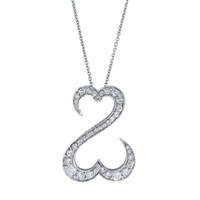
Jane seymour open heart looks like a butt

I laughed and laughed, because the first time The Wife and I were watching teevee and saw a commercial with Ms. Seymour displaying her “Open Heart” design, which looks like this:

…we both laughed, and I can’t remember which of us actually noted that it does, in fact, look partially like a human arse. I was then reminded of one of the funnier episodes of Everybody Loves Raymond, in which Marie (Raymond’s overbearing mother) takes a sculpture class and makes a giant sculpture that everybody but her sees as strongly resembling, well, a certain part of the female anatomy. (Clip here, although a plug-in download might be necessary to watch.)

That’s about it for this week.

Share This Post

Comfort Food

Roger commented on a list of “comfort foods”, indicating his thoughts on each particular item. I, of course, shall do the same. Because I’m a follower, not a leader.

Apple Pie: Yup, that’s a comfort food. Especially served warm with a scoop of French vanilla or vanilla bean ice cream. Oh yes. (But I just can’t do the “apple pie with a slice of cheddar cheese” thing. That makes no sense.)

Baked Beans: I’m not sure I call them a “comfort food”; they’re a nice and easy side dish. I do make a thing with sausage, baked beans and a few other condiments that I consider a comfort food, though.

Banana Pudding: Not really. I’m not that much into pudding, and I’m not wild about banana flavored stuff to begin with. Love bananas, but banana flavoring, not so much.

Beef Stew: I make a pot of beef stew a couple of times a year. Comfort food? I’m not sure I consider it “comfort” food, but I like it in the autumn.

Brisket Pot Roast: Not really. I like it and should make it more, though.

Chicken & Dumplings: This is probably one of the canonical comfort foods. I’m not sure I’ve ever had it, though.

Chicken Pot Pie: Yup. Comfort food all the way. I make a nice one, if I do say so myself.

Chicken Soup: Not really. My comfort soup is clam chowder, actually. I find chicken soup boring.

Chili: Again, a regular autumn and cold weather item for me. I’m not sure I call it “comfort food”, though.

Chocolate Chip Cookies: Certainly. I love chocolate chip cookies. Homemade are the best.

Corn on the Cob: Sure. I adore it. Corn in all forms, really. And cornbread! A pot of chili without cornbread is unforgivable. (Well, beer bread is acceptable too.)

Fried Chicken: Absolutely. Especially if it comes in a bucket with biscuits, cole slaw, mac-and-cheese, and a wet-nap.

Gelatin: Meh. Not a big fan.

Green Bean Casserole: I don’t like green beans, so no. The Wife insists on this being on the table every Thanksgiving or Christmas, though, whichever one we make ourselves.

Hot Dogs: I love them, but I’m not sure I consider them “comfort food”.

Ice Cream: Sure. But then, I nearly live on ice cream.

Macaroni & Cheese: Certainly. Especially homemade. I make a baked version with sausage mixed in with the noodles, parmesan sprinkled on top. (One time I topped it with crushed potato chips, which I thought rocked, but The Daughter gave that thumbs down.) And yes, I like the box stuff. Sorry.

Mashed Potatoes: I don’t like these. So no.

Meatloaf: Hmmmmm. I like meatloaf, but I haven’t had it in so long that I don’t think I can consider it a comfort food.

Potato Salad: Since I didn’t like it until adulthood, I can’t really consider it to have a nostalgic thing behind it. But I do love a good, mustardy potato salad.

Pumpkin Pie: Not really. I have one slice a year and I’m good. Mainly pumpkin pie serves for me as a contrast to the mound of whipped cream I consume with it.

Shepherd’s Pie: Mashed potato topping rules this out for me.

Spaghetti: Hmmmm. Maybe. Never thought of it as comfort food; just a reliable, quick meal.

Tomato Soup: I loved it as a kid; I still like it but only have it maybe once or twice a year. But it cries out for a grilled cheese sandwich along with it. Now, if the sandwich is made from caraway rye bread and the cheese is sharp cheddar, then yes, we’re talking comfort food.

Tuna Casserole: Sure.

What other comfort foods do I have? Tater tot casserole. Waffles and pancakes and French toast. Frozen pizza. Burgers at a drive-in, ice cream at a roadside stand. Vanilla and strawberry milkshakes.

Maybe anything I like is actually comfort food….

Share This Post

Do the pipes still work, Dear?

Howdy folks!

I’m finally back and blogging in Western New York this evening. Actually, The Daughter and I arrived back home early last evening, but we had so much stuff to do post-flight, continuing into today, that I’m only now able to sit down and get caught up on Teh Interweb. So here I am.

Anyway, yesterday’s cross-country return trip was just about the most picture-perfect day of travel I could imagine. The day was bright and sunny everywhere we went. Our first plane took off from Spokane right on time, and apparently the winds were favorably with us (like The Force!), because we were a half-hour early arriving in Minneapolis, where we were already scheduled for an eighty minute layover. The extra time was nice, as The Daughter and I were able to grab some lunch and then leisurely make our way from our arriving gate to our departing one. (The Minneapolis airport is huge. I’m always surprised by this, when I go through there.)

From Minneapolis it was off to Detroit, where we again arrived early, this time about fifteen or twenty minutes early. We disembarked the plane there, crossed the terminal to the teevee screens to find where we were to go for the final plane, from Detroit to Buffalo, whereupon we discovered that we were, in fact, taking the exact same plane. So we didn’t even have to budge from where we were.

And of course, the flight from Detroit to Buffalo basically involves traversing the length of Lake Erie, so this took about forty minutes. What was nice then was that the sun had gone down, and the night was very clear, so from our vantage point, sitting on the left side of the plane (and therefore facing north), as we made our way into the eastern portion of Lake Erie, The Daughter and I could see virtually all of the lights of Ontario’s “Golden Crescent”, which stretches from Niagara Falls to St. Catharines to Hamilton and around the bend of Lake Ontario toward Toronto. It was one of the most beautiful things I have ever seen.

Anyhow, now we’re back and faced with lots of domestic stuff that needs taken care of. The cats made short work of a box of Kleenex, for one thing; for another, one of the boys (Lester, for those keeping score) loves to chew plastic bags of any sort, and he had himself a field day. There was a plastic bag from the local liquor store that he chewed the hell of, dragging it across the floor. Thing is, it still had the bottle of wine in it, since I hadn’t got round to putting that bottle away when circumstances intruded. Plus the place hasn’t been vacuumed in two weeks. Oof. Yeah, so no parties at Casa Jaquandor for a while.

But we’re back and blogging, though. That’s something!

Share This Post