Ach, if not for the non-life-sized ship….

One of my favorite places at the County Fair is the Fine Arts building, where all entrants pertaining to the Fine Arts are displayed. Paintings, photographs, quilting, topiaries, costumery, cultivation of African violets and other flowers, et cetera, all in one building. We usually spend quite a bit of time in this building.

There’s always a section of the building given over to dioramas like this. I suppose a couple of themes are assigned and then entrants craft their entries around one of them; this year, one of the themes was “Treasure Island”, so there were three different dioramas devoted to all things piratical. Every diorama further sports a card on which the judges’ comments are noted. This one cracked me up, because if you click through to the large size, you can read it:

“Ship not life size.”

So, apparently this diorama would have been perfect if the artist had erected the Black Pearl behind it. Hmmmm.

Share This Post

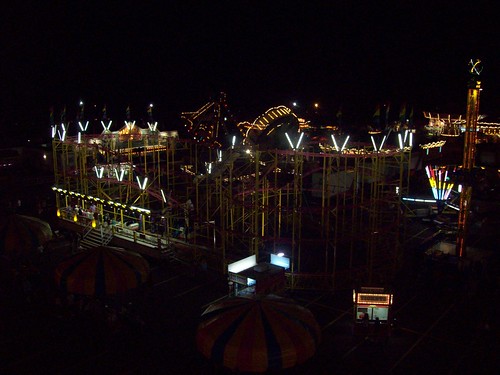
The Midway at Night, I


The Midway at Night, I, originally uploaded by Jaquandor.

I don’t know if my little Kodak digital point-and-shoot is equipped to take good night photos and I just haven’t figured it out, or not, but I’m usually slightly disappointed that I can’t get the Midway at night to look as bright in photos as it is in person. Nevertheless I like the way this turned out. I took this from about one-quarter of the way up while we rode the Giant Wheel.

Share This Post

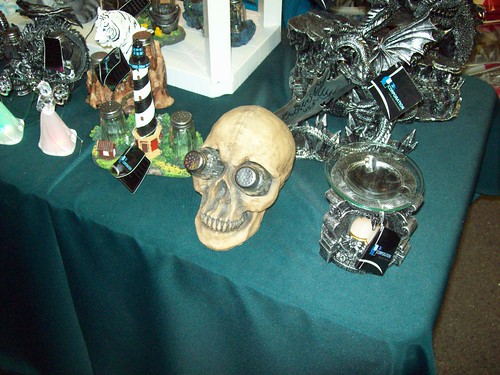
Yorick!


Yorick!, originally uploaded by Jaquandor.

From one of the more famous scenes in one of Shakespeare’s greatest plays, to the indignity of being used thusly at the Erie County Fair! For shame, for shame.

This was a booth selling all kinds of knick-knacks in this vein: place settings and decor for the goth set, I suppose.

(More County Fair photo posts will follow.)

Share This Post

You keep using that word….

John Scalzi, having previously displayed some very odd notions about what “good design” is all about (and having been factually wrong in the process), turns his eye from Star Wars to Star Trek. Unfortunately, the results are about the same: he gets some things wrong (the Probe in STIV is not attempting to “destroy everything”), he makes some odd assertions (his bit about phasers is just weird), and instead of talking about “design” he ends up talking about scientific plausibility. I mean, sure, “Red Matter” is one of the worst Maguffins I myself have ever seen in a movie, but what on Earth does that have to do with design?

Now, weird design choices in Star Trek aren’t that hard to find. Since there’s no real reason for it to be there, putting the bridge on top of the ship where it’s totally exposed is an odd choice. In the most recent movie, the design of the Romulan mining ship makes no sense, what with catwalks over yawning chasms and everyone splashing through ankle-deep water and all. But there’s more to critiquing design than saying that Red Matter is full of crap.

Oh well. This is clearly another attempt by John to get the geeks fired up, so mission accomplished!

Share This Post

Flo-Jo

I always liked Florence Griffith-Joyner, the great US track athlete from the late 80s and early 90s, and I was shocked when she suddenly died.

Here’s a pretty amazing article about Al Joyner and his incandescent love for Florence.

Dreams were her gift. Every morning, she’d wake up and tell her husband, Al, how she’d dreamed about angels or daughters or catastrophe. Good or bad, she’d always wake up with a story to tell — until the day she never woke up at all.

Al never had that gift. His dreams were vague, or they’d escape him 20 seconds into his day. He had nothing to jot down like she did, nothing to file away for a conversation over dinner. Even after she died some 11 years ago, he never dreamt of her, could never summon her back into his subconscious. This frustrated him to no end, because, once he was awake, all he did was daydream about her.

But then, about 10 weeks ago, in the middle of his deepest sleep, Al Joyner finally saw Flo Jo. She had driven up in a car, smiling, and strolled casually toward him. She was stunning, as always, and wore her hair in a bun, just the way he’d always adored it. He asked her, “What are you doing here?” And her response was, “I’m just coming to check on you.” He didn’t know what to say next. Their daughter, Mary, was about to graduate from high school, and he wanted to ask, “Are you here for graduation?” But before he could speak, his alarm clock went off.

The buzzing jarred him, and his dream was barely intact now. He could see her leaving, climbing back into her car, smiling again. He wanted more, wanted a full-blown conversation, but an instant later, Al was awake, the moment over.

He sat up in bed, both agitated and wistful. That was it? That was the whole dream? He hadn’t finished. There was so much to tell her, about him and Mary and premonitions that had come true. There was also news to share, news she’d probably beam about.

The next night, he went to bed early, hoping Flo Jo would reappear, hoping the dream would pick up where it left off.

But when he woke up, nothing. He wanted to punch his pillow. Nothing.

Do read the whole thing.

Share This Post

Five

He would have been five today. Had he not suffered the brain damage that caused his cerebral palsy, he would be entering Kindergarten this year. Alas, it wasn’t to be, and we’ll wonder “what if” for all the rest of our days.

Here he is, in the arms of his grandmother, who has since joined him…wherever it is that we go, when we leave.

Happy birthday, Little Quinn.

Share This Post

Work in Progress….

Don’t be alarmed, folks, but I’m in the process of changing my template. At long last I’ve grown bored of how the place has been looking. Bear with me as things will be slightly hinky for a while.

UPDATE: I think I’ve got it roughly the way I want it to look for right now, but does anyone know how to get rid of that “read more” link that’s on each post? I don’t do expanded posts like that, and thus have no need of that feature.

Share This Post

Don’t Eat the Snow in Hawaii

That’s the title of the very first episode ever of Magnum PI, which I saw Part One of last night, for the first time in…well, many moons. Watching favorite old teevee shows is, of course, an eternal pleasure, but particularly special are the pilot episodes of favorite shows. It’s always fun to see things in retrospect in the old pilots, from shows I know very well; noting the way characters interact at the outset before the show evolves, with the writers and producers learning what chemistries among the cast work best.

In “Don’t Eat the Snow in Hawaii”, the relationship between Magnum and Higgins is a lot more antagonistic than it would be later in the show’s run, owing to the fact that the pilot takes place early in their professional association, when neither man knows the other very well and certainly neither man takes the other particularly seriously. Magnum’s trademark narration of his adventures is present, but here it has a weird sound to it, with heavy reverb as though we’re listening to Magnum’s ghost. And the phrases he would use a lot later on in the show in his narrations — “I know what you’re thinking, and you’re right”, “When I write my book on how to be a world-class private investigator, I’ll include a chapter on….” — are not to be found. But other stuff — high-speed chases in the Ferrari, Magnum’s Viet Nam and Naval Intelligence history — are there from the get-go.

A word on the presentation of the show itself. Here in Buffalo, channel 2.3 — part of our local NBC affiliate’s trio of digital channels — airs “Retro TV”, which is just that: old teevee shows. Weeknights have been kind of fun this summer, with The A-Team and Magnum, PI airing each night. What has been kind of irritating, though, is that the channel is airing Magnum in no semblance of any kind of order. This always frustrates me. I tend to believe that when shows are aired in syndication, they need to be aired in the order they were originally telecast. This gives the opportunity to follow a show through in sequence, which in some cases is downright essential, in the case of shows with serialistic qualities. Now, Magnum, PI wasn’t entirely serialistic, but it did observe some continuity throughout its run. When the episodes are aired all over the place, as Retro TV is doing, the continuity is thrown out the window. It’s kind of frustrating.

Also disappointing, for me as an old fan of this show, is that the version of “Don’t Eat the Snow” is edited so that the show starts with the standard credits sequence. But “Don’t Eat the Snow” was a two-hour TV-movie, actually, and it featured a different credits sequence than the one we all know from later in the show’s run — and that credits sequence actually took place about five minutes into the episode! I tried to find that sequence online and failed, but you can hear the first Magnum, PI theme song here. At the beginning, you hear the revving sound of the Ferrari’s engine as Magnum speeds away, and then the titles begin, with animation based on what was, I assume, intended to be a major visual motif of the series — the Cross of Lorraine that was engraved on the ring that Magnum and his fellow Viet Nam buddies wear. While the eventual Magnum theme song would become one of the iconic teevee theme songs, I still like the “70s private eye” vibe of the original.

Share This Post

Facehugging the Body Electric

(Yes, that post title makes sense.)

Rewatching movies I haven’t seen in years, or even decades now, is a sometimes-pleasurable thing to do. Why only sometimes? Because sometimes I find myself admiring a film anew or rediscovering why I liked it in the first place; other times, however, I find myself either finding that a film I liked once isn’t as good as I remember it, or that a film I didn’t like to begin with is still a film I don’t like.

Fame came out in 1980. I recall it being highly regarded at the time, although since it was an R movie, I didn’t get to see it. (Of course, I was nine and my interests were nowhere in the remote vacinity of a movie like Fame.) Later there was a teevee series that ran for several years based on the movie, but I didn’t get to watch the film itself until I caught it on teevee at some point in the late 80s. It might have even been on PBS, I’m not sure…but it was a heavily-edited version. How edited? Well, it turns out, now that I’ve finally seen the whole thing as it ran in the theaters, heavily edited. There are a number of characters in Fame – not all of them, but a few – who are incapable of uttering a sentence without using the F-word at least three times in the sentence, including one very angry rant early in the film from a girl who doesn’t get into the prestigious school.

Fame follows a group of students through their years at the High School for the Performing Arts in New York City. We meet them during the audition process, and then track their progress through each of their four years in this school, wherein they learn to hone their respective artistic crafts. We see musicians, dancers, and actors in their auditions. Some are more convincing than others, of course; some are clearly delusional in their attempt to get into this school. One girl is a prospective dancer; she brings a male friend along with her to be her dance partner through her audition. Even though he’s just along for the ride, the male friend ends up impressing the judges more than the girl, who is rejected and walks out of the school and back to her regular life with a stream of profane invective. Another girl is auditioning to be an actress; at first glance her audition looks to be a disaster (her scene is someone waiting for an elevator) but when next we see her, she’s attending class.

We focus in, of course, on a few of these students more than others. The guy who was only a dance partner but ended up in the school is the “kid with the massive chip on his shoulder” who runs afoul of a stern teacher who won’t let him slack off one bit. There are the two acting students who are apparently very talented while also being very insecure, as well as the very talented singer and musician and would-be comedian who are very talented but who hide their insecurities well.

As the movie goes on, we basically follow these kids through their trials and tribulations mainly through small vignettes. We are invited to compare and contrast their behaviors as they grow, and to see them blossom in some cases and retreat into their shells in others. Each character is a fascinating person; there isn’t a single uninteresting character in this film. If anything, the film leaves me wanting to spend more time with these kids, and there is the ever-present desire to learn what became of all these kids after they graduate. (There is a cautionary tale there, in the way a graduating senior upon whom our heroes look in awe when they are freshmen turns out to be waiting tables three years later when our heroes are seniors.)

Fame is also a musical. The songs are decent enough; the most famous is the title number, with vocals by Irene Cara. The closing number, “I Sing the Body Electric”, is also a fine song. In truth, though, I had a bit of trouble with the musical nature of the film. Maybe it’s that the first number doesn’t come until about twenty minutes into the film, but for some reason, the film’s realism works against the musical numbers. The film attempts to ground the numbers in the realistic setting, but somehow they still end up feeling false in a way. I like the movie’s songs, but the film ends up being a musical that just doesn’t feel like a musical.

My larger quibble with the film is that I just didn’t think it was long enough. The movie creates an amazing world, within the walls of that school, and it populates that world with characters who are fascinating. I wanted to spend more time with them, to see more of their struggles and more of their conflicts and more of their successes and their failures. Maybe the fault here is that the film has too many characters, and thus to get them all in has to short-change them a bit, but I’m not sure that’s the case as I can’t decide for the life of me that, if that’s the case, which character I would cut from the film. But I didn’t see enough of the tense relationship between the black dance student and the gruff English teacher; I didn’t see enough of the young electronic musician and the cab-driver father who dotes on him; I didn’t see enough of the red-haired young gay actor. What we see of these people is great stuff! I wanted to see more of it, to such a degree that I must consider it a fault that I didn’t.

What I would not do is exactly what the film was wise enough to not do: we are given no hint at all as to the lives of these characters after they graduate and pursue their individual crafts. There is no American Graffiti-type summation that tells us who went on to be a successful writer, and who went on to be a career insurance salesman, and who got killed in a war. Fame leaves that entirely up to us.

So, after gushing about Fame, what’s the other movie that I re-watched recently? Well, I’ve never been a fan of the Alien franchise. I didn’t care for the first film, I didn’t care for the second, the third is crap on a stick, and on that basis I never bothered watching the fourth. But for some reason, I decided to give the original Alien another shot. And I still don’t like it.

Alien always gets props for being a classic of the horror genre, but I just don’t know. Boiled down, it’s just “horrible thing jumps out from the dark”, set in space. There are horror stories – movies, books, what have you – that retain their effectiveness on repeat explorations. Now, the specific “creep moments” may lose some effectiveness when you know what happens and who survives and who doesn’t and how those who don’t meet their fate, but the really great horror stories still manage to horrify on deeper levels, with psychological insights and that sort of thing. The final scene in The Silence of the Lambs can no longer put me on the edge of my seat, even when we see Buffalo Bill’s hand reaching for Agent Starling through the night vision glasses, because I know how that turns out. But I can still be disturbed by the film’s delving into a harrowing world of human psychosis.

Not so with Alien, where I continue to find that the movie’s set pieces lose their effectiveness completely when I know what happens, and where I find all the stuff in between the set pieces largely uninteresting filler. And that’s a shame, because the film’s production design really is awfully good. Nostromo looks like an actual place, which is essential. But so what? As has been my impression for years, Alien remains a monster movie that doesn’t have much to say about the monster, or what it means to be a monster, or how we should react to monsters, or anything else. The characters in Alien are not all that interesting, save for the two “grunts” who keep griping about their pay scale. In terms of interesting characters, the sequel Aliens is much better (and I end up disliking that movie for other reasons entirely).

The first time I saw Alien, I’ll admit that it was pretty gripping and scary. But each time thereafter — well, not so much. I’ve drawn this analogy before, but a friend once told me about the odd experience she had about a funny amusement park mishap she experienced once while riding a roller-coaster that takes place inside a building with all the lights off, in order to make a run-of-the-mill coaster more terrifying. I don’t recall if it was “Space Mountain” or someplace else, but she said that something went awry – maybe a power outage – just as her car was being pulled onto the track. The emergency lights came on, revealing the entire structure of the ride, and revealing it to be what it was all along: a humdrum coaster in a building. I find watching Alien now to be basically like riding “Space Mountain” with all of the lights turned on: when I know what’s going to happen, it’s a very humdrum movie.

Share This Post