Oddities abound! And some lazy linkage that’s not really odd at all.
:: Distracted by Star Wars ran a bunch of pictures yesterday, all themed around Princess Leia’s slave-girl bikini; start here and keep clicking “older”. For myself, I was always more attracted to Leia’s Ewok dress than the gold bikini, but…well, there it is.
:: Ever wonder what happens to retired military aircraft? Sure you did…and now you know. This is fascinating.
:: In the “Blogs you never thought the world needed but now that you see them, you realize that the world needed them all along” Department, we have Centaur-a-day, featuring daily drawings of centaurs. Really.
LC Scotty asks, easily enough: What is lemon curd? It sounds like something I should be eating.
Actually, I’m not sure if it’s something Scotty should be eating, if he’s asking from a health standpoint. Not that it’s necessarily bad for you, either, but it’s definitely something that you should be eating if you like things that taste good and if you file lemon under your personal label of “Things That Taste Good”.
But what is lemon curd? It’s a lemon-flavored spread that is made with eggs, sugar, and flavorings whipped together. The lemon flavor is pleasantly intense, but with enough sweetness to offset the lemon just enough. I spread mine on toast and English muffins. The flavor is strong enough that one doesn’t need a giant amount on the bread to make it taste good. It’s a very pleasant change of pace from jelly or jam. (I can’t get behind marmalade. Never liked the stuff.)
Here’s a recipe, but I’ll buying the stuff in a jar just the same. I’ve read that fruit curds don’t have to be lemon, but lemon’s what I see all the time.
Kerry asks: Why has no one ever discovered a Bigfoot (or a carcass thereof), when the creature has been written about and spoken of in native American culture for thousands of years??
Probably for the same reasons that no one’s ever found a mermaid at sea or discovered the Loch Ness Monster, and probably for the same reason that no one has ever captured or photographed one of the “Hidden Folk” or Iceland…the legends behind these beasts almost surely have roots in something real from way back when, but what it was? No one now knows, and it was also almost surely something not akin to what legendary creature would later accrue around it.
In the case of mermaids, the prevailing theory is that what was originally taken to be a mermaid was actually a manatee. In the case of Sasquatch, I suspect something similar. Maybe a particularly enormous bear, seen rearing onto its back legs. But thinking about it more, the notion of a giant human lurking somewhere “out there” is not limited to the Native Americans of the Pacific Northwest; virtually every human culture on Earth has at one time had some kind of similar legend. (The Yeti of the Himalayas is a good example.) They are among the most enduring of all legends.
Paul has a lengthy query about my favorite book, Guy Gavriel Kay’s The Lions of Al-Rassan. Part one: You mentioned the historical underpinnings of Kay’s novel The Lions of Al Rassan. Were you familiar with the historical facts before you read Lions the first time, or did you research that after? How did that knowledge affect your understanding and enjoyment of the novel?
The first time I read the book, I knew quite little about the period. Upon later re-reads…I don’t know a whole lot more about the period, aside from the broad strokes of the era. I certainly am not in any kind of position to evaluate GGK’s fidelity to the historical record, but as he is writing fantasy, to make such an evaluation would surely miss the point entirely.
I do know that history has rarely been driven by “larger than life” events and “larger than life” people as GGK depicts, but he has always admitted that he is not writing history after all. I find that GGK’s historical works tend to affect my understanding and enjoyment of the real history, rather than the other way around.
Back to Paul:
My biggest beef with Lions (I’m sure you’ve heard me say this before) is that I felt manipulated by the author at two specific points in the narrative. Kay sets us up to believe one thing has occurred, and then, much later, reveals that something entirely different actually happened. His protestations that he did it consciously and intentionally to provoke a specific reaction in the reader notwithstanding, I found it disturbing to my willing suspension of disbelief. It distracted me from the narrative, and made the author very apparent to me. A cardinal sin in writing we are told. What was your reaction to the events in the book I am talking about? how did it affect you differently from me?
Hmmmm. Firstly, I’m honestly not sure of what events in the book Paul is referencing, although I suspect he’s referring in part to the final duel of the novel? Without spoiling things, the conflicts come, in the end, to a single duel between the two principal men of the book. Which one wins? I won’t tell…but GGK writes the duel in such a way that we don’t even know which man is doing what in the fighting. I find it fascinating.
“Being aware of the author” isn’t something that’s ever much bothered me; in nearly every book I’ve ever read, I’ve been aware of the author at some point or other. Complete immersion in a story is something that rarely happens to me, and I almost always find myself aware of the author to one extent or another.
Not much of an answer, but without knowing specifically which events we’re discussing, I can’t go much farther into it.
I’ve waxed poetic about the library in my town a bit over the years. Truth to tell, one of my favorite places in any town is the library, and whenever I’ve moved, finding the local library has always been something I do very early on. So the Orchard Park Library has been a major part of my life — our lives, I should say — for all of the seven years we’ve lived here.
That photo, above, is the view I had a couple of weeks ago when I packed up the laptop and went to the library for an afternoon of writing and whatnot. I hadn’t planned to take the photo, actually, but I did when I realized that I’d never seen the library from that vantage point before. Because the library doesn’t have a ton of seating places that are in close proximity to power outlets, I had to sit way over on the far wall, by the fire exit. That’s over in the Children’s section, actually, which is another reason why I don’t spend much time over there. (The Daughter does, but I don’t.) Anyway, the vantage point struck me, the way the carpet pattern seems to mirror the grid of the new drop ceiling. (Our library was remodeled a year ago.)
After I left, when the library closed for the day, I decided to spend a few minutes exploring a place that I’ve often noticed but never really investigated. The library building is directly adjacent the old Orchard Park railroad station, which was pretty rundown when we moved here but has since received a lot of volunteer-based restoration work.
Behind me there is the library itself (and farther behind that, if I weren’t in the way, is my church). If I’d had more foresight that day, maybe I’d have worn the more railroad-appropriate hickory-striped overalls over there, but we can’t have everything, right? To the station itself:
Walking around the corner there, I found myself standing on the boarding platform, looking southeast:
And, of course, the trains running the other way would go toward Buffalo, because all roads lead to Buffalo:
Here’s the front of the station:
The station has a second, smaller building, which is now the permanent home of an old passenger car and a box car. I assume this was a freight depot:
I love the way the light is, on a late wintry afternoon when it’s snowing so that the air looks like it has bits of starlight in it:
By this point I was cold enough, and decided to go warm up with some soup at Panera Bread. But I kept thinking about the old trains that ran through here, so when I got home, to see where the trains ran, so I pulled up Google Maps. The first view is here, but here’s a grab:
It’s a bit hard to see from this resolution, but I wanted to give a hint of a few miles of train route here. On the screen grab, find South Buffalo St; the library and train station are located just up and left of the ‘St.’ label. You can see the train route very clearly, then, tacking off to the southeast, forming, for a short time, the northern boundary of the Orchard Park Country Club.
Tracing the train route from there, using Google Maps’s satellite view, turned out to be a pretty interesting exercise, as the rail route is clearly not in use today. This means that as the route heads into the rural country south and east of the Buffalo-Niagara region, the rail route shows up as a line tracing thinly through forests and at the border of farm fields and so on. At times it seems to disappear altogether, such as where it comes into the small town of Colden. More than a few times I found that I was no longer following a train route and had instead found a stream or some other land feature, and had to double back.
The trick became obvious, once I thought of it: trains can’t turn sharply, so train routes tend to make their curves very widely. This means that when the train route seems to vanish, all one really has to do to find it again is look in a straight line from where it disappeared. Then, finding a faint feature that might be the straight line of an old railroad right-of-way, all you do is follow that feature until you confirm it. Here’s a good spot: note how the automobile road, Route 24, sticks close to the stream there, forming almost a right angle, while our railroad route makes the hypotenuse through the sudden forest there!
The train line stays easy to follow, for the most part, through much of the countryside. I love the way it looks in this spot, a few miles north of Springville, a town at the very southern edge of Erie County, where the Southern Tier begins (if you’re heading south, that is; coming north, Springville is where the Southern Tier ends and Buffalo-Niagara begins). The route is marked by a double line of trees on each side of the rail line. Were those trees planted along the line like that? Or was that just natural tree-growth by virtue of farmers obeying limits on their fields bounded by the trains?
Exiting Springville, I lost the line again, because the terrain down there is hillier and because there are more distractions like roads and rights-of-way for power lines. I almost assumed the train there ended at Springville, but that just seemed odd to me — surely a southbound train wouldn’t stop there, for no apparent reason, and sure enough, it didn’t. Part of my error was again assuming the trains would have run somewhat along the route traced by US Route 219, which it actually doesn’t; a mile or two south of Springville, 219 jigs west a bit while our train route turns east, and crosses the Cattaraugus Creek gorge on a trestle that I never knew was there, even though I’ve driven Route 219 through that area more times than the best hypnotist could get me to remember:
I’ve always tended to assume that when the automobile arose, the roads tended to follow train routes pretty closely; I’d never really considered what now seems pretty obvious, that train routes would often wind through regions now almost never frequented by car. When I started following this route online, I figured the route would likely trace one of the two main southward routes out of the Buffalo-Niagara region, US 219 or NY 16 (which runs about ten miles east of 219). It turns out that the trains ran roughly between them, through towns I have rarely visited in nearly thirty years of living in this area.
Continuing south, I puzzled over the odd fixture here, just south of a town called West Valley. In addition to our railroad right-of-way, it appears that there used to be a couple of spurs that came off the line and back onto it. Those curving interchange-like lines must be artificial; they’re too perfect to be natural. But I can’t see any evidence of what must have once existed at that spot for trains to enter and exit the main line. Was there a factory here? A big granary? A mine? Who knows? If anyone in my readership is familiar with the history of West Valley, NY, let me know!
Anyway, our railroad line continues south until it “ends”, not in a town, but at a junction of a larger rail line, which runs southwest into Ellicottville or northeast to…well, I didn’t follow it that far. But again my assumptions were thwarted; I assumed that this train route out of Orchard Park might lead all the way to Olean in the Southern Tier, but it doesn’t. It just goes to a spot in between, ending in another rail line somewhere in the middle of the hills of the Southern Tier.
Japanese composer Joe Hisaishi is one of my favorite composers working today. He is best known as the composer of the music for all of Hayao Miyazaki’s films, and he is as central to there emotional fabric as John Williams is to Stephen Spielberg’s or George Lucas’s films. Here is a wonderful piano and solo violin arrangement of a theme Hisaishi wrote for My Neighbor Totoro, called “Tunnel of Wind”:
Here’s another version that is much closer to what is actually heard in the film:
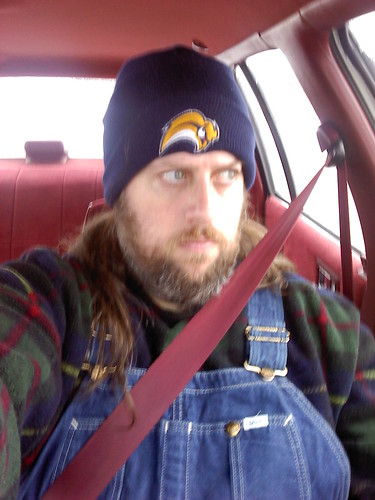
I just know that you, Dear Readers, have always wondered what I look like when I’m driving. So here are some photos taken whilst driving recently.
I’m a pretty paranoid driver, tending to assume the very worst about everyone else on the road. To my way of thinking, the only reasonable stance when driving is to adopt the belief that every other person on the road is a ne’er-do-well or, worse, a just plain malevolent soul looking to smash me with their vehicle. That leads me to looking like this:
I don’t trust any of you. Nothing personal, but when you’re on the road at the same time that I am on the road, you are now the enemy!
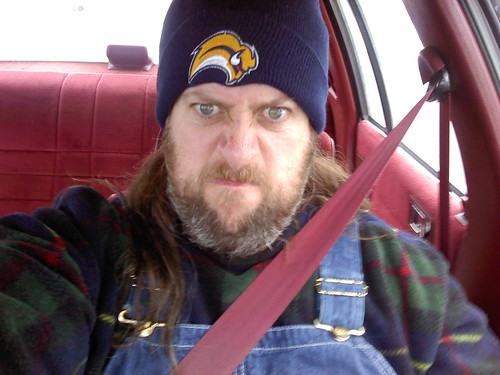
Now, one thing that frustrates me is when I get behind the Hesitant Turner. This is the person who is extremely hesitant about, you guessed it, turning. They’ll sit at the intersection until there is absolutely zero traffic in either direction, rather than make a judgment on when they can go based on their knowledge of their own vehicle’s ability to accelerate quickly. These people annoy me to no end, which leads to scenes like this, as I shout “GO GO GO GO GO!”
I’ve already established my loathing of people who refuse to turn right on red. Here’s the look I tend to give such folks, hoping they’ll look in their rear-view mirror and see the laser beams coming from my eyes to fry their brains, but they never do….
And here’s the bored look I get when I’m stuck on a long straightaway behind a lot of slow-moving traffic:
The title of this post is taken, of course, from the “Rules of Driving” that many of us learned in Driver’s Ed. (At least, those are the two I remember; the rest are here.) Try as I might, I don’t recall Mr. Wilcox (my Driver’s Ed teacher) telling me to not make contorted faces of extreme disdain at my enemy drivers, but he didn’t say not to, either. So….
(OK, in all honesty, I didn’t take any of these photos while the car was in motion. Heck, it wasn’t even in “Drive”; the car was stationary at the time. No, I’m not driving around taking self-photos of me making goofy faces while I’m actually handling a car in motion!)
OK, this round of answers will be a bit more positively toned than yesterday’s. But hey, someone asked a question about a topic guaranteed to set me a-rantin’ — kind of like the year someone basically gave me an engraved invitation to rip on the New England Patriots. Nobody did that this year! (And nobody asked any questions about overalls, either — I think that’s a first.)
Anyway, Charlie asks: What movie would you say is most soundtrack dependent (in other words, which movie would you most lose enjoyment of if you watched a soundtrack-free version)?
This is…a very hard question. The Star Wars and Lord of the Rings movies would be terribly different with different scores, and if they were music-free, both franchises might well be disastrously unemotional. But the same can be said of many, many films with fine scores — a musicless Ben Hur would be staggeringly silly, no?
To say that a film would be “soundtrack dependent” would be to say that without the music, the film would collapse like a house of cards. Obviously this would be true of any musical, so we’ll just set those aside for the purposes of this discussion.
Lots of movies don’t even have scores, but just collections of pop songs used in various places throughout the films. Sometimes these are of the “lather rinse repeat” variety; virtually any teen comedy suffices for mention here, where you could just switch out songs at random and the movie wouldn’t suffer at all. But other films, where the pop songs are chosen by the filmmakers for specific reasons? Those obviously would suffer. Pulp Fiction, Love Actually, When Harry Met Sally…, and Sleepless in Seattle would all be laughable without their music, precisely because those films feature songs that are chosen with extreme care.
To return to traditional filmscores for a moment, when I was active in various fora online in discussing film music, there was one kind of topic that cropped up fairly often that always annoyed me, which generally took the form of “Who would you have liked to have scored [Film XXX]?” This always annoyed me a lot, because it would invariably devolve into various expressions of hero worship, especially from the Jerry Goldsmith fans, who tend to be keenly aware that their hero scored more than his fair share of crappy movies. So, in those threads you’d hear a lot of “What if Goldsmith had done the Indiana Jones movies!” or “What if Jerry had done Lord of the Rings!” To me, this always seemed about as useful a line of discussion as a bunch of football players discussing what the Bills might have been like if they’d managed to draft Drew Brees. Who cares? They didn’t. Why talk about what might have happened?
All this is basically my way of admitting that I just don’t have a good answer for Charlie’s question. Truthfully, a movie without music would just be weird. Any movie. I found it unsettling when the Mimi Rogers film The Rapture closed with credits scrolling over no music at all. Which, I suppose, was entirely the point.
Speaking of Roger and speaking of film music, Roger asks: How do respond to people who think all of John Williams’ scores sound alike?
Generally, I either roll my eyes, or say something pithy like “Get back to me when you get cochlear implants.” It’s a frankly idiotic thing to say. For a brief demonstration, one could just listen to the clips in this post of mine from earlier in the month.
Now, there are similarities in sound from one work to the next. How could there not be? Williams is an artist, and of course there will be stylistic similarities to be found. I do hear them, same as I hear stylistic similarities amongst the works of Berlioz, and Wagner, and, heck, the Beatles. But the idea that all Williams scores sound alike is one of those notions that just doesn’t stand up to any serious scrutiny whatsoever.
The clips I chose in that post linked above are from different eras in Williams’s work, but one doesn’t even have to do that. One can listen to Williams scores from the same era and not hear anything more than superficial stylistic similarities. It would take a pretty sophisticated listener to recognize the main theme of Star Wars and the main theme of Dracula as coming from the pen of the same composer, and only two years separate those scores.
Thank you for joining me today. Many of you have come to know me through the years. You have supported me in good columns and bad. Now, you have good reason to be critical of me. All I can say is I’m sorry for my irresponsible and foolish behavior.
I’m addicted to Sporcle.
Perhaps you’ve never heard of Sporcle.com. If so, it’s only a matter of time. Sporcle is an on-line trivia site which is infiltrating the minds of tens of thousands of innocent, well-meaning people. Log on to it at your peril.
Do it. You know you want to. I’ll even make it easy by giving you a link: Sporcle.
Click it and you’ll be one of us!!!
(Sporcle’s lots of fun. Really. If you have any love of trivia at all, you’ll enjoy it.)
OK, Star Warriors, we’re back into Attack of the Clones. After the Naboo sequences, which needed quite a bit of fixing, we’re into the sections of the film that I consider the strongest; thus, we should be able to quicken the pace somewhat.
When last we left our adventurers in space, Anakin had (in my version) just thwarted another attack on Padme and made the Executive Jedi Decision to take her away from Naboo, since the assassins know she’s there. Remember, though: he hasn’t mentioned to her, yet, his fears about his mother. Plus, back on Kamino, Obi Wan has been ordered by Yoda to bring Jango Fett in for questioning.
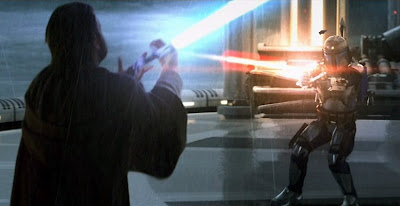
That’s where we start: with Obi Wan on his way to arrest Jango Fett. In the film, we cut right to Obi Wan charging onto the landing platform as the Fetts are about to leave, but in the script, there’s a bit where Obi Wan goes back to the Fett’s apartment and finds the place empty and looking like the Fetts have left in a hurry. I would have left that in, but I don’t think the film suffers without it. And for all that, the fight scene between Obi Wan and Jango Fett is one of my favorite parts of the film; it’s exciting and well-staged, and I like how evenly-matched Obi Wan and Jango are, even though Jango’s is more a function of his having the niftiest utility belt since Batman and having his kid at the firing controls of his spaceship on the same platform. I can’t think of a single thing I’d change in this sequence.
What’s so nice about this is the fact that it illustrates anew that Jedi aren’t superhuman warriors who can’t be defeated. It further illustrates a fact that will later come back to haunt the Jedi badly: that while they can slice their way through armies of battle droids (unless they are undone by sheer numbers), fighting against humans is far less of a given.
After Slave I flies off, with Obi Wan’s homing beacon secure about its hull, we cut to Tatooine, where a chrome-hulled Naboo ship is landing. Anakin and Padme venture out to find Watto, in order to seek out Shmi Skywalker. When they find Watto, he’s not in his shop but just sitting in a little stall on the street of Mos Espa. He looks like hard times have befallen him. I actually like this little scene, and after a bit of consideration, I really wouldn’t change it, except for a couple of tiny things:
ANAKIN and PADMÉ get down. Sitting on a stool in front of the shop is WATTO. He is using a small electronic screwdriver on a fiddly DROID. THREE PIT DROIDS are chattering away and are trying to help him, but they seem only to make him madder.
WATTO: (yelling, in Huttese) No, not that one – that one!
ANAKIN: (in Huttese) Excuse me, Watto.
WATTO: (in Huttese) What?
ANAKIN: (in Huttese) I said excuse me.
WATTO turns to the chattering PIT DROIDS.
WATTO: (in Huttese) Shut down.
The PIT DROIDS snap into their storage position.
ANAKIN: Let me help you with that.
ANAKIN takes the fiddly piece of equipment and starts to play with it. WATTO blinks in surprise.
WATTO: (continuing, in Huttese) What? I don’t know you…What can I do for you? You look like a Jedi. Whatever it is… I didn’t do it.
WATTO drops the screwdriver and curses loudly in Huttese.
ANAKIN: I’m looking for Shmi Skywalker.
WATTO looks at him suspiciously. He stares at PADMÉ, then back to ANAKIN.
WATTO: Annie?? Little Annie?? Naaah!!
Suddenly, the fiddly piece of equipment in Anakin’s hands WHIRS into life. WATTO blinks at it.
See, in the movie, this doesn’t happen! The thing that Anakin fixes just sits there, doing nothing. It’s a very weird detail for George Lucas and company to have completely missed. Something needs to happen there! (I’m indebted to D. Trull for pointing this out.)
WATTO: You are Annie! It is you! Ya sure sprouted! Weehoo! A Jedi! Waddya know? Hey, maybe you couldda help wit some deadbeats who owe me a lot of money…
ANAKIN: My mother…
WATTO: Oh, yeah. Shmi… she’s not mine no more. I sold her.
ANAKIN: Sold her?
WATTO: Years ago. Sorry, Annie, but you know, business is business. Sold her to a moisture farmer named Lars. Least I think it was Lars. Believe it or not, I heard he freed her and married her. Can ya beat that? Always wondered where he got the money for her….
That last bit is something I threw in there, in order to highlight something that will come in to play later on.
ANAKIN: Do you know where they are?
WATTO: Long way from here… someplace over on the other side of Mos Eisley, I think…
ANAKIN: I’d like to know.
Anakin holds out a small bag of coins, which Watto takes and examines.
WATTO: Republic credits? Annie, you know these aren’t no good out here–
He stops when he sees that ANAKIN’S grim look means business, and gets the hint quickly.
WATTO: Yeah… sure… absolutely. Republic credits will be fine. Let’s go look in my records. Too bad you can’t stay, eh? I just got in a YT-1300 freighter that needs some engine work….
PADME follows as ANAKIN and WATTO go into the shop.
I have to confess that Watto has always been one of my favorite supporting characters in the Prequel Trilogy. He’s not mean or sadistic, but he’s greedy enough to make him willing to make himself a pain in the ass on occasion, even if his greed never leads him to anything more than being a dealer in junk. (Of course, those of us out there who are self-programmed to find offensive things wherever we go might see Watto’s big nose and his obvious monetary greed and assume therefore that George Lucas is making a statement about Jews. I’m not willing to see things that way and am uninterested in discussing that line of thought.)
Immediately after this, we cut to the planet Geonosis, where Slave I comes out of hyperspace and heads down toward the planet. (Geonosis is, by the way, beautiful from space: a red, ringed world.) Behind him, Obi Wan arrives in his own ship. Jango’s scanners pick up Obi Wan’s ship, and Jango decides to try to lose Obi Wan in the asteroid field (the rings). What ensues is a fairly brief action sequence that obviously has some echoes of the asteroid field chase in The Empire Strikes Back, but this one is briefer and more of a high-speed cat-and-mouse game. Also interestingly, the first two-thirds of the scene is unscored; no music at all. I wondered at this when I first saw it, until I heard the sound produced by the “seismic charges”, which are for my money one of the coolest weapons ever unleashed in Star Wars.
Moments like this are why my general response to people who utter the constant refrain of SF whiners the world over, “There’s no sound in space!”, is basically “Oh, suck it.”
(By the way, I love the way Boba Fett laughs evilly and plays “backseat driver” as his Dad tries to fight off a Jedi knight.)
Anyway, I love this action sequence, which ends quickly with Obi Wan making Jango believe he’s been blown to bits and then hiding on an asteroid as Jango goes down to the planet surface. Obi Wan follows, and I like what follows here, as Obi Wan discovers during his flyover that Jango Fett has come to a planet where a lot of Trade Federation (the bad guys from The Phantom Menace) ships are landed. Then Obi Wan lands and proceeds to explore the happenings on Geonosis on foot.
We cut back to Tatooine, where Anakin and Padme arrive at the Lars homestead to learn that Shmi Skywalker has been abducted by Sandpeople. This all works very well for me; I love how the whole scene is shot near sunset, imbuing the scene with a sense that something is ending here on Tatooine. I also like the actor who plays Cliegg Lars, Shmi’s husband; he’s got this great grizzled and weary air about him. This whole sequence plays very well, with a sense of foreboding and impending doom. This whole subplot (an homage to the classic Western The Searchers) is very well done.
Anyway, Anakin decides that he’s going after the Sandpeople who kidnapped Shmi, which leads to this brief scene of farewell between Anakin and Padme:
EXTERIOR: TATOOINE, HOMESTEAD, MOISTURE FARM – LATE DAY
ANAKIN stands looking across the desert. PADMÉ comes running out of the homestead after him. ANAKIN turns to PADMÉ.
ANAKIN: You are going to have to stay here. These are good people, Padmé. You’ll be safe.
PADMÉ: Anakin…
PADMÉ hugs him. ANAKIN walks over to OWEN’S speeder bike, which is standing close by.
ANAKIN: I won’t be long.
ANAKIN swings onto the bike. The engine fires. He takes off across the desert. PADMÉ watches him go.
Again, in the context of the actual film, this is a very nice little scene. Visually it’s inventive: Lucas doesn’t show Anakin and Padme hugging, but rather he shows only their shadows, cast by the setting suns on the side of the white-domed Lars homestead farm building, as they embrace. I do need to make a change, though, owing to the fact that in my version of the film, Anakin has never actually told Padme that he’s been dreaming about his mother.
EXTERIOR: TATOOINE, HOMESTEAD, MOISTURE FARM – LATE DAY
ANAKIN stands looking across the desert. PADMÉ comes running out of the homestead after him. ANAKIN turns to PADMÉ.
ANAKIN: You are going to have to stay here. These are good people, Padmé. You’ll be safe.
PADME: You know something like this was happening, didn’t you?
ANAKIN: I…I feared it.
PADME: You saw it, didn’t you? You saw it through the Force. Those dreams you’ve been having…that’s why you brought me here.
ANAKIN: I brought you here to protect you.
PADME: But also to protect her.
She steps closer to him and takes his hand.
PADME: You know you can trust me, Anakin. You could have told me why you wanted to come here, of all the worlds you could have taken me to. I’d have come.
ANAKIN struggles for words, but finds he has none.
ANAKIN: I have to go. While it’s still light.
PADMÉ nods and hugs him. ANAKIN walks over to OWEN’S speeder bike, which is standing close by.
ANAKIN: I won’t be long.
ANAKIN swings onto the bike. The engine fires. He takes off across the desert. PADMÉ watches him go.
PADME: May the Force be with you.
I’ve always thought that a big part of Anakin’s fall to the Dark Side stems from his desire to do the right thing coupled with his confusion about what the right thing actually is. He’s in love with Padme, but he’s not entirely trusting with her, either; he doesn’t always let her in, until things have turned disastrous in the end. It would be entirely in keeping with his character to not tell her his underlying motivation for bringing her to Tatooine.
So Anakin speeds off on the speeder bike, whipping across the sands of Tatooine in search of the sandpeople who took his mother. This is very brief in the movie: a couple of shots of Anakin on the speeder bike, then Anakin conferring with some Jawas, and then we cut back to Obi Wan. In the script, however, there’s a little more: Anakin comes across a campsite where three moisture farmers have been slaughtered by Sandpeople. Not surprisingly, I’d have left this in.
Also in the script is a brief scene where a worried Padme talks to C-3PO about her growing confusion over her feelings for Anakin. I wouldn’t restore this, actually – it’s a pretty clunkily-written scene, after all – but I would show Padme at night, gazing in the direction Anakin has gone, maybe again holding that little pendant he’d carved for her in TPM. For purposes of information, though, here’s the scene as written:
INTERIOR: TATOOINE, HOMESTEAD – GARAGE (FULL MOON) – NIGHT
PADMÉ enters the garage where C-3PO sits working.
C-3PO: Hello, Miss Padmé.
PADMÉ: Hello, Threepio.
C-3PO: You can’t sleep?
PADMÉ: No, I have too many things on my mind, I guess.
C-3PO: Are you worried about your work in the Senate?
PADMÉ: No, I’m just concerned about Anakin. I saidthings… I’m afraid I may have hurt him. I don’t know. Maybe I only hurt myself. For the first time in my life, I’m confused.
C-3PO: I’m not sure it will make you feel any better Miss Padmé, but I don’t think there’s been a time in my life when I haven’t been confused.
PADMÉ: I want him to know I care about him. I do care about him.
C-3PO: Don’t worry about Master Annie. He can take care of himself. Even in this awful place.
Yeah, not the best thing in the world. As noted, I wouldn’t have included this entire thing — a nicely shot scene with no dialogue at all would have served fine — but its existence in the original script indicates that originally, Padme’s feelings for Anakin didn’t progress as quickly as they seem to in the finished film. Again I find myself wishing that George Lucas had realized that story should determine a film’s running time, and not the other way around.
One last quibble: in the film, we cut from Anakin conferring with the Jawas back to Obi Wan on Geonosis. The problem here is that the Tatooine landscape and the Geonosis landscapes are pretty similar, so it takes a few seconds before we realize we’re looking at Obi Wan and not Anakin (he’s shown from a distance). I think that cutting back there after showing a worried Padme would help the transition a bit, making it less confusing.
And that’s where we’ll leave things for this time. Next time, the Sandpeople discover that if you kidnap a human woman, you’d best make sure her son isn’t a Jedi Knight with a hair-trigger temper. Ah, the wisdom of Star Wars!