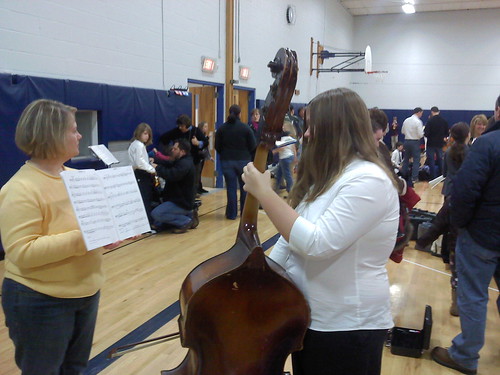
Anyway, while she doesn’t work as hard at it as we might like, she’s developed quite nicely as a bass player. She performed with the instrumentalists in the Christmas pageant at church, which was cool; she volunteered without being asked, which was awesome. And two weeks ago she played at a local Solo Festival, at which young musicians from local schools go to play a piece they’ve prepared in front of individual judges, for comment and constructive criticism. (She got a 92, which is pretty good, I hear.)
It’s quite a thing to see, watching the next generation of musicians take shape. In a lot of ways, The Daughter reminds me of…well, me as a musician at that age. I didn’t work very hard at it either, the first few years; I even tried to quit at one point, leading to one of the finer smackdowns I ever received from my father. (Damned if he wasn’t right.) The Daughter’s teachers are all agreed that she has talent, whereas I basically sucked at the trumpet for three years. (Well, only two years. My first year in band I sucked at the French horn. Then I switched to sucking at the trumpet.)
So why did I suck? Because when you’re a beginner, practicing sucks. It just does. Some kids do it because they have more stick-to-it than others; I did it because my parents ordered me to do it. It took me three years to put certain things together: first, that being part of music-making is cool; second, that the work of music-making doesn’t have to suck; third, that the drudgery part of practicing actually is important because there’s connective tissue between the endless repetition of scales and the production of music; and fourth, finally, I finally had to confront the reality, set forth by my father, that I wasn’t going to be released from my musical prison anytime soon, so as long as I had to be there, I might as well stop sucking.
So I started practicing voluntarily, and quite a bit, at that. I was tired of being crappy at the trumpet. I was tired of the other kids snickering when the band director, Mr. Beach, would decide to put people on the spot by making them play their parts alone in front of the band. (This is what band directors do when they feel the need to “Go Nuclear” on their students.)
This is why this one passage from Stephen King’s otherwise brilliant book On Writing: A Memoir of the Craft just drives me crazy every time I read it.
When my son Owen was seven or so, he fell in love with Bruce Springsteen’s E Street Band, particularly with Clarence Clemons, the band’s burly sax player. Owen decided he wanted to learn to play like Clarence. My wife and I were amused and delighted by this ambition. We were also hopeful, as any parent would be, that our kid would turn out to be talented, perhaps even some sort of prodigy. We got Own a tenor saxophone for Christmas and lessons with Gordon Bowie, one of the local music men. Then we crossed out fingers and hoped for the best.
Seven months later I suggested to my wife that it was time to discontinue the sax lessons, if Owen concurred. Owen did, and with palpable relief — he hadn’t wanted to say it himself, especially not after asking for the sax in the first place, but seven months had been long enough for him to realize that, while he might love Clarence Clemons’s big sound, the saxophone was simply not for him — God had not given him that particular talent.
I knew, not because Owen stopped practicing, but because he was practicing only during the periods Mr. Bowie had set for him: half an hour after school four days a week, plus an hour on the weekends. Owen mastered the scales and the notes — nothing wrong with his memory, his lungs, or his eye-hand coordination — but we never heard him taking off, surprising himself with something new, blissing himself out. And as soon as his practice time was over, it was back into the case with the horn, and there it stayed until the next lesson or practice-time. What this suggested to me was that when it came to the sax and my son, there was never going to be any real play-time; it was all going to be rehearsal. That’s no good. If there’s no joy in it, it’s just no good. It’s best to go on to some other area, where the deposits of talent may be richer and the fun quotient higher.
It’s been some years since I’ve been around musicians on any regular basis, but it’s still been my experience that musical talent does not present itself regularly as Mr. King expected it to…especially not for a seven-year-old kid. Maybe the kid got burned out on it; I don’t know, really. I wasn’t there. But just reading King’s description of his kid’s work makes me wonder if King’s expectations were a bit misplaced. I had to play my instrument for three years before I started ‘blissing out’ — and I was six years older than Owen King when I got there.
Should Owen have continued with the sax? I have no idea. But I do know that talent does not always present itself easily. I wonder if King’s expectations are colored by the apparent fact that his big talent — writing — manifested itself early in his life, and because “practicing” writing is a lot different from practicing music. Young writers don’t have to spend years learning the writing equivalent of scales, notes, and such. The writing equivalents of those things are learned by writing.
Talent doesn’t come out easily. Sometimes it’s only by sheer luck that we discover some talents at all. If I hadn’t been fired from my last job, in 2003; if another company had hired me before The Store; if the position The Store had hired me for had been, say, in the Bakery instead of in Maintenance…any of those things go differently, and maybe I’m not now discovering that I have talents for carpentry and equipment repair. But I read that passage by King, every time in that great book, and I get the feeling of a parent who, when their kid has expressed a desire to play baseball, replies with, “OK, here’s a bat. Get a base hit off my friend Mr. Greg Maddux here, and we’ll take it from there.”
Of course, things can be taken to an opposite extreme, as seen in a recent article by someone named Amy Chua, called — I shit you not — Why Chinese mothers are superior.
A lot of people wonder how Chinese parents raise such stereotypically successful kids. They wonder what these parents do to produce so many math whizzes and music prodigies, what it’s like inside the family, and whether they could do it too. Well, I can tell them, because I’ve done it. Here are some things my daughters, Sophia and Louisa, were never allowed to do:
• attend a sleepover
• have a playdate
• be in a school play
• complain about not being in a school play
• watch TV or play computer games
• choose their own extracurricular activities
• get any grade less than an A
• not be the No. 1 student in every subject except gym and drama
• play any instrument other than the piano or violin
• not play the piano or violin.
That might sound reasonable…until I get to the fact that her kids were not allowed to play any instrument other than the piano or the violin. I’m sorry, but everything else in that article is pure shit after an utterance like that. This woman sounds like a shrill, overbearing harpy whose kids will be writing memoirs with scenes in them that feature things like Mommy screaming “No wire hangers!!!” at them. Here’s a woman who has predetermined that all instruments, save two, are not worthy of her precious little charges? Whatever. I’ll bet real money that the third-chair clarinetist in the Berlin Philharmonic Orchestra has worked harder at the clarinet than her children have at the piano or the violin. Steven King worried that his kid wasn’t loving music enough; this woman doesn’t truly give two shits if her kids love music. What’s important to her is that music gives her another cudgel with which to beat her kids. The truth, as ever, lies somewhere between two extremes…but I’ll wager that it’s damned closer to King than it is to Amy Chua.
(Oh, and not being allowed to be in a school play? That’s nice. Way to teach your kids that an entire area of artistic endeavor is substandard. This is an awful, awful mother.)
Share This Post